1 EXPLORING ELECTRICAL ENGINEERING STUDENTS’ PERCEPTION TOWARDS ENGINEERING
MATHEMATIC III IN UTHM
S. K. Yee1,* & M. F. Lee2
1
Faculty of Electrical and Electronic Engineering, UTHM
2 Faculty of Technical and Vocational Education, UTHM
*Correspondence: [email protected]
Abstract
Engineering Mathematic III is a compulsory subject for the second years’ students in Faculty of Electrical and Electronic Engineering. Besides, it is also a pre-requisite subject for Electromagnetic Fields and Wave. It has been considered as one of the challenging subject amongst the bachelor courses in Electrical & Electronic Engineering programme. Therefore, students always facing problem to mastery this subject well and tend to fail this subject. Hence a case study through a survey method has been conducted to investigate the difficult subtopics in this subject. The survey also determined the problem facing by the students and their suggestions to overcome the obstacle to mastery this subject. A set of questionnaire through google form was used as instrument in this study. A purposive sampling technique was applied to select sample. About 14 students who are currently enrol in this subject and tend to have low score in the carry marks being selected as sample. Frequency and percentage were used to analyse the gather quantitative data, while the thematic analyses was applied to the gathered qualitative data. The findings shows that the 3 dimensional structure construction, triple partial integration and surface integral of vector field are the most challenging subtopics for the students. They must possess good imagination and basic mathematic in handling problems that involve many solution steps. They suggested that the lecturer should give additional exercises and punish the students if they do not complete the exercises. Students are satisfied with the current teaching method where the tutorial and lecture are allocated at different time slot in order to ensure their understanding for the subject content. Videos demonstrating of the solution step-by-step should be shared continuously and functioning as revision materials for students.
Keywords: Engineering Mathematic III, Electrical Engineering Students, Difficulty subtopic
1.0 INTRODUCTION
In the era of industrial revolution 4.0 (IR 4.0), the term “STEM” become highlight especially in the developing country. STEM refer to science, technology, engineering and mathematic. The important of STEM is discussed in the article by Natakoji & Wilson (2018), where the STEM is strongly recommended by the Australia, Canada, India, Japan, United Kingdom and United States to emphasise mathematics and science as foundation starting from the elementary school in order to prepare students for job market needs in STEM fields. Mathematics already become significant component in human daily life as mathematics knowledge is driven the development of science and technology.
2 Electromagnetic Fields and Wave course. However, it has been considered as one of the challenging subject amongst the bachelor courses in Electrical & Electronic Engineering programme. Almost every semester there are students who fail this course in Faculty of Electrical & Electronic Engineering, Universiti Tun Hussein Onn Malaysia. A lot previous studies also mention that students were reported to have difficulties in mathematics problem solving due to the basic mathematics knowledge and English proficiency level (Tarzimah & Thamby Subahan, 2010; Ahmad Shah Qasemi & Ainol Haryati Ibrahim, 2015).
Thus, this study was conducted to investigate the difficult subtopics in Engineering Mathematic III (Maths III) from students’ perspective. The students also being required to comment on the current teaching method and the problem faced by them in this subject through their learning reflection in Maths III. The findings of this study will be the reference for the course lecturers to prepare Continuous Quality Improvement (CQI) report to assist the new registered students.
2.0 METHODOLOGY
This study was employ a case study as the research design by using survey method. According to Carr-Chellman (n.d.) a good educator should assess student characteristics and entry level behaviours in order to analyse the gaps between the prior knowledge and the new learn knowledge. Survey is the best method than any informal method to assess students’ characteristics and entry level behaviours (Carr-Chellman, n.d.). The purposive sampling technique was used to select the sample in this study. The whole class of Engineering Mathematic III course students (total numbers of fourteen including four repeating students) in the current semester were involved as sample in this study.
A set of questionnaire was used as instrument to gather the needed information in order to achieve the research objectives. Questionnaire is the best fit instrument for a survey. In this questionnaire, the students’ grade in SPM Mathematic, SPM Additional Mathematic and Malaysian University English Test (MUET) band were questioned since the subject is conducted in English and the grades are able to reflect students’ fundamental knowledge in mathematics. All the subtopics in this subject were listed in the questionnaire and the students were required to choose those were difficult for them through dichotomous scale. They were also requested to comment about their problems and suggested solutions to overcome the mention problem.
Furthermore, the samples were asked to response on the current teaching method too. The current teaching method split the lecture and tutorial session, where in the lecture section, the lecturer shows the concept and exercises will be given only in the tutorial session. Besides that, video files which demonstrating the steps in solving mathematical exercise and tutorial are shared in the social media too. All the data was collected using open-ended questions. Frequency and percentage were used to analyse the gather quantitative data through dichotomous scale items, while the thematic analyses was applied to the gathered qualitative data through open-ended questions.
3.0 RESULTS AND DISCUSSION
3 Figure 1: SPM Mathematics and Additional Mathematic Grade of Students
Based on their MUET band results as shown in Figure 2, it is found that the English proficiency of the students are weak, 71.4 percent of the students achieved band 2 for their MUET, only one student achieved band 4. Since the Mathematics III course is conducted mainly in English, the students might facing difficulties in understanding the content delivered by the lecturer.
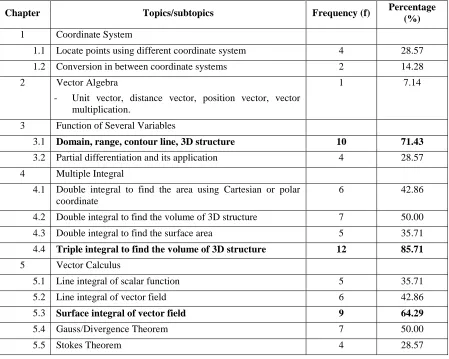
4 Table 1: Subtopics of Engineering Mathematics III perceived as Difficult by Students
Chapter Topics/subtopics Frequency (f) Percentage
(%)
1 Coordinate System
1.1 Locate points using different coordinate system 4 28.57
1.2 Conversion in between coordinate systems 2 14.28
2 Vector Algebra
- Unit vector, distance vector, position vector, vector multiplication.
1 7.14
3 Function of Several Variables
3.1 Domain, range, contour line, 3D structure 10 71.43
3.2 Partial differentiation and its application 4 28.57
4 Multiple Integral
4.1 Double integral to find the area using Cartesian or polar coordinate
6 42.86
4.2 Double integral to find the volume of 3D structure 7 50.00
4.3 Double integral to find the surface area 5 35.71
4.4 Triple integral to find the volume of 3D structure 12 85.71
5 Vector Calculus
5.1 Line integral of scalar function 5 35.71
5.2 Line integral of vector field 6 42.86
5.3 Surface integral of vector field 9 64.29
5.4 Gauss/Divergence Theorem 7 50.00
5.5 Stokes Theorem 4 28.57
The Engineering Mathematics III consists of four chapters and each of the chapter is split into subtopics as listed in Table 1. Based on the feedback from students, it is found that most of them (85.71%) are facing difficulties in performing triple integral for finding the volume of 3 dimensional (3D) structures, defining the domain, range and contour line for 3D structure (71.43%) and surface integral of vector field (64.29%). These subtopics are closely related as the students must construct the 3D structures before calculate for its volume based on triple partial integration. In general it is found that more than 42.86% of the students are facing problem in subtopics involve partial integration. Only one student perceived the Vector Algebra is difficult and it may due to this subtopic has been introduced in polytechnic. This topic involves the basic arithmetic of vectors which will be applied in chapter 5. More than 28.57% of students perceived the subtopics in chapter 5 are difficult.
The basic of Domain, Range and 3D structure has been introduced to the students during their secondary school in Form 4 through Additional Mathematics subject. However, based on their grades in Additional Mathematics, it may due to the students did not develop a strong fundamental knowledge on this subtopic. Furthermore, Additional Mathematics was taken by students around 8 years ago. On the other hand, the subtopic integration and differentiation is learnt during the secondary school and only involve single variable. Students have to perform partial differentiation and partial integration that involve more than one variable in Engineering Mathematics III. These may be the reasons that lead the subtopics in chapter 4 for Engineering Mathematics III are perceived as difficult subtopics by the students.
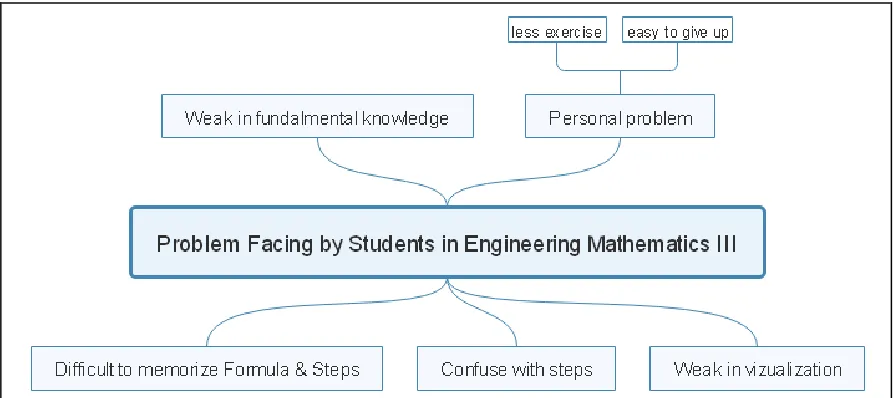
5 many careless mistakes were made during the assessment test. The students found the difficulties dealing with 3D structures because they do not have good visualization. Besides, some of the students mentioned the personal problem like lack of exercise and easy to give up.
Figure 3: Problem facing by students in Engineering Mathematics III
A reflection question was post to the students on what students themselves and the lecturer should do to enhance their mastery level in Engineering Mathematics III course. Some of the comments from the students are illustrated as follows:
“I as a student should study more and focus on topics that I don’t understand”
“more exercise, enhance basic maths skill, don’t give up”
“student should study hard, spend more time, and be fast learner”.
The theme that obtained through qualitative analyses process shows that students should do the following in order to enhance their knowledge and skills for Engineering Mathematics III course:
(i) spending extra time in solving more exercises (ii) pay extra attention in the class
(iii) meeting up with lecturer when they face problem in understanding the subtopics (iv) be proactive
On the other hand, form the students perspective, they wish the lecturers are able to:
(i) be strict especially in punishing students who do not complete the assignment or homework
(ii) give extra time to students so that they can try to solve the question before the lecturers disclose the correct steps in solving the questions during the lecture session
(iii) provide interactive methods into the classroom to make the lecture session more fun and interesting
6 “give homework discuss in tutorial, punish student if they din complete”
“solve the questions and share using video or facebook”
“Lecturer should be given more task and specific dateline for student to submit.”
Additionally, all the students are satisfice with the current delivery mode for Engineering Mathematic III course, where the tutorial session is being split from the lecture session. In their opinion, this mode provide the learning environment that allow them enhancing their understanding and be more focus especially during the lecture session. This delivery mode also provide them time to clear their doubt by seeking the lecturer before the tutorial session. The tutorial session helps to refresh their mind on the subtopics they have learnt. Besides, the students have extra time to answer the questions given at the end of the lecture at home and discuss during the tutorial session. Furthermore, video files which demonstrate the step by step solutions provided by lecturer are a good approach to enhanced students’ understanding on the content delivered by the lecturer. According to the students, they found the videos are useful because the learning process can be repeated and conducted regardless of the place and time. It is especially beneficial for those who are absent during the lecture session as the video can be played several times until they fully mastery the solving steps in Engineering Mathematics III problems.
4.0 CONCLUSION
As a conclusion, students’ perception on the difficult subtopics in Engineering Mathematics III has been identified. It is found that constructing 3D structures, performing triple partial integration and surface integral of vector field are the top three difficult subtopics. They are found difficult mainly because they involve too many steps and require good imagination, the students must have strong mathematic basic in order to handle these subtopics. Lecturers should be strict and give more exercises to students so they can master these subtopics well. The tutorial and lecture should be conducted in different session as this give sufficient duration to the students in solving exercises before the tutorial discussion. Video files sharing should be remained as they enhanced students’ understanding.
5.0 REFERENCES
Ahmad Shah Qasemi & Ainol Haryati Ibrahim. (2015). An Investigation of English Language Needs of Engineering Undergraduates at Jawzjan University. Retrieve from https://icsai.org/procarch/1iclei/1iclei-53.pdf
Bed Raj Acharya. Factors Affecting Difficulties in Learning Mathematics by Mathematics Learners International Journal of Elementary Education. Vol. 6, No. 2, 2017, pp. 8-15. doi: 10.11648/j.ijeedu.20170602.11
Carr-Chellman, A. (n.d.). Instructional Design for Teachers: Improving Classroom Practice. Routledge, p.142-153. Retrieve from http://site.ebrary.com/id/10416483?ppg=142
Centre for Academic Development and Training Universiti Tun Hussein Onn Malaysia. (2016). Academic Proforma 2016/2017 Bachelor of Electrical Engineering with Honours Faculty of Electrical and Electronic
Engineering. Dicapai dari http://fkee.uthm.edu.my/v3/wp-content/uploads/2016/08/Proforma-20162017-FKEE-BEV.pdf
Nakakoji, Y. & Wilson, R. (2018). First-Year Mathematics and Its Application to Science: Evidence of Transfer of Learning to Physics and Engineering. Educ. Sci. 2018, 8, 8. Pg 1-16. Retreive from
http://creativecommons.org/licenses/by/4.0/
Tarzimah, T. & Thamby Subahan, M.M. (2010) Students’ Difficulties in Mathematics Problem-Solving: What do they Say? Procedia Social and Behavioral Sciences 8 (2010) 142–151. Retrieve from