Electric Potential Structure in the Extraction Region of the
Negative Hydrogen Ion Source
∗
)
Shingo MASAKI
1), Kenta MAESHIRO
2), Katsuyoshi TSUMORI
1,3)and Motoi WADA
2)1)Department of Fusion Science, SOKENDAI (The Graduate University for Advanced Studies), Toki, Gifu 509-5292, Japan 2)School of Science and Engineering, Doshisha University, Kyotanabe, Kyoto 610-0394, Japan
3)National Institute for Fusion Science, Toki, Gifu 509-5292, Japan
(Received 9 January 2019/Accepted 4 June 2019)
Plasma parameters were compared in the extraction region of a negative hydrogen (H−) ion source between the discharge sustained by tungsten (W) and tantalum (Ta) high temperature cathodes. A hydrogen plasma driven by the Ta filament showed lower electron temperature and higher ratio of positive ion saturation current to negative ion/electron saturation current than a plasma excited by the W filament. Plasma potential indicated different spatial distribution along the direction of H−ion extraction corresponding to the voltage biased on the plasma electrode. These results are correlated to the intensities of the H−ion extraction current.
c
2019 The Japan Society of Plasma Science and Nuclear Fusion Research
Keywords: negative hydrogen ion, plasma parameter, Langmuir probe, negative ion extraction, filament material DOI: 10.1585/pfr.14.3401136
1. Introduction
The amount of negative hydrogen (H−) ion current which is extracted from a negative ion source driven by DC discharge cathodes is enhanced by seeding cesium (Cs) in the ion source with respect to the ion source of pure H2
dis-charge, meanwhile suppressing co-extracted electron cur-rent [1]. Continuous Cs seeding, however, is necessary to sustain the H− current and seeded Cs vapor condenses on the walls of the ion source. Some part of the Cs leaks to the accelerator and can induce voltage breakdowns be-tween the accelerator electrodes. For long-period opera-tion, the breakdown will be a serious problem to provide stable beams. For this reason, non-Cs materials have been investigated for efficient H−production [2–4].
Nishiuraet al. reported that formation rate of hydro-gen vibrationally excited molecules (H2∗) and H−ion yield
increased in hydrogen plasma generated with tantalum (Ta) filaments comparing to tungsten (W) ones [5]. One possi-ble explanation to the effects of Ta filaments on H− ion production is the suppression of associative detachment reaction between H− and hydrogen atoms due to adsorp-tion of hydrogen atoms by Ta deposiadsorp-tion on plasma elec-trodes [6]. Fresh Ta atoms that can absorb atomic hydrogen are supplied to the plasma electrode by evaporation from Ta filament during the hot filament cathode discharge. The absorbed hydrogen atoms can be released as the form of H2∗from the Ta atoms and increase the local H2∗density.
Higher density of the H2∗ can reduce local electron
den-sity through dissociative electron attachment to from H−, author’s e-mail: [email protected]
∗)This article is based on the presentation at the 27th International Toki Conference (ITC27) & the 13th Asia Pacific Plasma Theory Conference (APPTC2018).
while lower concentration of atomic hydrogen can further reduce electron density through lower reaction rate of as-sociative electron detachment through collisions with H−. Thus, in the vicinity of the plasma grid (PG) a Ta filament may reduce local electron density. Other plasma param-eters, electron temperature and plasma potential, must be altered due to Ta adsorption on PG surface.
A higher ratio of H−ion current (IH−) to co-extracted
electron current (Iext) was observed by using the Ta
fila-ment with respect to W filafila-ment in our previous experi-ment [7]. The result of the Ta filaexperi-ment operation showed different dependence of the extracted currents,IH−andIext,
upon the bias voltage induced to the plasma electrode (Vb),
which can affect the H−ion transport in the vicinity of the plasma electrode due to the correlation with the spatial dis-tribution of the plasma potential [8]. For theVbat which
theIH−takes the maximum intensity, the plasma potential
shows a flat spatial distribution against the distance from the plasma electrode. Consequently, the H−ions produced in the driver region upstream of the filter magnetic field [9] can travel to extractor without electrostatic trap [10]. The plasma potential distribution can be more sensitively affect the H−ion transport against the change of Vb in H−rich
plasmas like the case of cesium seeded ion source com-paring with the case of pure H2discharge [11]. Thus, the
investigation of the electric potential structure should give information for better understanding on the behavior of H−ions near the extractor in a negative ion source. The purpose of this study is two-fold; one is to map the local plasma parameters for confirming the effect due to a Ta filament operation as compared to the W filament opera-tion. Also, the difference of the potential structure in the extraction region of the H−ion source was investigated
be-c
2019 The Japan Society of Plasma
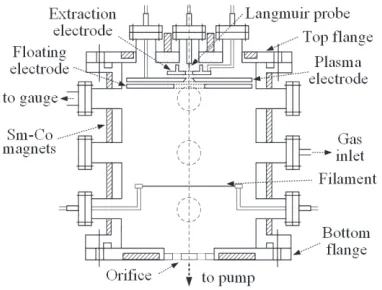
Fig. 1 The schematic illustration of the ion source.
tween W and Ta filament operations. Plasma parameters were measured with a Langmuir probe as a function of the distance from the extraction region.
2. Experimental Setup
Filament arc discharges are generated in a cylindri-cal ion source. Figure 1 displays a schematic diagram of the ion source chamber. The chamber has a volume of 150 mm diameter times 200 mm length. Plasma confine-ment magnets produced alternating magnetic field along the longitudinal direction on the outside wall forming a multi-cusp magnetic field. A 0.5 mm diameter and 70 mm length liner filament is negatively biased at 80 V against the chamber wall anode in 0.5 Pa hydrogen filling gas. The filament is fixed at a distance of 75 mm from the bottom flange. A stainless-steel plasma electrode masked by a 1.5 mm thick of floating electrode, exposes the surface in the center circular region of 30 mm diameter to the hydro-gen plasma. The floating electrode is separated with 1 mm distance from the plasma electrode by ceramic washers. Negatively charged particles, i.e. electrons and H− ions are extracted by an extraction electrode with the voltage of 800 V. A Langmuir probe is inserted through holes of 5 mm diameter of the plasma electrode and the extraction electrode to the plasma. The 0.35 mm diameter and 4 mm length tip of the Langmuir probe is made of W. In the ex-periment of H− ion extraction, negative ion current was detected by a Faraday cup introduced from the upper side of the extraction electrode by replacing the probe.
3. Experimental Results
3.1
Electron temperature
Probe characteristics with respect to the distance from the extractor were measured by the movable Langmuir probe inserted into the hot filament cathode discharge of 1.0 A. The distance of 0 mm represents the surface plane of the floating electrode. The bias voltage was changed from 0 to 2.5 V in every 0.5 V interval. Figure 2 shows spatial distributions of the electron temperature (Te) along
Fig. 2 The spatial distributions of the electron temperature: (a) W filament, (b) Ta filament.
the extraction axis. LowerTewas observed in the vicinity
of the extraction region than the region far from the plasma electrode. In comparison with the W filament, the result of the Ta filament showed steep characteristics ofTewith the
distance. The operation of the Ta filament also indicated lowerTeregardless of the bias voltage at the nearest point
for the extractor, while higherTeappeared around 10 mm
distance from the plasma electrode.
3.2
Electron density
Electron density (ne) measured in the extraction
re-gion is plotted in Fig. 3. Theneincreased as the distance
from the plasma electrode increased. The result shows slow linear increase toward the plasma center at 0 V bias, whereas the regions of steep slope appear as the bias volt-age is increased from 0 V to 2.5 V. The Ta filament opera-tion indicated slightly lowernewith respect to the W
fila-ment. The spatial distributions for the change in bias volt-age showed the differences between W and Ta filament;ne
at 0 mm for 1.5 V bias voltage was 5×109cm−3lower than
that of 0 V for the W filament operation, while Ta showed the difference of 2×109cm−3between the corresponding
conditions.
3.3
Plasma potential
The plasma potential (Vp) against the distance are
Fig. 3 The spatial distributions of the electron density: (a) W filament, (b) Ta filament.
Fig. 4 The spatial distributions of the plasma potential: (a) W filament, (b) Ta filament.
For the Ta filament, however, the potential at 10 mm in-creased corresponding to increment of the bias voltage.
3.4
Electron and ion saturation current
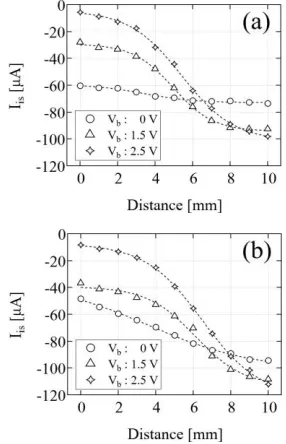
Figures 5 and 6 exhibit the spatial distributions of electron saturation current (Ies) and those of the ion
satura-tion current (Iis), respectively. The ion saturation currents
were obtained as the probe current values at−8 V probe bias voltage. As the bias voltage increased, the slopes of both curves of saturation currents became steeper. In terms of filament material comparison, Ta showed similar
Fig. 5 The spatial distributions of the electron saturation cur-rent: (a) W filament, (b) Ta filament.
Fig. 6 The spatial distributions of the ion saturation current: (a) W filament, (b) Ta filament.
amount ofIes but higher absolute intensity ofIis with
re-spect to W in the region far from the plasma electrode.
4. Discussion
the seeds of dissociative electron attachment reaction to vi-brationally excited molecules. Namely, the plasma driven by Ta filament has high potential to H− ion yield from dissociative attachment. The higher density of low tem-perature electrons in the Ta operation can be attributed to frequent collisions between electrons and hydrogen atoms and/or molecules. The density of the atomic hydrogens near the plasma electrode can be lower than W filaments due to the enhanced atomic hydrogen adsorption of Ta deposited on the plasma electrode surface by evaporation from Ta filaments. Consequently, the density of hydrogen molecules including vibrationally excited molecules may become high in the extraction region. The old results re-ported by Hallet al. [12] show the higher vibrational lev-els are populated for a discharge maintained with Ta fila-ment. These vibrational molecules can form a region of sink for electrons with proper kinetic energy; the electrons are transferred to H− in the region increasing the ratio of
Iis/Ies. The larger concentration of excited molecules near
the plasma electrode can reduce the local electron temper-ature through collisions.
The difference of electron temperature can affect the co-extracted electron current; the average Larmor radius of electrons, which should directly affect the cross-field elec-tron transport to the extraction aperture becomes larger at higher electron temperature. As shown in [7], the amount of co-extracted electrons makes theIH−/Iext ratio large at
higher plasma electrode biasVb. Operation with Ta
fila-ment made this ratio higher for entire range ofVb
com-pared with W filament operation. Thus, the extraction characteristics of negatively charged particles can be ex-plained by the measured plasma parameters.
The spatial distribution of the plasma potential changes responding to the applied bias voltage to the plasma electrode. The H−ion transport and electron trans-port toward the extractor, or the plasma grid are sensitively affected by this electrical potential profile. As the result of [7], both W and Ta filament operation indicated the max-imum negative ion current at 1.8 V bias voltage. From the result of the plasma potential measurement in Fig. 4, the potential structures at 1.8 V Vb exhibit plateau from the
extraction region to the driver region. For a bias voltage higher than 1.8 V, the direction of the electric field not only attracts H− ions but also electrons toward the extraction electrode, reducing electron density near the plasma elec-trode as shown in Fig. 3. Contrary to the extractor region, both the electron density and the temperature increased at the deeper region of the ion source plasma at the positive
Vbbias.
No significant difference was observed between W and Ta filament operation in the spatial distribution of elec-tron density. Meanwhile, the difference of the electron den-sity as well as the electron denden-sity can affect the H− ion transport in a very weak electrical potential as the func-tion of Debye shielding length. The parameter (Te/ne)1/2
was calculated from Figs. 2 and 3 to show it for
compar-Fig. 7 The function of Debye length calculated from compar-Fig. 3 and Fig. 4: (a) W filament, (b) Ta filament.
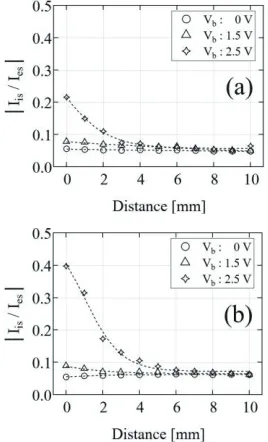
Fig. 8 The absolute ratio of ion saturation current to electron saturation current: (a) W filament, (b) Ta filament.
ison between the Ta filament operation and the W fila-ment in Fig. 7. The shorter Debye length in the vicinity of the plasma electrode can suppress penetration of extrac-tion electric field into the plasma, and Fig. 7 indicates some smaller penetration of the field for the Ta filament opera-tion.
neg-ative ions in plasma is substantial [13]. Apart from the effect due to a magnetic field [14], the ratio of positive ion saturation current, Iis, to negative ion/electron saturation
current, which appears as the electron saturation current in the ordinaryI-Vcharacteristics,Ies, was plotted as a
func-tion of distance. Figure 8 summarizes the ratios for both W filament and Ta filament operations for different bias volt-age induced to the plasma electrode. The figures (a) and (b) show positive ion saturation currents stay less than 20% of
Ies, and show the existence of enough electrons to estimate
the temperature. Figure 8 (b) also indicates that the rela-tive concentration of H−can be substantially higher at the positiveVb.
5. Conclusion
The plasma parameters including the potential struc-ture in the extraction region of the H− ion source were compared between a DC plasma driven by a W filament and that by a Ta filament. The operation with the Ta fila-ment showed spatial distributions of electron temperature, plasma potential and ratio of the saturation current diff er-ent from the operation with W filamer-ent when these pa-rameters were plotted as functions of the distance. The lower electron temperature, which can affect the amount of H−ions produced by dissociative electron attachment reac-tion, can be the result of recombinative desorption of inci-dent atomic hydrogen. Adsorption of hydrogen atoms by Ta deposited on the plasma electrode surface can also re-duce H−ion destruction near the plasma electrode surface. In addition to the low electron temperature, shorter Debye shield length associated with Ta filament operation can in-crease the ratio of H−ion current to co-extracted electron current by suppressing electrons extraction. The current results qualitatively explain the observed advantage of the
Ta filament operation against the W filament operation of the H−ion source. To make the discussion quantitative, a local distribution of vibrational/rotational levels of hydro-gen molecule at the vicinity of the plasma electrode [15] is indispensable.
Acknowledgments
This work has been supported in part by Collaborative Research Program of National Institute for Fusion Science NIFS18KNTR003, and in part by Japan Society for Pro-motion of Science KAKENHI No. 17H03512.
[1] M. Bacal and M. Wada, Appl. Phys. Rev.2, 021305 (2015). [2] L. Schieskoet al., Plasma Source Sci. Technol.17, 035023
(2008).
[3] Yu.I. Belchenko, G.I. Kuznetsov and E.A. Grigoryev, Rev. Sci. Instrum.71, 1079 (2000).
[4] M. Sasaoet al., Appl. Ohys. Express11, 066201 (2018). [5] M. Nishiuraet al., Rev. Sci. Instrum.73, 949 (2002). [6] M. Bacal and M. Wada, AIP Conf. Proc. 1869, 030025
(2017).
[7] S. Masaki, K. Maeshiro, K. Tsumori and M. Wada, AIP Conf. Proc.2052, 020002 (2018).
[8] K.N. Leung and M. Bacal, Rev. Sci. Instrum. 55, 338 (1984).
[9] K.N. Leung, K.W. Ehlers and M. Bacal, Rev. Sci. Instrum.
54, 56 (1983).
[10] H. Takahashi, T. Kasuya and M. Wada, Rev. Sci. Instrum.
77, 03A513 (2006).
[11] K. Tsumoriet al., Rev. Sci. Instrum.87, 02B936 (2016). [12] I. Hall, I. Cadez, M. Landau, F. Pichou and C. Scherman,
Phys. Rev. Lett.60, 337 (1988).
[13] E. Stamate and K. Ohe, J. Appl. Phys.84, 2450 (1998). [14] M. Sugawara, Phys. Fluids9, 797 (1966).