PERFORMANCE ANALYSIS OF FOUR-POINT EGAOR ITERATIVE
METHOD APPLIED TO POISSON IMAGE BLENDING PROBLEM
Jeng Hong Eng1*, Azali Saudi2 and Jumat Sulaiman3
1,3Faculty of Science and Natural Resources, Universiti Malaysia Sabah,
88400 Kota Kinabalu, Sabah, Malaysia
2Knowledge Technology Research Unit, Faculty of Computing and Informatics, Universiti Malaysia Sabah, 88400
Kota Kinabalu, Sabah, Malaysia
*Corresponding author:[email protected], [email protected]2 and [email protected]3
Received: 29th Oct 2018 Revised: 29th Oct 2018 Accepted: 19th Dec 2018
DOI : https://doi.org/10.22452/mjs.sp2019no1.5
ABSTRACT Poisson image blending is one of the useful editing tools in image processing to generate a desirable image which is impossible to acquire. The key to this solution is to obtain the unique solution of Poisson equation. Thus, the motivation of this paper is to examine the effectiveness of 4-EGAOR iterative method to solve the linear system generated from the Poisson image blending problem. To evaluate its effectiveness, the formulation and implementation of 4-EGAOR, SOR and AOR iterative methods are demonstrated. The numerical results revealed that 4-EGAOR iterative method improved the computational time taken and reduced the number of iterations used. In fact, the new images generated by the proposed block iterative method give a satisfactory visual effect.
Keywords Poisson equation, Poisson image blending, finite difference method, 4-EGAOR iteration, five-point Laplacian operator
INTRODUCTION
When the photographs are represented in digital form, it is known as digital images and when it is being processed by a digital computer, it is regarded as digital image processing. Digital image processing is present in many aspects of our daily life, with broad applications such as medical imaging, geographical mapping, remote sensing and observation of the earth resources. The origins of digital image processing can be traced back to Gonzalez and Woods (2001).
Nevertheless, in this research study, we focus on examining the Poisson image blending problem, which is also known as Poisson Image Editing (PIE). Solving image blending problem by imposing Poisson partial differential equation with Dirichlet
boundary condition was invented by Pérez et
al. (2003). Generally, PIE is defined as
inserting a desired region from source image into the target image seamlessly by solving the Poisson equation. However, the Dirichlet boundary condition often caused the issue of
color inconsistency. An extra inner
constrained boundary condition was added to
the edited region by Qin et al. (2008),
therefore the Laplacian values was enlarged in order to overcome the issue.
In addition, Morel et al. (2012)
reviewed that PIE is a lengthy process which involved a longer composition time. On account of this, Fourier method was implemented. This is a fast and efficient non-iterative type of solver. More recently, Hussain and Kamel (2015) proposed the method of image pyramid and divide-and-conquer to solve the Poisson equation more efficiently. The Poisson equation was solved for three pyramid levels in this method. Besides, modified Poisson blending (MPB)
solver had proposed by Afifi and Hussain (2015) in order to overcome the issues of bleeding artifacts and colour bleeding. To overcome the bleeding artifacts problem which occurred in the traditional methods, both the boundary pixels on the source and destination images were considered.
There are plenty of techniques being applied in Poisson image blending problem and their efficiency in resolving this problem are high. Generally, the linear system generated from the Poisson equation can be solved by direct and iterative methods. In this paper, we discretized the Poisson equation based on finite difference approach and then solved the linear system by using iterative method. Only few researches employed iterative method in Poisson image blending
problem, Hussain and Kamel (2015), Eng et
al. (2017a), Eng et al. (2017b), Eng et al.
(2018a) and Eng et al. (2018b). Thus, this
paper is examining the efficiency of the Four-Point Explicit Group Accelerated Over Relaxation (4-EGAOR) when applied to Poisson image blending problem as none of the researches have employed this technique in the problem.
In the meantime, Martino et al. (2016)
evaluated that finite difference approach is well performed in most of the Poisson image blending problem. Thus, three selected iterative methods based on this approach are proposed in this study: 4-EGAOR and point
iterative methods, Successive Over
Relaxation (SOR) and Accelerated Over Relaxation (AOR). Besides solving image blending problem, 4-EGAOR, SOR and AOR iterative methods and its variants had been used to solve other problems as well, for
example in Akhir et al. (2011), Dahalan et al.
generated from Poisson equation by simply assigning the value of zero to the right hand side of Poisson equation, is also applied in path planning problem (Saudi & Sulaiman, 2012; Saudi & Sulaiman, 2016).
MODEL DESCRIPTION
An image is a two-dimensional array of finite number of pixels where each of the pixels represent its own intensity value or
brightness. The coordinate system of an image is the rotated conventional two-dimensional Cartesian coordinate system by 90º in clockwise direction. Besides, a colour image is formed by various mixtures of three primary colours, Red, Green and Blue (RGB) and the size or resolution of an image is determined by the number of rows and columns in the image. Referring to Figure 1, the image is partitioned into many smaller square parts where each of them is representing a pixel.
Figure 1. Illustration of an image partitioned into 28 × 18 small square blocks.
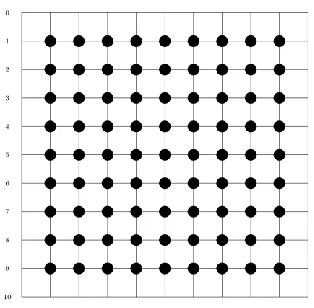
For convenience purpose, the image shown in Figure 1 will be simplified by considering the location of the pixels from the solution domain, as shown in Figure 2.
Figure 2. Finite grid network of pixels for n=10.
PIE is a type of gradient domain image editing method where it manipulates the gradients instead of the pixels of the
image. The Poisson blending process begins
by selecting the desired region O with ∂O
g. Then, extract the desired region and blend
into a destination image f* to generate a new
output image f. As stated by Pérez et al.
(2003), a guidance vector field v needs to be
generated first from the source image. After
that, a new set of intensity values f in the
desired region which will minimize the difference between the gradient of the new image and the vector field is computed.
The minimization problem is defined as,
minf∬ |∇f-ν|O 2 with f|∂O= f*|∂O (1)
where the intensity values are set to be the same at the boundary to generate a seamless image. The intensity values are extracted from the image itself. It will be used as the initial values for the generated linear system constructed from the discretization Poisson
equation via finite difference method. The details are discussed in the following section.
The solution of the minimization problem (1) is the unique solution of the Poisson equation with Dirichlet boundary condition,
∆𝑓 = div 𝐯 at O with 𝑓|𝜕O = 𝑓∗|𝜕O (2)
To generate a new image seamlessly, the vector field vis a gradient field directly extracted
from the source image and thus, Equation (2) can be rewritten as,
∆𝑓 = ∆𝑔 at O with 𝑓|𝜕O = 𝑓∗|
𝜕O (3)
The ∆ in Equation (3) denotes the Laplacian operator.
DERIVATION AND IMPLEMENTATION OF THE PROPOSED METHOD
To implement the three proposed iterative methods, Poisson equation is first to be discretized based on finite difference approach via Laplacian operator. The standard two-dimensional Poisson equation is defined as,
∂2𝑓
𝜕𝑥2+
∂2𝑓
𝜕𝑦2 = 𝑔(𝑥, 𝑦) (4)
Equation (4) is then discretized via five-point Laplacian operator. From the discretization process of Equation (4), the approximation equation is derived as,
𝑓𝑖,𝑗 ≅1
4[𝑓𝑖+1,𝑗+ 𝑓𝑖−1,𝑗+ 𝑓𝑖,𝑗+1+ 𝑓𝑖,𝑗−1− ℎ2𝑔𝑖,𝑗] (5)
𝑓𝑖,𝑗(𝑘+1) ≅ω
4[𝑓𝑖+1,𝑗(𝑘) + 𝑓𝑖−1,𝑗(𝑘+1)+ 𝑓𝑖,𝑗+1(𝑘) + 𝑓𝑖,𝑗−1(𝑘+1)− ℎ2𝑔𝑖,𝑗] + (1 − ω)𝑓𝑖,𝑗(𝑘) (6)
and by adding another accelerated parameter, r into Equation (6), it can also be redefined as,
𝑓𝑖,𝑗(𝑘+1) ≅ 𝑟
4(𝑓𝑖−1,𝑗(𝑘+1)− 𝑓𝑖−1,𝑗(𝑘) + 𝑓𝑖,𝑗−1(𝑘+1)− 𝑓𝑖,𝑗−1(𝑘) ) +
𝜔4(𝑓𝑖−1,𝑗(𝑘) + 𝑓𝑖+1,𝑗(𝑘) + 𝑓𝑖,𝑗−1(𝑘) + 𝑓𝑖,𝑗+1(𝑘) − ℎ2𝑔𝑖,𝑗) + (1 − 𝜔)𝑓𝑖,𝑗(𝑘) (7)
Thus, Equation (6) and (7) is the formulation of SOR (Young, 1954) and AOR (Hadjidimos, 1978) iterative methods respectively with 1 ≤ ω, r < 2 (Ali & Chong, 2007; Yousif & Martins, 2008).
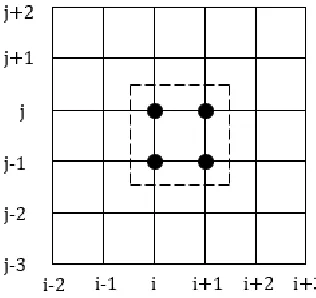
On the other hand, to implement the 4-EGAOR iterative method, let us consider a group of four points as shown in Figure 3 as follows,
Figure 3. Four points block iterative method.
and the 4-EG iterative method (Saudi & Sulaiman, 2012; Evans, 1985) is defined as,
[
4 −1 −1 0
−1 4 0 −1
−1 0 4 −1
0 −1 −1 4
]
[ 𝑓𝑖,𝑗 𝑓𝑖+1,𝑗
𝑓𝑖,𝑗+1 𝑓𝑖+1,𝑗+1]
= [ 𝑆1
𝑆2 𝑆3 𝑆4
] (8)
where,
𝑆1 = 𝑔𝑖,𝑗+ 𝑓𝑖−1,𝑗+ 𝑓𝑖,𝑗−1,
𝑆2 = 𝑔𝑖+1,𝑗 + 𝑓𝑖+2,𝑗 + 𝑓𝑖+1,𝑗−1,
Then, the inverse of the coefficient matrix (8) is determined as follows,
[ 𝑓𝑖,𝑗
𝑓𝑖+1,𝑗 𝑓𝑖,𝑗+1
𝑓𝑖+1,𝑗+1]
= 1
24[
7 2 2 1 2 7 1 2 2 1 7 2 1 2 2 7
] [ 𝑆1 𝑆2
𝑆3 𝑆4
] (9)
To implement 4-EGAOR (Martins et al., 2002) iterative method from Equation (9), let,
Sa =241 [S1+ 2S2+ 2S3+ S4],
Sb= 241 [2S1+ S2+ S3+ 2S4]. (10)
a1 = fi-1,j(k+1)-fi-1,j(k), a2 = fi,j-1(k+1)-fi,j-1(k), a3 = fi+1,j-1(k+1)-fi+1,j-1(k),
a4 = fi-1,j+1(k+1)-fi-1,j+1(k). (11)
Then, Equations (10) and (11) are substituted into Equation (9) and two weighted parameters, ω
and r with 1 ≤ ω, r < 2 are added. Thus, the 4-EGAOR iterative method can be implemented simultaneously by using the following formulation,
[ 𝑓𝑖,𝑗 𝑓𝑖+1,𝑗
𝑓𝑖,𝑗+1 𝑓𝑖+1,𝑗+1]
(𝑘+1)
=24𝑟 [
7 7 2 2 2 2 7 1 2 2 1 7 1 1 2 2
] [ 𝑎1
𝑎2
𝑎3
𝑎4
] +𝜔4[ 𝑆1 𝑆2 𝑆3 𝑆4 ] + 𝜔 [ 𝑆𝑎 𝑆𝑏 𝑆𝑏 𝑆𝑎
] + (1 − 𝜔)
[ 𝑓𝑖,𝑗 𝑓𝑖+1,𝑗
𝑓𝑖,𝑗+1 𝑓𝑖+1,𝑗+1]
(𝑘)
(12)
Algorithm 1: 4-EGAOR iterative method
i. Select desired region from source image.
ii. Map the desired region onto target image.
iii. Set the initial value f(0) = 0 and ε =
1.0.
iv. For all groups of four node points in the selected region, use Equation (12)
to compute
fi,j(k+1), fi+1,j(k+1), fi,j+1(k+1) and
fi+1,j+1(k+1)
v. For all ungroup node points in the selected region, use Equation (7) to compute.
vi. Examine the convergence. If it converges, go to step vii. Else, go to step iv.
RESULTS AND DISCUSSION
In order to verify the potency of the proposed methods, three sets of images with various sizes are chosen. Each set of the images comprises of source and target images were taken from Public Domain Pictures.net refer to Figure 4. To evaluate the performance of
the three selected iterative methods, two parameters are used, the number of iterations involved and the computational time taken to
generate a new blended image. In this paper,
we employed Root of Sum of Square (RSS) (Pérez et al., 2003), as stopping criterion with
1.0 threshold.
(i)
(ii)
(iii)
(a) (b)
Figure 4. (a) Target images. (b) Source images.
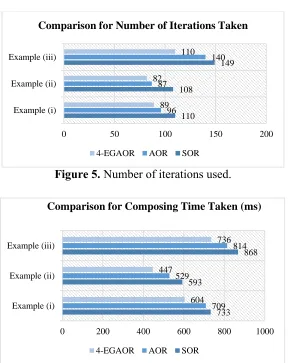
The performance evaluation of SOR, AOR and 4-EGAOR in terms of number of iterations used is presented in Figure 5 and
the values of ω and r used are optimal.
Referring to Figure 5, the number of iterations used by 4-EGAOR has reduced as compared to SOR and AOR iterative methods. It has decreased approximately 19.1 – 26.1% as compared to SOR iterative numerical result for comparison in the AOR iterative method. Meanwhile, the method and
Figure 5. Number of iterations used.
Figure 6. Composing time taken.
Subsequently, the new generated images after blending process are shown in Figures 7, 8 and 9. In order to assess the quality of the images produced, we used quantitative analysis. The quality metric used in this paper is the structural similarity index
measure (SSIM) by Wang and Bovik (2002).
The images produced by SOR method are used as reference image and then compared with the images produced by AOR and 4-EGAOR methods. The index values obtained are tabulated in Table 1, as follows,
Table 1. SSIM Index Values
Experiment Iterative Methods
AOR 4-EGAOR
(i) 1.0000 0.9999
(ii) 1.0000 1.0000
(iii) 1.0000 1.0000
110 108
149
96 87
140
89 82
110
0 50 100 150 200
Example (i) Example (ii) Example (iii)
Comparison for Number of Iterations Taken
4-EGAOR AOR SOR
733 593
868
709 529
814
604 447
736
0 200 400 600 800 1000
Example (i) Example (ii) Example (iii)
Comparison for Composing Time Taken (ms)
The range of SSIM index varies from -1 to 1 and value 1 indicates that both images are similar. From Table 1, all the SSIM index values obtained are close to 1 with four
decimal places, which implies that the images produced by all the proposed iterative methods are very similar.
(i)
a. SOR
(ω = 1.88) (ω = 1.86, r = 1.90) b. AOR (ω = 1.84, r = 1.92) c. 4-EGAOR
Figure 7. Output images generated for Example (i) with the size of 10229 pixels.
(ii)
a. SOR
(ω = 1.78) (ω = 1.75, r = 1.82) b. AOR (ω = 1.75, r = 1.79) c. 4-EGAOR
Figure 8. Output images generated for Example (ii) with the size of 5204 pixels.
(iii)
a. SOR
(ω = 1.90) (ω = 1.86, r = 1.91) b. AOR (ω = 1.85, r = 1.90) c. 4-EGAOR
Figure 9. Output images generated for Example (iii) with the size of 6186 pixels.
CONCLUSION
In this study, both point and block iterative methods are implemented for solving Poisson image blending problem in order to examine
4-EGAOR iterative method implements the
complexity reduction technique by
calculating a group of 4 points
simultaneously in one loop of iteration. Thus, it performed better than the proposed point iterative methods. Finally, the new blended images generated from the three proposed iterative methods showed excellent quality as evaluated using the SSIM index.
REFERENCES
Afifi, M. & Hussain, K.F. (2015). MPB: A modified poisson blending technique.
Computational Visual Media 1(4):
331-341.
Akhir, M.K.M., Othman, M., Sulaiman, J., Majid, Z.A. & Suleiman, M. (2011).
Half-sweep modified successive
overrelaxation for solving
two-dimensional helmholtz equations.
Australian Journal of Basic and Applied Sciences 5(12): 3033-3039.
Ali, N.H.M. & Chong, L.S. (2007). Group accelerated overrelaxation methods on rotated grid. Applied Mathematics and Computation 191: 533-542.
Dahalan, A.A., Saudi, A. & Sulaiman, J.
(2017). Numerical evaluation of mobile
robot navigation in static indoor
environment via EGAOR Iteration. Journal of Physics: Conference Series 890: 012064.
Eng, J.H., Saudi, A. & Sulaiman, J. (2017a). Numerical assessment for poisson image blending problem using MSOR iteration via five-point laplacian operator. Journal
of Physics: Conference Series 890:
012010.
Eng, J.H., Saudi, A. & Sulaiman, J. (2017b). Numerical analysis of the explicit group iterative method for solving poisson image blending problem. International
Journal of Imaging and Robotics 17(4):
15-24.
Eng, J.H., Saudi, A. & Sulaiman, J. (2018a). Performance analysis of the explicit decoupled group iteration via five-point rotated laplacian operator in solving poisson image blending problem. Indian Journal of Science and Technology 11(12).
Eng, J.H., Saudi, A. & Sulaiman, J. (2018b). Implementation of rotated five-point laplacian operator for poisson image blending problem. Advanced Science
Letters24(3): 1727-1731.
Evans, D.J. (1985). Group explicit iterative methods for solving large linear systems.
International Journal of Computer
Mathematics17:81-108.
Gonzalez, R.C. & Woods, R.E. (2001).
Digital Image Processing 2nd Edition,
New Jersey: Prentice Hall.
Hadjidimos, A. (1978). Accelerated
overrelaxation method. Mathematics of
Computation 32: 149-157.
Hussain, K.F. & Kamel, R.M. (2015).
Efficient poisson image editing.
Electronic Letters on Computer Vision
and Image Analysis14(2): 45-57.
Martino, J.M.D., Facciolo, G. & Meinhardt-Llopis, E. (2016). Poisson image editing.
Image Processing On Line6: 300-325.
solving elliptic partial differential
equations. Parallel and Scientific
Computations10(2):411-422.
Morel, J.M., Petro, A.B. & Sbert, C. (2012). Fourier implementation of poisson image
editing. Pattern Recognition Letters 33:
342-348.
Pérez, P., Gangnet, M. & Blake, A. (2003).
Poisson image editing. ACM
Transactions and Graphics313-318.
Bobek Ltd. (2007) Public Domain
Pictures.net. From:
https://www.publicdomainpictures.net/en/
view-image.php?image=211753&picture=offic e
-computer (accessed December 29, 2017).
Bobek Ltd. (2007) Public Domain
Pictures.net. From:
https://www.publicdomainpictures.net/en/
view-image.php?image=52663&picture=schoo l (accessed December 29, 2017).
Bobek Ltd. (2007) Public Domain
Pictures.net. From:
https://www.publicdomainpictures.net/en/
view- image.php?image=4433&picture=sand-heart-and-ocean (accessed December 29, 2017).
Bobek Ltd. (2007) Public Domain
Pictures.net. From:
https://www.publicdomainpictures.net/en/
view-image.php?image=36643&picture=games -on-the-beach (accessed December 29, 2017).
Bobek Ltd. (2007) Public Domain
Pictures.net. From:
https://www.publicdomainpictures.net/en
/view-image.php?image=87913&picture=vintag e
-automobile (accessed December 29, 2017).
Bobek Ltd. (2007) Public Domain
Pictures.net. From:
https://www.publicdomainpictures.net/en/
view-image.php?image=76803&picture=traveli n
g-by-car (accessed December 29, 2017).
Qin, C., Wang, S. & Zhang, X. (2008). Image editing without color inconsistency using
modified poisson equation. In
International Conference on Intelligent Information Hiding and Multimedia Signal Processing, 15-17 August, pp.
397-401, IEEE,China: Harbin.
Saudi, A. & Sulaiman, J. (2012). Robot path planning using four point-explicit group via nine-point laplacian (4EG9L) iterative
method. Procedia Engineering 41:
182-188.
Saudi, A. & Sulaiman, J. (2016). Path planning simulation using harmonic potential fields through four point-EDGSOR method via 9-point laplacian. Jurnal Teknologi 78(8-2): 12-24.
Saudi, A. & Sulaiman, J. (2017). Application of harmonic functions through modified SOR (MSOR) method for robot path
planning in indoor structured
Wang, Z. & Bovik, A.C. (2002). A universal image quality index. IEEE Signal Processing Letters 9(3): 81-84.
Young, D.M. (1954). Iterative methods for solving partial difference equations of elliptic type. Transactions of the American Mathematical Society 76: 92-111.
Yousif, W.S. & Martins, M.M. (2008). Explicit de-coupled group AOR method for solving elliptic partial differential
equations. Neural, Parallel and