The Occurrence and Analysis of Bisphenol A (BPA) in Environmental
Samples – A Review
Farhana Mohamed Ghazali and Wan Lutfi Wan Johari*
Department of Environmental Sciences, Faculty of Environmental Studies, University Putra Malaysia 43400 UPM Serdang, Selangor, Malaysia.
*Corresponding author: Dr. Wan Lutfi Wan Johari, Department of Environmental Sciences,
Faculty of Environmental Studies, University Putra Malaysia 43400 UPM Serdang, Selangor, Malaysia.
Email: [email protected]
INTRODUCTION
The growth of residents and world modernization have enhanced the total number of anthropogenic activities consequently led to the emission of toxic organic compounds in the environment, which include the endocrine disrupting compounds (EDCs). EDCs have been defined as exogenous materials or mixtures that appear during synthesis, secretion, transport, binding action or eradication of natural hormones and which cause harmful health effects in intact organisms or their progeny or (sub) population [1,2]. Rogers et al. [3] stated that the presence of EDCs in natural and synthetic compounds disrupts the endocrine system. Most EDCs are artificial compounds, which have been used for numerous purposes such as plasticizers, surfactants and pesticides [4].
Investigation of EDCs in Malaysia started in 1999 and became essential due to the difference in temperature, economic status and weather, which are totally different from other countries [5]. According to Razak et al. [6] the investigation of EDCs in environmental samples was initiated by reporting the
existence of some compounds like chlorophenicol, sulphonamides, estrone, estradiol and paraquat in selected places. EDCs are believed to contaminate the environment via the discharge of industrial or domestic sewage effluent. Other studies also determined that the level of phthalates in river water and sediments were critical in the industrialized Klang Valley [7]. Numerous studies on EDCs have proven that the level of contamination has become worse despite the prohibition by governments of the usage of toxic chemicals [8].
The consequences of EDCs have affected almost all the environmental media (air, water, sediment and biota). Even at very low doses, EDCs can have negative side effects, while in worse case scenarios they may cause the propagation of human prostate cancer cells and cardiovascular disorders [9]. Researchers have studied the pathway of EDCs including the sources. The highest concentrations of this compound have been found in wastewater [10,11], sewage samples [12], leachate [13] and in potable or natural mineral water [14].
HISTORY
Received: 16th November 2015
Received in revised form: 5th December 2015
Accepted: 20th of December 2015
ABSTRACT
This review paper briefly explains the meaning and characteristics of endocrine disrupting compounds (EDCs). EDCs comprise various types of natural and synthetic chemical compounds that can impede the reproductive action of the endocrine system in animals and humans. Further discussion is on bisphenol A (BPA), one of the examples of EDCs that is extensively used in industries nowadays. It acts as a monomer, which is desired in the production of polycarbonate plastics and epoxy resins. BPA later ends up in environmental compartments (air, water, sediment). In spite of this, BPA is not categorized as a persistent compound and it will be degraded either by photolysis or bacteria. It can only exist between three and five days in the environment. The concentration of BPA varies in different locations depending on the temperature, pH, source and time of sampling. BPA has been frequently debated due to its toxicity and carcinogenicity towards animals and humans. This paper also explains several extraction procedures and analytical methods concerning how to identify BPA in either aqueous or solid samples. However, an additional review is needed in respect of how to handle, reduce the level of BPA in the environment and understand the details concerning the existence of BPA.
KEYWORDS
occurrence of bisphenol A endocrine disrupting compounds analysis method
extraction method
JOURNAL OF BIOCHEMISTRY, MICROBIOLOGY
AND BIOTECHNOLOGY
This review will briefly examine the examples of EDCs followed by a focus on bisphenol A (BPA), a type of EDC that is extensively used in manufacturing processes. This paper will also assess the sources, effects and analytical methods that have been studied globally.
Examples of the EDCs
The environment has already been contaminated with hazardous chemicals due to industrial and anthropogenic actions. In order to distinguish all the chemicals, a screening procedure were introduced by United States Environmental Protection Agency (USEPA) that considered the physical chemical properties, exposure and effect using toxicological methods. Nowadays, numerous categories of EDCs have been discovered. USEPA has updated a list of EDCs, which has nearly 10000 chemicals present in the environment. Thousands of chemicals have been designated based on different criteria and actions in binding activity to cellular response in vitro to in vivo [15]. Some of them have been identified as hormones, alkylphenols and phthalates.
Estradiol, estriol and progesterone are examples of steroid hormones that are known to be non-polar or weakly polar compounds [16]. The presence of hormones in in soils and sediment has been discussed [17]. Some of the hormones were used in contraceptive pills [18] and to control the onset of menopause [19]. In addition, phthalates were employed as plasticizers and mainly applied in medical stores, paints, cosmetics, perfumes, propellants and clothing [20].
Josefson [21] explained that this compound can be absorbed through the skin and reported high levels in human blood and urine. Meanwhile, alkylphenol is a phenolic compound, the application of which is similar to phthalates. Vom Saal and Welshons [22] reported that this compound causes infertility due to prostate cancer cells and reduced sperm production. One of the examples of alkylphenol is BPA, which is the most recently discussed.
BPA as a representation of EDC
Lately, BPA is the EDC that has caused most concern due to its high demand from manufacturers. It has been produced domestically with the highest volume to produce mainly polycarbonate plastics and epoxy resin [23–28]. There are two different methods of BPA manufacturing. The first method involves synthesizing the compound from the acid-catalysed condensation of phenol and acetone in the presence of a catalyst and applied with distillation technology [29]. The second method uses a different catalyst and employs purification technology [30].
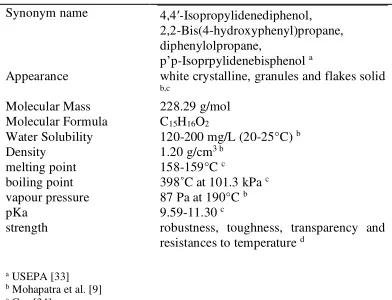
Recently, BPA has been applied in digital media, medical tools, food storage containers and dental sealants [28,31]. BPA, also known as 4,4’-dihydroxy-2,2-diphenylpropane, exists in the form of crystals or flakes with a mild phenolic odour. More information on the physical and chemical properties of BPA is listed in Table 1. Wastes are being formed, especially during the process of heating, handling, washing and sterilizing [32].
Extreme levels of BPA have also been observed in food containers, especially cans with epoxy resin linings. Moreover, Brotons et al. [36] and Yoshida et al. [37] noted that a significant exposure of BPA leached out from food containers. Some retailers already addressed the problem by eliminating products containing BPA since they are known to have a
negative effect and affect foetuses, infants and young children. Denmark for instance, has forbidden the usage of BPA in baby bottles followed by Canada which was the first to declare BPA a toxic compound followed by all European countries [3].
Table 1 Physical and chemical properties of BPA.
Synonym name 4,4′-Isopropylidenediphenol, 2,2-Bis(4-hydroxyphenyl)propane,
diphenylolpropane, p’p-Isoprpylidenebisphenol a
Appearance white crystalline, granules and flakes solid
b,c
Molecular Mass 228.29 g/mol Molecular Formula C15H16O2
Water Solubility 120-200 mg/L (20-25°C) b
Density 1.20 g/cm3 b
melting point 158-159°C c
boiling point 398˚C at 101.3 kPa c
vapour pressure 87 Pa at 190°C b
pKa 9.59-11.30 c
strength robustness, toughness, transparency and resistances to temperature d
a USEPA [33] b Mohapatra et al. [9] c Cao [34] d Kang et al. [35]
According to The Star [38] BPA bottles in Malaysia have been banned as a safety measure. To date, no studies have reported BPA as being harmless and environmentally friendly. Tan and Mustafa [39] declared that polycarbonate plastics are not safe even if they are acknowledged to be tough and durable with high resistivity towards elevated temperature. Hydrolysis and BPA leaching are extremely high, especially when keeping boiling water inside or heating in the microwave [39,40]. The monitoring of BPA in environmental samples has also been done in water. Unfortunately, the concentration of BPA varies with time and month due to the inconsistent rainy and dry seasons in Malaysia [5].
Availability of BPA in the environment
BPA does not exist as a natural product. The availability in the environment is as a consequence of human activities. During the early 1990s, Krishnan et al. [41] accidently found that the BPA compound leached out from a polycarbonate flask during culture media autoclaving. Following that, the BPA level has also been investigated in landfill leachate, wastewater treatment plants, estuaries, lagoons [42], sewage, river and sea water, sediment [43], biota [44] and air [45]. The concentration of BPA in environmental compartments varies depending on the biotic and abiotic factors, source of samples, time of sampling, water pH and temperature, presence of bacteria and much more [46,47].
Water
compound. It could disappear and degrade within 2.5 and 4.7 days under aerobic conditions [30,46,47] but degrades more slowly in an anaerobic state [49]. The degradation of BPA within 3-5 days by bacteria will provide adequate time to have some impact on aquatic organisms [35]. Basheer et al. [50] found that the BPA concentration in biological samples is quite high, between 13.3-213.1 ppb particularly in Portunus
pelagicus. However, if no degradation takes place within 30
days, the possibility of biota becoming contaminated could be higher [35].
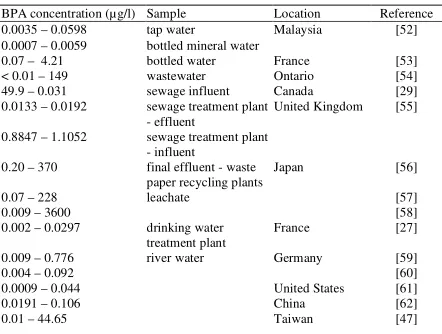
Table 2 focuses on the level of BPA monitored worldwide in water, treatment plants, sewage and water bottles. The majority of concentrations of BPA detected in river water were lower than 0.01µ g/L, except for a study done in Taiwan, in which the concentration was much higher with levels up to 44µg/L. In the meantime, the highest BPA concentration was found in bottled water in France. This is due to BPA migrating towards water, especially from polycarbonate drinking bottles when exposed to elevated temperatures [51]. BPA concentration in the leachate area before employing any treatment was detected up to 3000 µg/L.
Table 2 Concentration level of BPA measured in general sources.
BPA concentration (µg/l) Sample Location Reference
0.0035 – 0.0598 tap water Malaysia [52]
0.0007 – 0.0059 bottled mineral water
0.07 – 4.21 bottled water France [53]
< 0.01 – 149 wastewater Ontario [54]
49.9 – 0.031 sewage influent Canada [29] 0.0133 – 0.0192 sewage treatment plant
- effluent
United Kingdom [55]
0.8847 – 1.1052 sewage treatment plant - influent
0.20 – 370 final effluent - waste paper recycling plants
Japan [56]
0.07 – 228 leachate [57]
0.009 – 3600 [58]
0.002 – 0.0297 drinking water treatment plant
France [27]
0.009 – 0.776 river water Germany [59]
0.004 – 0.092 [60]
0.0009 – 0.044 United States [61]
0.0191 – 0.106 China [62]
0.01 – 44.65 Taiwan [47]
Soil and sediment
The probability of BPA traces released from wastewater treatment and accumulates in sewage sludge is very high. Table
3 indicates the earlier studies that have been carried out. The sediment or soil has been recognized as a secondary source of EDCs rather than water due to its hydrophobic character, which tends to absorb more into the sediment [63].
Table 3 Environmental concentration of BPA measured in sediment and
soil.
Location BPA
concentration (µg/Kg)
Type Reference
Germany- Baden-Württemberg
0.5 – 15.0 river sediment [64]
Germany- Brandenburg and Berlin
10 – 190 4 – 1363
river sediment sewage sludge
[65]
Germany- River Elbe 10 – 380 freshly deposited sediment
[60]
Canada- Ontario 7.01 – 74.38 up to 6.1
sewage sludge surface sediment
[66]
Italy- Venice Lagoon 2.1 – 118 lagoon sediment [67] Japan- Okinawa < 1.2 – 22.0
nd – 6.8
urban river area rural river area
[68]
Canada- Halifax Harbour <0.09 – 9.50 surface sediment [69] Spain- Spanish Region, 0.7 – 4.6 agricultural soil [70]
Bilbao Area 1.1 – 44.5 industrial soil
Iran- Anzali Wetland 10 – 6970 surface sediment [71] Staples et al. [30] found that around 50% of BPA will be absorbed into sediments or soils. The research on the occurrence of BPA in sediment is still limited [67]. A study by Bolz et al. [64] discovered that the availability of BPA in sediment is quiet high due to the discharge of sewage from treatment plants into water. Another study on BPA using soil adsorption has proven that this compound is unstable, mobile and bioavailable [72]. In order to understand the adsorption actions or mechanisms of BPA in sediment, a study was performed by Zeng et al. [73] using the Freundlich model. They found that the adsorption of BPA into the sediment decreases as the concentration of sediment increases.
Air
Many studies have been conducted in water and sediment with the exclusion of air. However, the information on BPA spreading in the atmosphere is very limited and rarely reported [45,74,75]. BPA is an organic compound, which has low volatility [76]. This was proven when Staples et al. [30] determined that the distribution and movement of BPA in air is much lower than in water and sediment.
In addition, the half-life of this compound in air is much shorter compared to other environmental compartments. Based on Kang et al. [35] BPA in air will degrade somewhere between 0.74 and 7.4 hours. Thus, the possibility of inhaling this compound is much lower. However, a survey has shown that the BPA level in resin factories is much higher (492µ g/m3)
[28,77]. Hanaoka et al. [78] discovered that the concentration of BPA in the urine of workers was higher compared to workers who were not involved in BPA industries.
Surprisingly, BPA can also be emitted through the combustion of computer printed circuit boards in electronic waste [79] as well as in household products in the home and furnishing materials in the office [45]. Fu and Kawamura [80] contended that the presence of BPA in the air will have health consequences and therefore all sources of emission should be suitably controlled.
Threats of BPA on biological samples
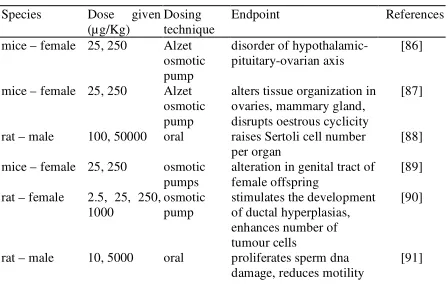
Leaching of BPA is due to hydrolysis of the ester bond that binds them with polycarbonate or resin according to the temperature, acidity and basic condition [22]. The toxicity and carcinogenicity of BPA compounds are being studied due to the high production of BPA in industry. There have been many studies on the effects of consuming this compound [22,46,81]. Rogers et al. [3] claimed that EDCs interrupt the body system in numerous ways including binding to the nuclear and hormone receptors with sex and steroid hormones. The study conducted by Vom Saal and Welshon [22] suggested that BPA could have a considerable effect at very low doses in mice due to the limited binding of BPA to plasma binding proteins.
Table 4 Biological effect of BPA on animal studies.
Species Dose given (µg/Kg)
Dosing technique
Endpoint References
mice – female 25, 250 Alzet osmotic pump
disorder of hypothalamic-pituitary-ovarian axis
[86]
mice – female 25, 250 Alzet osmotic pump
alters tissue organization in ovaries, mammary gland, disrupts oestrous cyclicity
[87]
rat – male 100, 50000 oral raises Sertoli cell number per organ
[88]
mice – female 25, 250 osmotic pumps
alteration in genital tract of female offspring
[89]
rat – female 2.5, 25, 250, 1000
osmotic pump
stimulates the development of ductal hyperplasias, enhances number of tumour cells
[90]
rat – male 10, 5000 oral proliferates sperm dna damage, reduces motility
[91]
These days, human exposure to BPA has become a topic in the media. The reference dose of taking BPA is 50µ g/kg-d [92]. There are a few researchers who claim that food and water are the predominant routes of exposure [51,53,93–95]. Unfortunately, human biomonitoring of BPA has only been studied in urine (external exposure) and blood (internal exposure) [31,94]. BPA is completely excreted in urine within 24 hours and the value of concentration is expected to be reliable with a reference value [31,92].
There have been numerous studies that have clarified that BPA has a wide range of effects. These include learning defects, increased aggression, immune deficiency syndrome, multiplying of the growth rate, abnormalities in liver-enzyme, chronic kidney and respiratory disease, diabetes and obesity [9,32,96]. Due to these impacts, BPA has been declared a noxious compound that must be taken seriously in respect of human health. More work is needed to further explore the toxicity and carcinogenicity of BPA and its effects on human health.
Method analysis of BPA
Sample preparation
The sample preparation is the most important stage prior to the analytical method. This technique can enhance the sensitivity and reduce the interference by cleaning and concentrating the samples [97]. The sample preparation for liquid and solid samples is different. For liquid samples, liquid-liquid extraction is commonly used (LLE) [98], solid phase extraction (SPE) [99] and solid phase microextraction (SPME) [100]. Meanwhile, the type of extraction for solid samples includes soxhlet extraction (SE) [12], accelerated solvent extraction (ASE) [59] and microwave extraction system (MAE) [47].
Extraction of analyte from environmental samples
Generally, samples need to be filtered to eliminate the suspended and organic materials. They can either be filtered by normal filter paper or a membrane filter as long as the size is in microns. Cai et al. [101] and Liu et al. [102] contend that a millipore cellulose membrane or pre-combusted GF/F filter paper can also be used in water analysis. Usually, filtration is followed by the extraction process.
The pre-treatment for solid samples necessitates many steps due to the complexity of the matrices. Samples first need to be extracted before being injected into the instrument. In this
case, a few techniques have been introduced. SE is a conventional method for extraction, which even though it consumes a lot of solvent and time, researchers still use it in the extraction of solid samples. The latest known techniques are ASE and MAE, both of which give a better outcome and require less solvent in the extraction. The time required for the extraction is also much faster compared to SE. For liquid samples, LLE is one of the traditional methods used in the analysis of BPA. Nevertheless, it uses a large amount of solvent, increases the extraction time, requires a huge volume of sample and the formation of emulsion frequently occurs [97].
Recently, the SPE method has often been used in sample preparation. The optimization of SPE is crucial to make sure the sample is totally concentrated and clean. It involves a few steps including conditioning of the sorbent, elution, volume of sample and type of sorbent used during extraction [97]. Different sorbents have different selectivity and recoveries. Examples of the sorbents that are mainly used include Oasis HLB, RP-C18, Strata X-AW and polymeric cartridges. Gros et al. [103] determined that both Oasis HLB and Strata X are capable of extracting analyte with a wide range of pH. However, Strata X is mostly employed in multi-group analysis even though it does not always achieve better recoveries. RP-C18 is essential for pH adjustment on a sample by referring to the characteristics of the compound prior to extraction.
The volume of sample also plays an important part in obtaining a better recovery. Commonly, 1L of sample is taken and extracted using an appropriate solvent. Although a small volume of sample will reduce the extraction time it will not fully concentrate [97]. Hence, small recoveries will be acquired after being analysed. SPE consists of two types: (i) disks [69] and (ii) sorbent cartridge [104]. Disks seem to have more benefit compared to the sorbent cartridge because they have the ability to minimize sample clogging and have a large surface area. However disks tend to use a large volume of solvent for sample elution hence more interference will emerge in the chromatogram [9].
The SPME technique is the newest method, which is a process for the adsorption of the analyte onto the surface of the coated silica fibre. Different types of fibre have a different selectivity. According to Chang et al. [105] the amount of analyte adsorbed onto the fibre during equilibrium time is directly related to the sample concentration. The fibre is acknowledged to have sensitivity to organic compounds. Mohapatra et al. [9] stated that SPME is more effective compared to other techniques. It has the ability to reduce the time required and the amount of solvent while giving better recovery during analysis. However, this technique has not been fully utilised by other researchers and SPE still remains the most extensively used.
Analytical method
Gas chromatography-mass spectrometry (GC-MS) and liquid chromatography-mass spectrometry (LC-MS) are the most common instruments in the determination of BPA [98,106]. Table 5 represents the details concerning the determination of BPA in different countries using various analytical and extraction skills.
Although GC-MS is the most common instrument used, it still has a few drawbacks in the analysis of BPA. Before the sample injection, a derivatizing agent should be added, which, generally requires a whole day to derivatize due to inadequate volatility for direct analysis [9,107]. In addition, even though the percentage of sample lost during derivatizing is high, researchers use this instrument to detect the presence of BPA even though it has been classified as time consuming. Yasuhara et al. [108] employed GC-MS to determine the occurrence of organic components in leachate. Nonetheless, this method was slightly modified to obtain a virtuous chromatographic diagram [10,29].
Krishnan et al. [41] detected the existence of BPA released from a polycarbonate flask during autoclaving using the reversed-phase HPLC. Nevertheless, this method has been superseded by a more sensitive instrument, the LC-MS and later the LC-MS-MS which is considered to be a more sensitive, fast and simple instrument that does not require a derivatizing agent [109]. Currently, Dorival-García et al. [110,111] used LC-MS-MS to analyse BPA, including chlorinated derivatives in sewage sludge and obtained a highest recovery rate from 97.7% to 103.1%. This proved how sensitive this instrument is.
An internal standard is essential when sample monitoring. This standard is to compensate the potential loss of analyte during analysis and for any variations in instrument performance [107]. Different analyses will apply different internal standards. Bisphenol A d-16 is commonly used for BPA studies [52,67,112]. Dekant and Völkel [107] mentioned that an ordinarily stable isotope was used because of the physicochemical characteristics, which are almost comparable to the unknown analyte.
CONCLUSION
BPA is produced during the condensation process of phenol and acetone and is needed in the manufacturing of resin and polycarbonate plastics. The BPA compound has already demonstrated the signs of oestrogenic performance and has acute toxicity to aquatic life due to their discharge into the surroundings (water, air, soil). An elevated concentration of BPA can be found in effluent and leachate, while moderate levels of BPA can be obtained in seawater, river water and bottled water. The toxicity and carcinogenicity of BPA has been disputed by many researchers. The reference dose (RfD) of BPA is 0.05 mg/kg/day and only has an effect when the dosage is more than 50mg/kg bw/day. BPA has been recognized as a toxic compound due to the reaction that can have an adverse effect on the endocrine system. More research must be done to determine the carcinogenicity and toxicity of BPA. Sensitive and selective procedures have been developed and applied to detect traces of BPA. SPE is known to be a simple, clean and concentrated technique for sample preparation, while MAE is a newer approach that has been applied for the extraction of solid samples. GC-MS and LC-MS-MS are considered to be convenient analytical techniques that are selective and sensitive for perceiving low amounts of BPA.
Table 5 Various determination of BPA in different country.
ACKNOWLEDGMENT
This work was supported under a Malaysian Fundamental Research Grant Scheme (FRGS/07-01-13-1179FR).
REFERENCES
1. Markey CM, Rubin BS, Soto AM, Sonnenschein C. Endocrine disruptors: from Wingspread to environmental developmental biology. J Steroid Biochem Mol Biol. 2002 Dec;83(1–5):235–44. 2. Umar M, Roddick F, Fan L, Aziz HA. Application of ozone for
the removal of bisphenol A from water and wastewater – A review. Chemosphere. 2013 Feb;90(8):2197–207.
3. Rogers JA, Metz L, Yong VW. Review: Endocrine disrupting chemicals and immune responses: A focus on bisphenol-A and its potential mechanisms. Mol Immunol. 2013 Apr;53(4):421–30. 4. Bonefeld-Jørgensen EC, Long M, Hofmeister MV, Vinggaard
AM. Endocrine-disrupting potential of bisphenol A, bisphenol A dimethacrylate, 4-n-nonylphenol, and 4-n-octylphenol in vitro: new data and a brief review. Environ Health Perspect. 2007 Dec;115 Suppl 1:69–76.
5. Mohd MA. Endocrine disruptors research in Malaysia [Internet].
University of Malaya; Available from:
https://www.env.go.jp/chemi/end/sympo/2001/report/pdf_e/mohd _e.pdf
6. Razak ARA, Ujang Z, Ozaki H. Removal of endocrine disrupting chemicals (EDCs) using low pressure reverse osmosis membrane (LPROM). Water Sci Technol. 2007 Oct 1;56(8):161–8. 7. Sin J-C, Lam S-M, Mohamed AR, Lee K-T, Sin J-C, Lam S-M, et
al. Degrading Endocrine Disrupting Chemicals from Wastewater by TiO Photocatalysis: A Review. Int J Photoenergy. 2011 Oct 18;2012, 2012:e185159.
8. Sudaryanto A, Kunisue T, Tanabe S, Niida M, Hashim H. Persistent Organochlorine Compounds in Human Breast Milk from Mothers Living in Penang and Kedah, Malaysia. Arch Environ Contam Toxicol. 2005 Aug 24;49(3):429–37.
9. Mohapatra DP, Brar SK, Tyagi RD, Surampalli RY. Physico-chemical pre-treatment and biotransformation of wastewater and wastewater Sludge – Fate of bisphenol A. Chemosphere. 2010 Feb;78(8):923–41.
10. Fürhacker M, Scharf S, Weber H. Bisphenol A: emissions from point sources. Chemosphere. 2000 Sep;41(5):751–6.
11. Ballesteros O, Zafra A, Navalón A, Vílchez JL. Sensitive gas chromatographic–mass spectrometric method for the determination of phthalate esters, alkylphenols, bisphenol A and their chlorinated derivatives in wastewater samples. J Chromatogr A. 2006 Jul 21;1121(2):154–62.
12. Vega-Morales T, Sosa-Ferrera Z, Santana-Rodríguez JJ. Determination of alkylphenol polyethoxylates, bisphenol-A, 17α -ethynylestradiol and 17β-estradiol and its metabolites in sewage samples by SPE and LC/MS/MS. J Hazard Mater. 2010 Nov 15;183(1–3):701–11.
13. Yamamoto T, Yasuhara A, Shiraishi H, Nakasugi O. Bisphenol A in hazardous waste landfill leachates. Chemosphere. 2001 Feb;42(4):415–8.
14. Dévier M-H, Le Menach K, Viglino L, Di Gioia L, Lachassagne P, Budzinski H. Ultra-trace analysis of hormones, pharmaceutical substances, alkylphenols and phthalates in two French natural mineral waters. Sci Total Environ. 2013 Jan 15;443:621–32. 15. Snyder SA, Vanderford BJ, Drewes J, Dickenson E, Snyder EM,
Bruce GM, et al. State of knowledge of endocrine disruptors and pharmaceuticals in drinking water. Denver, CO: Awwa Research Foundation; 237 p.
16. Kuster M, López de Alda MJ, Hernando MD, Petrovic M, Martín-Alonso J, Barceló D. Analysis and occurrence of pharmaceuticals, estrogens, progestogens and polar pesticides in sewage treatment plant effluents, river water and drinking water in the Llobregat river basin (Barcelona, Spain). J Hydrol. 2008 Aug 30;358(1– 2):112–23.
17. Sarmah AK, Northcott GL, Scherr FF. Retention of estrogenic steroid hormones by selected New Zealand soils. Environ Int. 2008 Aug;34(6):749–55.
18. Atkinson SK, Marlatt VL, Kimpe LE, Lean DRS, Trudeau VL, Blais JM. The occurrence of steroidal estrogens in south-eastern Ontario wastewater treatment plants. Sci Total Environ. 2012 Jul 15;430:119–25.
19. Head KA. Estriol: safety and efficacy. Altern Med Rev J Clin Ther. 1998 Apr;3(2):101–13.
20. USEPA. Phthalates Action Plan [Internet]. USEPA; 2012 Mar. Available from: https://www.epa.gov/sites/production/files/2015-09/documents/phthalates_actionplan_revised_2012-03-14.pdf 21. Josefson D. US study highlights high levels of plastic compound
in humans. BMJ. 2001 Mar 31;322(7289):756.
22. vom Saal FS, Welshons WV. Large effects from small exposures. II. The importance of positive controls in low-dose research on bisphenol A. Environ Res. 2006 Jan;100(1):50–76.
23. Staples CA, Dorn PB, Klecka GM, O’Block ST, Branson DR, Harris LR. Bisphenol A concentrations in receiving waters near US manufacturing and processing facilities. Chemosphere. 2000 Mar;40(5):521–5.
24. Hu J, Aizawa T, Ookubo S. Products of Aqueous Chlorination of Bisphenol A and Their Estrogenic Activity. Environ Sci Technol. 2002 May;36(9):1980–7.
25. Yamamoto T, Yasuhara A. Chlorination of bisphenol A in aqueous media: formation of chlorinated bisphenol A congeners and degradation to chlorinated phenolic compounds. Chemosphere. 2002 Mar;46(8):1215–23.
26. Gallard H, Leclercq A, Croué J-P. Chlorination of bisphenol A: kinetics and by-products formation. Chemosphere. 2004 Aug;56(5):465–73.
27. Dupuis A, Migeot V, Cariot A, Albouy-Llaty M, Legube B, Rabouan S. Quantification of bisphenol A, 353-nonylphenol and their chlorinated derivatives in drinking water treatment plants. Environ Sci Pollut Res Int. 2012 Nov;19(9):4193–205.
28. Huang YQ, Wong CKC, Zheng JS, Bouwman H, Barra R, Wahlström B, et al. Bisphenol A (BPA) in China: A review of sources, environmental levels, and potential human health impacts. Environ Int. 2012 Jul;42:91–9.
29. Lee H-B, Peart TE. Determination of Bisphenol A in Sewage Effluent and Sludge by Solid-Phase and Supercritical Fluid Extraction and Gas Chromatography/Mass Spectrometry. J AOAC Int. 2000 Mar 1;83(2):290–7.
30. Staples CA, Dome PB, Klecka GM, Oblock ST, Harris LR. A review of the environmental fate, effects, and exposures of bisphenol A. Chemosphere. 1998 Apr 1;36(10):2149–73. 31. Teeguarden JG, Hanson-Drury S. A systematic review of
Bisphenol A “low dose” studies in the context of human exposure: A case for establishing standards for reporting “low-dose” effects of chemicals. Food Chem Toxicol. 2013 Dec;62:935–48. 32. Erler C, Novak J. Bisphenol a exposure: human risk and health
policy. J Pediatr Nurs. 2010 Oct;25(5):400–7.
33. USEPA. Bisphenol A [Internet]. 1988. Available from: https://cfpub.epa.gov/ncea/iris/iris_documents/documents/subst/03 56_summary.pdf
34. Cao, Xu-Liang. Chemistry and analytical methods for determination of bisphenol A in food and biological samples. In Ottawa, Canada; 2010. p. 29.
35. Kang J-H, Kondo F, Katayama Y. Human exposure to bisphenol A. Toxicology. 2006 Sep 21;226(2–3):79–89.
36. Brotons JA, Olea-Serrano MF, Villalobos M, Pedraza V, Olea N. Xenoestrogens released from lacquer coatings in food cans. Environ Health Perspect. 1995 Jun;103(6):608–12.
37. Yoshida T, Horie M, Hoshino Y, Nakazawa H. Determination of bisphenol A in canned vegetables and fruit by high performance liquid chromatography. Food Addit Contam. 2001 Jan;18(1):69– 75.
38. BPA bottles now banned. The Star Online [Internet]. 2012 Mar 1;
Available from:
http://www.thestar.com.my/news/nation/2012/03/01/bpa-bottles-now-banned/
39. Tan BLL, Mustafa AM. Leaching of Bisphenol A from New and Old Babies’ Bottles, and New Babies’ Feeding Teats. Asia Pac J Public Health. 2003 Jul 1;15(2):118–23.
41. Krishnan AV, Stathis P, Permuth SF, Tokes L, Feldman D. Bisphenol-A: an estrogenic substance is released from polycarbonate flasks during autoclaving. Endocrinology. 1993 Jun 1;132(6):2279–86.
42. Pojana G, Bonfà A, Busetti F, Collarin A, Marcomini A. Determination of natural and synthetic estrogenic compounds in coastal lagoon waters by HPLC-electrospray-mass spectrometry. Int J Environ Anal Chem. 2004 Aug 20;84(10):717–27. 43. Kawahata H, Ohta H, Inoue M, Suzuki A. Endocrine disrupter
nonylphenol and bisphenol A contamination in Okinawa and Ishigaki Islands, Japan––within coral reefs and adjacent river mouths. Chemosphere. 2004 Jun;55(11):1519–27.
44. Santhi VA, Hairin T, Mustafa AM. Simultaneous determination of organochlorine pesticides and bisphenol A in edible marine biota by GC–MS. Chemosphere. 2012 Mar;86(10):1066–71.
45. Wilson NK, Chuang JC, Lyu C. Levels of persistent organic pollutants in several child day care centers. J Expo Sci Environ Epidemiol. 2001 Dec 27;11(6):449–58.
46. Crain DA, Eriksen M, Iguchi T, Jobling S, Laufer H, LeBlanc GA, et al. An ecological assessment of bisphenol-A: Evidence from comparative biology. Reprod Toxicol. 2007 Aug;24(2):225–39. 47. Lee C-C, Jiang L-Y, Kuo Y-L, Hsieh C-Y, Chen CS, Tien C-J.
The potential role of water quality parameters on occurrence of nonylphenol and bisphenol A and identification of their discharge sources in the river ecosystems. Chemosphere. 2013 May;91(7):904–11.
48. Suzuki T, Nakagawa Y, Takano I, Yaguchi K, Yasuda K. Environmental Fate of Bisphenol A and Its Biological Metabolites in River Water and Their Xeno-estrogenic Activity. Environ Sci Technol. 2004 Apr;38(8):2389–96.
49. Ying G-G, Kookana RS. Degradation of Five Selected Endocrine-Disrupting Chemicals in Seawater and Marine Sediment. Environ Sci Technol. 2003 Apr;37(7):1256–60.
50. Basheer C, Lee HK, Tan KS. Endocrine disrupting alkylphenols and bisphenol-A in coastal waters and supermarket seafood from Singapore. Mar Pollut Bull. 2004 Jun;48(11–12):1161–7. 51. Cooper JE, Kendig EL, Belcher SM. Assessment of bisphenol A
released from reusable plastic, aluminium and stainless steel water bottles. Chemosphere. 2011 Oct;85(6):943–7.
52. Santhi VA, Sakai N, Ahmad ED, Mustafa AM. Occurrence of bisphenol A in surface water, drinking water and plasma from Malaysia with exposure assessment from consumption of drinking water. Sci Total Environ. 2012 Jun 15;427–428:332–8.
53. Colin A, Bach C, Rosin C, Munoz J-F, Dauchy X. Is drinking water a major route of human exposure to alkylphenol and bisphenol contaminants in France? Arch Environ Contam Toxicol. 2014 Jan;66(1):86–99.
54. Lee H-B, Peart TE, Gris G, Chan J. Endocrine-Disrupting Chemicals in Industrial Wastewater Samples in Toronto, Ontario. Water Qual Res J Can. 2002;37(2):459–72.
55. Hernando MD, Mezcua M, Gómez MJ, Malato O, Agüera A, Fernández-Alba AR. Comparative study of analytical methods involving gas chromatography–mass spectrometry after derivatization and gas chromatography–tandem mass spectrometry for the determination of selected endocrine disrupting compounds in wastewaters. J Chromatogr A. 2004 Aug 20;1047(1):129–35. 56. Fukazawa H, Watanabe M, Shiraishi F, Shiraishi H, Shiozawa T,
Matsushita H, et al. Formation of Chlorinated Derivatives of Bisphenol A in Waste Paper Recycling Plants and Their Estrogenic Activities. J Health Sci. 2002;48(3):242–9.
57. Asakura H, Matsuto T, Tanaka N. Behavior of endocrine-disrupting chemicals in leachate from MSW landfill sites in Japan. Waste Manag. 2004;24(6):613–22.
58. Kurata Y, Ono Y, Ono Y. Occurrence of phenols in leachates from municipal solid waste landfill sites in Japan. J Mater Cycles Waste Manag. 2008 Oct 8;10(2):144–52.
59. Heemken OP, Reincke H, Stachel B, Theobald N. The occurrence of xenoestrogens in the Elbe river and the North Sea. Chemosphere. 2001 Oct;45(3):245–59.
60. Stachel B, Ehrhorn U, Heemken O-P, Lepom P, Reincke H, Sawal G, et al. Xenoestrogens in the River Elbe and its tributaries. Environ Pollut. 2003 Aug;124(3):497–507.
61. Boyd GR, Palmeri JM, Zhang S, Grimm DA. Pharmaceuticals and personal care products (PPCPs) and endocrine disrupting chemicals (EDCs) in stormwater canals and Bayou St. John in
New Orleans, Louisiana, USA. Sci Total Environ. 2004 Oct 15;333(1–3):137–48.
62. Jin X, Jiang G, Huang G, Liu J, Zhou Q. Determination of 4-tert-octylphenol, 4-nonylphenol and bisphenol A in surface waters from the Haihe River in Tianjin by gas chromatography–mass spectrometry with selected ion monitoring. Chemosphere. 2004 Sep;56(11):1113–9.
63. Zhang X, Li Q, Li G, Wang Z, Yan C. Levels of estrogenic compounds in Xiamen Bay sediment, China. Mar Pollut Bull. 2009 Aug;58(8):1210–6.
64. Bolz U, Hagenmaier H, Körner W. Phenolic xenoestrogens in surface water, sediments, and sewage sludge from Baden-Württemberg, south-west Germany. Environ Pollut. 2001 Dec;115(2):291–301.
65. Fromme H, Küchler T, Otto T, Pilz K, Müller J, Wenzel A. Occurrence of phthalates and bisphenol A and F in the environment. Water Res. 2002 Mar;36(6):1429–38.
66. Chu S, Haffner GD, Letcher RJ. Simultaneous determination of tetrabromobisphenol A, tetrachlorobisphenol A, bisphenol A and other halogenated analogues in sediment and sludge by high performance liquid chromatography-electrospray tandem mass spectrometry. J Chromatogr A. 2005 Dec 2;1097(1–2):25–32. 67. Pojana G, Gomiero A, Jonkers N, Marcomini A. Natural and
synthetic endocrine disrupting compounds (EDCs) in water, sediment and biota of a coastal lagoon. Environ Int. 2007 Oct;33(7):929–36.
68. Kitada Y, Kawahata H, Suzuki A, Oomori T. Distribution of pesticides and bisphenol A in sediments collected from rivers adjacent to coral reefs. Chemosphere. 2008 May;71(11):2082–90. 69. Robinson BJ, Hui JPM, Soo EC, Hellou J. Estrogenic compounds in seawater and sediment from Halifax Harbour, Nova Scotia, Canada. Environ Toxicol Chem. 2009 Jan 1;28(1):18–25. 70. Sánchez-Brunete C, Miguel E, Tadeo JL. Determination of
tetrabromobisphenol-A, tetrachlorobisphenol-A and bisphenol-A in soil by ultrasonic assisted extraction and gas chromatography– mass spectrometry. J Chromatogr A. 2009 Jul 17;1216(29):5497– 503.
71. Mortazavi S, Riyahi Bakhtiari A, Sari AE, Bahramifar N, Rahbarizade F. Phenolic endocrine disrupting chemicals (EDCs) in Anzali Wetland, Iran: Elevated concentrations of 4-nonylphenol, octhylphenol and bisphenol A. Mar Pollut Bull. 2012 May;64(5):1067–73.
72. Fent G, Hein WJ, Moendel MJ, Kubiak R. Fate of 14C-bisphenol A in soils. Chemosphere. 2003 Jun;51(8):735–46.
73. Zeng G, Zhang C, Huang G, Yu J, Wang Q, Li J, et al. Adsorption behavior of bisphenol A on sediments in Xiangjiang River, Central-south China. Chemosphere. 2006 Nov;65(9):1490–9. 74. Berkner S, Streck G, Herrmann R. Development and validation of
a method for determination of trace levels of alkylphenols and bisphenol A in atmospheric samples. Chemosphere. 2004 Jan;54(4):575–84.
75. Matsumoto H, Adachi S, Suzuki Y. Bisphenol A in Ambient Air Particulates Responsible for theProliferation of MCF-7 Human Breast Cancer Cells and Its ConcentrationChanges over 6 Months. Arch Environ Contam Toxicol. 2005 Mar 24;48(4):459–66. 76. Potyrailo RA, Lemmon JP. Time-Modulated Combinatorially
Developed Optical Sensors for Determination of Non-Volatile Analytes in Complex Samples. QSAR Comb Sci. 2005 Feb 1;24(1):7–14.
77. He Y, Miao M, Wu C, Yuan W, Gao E, Zhou Z, et al. Occupational Exposure Levels of Bisphenol A among Chinese Workers. J Occup Health. 2009;51(5):432–6.
78. Hanaoka T, Kawamura N, Hara K, Tsugane S. Urinary bisphenol A and plasma hormone concentrations in male workers exposed to bisphenol A diglycidyl ether and mixed organic solvents. Occup Environ Med. 2002 Sep;59(9):625–8.
79. Owens CV, Lambright C, Bobseine K, Ryan B, Gray LE, Gullett BK, et al. Identification of Estrogenic Compounds Emitted from the Combustion of Computer Printed Circuit Boards in Electronic Waste. Environ Sci Technol. 2007 Dec;41(24):8506–11. 80. Fu P, Kawamura K. Ubiquity of bisphenol A in the atmosphere.
Environ Pollut Barking Essex 1987. 2010 Oct;158(10):3138–43. 81. Vandenberg LN, Hauser R, Marcus M, Olea N, Welshons WV.
82. Hunt PA, Koehler KE, Susiarjo M, Hodges CA, Ilagan A, Voigt RC, et al. Bisphenol A Exposure Causes Meiotic Aneuploidy in the Female Mouse. Curr Biol. 2003 Apr;13(7):546–53.
83. Ichihara T, Yoshino H, Imai N, Tsutsumi T, Kawabe M, Tamano S, et al. Lack of Carcinogenic Risk in the Prostate with Transplacental and Lactational Exposure to Bisphenol a in Rats. J Toxicol Sci. 2003;28(3):165–71.
84. Timms BG, Howdeshell KL, Barton L, Bradley S, Richter CA, Saal FS vom. Estrogenic chemicals in plastic and oral contraceptives disrupt development of the fetal mouse prostate and urethra. Proc Natl Acad Sci U S A. 2005 May 10;102(19):7014–9. 85. Ho S-M, Tang W-Y, Frausto JB de, Prins GS. Developmental Exposure to Estradiol and Bisphenol A Increases Susceptibility to Prostate Carcinogenesis and Epigenetically Regulates Phosphodiesterase Type 4 Variant 4. Cancer Res. 2006 Jun 1;66(11):5624–32.
86. Markey CM, Luque EH, Toro MM de, Sonnenschein C, Soto AM. In Utero Exposure to Bisphenol A Alters the Development and Tissue Organization of the Mouse Mammary Gland. Biol Reprod. 2001 Oct 1;65(4):1215–23.
87. Markey CM, Coombs MA, Sonnenschein C, Soto AM. Mammalian development in a changing environment: exposure to endocrine disruptors reveals the developmental plasticity of steroid-hormone target organs. Evol Dev. 2003 Jan 1;5(1):67–75. 88. Wistuba J, Brinkworth MH, Schlatt S, Chahoud I, Nieschlag E.
Intrauterine bisphenol A exposure leads to stimulatory effects on Sertoli cell number in rats. Environ Res. 2003 Feb;91(2):95–103. 89. Markey CM, Wadia PR, Rubin BS, Sonnenschein C, Soto AM.
Long-Term Effects of Fetal Exposure to Low Doses of the Xenoestrogen Bisphenol-A in the Female Mouse Genital Tract. Biol Reprod. 2005 Jun 1;72(6):1344–51.
90. Murray TJ, Maffini MV, Ucci AA, Sonnenschein C, Soto AM. Induction of mammary gland ductal hyperplasias and carcinoma in situ following fetal bisphenol A exposure. Reprod Toxicol. 2007 Apr;23(3):383–90.
91. Tiwari D, Vanage G. Mutagenic effect of Bisphenol A on adult rat male germ cells and their fertility. Reprod Toxicol. 2013 Sep;40:60–8.
92. Krishnan K, Gagné M, Nong A, Aylward LL, Hays SM. Biomonitoring Equivalents for bisphenol A (BPA). Regul Toxicol Pharmacol. 2010 Oct;58(1):18–24.
93. Geens T, Goeyens L, Covaci A. Are potential sources for human exposure to bisphenol-A overlooked? Int J Hyg Environ Health. 2011 Sep;214(5):339–47.
94. Christensen KLY, Lorber M, Koslitz S, Brüning T, Koch HM. The contribution of diet to total bisphenol A body burden in humans: Results of a 48 hour fasting study. Environ Int. 2012 Dec 1;50:7–14.
95. Khedr A. Optimized extraction method for LC–MS determination of bisphenol A, melamine and di(2-ethylhexyl) phthalate in selected soft drinks, syringes, and milk powder. J Chromatogr B. 2013 Jul 1;930:98–103.
96. Rezg R, El-Fazaa S, Gharbi N, Mornagui B. Bisphenol A and human chronic diseases: Current evidences, possible mechanisms, and future perspectives. Environ Int. 2014 Mar;64:83–90. 97. Tomšíková H, Aufartová J, Solich P, Nováková L, Sosa-Ferrera Z,
Santana-Rodríguez JJ. High-sensitivity analysis of female-steroid hormones in environmental samples. TrAC Trends Anal Chem. 2012 Apr;34:35–58.
98. Pedersen SN, Lindholst C. Quantification of the xenoestrogens 4-tert.-octylphenol and bisphenol A in water and in fish tissue based on microwave assisted extraction, solid-phase extraction and liquid chromatography–mass spectrometry. J Chromatogr A. 1999 Dec 9;864(1):17–24.
99. Chen T-C, Shue M-F, Yeh Y-L, Kao T-J. Bisphenol A occurred in Kao-Pin River and its tributaries in Taiwan. Environ Monit Assess. 2010 Feb;161(1–4):135–45.
100. Mousa A, Basheer C, Rahman Al-Arfaj A. Application of electro-enhanced solid-phase microextraction for determination of phthalate esters and bisphenol A in blood and seawater samples. Talanta. 2013 Oct 15;115:308–13.
101. Cai Y, Jiang G, Liu J, Zhou Q. Multiwalled carbon nanotubes as a solid-phase extraction adsorbent for the determination of bisphenol A, 4-n-nonylphenol, and 4-tert-octylphenol. Anal Chem. 2003 May 15;75(10):2517–21.
102. Liu R, Zhou JL, Wilding A. Simultaneous determination of endocrine disrupting phenolic compounds and steroids in water by solid-phase extraction–gas chromatography–mass spectrometry. J Chromatogr A. 2004 Jan 2;1022(1–2):179–89.
103. Gros M, Petrović M, Barceló D. Multi-residue analytical methods using LC-tandem MS for the determination of pharmaceuticals in environmental and wastewater samples: a review. Anal Bioanal Chem. 2006 Jul 8;386(4):941–52.
104. Coughlin JL, Winnik B, Buckley B. Measurement of bisphenol A, bisphenol A ß-D-glucuronide, genistein, and genistein 4’-ß-D-glucuronide via SPE and HPLC-MS/MS. Anal Bioanal Chem. 2011 Aug;401(3):995–1002.
105. Chang H-S, Choo K-H, Lee B, Choi S-J. The methods of identification, analysis, and removal of endocrine disrupting compounds (EDCs) in water. J Hazard Mater. 2009 Dec 15;172(1):1–12.
106. del Olmo M, González-Casado A, Navas NA, Vilchez JL. Papers presented at Euroanalysis IX, Session on “Emerging Techniques in Environmental Analysis”Determination of bisphenol A (BPA) in water by gas chromatography-mass spectrometry. Anal Chim Acta. 1997 Jun 30;346(1):87–92.
107. Dekant W, Völkel W. Human exposure to bisphenol A by biomonitoring: Methods, results and assessment of environmental exposures. Toxicol Appl Pharmacol. 2008 Apr 1;228(1):114–34. 108. Yasuhara A, Shiraishi H, Nishikawa M, Yamamoto T, Uehiro T,
Nakasugi O, et al. Determination of organic components in leachates from hazardous waste disposal sites in Japan by gas chromatography–mass spectrometry. J Chromatogr A. 1997 Jul 11;774(1–2):321–32.
109. Gabet V, Miège C, Bados P, Coquery M. Analysis of estrogens in environmental matrices. TrAC Trends Anal Chem. 2007 Dec;26(11):1113–31.
110. Dorival-García N, Zafra-Gómez A, Navalón A, Vílchez JL. Analysis of bisphenol A and its chlorinated derivatives in sewage sludge samples. Comparison of the efficiency of three extraction techniques. J Chromatogr A. 2012 Aug 31;1253:1–10.
111. Dorival-García N, Zafra-Gómez A, Navalón A, Vílchez JL. Improved sample treatment for the determination of bisphenol A and its chlorinated derivatives in sewage sludge samples by pressurized liquid extraction and liquid chromatography-tandem mass spectrometry. Talanta. 2012 Nov 15;101:1–10.
112. Salgueiro-González N, Concha-Graña E, Turnes-Carou I, Muniategui-Lorenzo S, López-Mahía P, Prada-Rodríguez D. Determination of alkylphenols and bisphenol A in seawater samples by dispersive liquid–liquid microextraction and liquid chromatography tandem mass spectrometry for compliance with environmental quality standards (Directive 2008/105/EC). J Chromatogr A. 2012 Feb 3;1223:1–8.
113. Rodriguez-Mozaz S, de Alda ML, Barceló D. Analysis of bisphenol A in natural waters by means of an optical immunosensor. Water Res. 2005 Dec;39(20):5071–9.
114. Zafra A, del Olmo M, Suárez B, Hontoria E, Navalón A, Vı́lchez JL. Gas chromatographic–mass spectrometric method for the determination of bisphenol A and its chlorinated derivatives in urban wastewater. Water Res. 2003 Feb;37(4):735–42.
115. Vı́lchez JL, Zafra A, González-Casado A, Hontoria E, del Olmo M. Determination of trace amounts of bisphenol F, bisphenol A and their diglycidyl ethers in wastewater by gas chromatography– mass spectrometry. Anal Chim Acta. 2001 Mar 8;431(1):31–40. 116. Watabe Y, Kondo T, Morita M, Tanaka N, Haginaka J, Hosoya K.
Determination of bisphenol A in environmental water at ultra-low level by high-performance liquid chromatography with an effective on-line pretreatment device. J Chromatogr A. 2004 Apr 2;1032(1–2):45–9.
117. Sajiki J, Yonekubo J. Leaching of bisphenol A (BPA) to seawater from polycarbonate plastic and its degradation by reactive oxygen species. Chemosphere. 2003 Apr;51(1):55–62.
118. Hashimoto S, Ueda Y, Kurihara R, Shiraishi F. Comparison of the estrogenic activities of seawater extracts from Suruga Bay, Japan, based on chemical analysis or bioassay. Environ Toxicol Chem. 2007 Feb 1;26(2):279–86.
derivatization and thermal desorption-gas chromatography–mass spectrometry. J Chromatogr B. 2004 Jun 5;805(1):41–8. 120. Kawaguchi M, Ito R, Endo N, Okanouchi N, Sakui N, Saito K, et
al. Liquid phase microextraction with in situ derivatization for measurement of bisphenol A in river water sample by gas chromatography–mass spectrometry. J Chromatogr A. 2006 Mar 31;1110(1–2):1–5.
121. Yamamoto T, Yasuhara A. Quantities of bisphenol a leached from plastic waste samples. Chemosphere. 1999 May 1;38(11):2569– 76.
122. Chang C-M, Chou C-C, Lee M-R. Determining leaching of bisphenol A from plastic containers by solid-phase microextraction and gas chromatography–mass spectrometry. Anal Chim Acta. 2005 May 10;539(1–2):41–7.
123. Wang L, Ying G-G, Zhao J-L, Liu S, Yang B, Zhou L-J, et al. Assessing estrogenic activity in surface water and sediment of the Liao River system in northeast China using combined chemical and biological tools. Environ Pollut. 2011 Jan;159(1):148–56. 124. Yan Z, Lu G, Liu J, Jin S. An integrated assessment of estrogenic
contamination and feminization risk in fish in Taihu Lake, China. Ecotoxicol Environ Saf. 2012 Oct 1;84:334–40.
125. Ying G-G, Kookana RS, Kumar A, Mortimer M. Occurrence and implications of estrogens and xenoestrogens in sewage effluents and receiving waters from South East Queensland. Sci Total Environ. 2009 Sep 1;407(18):5147–55.
126. Shin H-S, Park C, Park S-J, Pyo H. Sensitive determination of bisphenol A in environmental water by gas chromatography with nitrogen–phosphorus detection after cyanomethylation. J Chromatogr A. 2001 Mar 30;912(1):119–25.
127. Bayen S, Zhang H, Desai MM, Ooi SK, Kelly BC. Occurrence and distribution of pharmaceutically active and endocrine disrupting compounds in Singapore’s marine environment: influence of hydrodynamics and physical-chemical properties. Environ Pollut Barking Essex 1987. 2013 Nov;182:1–8. 128. Tan BLL, Mustafa AM. The Monitoring of Pesticides and