EFFECTS OF EXAMPLE-PROBLEM BASED LEARNING ON
TRANSFER PERFORMANCE IN CIRCUIT THEORY
Noor Hisham Jalani
Department of Electrical and Electronic
Advanced Technology Training Centre, Johor, Malaysia [email protected]
Lai Chee Sern
Faculty of Technical and Vocational Education Universiti Tun Hussein Onn Malaysia
ABSTRACT
In the domain of Circuit Theory, the main goal of the experiment was to investigate a hypothesis that Example-Problem-Based Learning (EPBL) would lead to better transfer performance than Traditional Learning (TL) approach; this applied specifically to near-transfer and far-transfer scale. The participants were vocational diploma-level students who were novices in completing the given tasks. As a means of data collection, 10-items open-ended test was applied as a pre-test and post-test. A sufficient reliability value was obtained (Cronbach’s Alpha) 0.74. It was hypothesised and confirmed that EPBL would lead to higher learning outcomes on the near- and far-transfer scale than TL approach.
1 INTRODUCTION
In the calculation domain, vocational students have considerable difficulties in understanding the meaning of variables and principles. Furthermore, vocational students have serious difficulties in applying formal concepts of specific domains to real situations (Stark, 2004). However, most lecturers in vocational institutions feel comfortable using the Traditional Learning (TL) approach to deliver theoretical knowledge to students. In the TL approach, lecturers in the classroom are seen as 'didactic leaders' who are trying to control the learning process by explaining the contents to students in front of the class. The lecturers and textbooks play an active role in presenting and explaining the material to be learnt (Zhu & Simon, 1987). The textbooks contain instructional texts and example tasks, which are solved by the lecturers on the board (Stark, 2004).
According to Darabi et al. (2006), a TL focuses less on development schema, learning becomes ineffective. Development of schema is very important because the schema is a knowledge structure in long-term memory that allows students to identify problems and determine the most appropriate measures to solve a problem (Sweller, 1988; Kalyuga et al., 2001). In addition, TL places little emphasis on the concept of cognitive load because the method involves extraneous activities unrelated to the performance domain (Kirschner, Paas, Kirschner, & Janssen, 2011; Tarmizi & Bayat, 2012). This situation becomes even more critical if it involves a domain that contains several problem-solving elements such as Circuit Theory.
The domain consists of a combination of mathematical formulas and electrical theories, which cause the information content to be learnt challenging and lead to increased intrinsic cognitive load (Van Gog, Paas, & Van Merriënboer, 2006), especially among novice students who have no prior knowledge of the domain. The difficulty (intrinsic nature) causes novice students to use weak strategies such as means-ends-analysis in problem solving (Van Gog, Paas, & Van Merriënboer, 2004). Means-ends-analysis involves a lot of interaction between students and information (Sweller, 1988). Interaction with many pieces of information, in which several of them are irrelevant, leads to high extraneous cognitive load. Van Gog, Paas, and Van Merriënboer (2004) explain that extraneous cognitive load is not effective against the burden of learning (schema construction) due to poor learning approach. This situation will result in too many elements to be processed by the novice students at a time; hence, it takes a high mental effort on the cognitive system (Sweller, 1988; Paas & Van Merriënboer, 1994; Van Gog et al., 2004).
early phases of learning.
Paas, Renkl, and Sweller (2003) proposed Example-Based Learning (EBL), which is expected to reduce extraneous cognitive load during learning. EBL is a model of problem solving that consists of three components: a statement of the problem, solution steps and the final solution to the problem (Renkl & Atkinson, 2003). Through EBL, students study the worked examples and understand each step of the solution. The main advantages of EBL are that it prevents students from finding irrelevant processing methods of information; it helps them to concentrate by studying problem-solving steps provided; and it supports them in building problem-solving schema in the long-term memory (Wittwer & Renkl, 2010). The positive learning result is known as the worked-example effect, which allows novice students to develop stronger cognitive representation and appropriate problem-solving schema gradually until they reach the expert level (Van Gog et al., 2006).
However, in the case where students have attained the expert level, EBL may no longer be appropriate because the positive effects of EBL will be lost when students have sufficient knowledge and skills in a specific domain. Increase in expertise among students will result in lower intrinsic load imposed on the problems to be solved; this leaves more space for the processing of cognitive information related to the problem. Expert students may be familiar with the information given in the worked examples and are not motivated to have a better understanding of the information; this results in a passive learning process (Atkinson & Renkl, 2007). Thus, Atkinson and Renkl (2007) explained that expert students no longer need guidance as provided by EBL because the information is considered redundant.
As a result, EBL not only has no positive effect on learning, it also can be detrimental to expert students (Van Gog et al., 2011).Based on the foregoing, the level of students' knowledge should be taken into account in the learning process. In this study, a combination of worked examples and problem solving are proposed in the domain of Circuit Theory. In the early stages of knowledge acquisition, novice students benefit more from EBL, while expert students may no longer benefit from studying worked examples, but they benefit from problem solving (PS). We call this approach Example-Problem-Based Learning (EPBL), and we predict that high achievement in near- and far-transfer test performance.
1.1 Learning Transfer
believe that the learning transfer in higher education is a very significant issue as it showcases the skills and employability of students (Leberman, McDonald, & Doyle, 2006). Although learning transfer does not happen easily, it is the ultimate goal of the whole learning process (Leberman et al., 2006). In general, learning transfer is often seen in the context of near-transfer and far-transfer.
Near-transfer occurs when students apply the knowledge they have learnt to the same situations or contexts. Near-transfer is the ability of students to apply content knowledge, concepts or skills learnt to the same work situation (Albany, 2006). This type of transfer occurs when the skills learnt are applicable to a new situation, which is similar to the learning context. Far-transfer occurs when the knowledge is applied to a context very different from the original context in which knowledge was learnt. Far-transfer refers to the ability of students to apply content knowledge, concepts or skills learnt even if the work environment is not the same as learning sessions (Albany, 2006). Far-transfer is more complicated than near-transfer because students need to analyse a situation in detail to identify the concepts needed before they can apply the relevant knowledge and skills to suit different circumstances.
The advantage of near-transfer is that skills and knowledge are easier to practise and transfer of learning will normally go smoothly. The disadvantage of this type of transfer is that if the situation changes, a person may not know how to use the knowledge and skills learnt in solving the problem. To measure near-transfer, the problem given to the students should have the same structure as the example problems given during learning but differ in exterior features (Moreno, Reisslein, & Ozogul, 2009). The advantage of far-transfer is that when the use of the skills and knowledge is needed in a particular situation, an individual can make his or her own assessment and is able to apply both skills and knowledge as required in different problems. However, far-transfer has its disadvantage. The skills and knowledge are more difficult to apply, and the application process is not so straightforward during the transfer of learning. Far-transfer does not allow students to memorise the procedures alone. Students should be able to use parts of the relevant procedures in the new problem. They also need to understand the rationale behind the solution steps, i.e. not only know the procedural steps to complete the task, but also understand when to use it and how it works (Van Gog et al., 2006).
2 METHODOLOGY
2.1 Participants
participants because they had all taken the same course using the same syllabus in the preceding years.
2.2 Design and procedures
This study employed an experimental pre-test post-test, with a control group design (Campbell & Stanley, 1963). Participants were randomly assigned to two experimental groups. In the first week of the experiment, the pre-test was given. Next, the treatment phase began in the second week to the ninth week of the experiment. Both groups were given a treatment with two different learning methods, namely the Example-Problem-Based Learning (XEPBL) and Teacher-Centered Learning (XTCL). Finally, the post-test was given in the tenth
week experiment.
2.3 Instruction
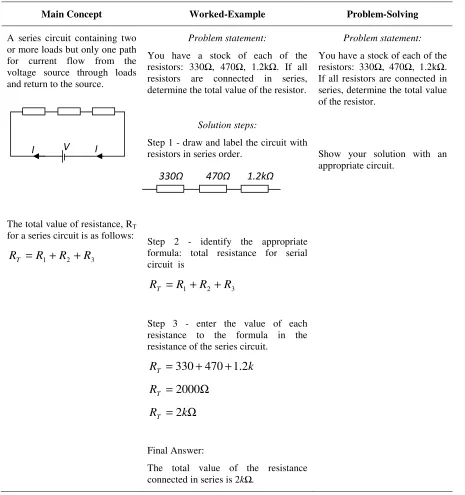
In the first session of the experimental group (EPBL), students were divided into heterogeneous groups consisting of four to five members each. A leader was then appointed and rotated among the members for each session. The participants worked in a group for about two hours for each session. During the eight weeks of the treatment, all groups received their eight worked-examples and eight problem-solving exercises in the form of written papers. Each cycle of the EPBL process involves three stages:
(a) Students are given brief/short lectures or main concept to provide basic knowledge of the principles of each topic.
(b) Then, to understand how to apply the principles to the domain, students receive a complete worked-example with solution steps and final answer.
(c) Finally, students are given the problem-solving exercises designed to improve the speed and accuracy of problem solving.
Table 1: The EPBL process
Main Concept Worked-Example Problem-Solving
A series circuit containing two or more loads but only one path for current flow from the voltage source through loads and return to the source.
The total value of resistance, RT
for a series circuit is as follows:
3 2
1 R R
R
RT = + +
Problem statement:
You have a stock of each of the resistors: 330Ω, 470Ω, 1.2kΩ. If all resistors are connected in series, determine the total value of the resistor.
Solution steps:
Step 1 - draw and label the circuit with resistors in series order.
Step 2 - identify the appropriate formula: total resistance for serial circuit is
3 2
1 R R
R
RT = + +
Step 3 - enter the value of each resistance to the formula in the resistance of the series circuit.
k RT =330+470+1.2
Ω =2000 T R Ω = k
RT 2
Final Answer:
The total value of the resistance connected in series is 2kΩ.
Problem statement:
You have a stock of each of the resistors: 330Ω, 470Ω, 1.2kΩ. If all resistors are connected in series, determine the total value of the resistor.
Show your solution with an appropriate circuit.
The procedures for the control group (TL) were retained according to the existing setting. The chalk-and-talk method are dominant in explaining rules, definitions and solving problems (Abdulah, Tarmizi, & Abu, 2010). Lectures were conducted for two hours in the classroom each week. As usual, the lecturer delivered information and facts, explaining
330Ω 470Ω
1.2kΩ
terms, symbols, concepts and procedures. Students acted as passive learners. The instructions were given for eight weeks, in parallel with the time frame of the experimental group.
2.4 Learning Transfer Test
The pencil-and-paper learning-transfer test consisted of ten open questions on electrical circuit theory, five questions for each near-transfer and far-transfer test, which had to be completed in fifty minutes. An example of a learning-transfer item is described in Table 2:
Table 2: Near-transfer and far-transfer task
Learning Task Near-Transfer Task Far-Transfer Task
You have a stock of resistors, one each of 220Ω, 330Ω, and 560Ω. Find the total resistance RT if all resistors are
serial-connected.
You have a stock of resistors, one each of 120Ω, 120Ω, and 180Ω. Find the total resistance RT if all resistors are
serial-connected.
A technician has a stock of the following colour-coded resistors: four 68Ω, five 82Ω, two 120Ω, three 180Ω, two 330Ω, and one each of 470Ω, 560Ω, 680Ω, and 820Ω. A circuit being designed needs a 37Ω resistance. Find the combination of resistors, using the least possible number of components that will satisfy the design requirement.
For a correct solution, five points were awarded. Partial marks were given for a partially correct solution (near: between 0 and 3 points; far: between 0 and 5 points). We obtained sufficient reliability (Cronbach’s Alpha) for the transfer scales: 0.74. According to (Ary, Jacobs, & Sorensen, 2010) test coefficients in the range of 0.5 to 0.6 are considered modestly reliability, which is acceptable for the purpose of research.
3 RESULTS
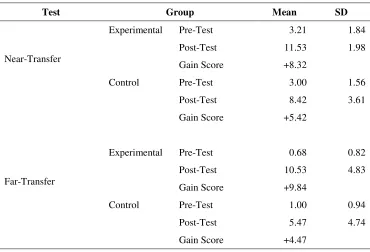
Table 3: Mean and standard deviation of near- and far-transfer
Test Group Mean SD
Near-Transfer
Experimental Pre-Test 3.21 1.84
Post-Test 11.53 1.98
Gain Score +8.32
Control Pre-Test 3.00 1.56
Post-Test 8.42 3.61
Gain Score +5.42
Far-Transfer
Experimental Pre-Test 0.68 0.82
Post-Test 10.53 4.83
Gain Score +9.84
Control Pre-Test 1.00 0.94
Post-Test 5.47 4.74
Gain Score +4.47
Table 4: MANCOVA for near- and far-transfer score
Source Dependent Variables
Type III Sum of Squares
df Mean square F
p Value
Corrected Near_posttest 141.665a 3 47.222 6.289 .002
Model Far_posttest 480.290b 3 160.097 9.262 .000
Groups Near_posttest 104.723 1 104.723 13.946 .001
Far_posttest 281.372 1 281.372 16.278 .000
Error Near_posttest 255.309 34 7.509
Far_posttest 587.710 34 17.286
a. R Squared = .111 (Adjusted R Squared = .039) b. R Squared = .227 (Adjusted R Squared = .164)
respectively. The near-transfer test was statistically significant, [F (1, 38) = 13.95, p < 0.05). There was a statistically significant difference in mean score of the near-transfer test between EPBL and TL group (Cohen’s d = 1.07; Effect size r = 0.47). In term of far-transfer, the participants in the EPBL group showed better results in the post-test than participants in the TL group, with 10.53 (SD = 4.83) and 5.47 (SD = 4.74) respectively. The far-transfer test was statistically significant, [F (1, 38) = 16.28, p < 0.05). There was a statistically significant difference in mean score of the far-transfer test between EPBL and TL group (Cohen’s d = 1.06; Effect size r = 0.47).
4 CONCLUSION
This study aimed to compare the effects of the EPBL and TL approach on learning transfer performance, specifically among vocational students in the domain of Circuit Theory, in terms of near-transfer and far-transfer. The results of this study reaffirmed previous studies, where the use of a combination of worked-examples and problem-solving proves to be an effective instructional approach that results in better near-transfer and far-transfer performance by improving the students’ understanding. Participants in the EPBL group are able to apply parts of the relevant procedures to the new problem. They also have a deeper understanding of the rationale behind the solution steps; they not only know the procedural steps to complete the task, but they also understand when to use the different steps and how they work. Due to the positive effects of the worked example on transfer test tasks, participants showed better performance.
REFERENCES
Abdulah, N. I., Tarmizi, R. A., & Abu, R. (2010). The effects of problem based learning on mathematics performance and affective attributes in learning statistics at form four secondary level. Procedia Social and Behavioral Sciences, 8, 370–376. doi:10.1016/j.sbspro.2010.12.052
Albany. (2006). A practitioner guide to transfer of learning and training. Intergovernmental Studies Program Primer, Rockefeller College of Public Affairs & Policy, University at Albany. Retrieved January 22, 2013, from http://www.albany.edu/polis/pdf/transfer learning_primer_final.pdf
Ary, D., Jacobs, L. C., & Sorensen, C. (2010). Introduction to research in education. 8th Edition. Wadswoth, USA: Cencage Learning. Pp. 249.
Atkinson, R. K., & Renkl, A. (2007). Interactive example-based learning environments: Using interactive elements to encourage effective processing of worked examples. Educational Psychology Review, 19(3), 375–386.
Barnard, J. K. (2005). The effects of a near versus far transfer of training approach on trainees’ confidence to coach related and unrelated tasks. The Ohio State.
Darabi, A. A., Sikorski, E. G., Nelson, D. W., & Palanki, S. (2006). Efficient, motivational, and effective strategies for complex learning: Computer-based simulation. Tech. Inst. Cognition and Learning, 3, 233– 247.
Kalyuga, S., Chandler, P., Tuovinen, J. E., & Sweller, J. (2001). When problem solving is superior to studying worked examples. Journal of Educational Psychology, 93(3), 579–588.
Kirschner, P. A., Sweller, J., & Clark, R. E. (2006). Why minimal guidance during instruction does not work: An analysis of the failure of constructivist, discovery, problem-based, experiential, and inquiry-based teaching. Educational Psychologist, 41(2), 75–86.
Leberman, S., McDonald, L., & Doyle, S. (2006). The transfer of learning: Participants’ perspectives of adult education and training. Gower. Gower Publishing Limited. Retrieved from https://www.ashgate.com/pdf/SamplePages/Transfer_of_Learning_Intro.pdf
Moreno, R., Reisslein, M., & Ozogul, G. (2009). Optimizing worked-example instruction in electrical engineering: The role of fading and feedback during problem-solving practice. Journal of Engineering Education, (January), 83–92.
Paas, F., Renkl, A., & Sweller, J. (2003). Cognitive load theory and instructional design: Recent developments. Educational Psychologist, 38(1), 1–4.
Paas, F., & Van Merriënboer, J. J. . (1994). Variability of worked examples and transfer of geometrical problem-solving skills: A cognitive-load approach. Educational Psychology, 86(1), 122–133.
Renkl, A., & Atkinson, R. K. (2003). Structuring the transition from example study to problem solving in cognitive skill acquisition: A cognitive load respective. Educational Psychologist, 38(1), 15–22.
Stark, R. (2004). Implementing example-based learning and teaching in the context of vocational school education in business administration. Learning Environments Research, 7(December 2003), 143–163.
Sweller, J. (1988). Cognitive load during problem solving: Effects on learning. Cognitive Science, 12(2), 257– 285.
Tarmizi, R. A., & Bayat, S. (2012). Collaborative problem-based learning in mathematics: A cognitive load perspective. Procedia Social and Behavioral Sciences, 32(2011), 344–350.
Van Gog, T., Kester, L., & Paas, F. (2011). Effects of worked examples, example-problem, and problem-example pairs on novices’ learning. Contemporary Educational Psychology, 36(3), 212–218.
Van Gog, T., Paas, F., & Van Merriënboer, J. J. G. (2004). Process-oriented worked examples: Improving transfer performance through enhanced understanding. Instructional Science, (32), 83–98.
Van Gog, T., Paas, F., & Van Merriënboer, J. J. G. (2006). Effects of process-oriented worked examples on troubleshooting transfer performance. Learning and Instruction, 16, 154–164.
Wittwer, J., & Renkl, A. (2010). How effective are instructional explanations in example-based learning? A meta-analytic review. Educational Psychology Review, 22(4), 393–409.