Licensed under Creative Common Page 1
http://ijecm.co.uk/
ISSN 2348 0386
INFLUENCE OF THE DEVELOPMENT OF CORE COMPETENCY
ON INCREASE IN THE PERFORMANCE OF ISLAMIC
FINANCIAL INSTITUTIONS
Muslim A Djalil
Faculty Economic Syiah Kuala Darussalam University Banda Aceh, Indonesia
& Doctoral Students of Management Department, Faculty of Economics and Business,
Padjadjaran University, Bandung, Indonesia [email protected]
Ernie Tisnawati Sule
Dept of Management, Faculty of Economics and Management,
University of Padjadjaran, Bandung, Indonesia
Raja Masbar
Dept of Economics, Faculty of Economics, University of Syiah Kuala, Banda Aceh, Indonesia
Abstract
The purpose of this study was to find solutions for problems related to the performance of
islamic financial institutions when connected with development of core competency. This study
was theoretical review, especially about the effect of development of core competency on
performance of islamic financial institutions. The study looked for proposing a causal
relationship between the variables that are expected to answer the problems associated with
suboptimal especially in the Islamic Financial Institutions in optimizing core competencies. Core
competency for Islamic Financial Institutions do not have elements that can ensure the core
competencies possessed could sustainable in a long time. the core competency of the company
differentiates competitive and reflect the personality and core competency arise in a long time in
an organization through the process of accumulation and learning in the use of resources and
capabilities. The results showed that development of core competency have a significant effect
on performance of islamic financial institutions. Also, that development of core competency has
implication for performance of Islamic financial institutions.
Licensed under Creative Common Page 2 INTRODUCTION
Globally, although the banking and financial services industry based on sharia is the financial
services industry is still relatively nascent, with an annual growth rate on average by 15-20% in
the last five years, but the Islamic banking and finance market segments classified fastest thrive
in the global financial services industry sector, has penetrated even to more than 35 countries
by the number of Islamic banks over 100 banks and asset value already exceeds $ 1 trillion
(El-Galfy and khiyar, 2012; Ariff and Rosly: 2011). Not much different from the global trend, the
development of Islamic banking and finance institutions Indonesia which is the largest country in
the world population of the Islam also showed significant growth in the past two decades.
Although the market share of Islamic banking is still very small compared with the market share
of conventional banks, but throughout 2010 Indonesian Islamic banking is growing at a very
high volume of business in the amount of 43.99% (yoy) increase compared to the same period
of the previous year amounting to 26.55% (yoy ).
Low performance of Islamic Financial Institutions in Aceh is the high price of financing
products to be paid by the customer with an average of 8% / year, compared to the price paid
by the customer conventional bank financing products to skim recorded only by an average of
6% per year old. The high cost of financing the sale price is thought to be caused by other than
the high cost of funds, as well as influenced by the level of business efficiency is still low. In
other words, the business activities carried out by the Islamic Financial Institutions is still
running at a high cost. Another problem is related to product differentiation. There is no clear
distinction between the features of banking products issued by the Islamic Financial Institutions
with banking products issued by conventional financial institutions, particularly between the
products offered in the premium market segment with the offered segments being subordinated
So that the customer is still difficult to accept the product This sharia, because basically seen
and felt by them, almost no different from conventional banking products.
Such conditions can be understood as the application of differentiation focus strategy,
which is the application of a generic strategy to gain a competitive advantage by offering a
unique product attributes to the selected target segments are done consistently and
continuously on Islamic Financial Institutions (Thompson et al. 2014: 208). Another cause which
also makes the performance of Islamic financial institutions in Aceh still not optimal is weak
cooperative strategy in achieving competitive advantage. Islamic banking Aceh was not able to
take advantage of opportunities to cooperate in the collection of funds with various
stakeholders, among others, with the client organization as Bayt Islamic philantrophik malls and
other organizations that have a lot of idle funds, local governments, and also with a nice fellow
Licensed under Creative Common Page 3 Actually, through the application of cooperative strategies or strategic partnership, Islamic
financial institutions will acquire the association funds with relatively low prices. By cheapening
the cost of funds, then the cost of production services Islamic financial institutions actually be
cheaper. So the value creation that is created will be greater than the value offered by
conventional banks. Through the application of cooperative strategies in the form of joint
ventures or strategic alliances with how the collective resources and capabilities will allow the
company to enter the market are limited, moving from a competitive advantage to other
competing forte, and also gain a dominant market force (Ireland, Hoskisson and Hitt . 2011:
245; Wheelen et al. 2015: 208). Islamic banking inability to gain a sustainable competitive
advantage as well as the implementation of cooperative strategies amid intense competition
intensity, showing Islamic Banking Core Competency yet have adequate is a core skill in
carrying out the activities of the company which is the center of a strategic competitive
advantage and superior achievement of business performance. According to Thompson et. al
(2014), Core Competency which lies in the intellectual-based, ie the human resources and
intellectual capital of the company rather than the amount of assets in the balance sheet.
Thompson et. al also added that the Core Competency will be the basis of competitive
advantage if the resources and capabilities that are distinctive competence in resources or the
unique ability to perform an activity company that exceeds what the competitors.
Core competency for Islamic Financial Institutions do not have elements that can ensure
the core competencies possessed could sustainable in a long time. These elements include
Valuability means worth, Rarity means not owned by many competitors, In-Imitability rtinya
difficult and costly to imitate and non-substitutability means that it is difficult to find a
replacement (West & Bamford, 2010: 167). Besides that also need attention is variable
Industrial Environment. Islamic Banking is less responsive, less adaptive and less flexible to
changes in the industrial environment as factors change Equivalent Rate PYD Bank Indonesia
made several financing schemes through Islamic Banking becomes relatively more expensive
than conventional banking products. This raises the propensity of customers to move to another
bank that has a higher competitiveness. In adapting to the intensity of industrial environmental
changes, in principle, there are five forces that can determine the level of competition in the
banking industry, including service industries, namely the threat of entry of new industry, threat
of substitute products, bargaining power of suppliers, bargaining power of customers, and the
intensity of competition manuvering company which has existed (Thompson et. al, 2014; Pearce
& Robinson, 2012; Wheleen et. al. 2015; David: 2009). Based on the above issues and
phenomena, researchers interested in conducting in-depth empirical studies on the extent of the
Licensed under Creative Common Page 4 Cooperative Strategy and Performance Implications of Islamic Financial Institutions in Aceh
province. From the results of this study are expected to appear various alternative solutions to
improve the performance of Islamic Financial Institutions in Aceh Province and National by
using variables Core Competency solutions, Industrial Environment, Competitive Strategy and
Strategic Cooperative.
REVIEW OF LITERATURE
Core Competency
Although a lot of disagreement about the terminology and definitions core competency among
experts strategic management, but they have relatively the same opinion that the core
competency is part of the resource and capability company which is a derivation of the
approach Resource Based View (RBV) of the firm. In principle, the approach of Resource
Based View (RBV) argues that the internal factors which consists of resources and capability
including core competency is more important than the external factors which covers general
environmental and industrial environments in creating a competitive advantage and improve
company performance (Pearce II and Robinson, 2013; Dess et. al, 2012; Ireland, Hoskisson
and Hitt, 2011; West III and Bamford, 2010; Barney and Hesterly, 2012; Wheelen et. al, 2015).
In a business environment that is constantly changing and volatile, almost no company can
maintain core competency forever and at the same time maintaining competitive advantage in a
sustainable manner, as many competing companies around will imitate and create replacement
products goods and services of the resulting company with goods and the same kind of services
even cheaper and quality equal to or even better than that of the company. To that end, the
company needs to have the resources and capabilities that have outstanding or unique
characteristic that distinguishes it from the company's competitors or often referred to as core
competency.
Discusses terminology and definitions core competency can not be separated from the
name Hamel and Prahalad (1990, 1994) as a management expert who initiated and popularized
the jargon of "core competency" as a source of competitive advantage and performance
improvements. Hamel and Prahalad In essence (1990, 1994), which is often mentioned as a
core competency capability something that "excellence" or "world class", suggested that
perusahahaan can gain a competitive advantage on an ongoing basis, management should
focus on long term basis in the identification, development, and utilization of core competencies
within the organization.
Hamel and Prahalad (1990), defines "core competency" as a collective learning in the
Licensed under Creative Common Page 5 of current technology. But after a decade later Hamel and Prahalad (1994) to revise and update
the definition of "core competency", ie as part of a competency which is the result of a union of
expertise and specific production techniques that are unique to provide a value to the customer.
Competence enables organizations to gain access to a wide range of markets that are
accumulated learning between individual units and organizational units of the company.
Hamel and Prahalad Further (1994) suggest three test tool for a company that can identify its
core competency: Test equipment 1: Customer Value. Are the resources and capabilities to
provide value to customers ?. The greater the contribution made by the core competencies to
create value to pelannggan, the greater the competitive advantage provided by the core
competency Test Tool 2: Competitive Uniqueness. Core competency should really unique
compared to competitors and it is difficult for competitors to imitate. Test equipment 3:
extendibility. A core competency should be able to improve and expand access to various new
applications and other new markets. White (2004) succinctly defines a "core competency as a
strategic capability" White (2004) also revealed that there are five determinant in deciding
whether a resource and capability into a core competency and thinks the more complete the
company has five determinant or characteristic combination of core competency is the longer
survival of competitive advantage will be achieved. Fifth determinant or indicator or
characteristic core competency can be described as follows:
1. Superiority. Are capabilities possessed actually better than that of the competitors ?,
Value to the customer if it's really growing, or fundamentally different? What is more valuable
than any other resource ?. The indicators: level of differentiation
2. Inimitability (difficult to be imitated). Is hard copy capability or duplicated ?. The indicators:
uniqueness, dependence direction (path independence), and causal ambiguity
3. Durability. How quickly a certain capability shrink or survive. The indicators: level of
sustainability
4. The report uses (appropriateness or suitability). Who will claim propriety of a capability?
Comparative vs. whether the capabilities possessed the habit of producing goods and services
that are good ?. The indicators: competitive advantage
5. Substitutability (analogs). What are the effects and products produced from a capability
available replacement product. The indicators: source alternative effect.
Thompson et. al. (2015: 90) also revealed to be a core competency and a source of
competitive advantage and become the main strategy, capability of the company must pass four
tests competitive value. This test is also called the Vrin test for sustainable competitive
advantage (Valuable, Rare, Inimitable, and Non-substitutable), in which the second test first to
Licensed under Creative Common Page 6 second test last determine whether a competitive advantage can be sustained in the face of
competition:
1. Is the resource (or capability) competitively Valuable? (What resources or capabilities of the
company actually has a competitive value than competitors?)
2. Is the resource Rare --- is it something rivals lack? ((Is the company's resources really are
rarely --- which is not owned by a competitor?)
3. Is the resource hard to copy (inimitable)? (What resources owned companies actually more
difficult and more expensive to emulate ?). Because of the more difficult and costly to imitate,
the more likely the resources and capabilities have a competitive value.
4. Is the resource invulnerable to the threat of substitution from different types or resources and
capabilities (Non-substitutability)? (Are the resources of the company strong in the face of the
threat of substitute products from various resources and capabilities of competitor)
Besides the base associated with the strategy and competitive advantage, core
competency was also a set of competencies that occur across borders division, and are
dispersed in an organization, and something that is done by the company are very good
(Wheelen et. Al. 2015: 162) , Furthermore, West and Bamford (2010), calling terminology core
competency with extraordinary resources (resource outstanding) and defines it as "the
resources or capabilities that are believed to management companies simultaneously shaped
rare, durable, relatively not can be replaced (are relatively non-substitutable), can not be traded
(non-tradable), and worth the (valuable). "Further West and Bamford (2010) also mentions that
there are five main dimensions of a tremendous resource (extraordinary resources) or core
competency, which commonly known by the acronym VRIST Framework as follows:
1. Valuable-Resources or extraordinary capability that has the ability to create value to
customers
2. Resource Rare-- or extraordinary capabilities relatively unique compared owned competitors
3. Resource Imitation-- or extraordinary capability that is difficult to imitate competitors
4. Substitution - Resources or the extraordinary capabilities of the company in which the
competitors do not have equivalensi stratejis
5. Tradetable - Resources or extraordinary capabilities that are difficult to be transferred to
the competitors
So by linking the Resource Based View of the firm (RBV) with the resources and
capabilities, Barney and Hesterly (2012: 86-88), suggests that there are four questions that
must be answered to determine whether a resource or capability to have a competitive value or
not (core competencies). These questions are by Barney and Hesterly mentioned as VRIO
Licensed under Creative Common Page 7 1. The question of Value: "Is their resources allow companies to exploit opportunities and
neutralize threats ?. If the answer is "yes", then the resource is valuable and once regarded as
something "strength"; otherwise if the answer is "no", then the resource is considered worthless
and at the same analogy as "weakness"
2. The question of Rarity: What specific resources and capabilities that exist now only controlled
by a small sebahagian company?
3. The question of Imitability: Are the competitors who do not have the same resources as the
company suffered a loss if it has a similar resource and develop?
4. The question of Organization: Are policies and procedures have been deployed well to exploit
valuable resource (Value), rarely (Rarity), can not be imitated (Imitability), and expensive to be
replaced (costly-to imitate)?
Then, in the sense that not much different from that by linking the core competency as
something that excellence and the achievement of the overall mission disclosed by Pearce II
and Robinson (2013: 164), which defines, "Core Competency as a capability or expertise that a
company had the ability to carry it out while achieving the company's overall mission.
Furthermore, Pearce II and Robinson (2013: 165-167) adds that the core competence that can
differentiate a company with a rival company called distinctive competence. According to him,
the resources and capabilities of the company consists of tangible assets, intangible assets, and
the capability of the organization. Not all of the resources and capabilities of the company is a
core competency and not all core competency has a value (valuable) and a source of
sustainable competitive advantage.
In this regard, Pearce II and Robinson (2013: 166-169) also describe an RBV guidelines
or instructions or a core competency indicators that can provide a value (valuable) and can be a
source of sustainable competitive advantage as follows:
a. Is critical, meaning that resources and capabilities are critical or important component in the
ability to meet customer needs better than a competitor.
b. Resources and capabilities are Scarce (uncommon or rare), the resources and skills are
scarce due to the unavailability of either stock or easily replaced or difficult to imitate.
c. Resources and capabilities to act as a trigger (drive) in the formation of a major portion of the
profit.
c. The resources and capabilities of its last long (durable.
Understanding core competency brief but meaningful substantially expressed by Ireland,
Hoskisson, and Hitt (2011: 74-77), namely "core competencies are capabilities that provide a
source of competitive advantage for the company against its competitors.". They argued that the
Licensed under Creative Common Page 8 competency arise in a long time in an organization through the process of accumulation and
learning in the use of resources and capabilities. When the capacity is already well underway,
will become a core competency for the uniqueness of a company, which is reflected in a series
of activities of the company is much better than the competitors and through which the company
adds unique value to the products and services produced in the long run.
Ireland, Hoskisson, and Hitt (2011: 74-77) also suggest the use of four criteria or test
equipment or indicators that resources and capabilities can serve as a core competency and a
source of competitive advantage of the company as follows:
1). Valuable (Worth). Capability is said to be worth, if a company is able to exploit opportunities
and neutralize threats from the external environment in utilize the resources and capabilities to
create value to the customer.
2) Rare. Rarely capability (rare capabilities) is a capability which only a small part or entirely
owned by the competitors. The question is how stout the company competitors who also have a
valuable capacity similar to that of the Vendor?
3). Costly to imitate (expensive / difficult to replicate). Capacity is difficult or expensive to
replicate (Costly-to-imitate capabilities) is a capability that is rather expensive or difficult was
developed by other companies. Expensiveness or difficult to emulate is caused by one or a
combination of the three factors below: a). Unique historical conditions; The historical
uniqueness is usually derived from the value of an organization's culture and brand names are
dimiki companies .; b). Social ambiguity. Difficulties or costliness to emulate because of social
ambiguity occurs when the relationship between the unique capabilities of the company with a
competitive advantage that is achieved is vague or could not be explained clearly, so that the
competitors are not able to understand clearly how companies leverage their capabilities dlm
gain a competitive advantage the end of the competitors are not sure about what capabilities
should be developed to mimic the benefits of value creation strategy that created the company
(value-creating strategy); c). Social complexity. Social complexity which makes a capability
difficult or costly to imitate happens because basically these capabilities is the accumulated
result of complex social phenomena arising from interpersonal relationships, trust,
persahahabatan between managers, between managers and employees, as well as the
company's reputation in the eyes suppliers and customers which are not easy to replicate.
4). Non-substitutable (can not be replaced). Capabilities that can not be replaced
(Non-substitutable capabilities) is the capability of the company in which the company does not have
strategic competitors. In general, the value stratejis a capability will increase if the capability is
difficult to find a replacement. Capabilities that are hard to find his bride among others certain
Licensed under Creative Common Page 9 and employee non-managers the basis of trust, and others. In essence briefly can be affirmed
that the value stratejis a capability would be able to create a source of sustainable competitive
advantage of the company and produce superior business performance if the company has the
capability of four criteria, namely Valuable (worth), Rare (charcoal), Costly to imitate (expensive
/ difficult to imitate), and Non-substitutable (not replaceable).
Furthermore, Ireland, Hoskisson, and Hitt (2011: 74-77) formulate some criteria
combination of resources and capabilities if it is associated with a competitive advantage and
performance of the company include: 1) The condition in which the company only has the
resources and capabilities of a standard course, which is not worth, easily available,
inexpensive and easily replicable, and available substitute products. In these conditions the
economic value created by firms is lower than that produced by the competitors so that
companies do not gain a competitive advantage and its performance is below average; 2) The
conditions under which the economic value created by the same company that produced the
competitors so that companies do not gain a competitive advantage the company has the
resources and capabilities of value, but does not have the characteristic of rare, expensive and
difficult to imitate, and not available products replacement. In this condition the only company in
a position between or referred to competitive parity and performance achieved only average; 3).
Condition in which the company has the resources and capabilities of value and rare, but does
not have the characteristic expensive / difficult to imitate (Costly to imitate) and can not be
replaced (Non-substitutable). In this condition, although the resources and capabilities valuable
and rare, but because it can easily be copied competitors and substitute products are also
available in various places, so the competitive advantage gained only temporary and
unsustainable (temporary advantage) and the performance obtained ranged from average to
above average; 4). The most ideal conditions, where the company has the resources and
capabilities that include a fourth characteristic that is worth (Value), rare, expensive / difficult to
imitate (Costly to imitate) and can not be replaced (Non-substitutable). Under ideal conditions
the fourth time like this to have the attributes of the resource, the company will be able to gain a
sustainable competitive advantage and achieve above-average performance.
In this study, the dimensions of the Core competency appropriate based on the consideration of
existing concepts and condition of the object of research on Islamic Financial Institutions in the
Province of Aceh can be grouped as follows:
1. Resource and Capability of value (Valuable),
2. Resources and Capabilities are rare,
3. Resources and valuable capability expensive / difficult to imitate (Costly-to imitate),
Licensed under Creative Common Page 10 Performance
Jones (2004) says that companies must constantly change or develop a way to use existing
resources and capabilities to enhance the ability to create value and to develop its
effectiveness. The amendment is intended to find improved performance. Performance is meant
here is not the performance in the narrow sense that only limited to financial gain.
Indeed, the advantage of course have to be hunted, because without profit companies
will not be able to survive, but the goal of the company from a management perspective startejik
is intended to obtain and maintain a sustainable competitive advantage and achieve superior
performance. At first it only financial criteria used to assess whether or not the superior
performance of a company.
Performance serves as an instrument to determine whether the company has the ability
to sustain life (going concern), as well as a basis for formulating operational planning company
in the future and for the information of shareholders, stakeholders, customers, regarding the
achievements and success of the company. There are many approaches, in defining the
performance, according to Mulyadi (2007: 337): "Performance is the success of personnel,
team, or organizational unit in achieving the strategic objectives that have been set previously
with the expected behavior".
Mulyadi, also explained that the successful achievement of strategic objectives needs to
be measured. That is why the strategic objectives that form the basis of performance
measurement is necessary to determine its size, and determined initiative only possible
because of the efforts of the actors that exist in the organization. Prawirosentono (2000),
defines performance as: "The work that is accomplished by a person or group in an organization
within a certain time, in accordance with the authority and responsibilities of each, in an effort to
achieve the goals of the organization in question legally, do not violate the law and in
accordance with moral and ethical."
In the related literature, there are two approaches to measuring the company's
performance advantage (Supratikno et.al, 2005). The first approach stated that the superior
performance of the company called if it has performed above average (above average
performance) is viewed from a variety of dimensions, such as market share, etc. The second
approach assesses corporate excellence implied from the age of the company (corporate
longevity). Companies that age who can survive long in a long time regarded as a superior
corporate performance.
The development of further stated that the overall performance can be measured by five
indicators / perspectives, namely through a financial perspective, customer perspective, internal
Licensed under Creative Common Page 11 measurement mentioned above are often referred to as the concept of Balanced Scorecard
(BSC) developed by Kaplan and Norton (Pearce II and Robinson 2012).
Performance Measurement With the Balanced Scorecard (BSC)
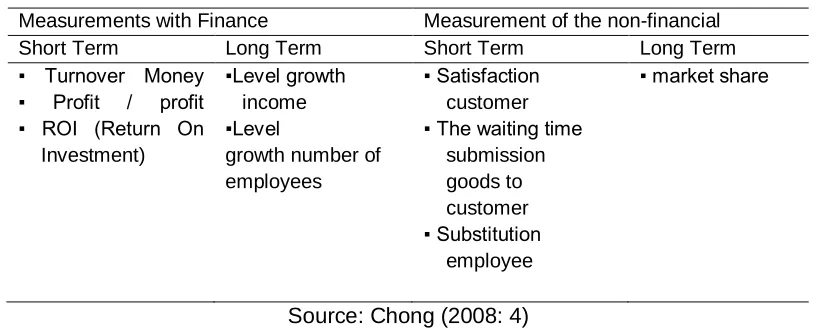
However, according to Chong (2008), a relatively precise measurement of performance is by
using a hybrid approach, ie by combining a combination of financial and non-financial
measurements. In detail the dimensions of each measurement financially and non-financially
can be seen in Table 1 below.
Table 1 Performance Indicators with Hybrid Approach
Measurements with Finance Measurement of the non-financial Short Term Long Term Short Term Long Term ▪ Turnover Money
▪ Profit / profit ▪ ROI (Return On Investment)
▪Level growth income ▪Level
growth number of employees
▪ Satisfaction customer ▪ The waiting time submission goods to customer ▪ Substitution employee
▪ market share
Source: Chong (2008: 4)
This approach is also in accordance with the opinion Ledwith (2008: 100), in which to measure
the performance of the banking and financial approach to the market performance indicator is
the sales growth, profitability, market share, sales and ROI. In general, show some similarities in
the formulation of the principle of the meaning of a performance include:
1. Performance is the final output of a work process
2. Performance measurement is one barometer of the success of the implementation of the
strategy. (One of the winning test of strategy)
3. To describe the results of the process of a company in achieving its mission and objectives
comprehensively need financial performance measurement and non-financial.
Based on the literature study, the dimensions of performance relevant to this study, the
concept mangacu Gin Chong (2008). The researchers only use three-dimensional performance
measurement on Islamic Financial Institutions, namely:
1. Income growth
2. Market Share
Licensed under Creative Common Page 12 THEORETICAL FRAMEWORK
Core competency course if properly managed will create a sustainable competitive advantage
and in turn will generate above average business performance. Core competency as a source
of competitive advantage and also affect the performance has been expressed by teachers core
competency few decades ago, namely by Prahalad (1990) of the results of the survey to some
global organization at the time such as Xerox, Kodax, and others. Results of a survey
conducted by Prahalad suggests that "The findings revealed that there is a relationship between
competences and competitive advantage and, in turn, on performance".
In addition, the results of research conducted on 18 industrial companies in America conducted
by Hitt and Ireland (1985) to study the effect of core competency, or distinctive competence of
the performance, the results indicate a positive influence although its influence varies from one
industry to the industry other. The research results can be summarized as follows: "Results of
the research suggested that distinctive competencies associated with performance vary
According to the grand strategy used and the firm's principal industry. Specific distinctive
competencies were identified for call now strategy and industry type (Hitt and Ireland. 1985).
Research results show that the distinctive briefly advantage / core competency effect on
performance, but the effect varies based grand strategy used. Distinctive Competency / core
competency for each strategy and the type of industry has been identified.
Besides the above empirical research results, Ireland, Hoskisson, and Hitt (2011: 77)
also reinforce core competency influence on the performance of the mentioned "core
competencies are capabilities that serve as a source of competitive advantage for a firm over its
rivals.", Which meaning relatively similar to that expressed by Prahalad core competency is a
source of competitive advantage, which in turn with increasing competitive advantage certainly
improve the performance of the company.
Study the influence of the uniqueness of the resource and capabilites or better known as
the core competency of the performance of LKS is also done by Tan, Li, and Li (2006).
Empirical research by taking samples very much that some 12 047 SMEs in the industrial areas
of the People's Republic of China to the retrieval of data from 1991 to 1992 were collected from
the Bureau of Statistics of China. With pmengunakan method of factor analysis and multiple
regression research results reveal: "We found that most of the firm-specific resources and
capabilities Examined in this study have a positive impact on performance." Penelitaiannya
results found that most of the resources and specialized capabilities or core competencies
possessed a positive effect on the performance of SMEs in the industrial areas of the People's
Licensed under Creative Common Page 13 Although relatively similar research carried out in the Middle East to assess the effect on the
performance of the company's core competencies are also performed by Agha, Alrubaii, and
Jamhour (2012) to the paint industry in the United Arab Emirates by taking samples of 77
people managers from the industry that the survey conducted through distribution questionnaire
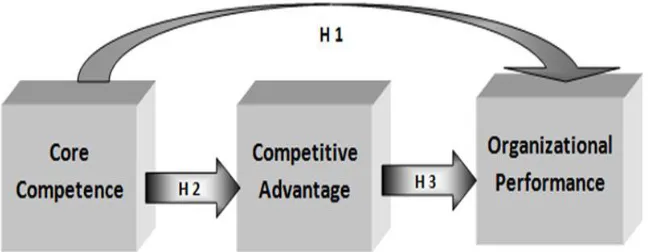
via the internet. The study aims to investigate the influence of core competency on competitive
advantage and its implications for performance. Framework built concept can be seen in the
figure below:
Figure 1 Effect of Core Competency for LKS Performance
Source: Agha, Alrubaii, and Jamhour (2012)
The finding of the extensive review indicates that, while the core competence has a strong and
positive impact on competitive advantage and organizational performance, competitive
advantage has also significant impact on organizational performance. It has also been found
that flexibility as one of the competitive advantage's dimensions have higher impact on
organizational performance than that of responsiveness.
In summary the results of this study indicate that while the core competency has a
strong and positive influence on organizational performance, competitive advantage also has a
significant influence on the performance of the organization. The results also showed that
flexibility is one of the dimensions of the competitive advantage of having a greater influence on
the performance compared with the dimensions of flexibility.
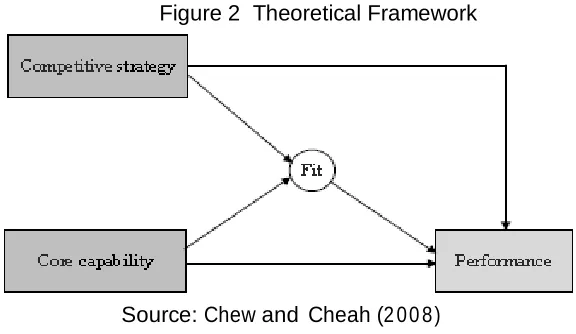
Besides, although the mention of the term core competency in core capability, the
results of research conducted by Chew, Yan, and Cheah (2011) for SME companies engaged in
construction in China also indicates the influence of core capability / core competency of the
Licensed under Creative Common Page 14 Figure 2 Theoretical Framework
Source: Chew and Cheah (2 00 8)
The findings of research indicated that “Core capability/core competency and competitive
strategy are found to influence construction SMEs’ performance. Moreover, there are positive
relationships between core capability/core competency and competitive strategy. This suggests
a need to align core capability/core competency and competitive strategy as a precondition for
superior performance.”
Specific research on the effects on the performance of LKS core competency is the
research conducted by Roziq (2012). Empirical research that examines the influence of
competence Account Officer (AO), Islamic business ethics, to asymmetri information, risk
financing and performance mudharaba mudharaba financing Islamic banking in East Java is
done by using a sample of 35 respondents from 19 branches BUS and UUS in East Java and
uses SEM-PLS as a tool pengelolahan data. Research results indicate confirmation of the
results of previous studies in which core competency positive and significant effect on
performance: “The study results showed that the competency of sharia account officer is
significant influence to risk of mudharaba financing and performance of mudharaba financing.
Islamic business ethics significantly affect on information asymmetry and does not significantly
affect to the performance of mudharaba financing. Information asymmetry has a significant
effect on the risk of mudharaba financing and the performance of mudharaba financing. Risk of
mudharaba financing is not significant influence on performance of mudharaba financing. The
study concluded that products of mudharaba financing at sharia banks in East Java have a lot of
obstacles making it difficult executed perfectly (kaffah).”
The above results indicate that the competence Accounts Officer significantly affect the
risk of financing and performance mudharaba mudharaba financing. Islamic business ethics
significantly affect the symmetry of information but does not significantly influence the
performance mudharaba financing. Symmetry information significant effect on financial risk and
Licensed under Creative Common Page 15 mudharaba on banking products sayariah in East Java has many constraints to be applied
based on Islamic principles thorough (Kaffah) "
Meanwhile studies evaluating the effect of core competency on competitive advantage
and ultimately affect the performance of the LKS is also done by Nimsith, National Conference,
and Shibly. 2014 in Sri Lanka. Research carried out by taking a sample of the 180 Islamic
banking and Islamic microfinance institutions in Sri Lanka concluded that: “The overall result
suggested that core competency had positively and significantly influence on the competitive
advantages and in turn led to an improving performance of Islamic financial institutions in Sri
Lanka.” Overall results conclude that the core competency has a positive and significant impact
on competitive advantage and ultimately Increase LKS performance in Sri Lanka.
CONCLUSIVE REMARKS
The development of core competencies effect the increase the performance of Islamic financial
institutions. The theories that already exist about management and organization make more
emphasized linkages, that the influence the development of core competencies to increase the
performance of Islamic financial institutions. The results of the theoretical evidence from this
study can be used to solve problems that occurs the development of core competencies and
the performance of Islamic financial institutions. The performance of Islamic financial institutions
can be improved through increases in the development of core competencies.
REFERENCES
Abdul-Majid, M., Saal, DS, & Battisti, G. 2011. The Impact of Islamic Banking on the Cost Efficiency and Productivity Change of Malaysian Commercial Banks. Applied Economics, 43 (16), 2033-2054.
Agha, Sabah, Alrubaiee, Laith, and Jamhour, Manar. 2012. Effect of Core Competence on Competitive Advantage and Organizational performance.International Journal of Business and Management Vol. 7, 1; January.
Antonio. Muhammad Syafie. 2001. Islamic Banking: from Theory to Practice. Jakarta: Gema Humanities.
Ariff, Mohamed, Saiful Azhar Rosly. 2011. Islamic Banking in Malaysia: unchartered Water.Asian Economic Policy Review. Japan Center for Economic Research 6, 301-319
Ascarya. 2006. Agreement and Islamic Bank Product: Concepts and Practices in Some Countries. Bank Indonesia
Bank Indonesia. 2008. The Grand Strategy of Market Development of Indonesian Islamic Banking, Islamic Banking Publications Directorate, Bank Indonesia. www.bi.go.id
Bank Indonesia. 2011. Outlook 2010. The Directorate of Islamic Banking Islamic Banking. www.bi.go.id.
Licensed under Creative Common Page 16 Bank Indonesia. 2012. Study of Islamic Banking Business Model. Directorate of Islamic Banking. Bank Indonesea. www.bi.go.id
Bank Indonesia. 2011. Regional Economic Analysis Aceh Province fourth quarter of 2010. Bank Indonesia. Banda Aceh. www.bi.go.id
Bank Indonesia. 2012. Regional Economic Analysis Aceh Province, Third Quarter, 2012. Bank Indonesia. Banda Aceh. www.bi.go.id
Barney, Jay. B, and William. S Hesterly. 2012. Strategic Management and Competitive Advantage Concepts. Fourth Edition. USA: Pearson Prentice Hall.
Bolton, R.N. 1998. A Dynamic Model Of The Duration of The Consumer's Relationship With A Continuous Service Provider: The Role of Satisfaction. Marketing Science, 17 (1): 45-65.
Chew, David AS, Yan, Shigang, and Cheah, Charles YJ. 2008. Core Capability and Competitive Strategy for Construction SMEs in China. Chinese Management Studies Vol. 2 No. 3, 2008 pp. Emerald Group Publishing Limited.50-614X 203-214 DOI 10.1108 / 17506140810895898
Chi, Ting, Kilduff, PD., Peter, and Vidyaranya, Gargeya P ,. 2009. Alignment between Business Environment Characteristics, Competitive Priorities, Supply Chain Structures, and Firm Business Performance. International Journal of Productivity and Performance Management. Vol. 58 No. 7. pp. 645-669. Emerald Group Publishing. 1741-0401.DOI10.1108 / 17410400910989467
Contractor, FJ, and Lorange, P. 1988. Cooperative Strategy in International Business. MA: Lexington. Lexington Book
Cravens, David W., and Nigel F Piercy. 2009. Strategic Marketing, Ninth Edition. McGraw-Hill
David, Fred R. 2006. Strategic Management, 10 edition Publisher Salemba Four. Jakarta.
David, Fred R. 2011. Strategic Management: Concepts and Cases, Thirteenth. Edition. USA: Pearson Education.
Dess, Gregory G., at al. 2012. Strategic Management: Text and Cases. Sixth edition. USA: McGraw-Hill
Dyer, JH, and Singh, H. 1998. The Relational View: Cooperative Strategy and Source of Interorganizational Competitive Advantage, Academy of Management Review. Vol 23, pp.551-72
El-Galfy, Ahmed Abdalla khiyar khiyar. 2012. Islamic Banking and Economic Growth: A Review. Journal of Applied Business Research. Sept / Oct .; 2012; 28.5; ABI / INFORM Complete
ElTiby, Mohamed Amr. 2011. Islamic Banking: How to manage the Risk and Improve Profitability. John Wiley & Son Inc.
Ferdinand, Augusty. 2000. Marketing Management: A Strategic Approach, Research Paper Series, Master of Management Program Diponegoro University, Semarang.
Gulati, Ranjay, Nohria, Nitin, and Zaheer, Akbar. 2000. Strategic Networks. Strategic Management Journal. Strat. Mgmt J. 21. 203-215
Gupta, RK., 2013. Core Competency for Business Excellence. Advances in Management. Vol. 6 (10) October.
Licensed under Creative Common Page 17 Hamel, G. and Prahalad C..K. 1994. Competing For The Future, Harvard Business School Press, Boston, Mass.
Hamel, G. and C.K. Prahalad,. 1989. Strategic Intent. Harvard Business Review, pp. 63-7.
Hamel, G, Doz, Y., and C.K. Prahalad ,. 1989. Colloborate with your Competitors and Win. Harvard Business Review. Vol 67. pp133-9.
Hamsal, Muhammad, the Great, I. Gusti Ngurah. 2007. The Paradoxical Strategies and Firm Performance: The Case of Indonesian Banking Industry. The South East Asia Journal.Volume 1. No. 1
Harrison, Jeffrey S. 2003. Strategic Management of Resources and Relationships: Concept and Cases. John Wiley and Sons, Inc.
Hassan, Kabir M., Sanchez Benito M., and Safa, Faisal. 2013. Impact of Financial liberalization and Foreign Bank Entry on Islamic Banking Performance. International Journal of Islamic and Middle Eastern Finance and Management, Vol. 6 Iss 1 pp. 7 - 42. http://dx.doi.org/10.1108/17538391311310716
Lawrence, Supratikno, Anton Wachidin Widjadja, and Durianto senior official. 2006. Performance Management for Creating Competitive Advantage. Graha Science Publishers. Yogyakarta.
Hitt, Michael A., Ireland, Duane R. 1985. Corporate Distinctive Competence, Strategy, Industry and Performance. Strategic Management Journal. Volume 6 Issue 3 (July- SEP) were, 273-293
Hrebiniak, Lawrence G. 2005. Making Strategy Work: Leading Effective Execution and Change. USA: Wharton School Publishing.
Huang, Kuo-Feng. 2011. Technology Competencies in Competitive environment. Journal of Business Research 64 172-179. doi: 10.1016 / j.jbusres. 2010.02.003
Prahalad, C.K., and Gary Hamel. 1990. The Core Competence of the Corporation. Harvard Business Review 68, no. 3 (May / June 1990): 79-91.
Huang Kuo Feng. 2011. Technology Competencies in Competitive Environment Journal of Business Research .172-179. Emerald Group Publishing 0025-1747. OI 10.1108 / 00251740410550961
Huda, Nurul, Mustafa Edwin Nasution. 2009. Current Issues: Islamic Financial Institutions. Jakarta: Prenada Media Group.
Hubeis, Moses and Mukhamad Najib. 2008. Strategic Management in the Development of Organizational Competitiveness. Publisher PT. Elex Media Komputindo Gramedia Group. Jakarta.
Indonesia, Bank. 2008. Grand Strategy of Islamic banking market developments. July, Directorate of Islamic Banking.
Iqbal, Zamir, Abbas Mirakhor. 2007. An Introduction to Islamic Finance: Theory and Practice. Singapore: John Wiley & Sons.
Ireland, Duane R., Robert E. Hoskisson, and Michael A. Hitt. 2011. The Management of Strategy: Concepts and Cases. 9th. Edition. Canada: South-Western Cengage Learning
Khir, Kamal, Lokesh Gupta, and Bala Shanmugam. Longman, 2008. Islamic Banking: A Practical Perspective. Pearson Malaysia Sdn.Bhd.
Licensed under Creative Common Page 18 Kaplan, S. Robert; Norton, P. David. 2004. Strategy Maps: Converting Intangible Assets Into Tangible Outcomes. Harvard Business School Publishing Corporation, USA. Khir, Kamal Gupta, Lakesh, and Shanmugam, Bala. 2008. Islamic Banking: A Practical Perspective. Kuala Lumpur: Malaysia SDN Pearson. BHD
Kuncoro, Muhammad. 2006. Strategies: How to Achieve Competitive Advantage. Publisher, Jakarta
Joanna Ledgerwood. 2008. Microfinance Handbook: an Institutional and Financial Perspective. IBRD, World Bank.
Lewis, K, Mervyn, Latifa M. Algaoud. 2001. Islamic Banking: Principles, Practices, and Prospects. Jakarta: Porch.
Lily, Harjati. 2003. Not Enough Just Needed Customer Satisfaction Customer Value For Survival, Journal of Business Economics Vol. 10 1 March 2003, p 37-55. Lina, anatan and Lena Ellitan. 2009. Competitive Strategy. Publisher Alfabeta. Bandung.
Longenecker, Justin G, Moore, Carlos W, and Petty, J. William. 2003. Small Business Management an Entrepreneurial Emphasis. Thomson South-Western, United States of America.
Karim, Adiwarman. 2004. Bank Islam: Analysis Fiqh and Keuangan. Rajawali Press. Jakarta.
Ma, Hao. 2004. Toward Global Competitive Advantage: Creation, Competition, Cooperation, and Co-option, Journal of Management Decision, Vol.42 No.7, pp.907-924.
Markplus and Bank Indonesia. 2008. The Grand Strategy of Market Development of Indonesian Islamic Banking, Islamic Banking Publications Directorate, Bank Indonesia
Marcus, A. Alfred. 2005. Management Strategy: Achieving Sustained Competitive Advantage.USA: McGraw -Hill Company
Mithas, Sunil, Tafti, Ali, and Mitchell, Will. 2013. How a firm's competitive Environment and Digital Strategic Posture influences Digital Business. MIS Quarterly Vol. 37 No. 2, pp. 511-536 / June
Mooradian, Todd A., Kurt Matzler, Lawrence J. Ring. 2012. Strategic Marketing. International Edition. USA: Pearson
Morris, Michael H, Laugh, Akin, and Ozel, Alper. 2007. Coopetion as a Small Business Strategy: Implication for Performance. Journal of Small Business Strategy. Vol. 18, No. 1 Spring / Summer
Muhammad. 2005. Islamic Banking: Problems and Prospects of Development in Indonesia. Jakarta: Graha Science Publishers.
Mulyadi. 2009. Integrated Systems Performance Management Balanced Scorecard lBerbasis Persone. Publisher College of Management Sciences YKPN, Yogyakarta.
Nandakumar, MK, Ghobadian, Abby, O'Regan, Nicholas. 2010. Business Level Pearce II, John A, and Richard B Robinson. 2013. Strategic Management: Planning for Domestic and Global Competition, Thirteenth Edition. MC Graw Hill Company, Inc.
Prahalad, C.K., and Gary Hamel.1990. Ther Core Competence of the Corporation. Harvard Business Review 68, no. 3): 79-91. May / June.
Licensed under Creative Common Page 19 Ridwan, Engkos Achmad Kuncoro. 2008. How to Use and Interpret the Path Analysis (Path Analysis). New York: Alfabeta.
Ramaseshan, B., Caruna, A and Pang, L.S. 2002. The Effect of Market Orientation on New Product Performance: A Study Among Singaporean Firms, Journal of Product & Brand Management, vol.11 6 pp. 399-409.
Roziq, Ahmad. 2012. Accounts Officer Competency of Sharia, Islamic Business Ethics, Information asymmetry, Risk of Mudharaba Financing and Performance of Mudharaba Fiancing on Sharia Banking in East Java Conference Proceedings: Annual International Conference on Islamic Studies (AICIS XII). IAIN Sunan Ampel. Surabaya
Rufaidah, Popy. 2012. Strategic Management. Second Edition. Bandung: Penerbit Humaniora
Sari, Wahyu. 2003. Strategic Alliance Development: A Study on Competing Alliances Between Firms, Research School System, Organization and Management. Rijksuniversiteit Groningen, Groningen.
Shahid Yusuf. 2007. From Creativity to Innovation, Policy Research Working Paper. Development Reseach Group, World Bank, Washington, DC.
Sucherly. 2003. Role of Strategic Marketing Management in Positional Advantage Creation And Its Implication to Business Organizational Performance and Non-Business. Inauguration Speech Professor Position: ubuntu
Sucherly, 2010. The lecture material Strategic Marketing, Doctoral Program in Economics, Concentration in Business Management, University of Padjadjaran Bandung
Suharsimi Arikunto, 2002, Research Procedure A Practice Approach, London: Rineka.
Suwarsono, Muhammad. 2008. Strategic Management: Concepts and Cases. Publisher College of Management Sciences YKPN, Yogyakarta.
Tan, Justin, Li, Shaomin Li, Weian. 2006. Building Core Competencies in a Turbulent Environment: An Exploratory Study of Firm Resources and Capabilities in ChineseTransitional Economy. Managing Global Transitions 4 (3): 197-214
Tavitiyaman, Pimtong, Zhang, Qiu Hanqin, and Qu, Hailin. 2012. The Effect of Competitive Strategies and Organizational Structure on Hotel Performance. International Journal of Contemporary Hospitality Management. Vol. 24 No. 1. pp. 140-159. Emerald Group Publishing. 0959-6119. DOI 10.1108 / 0959
Thompson et. al. 2014. Crafting and Executing Strategy: The Quest for Competitive Advantage: Concepts and Cases, 19th. Edition. The McGraw Hill Company, USA.
Omar Hussein. 2010. Strategic Management Research Design: Easy Ways To examine issues of Strategic Management for Thesis, Thesis, and Business Practices. Jakarta: PT. RajaGrafindo Persada.
Vayanos, Peter and Wackerbeck, Philipp. 2009. Islamic Banking: How Do Islamic Banks Compete in an Increasingly Competitive Environment. Booz & Company. Germany
Walker, Gordon. 2009. Modern Competitive Strategy, Third Edition. McGraw Hill International.
Licensed under Creative Common Page 20 West III, Page G., Charles E., Bamford. 2010. Strategy: Sustainable Advantage and Performance. Canada: South-Western, Cengage Learning.
Wijaya, Toni. 2009. Analysis of Structural Equation Model Using Amos. Yogyakarta: Universitas Atma Jaya Yogyakarta.
Weiers, Ronald M. 1998. Introduction to Business Statistics. International Thompson Publishing Company.
Wheelen, Thomas L, and Hunger, David J., 2012. Strategic Management and Business Policy: toward Global Sustainability. 13rd. Edition. USA: Pearson.
Wheelen at.al. 2015. Strategic Management and Business Policy: Globalization, Innovation, and Sustainability. 14th. Edition. USA: Pearson.
White, Colin. 2004. Strategic Management. NY: Palgrave-Macmilan
Yamin, Sofyan, Heri Kurniawan. 2009. Structural Equation Modeling: Learning Easier Data Analysis Techniques questioner with lisrel-PLS. Jakarta: Salemba Infotek.