Thesis submitted for the degree of Doctorate of Philosophy, Department of Geography, University College London,
University of London
2000
All rights reserved
INFORMATION TO ALL USERS
The quality of this reproduction is dependent upon the quality of the copy submitted.
In the unlikely event that the author did not send a complete manuscript and there are missing pages, these will be noted. Also, if material had to be removed,
a note will indicate the deletion.
uest.
ProQuest U643804
Published by ProQuest LLC(2016). Copyright of the Dissertation is held by the Author.
All rights reserved.
This work is protected against unauthorized copying under Title 17, United States Code. Microform Edition © ProQuest LLC.
ProQuest LLC
789 East Eisenhower Parkway P.O. Box 1346
This research examines the employment characteristics of the Brunei workforce as a whole and in selected industries. It focuses on the segmentation processes that create differences in the employment characteristics between different groups of workers in Brunei.
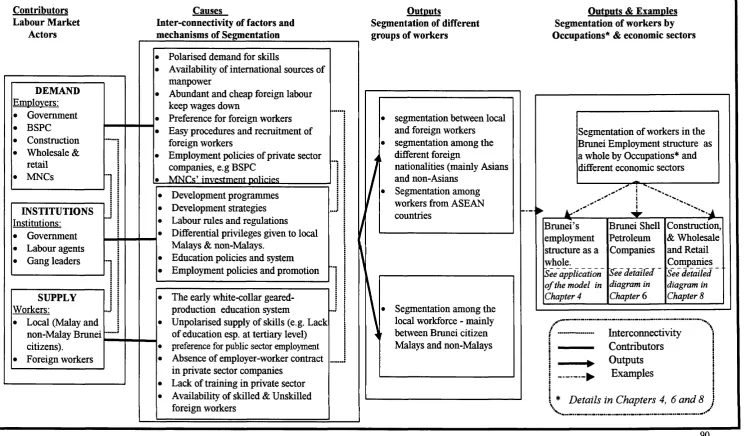
The underlying hypothesis is that the incompatibility between job demands and skills supplies in Brunei exacerbates domestic labour shortages, leading to heavy dependence on foreign workers. Consequently, the employment structure has become segmented by types of occupation and economic sectors between different groups of workers. These differences are consequent upon the segmentation processes, created by the principal actors in the labour market: the government, employers and local workers. The study uses the inter-relationship framework model, i.e. the inter-play of the factors and mechanisms through the roles of the govemment-employers-workers team for analyzing the segmentation processes.
fo r his love, patience and continuous moral support
To my children, Anwar, Raidah, Akmal andNadiah, may this work be an inspiration to them To you all, I owe my greatest debt especially fo r enduring my absence during the early part
o f this research
Bismillahirrahman nirahim.
I wish to express my gratitude to the Government of Brunei Darussalam for the financial support through the Universiti Brunei Darussalam.
To my supervisor, Dr. John Salt, I am deeply grateful for his interest, assistance, continuous support and constructive criticism during the preparation of this thesis.
I would also like to thank the Brunei Shell Petroleum Companies, particularly staff of the Pesonnel Planning and Development, Department of Labour, and Economic Planning Unit for providing statistical materials. Without their generosity, it was impossible to carry this research. My thanks also go to other personnel of the Brunei Shell Petroleum for helping me in every way, during my two-months stay in the company.
I would also like to express my sincere appreciation to all companies’ employers and senior personnel of the construction, and wholesale and retail sectors, for accommodating me in their busy work schedules. The information they provided during interview surveys were certainly invaluable to this research.
My sincere thanks and appreciation go to the staff of the Department of Geography, Universiti Brunei Darussalam, for the various support they rendered, such as in giving moral support and kindly lightening my teaching load which enabled me to spend more time to concentrate on my research.
I also wish to record my gratitude and heartfelt appreciation to my husband, Pengiran Mohamed and my children, without whose love, encouragement, support and patience, especially during those difficult times, this study would never have been completed.
Pages 3.1 Processes of segmentation of employment structure in Brunei Darussalam 90
5.1 Fieldwork survey: Sources, method and nature of data 154
6.1 Trends of employment in the BSPC, 1984-92 184
6.2 Staff categories of Brunei Shell Petroleum Companies, 1984-92 185
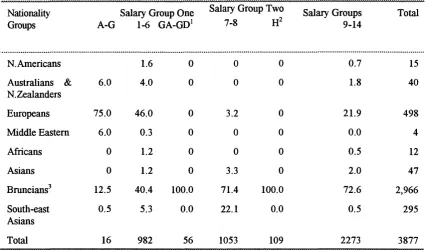
6.3 Salary levels, by residential status, 1991/92 189
6.4 Processes of Segmentation of employment structure in BSPC 192
6.5 Brunei Shell Petroleum Companies: Ownership, activities and
distribution of workers 194
6.6 Recruitment procedures in Brunei Shell Petroleum Companies 196
6.7 Qualification, by residential status and function 1991/92 203
6.8 Brunei Citizens: Malay and Non-Malay, by staff levels, 1984-92 226 8.1 Processes of Segmentation of employment structure in the Construction, and
1.1 Government planned investments, 1975-2000 25
1.2 Private sector investments (projected), 1975-95 25
1.3 Brunei's sectoral annual growth rates (output), 1971 -96 26
1.4 Brunei's sectoral growth rates, during National Development Plans, 1975-95 27
1.5 Gross domestic product by economic activities at constant prices, 1975-95 28
1.6 Working population, aged 15 and over, by sector and residential status,
1981-91 31
1.7 Sectoral distribution of working population, 1971-91 31
4.1 Trends of population growth of Brunei Darussalam, 1921-91 110
4.2 Total population by countries of origin, 1981-91 112
4.3 Total population by residential status, 1971-91 114
4.4 The profile of labour demand and supply (official projection), 1996-2011 114
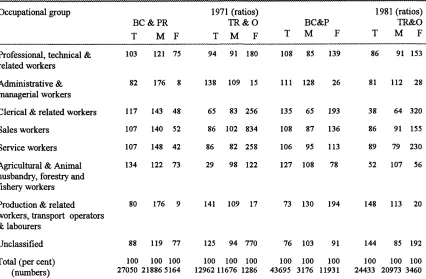
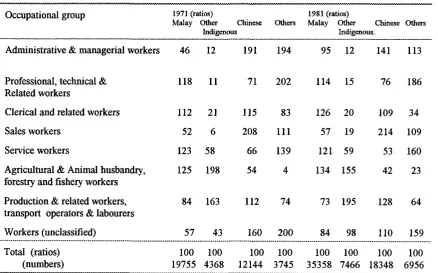
4.5 Working population by occupations and residential status, 1971-81 118
4.6 Working population by occupations, residential status and sex, 1991 119
4.7 Sectoral distribution of working population by residential status and sex, 1971-91 122
4.8 Skilled and unskilled local and foreign workforce, 1991 124
4.9 Skilled and unskilled local and foreign workforce by occupations, 1991 125
4.10a Working population, by occupations and ethnicity, 1991 127
4.10b Working population by occupations and ethnicity, 1971-81 127
4 .11 Sectoral distribution of working population by ethnicity, 1971-91 129
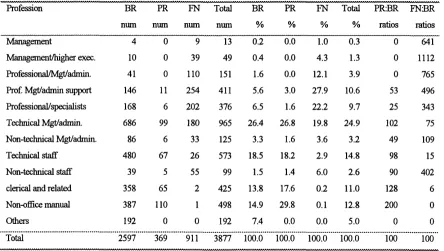
6.2 Local and foreign employees ofBSPC by occupations, 1991/92 186
6.3 Salary levels of workers ofBSPC by nationalities, 1991/92 188
6.4 Employees ofBSPC by residential status and qualifications, 1991/92 202
6.5 Brunei Shell Companies’ engineers by residential status, 1991/92 206
6.6 Brunei Shell Petroleum Companies’ technicians, 1991/92 208
6.7 Distribution of workers ofBSPC by functions, 1991/92 212
6.8a Departments of Personnel and Organisation Function by residential status, 1991/92 213
6.8b Departments of Personnel and Organisation Function by residential status and staff
categories, 1991/92 213
6.9 Distribution of locals in the Medical Department (PML) by occupations, 1991/92 215
6 .10a Distribution of workers in Service Function by residential status, 1991/92 217
6.10b Service Function by staff categories and residential status, 1991/92 219
6.11 Distribution of Brunei citizens: Malays and non-Malays by Functions, 1991/92 222
6.12 Brunei Citizen: Malays and non-Malays in Personnel and Organisation Function,
1991/92 224
6.13 Brunei Citizen: Malays and non-Malays in Engineering Function, 1991/92 225 7.1 Local and foreign workers in the construction, wholesale and retail sectors,
1989 and 1993 243
7.2a Foreign workers by nationalities and regions in the construction sector,
1989 and 1993 246
7.2b Foreign workers by nationalities and regions in the wholesale and retail sectors,
1989 and 1993 247
7.3b Percentage changes in the employment of local and foreign workers in the construction
sector, 1989 and 1993 252
7.4a Local and foreign workers by occupations in the wholesale and retail sectors,
1989 and 1993 254
7.4b Percentage changes in the employment of local and foreign workers in the wholesale
and retail sectors, 1989 and 1993 254
7.5a Distribution of workers by nationalities and occupations in the construction sector
(pgr cg/7^), 1989 and 1993 267
7.5b Distribution of workers by nationalities and occupations in the construction sector
(ratios), 1989 and 1993 259
7.6a Distribution of workers by nationalities and occupations in the wholesale and retail
sectors, 1989 and 1993 (percent) 262
7.6b Distribution of workers by nationalities and occupations in the wholesale and retail
sectors, 1989 and 1993 (ratios) 264
7.7 Trends of employment in the construction, wholesale and retail sectors, 1971-91 276
8.1a Turnover rates of local and foreign workers in the construction sector, 1990-1993 286
8. lb Turnover rates by nationalities in the construction sector, 1990-93 287
8.2a Turnover rates of locals and foreign workers in the wholesale and retail sectors,
1990-1993 289
ADMIN Administration
AP Public Affairs
ASEAN Association of South-east Asian Nations
EC Brunei Coldgas
BIMP-EAGA Brunei/Indonesia/Malaysia/Philippines-Eastem Growth Area
BLNG Brunei Liquefied Natural Gas
BR Bruneians
BSB Bandar Seri Begawan
BSM Brunei Marketing
BSP Brunei Shell Petroleum
BSPC Brunei Shell Petroleum Companies
BT Brunei Tanker
CA Personnel and Organisation Department
DPI Direct Foreign Investments
DM Petroleum Engineering
ECO Construction Operations
EDE Central Engineering
EFE Engineering Front End
ELM External Labour Market
EM Engineering
EPA Engineering Project Services
EPF Employment Pension Funds
EPS Engineering Project Onshore
EPU Economic Planning Unit
EQA Engineering Quality Assurance
FM Finance
FN Foreign Nationals
GCC Gulf Cooperation Council
GDP Gross Domestic Product
HND Highest National Diploma
ILM Internal Labour Market
n c A Japanese International Cooperation Agency
LGL Legal
MGT Management
MNC Multinational Companies
MPS Manpower Supply Service
NDP National Development Plan
NIC Newly Industrialised Countries
ODA Overseas Development Aid
CM Operation
PML Medical
PMTl/2/3 Professional, Managerial and Technical
PR Permanent Residents
PRS Personnel Relation and Effectiveness
PTR Training
ROS Refinery
SAV Aviation
SHuTT Service Hub for Trade and Tourism
SM Services
SMR Marine
ss
Senior Staffssss
Supervisory staff specialistsssu
SuppliesSTC Short-term Contract
STS Transport Planning and Scheduling
TAS Technical and Administrative Staffs
ID Technical
IN C Transnational Cooperation
UAE United Arab Emirates
WW2 World War Two
Title page 1
Abstract 2
Dedication 3
Acknowledgement 4
List of figures 5
List of tables 6
Abbreviations 9
Table of contents 11
Chapter One: Introduction 16
1.1 Aims and objectives 17
1.2 The Brunei economy 21
1.2.1 Brunei development plans 23
1.2.2 Economic structural and sectoral growth 26
1.3 Distribution of employment by economic activities 3 0
1.4 Scope of study 33
1.5 Organisation of thesis structure 34
Chapter Two: Segmentation Processes in Selected Labour-Short
Countries of ASEAN, NICs and the Arab’s Gulf Countries: An Overview 37
2.1 Introduction 37
2.2 The concept of labour market segmentation 41
2.3 Development and international labour migration 46
2.4 Segmentation processes in selected NICs, ASEAN and the Arab’s
Gulf Countries 53
2.4.2 Changes in the nature of labour supply 63
2.4.3 Government and non-government’s roles 71
2.5 Towards a model of segmentation for Brunei Darussalam 83
2.6 Conclusion 84
Chapter Three: A Model of Segmentation for Brunei Darussalam 88
3.1 Introduction 88
3.2 A model of Segmentation of employment in Brunei Darussalam 89
3.2.1 labour demand and labour market segmentation 91
3.2.2 Institutional factors and segmentation processes 96
3.2.3 Supply factor and segmentation processes 101
3.3 Conclusions 105
Chapter Four: Labour Market Developments and Patterns of
Employment in Brunei Darussalam 107
4.1 Introduction 107
4.2 Labour market developments, 1971-1991 109
4.3 Patterns of employment, 1971-91 115
4.3.1 Local and foreign workers 116
4.3.2 Skilled and unskilled local and foreign workers 123
4.3.3 Malay and non-Malay Brunei citizen workers 126
4.4 Segmentation processes and labour market actors 132
4.4.1 The role of the government 133
4.4.2 The role of employers 138
4.4.3 The role of local workers 142
Chapter Five: Fieldwork strategy and sources of data 149
5.1 Introduction 149
5.2 Industrial sectors for the thesis and sources of data 150
5.3 Nature of secondary data and fieldwork strategy 152
5.4 Brunei Shell Petroleum Companies 155
5.4.1 Sources and types of data 156
5.4.2 Organisation of interview and questionnaire surveys 157
5.4.3 Respondents for interview and questionnaire surveys 160
5 .4.4 Methods of primary data collection 161
5.4.5 Evaluation of data fi*om B SPC 163
5.5 Construction, and Wholesale and Retail sectors 166
5.5.1 Sources and types of data 167
5.5.2 Organisation of interview and questionnaire surveys 170
5.5.3 Respondents for interview and questionnaire surveys 171
5.5.4 Methods of primary data collection 171
5.5.5 Evaluation of data for construction, wholesale and retail 173
5.6 Practical problems in the first and second fieldwork 174
5.7 Data processing 178
5.8 Conclusion 178
Chapter Six: Patterns of Employment in Brunei Shell Companies 180
6.1 Introduction 181
6.2 Employment profiles in BSPC, 182
6.3 Segmentation processes in BSPC 191
6.3.1 Company’s size and structure of ownership 193
6.3.2 Recruitment strategy and procedure 195
6.3.3 Employment policies in BSPC 198
6.3.4 Levels of education 201
6.3.5 Qualification and length of service 204
6.4 Segmentation of local and foreign workers by functions and departments 209
6.4.2 Service fijnction 216
6.5 Segmentation between Brunei Malay and non-Malay citizen staff 219
6.5.1 Personnel and orgnisation function 222
6.5.2 Engineering function 223
6.6 Training, career development and promotion in BSPC 226
6.6.1 Training of employees 227
6.6.2 Career development for Brunei citizen staff 231
6.6.3 Promotion of employees 233
6.7 Conclusion 237
Chapter Seven: Patterns of employment in Construction, and
Wholesale and Retail Sectors 240
7.1 Introduction 240
7.2 Employment characteristics in construction, and wholesale and retail sectors 241
7.2.1 Participation of local and foreign workers 242
7.2.2 Participation of foreign workers of different nationalities 245
7.2.3 Employment patterns of local and foreign workers 249
7.2.4 Employment patterns of workers of different nationalities 255
7.3 Conclusion 265
Chapter Eight: Segmentation Processes in the construction, and
wholesale and retail sectors 267
8.1 Introduction 267
8.2 The role of workers in segmentation processes 270
8.2.1 Unpolarised supply of local skills 271
8.2.2 The attitudes of Bruneians in the construction, and wholesale and retail sectors 277
8.3 The role of employers in segmentation processes 291
8.3.1 Construction sector 291
8.3.2 Wholesale and retail sector 295
8.5 The role of non-government institutions in segmentation processes 3 04
8.5.1 Internal labour market resourcing proceduce 3 04
8.5.2 External labour market resourcing procedure 307
8.6 Conclusion 312
Chapter Nine: Summary and Conclusion 315
9.1 Introduction 315
9.2 The roles of labour market actors 319
9.2.1 Government 319
9.2.2 Private sector employers 320
9.2.3 Local and foreign workers 321
9.3 Segmentations in BSPC, the construction, and wholesale and retail sectors 323
9.3.1 Brunei Shell Petroleum Companies 323
9.3.2 The construction, and wholesale and retail sectors 325
9.4 Forms of segmentation in BSPC, the construction, and wholesale and retail
Sectors 326
9.5 Development, labour migration and segmentation in Brunei, selected NICs,
ASEAN and the Gulf countries 326
9.6 Brunei’s diversification pursuit and future development possibilities 329
9.6.1 New economic niches for Brunei Darussalam 333
Bibliography 3(39
CHAPTER ONE: INTRODUCTION
The disparities between the structure of labour demand and the structure of labour supply have exacerbated shortages in the Brunei Darussalam’s^ labour market and created segmentation in its employment structure. These disparities and the resulting segmentation are reinforced and maintained by the existence of segmentation processes brought about by the articulation of the nature of labour demand and supply in the Brunei labour market acting through three main agencies; government, employers and workers.
The structure of labour demand here is defined in terms of a set of job hierarchies, required to satisfy the operational needs of companies in different economic sectors. Higher job hierarchies are managerial, administrative, technical; while lower ones are carpentering, bricklaying, garbage-collecting and so forth. The different job hierarchies are closely related to the economic stages of a country. At early stages of economic evolution, jobs are mainly in the production of primary sector goods, such as unprocessed agricultural and mining products. As a country advances economically, more jobs are involved in processing primary sector products into manufactured and high value-added consumer goods, until finally service sector jobs become significant.
The structure of labour supply is interpreted as a set of skill hierarchies of labour which provides the expertise and manual abilities to perform tasks for the production of goods and/or services. This structure is also related to economic evolution. Thus, as a country's economy develops, it will increasingly train its human resources in highly technical and professional specialist skills to meet the requirement of its labour market, thereby satisfying demand fi’om the expanding economy. Foreign labour has fi*equently been seen as a short-term measure to satisfy the demand for skills to sustain the operational needs of companies (Bohning, 1984; Castles and Kosack 1985; Seccombe, 1988).
Disparities between the structure of labour demand and labour supply arise from incompatibilities between the différent types of jobs which need to be done and the different types of skill available, creating a mismatch whereby the types of skill available cannot satisfy the requirements of jobs that need to be performed. Such a situation exists in labour-short countries, such as Brunei and its other ASEAN counterparts, the Asia NICs and the small Arab Gulf States, which consequently leads to the recruitment of foreign workers to fill job vacancies that cannot be filled by the locals^, and ultimately creates segmentation of the labour market and employment structure.
1.1 Aims and objectives
Theoretically, Brunei should not experience any labour shortages to hinder its economic development goals. This is simply because the neighbouring countries in the region have an abundant supply of cheap labour. However, the prevailing local labour market mismatch, which is apparent in the parallel existence of rising unemployment amongst Bruneians amid increasing labour shortages, as well as the government’s emphasis on Bruneianisation of employment policy, have led to an overall policy to reduce the country’s dependence on foreign labour. This amplifies the underlying dilemma of Brunei because with a limited domestic labour supply^, its pursuit of economic diversification, which requires increased demand for labour in the public and private sectors, will become even more difficult.
There are, therefore, several delimitation factors to Brunei's economic diversification. One is the physical and relative shortages of domestic labour as evidenced in the increased reliance on foreign labour. A second is the lack of qualified local manpower, on the one hand, and of skilled and unskilled manual workers on the other. A third is the Bruneians’ partiality for white
^Citizens and permanent residents of Brunei. Also referred in the thesis as “Bruneians”. Brunei citizens are holders of yellow identity cards while Permanent Residents (PR) are holders of purple identity cards. PR are stateless persons who have been residing in Brunei for many years either following parents who migrated into Brunei and have not acquired citizenship, or non-citizen spouses of some locals. The PR are provided with almost all services that are given free to Brunei citizens. One of the important exceptions, however, is that they cannot own land in the country.
collar occupations in public sector employment. A fourth is the government’s pursuit of its Bruneianisation policy, which does not take account of the indigenous workforce’s aspirations for white collar employment, and the shortages of local manpower both quantitatively and qualitatively.
It is against such a background that this study proposes a number of hypotheses. First, the local manpower shortage is exacerbated because the Brunei labour market is structurally and sectorally segmented, with certain professions reserved for Bruneians while others have to be continuously filled by foreign employees. Second, such an employment structure is the result of a series of processes created by the main labour market actors - government, employers and local workers - interacting with other factors and generating a segmentation of the country’s labour market and employment structure. As will become apparent later (Chapters Four, Six and Seven), this segmentation is not only between local and foreign labour, skilled and unskilled, males and females, but also between different ethnic groups within the local population. Third, segmentation of Brunei’s labour market and employment structure is also maintained by the interplay of several mechanisms through the roles played government, employers and local workers.
This thesis aims firstly, to identify, examine and explain a series of processes of segmentation and the resultant employment patterns by types of occupation and economic sectors. Secondly, to assess the permanency of segmented labour market and employment structure in Brunei. Thirdly, to establish the occupational roles of both local and foreign labour, as well as examine the implications of economic diversification which lead to increased reliance on foreign labour and Bruneianisation of employment policy"^. These objectives, will support further research avenues on the outcome of the continuing policies of diversification and Bruneianisation of the workforce.
Brunei’s economic diversification and its Bruneianisation policies mainly stemmed fi*om a drive to do something about its narrow economic base and increasing reliance on foreign labour, respectively. The diversification is essential because the country suffers fi'om a serious structural imbalance, with the non-oil sector is very poorly developed. Bruneianisation policy specifically concerns increased participation of Bruneians in both public and private sector employment, thereby reducing the proportion of foreign labour in the total workforce composition. This policy is one of the objectives in the Fifth, Sixth and Seventh National Development Plans (see Section 1.2.1). Thus Bruneianisation policy aims:
“To provide a higher proportion of employment for the Bruneians in the industrial and commercial private sector jobs, and commensurately reduce the proportion of employment in the public sector” ^
Since a large proportion of private sector employment has been manned by foreign labour, Bruneianisation implies the intention of Brunei to reduce its foreign labour component. Indeed as will be elaborated further in Chapter Four, the government has set a maximum limit: foreign labour should comprise no more than one-third of the total working population of Brunei. Thus far, the limit has been surpassed since 1996 (42.2 per cent)^ because of the continuous local manpower shortage problem amid an economic diversification programme.
'^Bruneianisation means the policy of the government to increase employment participation of the locals in both the public and private sector. These are especially emphasised in the last three National Development Plans, the Fifth, Sixth and Seventh.
Brunei is a small country with a capital-rich and labour-short economy. It is extremely small in area (5,765 square kilometres), rich in wealth (1996 GDP: US$5,123.2 ^ per capita) and a micro-state in population (1991 census: 260,482). The non-renewable assets, oil and gas, which dominate the Brunei economy have not provided the desired economic stability because its economic growth is inextricably linked to world trade developments in oil. In effect, national income and employment have varied greatly in accordance with the fluctuation in the international price of oil (Tan and Hashim, 1995). Such an economic instability necessitates economic diversification of the domestic production base, in favour of a greater contribution from the non-oil sector.
As will be made clearer below, development in the non-oil sector during the previous four decades has not been significant (see Section 1.2.2). This slow growth has been attributed to three main factors: limited foreign investments, under-developed infi*astructure conducive to industrial development; and the small domestic workforce. This thesis is mainly dealing with the last factor. The underlying development problem, as far as limited manpower is concerned, is both quantitative and qualitative. There is a lack of suitable indigenous manpower for jobs that require highly professional skills on the one hand, and skilled and unskilled manuals on the other. A major reason for this is Bruneians’ lack of tertiary qualifications and technical skills, as well as their penchant for civil service white collar occupations. The consequence of this mismatch is that for many decades Brunei has been heavily dependent on foreign labour. With the present emphasis on developing the non-oil sector economy, the reliance on foreign employees is unlikely to decrease significantly.
The small population base and a domestic labour shortage constrains Brunei in not only pursuing a progressive non-oil sector economic development that would lead to economic diversification, but also in maintaining many types of services. The local manpower constraints are further exacerbated by the mismatch between job requirements and skills available. This has resulted in rising unemployment since the early 1970s. Since the mid 1980s, the government, in its Fifth National Development Plan has emphasised human resource development amongst
the locals so that the unemployed can be absorbed into the expanding private sector. This endeavour is an attempt to pursue a Bruneianisation policy by increasing local participation in private sector employment which has been monopolised by foreign workers (Chapters Four, Six and Seven), thereby reducing reliance on foreign labour. Nevertheless, unemployment remains high and has increased* as Bruneians remain selective in the types of occupation and economic sectors that they are willing to be engaged in. Most unpopular are low level manual jobs, particularly in construction. This reluctance has fiirther exacerbated manpower shortages,
structurally and sectorally.
1.2 The Brunei economy
This section examines Brunei’s economy, focusing on its development plans, investments, sectoral growth and employment distribution by economic activities. Such an examination is important to the thesis because it provides the context in which manpower shortage, continued dependence on foreign labour, and the resultant segmentation of the Brunei labour market and employment structure must be viewed.
Brunei's small population and oil-rich economy makes its development unique in South-east Asia. Despite its manpower shortage, Brunei is determined to promote its industrial development without delay so that (among other economic and employment generating reasons stated above), the country will not be left behind other countries (Hamzah, 1989). Notwithstanding its different economic base, Brunei shares a common problem with several of its neighbours, namely its indigenous labour deficit in numbers and skill qualities, which leads to dependence on foreign workers. The magnitude and the structure of labour demand and supply, however, differ between countries because of disparities in their stages of economic evolution. Brunei's socio-economic development problems are more in common with the oil-exporters of the Gulf States, such as Kuwait, Oman, Qatar and the United Arab Emirates, than its ASEAN
1997).
counterparts. At the heart of the common development problem with the small Gulf States are the constraints in promoting the non-oil sector. Thus, Colclough^, a specialist in Middle East oil-rich societies is of the opinion that for Brunei,
" The oil has no developmental effects. It establishes no significant linkages with the rest of the economy. It has no "backward linkages" in that it employs a tiny labour force and acquires its capital and technology from abroad. Nor does the oil sector establish "forward linkages" in that most of its products are exported. Oil has only one substantial effect: it provides the state with an income, which can for all intent and purposes, be treated as a form of rent. Any further effects of the oil sector quite clearly depend on what is done with the rent - vis-à-vis, for example the political character of the state and the developmental programmes it initiates.
Colclough further posits that,
"Brunei has a remuneration structure which cannot be easily replicated by those industries which have to compete in the international market with products from countries where labour costs are lower. This relatively high structure is further exacerbated by the tendency for the value of domestic currency to become inflated relative to those of other countries. A combination of these factors prevents an economy like Brunei from diversifying into other export industries, and net increments tend to go into the non-tradable sector - that is trade, finance, and services because almost everything can be imported more cheaply than it can be produced at home."*^
Becoming a rentier nation^^ is one option for Brunei. However, in order to provide some degree of production, income security for future generations and employment for its increasing labour force, the alternative is to pursue economic diversification. Brunei has rejected the rentier option, and instead opted for economic diversification as emphasised in its more recent national development plans. This is because economic diversification is
and females, 9.7 per cent compared to 7.7 per cent for males. (EPU, Brunei Darussalam, Report on the Labour Force Survey 1995: 28 and 29).
^Christopher Colclough was a former advisor to Brunei on employment policy.
'°Cited in Menon, K.U. (1987), "Brunei Darussalam in 1986: In search of the Political Kingdom", in Asian Affairs: 30.
'’Colclough, C. cited in Menon, K.U. (1987), op ait: 30.
regarded as a vital strategy for promoting business and creating more jobs so as to establish a secure economic base on which to build a distinctive Bruneian culture and polity (Cleary and Wong, 1994).
1.2.1 Brunei development plans
Brunei has formulated seven five-year development plans to date. The plans are macro, multi-sectoral and project-based (Cleary and Wong, 1994). The first and the second were for the periods 1953-58 and 1962-66 respectively. The main objective of the former was to develop the physical and basic infi-astructure. The latter was a continuation and expansion of the previous development plan, but was aimed specifically at the creation of a foundation for future developments. Consequently, upon the instability of international oil prices, and in line with the government's petroleum depletion policy^^ which is to prolong the supply of known reserves, successive plans instituted a more ambitious development programme in which the overriding strategy is economic diversification.
The diversification of Brunei's narrow oil-based economy was initiated in the Third Development Plan (1977-79), and emphasised in successive Plans after that. Specifically, the objective was to reduce structural imbalance and to arrest the declining performance of the agriculture, forestry, fishery and manufacturing. Economic diversification lies at the core of the country's development agendas. Among the common objectives pursued in the F o u r t h F i f t h ^ \ Sixth^^ and Seventh^^ National Development Plans (1980-84, 1986-90,
1991-95 and 1996-2000 respectively), inter alia
• To diversify the economy by accelerating the development of agriculture and non-oil based manufacturing industries.
’^Since 1988, Oil production was reduced to 150,000 barrels per day, (cited from Sixth NDP, 1991-95, Appendix 1: 55).
''’EPU., Fourth NDP 1980-84\ 56 and 57. '^EPU., Fifth NDP 1986-90: 19.
• To develop a new export oriented-industry as well as import-substitution industries. • To accelerate human resources development so as to meet the country's demand for an
increasingly sophisticated economy.
• To maintain full employment and increase the level of productivity.
• To widen the economic base and create a favourable climate for industries. • To sustain the development of the oil/gas industry.
• To encourage the development of a strong private sector.
• To encourage and nurture the development of “Rakyat Melayu'’^^ as leaders of industries and commerce.
These objectives portray strong government determination to reduce the structural imbalance in the Brunei economy, hence to widen the structural economic base of the country. However, a number of difficulties have been encountered, some of which appear to be ingrained in the social-economic inclination of the indigenous population and which are leading to growing and seemingly permanent dependence on foreign labour.
In the previous development plans social services, followed by transport and communication, have received the largest share of public sector investment, except in the Fifth Plan when public utilities were allocated the second largest capital expenditure (Table 1.1). Despite the stronger emphasis on the promotion of the non-oil sector economy, government investment in industry and commerce received a much smaller (though increasing) budget allocation than might have been expected. The investment was to promote selected economic sectors, namely agriculture, forestry, fisheries, commerce and industries (manufacturing), by providing facilities and incentives for industrial developments, such as industrial estates and loan funds for industrial developments. The government has not invested in production per se in these sectors, because it expects the private sector to play a more aggressive role in participating in the country's industrial development especially in:
"Pursuing new ventures and more responsive towards new technologies and new market opportunities. The private sector will have had more exposure to international standards and dealings through associations with regional and international bodies, and will therefore be in a better position to respond to the government's industrial policy and industrialisation efforts.
However, throughout the 1975-1990 planning period, the bulk of private investments remained in the oil sector, though it declined by 9.5 per cent from the Fourth Plan (Table 1.2). Investments in the non-oil sector dropped slightly between the Third and Fourth Plan but rose by nearly 10 per cent in the Fifth Plan.
Sectors Third Plan
1975-1979 per cent Fourth Plan 1980-1984 per cent Fifth Plan 1986-1990 per cent Sixth Plan 1991-1995 per cent Seventh Plan 1996-2000 per cent Industry and Commerce
6.6 3.8 9.3 10.0 12.6
Transport and communication
33.6 23.0 19.3 20.2 19.5
Social Services 36.6 39.9 33.2 29.3 27.5
Public Utilities 20.3 13.4 20.4 20.0 21.9
Public Buildings 2.9 13.6 9.9 10.0 8.8
Security - - 7.6 7.0 7.3
Miscellaneous - 6.3 0.3 3.7 2.4
Total 100.0 100.0 100.0 100.0 100.0
Sector Third Plan
1975-1979 Fourth Plan 1980-1984 Fifth Plan 1986-1990 Sixth Plan 1991-1995
Oil sector 89.6 90.9 81.4 54.4
Non-Oil sector 10.4 9.1 18.6 45.6
Total 100.0 100.0 100.0 100.0
Source: EPU., Fifth and Sixth National Development Plans'. 32, 56 and 171.
Source: EPU., Fifth & Sixth and Seventh NDP: 9, 12 and 170.
At the same time, the non-oil sector investment rose remarkably (82 per cent), then declined by 12 per cent. This poor investment performance in the non-oil private sector is associated with the lack of both foreign and indigenous investments.
1.2.2 Economic structural and sectoral growth
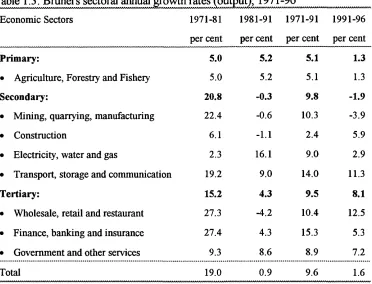
Brunei’s economic structure and sectoral growth is shown in Table 1.3. All the sectors (primary, secondary and tertiary) recorded a decline in growth rates between 1971-81, 1981- 1991, 1991-96; the largest was in the secondary sector, almost entirely accounted for by the oil industry. In the Tertiary sector, the dominant role of the private sector relative to that of the government led to high growth rates.
"able 1.3: Brunei's sector^ ^ u d groy^ rates (output
Economic Sectors 1971-81 1981-91 1971-91 1991-96 per cent per cent per cent per cent
Primary: 5.0 5.2 5.1 1.3
• Agriculture, Forestry and Fishery 5.0 5.2 5.1 1.3
Secondary: 20.8 -0.3 9.8 -1.9
• Mining, quarrying, manufacturing 22.4 -0.6 10.3 -3.9
• Construction 6.1 -1.1 2.4 5.9
• Electricity, water and gas 2.3 16.1 9.0 2.9
• Transport, storage and communication 19.2 9.0 14.0 11.3
Tertiary: 15.2 4.3 9.5 8.1
• Wholesale, retail and restaurant 27.3 -4.2 10.4 12.5 • Finance, banking and insurance 27.4 4.3 15.3 5.3
• Government and other services 9.3 8.6 8.9 7.2
Total 19.0 0.9 9.6 1.6
Source: EPU., Brunei Statistical Yearbook (various issues) and (Tan and Hashim 1995: 47).
Table 1.4 summarises sectoral growth trends. Oil performed badly in the Fourth and Fifth Plan periods. In the non-oil sectors, generally neither the government nor the private sector
demonstrated consistent growth performance during the four plans. Despite the strong emphasis on diversification, accompanied by increased government investments in industrial and commercial infi-astructure, and in loan funds, private sector growth rates continued to decline.
Table 1.4: Brunei's sectoral growth rates during National Development Plan, 1975-95 Index of GDP Third Plan
1975-79 Fourth Plan 1980-84 Fifth Plan 1986-90 Sixth Plan 1991-95
Oil Sector 6.9 -4.3 -1.3 1.5
Non- oil Sector: Government Private Sector
6.3 5.9 6.6 7.4 12.5 4.3 5.8 7.5 3.9 5.7 5.6 5.9
Total 6.8 -2.4 1.3 1.4
Source: EPU., Fourth, Fifth and Seventh NDP\ Brunei Darussalam Statistical Yearbook (various issues)^’ and Tan and Hashim, 1995: 48).
Although the contribution of the non-oil sector to the country's GDP, increased between 1975 and 1990 (14 to 37 per cent), its role is still relatively small (Table 1.5), thus, reflecting relatively marginal increases in the primary and secondary sectors. The tertiary sector appears to have made a relatively big contribution to the country's GDP, increasing fi-om 8.3 per cent in 1975, to 27.9 in 1990 and 52.2 in 1995. However, if the government- provided community, social and personal services, are excluded fi-om the tertiary sector, the contribution of the private non-oil sector is less impressive, increasing fi-om 3.7 per cent to only 7.9 per cent between 1975, 1990 and 18.4 per cent in 1995.
The contribution to GDP of the construction, wholesale and retail trade sectors is small, though generally increasing between 1991 and 1995^^. Overall the non-oil private sector increased its contribution to the growth of GDP by 8.7 per cent in the Third Plan and 13.2 in the Fourth, but declined to only 0.3 in the Fifth^^, and rose to 29.9 in the Sixth. The significant rise in the last planning period was Brunei’s emergence fi-om the recession between the mid 1980s and early
1990s, as oil prices stabilised and the efifect of diversification policy, particularly to increased economic activities in construction, trade, and financial and insurance services, became evident^"^. But in real terms, oil continues to dominate the Brunei economy (54 per cent as compared to 45.6 for non-oil sector in 1995), and economic diversification in the private sector has made only a limited break through^\
Table 1.5: Gross domestic product by economic activities at constant prices, 1975-95
Economic Activities 1975 1980 1985 1990 1995*
Oil Sector 86.0 83.7 72.8 62.9 30.7
Non-oil Sector 14.0 16.3 27.2 37.1 69.3
Primary Sector 1.4 1.0 1.2 1.4 2.7
Agriculture & Livestock 1.0 0.8 0.8 1.2 1.9
Forestry and Logging 0.2 0.1 0.2 0.1 0.3
Fishing 0.2 0.1 0.2 0.1 0.5
Secondary Sector 4.3 3.8 5.4 7.8 14.0
Mining, Quarrying & Manufacturing 1.2 0.8 0.7 1.7 3.1
Electrical 0.3 -0.1 0.5 1.0 1.0
Construction 2.0 2.3 2.1 2.8 5.7
Transport, Storage & Communication 0.8 0.9 2.1 2.3 4.2
Tertiary Sector 8.3 11.5 20.6 27.9 52.2
Wholesale trade 0.5 0.7 1.0 1.5 2.3
Retail trade 1.7 1.9 2.0 3.3 4.6
Restaurants and hotels 0.4 0.3 0.5 0.8 1.5
Banking and finance 0.8 1.6 2.4 2.5 4.2
Insurance 0.03 0.1 0.2 0.8 1.3
Real Estates & Business services 0.7 1.4 1.7 0.7 1.1
Ownership o f Dwellings 0.5 0.3 0.5 0.6 1.1
Community, social & personal 4.6 6.5 14.4 20.0 33.8 services
Less bank charges (-) 0.9 1.3 2.1 2.3 2.3
Gross Domestic Product 100.0 100.0 100.0 100.0 100.0
Source: EPU., Sixth and Seventh NDP, 1991-95; 1996-2000: 5 and 168. Note: At current prices (constant prices - not available). * Estimates.
Various explanations can be offered for the unsuccessful diversification performance in the promotion of a non-oil base economy. Cleary and Wong (1994: 94-95) argued that, “.. .at least until recent years, the development plans paid little more than lip-service to such
^^EPU., Fifth and Sixth NDP\ Brunei Darussalam Statistical Yearbook, 1994.
aims, rather than elaborating clear strategies to achieve diversification”. Specifically, however, one fundamental constraint for diversification is the extremely small population size. Indeed, according to Ali (1992) one of the real impediments to industrial growth in Brunei is its manpower shortage problem, which partly stems from the small population base and partly from its educational and social-cultural characteristics. Another is the relatively undeveloped domestic financial sector, which also poses problems for business undertakings in the country. The small population size has two implications: the limited internal market is unattractive to foreign investors; and the limited supply of local labour, in both volume and expertise, is inadequate for the industrialisation of the non-oil sector. It has also been pointed out that economic diversification of industry in Brunei would require cheap labour which Brunei does not have (Franz, 1990). Indeed it was later argued that Brunei would face difficulties in achieving its industrialization target because of the high cost of inputs (except for electricity and water), high cost of labour (the highest in the region), and the local supply is too small to meet the demand from the various sectors Thambipillai and Sulaiman (1995). The problem is accentuated by the locals’ preference for tertiary employment in the public sector. Thus, in Brunei it is true that:
"There is no tradition of creating wealth through private initiative. Most people still look first at government for employment. Real diversification will only be achieved through cultural change." (Finnerty 1992: 33)
Moreover, the Brunei domestic labour shortage has been exacerbated by the aversion of locals to industrial and infi-astructure projects that are discerned by them to rely heavily on foreign workers^^. Acknowledging the difficulties overseas investors have in recruiting domestic labour, the government has relaxed the rules of recruitment of foreign workers thus exacerbating the problem.
1.3 Distribution of employment by economic activities
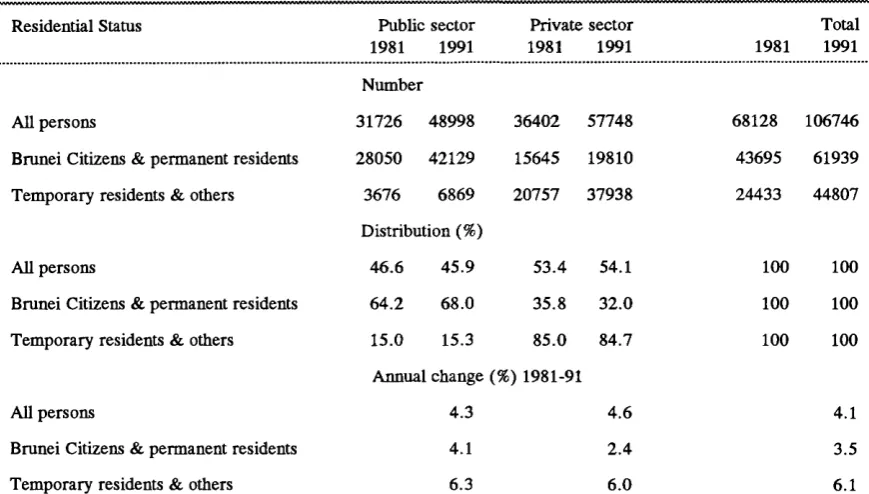
The preference of the domestic labour force for government sector employment is clearly demonstrated in Table 1.6. More than two-thirds of the domestic workforce are in government sector employment, the proportion hardly changing during the 1981-91 decade. The high proportion of locals in the public sector is anomalous, compared to the situation in neighbouring countries. For example, in Malaysia the public sector accounted for 13.2 per cent of all employment in 1990; in Singapore, only 7.8 per cent^^, while in Brunei in 1995 was 45.7 per cent^*. The number of locals in the private sector grew only slowly (2.4 per cent) in the 1980s, while that of foreign workers grew much faster (6.0 per cent), creating an overall situation in which the proportion of locals employed in the private sector remains small while that of foreigners remains high. Though the proportion of local workers increase significantly in 1995 (45.7 per cent - see footnote 27), it is still relatively small compared to its ASEAN counterparts.
The main reasons for the local workers (see footnote 3) to prefer working in the public sector are better pay, provision of other financial and non-financial benefits and working conditions, and better job security. Many of them regard the public sector as a lifetime career. In these circumstances it is inevitable that jobs in the private sector are increasingly filled by foreign workers. Hence, the working population of Brunei is segmented according to types of occupation and economic sectors in the public and private sectors. As will be seen in Chapter Four, it is also segmented according to sex, ethnicity and residential status.
A profile of the distribution of employment by economic sectors in Table 1.7 shows that it is mainly the tertiary sector industries that have experienced an increasing share of employment. Between 1971 and 1991, the wholesale, and retail sector and the finance, banking and insurance sector shares rose by around four percentage points; and community and personal
^ Economic Report 1990/91, Malaysia, 1990; Economic Survey of Singapore, Ministry of Trade and Industry, Singapore, 1992, cited in Tan and Hashim, ibid.
services by 11.3 percentage points. The remaining sectors, generally experienced a decline in their share of employment.
Table 1.6: Working population aged 15 and over by sector and residential status, 1981-91
Residential Status Public sector 1981 1991
Private sector 1981 1991
Total 1981 1991
All persons
Brunei Citizens & permanent residents Temporary residents & others
All persons
Brunei Citizens & permanent residents Temporary residents & others
All persons
Brunei Citizens & permanent residents Temporary residents & others
36402 57748 15645 19810 20757 37938 Number
31726 48998 28050 42129 3676 6869 Distribution (%)
46.6 45.9 64.2 68.0 15.0 15.3
Annual change (%) 1981-91 4.3
4.1 6.3
68128 106746 43695 61939 24433 44807
53.4 35.8 85.0 54.1 32.0 84.7 4.6 2.4 6.0 100 100 100 100 100 100 4.1 3.5 6.1 Source: EPU., (1993), Report on the 1991 Population Census: 77.
iistribution of working populatior
Economic Sectors 1971 1981 1991 Annual Growth Rate
1971-81 1981-91 Agriculture, Forestry & Fishing 11.9 5.0 2.0 -3.2 -46
Mining & Quarrying 7.3 5.7 5.0 2.9 3.3
Manufacturing 4.4 4.1 3.8 4.7 3.9
Electricity, Water & Gas 2.7 2.9 2.1 6.1 1.2
Construction 20.2 18.6 13.3 4.6 1.7
Wholesale, Retail & Restaurant 10.5 10.8 14.4 5.8 7.6 Transport, Storage & Communication 5.3 6.6 5.1 7.9 1.7
Finance, Banking & Insurance 1.6 3.0 5.4 12.0 11.2
Community & Personal Services 37.5 43.0 48.8 7.2 5.9
Unknown 0.2 0.4 0.1 -
-Total (%) (niunber) 100.0 40012 100.0 68,128 100.0 106746 5.4 4.6
Manufacturing industry, promoted under the diversification policy, suffered a decline both in its employment share (fi-om 4.4 to 3.8 per cent in 1971 and 1991 respectively), and in its decade growth rates fi-om 4.7 (1971-81) to 3.9 per cent (1981-91). This fall in employment does not necessarily imply a negative output performance of the manufacturing sector, as improved technology increases productivity. However, in the Brunei non-oil industrial context, the few industries established are of small and medium scale, and hence unlikely to employ sophisticated technology. In short, they are mainly labour-intensive light industries.
In summary, Brunei’s economy is still dominated by the oil sector. Despite four recent development plans which emphasised economic diversification through promotion of the non oil sector, achievements have been minimal. Other traditional economic sectors, notably agriculture, also lagged behind. One of the factors which undermines progress towards diversification appears to be a lack of a suitable domestic labour force, which is further exacerbated by the preference of locals for white collar occupations in the public sector, and employers’ preference for foreign labour (see Chapter 6 and 7). In effect, employment is dichotomised: the locals mainly in the government sector while foreign workers concentrate mainly in the private sector. Further segmentation tendencies accentuate the local labour shortage, manifested sectorally and occupationally, with the result that certain sectors and occupations are sustained by foreign labour.
per cent, leaving only 6 per cent allocated to industry and commerce to diversify the economic base (E.P.U. Seventh National Development Plan, 1996-2000).
As far as the structure of employment is concerned, Brunei relies heavily on foreign labour at both ends of the skill spectrum and particularly in the private sector. Hence, labour migration and development in Brunei are largely interdependent. This is typical not only of Brunei but also of several countries in the region have long used foreign labour in their economic development. But the foreign labour sector is disproportionately large in Brunei in comparison with other countries in the region (Chapter Two). This, combined with the simultaneously rising unemployment (see Chapter Four), particularly among young Bruneians, should be a stimulant to the Brunei government to review the socio-economic viability of its development strategy, especially in view of its policy to reduce dependence on foreign labour, increase Bruneianisation and promote the non-oil sector.
1.4 Scope of study
The three selected sectors which are the focus of this research are (1) the Brunei Shell Petroleum companies (BSPC), (2) construction, and (3) the wholesale and retail sector. The main period of analysis is 1989-1993 when fieldwork was carried out. For the BSPC, the detailed data made available by the company were for 1992/93, plus more general statistical information for 1984-1992.
repatriated, the majority of the locals were absorbed into that part of the company holdings which remains in operation. Recently, Brunei’s government investment in construction has also slowed down, but again this has not altered patterns of employment significantly. At most, it has only reduced foreign labour inflows marginally and temporarily. Figures have not been disclosed as to how many foreign workers were repatriated from Brunei and how many locals were laid-off by the closure of the stated companies. What is certain from observation is that the patterns of employment in the country as a whole remains generally unchanged. Thus, the fieldwork and analysis remain highly relevant and the conclusions have, in fact been reinforced in that the closure of the firms has tended to reduce the confidence of the locals with regards to working in the private sector (see Chapter Seven).
1.5 Organisation of thesis structure
The thesis aims and objectives have been outlined in this introductory chapter. The study is pursued on the basis of conflicting socio-economic goals in Brunei: diversification, Bruneianisation, and domestic labour constraints. The main concern here is the increasing reliance on foreign workers by Brunei to supplement the limited local manpower. Shortage of manpower is a significant underlying constraint in the country and this has been further exacerbated by the incompatibility of the structure of labour demand and supply. Consequently, this has precipitated labour migration in order to maintain existing services and pursue further development. In increasingly utilising foreign labour for development, the resultant Brunei labour market and employment structure has been that of segmentation between different groups of workers. The thesis concludes that the processes which have brought this situation about seem to have become permanent - at least for the foreseeable future.
studies of how segmentation has been created and maintained in the other labour-short countries, such as the NICs, ASEAN and the Gulf States are examined. Since the economic diversification problems of these countries were related to changes in the nature of labour demand and supply, as well as government intervention during their development processes, the model of examination pursued is that of the relationship between the principal labour market actors: employers, workers, and government and non-government bodies.
Since the economic diversification problem in Brunei seems to be similar to that of the NICs, ASEAN and the Gulf countries, that is disparities in the labour demand (employers) and supply, qualitatively and quantitatively (workers), this study uses these labour market actors as part of a model for explaining segmentation in the Brunei labour market and employment structure. A third factor: an institutional role (government and non-government) is also included to the model because of its significant role in influencing the inflow and policies for employing foreign labour and the resultant structure of employment. The role of these labour market actors in creating and sustaining the resulting segmentation are examined in Chapter Three.
The remaining chapters, form the heart of the thesis as they present analyses of primary data to supplement secondary information derived from the census and other sources. These data detail the employment structure that has evolved in particular economic sectors, together with the occupational roles of the different groups of workers and their employment characteristics, and identify the segmentation processes that have created and maintained the resultant segmented labour market and employment structure in these sectors. Chapter Five mainly explains the fieldwork strategy, sources of data, method of data collection, and problems that emerged during the fieldwork. Analyses of workforce composition, identification and explanation of segmentation processes which produced the resultant employment characteristics of BSPC, the construction, and wholesale and retail sectors, are presented in Chapter Six, Seven and Eight.
Chapter Six identifies and explains the trends and patterns of employment in BSPC between 1984 and 1992^^. Detailed analysis of employment structure by functions, departments, professions (engineering and technical) between locals and foreign workers, and locals by ethnicity (Brunei Malay citizens and non-Malay) is also made. This is followed by analysis of segmentation processes using the model developed for the company, which is basically similar to the base model illustrated in Chapter Three. In the model for the company, those factors and mechanisms causing segmentation, mainly through the interactions of the roles of the principal labour market actors, are identified and explained systematically. The findings show that the segmented employment structure in BSPC between local and foreign workers, between foreign nationalities and among the locals have been created and maintained by a set of factors and mechanisms at work, some of which are common to all industrial sectors in Brunei (such as preference for employment and promotion for the citizen Malays) while others are unique to the company (such as joint-ownership status and recruitment policies).
differences in terms of job and skill hierarchies (Chapter Six), there are many similarities between the construction, and wholesale and retail sectors. The similarities are in terms of segmentation processes which have caused occupational selectivity and sectoral segmentation in the sectors, leading to reliance on foreign labour and the permanency of segmented labour market and employment structure. Because, the construction, wholesale and retail sector in particular are very similar in terms of segmentation processes affecting them, they are examined and analysed together in Chapter Seven and Eight.
As far as dual and multiple segmentations are concerned, segmentation of workers between local and foreign, as well as between different ethnic groups (Malays and non-Malays) in construction and wholesale and retail reflect the segmentation characteristics of the employment structure for Brunei as a whole, revealed in Chapter Four. Both forms of segmentations as well as that between the different foreign nationalities are also evidence in the three sectors examined (Chapters Six, Seven and Eight). Overall, examination of the employment structure and characteristics of these three sectors will portray the manpower problems, particularly segmentation of workers by occupation and economic sectors in Brunei which has undermined its economic diversification. A summary and conclusion of the thesis is presented in Chapter Nine.
CHAPTER TWO; SEGMENTATION PROCESSES IN SELECTED LABOUR-SHORT COUNTRIES OF ASEAN, NICs AND THE ARAB GULF: An Overview
2.1 Introduction
In Chapter one, it was suggested that Brunei’s manpower shortage has been exacerbated by the policy of the government to carry out economic diversification, resulting in increased use of foreign labour. Simultaneously, there has been rising unemployment among locals which has led the government to pursue a policy of Bruneianisation of labour supply, with a view to reducing the reliance on foreign labour. There is, therefore, a contradiction in policy objectives: the economic diversification policy will increase dependence on foreign labour, while the Bruneianisation of employment policy will require Brunei to reduce reliance on foreign workers.
However, one of the development issues in Brunei is that it has been difiScult to diversify the country’s economy, partly because of the limited supply of domestic manpower, especially in top level occupations and among skilled and unskilled manuals. With limited domestic manpower both in terms of numbers and skill quality, the increasing reliance on foreign labour therefore becomes unavoidable, especially with the pursuit of economic diversification by the government. The foreign labour has compensated for labour shortages in both skilled and unskilled jobs in almost all economic sectors, especially those shunned by the local labour. Consequently, over time, segmentation has emerged in the Brunei employment structure between local and foreign workers, within the local workforce and between the different foreign groups.
effort at development which consequently increased their reliance on foreign labour has created a segmentation of workers by types of occupation and distribution in different sectors of the economy. Thus, in other labour short-countries in the Southeast Asian region (Brunei’s ASEAN counterparts, the NICs) and the small Gulf countries, development, migration and segmentation are also closely interrelated. This thesis suggests that segmentation processes and the resultant segmentation of employment structure are inevitable consequences of development and labour migration in labour-short countries.
This chapter first presents an exploratory examination of the concept of segmentation as it operates within the Brunei labour market and employment structure. Its objective is to identify those segmentation processes which are inherent in the development processes as a whole and in the economic diversification of labour short-countries, such as Brunei (Chapter Four) and in specific economic sectors (Chapters Six, Seven and Eight). Second, it examines the conceptual links between development and international labour migration and their effects on the employment structure of selected labour-short countries of NICs, ASEAN and the small Gulf States, vis-à-vis their utilisation of foreign labour, and the knock-on effect on the composition of their total workforce. The objective here is to use empirical evidence to show how the processes of development and international labour migration have brought about segmentation in labour markets and effected the structure of the labour force. Empirical examples will be drawn fi’om the development strategies of selected labour-short NICs, ASEAN members (including Brunei) and the Gulf Countries^ in order to show how these countries have come to rely on foreign labour for their manpower supply. The importance of this exercise to the thesis is, first, that it enables comparison of the main variables that have
engendered segmentation processes in Brunei and elsewhere. Hence, it should be possible to determine how far the manpower problems associated with development constraints in Brunei are typical in the countries examined. By focusing on the role of foreign labour in the economic Odevelopment of the countries examined, it will be possible to show how their utilisation has become a central element in the segmentation of the workforce as a whole by types of occupation and economic sectors.
The chapter reveals how segmentation of the labour market and employment structure of the labour-short NICs, ASEAN and the Gulf countries has been brought about by several factors and mechanisms in the process of their economic development. The main factors and mechanisms involved are the development strategies and industrial programmes, abundant supply of unskilled local labour at the initial stage of development and later foreign workers, mismatches of local labour demand and supply and the attitudes of local workers towards blue collar jobs. These factors and mechanisms are reinforced further by the implementation of governments’ labour rules and regulations, population and education policies interacting with MNCs investment and recruitment/employment policies. Thus, the roles of the main labour market actors, employers, workers and government and non-government bodies are identified. Indeed, it is the ways in which the governments (of the countries examined) and non government bodies (mainly MNCs) themselves interact which constitute the very process of segmentation. Generally, the segmentation processes become more robust as economic development progresses because they lead to finther changes in the nature of labour demand and supply and the ways governments react to these changes. The present chapter concludes that in the countries studied the nature of the relationship between development and labour migration is itself causal in creating and maintaining a segmented labour market and employment structure in the labour-short economies in the Southeast Asian region and the Gulf States.
2.2 The concept of labour segmentation
The concept of labour segmentation originated from the theory of segmentation, which was initiated by a group of economists to study labour force problems of the disadvantaged who were subjected to persistent inequalities and discontinuities in labour market competition in the United States. Although segmentation theory originated in the United States in the early 1960s, its postulation bears much resemblance not only to the employment of migrant workers but is also generally applicable to the employment structure produced by the practice of governments and employing companies of different economic sectors in other countries (see Chapters Four, Six and Seven). In the United States, segmentation theory has been used to suggest that the labour market comprises two sectors: primary and secondary. Piore (1970), the first of duality segmentationists, proposed:
"The primary market offers jobs which possess several of the following traits: high wages, good working conditions, employment stability and job security, equity and due process in the administration of work rules, and chances for advancement. The secondary sector, has jobs which relative to those in the primary sector, are decidedly less attractive, They tend to involve low wages, poor working conditions, considerable variability in employment and harsh and often arbitrary discipline, and little opportunity to advance. The poor are confined to the secondary market". Piore (1970, cited in McNabb and Ryan, 1990: 153).