Calculus Based On Contextual Learning Model To
Cultivate Student’s Activity, Interest And
Mathematical Connection Ability
Nana Sepriyanti, Ahmad Fauzan, I Made Arnawa, Lufri
Abstract: The preliminary study on Calculus classes in Department of Mathematics of Tarbiyah Faculty of IAIN Imam Bonjol Padang, reveals that the instructional process and materials that the lecturer used not yet facilitated the students to construct their own learning in calculus. The effectiveness of learning calculus is still low and the learning process is still conventional. So that, it needs for the development of calculus-based contextual learning model. The purposes of this research were to develop a model of calculus based contextual learning (CBCL) that is valid, practical, and effective. But, in this article, it just discussed about the effectiveness of this model. A Design research was conducted to develop a model of calculus instruction through contextual based adapted from the model suggested by Plomp [18]. The design research phases involved preliminary research, prototyping phase and assessment phase. The research data were qualitative and quantitative. Qualitative data were collected through observation and questionnaires and quantitative data were obtained through testing and observation activities of students. The result of prototype phase showed that the Syntax calculus-based contextual learning model consists of five phases, namely: (1) Phase 1. Delivering objective, Giving Motivation and Apperception, (2) Phase 2. Organize the students into groups and Delivering learning how to learn, (3) Phase 3. Guided group work, (4) Phase 4. Guiding and Class Discussion (5) Phase 5. Reflection and Evaluation. The improvement of the model of CBCL at the effectivity test show that the all four aspects of assessment obtain the effectivity percentage value with effective category, that is the result of students activity observation of the model of CBCL is 70,5% with effective category, students learning interest questionnaire of the model of CBCL is 76,5% with effective category, the IWS score is 74,39 with effective category. The students’ mathematical connection ability taught by using the model of CBCL is higher than the student mathematical connection ability taught by using conventional learning.
Index Terms: model of learning, contextual teaching and learning, calculus
————————————————————
1
I
NTRODUCTIONThe development of science and technology has bring basic change of goal and the nature of mathematics education starting from the elementary school level to university level. The changing paradigm of mathematics education emphasis on realistic and contextual learning situation; able to construct the solution, and interaction between the teacher and the students. The changing paradigm has many similarities with paradigm theory of RME (Realistic Mathematics Education) which is developed in the Netherland. According to RME, mathematic learning should be related with real life and CTL (Contextual Teaching and Learning) which has been developed in America. The core is that educator should bring the real world situation into the classroom and encourage the students to relate the knowledge they owned with the implication in their daily life. Hence, the students can get a real understanding on the lesson they are learning. Therefore, the four pillar of universal education suggested by UNESCO, namely learning to know, learning to do, and learning to be and learning to live together in peace and harmony could be realized [6]; [10]. CTL can change the regular program, a program which is not interesting to the university students, become dynamic programs, so that they can perform a high standard achievement. Learning on contextual based is a new constructivism approach on mathematics learning, which has been developed in America that is the forming of Washington State Consortium for Contextual by the department of Education, United Stated of America [1]; [2]; [10]. However, the real situation at schools and university indicate different. The teaching and learning process was held conventionally. The teacher and the lecturer dominate the classroom being active in talking meanwhile the students just be passive low involvement in classroom activity, so that learning outcomes which consist of cognitive aspect, affective aspect and psychomotor aspect cannot be reach well. The role of context problems used to be limited to the applications that would be
234 mathematical definition that can be used for formal reasoning.
In contrast to Tall, Kaput (1994a), emphasizes the relationship between mathematical symbol systems like graphs and everyday reality. The problem, in his view, is the gap between the island of formal mathematics and the mainland of real human experience. He elucidates this gap with the difference between mathematical functions that are defined by algebraic formulas, and empirical functions that describe everyday-life phenomena. To underscore his point, he quotes Thomas Tucker’s rhetorical question: ‘Are all functions encountered in real life given by closed algebraic formulas? Are any?’ [3];[12] [5] who describe an instruction period where the students invented graphing, for instance, report such an approach. Albeit, not as a result of ample instructional planning. As a matter of fact, the invention process was more or less incidental. The students had been programming simulations of real-life motions with a Logo-like turtle that left a trail of dots across the screen. Next, the students were asked to come up with a paper-and-pencil way to represent the motion story of one of the simulations they worked on. The solutions of the students that were to some extent inspired by the dot-track of the computer simulation, formed the starting point for a series of discussions and activities, in which a graph-type representation of this motion story emerged. Following [14] we can take this line of thinking one step further, by acknowledging a dialectical relation between notations-in-use and mathematical sense making. According to this dynamic point of view, it is in the process of symbolizing that symbolizations emerge and develop their meaning. In this process, notational systems shape the very activities from which they emerge, while at the same time, the activities shape the meanings that emerge. Calculus is one of the course learned by university students coming from mathematics, physics, biology, technique, agriculture, statistic, pharmacy [13] and also Mathematic Tadris at Tarbiyah Faculty, IAIN Imam Bonjol Padang. Calculus course which is part of mathematics tadris curriculum at IAIN Imam Bonjol Padang consist of Calculus I, Calculus II and Calculus with many changer variables, is an obliged course. Students can learn Calculus II after they finish learning Calculus I. Next, Calculus with many changer variables can be learned after learning Calculus II. In conclusion, in order to learn the next level of calculus, a student have to master the previous one. The effectivity of calculus learning at Tadris Mathematic is still low. The low of the effectivity in learning calculus, can be seen through the percentage of students getting score A to Calculus I, II and Calculus Multivariate in the last 4 years. The highest percentage of A is only 22%, and percentage of B is only 48%. The low of calculus learning effectivity also experienced by other universities. Some researchers observed this problem, such as [4]; [9]; [17]; [24], [25]. Research development of mathematics learning at university level is a relatively new phenomena, indeed research on calculus-based contextual learning model [11]. The problems occur on mathematics education at university cannot be solved only by having an experiment research to seek for learning strategy or method or by adopting new textbook. Therefore, it realized the importance practicing this research development.
a. Prototype Phase
This phase aimed to produce a valid prototype. There are three steps on this activity, (a) designing the prototype, (b) formative evaluation and (c) revision of prototype [18 ]..
b. Assessment Phase
This is aimed to hold a deeper assessment on revised prototype. Summative evaluation applied by using practicality testing and effectivity testing. The focus activity is field testing. The objective is to get to know whether the developed learning model is already practical and effective. The testing is limited field test [ 16];[18].
2. METHODS
This is a limited product testing applied to the students of mathematical Tadris Department, Tarbiyah Faculty IAIN Imam Bonjol Padang at 1st semester. There are two reasons in choosing the subject were as a realization of three university devotion and based on the analysis of needs and contexts. Types of data used in this research is qualitative and quantitative data. Qualitative data can be gathered from discussion result, observation, and interview. Meanwhile, quantitative data can be obtained from learning test result, questionnaire, and observation sheet. The obtained data in this research are qualitative and quantitative. These data are to answer the question of whether developed contextual teaching and learning model already valid, practical and effective.
3. RESULTS AND DISCUSSION
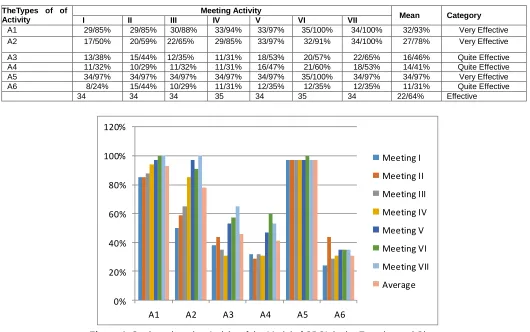
Syntax of the model of CBCL consist of five phases, namely: (1) phase 1. Delivering objective, Giving Motivation and Apperception, (2) Phase 2. Organize the students into groups and Delivering learning how to learn, (3) Phase 3. Guided group work, (4) Phase 4. Guiding and Class Discussion (5) Phase 5. Reflection and Evaluation. Every phase describes the sequence of lecturer and students activities during teaching and learning process. The analysis result of the model of CBCL development at the validity and the practicality test phase, it can be seen that the all of assessment aspects obtain validity percentage value with valid and very valid category and all of assessment aspects obtain practicality percentage value with practical and very practical category. So that, the try out can be continued to the effectivity phase. The effectivity lied on the aspects of (1) students learning activity at the model of CBCL; (2) students learning interest at the model of CBCL (3) the value of IWS; (4) the final test score of mathematical connnection ability [9] and (5) interview with the lecturer and students.
Table 1. The Analysis Result of Students Learning Activity of The Model of CBCL in The Experimental Class
TheTypes of of Activity
Meeting Activity
Mean Category
I II III IV V VI VII
A1 29/85% 29/85% 30/88% 33/94% 33/97% 35/100% 34/100% 32/93% Very Effective A2 17/50% 20/59% 22/65% 29/85% 33/97% 32/91% 34/100% 27/78% Very Effective A3 13/38% 15/44% 12/35% 11/31% 18/53% 20/57% 22/65% 16/46% Quite Effective A4 11/32% 10/29% 11/32% 11/31% 16/47% 21/60% 18/53% 14/41% Quite Effective A5 34/97% 34/97% 34/97% 34/97% 34/97% 35/100% 34/97% 34/97% Very Effective A6 8/24% 15/44% 10/29% 11/31% 12/35% 12/35% 12/35% 11/31% Quite Effective
34 34 34 35 34 35 34 22/64% Effective
0% 20% 40% 60% 80% 100% 120%
A1 A2 A3 A4 A5 A6
Meeting I
Meeting II
Meeting III
Meeting IV
Meeting V
Meeting VI
Meeting VII
Average
Figure 1. Students learning Activity of the Model of CBCL in the Experimental Class
b. The Questionnaire of Students Learning Interest in the Model of CBCL
The questionnaire of students learning interest in the model of CBCL was filled by 35 students of experimental class. The analysis result of students learning interest questionnaire of the model of CBCL in the experimental class can be seen on table 2, as follow:
Table 2. The Result Analysis of Students Learning Interest of the Model of CBCL in The Experimental Classroom
Sub
Variable Indicator
The Statement
Number Mean
Percen
tage Category
Positive Negative
The interest to the calculus material
a. The interest related with the nature of the material
2,18 1,3,13 3,90 78% Effective
b. The interest
related with life 14,17,20 6,7,19 3,67 74% Effective The
interest to the calculus material
a. The interest related with the learning model
4,9,22,24 5,12,21 3,84 77% Effective b. The interest
related with the students activity in learning
16,23 8,10,11,15 3,97 79% Effective
3,85 77% Effective
Table 2 shows the average percentage effectivity of students learning interest of experimental class in the model of CBCL with the four indicators such as: the interest related with the nature of the material is 78% (effective), the interest related
236 shows the percentage of student’s effectivity on learning
interest in the experimental class, as follow:
Figure 2. The Effectivity on Students Learning Interest in The Experimental Class
c. The Individual Working Sheet (IWS) Score
The IWS the model of CBCL handbook consists of IWS which is done individually, in order to see the students’ mathematical
connection ability of the model of CBCL in the experimental class which can be seen in the table 3, as follow:
Table 3. The Analysis of Students’ Score on IWS of the Model of CBCL in The Experimental Class
The Meeting of IWS
Mean Deviation
Standard Percentage Category
I 76.7 13.51 77% Effective
II 76.1 16.91 76% Effective
III 64.9 13.16 65% Quite Effective
IV 69.1 16.43 69% Effective
V 74.2 12.64 74% Effective
VI 71.3 11.11 71% Effective
VII 87.1 13.44 87% Very Effective
Mean 74.2 13.89 74% Effective
Table 3 shows that the experimental students of the model of CBCL average percentage of IWS score in 7 times meetings is 74% (effective) within the range of values 65% (quite effective) up to 87% (very effective).
d. The Learning Result Test of Mathematical Connection Ability
The final test aimed to see the difference of student’s mathematical connection ability among the students of control class that were taught by using conventional learning model. Table 4 shows the analysis result of students’ score on mathematical connection ability of the model of CBCL in the experimental class compared with the students’ score on mathematical connection ability of the model of CBCL in the control class, as follow.
Table 4. The Mathematical Connection Test Result Distribution in The Experimental Class and Control Class
Class N Mean SD Xmax Xmin Control 32 64.97 10.12 81 45 Experiment 35 73.37 7.00 88 58 Table 4 shows that the mean of students mathematical connection ability that were taught by using the model of CBCL model is higher than the mean of students mathematical connection ability that were taught by using conventional learning. Based on the standard deviation data, it can be seen that the score of students mathematical connection ability has a wider distribution compared with control class. The minimum
score of mathematical connection ability of experimental class is higher than control class.
1) The Analysis Requirement Test a) The Normality Test
The first analysis requirement test is the normality test with Kolmogorov-Smirnov and Shapiro-Wilk test by using SPSS software. The test result can be seen on Table 5.
60% 70% 80% 90%
1 2 3 4 5 6 7 8 9 10 11 12 13 14 15 16 17 18 19 20 21 22 23 24
Table 5. The Result of Normality Test of Control Class vs Experiment class
Class Kolmogorov-Smirnova Shapiro-Wilk Statistic Df Sig. Statistic Df Sig. Ability
Mathematical Connection
Control ,088 32 ,200* ,960 32 ,277
Experiment ,079 35 ,200* ,990 35 ,980
*. This is a lower bound of the true significance. a. Lilliefors Significance Correction
Table 5 shows that the significance value of all data 0,05,
where control class = 0,2 > 0,05 and experiment class = 0,2 > 0,05, so that it can be concluded that the students’ score of experimental class as well as control class on mathematical connection ability are normally distributed.
b) The Homogeneity Test
The next analysis requirement test is homogenity test. The test result can be seen on Table 6.
Table 6. The Homogenity Test Toward The Students’ Score on Mathematical Connection Ability by Using Levene Test
Levene Statistic df1 df2 Sig.
3,399 1 65 ,070
Table 6 shows that the value of significance is = 0,070 0,05, so it can be concluded that the data has a homogeneous variety to the test score of mathematical connection ability for both the experimental class and control class.
c) The Hypothesis Testing
Based on the analysis requirement test, every group of data distributed normally and homogeneous. The experimental research design used is t test. The management of hypothesis testing of this research is done by using SPSS software. The calculation result by using t test can be seen on table 7.
Table 7. The Hypothesis Testing Toward The Mathematical Connection Ability Test Score by Using t Test
Class Mean Df t count t table Significance Control 64.97
65 3.979 1.645 0.000 Experiment 73.37
The criteria of hypothesis testing are if , it means that H0 is accepted and if tcount> ttable , it means that H0 is rejected. Table 7 shows that the value of t count for the distribution of mathematical connection ability is 3,979. The real level ( and df = 65 shows ttable 1,645, because tcount> ttable, so H0 is rejected, it means that the students mathematical connection ability taught by using CBCL is higher than the student mathematical connection ability taught by using conventional learning.
e. Interview with the Lecturer and Students.
Based on the interview result, it can be known that the practitioner understand about the guidance in the Lecturer Working Handbook Calculus Based Contextual, the practitioner never know the model of CBCL like what the research has designed. According to the practitioner, at the first and the second meeting, the time available for the students to finish Group Working Sheet (GWS) and IWS is not
enough, since the students is still adapting the model of CBCL which is still new for both the practitioner and the students, the questions of GWS and IWS are in the moderate or difficult level for moderate level group and low level group of students, it can be seen from their IWS score, about the ease and the use of the Lecturer Working Handbook Calculus Based Contextual which is effective in use and the design which applied to the Lecturer Working Handbook Calculus Based Contextual is interesting for the practitioner. Based on the interview result with students, it can be known that according to the students, the guidance instruction of Students Working Handbook Calculus Based Contextual is clear and understandable. This book helps students to understand the learning material, especially in dealing with concept mapping. This is an interesting book, however, it should be enriched more, so that it can be much more interesting. The questions available in this book are in the moderate level, so that some of the questions in GWS and IWS can be answered, otherwise. The time given to fill the GWS and IWS in the Students Working Handbook calculus based contextual is enough.
5. CONCLUSION
Based on the result of the model of CBCL improvement at the effectivity test step shows that the four aspects of assessment obtain effectivity percentage value with effective category. They are, the observation result of students learning activity of the model of CBCL is 70,5% with effective category, the students learning interest questionnaire of the model of CBCL is 76,5% with effective category, the score of IWS is 74,39 with effective category. The students mathematical connection ability taught by using the model of CBCL is higher than the student mathematical connection ability taught by using conventional learning. Based on the interview result with the lecturer and the students, it can be concluded that the Lecturer Working Handbook and the Students Working Handbook are effective right in the time, the use and the benefit.
6. IMPLICATION
The Model of Calculus Based Contextual Learning shows effectivity to be implemented in the learning. Because it can facilitate students to improve their mathematical ability which has impact to the construction ability and knowledge inquiry, learning ability with multi context, effective thinking, analytical ability, cooperation ability in group and increase the interest and students learning motivation.
7. SUGGESTION
238 improve the students interest and learning motivation.
b. The test to the resulted product is still limited to the Tadris major of Mathematics IAIN Imam Bonjol Padang only. It is suggested to the researchers who are interested to implement to the other Mathematics major of other university. c. The research product is still limited to the Lecturer
Working Handbook and students Working Handbook. It is suggested that calculus lecturer and the researchers who are interested to make a teaching book based contextual. d. The material being discussed at the Lecturer Working
Handbook and The students Working Handbook is the derivative one and for the derivative use. It is suggested that calculus lecturer and the researchers who are interested to improve to other calculus I material.
8. REFERENCE
[1] Berns, R and Se-Stefano,J, 2001. Best Practise in Contextual Teaching and Learning (A Research Monograph). Office of Vocational and Adult Education.
[2] Berns, R.G and Erickson, P.M, 2001. Contextual Teaching and Learning. The Highlight Zone : Research a Work No.
5 (Online) Available: http:
//www.ncte.org/publications/infosyntesis/highlight 05/index.asp ?dirid = 145 & dspid =1.
[3] Bishop, A.J., Clements, K., Keitel, Ch., Kilpatrick, J. and Laborde, C. (eds.): 1996, International Handbook on Mathematics Education, Kluwer Academic Publishers, Dordrecht.
[4] Czocher, Jennifer & Baker, 2010. Contextual Learning in Math Education for Engineers. The Ohio State University, Department of Mathematics, Columbus, OH 43201, USA.
[5] DiSessa, A.A., Hammer, D., Sherin, B. and Kolpakowski, T.: 1991, ‘Inventing graphing: meta-representational expertise in children’, Journal of Mathematical Behavior 10, 117–160.
[6] Fauzan, A. 2002. Applying Realistic Mathematics Education in Teaching Geometry in Indonesian Primary Schoos. Doctoral Dissertation, University of Twente, Enschede, The Netherlands.
[7] Gravemeijer, K.: 1994, ‘Educational development and educational research in mathematics education’, Journal for Research in Mathematics Education 25 (5), 443–471.
[8] Gravemeijer, K.: 1999, ‘How emergent models may foster the constitution of formal mathematics’, Mathematical Thinking and Learning 1 (2), 155–177
[9] Gravemeijer, Koeno & Doorman, Michiel, 1999. Context Problems in Realistic Mathematics Education: A Calculus Course as an Example. Educational Studies in Mathematics, Kluwe Academic Publisher. The Netherlands.
[10]Johnson, Elaine B, 2002. Contextual Teaching and Learning . California: Corwin Press.
[11]Joyce, B, Weil, M., with Shower, 1992. Models of Teaching. Boston: Allyn & Bacon.
[12]Kaput, J.J.: 1994b, ‘Democratizing access to calculus: new routes to old roots’, in A.H. Schoenfeld (ed.), Mathematical Thinking and Problem Solving, Lawrence Erlbaum Associates, Publishers, Hove, UK.
[13]Latorre, Donald R.; Kenelly, John W.; Reed, Iris B.; Biggers, Sherry, 2007. Calculus Concepts: An Applied Approach to the Mathematics of Change, Cengage Learning, ISBN 0-618-78981-2, Chapter 1, p 2 at http://id.wikipedia.org/wiki/Kalkulus.
[14]Meira, L.: 1995, ‘The microevolution of mathematical representations in children’s activity’, Cognition and Instruction 13 (2), 269–313.
[15]National Council of Teacher of Mathematics (NCTM), 2000. Principles and standars for school mathematics. USA: The National Council of Teachers of Mathematics, Inc. www.nctm.org.
[16]Nieveen, Nienke, 2013. Formative Evaluation in Educational Design Research at Tjeerd Plomp and Nienke Nieveen (Ed). An Introduction to Educational Design Research. SLO. Netherland Institute for Curriculum Development.
[17]Penglase, 2010. Learning Approaches in University Calculus: The Effects of an Innovative Assessment Program. University of Western Sydney.
[18]Plomp, Tjeerd, 2013. Educational Design Research: An Introduction to Educational Design Research.
[19]Streefland, L.: 1990, Fractions in Realistic Mathematics Education, a Paradigm of Developmental Research, Kluwer Academic Publishers, Dordrecht.
[20]Tall, D.O.: 1985, ‘The gradient of a graph’,Mathematics Teaching111, 48–52.
[21]Tall, D.O.: 1986, ‘A graphical approach to integration’,Mathematics Teaching 114, 48–51.
[22]Tall, D. (Ed.): 1991, Advanced Mathematical Thinking, Kluwer Academic Publishers,Dordrecht.
[23]Treffers, A.: 1991, ‘Didactical background of a mathematics program for primary education’, in L. Streefland (ed.),Realistic Mathematics Education in Primary School,CD-ß Press, Utrecht, pp. 21–57.
[24]Zhang, Biao, 2003. Using Student-Centred Teaching Strategies in Calculus. Department of Mathematics Harbin Institute of Technology Harbin 150001 People’s Republic of China.