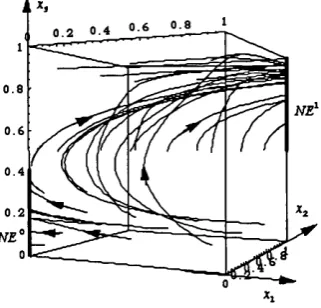
Co n t in u o u s-Time Selection Dynamics
AND Their Eco no m ic Applications
by Giovanni B. Ponti
Submitted to the Department of Economics in fulfilment of the requirements for the degree of
Doctor of Philosophy at the
University College Lo n d o n
ProQuest Number: 10046171
All rights reserved
INFORMATION TO ALL USERS
The quality of this reproduction is dependent upon the quality of the copy submitted.
In the unlikely event that the author did not send a complete manuscript
and there are missing pages, these will be noted. Also, if material had to be removed,
a note will indicate the deletion.
uest.
ProQuest 10046171
Published by ProQuest LLC(2016). Copyright of the Dissertation is held by the Author.
All rights reserved.
This work is protected against unauthorized copying under Title 17, United States Code.
Microform Edition © ProQuest LLC.
ProQuest LLC
789 East Eisenhower Parkway
P.O. Box 1346
Abstract
In the recent years, there has been an impressive advance in the study of models in which (boundedly rational) economic agents adjust their behavior over time, in reaction to the additional information they acquire as time progresses.
Some of these models involve the use of autonomous continuous-time dynamical systems, known in the literature as selection dynamics, in which the adjustment process is directly linked to the relative performance of each strategy at each given point in time.
The aim of the thesis is to contribute to this line of research exploring the formal properties of these dynamics, as well as modeling suitable economic environments in which these dynamics can be applied.
In particular, the thesis explores the behavior of selection dynamics in three different game- theoretic frameworks: (game-form) mechanisms, extensive form games and games with pre-play communication.
A (game-form) mechanism is a game whose equilibria satisfies certain desirable properties but which does not necessitate vast amount of knowledge by the authorities {'the planner") to put it in place. Instead, this social arrangement should basically self police itself, and the planner should only make sure that the rules of the game are correctly followed by the agents.
An extensive form game is a game in which players move sequentially, and make use of the information they acquire as the game proceeds to improve their performance.
A game with pre-play communication is a game which is preceded by a stage in which the agents are allowed to send costless signals to their opponent, in order to influence their behavior.
Acknowledgements
First, I would like to thank my supervisors, Ken Binmore and Rob Seymour. I thank Ken for introducing me to the magic of game theory, and for showing me some of his best “tricks”.. Without his creative support, this work would be still a long way to its end.
Quoting an Italian pop song, I thank Rob for explaining my own ideas in a way I can understand. He also co-authored the paper on which chapter 4 is based.
I also thank Ken and the Centre for Economic Learning and Social Evolution (ELSE) which provided me financial support in my final year at UCL. Financial support from the European Union, through the “Human Capital Mobility” Program, is also gratefully acknowledged.
During my year at UCL 1 had the chance to work and interact with many colleagues. Among them, 1 would like to thank explicitly those who had a major impact on this thesis: Murali Agastya, Paolo Battigalli, Tilman Borgers; Antonio Cabrales (who co-authored the paper chapter 2 is based on), Antonella lanni and Larry Samuelson.
C
o n t e n t s
1. INTRODUCTION
1.1 Evolutionary Dynamics and Equilibrium Analysis. 7
1.2 Some Simple Examples 10
1.3 Continuous-Time Evolutionary Dynamics. History and Main Results 15
1.4 Economic Microfoundations 18
1.5 Selection Dynamics and Dominated Strategies 2 2
1.6 Selection Dynamics and Games of Perfect Information 26
1.7 Selection Dynamics with Drift 27
1.8 Plan of the Thesis 29
Appendix. 33
2. IMPLEMENTATION, ELIMINATION OF WEAKLY DOMINATED STRATEGIES AND EVOLUTIONARY
Dynamics
2.0 Abstract 35
2.1 Introduction 35
2.2 The model and the dynamics. 39
2.3 An Example 42
2.4 Local results for the general game 44
2.5 More on the example (stability with/out drift) 47
2.6 Fictitious play and Sjostrom's mechanism 51
2.7 Conclusions 53
Appendix 54
3. Cyclesof Learninginthe Centipede Game
3.0 Abstract 65
3.1 Introduction 65
3.2 The Centipede Game 68
3.3 The Dynamics 70
3.4 The MS Dynamics and the Centipede Game 71
3 5 «Cycles of learning»: some simulation results 77
3.6 Conclusions 83
4. Conventionsand Social Mobiutyin Bargaining Situations
4.0 Abstract 85
4.1 Introduction 85
4.2 The Basic Model 88
4.3 Some General Theory 91
4.4. One-custom society 93
4.5 Social mobility 96
4.6 Two-custom society 100
4.7 The full 64-custom society 111
4.8 Conclusions 112
Appendix 114
C
o n t in u o u s
-T
im e
S
elec t io n
D
y n a m ic s
C
h a pter
1
I
n t r o d u c t io n
1 .1 . E
v o l u t io n a r yD
y n a m ic sa n dE
q u i u b r i u mA
n a l y s isSince Adam Smith [1776] introduced the notion of natural price, as "...the central price, to which the prices o f all commodities are continually gravitating..." it is difficult to think of an
idea that has been more widely applied in economic theory than the concept of an equilibrium. Yet, it is even more difficult to name another concept about whose interpretation has evolved so sharply along the years. Consider, for example, the alternative equilibrium notions proposed by Walras [1874], Cournot [1838], Marshall [1916], Keynes [1936], Arrow and Debreu [1954], Hahn
[1973], Lucas [1972], Cass and Shell [1983]...
Despite its pervasive use in economic modeling, serious questions concerning the foundational aspects of equilibrium analysis remain, questions that are too serious to be dismissed as mere academic puzzles. Market fluctuations and imperfections are endemic in real- life economics. From the unemployment equilibria of Keynesian memory, to the various real business cycle and disequilibrium theories proposed in later literature, the focus on equilibrium
analysis has been continuously challenged, on various grounds and from different perspectives.^ Clearly, game theory cannot avoid considering the foundational aspects of equilibrium analysis, since it is an equilibrium concept, namely Nash equilibrium, which has made its fortune. In this respect, we shall follow Binmore [1987-8] in distinguishing between two alternative justifications of equilibrium analysis which have been maintained by the game- theoretic tradition:
• an eductive justification, which relies on the agents’ ability to reach equilibrium through careful reasoning. Since agents are fully rational, they can always correctly predict their opponents’ behavior and maximise against it;
• an evolutive justification, which relies on the possibility that (partially rational) agents reach equilibrium by means on some adjustment processes.
The aim of this dissertation is to contribute to the latter methodological approach with the aid of evolutionary dynamics, which are meant to describe how imperfectly rational economic agents may adjust their behavior over time, in reaction to the additional information they acquire as time progresses. In other words, the evolutive approach we pursue tries to answer the following (apparently simple) question:
how do we learn to play games?
We shall break this grand question into smaller pieces. By doing so, we will introduce the main methodological assumptions on which the evolutionary paradigm (or, at least, the evolutionary paradigm we follow in this dissertation) is based.
• Where do we leam ? That is: which are the institutional (strategic) features of the
environment in which our agents are assumed to operate? In this respect, the literature to which we refer makes the following assumption: in formalising how people’s behavior changes over time it considers models in which the interaction structure is exogenously given and fixed, in the form of an (infinitely) repeated game.2 Moreover, and perhaps more crucially, the strategy space (i.e. the set of possible behaviors our agents may adopt) coincides with the strategy space of the stage game. In this respect, evolutionary games differ from other strategic frameworks like differential games (in which the current payoff is a function of time) ot supergames (in which strategies are defined over time-paths).
It may be worthwhile noting that any justification of this (drastic) assumption, apart from mathematical tractability, contains serious weaknesses. It is impossible to consider two situations as being absolutely id en tica l, or in which we totally neglect the future consequences of our actions. However, when interaction is anonymous (i.e. takes place among a large population of agents who have no prior knowledge of the identity, the history, or any other relevant characteristics of their opponents), this framework appears to be more reasonable (and this is the reason why the literature has focused almost entirely on this case).
• What do we leam (from)? In this respect, we follow Selten [1991] by distinguishing three
class of learning models:
(i) rote (individual) learning models, i.e. models in which success and failure directly influence
choice probabilities;
(ii) imitation (social) learning models, in which success and failure o f others directly influence
choice probabilities;
(iii) belief \ t2inm% models, in which experience has only a direct effect on players’ beliefs, usually characterised as probability distributions over the possible states of play.)
In the dissertation, we will mainly deal with models of the first two categories, in which players need not know (or care) a great deal about the game they play, other than the payoff they (or other agents in the population) obtain.^
A related question along these lines could be the following:
• Do we lea m only from current states o f events, or do we remember, making constant use
o f the information acquired in the past? In formalising how people’s behavior changes over
time, we shall consider models in which there is no memory. The quantitative features of the adjustment process (i.e. the vector field) are in fact completely determined by the behavior of the system at each point in time.)
Numerous other questions could be asked^, but we shall stop here. To address these problems correctly, we need a theory of the m ind which accounts for the cognitive processes by which agents make their decisions, in games as well as in other circumstances. Unfortunately, no such a theory exists, and perhaps, never will. All we have is a set of conflicting paradigms, which one can use to shed some partial light on one of aspect of the problem.
The behavioral paradigm we shall follow is that of evolutionary gam e theory. In their standard formulation, evolutionary models are based on the assumption that agents’ behavior is genetically programmed, i.e. encoded in the genes which characterize each agent’s type. If
such a representation is to be applied to study economic environments, it has been argued, this can only be at a metaphorical level. Borgers [1996] provides three good reasons why it should be SO:
• it is not practically feasible, given the state-of-the art knowledge in genetics, to derive predictions of human behavior by appealing to its genetic determination;
• the way in which genetic codes determine behavior seems to be very complicated;
• the adaptation of human genes appears to occur so slowly that predictions which rely on this mechanism appear to be problematic.
)A typical example of a belief learning model is the classic fictitious play dynamics, first introduced by Brown [1951]. According to fictitious play, the agent select, at each point in time, the pure strategy which maximises utility against the mixed strategy in which probabilities equal the relative frequency with which each pure strategy has been observed in the past. Recent papers in his research field include Jordan [1991], Fudenberg and Kreps [1988], Kalai and Lehrer [1191], Milgrom and Roberts [1990]. See Battigalli et a/. [1992] and Fudenberg and Levine [1997] provide comprehensive surveys on this research field.
'^A noticeable exception is the model contained in Chapter 4, in which belief learning will also be considered.
)Some might regard also this assumption as unreasonable. Take for example, the case in which the dynamics exhibit limit cycles like, for example, the model of chapter 3 of this dissertation. This would imply that the agents are not able to recognise this cyclic pattern and modify their response in reaction to it. As Fudenberg and Levine [1997] argue: "we suspect that i f cycles persisted long enough the agent would eventually use more sophisticated inference rules that detected them; fo r this reason we are not convinced that models o f cycles in learning are useful descriptions o f actual behavior... ” (p. 3). The fact that the system is autonomous simply discards this possibility: whenever the agents find themselves in the same state (i.e. play a mixed strategy in the limit cycle set), the adjustment process (i.e. the vector field of / ) is the same, and therefore, leads to an infinite repetition of that cyclic behavior.
Such criticisms take for granted that evolution is to be understood in a strictly biological sense. However, social evolution is also worthy of study, and evolutionary dynamic models have been justified by some recent literature which derives dynamic adjustment processes similar to those studied here starting from concrete models of social interaction.^ But before we look at these models in more detail, it will be instructive to examine some simple examples from a biological perspective.
1 .2 S
o m eS
im p l eE
x a m p l e sConsider the following 2x2 game:
C
DX C
l - x D
3 ,3 2 , 4 4 , 2 1,1
Figure l . l
The game Chicken
known in the literature as the game Chicken. In a biological context (see Maynard Smith [1982]), this payoff structure can be used to model the interaction between two animals contesting a resource of fixed value (6, in our example), which is efficiently distributed only if at least one of the two contestants “cooperates” (i.e. does not fight) Alternatively, following Schelling [I960], one can think of Chicken as a tacit bargaining situation: given that the players differ in their ranking of the various equilibrium outcomes, the choice of a particular equilibrium has clear distributional effects, since a better bargain for a player always corresponds to less for the opponent.
Let “Anna” (A) denote the row player, and “Beppe” (B) the column player. First notice that the game has two asymmetric Nash equilibria in pure strategies, namely (C,D) and (D,C), and a symmetric Nash equilibrium in mixed strategies in which both strategies are played with equal probability. We start by assuming that Anna and Beppe are drawn from a single (large) population of agents whose behavior is genetically encoded. Let x (resp. 1-%) denote the relative frequency of agents programmed to play strategy C (D). Suppose that the game’s payoffs represent the fitness, measured as the number of offspring per time unit. Each individual offspring is absolutely identical to its single parent. Under the above assumptions, it can be shown9 that the fraction x of the population playing strategy C can be approximated by the following differential equation:
X = x{{2 + x ) - ((2 + x)x + (1 + 3x)(l - x))) = x (l - x)(l - 2x) (1.2.1)
7See § 1.4.
^Following a well-established tradition, throughout the dissertation we shall label the two strategies C (for cooperate) and D (for defect), the latter identifying the m in m a x strategy of the game.
x ( t )
in which the growth rate equals the difference in payoffs between the pure strategy C and the mixed strategy in which the pure strategy C (D) is played with probability x (\-x). We call the latter the popu lation strategy. We will make constant reference, throughout the dissertation, to dynamic processes of this kind, known in the literature as Replicator Dynamics, which have been regarded as stereotypical natural selection processes.
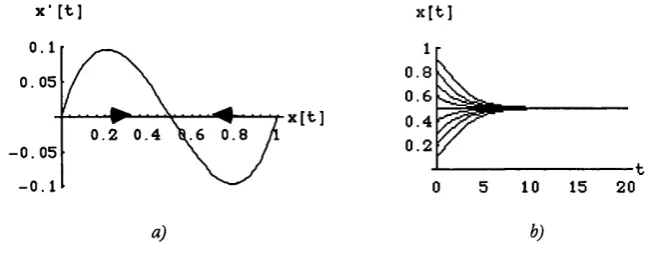
We shall start by looking at the dynamics (1.2.1) in more detail. First note that (1.2.1) has three restpoints, i.e. solutions of the equation i = 0. These restpoints are % = 0, x = l and a: = - . If the system starts at any of these points, it will remain there forever. We shall be interested in the evolution of (1.2.1) when % (0)e(0,l), that is, when both strategies are present in the initial population:
• Proposition l . l . Any interior solution % (x(0),f) o f (1.2.1) converges to 1 / 2 .
To see why, look at the following figure 1.2. In figure l.2a) we plot x'(t) as a function of x(t), while in figure 1.2b) we trace some interior trajectories of (1.2.1).
X [ t ]
0. 05
x [ t ]
-0. 05
x [ t ]
0
0
0 0
t
10 15 2 0
0 5
a) b)
FIGURE 1.2
The Replicator Dynamics and the game Chicken in a single-population environment
As figure 12a) shows, %%f) is positive (negative) for any x{t) below (above) 1/2. Therefore, any interior trajectory must converge to the point which corresponds to the (symmetric) mixed strategy equilibrium.
Consider now an alternative scenario. Assume instead that the agents are drawn from two distinct populations; one population of Annas and one population of Beppes. matched at random to play the game of figure 1.1. Since there are now two reference populations, it is no longer true that the relative frequency of Annas who cooperate should equalise (in expected terms) the relative frequency of Beppes who cooperate. Other things being equal (i.e. we shall maintain
the assumptions about the reproductive process, which now takes place in the two separate populations) we look at the dynamic properties of this new setting:
0
0
0
0
0 . 2 0 . 4 0 . 6 0 . 8 1
Figure 1.3
Replicator Dynamics and Chicken in a 2-population environment.
Let X be the relative frequency of Beppes who defect, and y be the relative frequency of Annas who cooperate. Figure 1.3 displays a phase diagram of the Chicken game given this new two-population setting. The picture is now quite different: the two asymmetric (strict) Nash equilibria in pure strategies attract any interior trajectory other than the one which corresponds to the Nash equilibrium in mixed strategies at (1/2,1/2).
• Pr o p o s it io n 1.2. Any generic interior trajectory of the Replicator Dynamics, in the two- population case, converges either to (C,D) or to (D,C).
Pr o o f. See Weibull [1995], Chapter 5. #
Consider now another modification of the strategic interaction proposed above. Assume that now players move sequentially: Anna moves first, deciding whether to cooperate or to defect. If Anna cooperates, the games ends; if Anna defects, then Beppe has to decide whether to reciprocate defection or to cooperate in return. Under this new assumption, the strategic scheme can be represented by means of the following extensive-form game of perfect information:
[ . 1 2 j
l - x X
C D
y C 2 , 4 2 , 4
F ig u r e 1 .4
V[\t Entry %2mt
known in the literature as the Entry game^i. The latter can be interpreted as a situation in which Anna (the potential entrant) has to decide whether to challenge Beppe (i.e. to play D) under the threat that Beppe (the incumbent) may fight back (and this would lead to an inefficient outcome for both players). On the other hand, she also knows that she can credibly commit herself to defection, since her action is perfectly observed by Beppe before he is asked
to move.
We will analyse this game in more detail later in this chapter; 12 at this point we simply note that the game of figure 1.4 has a Nash (subgame-perfect) equilibrium in pure strategies, namely (D,C), and a com pon en t (that is, a closed and connected set) of Nash equilibria with the
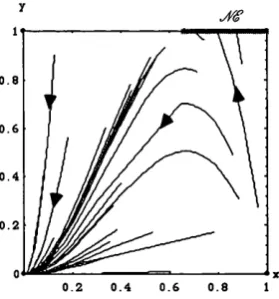
common property that Anna opts out with probability 1 and Beppe plays his (weakly dominated) strategy D with some positive probability . Let the symbol ./^ d e n o te this component. In the following figure 1.5 we trace some interior trajectories of the Replicator dynamics of the Entry
game.-0
0
0
0
0 . 8 1
0 . 2 0 . 4 0 . 6
FIGURE 1.5
The Replicator Dynamics and the Entry game
Note that there are interior trajectories which lead to the Nash equilibrium component
I n other words, the players’ limiting behavior may fail to eliminate strategies which are weakly dominated:
• P r o p o s i t i o n 1.3. Any interior trajectory of the Replicator Dynamics converges to a Nash equilibrium of ihe Entry game, with each (x.y) e ./^ b e in g the limit point of some interior solution.
Pr o o f. See Binmore etal. [1995], Proposition 1. é
We conclude this brief overview by returning to coming back to our original example, the game Chicken played by a single population. One might argue that the reason why, in equilibrium, the agents get (on average) less than the full share of the cake^) is that the game is symmetric, but has with asymmetric (efficient) equilibria. Given that players are drawn from a
single population, only symmetric mixed strategy profile are possible, therefore the possibility of
a convergence toward one of the two efficient asymmetric equilbria is excluded.
However, even if payoffs are distributed in a symmetric fashion, it is difficult to think of a real- life situation in which the position of the two players is absolutely interchangeable. As Maynard Smith [1982] points out; “..Most actual contests, however are asymmetric. They might be between a male and a female, between an old an d a young or a small a n d large individual,
or between the owner o f a resource a n d a non-owner. An asymmetry m ay be perceived
beforehand by the contestant; if so, it can a n d usually will influence the choice o f action.
One might then argue, along these lines, that if the agents’ possibilities were somehow enlarged, to allow some kind of “communication” before the game is played (or simply to condition their choice to some signal they receive, without any explicit communication actually taking place), this new feature of the game might solve their (anti)coordination problem, providing the (anti)coordination device they need to play efficiently in the stage game. In the terminology of game theory, such costless pre-play communication is often termed as cheap talk.
Following Maynard Smith [1982], assume that the (unmodeled) matching process is such that the stage game is always played between a female (Anna) and a male (Beppe), with Annas and Beppes present in the population in equal number. i5Now introduce a new type B to the cooperators and the defectors labeled C and D. The bourgeois type which can condition its behavior on its own gender. In particular, any bourgeois will play D if Anna, and C if Beppe.
X C
y D
l - x - y B
3 ,3 2 , 4 5 7 2 ’ 2
4 , 2 1,1
5 3 2 ’ 2 7 5
2 ’ 2 3 5 2 ’ 2
3 ,3
x [ t ]
0 . 2 0 . 4 0 . 6 0 . 8 1
C
FIGURE 1.6
Maynard Smith’s “Hawk-Dove-Bourgeois” Game
^^Since the expected payoff, for each player, in the case of the mixed strategy equilibrium is equal to 2.5. ^^See Maynard Smith [1982], p. 22.
• Pr o p o s it io n 1.4. Any interior solution of the Replicator Dynamics in the case of the “Hawk- Dove-Bourgeois” Game evolves to B.
PROOF. See the Appendix, é
In other words, only the agents who are able to condition their strategy on their player position in the stage game will eventually
survive.i^
We have here an evolutionary explanation for the emergence of asocial norm o f chivalry!To summarise: we are now in possession of new techniques which allow us to develop more sophisticated evolutionary models (both with respect to the stage game and the dynamics) in which asymmetric and sequential structures of various forms can be
analysed.i^
As our brief overview suggests, these specifications matter, as they do indeed in traditional game-theoretic analysis. However, evolutionary models seem to provide answers to these problems which are closer to our intuition, and to the experimental evidence. The aim of this dissertation is to contribute to this line of research, both on the theoretical side (exploring the formal properties of these dynamics), and by providing interesting economic problems to which this methodology can be fruitfully applied.1 .3 . C
o n t i n u o u s-T
im eE
v o l u t io n a r yD
y n a m i c s. H
i s t o r y a n dM
a i nR
e s u l t sThis section provides a summary of the theoretical results which will be used in subsequent analysis.
Before doing so, we choose the notation. Let 3 denote a (finite) set of players, whose generic element will be denoted by i. The players repeatedly interact, playing a given (finite) normal form game r = { 3 ,S'.,»,}. A player’s behavior is formalised as the mixed strategy she adopts at each point in time. Denote with r^{t), i e 3 , the probability at time t with which player i, selects her pure strategy 6 S,., with r f t ) = {r. (t ) ) denoting the vector collecting such probabilities. Thus, we have rft) e A,., with A. denoting the |S, - l|-dimensional simplex which describes player i ’s mixed strategy space. We also consider the vector r(t) = {/;(0},i e 3 as \he state o f the system, defined over the state space A = x^A,., with A” denoting the relative interior of
A ,
that is, the set of completely mixed strategyprofiles.^®
• Assu m pt io n l.l. The evolution of r(t) is given by the following system of continuous-time differential equations:
similar approach has been proposed in the analysis of coordination games in which pure strategy equilibria are Pareto rankable. In this case cheap talk acts as a coordination device for those who can condition their actions on such costless signal. See Robson [1990], Blume, Kim and Sobel [1993], Schlag [1993].
clear signal is the growing literature which reviews and organise, in the form of monographs if not textbooks, the state-of-the- art research in the field. Among others, see Fudenberg and Kreps [????], Fudenberg and Levine [1997], Samuelson [1997], Weibull [1995], together with the classic Hofbauer and Sigmund [1988].
(1.3.1)
We refer to the autonomous system / = (/;) = ( ( / ; ' , . . . , as these/ecr/ow dynam ics, i. e. the term that captures the relevant forces that govern the players’ strategy
revisions.. 19
Some terminology is needed to specify the set of assumptions on f\• D e f i n i t i o n l.l. f is said to yield a (continuous-time) regu lar dynamic if the following conditions are satisfied:
• Lipschitz continuity2o • £ /; * (r (0 )= 0 ;/G 3
keS,
lim exists and is finite.
This regularity assumption has the implication of making the growth rates ^ (0 continuous over the state space A, and that (1.3.1) has a unique solution through any initial state which leaves A, as well as A", invariant: any solution path starting from (the relative interior of) A does not leave (the relative interior of) A :
r*(0)>0<3>/}*(0>0;V r>0
We have here a “no creation/no extinction” property: any pure strategy which is played with positive probability at time zero will also be played in any finite time interval. On the other hand, if a strategy is not played at time zero, it will never be used.
To complete the description of the dynamics we need to establish a formal link between the selection dynamics and the game payoffs. We do so by introducing what are probably the most popular evolutionary dynamics, that is, the Replicator Dynamics (Taylor and Jonker [1978]).
F* (t) According to the Replicator Dynamics the growth rate of strategy s f, yf(KO) = ~i— , equals
^ (0 the (expected) payoff difference between strategy sf and the mixed strategy /;.(r):
r^(t) = r^(t)(u.(sf,r_.(0) ~ (1-3.2)
Taylor and Jonker [1978] propose two alternative interpretations for (1.3.2):
^^Note that, as we noted earlier, there is an implicit “Markov” assumption in (1.3-1); the strategy revision process undertaken by the players is only affected by the current state r(t).
• there is a single agent for each player’s position i, who selects her pure strategy at time t starting from a probability distribution which follows the dynamics (1.3.2) as a result of some (unmodeled) learning adjustment process;
• there is a population o f agents who are genetically programmed to play a particular strategy. An (unmodeled) natural selection mechanism governs the relative shares of each type in the population, whose law of motion evolves according with (1.3.2).
While the latter interpretation seems to suit more closely the biological ev o lu tio n a ry metaphor we used earlier in this chapter, the former considers the evolutionary dynamics as a
proxy of an individual learning process. In the following § 1.4 both these interpretations will be derived formally.^i
Since the introduction of the Replicator Dynamics by Taylor and Jonker [1978], a plethora of alternative definition has been proposed, in order to capture within a more general framework the "success breeds success” intuition implicit in the dynamics (1.3.2). The first noticeable attempt in this direction leads to the notion oiselection dynamics due to Nachbar [1990]. In his paper, he defines a selection dynamics as a regular dynamics which satisfies the condition of monotonicity:
• Definition 1.2. A regular selection dynamics is said to satisfy the property of monotonicity (MS hereafter) if:
; M,.(5*,r_,.(0)> ,.(0) <=> 7,*(KO)^ 7,*'(KO) (13.3)
The condition of payoff monotonicity tries to capture an appealing property of the Replicator Dynamics: given the mixed strategy profile played at each point in time, more successful pure strategies grow at a higher rate, compared to poorly performing ones. Samuelson and Zhang [1992] extend the condition of mono tonicity to m ixed strategies, introducing the notion of aggregate monotonicity:
• Defin itio n 1.3. A regular selection dynamics is said to satisfy th e pro p erty o f aggregate monotonicity (AMS) if:
V(t,.,(t; ga,. ; M,.((j,.,r_,.(0) > M,(t7;,r_.(0) <=> ^ yf (K0)<7f ^ % 7 f(K 0 )< * (13.4) k e S, k e Sj
that is, if a mixed strategy cr,. yields a higher expected payoff than against the mixed strategy played by i ‘s opponents at time t, the vector field induced by /(K O ) should point “more” in
the direction of the former. The following condition of payoff positivity, also due to Nachbar [1990] 22, generalises the Replicator Dynamics in a different direction:
• Definition1.4. A regular selection dynamics is said to satisfy the property of payoff positivity (PPS) if:
Vj* g5,. ; r f(K O )^ 0 (1.3.5)
that is, only pure strategies which perform “better than the average” have a positive growth rate. The condition of payoff positivity can be relaxed by requiring instead that there is at least one pure strategy, among those which yield more than the average payoff, which has a positive growth rate.
• Definition 2.2. A regular selection dynamics is said to satisfy the p roperty o f w eak payoff positivity (WPPS) if for any r g A and i g 3 , there exists a jf g 5,. such that:
u f s ’l, r _ f t ) ) > uf r f t ) )
<=> y,*(KO) ^ 0
(1.3.6)
It follows from the definitions that A M S c M Sand W P P S c { MS u P P S ).23 It also turns out that WPPS is the more general class of continuous-time selection dynamics which satisfies the following property, to which we will make constant use throughout the dissertation:
• Proposition1.5. Suppose f is a WPPS dynamics. Then, if t g A is the limit to some interior solution, then r is a Nash equilibrium of T.
Pro o f. See Weibull [1995], Theorem 5 2 (c).û
1 .4
E c o n o m ic M ic r o f o u n d a t io n sIn this section, we shall review the literature which derives the evolutionary dynamics starting from an explicit model of social interaction. As we noticed earlier, the extent to which these (or similar) models capture the essence of concrete economic environments provides the limits within which the use of such dynamics can be applied in economic modeling.
There are basic two alternative “stories” which have been proposed to justify the use of selection dynamics in the context of economic learning. Not surprisingly, each story is based on one of the “informal” justifications provided by Taylor and Jonker [1978] for the case of the Replicator Dynamics. We shall look at each justification in more detail in the remainder of the section.
1.4.1. The “Individual Learning” Story: Learningby Reinforcement
5-To present this first class of models, we shall use as a reference the paper by Borgers and Sarin [1993]. In their model, two agents, Anna and Beppe, repeatedly interact to play a fixed normal form game. Their behavior is not fixed (as we assumed in § 1.2), but instead changes over time according to a very simple updating rule, which links the outcome of the stage game with the mixed strategy which will be used in the subsequent round. In particular, pure strategies which perform well against the opponents’ actions are reinforced, and the probability with which they are selected grows accordingly.
As one may notice, there is a clear shift in the reference framework from § 1.2. In Borgers and Sarin [1993] alternative strategies compete within the mind of the agents, as populations of ideas. As the authors observe «..Decision makers are usually not completely committed to ju st one set o f ideas, orju st one way o f behaving. Rather, several system o f ideas, or several possible
ways o f behaving are present in their m ind simultaneously. Which o f these predominate, an d
which are given less attention, depends on the experience which an individual makes...
This approach is not new, as it follows the tradition of Estes’ [1950] “stimulus sampling theory” of behavioral psychology, subsequently formalised in Bush and Mosteller’s [1951], [1955] stochastic learning theory, and in the theory of “adaptive economic behavior” proposed by Cross [1973], [1983] .25
Before summarising Borgers and Sarin findings on the relationship between the (stochastic) adjustment process they analyse and the (deterministic) dynamics studied in this dissertation, we shall describe the reference model more in detail. While the authors are mainly concerned with the relationship between their learning process and the Replicator Dynamics, we will modify slightly their assumptions to allow a higher degree of flexibility in defining the evolutionary dynamics.
Anna and Beppe are two individual players, who are engaged in a (possibly infinitely) repeated game r = ( 3 , 5 , interaction. Both players select, at each point in (discrete) time n e (0,1,2,...), an action i'* g 5 ;,i = A ,5 , starting from a probability distribution (mixed strategy) r f n ) . It is assumed that, at each round, Anna/Beppe observes only the action s/he plays, and the payoff s/he obtains. Suppose that, at round n, Anna has played her pure strategy s{ and Beppe has played his pure strategy 5*; then Anna will update her mixed strategy as
follows:
ri (n + l) = v^ (f^ , 4 ) + (1 - ( 4 A ) ) r i (n) (1.4.1) /;{'(n + l) = ( l - v ^ ( 4 , 4 ) W ('î).fo^'a^^y (1.4.2)
where v,.:a,.(r) + ^,.(r)M,., with and both Lipschitz continuous functions satisfying the following condition: v,.(.)g(0,1). In words: the change in probability
Ar^(n) = (4 (n +1) - ^ (n)) is proportional to a given affine transformation of the payoff Anna
received in the stage game, with coefficients which may depend on the state variable r{n),up to a rescaling which constrains (n +1) to be in the unit simplex.26
2'^See Borgers and Sarin [1993], p. 1.
25Models of reinforcement learning are also those by Bendor eta l. [1991], Borgers and Sarin [1996], Sarin [1995] and the experimental studies conducted by Mookerjee and Sopher [1994] and Roth and Erev [1983], [1995].
If the dynamics lie in the relative interior of the state space, (1.4.1-2) imply that, no matter how performed against Sg compared to other strategies in Anna’s support, r { i n + l)will always be bigger than ( n) since Arj^(n ) = (.y^ )(1 - r{ (n )) > 0, although the strength of the reinforcement is sensitive to the absolute magnitude of From (1.4.1-2) we derive the following expression
E[Ar{ (n )] = ,5* )](l - ri (n)))/^ (n ) - , 4 ) ] d (» )
(1.4.3) = d (n){v^ K ,rgin)) - (r(n )))
which implies the following:
• Proposition 1.6. For each player / g 3 , th e expected m otion o f th e discrete-tim e dynamics is aggregate monotonie.
1.4.2. The “Culturalevolution” Story: Learningby Im itation.
The models which fall into this category will be said to represent cultural (or social) evolution, since they rely on the ability of agents to observe (and successfully imitate) behaviors from other agents in the population. In other words, these model follow the “biological metaphor” more closely, since they look at the aggregate behavior of a population of agents. To present this second class of models, we shall use as a reference the model proposed by Schlag [1994]. Suppose there are two (large) populations of agents, one population of Annas and one population of Beppes, involved in a repeated situation (either a game, or simply a decision problem). In each round each agent selects an action, and is then randomly matched with an agent of the opposite role, obtaining a payoff as a result of the encounter (in the absence of knowledge of both the action and the payoff of the opponent). Between rounds each agent receives information about another individual o f the same population, via a symmetric random sampling procedure.^^ Each player then adjusts her current strategy according to an updating rule, which is a function that maps from current payoffs and actions of both sampling and
sampled agents to the action which is to be played in the following round. Following the stationary assumption typical of this literature, only updating rules which condition on the current period information are considered.
In his analysis, Schlag [1994] first proposes a class of updating rules that agents might eventually select, if allowed to choose among those rules, once and for all, before entering into the matching and sampling scenario. He defend this class on the basis of a set of axioms intended to characterise a particular type of bounded rationality Such rules exhibit the following common properties:
• they are imitative, in the sense that an agent will never switch to an action which has not been observed in the current period;
• the probability of switching to an action which performed better is p ro p o rtio n a l to the difference in payoffs, between the action of the sampled agent compared with the action currently used by the sampling agent.
We will refer to these rules as proportional im itation rules. Under these rules, at each round n, agent i, after having played strategy s] and sampled agent i' who played strategyjf'will revise her strategy from sf to sf' with probability j3, (u.(sf,-)-u .(sf',-)) if u ^ ( s f , - ) < u . ( s f ' , - ) ,
and will not revise her strategy otherwise. By analogy with § 1.4.1, we shall assume p.: A-> Lipschitz continuous, with /!,. (.) e (0,1).
The next step will be to consider an environment in which agents of the same population use the same (proportional imitation) updating rule and to look at the expected motion of the frequencies with which the various actions are played. Denote by rf^in) the frequency with which sf is played at time ne (0,1,2,...). Straightforward calculations lead to the following:
E[ Ar f (n) ) = Pi [ u . [ s f, /-_,(«)) -
M,(r
(« ))];/ = A , B . (1.4.3)which in turn implies
• Pr o p o s it io n 1.7. For each population I G 3 , the expected motion of the frequencies with which each pure strategy is played is aggregate monotonie.
As for the related literature on social evolution, Binmore and Samuelson [1993] set up another model in which agents may switch their strategy as a result of imitative behavior. However, their model has also some similarities with the “individual learning” approach proposed in § 1.4.1, since agents change their pure strategy only if the current payoff is lower than the payoff they received in the previous round (in this respect, their updating rule is governed by an endogenous aspiration level, which is set equal to the previous round
payoff).
Under these assumptions, they show that the expected motion the expected motion of the frequencies with which each pure strategy is played over time follows, by analogy with Proposition 1.7, the Replicator Dynamics. Bjornerstedt and Weibull [1995] consider a model in which the agents receives a signal, which summarises the realised payoff of a sample of other agents in the population. However, this signal is perturbed and might distort the information delivered. Under these assumptions, they show that if the support of the noise is sufficiently large, the resulting dynamics satisfies the monotonicity condition (1.3.1). Cabrales [1993] also derives the Replicator Dynamics starting from a model which is similar to those presented in this section. Experimental evidence on games in which agents can imitate others can be found in Malawski [1989].
1.4.3. Expectedm o tio nv5. Asymptotic Behavior
We conclude this section with a remark. We derived evolutionary dynamics as expected motion of two alternative stochastic processes, based on quite different models of social
interaction. Moreover, it can be shown that, in both cases, the same evolutionary dynamics well approximates the stochastic process as the time scale gets to its continuous limit, since both stochastic processes converge in probability to the corresponding (aggregate monotonie) deterministic
dynamics.^?
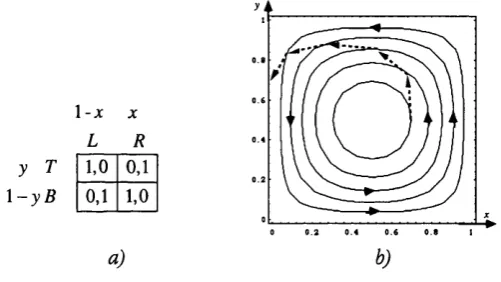
However, it turns out that the above results hold only for any fin ite time, i.e. they do not refer to asymptotics. Which may well differ whether we look at thestochastic process or at its (either continuous or discrete) deterministic approximation. Borgers and Sarin [1993] provides an useful example to clarify this point, considering the asymptotic behavior of their learning dynamics in the case of zero-sum games.
l - x X
L R
T T 1,0 0,1
l - y B 0,1 1,0
a) b)
Figure 1.7
Discrete-vs. Continuous -Time Replicator Dynamics and Zero -Sum-Games
Figure 1.7b) traces some orbits of the continuous-time Replicator Dynamics in the case of the (constant-sum) game of figure l.la ). The dotted arrows of figure 1.769 represent the (expected) jump of the discrete time dynamics (1.4.1-2). In other words, while the continuous time process cycles around the (unique) equilibrium in mixed strategies, the discrete time (deterministic) process does not converge, approaching the boundaries of the state space. Moreover, we also know that the stochastic dynamics will eventually end up in one of the four absorbing states of the system, i.e. one of the four pure strategy profiles. As a result of that, even if the (stochastic) learning dynamics is well approximated by the continuous-time deterministic process within any finite time interval, the asymptotic properties of the two processes may differ in a substantial
way.3o
1 .5 . S
e l e c t i o nD
y n a m ic sa n dD
o m in a t e dS
t r a t e g ie s29See Borgers and Sarin [1993], Proposition 4, and Schlag [1994], Theorem 6.
We have already found an example Entry game) in which the Replicator Dynamics fails to eliminate weakly dominated strategies. This result, which contrasts a well-established tradition in standard game-theoretic analysis^i, is also somehow counterintuitive if observed from an evolutionary perspective. In fact, if initial conditions lie in the relative interior of the (mixed strategy) state space, as it is commonly assumed by this literature, weakly dominated strategies will always yield strictly lower payoffs than those which dominate them, at least within any finite time, and this is essentially because, by forward invariance, the system will never reach (if not in the limit) one of the faces of the state space in which the dominant and the dominated strategy yield the same payoff.
Given this preliminary consideration, it may be interesting to investigate how general the above result is, and if it can also be extended to the case of strategies which are even strictly dominated. This is the aim of this section, in which we summarise some theoretical results concerning the relation between evolutionary dynamics and dominated strategies.
We shall consider strict dominance first. In this respect, it turns out to be crucial how the concept is formally defined. Conventionally, we say that a pure strategy s. is strictly dominated if it exists another (pure or mixed) strategy <r' g A, which yields a (strictly) higher payoff against any mixed strategy in the support of the opponent(s):
< m,.((t;,ct_,.);Vo-_, g A_. (1.5.1)
Otherwise, to consider 5 strictly dominated, one might ask for the stronger requirement of a[ G A,, being a pure strategy itself. If strict dominance is interpreted in this more restrictive
sense, we then know that, under any monotonie selection dynamics, not only strategies which are strictly dominated)^, but also strategies which do not survive the iterated deletion of strictly dominated strategies, will eventually vanish:
• P r o p o s i t i o n 1.8. Let r{r{0),t) be the interior solution of a regular MS dynamics (1.3.1). If does not survive the iterated deletion of pure strategies strictly dominated by pure strategies, then lim r f { t ) = 0 .
Pr o o f. See Samuelson and Zhang [1992], Theorem 1.
Things are different if we also consider mixed strategies. To obtain the same result as in Proposition 1.8, we then need to impose some more stringent conditions on the dynamics than monotonicity alone.)) To clarify this point, we provide an example, adapted from Dekel and Scotchmer [1992], who first addressed the problem of elimination of strictly dominated strategies (by mixed strategies) in the context of (discrete-time) selection dynamics:
) ^Theoretical justifications of the (iterated) deletion of weakly dominated strategies, have been provided (among others) by Kohlberg and Mertens [1986], Moulin [1986], Dekel and Fudenberg [1991].
)^This result is due to Nachbar [1990].
1 - J C
L
y T
z M
\ - y - z B
1 ,0 0 ,1 . 4 , . 4 . 4 , . 4
0 ,1 1 ,0
Figure 1.8
An adaptation of Dekel and Scotchmer’s [1992] counterexample
Note that the game of figure 1.8 differs from the game of figure 1.7 only by the fact that Anna has now an additional strategy (M) which yields a payoff equal to .4 to both players, regardless of what Beppe does. Moreover, strategy B, although it is not strictly dominated by any other pure strategy in Anna’s support, is strictly dominated by any mixed strategy “sufficiently close” to the (unique Nash equilibrium) strategy, which attaches probability .5 to both strategies T and B.
a)
FIGURE 1.9
Monotonie Dynamics and Strictly Dominated Strategies
b)
Figure 1.9a) traces some trajectories of the standard Replicator Dynamics for the game of figure 1.8. The orbits of figure \.lb ) are now limit cycles for the trajectories of figure 1.9aj., once the strictly dominated strategy B has been eliminated. Figure \.% ) shows instead trajectories of the following MS dynamics:
(1.5.2)
In a recent paper, Hofbauer and Weibull [1996] show how this behavior is not peculiar to the functional form (1.5.2). In their paper, they consider a class of regular selection dynamics (which they call functional selection dynamics) in which all growth rate functions yf (KO) are as follows:
rf(KO) = a,.(KO)+A(K0)<p[M,(-y?,r_,.(0)] (1.5.3)
with a, and A as in (1.4.1-2), and Lipschitz continuous. In (1.5.3) the evolutionary dynamics are described by means of a function in which the utility of each pure strategy enters explicitly, instead of appearing as a side constraint, as in § 1.3. Although the class of evolutionary dynamics described by (1.5.3) is more restrictive than the class we introduced in § 1.3, all the conditions defined in § 1.3 have a natural counterpart as special cases of (1.5.3).^^
The relation between the asymptotic behavior of strictly dominated strategies and functional selection dynamics of the form (1.5.3) is stated in the following proposition:
• Pr o p o s it io n 1.9. Let KKO),-) be the interior solution of a functional selection dynamics (1.5.3). If .y-does not survive the iterated deletion of pure strategies strictly dominated by mixed strategies and q> is strictly increasing a n d convex, then lim rf(t) = 0.
Pr o o f. See Hofbauer and Weibull [1996], Theorem 1.
The authors note that convex functional selection dynamics heuristically represent agents whose reaction to higher payoff is at least proportional (in other words, their utility exhibits risk aversion with respect to fitness)
We now move to weak dominance. We will only consider here the case of pure strategies which are weakly dominated by other pure strategies. We already know, from the dynamic analysis of the Entry game,, that weakly dominated strategies may fail to be eliminated by the Replicator Dynamics, that is, by an evolutionary dynamics which satisfies all the conditions (1.3.1- 6). This result might suggest that weak dominance considerations have no role in determining the limiting play under any selection dynamics. However, it turns out this not to be the case. In particular, if a weakly dominated strategy does not vanish, this implies the extinction of all the pure strategies in the support of the opponents against which the dominated strategy yields the same payoff as the dominant strategy. This result, first proved by Nachbar [1990] in the case of monotonie dynamics which converge to a Nash equilibrium, has now been also proved by Cressman [1996] for the case of the Replicator Dynamics without the need to assume that the process converges:
5^For example, it is sufficient to assume Ç strictly increasing to obtain a m onotonie dynamics, o r to assume 05. = —A ( K D ) 9 ^ [ w , ( K D ) ] . with cp still strictly increasing, to have a payoff positive dynamics, and so on.
• P ro p o s itio n
l . i o .
Letr(r(0),-)
be th e interior solution of th e Replicator Dynamics (1.3.2). If a pure strategy j* is weakly dom inated hy an o th er pure strategy th e n at least o n e o f the following statem ents are true:lim a;*(0 = 0 (1.5.4)
lim /X O = 0 , V / . s.t. M,(J*,^*,) < (1.5.5)
• Pr o o f. See Cressman [1996] Proposition 3.1.#
The above result will play a key role in our analysis and will he generalised to the class of monotonie selection dynamics (1.3.3). 3^
1 .6 .
S e l e c t i o n D ynam ics a n d Gam es o f P e r f e c t I n f o r m a tio nOne of the standard rationality principles in the game-theoretic analysis of games with perfect information appeals to the notion of backward induction, first introduced hy Zermelo [1913]. According to this principle, Anna should defect in the Entry game, because she can rely on the fact that Beppe will cooperate in return. This is because, if Anna plays D, Beppe is strictly better off if he cooperates, as cooperating yields him a higher payoff. In other words, any threat of defecting hy Beppe is rendered incredible hy the assumption that he is rational (and his, as well as Anna’s rationality are common knowledge).
This conclusion has been repeatedly challenged on the grounds that, as with any solution concept based on an equilibrium notion, the backward induction principle leads is often ill- defined when applied q^the equilibrium path {what if Anna cooperates?) , as it may well happen that it would he advantageous for all the players to violate the backward induction prescription. Far from proposing an alternative view on such a controversial matter,37 we merely acknowledge that dynamic processes analogous to those proposed here have been used to analyse games of perfect information, precisely because the player behavior is completely specified under all contingencies. The study of the asymptotic behavior of some evolutionary dynamic may therefore provide a further argument in favour (or against) the backward induction principle (or any other rationality principle, for what matters).
In this respect, we mention here a recent contribution which has solved some unanswered questions on the dynamic properties of these games. Cressman and Schlag [1995] apply Cressman’s [1996] technique in the analysis of two-player games of perfect information with no relevant payoff ties. In this class of games, the use of backward-induction (or alternatively, the iterative deletion of weakly dominated strategies) selects a unique Nash equilibrium, which is the subgame-perfect equilibrium of the game. They restrict their analysis to the Replicator Dynamics, for which they prove (among other properties) the following:
3%ee Proposition 3-4.1.
• every interior path converges to a Nash equilibrium (Theorem 2);
• for “simple” games, (games of perfect information in which at most three consecutive decisions are made), the Nash equilibrium component which contains (i.e. is outcome- equivalent to) the backward induction solution is the unique interior asymptotically stable set (theorem 5).
The first result is relevant, as it identifies a class of games for which an equilibrium notion (namely, Nash equilibrium) accurately describes the asymptotic play of a particular selection dynamics (namely, the Replicator Dynamics). However, this result does not support more stringent equilibrium requirements like, for example, subgame-perfection, since Nash equilibria which are not subgame-perfect may well be limit points of (a non-zero measure set of) interior trajectories, as we know from our analysis o lih t Entry game.
In this respect, theorem 5 tells us that, although the Nash equilibrium component . / ^ o f figure 1.5 is interior-attracting under the Replicator Dynamics, it cannot be asym ptotically
stable: trajectories starting arbitrarily close to will move away from it and never come back
(whereas the same phenomenon cannot occur when we consider the subgame-perfect equilibrium of the game, namely the strategy profile (D,C)).
However, by theorem 5, the asymptotic stability of the backward induction solution is not guaranteed if games are not simple in Cressman and Schlag’s terminology; for more complex games such an asymptotically stable set may even fail to exist.
As the authors comment, the predictive power of backward induction is supported only partially by the results contained in the paper, which they entitle The Dynamic (In)stability o f Backward Induction.
1 .7 .
S e l e c t i o n D yn am ics WITH D r i f tBinmore et a l [1995] explore the dynamic properties of the Replicator Dynamics in the case of another game of perfect information with no relevant ties, that is, the Ultimatum Game. In this game Anna proposes to Beppe a particular division of a cake; subsequently, Beppe has to decide whether to accept Anna’s proposal or not. If Beppe accepts, the pie is shared as agreed; if Beppe rejects the offer, nobody gets anything. This game has a unique subgame-perfect equilibrium in which Anna offers (an e more than) nothing and Beppe accepts. The intuition is the same as in the Entry game: if Beppe’s rationality is common knowledge, Anna can rely on the fact that Beppe will accept anything no matter how little it is. As a matter of fact, there is a clear analogy between the two games: if we restrict the possible offers to two {high or low), assuming that a high offer is automatically accepted by Beppe, the Ultimatum Game collapses to a much simpler form which is absolutely analogous to the Entry game of figure 1.4 (and therefore has the same asymptotics under the Replicator Dynamics)^^.
The Ultimatum Game is an example in which the backward induction hypothesis is universally rejected by the experimental evidence, although the various experimental results provide no clear alternative
hypothesis.)^
To explain the fundamental weaknesses of the backward induction hypothesis in the context of the Ultimatum Game, Binmore et a l [1995] propose the following dynamics:
= + (1.7.1)
We will refer to the dynamics (1.7.1) as the Replicator Dynamics with drift. In Binmore et a l [1995] the dynamic (1.7.1) is derived from a population game in which agents die (or leave the game, or experiment new ways of playing) at a fixed rate equal to A,.dr. Those who die are replaced by novices (or experimenters) who play each strategy s] with probability p f., while the rest of the population aggregate behavior follows the Replicator Dynamics. The relative importance of the drift is measured by A , which we refer to as the drift level We assume A to be “very small”, reflecting the fact that all the major forces which govern the dynamics should be captured by the evolutionary dynamics (1.3.1), which here takes the form of the Replicator Dynamics. In figure 1.10 we trace some trajectories of (1.7.1) for the Entry game, under different realizations of A,, (setting /I* = 1 / 2, Vi,â:):
1
0 . 8
0 . 6
0 . 4
0 . 2
0
0 . 2 0 . 4 0 . 6 0 . 8 1
a) A. = 0
Fig u re l.lO
Phase diagrams of the 1-stage Ultimatum Game
0 . 2 0 . 4 0 . 6 0 . 8 1
b) A^ = Ag = 0.001
1
0 . 8
0 . 6
0 . 4
0 . 2
0 X
0 . 2 0 . 4 0 . 6 0 . 8 1
c)A^ =0.005; Ag=0.05
Figure l.lQa) shows trajectories of the unperturbed Replicator Dynamics that mimic the behavior already shown in the phase diagram of figure 1.5. Figure 1.1069 shows trajectories of (1.7.1) when both A^ and Ag are “negligible”. In this case, the drift against Beppe’s (weakly dominated) strategy D is sufficient to push the system away from the v/^ com p onent. In figure 1.10c) Ag is substantially higher than A^ : in this case the system (1.7.1) has two restpoints close to the component, one of which is asymptotically stable. In other words, although the drift points toward the relative interior of the state space (since p f g (0,1)) it may not be
sufficient to destabilize the ./^ c o m p o n e n t in which a suboptimal action is played with positive probability.
In the following proposition, we shall replicate Binmore e t a l [1995] results fixing = 1 / = p,pg = 1 - /1 = Ag = A, and letting A ^ 0 (we do so to be consistent with the rest of the dissertation)^^:
• Proposition l . l l . Let RE(P) be the set of restpoints of (1.7.1) for A sufficiently close to 0. The following properties hold:
a ) for all /3 g (0 ,I), RE(p) contains the subgame-perfect equilibrium (D,C) which is also
asymptotically stable.
b) when p is sufficiently large, RE{p) contains also two additional restpoints, both belonging to
one of which is asymptotically stable.
Pro o f. See th e A ppendix.#
The authors comment: “...the question whether the subgame-perfect equilibrium should be regarded as the one and only game-theoretic prediction for the Ultimatum Game ... [has] a convincing and firmly negative answer..
We postpone any comment on such controversial matters to chapter 3, in which we provide a similar analysis for another game of perfect information with no relevant ties, that is Rosenthal’s [1981] Centipede Game. What remains to be said at this stage is only that the analysis of (1.7.1) (or similar dynamics) may be used to test the robustness of any theoretical prediction based on the asymptotic properties of our continuous-time evolutionary dynamics. This is the reason why in chapters 2 and 3 of this dissertation the analysis of the Replicator Dynamics with drift (1.7.1) will complement the analysis of the pure evolutionary dynamics studied elsewhere.
1 .8 . P
l a nOF
THET
h e s i sThis dissertation consists of four chapters (including this introductory survey), followed by the reference index. In what follows, we shall briefly summarise the content of the other three main chapters.
1.8.1. EVOLUTIONARY DYNAMICS AND “THE IMPLEMENTATION PROBLEM”
In chapter 2, we try to understand the effect of taking an evolutionary approach to the study of implementation theory. The theory of implementation is that branch of game theory which addresses the problem of designing games, or mechanisms, whose equilibria satisfy certain socially desirable properties, but which do not necessitate vast amounts of knowledge by the