in children with normal and atypical speech
and language development
Margaret Vance
Department of Human Communication Science,
University College London
Submitted for the degree of Doctor of Philosophy,
All rights reserved
INFORMATION TO ALL USERS
The quality of this reproduction is dependent upon the quality of the copy submitted. In the unlikely event that the author did not send a complete manuscript and there are missing pages, these will be noted. Also, if material had to be removed,
a note will indicate the deletion.
uest.
ProQuest U641894
Published by ProQuest LLC(2015). Copyright of the Dissertation is held by the Author. All rights reserved.
This work is protected against unauthorized copying under Title 17, United States Code. Microform Edition © ProQuest LLC.
ProQuest LLC
789 East Eisenhower Parkway P.O. Box 1346
Margaret Vance, Department o f Human Communication Science,
University College London
Submitted for the degree o f Doctor o f Philosophy, November 2000.
ABSTRACT
This thesis is motivated by research evidence o f significant relationships
between short-term memory and speech and language development, and by
clinical observations o f poor short-term memory skills in some children
with developmental language difficulties. It addresses the question ‘to what
degree do speech processing skills underpin short-term memory and
language development’? A series o f experiments were carried out,
collecting data from children, aged 7 years and under, who were
developing normally, and from children with speech and / or language
difficulties.
Performance on tasks o f speech production and auditory discrimination
were found to show significant developmental differences, and these
speech processing skills were significantly correlated with non-word
repetition performance. Different presentation and response mechanisms,
and the phonological complexity o f words to be recalled significantly
affected short-term memory performance. These findings implicate speech
input and output processing in short-term memory performance. Data from
a longitudinal study showed that auditory discrimination skills significantly
A series o f case studies o f children with speech and / or language
difficulties demonstrated a range o f individual, longitudinal profiles of
performance across speech processing, short term memory and
standardised language measures. Findings from the normative data did not
explain the patterns o f development in clinical cases, however, short-term
memory skills were broadly in line with the level o f receptive language
development attained. Relationships between short-term memory, speech
and language in normal development may not reflect the mechanisms by
which short-term memory and language is impaired in disordered
First, and foremost, I would like to thank my family, Andrew, James and
Patrick for their support over the past few years. They have cheerfully
tolerated my distraction and given practical help, ranging from doing all the
ironing, to compiling tables and reference lists. I must also thank my
parents, Ron and Eileen, for encouragement over many years, and my
father for taking the photographs that I used as pictorial stimuli.
Bill Wells and Joy Stackhouse first motivated me, and gave me my first
opportunity, to enter the daunting world o f research. Joy Stackhouse and
Chris Donlan have been stimulating and supportive supervisors and I thank
them for their encouragement. Chris has been ever willing to patiently
explain the finer points o f statistics to me - yet again, and cheered me over
the finishing line. Joy has always been generous with her support, and I am
grateful to her for the doors she has opened for me.
I am also grateful to all o f my colleagues at the Department o f Human
Communication Science, who have given constant moral and practical
support. Anne Edmundson took on much o f my administrative work-load,
in the final few months, to allow me time to complete the writing o f this
Abstract 2
Acknowledgements 4
Table of Contents 5
List of Tables 13
List of Figures 17
Chapter 1 Short-term memory and language development
1.1 Introduction 19
1.2 Short term memory 21
1.2.1 Working memory 21
1.2.Ü The phonological loop 22
1.2.111 Working memory and short term memory 25
1.3 Short term memory and language development 26
1.3.1 STM and vocabulary development 27
1.3.11 STM and grammatical development 38
1.3.111 STM and second language learning 42
1.3.1v STM and developmental language disorder 44
1.4 Conclusion 45
Chapter 2 Short term memory and speech processing skills
2.1. Introduction 47
2.2 A developmental speech processing model 48
2.2.1 Speech processing and STM 51
2.3 Speech output skills In STM 54
2.3.1 Speech rate and STM 54
2.3.11 Sub-vocal rehearsal 58
2.4.Ü Operational efficiency hypotheses 69
2.4.111 Phonological representations and STM 70
2.5 Lexical representations and STM 73
2.6 Mental processing speeds and STM 76
2.7 Conclusion 82
Chapter 3 Experiment 1: Auditory discrimination and speech
production task performance in young children.
3.1 Introduction to chapter 84
3.2 Introduction to experiment 85
3.2.1 Psycholinguistic assessment o f speech processing
skills 85
3.2.Ü Auditory discrimination skills 86
3.2.111 Speech production skills 96
3.3 Rationale for this experiment 102
3.3.1 Predictions 103
3.4 Method 104
3.4.1 Experimental design 104
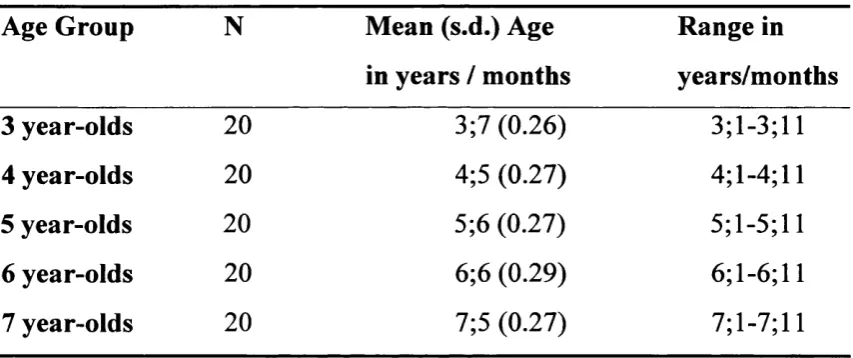
3.4.Ü Participants 104
3.4.111 Task materials and procedures 105
3.4.iv Experimental procedure 112
3.5 Results 113
3.5.1 Auditory discrimination tasks 113
3.5.Ü Speech production tasks 119
3.5.111 Comparison between auditory discrimination
discrimination tasks 135
3.6.iii Differences in performance on speech production
tasks 137
3.6.iv Correlations between speech production and
auditory discrimination performance 141
3.6.V Factors underlying performance on speech
production and auditory discrimination 142
3.7 Conclusion 143
Chapter 4 Experiment 2: Non-word repetition and speech processing
skills
4.1 Introduction to chapter 145
4.2 Introduction to experiment 146
4.2.i NWR as a phonological STM task 146
4.2.Ü NWR as speech processing task 149
4.2.iii Lexical influences on NWR 154
4.3 Rationale for this experiment 159
4.3.i Predictions 160
4.4 Method 160
4.4.i Experimental design 160
4.4.Ü Participants 161
4.4.iii Materials and procedures 161
4.5 Results 161
4.6 Discussion 166
5.1 Introduction to chapter 170
5.2 Introduction to experiment 171
5.2.1 STM task paradigms 171
5.2.Ü Spoken duration in STM performance 178
5.3 Rationale for this experiment 181
5.3 .i Predictions 181
5.4 Method 182
5.4.1 Experimental design 182
5.4.Ü Participants 182
5.4.111 Task materials and procedures 183
5.4.iv Experimental procedure 190
5.5 Results 191
5.5.1 Pilot study 191
5.5.Ü Task and complexity effects at T1 191
5.5.111 Task and complexity at T2 194
5.5.iv Effects of phonological complexity in different
recall conditions 195
5.6 Discussion 196
5.6.1 Differences in performance between STM task
paradigms 196
5.6.Ü Phonological complexity effects 199
5.6.111 Effects o f complexity on spoken and non-spoken
recall 200
6.1 Introduction to chapter 203
6.2 Introduction to experiment 204
6.2.1 Relationships between NW R and STM and speech
and language development 204
6.2.Ü The role o f speech processing and language
development in STM capacity. 207
6.2.111 The role o f speech processing and STM capacity
in language development 210
6.3 Rationale for this experiment 211
6.3.1 Predictions 212
6.4 Method 213
6.4.1 Experimental design 213
6.4.11 Participants 213
6.4.111 Experimental procedure 214
6.4.iv Task procedures and materials 215
6.5 Results 222
6.5.1 Relationships between NW R and STM and speech
and language skills 224
6.5.11 Relationships between speech processing and
language skills and STM. 229
6.5.111 Relationships between speech processing,
STM and language development 234
6.6 Discussion 240
6.6.1 Do speech processing or STM skills predict NWR? 240
6.6.Ü Is language development predicted by NW R
6.6.iv Does speech processing speed predict
STM capacity? 248
6 . 6 . V Do language skills predict STM capacity? 250
6.6.vi Which measures best predict STM? 251
6.6.VÜD0 speech production and auditory discrimination
skills predict language development? 252
6.6.viii Does STM capacity predict language skills? 253
6.6.ix Which measures best predict language
development? 253
6.6.x Do STM and grammatical skills predict sentence
repetition performance 254
6.7 General discussion 255
6.8 Conclusion 258
Chapter 7 Experiment 5: Individual profiles of short-term memory,
speech processing and language in children with speech and language
difficulties.
7.1 Introduction to chapter 259
7.2 Introduction to experiment 260
7.2.i STM deficits in speech disorder 260
7.2.Ü STM deficits in children with specific
language impairment 261
7.2.111 The nature o f the relationship between SLl
and STM deficits 263
7.2.iv NW R deficits in children with SLI 268
7.2.V Differential performance on STM tasks 273
7.4 Method 277
7.4.1 Experimental design 277
7.4.Ü Participants 277
7.4.111 Experimental procedure 279
7.4.iv Task procedures and materials 280
7.5 Case profiles 282
7.5.1 RF 282
7.5.Ü KM and SB 282
7.5.iiiRN, S A an d R W 282
7.5.iv EP, ZC and MG 298
7.5.V BH 305
7.5.vi CB 308
7.6 General discussion 311
7.6.1 STM capacity 312
7.6.Ü Language development 314
7.6.111 Non-word repetition 315
7.6.iv Speech processing speed 316
7.6.V Sentence repetition 317
7.6.vi Summary 317
7.7 Conclusion 318
Chapter 8 Concluding Discussion
8.1 Introduction 319
8.2 Indications from previous research 320
8.3 Speech processing skills 321
8.3.1 Auditory discrimination and speech production 321
8.4.1 STM tasks 322
8.4.Ü STM stimuli 323
8.5 Speech processing, STM and language development 325
8.6 Speech processing, STM and language in clinical cases 327
8.7 Future directions 329
8.7.1 Models o f STM development 329
8.7.Ü The development o f STM and language 331
8.7.iii STM deficits and speech and language disorder 332
8.7.iv Measuring speech processing and STM skills 334
8.8. Conclusion 335
References 337
Appendix 1 357
Appendix 2 358
Appendix 3 360
Appendix 4 361
Appendix 5 363
Appendix 6 364
Appendix 7 365
Appendix 8 366
Appendix 9 368
Appendix 10 370
3.1 Subject characteristics o f participants in experiment 1 105
3.2 Examples o f matched stimuli, at each word length, for 106
experimental tasks
3.3 Mean (s.d.) number o f items correct for each age group on 114
auditory discrimination tasks
3.4 Mean (s.d.) percentage o f items correct by 5-7 year-olds 116
3.5 ANOVA table o f Age X Task for percentage scores on 116
auditory discrimination Tasks by 5 and 6 year-olds
3.6 Partial correlations, age controlled for, in 5-7 year-olds 118
auditory discrimination performance
3.7 Mean (s.d.) number o f items correct for same / different task 119
3.8 Mean (s.d.) number o f items correct for each age group on 119
speech production tasks
3.9 ANOVA table o f Age X Task for sp. prod, for 3 & 4 yr olds 120
3.10 ANOVA table o f Age X Task for speech prod. 4-7 year-olds 122
3.11 Mean (s.d.) number o f items correct, at each word length, on 125
speech production tasks
3.12 Partial correlations, age controlled for, in speech prod, tasks 130
3.13 Partial correlations, age controlled, in auditory disc, picture 131
task & speech production tasks in 3 & 4 year-olds
3.14 Partial correlations, controlling for age, for auditory 132
discrimination. & speech production in 5 & 6 year-olds
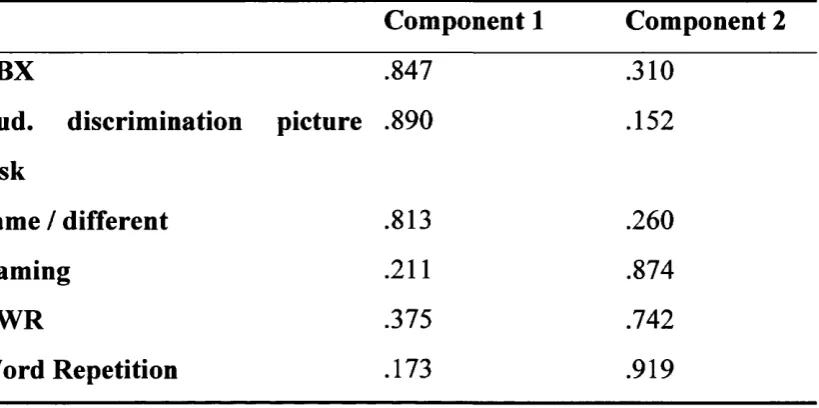
3.15 Rotated component matrix showing the 3 auditory 133
discrimination measures load onto component 1 & the 3
speech production measures load onto component 2
4.3 Hierarchical multiple regression analyses, predicting NW R 164
in 3 & 4 year-olds
4.4 Hierarchical multiple regression analyses, predicting NW R 165
in 6 & 7 year-olds
5.1 Stimuli sets for T1 188
5.2 Stimuli sets for T2 189
5.3 Mean (s.d.) number o f simple and complex items correct for 192
each STM task at T1 and T2
5.4 ANOVA table o f Task X Complexity at T1 192
5.5 ANOVA table o f Task x Complexity at T1 (data from one 193
subject omitted)
5.6 ANOVA table of Task x Complexity at T2 194
6.1 Mean (s.d.) o f number o f items correct for each speech 223
processing, and STM task, and mean (s.d.) o f time taken in
seconds for speed o f processing measures, at T1 and at T2
6.2 Correlational matrix for measures at T1 225
6.3 Correlational matrix for measures at T2 226
6.4 Correlations between T2 language measures and T1 NW R 228
and STM
6.5 Simultaneous multiple regression analysis with T1 STM and 228
NWR as predictor variables and T2 receptive grammar as the
dependent variable.
6.6 Simultaneous multiple regression analysis with T1 STM and 229
NW R as predictor variables and T2 expressive grammar as
discrimination as predictor variables
6.8 Correlations between STM at T2 and language measures at 232
T1
6.9 Simultaneous multiple regression with STM at T2 as the 233
dependent variable, and 3 predictor variables
6.10 Correlations between standardised language measures at T2 234
and speech production and auditory discrimination at T1
6.11 Simultaneous multiple regression with receptive vocabulary 235
at T2 as dependent variable
6.12 Simultaneous multiple regression with receptive grammar at 236
T2 as dependent variable
6.13 Simultaneous multiple regression with language measures at 237
T2 as the dependent variable, and auditory discrimination
and STM at T1 as predictor variables
6.14 Correlational matrix for T2 sentence repetition and T1 238
auditory discrimination, grammar and STM measures
6.15 Hierarchical regression analyses, sentence repetition at T2 as 239
the dependent variable
7.1 Age and language scores for participants with speech and / 279
or language difficulty
7.2 Z scores for individual tasks for RF 283
7.3 Z scores for individual tasks for KM 286
7.4 Z scores for individual tasks for SB 287
7.5 Z scores for individual tasks for RN 291
7.6 Z scores for individual tasks for SA 292
7.9 301
7.10 Z scores for individual tasks for MG 302
7.11 Z scores for individual tasks for BH 306
1.1 Model o f the phonological loop, taken from Gathercole & 23
Baddeley (1993)
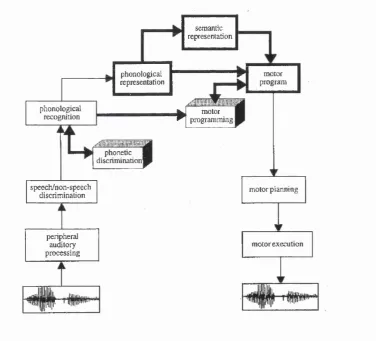
2.1 Figure 2.1: A developmental speech processing model, 49
Stackhouse and Wells (1997)
2.2 Outline o f model proposed by Kail and Park (1994) 78
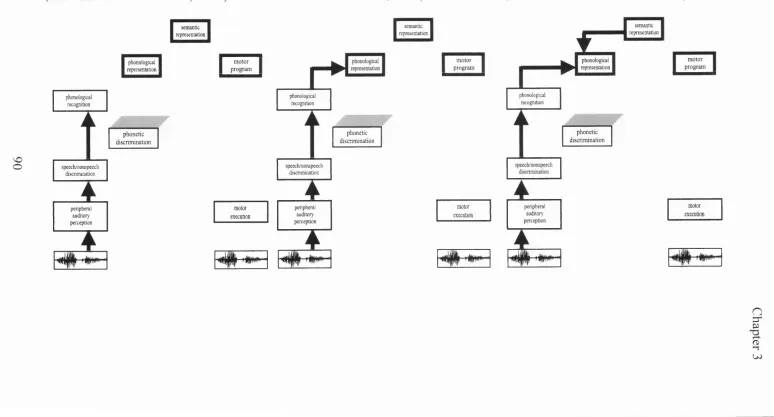
3.1 Speech processing in auditory discrimination o f non-words 90
(after Stackhouse & Wells, 1997)
3.2 Speech processing in auditory discrimination o f words (after 90
Stackhouse & Wells, 1997)
3.3 Speech processing in auditory discrimination picture task 90
(after Stackhouse & Wells, 1997)
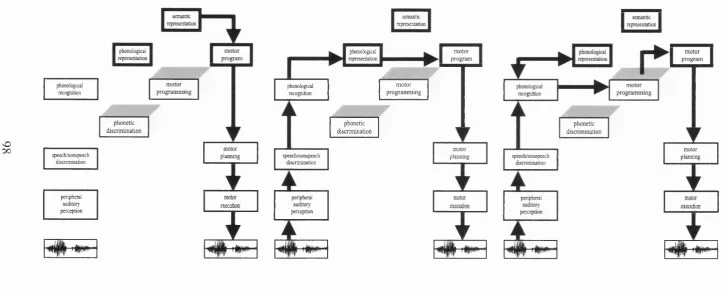
3.4 Speech processing in the naming task (after Stackhouse & 98
Wells, 1997)
3.5 Speech processing in the word repetition task (after 98
Stackhouse & Wells, 1997)
3.6 Speech processing in the non-word repetition (after 98
Stackhouse & Wells, 1997)
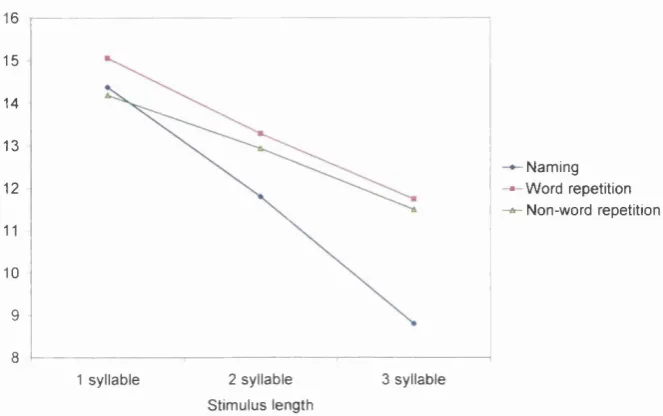
3.7 Mean performance on speech production tasks, by age-group 121
3.8 3 year-old children’s mean performance on speech 127
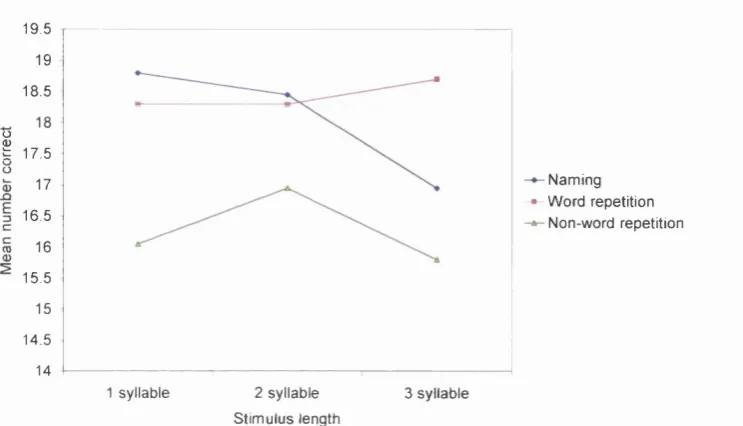
production tasks, by stimulus length
3.9 6 year-old children’s mean performance on speech 129
production tasks, by stimulus length
3.10 7 year-old children’s mean performance on speech 129
production tasks, by stimulus length
5.1 Speech processing for Spoken-Input Spoken-Output task 173
5.3 Speech processing for Picture-Input Spoken-Output task 173
(after Stackhouse & Wells, 1997)
6.1 Hypothetical model o f relationships between speech 257
CHAPTER 1:
SHORT-TERM MEMORY AND LANGUAGE DEVELOPMENT
1.1 INTRODUCTION
The aim o f this thesis is to investigate the relationship between short-term
memory, language development and speech processing skills in normal and
atypical development. The first two chapters o f this report will consider the
theoretical background to short-term memory and to speech processing.
Research findings into possible relationships between short-term memory
and language development, and between short-term memory and speech
processing skills will be discussed. Chapter 3 will present an experiment in
which the speech processing skills o f young children are assessed. A
developmental perspective is taken. Chapter 4 will further analyse data
from the first experiment to allow particular exploration o f non-word
repetition skills. Chapter 5 will present an experiment using short-term
memory tasks with young children. It will contrast recall o f stimuli with a
simple phonological structure with recall o f those with a more complex
structure. Different presentation and response modalities are used to allow
the speech processing demands tasks to be compared. Chapter 6 will
present data from a longitudinal study o f a group o f young children who are
developing normally. The measures used include tasks o f short-term
memory, speech processing and language skills. Chapter 7 will present the
individual profiles o f a number o f children with speech and / or language
difficulties showing performance on short-term memory, speech processing
and language measures. Chapter 8 will discuss the findings o f the study,
and present conclusions about the relationship between speech processing,
Short-term memory capacity is considered to affect the ability to process
language. For example, Cowan (1996) discusses the role o f short-term
memory in understanding language, “it is impossible to comprehend a word
within conversation without keeping in mind the necessary background
information established by prior words in the sentence, and often by
preceding sentences” (p. 1). However, adults with acquired short-term
memory deficits do not seem to have a problem with language
comprehension (as in the case described by Baddeley, Papagno & Vallar,
1988).
A number o f studies have identified relationships between the development
o f short-term memory and o f language (e.g. Adams & Gathercole, 1995,
1996). It has been suggested that one role for the phonological loop within
the working memory model is to support language learning (Baddeley,
Gathercole & Papagno, 1998). Some o f the evidence for this suggestion
comes from findings o f strong correlational relationships between short
term memory span and language measures in children. However it is also
possible that some speech processing or cognitive factors underpin the
development o f both short-term memory and language.
The purpose o f this first chapter is to consider the theoretical background to
short-term memory and to explore research findings o f the relationship
between short-term memory and language development.
Firstly a model o f short-term memory, the working memory model
(Baddeley & Hitch, 1974), will be explored.
Secondly research findings will be discussed that focus on the relationship
between short-term memory and
• grammatical development.
• second language learning.
• developmental language disorder.
1.2 SHORT-TERM MEMORY
Short-term memory (STM) is defined by Baddeley (1999) as “a system for
storing information over brief intervals o f time” (p. 21). The information
retained may be directly recalled in some way and / or be required for
performance o f an on-going task. Early STM research focussed on span
tasks. Participants listened to lists o f numbers or words, and immediately
recalled them. A consistent finding is that most adults can recall six or
seven items (Baddeley, 1999). However, research by Brown (1958) and
Peterson and Peterson (1950) (cited in Baddeley, 1999) showed that lists o f
items would be recalled poorly if participants were given a task to perform
between presentation and recall. It was inferred that this intervening task
prevented participants from rehearsing the items to be recalled. These two
features o f limited capacity and loss o f information unless material is
actively rehearsed characterise the phenomenon o f STM.
1.2.: Working Memory
One influential model of how STM might function is the working memory
(WM) model, first described by Baddeley and Hitch (1974). The term WM
is used for this system which involves the “temporary processing and
storage o f information” (Gathercole & Baddeley, 1993 p. 2), for cognitive
tasks, including language comprehension and long-term learning. The WM
model accounts for the findings o f limited capacity and need for rehearsal.
It has been the focus o f much o f the more recent research into STM. The
considered to control the overall system, and this is called the central
executive. Two slave systems are described, the visuo-spatial sketch pad
and the phonological loop. The central executive is viewed as “a limited
capacity attentional system that controls the phonological loop and sketch
pad, and relates them to long term memory” (p. 66 Baddeley, 1999). It is a
complex system involved in the processing o f the information that is being
retained in STM, but is not yet fully explored or understood. The visuo-
spatial sketch pad is involved in the short-term retention o f visual and
spatial information. The phonological loop is considered to be the system
specialised for the maintenance o f speech-based material in STM. This
component o f the WM model is a main focus for the current study.
1.2.:! The Phonological Loop
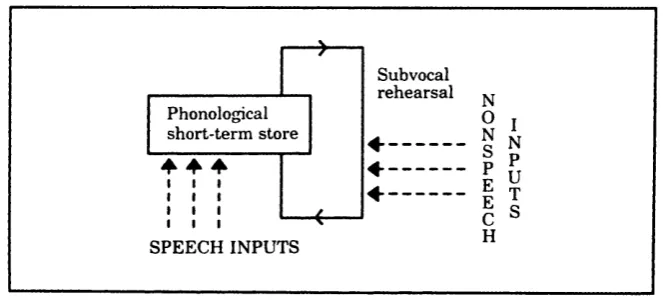
The phonological loop consists o f a phonological store in which material to
be remembered is held in a phonological code, and a sub-vocal rehearsal
process whereby material held in the store is recoded and refreshed (see
Figure 1.1). The rehearsal mechanism is viewed as an integral part o f this
model. The material in the phonological store is considered to be subject to
decay over time. The sub-vocal rehearsal process refreshes this material,
allowing it to be maintained for longer within the loop. Research findings
have suggested that the capacity o f the phonological loop is the amount of
spoken material that an individual can articulate within about 1.5 seconds
(Baddeley, 1999). Hulme and MacKenzie (1992) suggest that performance
on STM tasks will be a function of the length o f each item o f material
presented and the rate o f articulation.
There is evidence to suggest that the phonological loop is implicated in the
recall o f some visual material, such as written words or pictures (Hitch,
therefore allows for non-speech input to be coded in a speech based form
through the sub-vocal rehearsal process. Visual stimuli can then be
maintained and rehearsed within the phonological loop in the same way as
speech stimuli. The recall o f picture material will be further discussed in
Chapter 5.
Figure 1.1: Model o f the phonological loop, taken from Gathercole and
Baddeley (1993).
---^---Phonological short-term store
4 4 4^
1 1 1 1 1 1 I 1 1
— (
---SPEECH INPUTS
Subvocal rehearsal ^
: ?
♦
I
I
c ^
H
The Subvocal Rehearsal Process
One major area o f investigation into the functioning o f the phonological
loop has focussed on word length effects. A robust finding, that has been
replicated in a number o f studies, is that people can recall fewer longer
words than shorter words (Baddeley, Thomson & Buchanan, 1975). The
word length ejfect is thought to reflect the limited capacity o f the rehearsal
process, in that longer words take longer to say and so will take up more
time within the sub vocal rehearsal process. Shorter words can be
articulated more quickly and so more short words can be rehearsed, and,
therefore, maintained in the phonological store. The word length effect will
Other evidence for the subvocal rehearsal process comes from experiments
in which participants were required to repeat something other than the
stimuli to be recalled, e.g. “the, the, the”, between presentation and recall.
In this condition, participants can recall fewer visually presented stimuli
(Murray, 1965, cited in Baddeley, 1986) and the word length effect is
reduced (Baddeley, 1992). This concurrent speech effect, also known as
articulatory suppression, is considered to prevent participants from using
the subvocal rehearsal process. They are unable to verbally code visually
presented material and to rehearse this or spoken stimuli.
The Phonological Store
Another phenomenon that appears to interfere with the verbal coding o f
visual stimuli is the unattended speech effect. Here irrelevant spoken
material is presented at the same time as auditory or visual stimuli are
presented for recall. Although participants were instructed not to attend to
the irrelevant material, recall was impaired (Salame & Baddeley, 1982 and
Hanley & Broadbent, 1987, cited in Hulme & MacKenzie, 1992). Baddeley
(1999) argues that the unattended, or irrelevant, speech disrupts recall
because it gains obligatory access to the phonological store and corrupts the
memory trace.
Another robust finding in STM research is o f a phonological similarity
effect. Recall o f a list o f stimuli that sound similar is poorer than for an
equivalent list o f stimuli that do not sound similar (Conrad & Hull, 1964,
cited in Gathercole & Baddeley, 1993). The disruption to recall is
considered to occur within the phonological store (Gathercole & Baddeley,
1993) because as the phonologically coded material degrades and loses
definition, it is more easily confusable with other material that is
The Phonological Loop in Development
The word length effect has been found in children’s recall (Hulme,
Thomson, Muir & Lawrence, 1984, Hulme & Tordoff, 1989, Hitch et ah,
1989c, Henry & Millar, 1991). There is also evidence for the phonological
similarity effect (Halliday, Hitch, Lennon & Pettipher, 1990, Hulme 1987),
and the concurrent speech effect (Hitch et ah, 1989b, Henry, 1991a) to be
operating in children’s STM performance. However, these effects are less
marked in younger children and there is some debate about whether a
subvocal rehearsal process is operating early in development (e.g.
Gathercole & Hitch, 1993). This issue will be further discussed in the next
chapter (Chapter 2).
1.2.::! Working Memory and Short-term Memory
Hulme and Roodenrys (1995) acknowledge that the term WM is being used
in different ways and define WM as "the system (or more accurately set o f
systems) responsible for the temporary storage o f information during the
performance o f cognitive tasks” (p. 374). Hulme and Mackenzie (1992)
discuss how “the importance o f the concept o f WM as a functional term
needs to be distinguished from the adequacy o f the Baddeley and Hitch
model as a structural model, used to account for many STM phenomena”
(p. 22).
Swanson (1993) defines STM as a “small amount o f material held
passively and then reproduced in untransformed fashion” (p. 87), whilst
WM is defined as holding “a small amount o f material in mind for a short
time, while simultaneously carrying out further operations” (p. 87). This
view is in accord with Oakhill and Kyle (1999) who suggest that WM tasks
Dempster (1985, cited in Henry & Millar, 1993), however, assumes STM
and WM to be equivalent.
One interpretation to consider is that within the WM model the
phonological loop component is involved in STM task performance,
whereas WM tasks will additionally involve the central executive
component. Within this study the memory measures used will require
untransformed recall o f visually and verbally presented stimuli. The
measures used are, therefore, considered to be measures o f STM and not of
WM.
Researchers have more recently made use o f the terms phonological
memory, phonological short-term memory and phonological working
memory. For example, Gathercole and Martin (1996) use the term
phonological short-term memory (PSTM) to refer to the retention of
“sequences o f verbal material over short periods o f time” (p. 73).
Phonological memory seems, therefore, to imply the use of the
phonological loop o f the WM model.
1.3 STM AND LANGUAGE DEVELOPMENT
Experimental evidence supports the view that there is a relationship
between the development o f STM capacity and the development of
language skills. However, different research methodologies have been
used, and the measures o f STM capacity vary. There is also some debate
about the nature o f the relationship. It is not clear whether increased STM
capacity drives further language development, or whether STM capacity is
both STM capacity and language are related because other cognitive
processes underlie development o f both these skills.
1.3.: STM and Vocabulary Development
The aspect o f language development that has been most researched in
regard to STM is vocabulary development. Robinson, Dale and Landesman
(1990, cited in Speidel 1993) found that pre-school children with
precocious expressive vocabulary also scored very highly on a sentence
repetition task, suggesting that verbal STM was also exceptionally well
developed. Two other measures o f STM have been used in the research in
this area. These are non-word repetition (NWR) and word or digit span. For
the NWR task the experimenter says some made-up (or non-) words, one at
a time, and the participant repeats each stimuli. Performance score is
usually based on the accuracy o f the production o f the non-word. For span
tasks, the experimenter presents spoken lists o f words for the participant to
repeat. The lists are short to begin with and increase by one item at a time
until the participant is unable to recall all the items in the list. Performance
score may be for the maximum list length correctly recalled, with each item
in the correct serial order. However, some researchers score for free recall,
i.e. the number o f items recalled without regard for the serial order.
A large body o f work considering relationships between STM and
vocabulary development has been carried out by Gathercole and
colleagues. Gathercole, Willis, Emslie and Baddeley (1992) analysed
longitudinal data from a group o f children tested at 4, 5, 6 and 8 years of
age. They found that phonological memory, as tested using a NW R task,
was significantly correlated with vocabulary skills at ages 4, 5, and 6 years.
A digit span task was only used with the two oldest groups and was
correlations held when age and IQ were partialled out. Cross-lagged
correlations between adjacent age groups, with age, IQ and earlier scores
partialled out o f the analyses, showed that NW R at age 4 was significantly
more strongly correlated with vocabulary at age 5 years, than vice-versa.
This suggested that NWR skills (interpreted by Gathercole et al. (1992) to
be phonological memory skills) play a causal role in vocabulary
development. Between the ages o f 5 and 6 years, the reverse relationship
was found. Vocabulary knowledge at 5 years was significantly more
strongly correlated with NW R at 6 years than vice versa, the same pattern
occurring between 6 and 8 years. This suggests that for these older age
groups it is vocabulary knowledge that supports NWR. Gathercole et al.
(1992) propose that “children with good phonological memory abilities
produce phonological memory traces that are highly discriminable and
persistent and that, as a consequence, there is a greater probability for these
children that any particular phonological trace will a) become a long term
durable phonological trace and b) link semantically with its referent” (p.
896). They also propose that “beyond 5 years o f age children’s linguistic
knowledge, as indexed by their vocabulary scores, exerts an important
causal influence on their performance on phonological STM measures” (p.
896).
A study by Gathercole and Baddeley (1990a) explored the STM /
vocabulary development relationship by looking at how quickly children
learned new words. Children aged 5 years old were split into two groups,
on the basis o f their NWR performance. One group had performed well on
a NWR task and the other group had performed poorly. The children were
shown toy animals and told the names assigned to them. The names were
either familiar names or non-word names. The tester named each toy and
name correctly. Children were than asked to recall the name for each toy.
The group o f children who had performed less well on NW R took
significantly longer to leam the non-word names than the children with
high NW R scores, and delayed recall o f the names was also significantly
poorer. This study seems to indicate that children who are better at
repeating non-words, are quicker to leam vocabulary and retain it for
longer. Gathercole and Baddeley (1990a) consider NW R to primarily
reflect phonological memory skills and that “phonological memory plays
an important role in the long-term phonological learning'' (p. 450). They
suggest that, for the group of children with poorer NWR skills, encoding o f
the new phonological form may be ‘more noisy', or less strongly specified,
or the temporarily stored material may decay more rapidly. These less
adequate phonological representations may prevent longer term learning o f
the phonological form.
In 5 year-olds NW R and non-word memory span (single syllable) was
significantly correlated with existing receptive vocabulary and the ability to
recognise and produce newly learnt words, that were explicitly taught
(Michas & Henry, 1994). Michas and Henry support Gathercole and
Baddeley's (1989, 1990a) hypothesis, in suggesting that “phonological
memory is required to help establish a long-term phonological
representation for new words" (p. 160). The relationship between NW R
and non-word span and vocabulary learning was not significant when the
experimental condition was incidental word learning. Michas and Henry
(1994) also conclude that as age, spatial memory and the non-word
measures only accounted for between 23% and 26% o f the variation in
vocabulary or word learning, other cognitive and environmental factors are
Further evidence for a relationship between STM and receptive vocabulary
comes from Adams, Bourke and Willis (1999). In this study, a composite
score o f NW R and word and digit span was found to account for 10% of
the additional variance in receptive vocabulary scores after age, non-verbal
skills, and measures o f visual memory and central executive functioning
had been accounted for.
In a study o f productive vocabulary, Adams and Gathercole (1995)
measured the number of different vocabulary items that occurred in 3 year-
old children’s spontaneous speech. Analyses showed that children who had
performed less well on tasks o f NWR and digit span used significantly
fewer different words in their utterances, than children who had performed
better on NWR and digit span. Adams and Gathercole (1995) conclude that
this supports the view that the phonological loop is critical to language
learning and to the acquisition o f new vocabulary.
Avons, Wragg, Guppies and Lovegrove (1998) found a significant
relationship between NWR and vocabulary development in 5 year-old
children, but not in 6 year-old children. NW R at 5 years did not predict
vocabulary development a year later. This is contrary to the findings of
Gathercole et al.’s (1992) study. Avons et al. (1998) suggest one reason for
this difference may lie in the use o f a slightly different presentation o f the
NW R task, in that Avons et al. only allowed 3 seconds for the children to
repeat the non-words, whereas Gathercole et al. allowed unlimited time.
Vocabulary Development and Non-Word Repetition
From a speech processing perspective the relationship between NW R and
vocabulary development found in some o f these studies (Gathercole &
unsurprising. Both NWR and new word learning, which underpins
vocabulary development, involve very similar levels o f speech processing.
The NW R task will be more hilly described and discussed in Chapters 3
and 4. However, both NW R and new word learning will involve the
following speech processing levels:
• The perception o f components o f unfamiliar verbal material.
• The creation o f new motor programs for unfamiliar strings.
• Speech output articulatory skills.
The only difference is in the nature of the representation o f the new strings
o f phonological material, either as a temporary representation in the case o f
NWR, or as a more permanent representation, for new word learning and
vocabulary development. This would lead one to expect that correlations
between NW R and measures o f vocabulary and new word learning would
be consistently strong. Whilst Gathercole and Baddeley’s hypotheses about
the role o f the quality and durability o f temporary representations in
learning new words may be relevant, this is not the only conclusion that
can be drawn from the experimental evidence. These significant
relationships may well arise from the common speech processing involved
in both activities.
Adams and Gathercole (1995) acknowledge the possibility o f similar
processing demands being responsible for the relationships found. They
found that receptive vocabulary was more closely related to NW R than to
digit span in 3 year-old children. They suggest that this might occur
because “common to both NWR and vocabulary acquisition is the
efficiency with which novel phonological forms can be processed it
may be this overlap in processing demands that lies at the root o f the highly
It can also be argued that any causal relationship between NW R and
vocabulary development may be in the opposite direction to that claimed
by Gathercole and Baddeley (1990a) and Gathercole et al. (1992).
Snowling, Chiat and Hulme (1991) argue that children who have good
existing vocabularies may be better at NW R than children who do not. For
example, better morphological knowledge will enable a child to recognise
elements o f non-words, e.g. the affix ‘ery’ in ‘thickery’ and use this in
production. This effect o f existing lexical knowledge on NW R will be
further discussed in Chapter 4.
Bowey (1996) evaluates the use o f NW R as a measure o f phonological
memory, “NWR incorporates several components in addition to
phonological memory” (p. 47). She comments on some aspects o f the
Gathercole and Baddeley (1990a) study o f new word learning described
above. Firstly, the children were taught to repeat the new names, and
Bowey (1996) points out that this task is equivalent to NWR. As the
children had already been divided into those who were good or poor at
NWR, this would be expected to reflect in their performance on this first
task o f repeating the new names, and subsequently in learning the new
names.
Bowey (1996) also argues that Gathercole and Baddeley’s (1990a)
hypothesis, that only phonological memory contributes to vocabulary
development, can only stand if it accounts for further significant variation
after other phonological processing skills have been accounted for. Bowey
(1996) reports her own study o f a large group o f 5 year-old children.
Phonological sensitivity (more usually termed phonological awareness) and
phonological memory (digit span and NWR) were both significantly
phonological memory tasks, phonological awareness tasks, and receptive
vocabulary and grammar skills were all loaded onto a single factor,
suggesting a single underlying language ability factor. Multiple regression
analyses revealed that after effects o f age, non-verbal skills and
phonological awareness had been controlled for, digit span accounted for
further significant variation in vocabulary development, but NW R did not.
However, phonological awareness accounted for further significant
variation in vocabulary after the effects o f phonological memory had been
controlled for. Bowey (1996) concludes that there is “no support for the
notion o f a specific link between phonological memory and receptive
vocabulary in 5 year-old children findings are consistent with the latent
phonological processing ability account” (p. 66). As NW R requires a high
level o f phonological processing skill, its relationship with vocabulary
development is unsurprising.
Another contribution to this debate comes from Metsala (1999). Metsala
found that neither NWR scores nor digit and word span scores accounted
for any further significant unique variation in vocabulary knowledge, once
variation due to age and phonological awareness skills had been entered
into the equation. Metsala (1999) argues that NW R is related to vocabulary
development because they are both correlates o f a third variable, i.e. the
underlying structure o f lexical representations. “The robust relationship
between vocabulary and NWR is not a function o f common variance due to
short-term memory, but rather reflects the underlying structure o f lexical
items” (p. 11).
M etsala (1999) argues that vocabulary development aids the shift from
whole to segmented representations as restructuring o f the lexicon takes
the development o f phonological awareness skills. Phonological awareness
skills and more accurately segmented representations, in turn, allow for
more robust representation, and hence repetition, o f non-words.
An alternative interpretation o f M etsala’s (1999) data may lie in the
development o f speech processing skills. More specifically, the clear
relationship between NWR and phonological awareness that is found may
be explained by common speech processing demands. For example, most
o f the phonological awareness tasks used in this study required the
blending o f onset and rhyme or o f phonemes to make words and non
words. To do these tasks, children must first auditorally discriminate the
spoken stimuli, then construct a motor programme o f the blended stimuli
and articulate the resulting motor programme. Stackhouse and Wells
(1997) argue that even if the blended stimulus is a word, rather than a non
word, children may well take a bottom-up approach to this task. “Children
will often produce a correct response out loud and then show surprise that
what they have said is a real word” (p. 72), rather than recognising a known
word from the segmented stimuli and accessing existing motor
programmes. Auditory discrimination, motor programming and articulatory
skills are all also implicated in successful NW R performance. It may be
these skills that underlie the relationship between NW R and phonological
awareness, rather than the structure o f lexical representations. The case for
common speech processing demands between NW R and vocabulary
development has already been argued at the beginning o f this section.
These studies show that although there appears to be strong and consistent
correlations between NW R and vocabulary development, the nature o f this
relationship is unclear and may be complex rather than direct. Gathercole
underlie the relationship between NWR and vocabulary development. She
argues for the role o f speech perception and phonological segmentation
skills. Gathercole and Adams (1993) found that non-word and word
repetition were both significantly correlated with vocabulary. Further
analyses showed that this was not due to phonological memory variance,
but rather to “a source o f individual differences unique to word and non
word repetition” (p. 775), which implicates output processes. Consideration
o f the speech processing o f tasks may help to untangle these relationships,
and this will be a focus for this thesis. As a number o f other factors may be
responsible for associations between NWR and vocabulary development,
then a relationship between vocabulary development and STM must also be
demonstrated with the use o f STM tasks other than NWR.
Vocabulary Development and Span
Bowey (1996) and Metsala (1999) included word and digit span measures
in their analyses o f which factors are important in vocabulary development.
Bowey (1996) found that digit span was significantly correlated with
receptive vocabulary in 5 year-old children. It also accounted for
significant additional variation in vocabulary after controlling for the
effects o f age, non-verbal skills, phonological awareness and NWR.
M etsala (1999) also found significant correlations between digit and word
span and receptive vocabulary. In this study, STM did not account for
significant additional variation in vocabulary after controlling for the
effects o f age and phonological awareness, in 4-5 year-old children, but did
account for additional variation in 6 year-old children. There are some
procedural differences between the studies o f Bowey (1996) and Metsala
(1999), particularly in terms o f the phonological awareness tasks. It may be
that differing levels o f speech processing and cognitive demands on these
The study by Avons et al. (1998) considered the relationship between word
span and vocabulary development. Vocabulary was significantly correlated
with span in 4-5 year-old and in 6 year-old children. Word span and a
phonological awareness task predicted vocabulary one year later. Cross
lagged correlations indicated that the reverse relationships were not
significant, vocabulary at age 5 years did not predict span or phonological
awareness a year later. Avons et al. (1998) conclude that vocabulary
development relies on phonological memory
A series o f experiments was carried out by Gathercole, Service, Hitch,
Adams and Martin (1999). Digit span was significantly correlated with
performance on a word definitions task in 4 year-old children. Whilst this
task may reflect vocabulary knowledge to some extent, performance will
also be heavily influenced by more general expressive language skills.
Digit span was also significantly correlated with a composite expressive
and receptive vocabulary score for both 5 year-old children and 13 year-old
children, when a single word measure was used.
However, Gathercole and Adams (1993) found that digit span was not
significantly correlated with receptive vocabulary in 3 year-olds. Word
span and digit span were not significantly correlated with receptive
vocabulary in 4 and 5 year-old children (Gathercole & Adams, 1994).
Whilst this is at odds with findings previously reported, it is possible that
digit span performance is not representative o f STM capacity in 3 year-old
children, as digits may not be familiar to them. Adams and Gathercole
(2000) used a measure o f expressive vocabulary, o f the number o f different
words used in samples o f 4 year-old children’s spontaneous language. This
Avons et al.’s (1998) study showed different relationships for word span
and for NW R and vocabulary. Receptive vocabulary was significantly
correlated with word span at age 6 years but not with NWR. Word span at
age 5 years predicted vocabulary scores a year later, but NW R did not.
Span and NW R may not, therefore, be interchangeable tasks o f
phonological memory, in the context o f language learning studies. The
experiment reported in Chapter 6 will compare performance on NW R and
STM for word lists in analysing relationships between phonological
memory and language.
Role o f the Phonological Loop in Vocabulary Learning
There is a body o f opinion that one function o f the phonological loop is to
support language learning, and in particular vocabulary development (e.g.
Gathercole & Baddeley, 1990a, Adams & Gathercole, 1995, Baddeley et
al., 1998). Indeed Baddeley et al. (1998) argue that this is the primary
purpose o f the phonological loop, and that its use for recall in STM tasks is
secondary to this. In a review o f the literature, these authors find evidence
of associations between NWR, word and digit span, vocabulary
development and new word learning. These associations are found in
children who are developing normally, in those who have specific language
impairment, and in adults with learning disabilities or STM deficits.
Baddeley et al. (1998) argue that “the function o f the phonological loop is
to provide temporary storage o f unfamiliar phonological forms while more
permanent memory representations are being constructed” (p. 159). These
authors specify the phonological store as being the part o f the phonological
loop that is implicated in language learning. They present a model that
acknowledges the role o f existing lexical knowledge and o f speech
Summary o f SectionLS.i
There are clearly significant relationships between STM and vocabulary
development. However, caution should be exercised in interpreting these
relationships where NWR was the only STM task used. Findings where
span measures have been used are not clear-cut. Despite strong claims for
the phonological loop to play a causal role in vocabulary development, the
nature o f the relationship is not yet fully understood. In particular the
speech processing demands o f STM tasks and the contribution o f speech
processing skills to vocabulary development warrants more detailed
consideration. These issues will be further considered in two experimental
studies reported in Chapters 4 and 6. One reason for a lack o f concord in
the experimental findings is that different measures o f STM and o f
language have been used and the children studied o f different ages. It is
possible that different mechanisms are important to different stages o f
vocabulary development. For example, Gathercole et al. (1999)
acknowledge that “phonological memory constraints may become less
important in learning new words in the later childhood years” (p. 71), with
other factors, such as reading experience, becoming more influential.
1.3.!: STM and Grammatical Development
The relationship between STM and grammatical development has not yet
been scrutinised so thoroughly as that o f STM and vocabulary
development. It is possible that vocabulary and grammar develop
somewhat independently, with a slightly different cognitive profile
underpinning successful performance in each aspect o f language.
The relationship between phonological memory and spoken language in 3
year-old children was examined by Adams and Gathercole (1995).
utterance and grammatical complexity. Children who had poor combined
phonological memory scores, based on measures o f NW R and digit span,
were compared with children who had high combined phonological
memory scores. Mean length o f utterance was significantly longer in the
group o f children with higher phonological memory scores. These children
also scored significantly more highly on a measure o f the complexity o f
their productive syntax. Analysis o f the data suggested that the relationship
found between NW R and productive syntax is mediated by speech rate.
Adams and Gathercole (1995) argue that “articulatory abilities may limit
the efficiency o f the imitation process and hence the construction o f the
corpus o f words and phrases that provide the basis for the development o f
syntactic knowledge” (p. 411). This suggests a role for speech output
processing in language learning and in NW R performance. They agree with
Speidel (1989) who argues that children’s early articulatory skills influence
the development o f STM, which will in turn determine syntactic learning.
Adams and Gathercole (1995) also hypothesise that phonological memory
is important in children learning new syntactic constructions.
These measures o f expressive language were also used in a study by
Adams and Gathercole (2000). The mean length o f utterance o f 4 year-old
children was found to be significantly correlated with NW R and with word
span. The measure o f productive syntax was also significantly correlated
with NWR and with word span. A further study (Adams & Gathercole,
1996) found that a composite word and digit span measure and NW R
scores were both significantly correlated with information and grammar
scores on the Bus story task (Renfrew, 1991) in 3-4 year-old children. For
this language measure the children retell a story, they have previously
heard. Hierarchical multiple regression revealed that once variation due to
account for any further significant variation in bus story scores. However,
NW R scores did account for some further significant variation. Adams and
Gathercole (1996) note the presence o f a specific link between expressive
language and NWR, and the absence o f a link with span. They argue that
this is evidence for the common influence o f processing o f phonological
information in the absence o f existing phonological representations in both
NW R and language learning.
As has been discussed in the previous section, the use o f the NW R task as a
measure of phonological memory is open to interpretation, particularly in
terms o f the speech processing skills required, that are additional to STM.
Adams and Gathercole (1996) acknowledge the role o f phonological
processing in spoken language development, and particularly the facility
for phoneme segmentation and articulatory assembly, which will also be
implicated in performance on NWR tasks.
Blake, Austin, Cannon, Lisus and Vaughan (1994) looked at the
relationship between word span and imitation o f increasingly complex
sentences and mean length o f utterance in the spontaneous language o f 2- 5
year-old children. Word span was significantly correlated with sentence
imitation for all the children and with mean length o f utterance o f the
children aged under 3 V2 years, but not for the older children. Span
accounted for further significant variation in sentence imitation and mean
length o f utterance after effects o f age were accounted for. This suggested
that word span was a good predictor o f complexity o f spontaneous
language production for younger pre-school children. Blake et al. (1994)
suggest that as children get older “increasing mastery o f linguistic rules
enables greater automaticity o f speech programming, thereby obviating
experiment replicated these findings, with span proving to be a better
predictor o f mean length o f utterance than chronological or mental age, in 3
year-old children. Blake et al. (1994) interpret these effects o f span on
performance as reflecting a capacity limitation model o f STM (Just &
Carpenter, 1992, cited in Blake et al., 1994). On this view limited capacity
may constrain language storage and processing, which may be less taxed in
spontaneous production, than in imitation o f complex sentences. However,
Blake et al. (1994) acknowledge that these correlational findings do not
prove a causal link between STM and language skills.
Links between receptive grammar skills and STM in 5 year-old children
have been examined by Bowey (1996). NW R and digit span were both
significantly correlated with receptive grammar scores. Hierarchical
multiple regression found that digit span explained significant independent
variation in grammar after age, non-verbal skills and phonological
awareness were controlled for, but NW R did not. This was confirmed in a
similar finding by Ciccarelli (1996). In this study, Ciccarelli found that
word span best predicted receptive grammar in 5 year-old children,
whereas NW R did not. De Vincenzi, Ciccarelli and Rellini (1996) also
found that word span showed a significant correlation with a measure o f
understanding ‘w ho’ and ‘which’ questions in 5 year-old children. NWR
was not significantly correlated. Adams et al. (1999) reported that NWR,
word span and digit span were all significantly correlated with a receptive
language test, the revised Reynell Developmental Language Scales
(Edwards, Fletcher, Garman, Hughes, Letts & Sinka, 1997).
However, some researchers do not find significant relationships between
STM and grammatical development. In a group o f 8 year-old children,
correlated with verbal comprehension as measured by the Token Test
(DiSimoni, 1978) (Smith, Mann & Shankweiler, 1986)
Findings from most o f these studies show clear indications o f a relationship
between STM and grammatical development. Several studies indicate that
STM as measured by a span task is more strongly related to measures o f
receptive grammar than NWR performance is. As with the research into
vocabulary development, this suggests that STM span tasks and NWR are
not interchangeable measures o f STM.
1.3.:!: STM and Second Language Learning
A number o f studies have examined the role o f STM in second language
learning. Whilst second language learning may not proceed in exactly the
same way as first language learning, these studies may give some insight
into language learning processes and a possible role for STM in these.
A longitudinal study showed that Finnish children’s scores on NW R o f
English-sounding non-words at 9 years o f age were significantly correlated
with their English grades for both comprehension and production 2 to 3
years later (Service, 1992). Repetition o f English sounding non-words and
native language reading skills at age 8 years were significantly correlated
with English language skills at age 9 years for another group o f Finnish
children (DufVa & Voeten, 1999). Using structural equation modelling,
Dufva and Voeten found that NWR had less predictive power on English
language skills than native language written word recognition skills. Dufva
and Voeten (1999) conclude that native language skills could have affected
both the learning o f English and NWR skills, thus explaining the strong
correlations between NWR and second language learning that has been
These studies o f second language learning have used NW R as the measure
o f phonological STM, and so are open to the same arguments that have
already been put forward for the relationship between NW R and
vocabulary development. Dufva and Voeten’s (1999) hypothesis that
existing language skills may affect NW R and ability to leam a second
language might also be applied to first language learning. It is possible that
children with good early language skills may have more potential for
further language development, than children who do not. Furthermore,
accuracy o f NWR might be affected by existing language skills, rather than
influencing future language development.
Ellis and Sinclair (1996) explored second language learning in adults to
examine the effects o f encouraging or preventing repetition o f the material
being learned, to see if the sub-vocal rehearsal process was implicated. The
participants who were encouraged to repeat the material learned
significantly more about the grammar and phonology o f the new language
than those who had been prevented from rehearsing by articulatory
suppression, or by remaining silent. Ellis and Sinclair (1996) conclude that
WM, and particularly sub-vocal rehearsal, is heavily involved in language
acquisition because it allows retention o f sequences o f language. However,
this might also be considered to show the role o f speech output skills in
language learning, rather than functioning o f the sub-vocal rehearsal
process. Speech output skills have also been implicated in language
learning by Adams and Gathercole (1995) (see Section 1.3.Ü). Baddeley et
al. (1998) have argued that it is the phonological store component o f the
phonological loop that is responsible for language learning, rather than the