An Energy Aware Data Aggregation In Wireless
Sensor Network Using Multi Verse Optimized
Connected Dominant Set
K.Santhoshkumar Dr.P.Suganthi
Abstract: The Wireless Sensor Network (WSN) can be defined as a self-organizing multi-hop network composed of several sensor nodes that are scattered within a particular region by means of wireless communication. The network also faces some critical barriers such as the transmission of redundant data, consumption of energy owing to heterogeneous traffic and fault tolerance. Aggregation of data is an extremely critical technique that is used for data processing in the WSN. With aggregation of data, energy consumption can be reduced by the elimination of all types of redundant data or by means of bringing down the packets forwarded. There are several routing protocols that are based on clustering which provide efficient methods to extend the WSN lifetime. It further involves large node quantity which entails the multi-hop network wherein the nodes interact for vicinity with one another that has higher routing responsibilities. Connected Dominating Set (CDS) will serve to be a backbone for the WSN as there has been no infrastructure that is fixed or any centralized management available in the WSN. Using the CDS, routing can become easier and easily adaptable to changes in topology. The problem of the CDS is extensively studied using undirected graphs in the Unit Disk Graphs (UDG), wherein every senor node has the same range of transmission. In this work, a Multi-hop - Low Energy Adaptive Clustering Hierarchy (M-LEACH) based protocol with a multiverse optimized CDS algorithm is proposed. The results have proved that the method was attain the better levels of performance in terms of the number of clusters, energy consumption, and lifetime computation. It also has a lower end-to-end delay and packet loss rate.
Index Terms: Wireless Sensor Network (WSN), Energy, Data Aggregation, Routing, Multi-Verse Optimizer (MVO), Connected Dominating Set (CDS),Fault Tolerance.
—————————— ——————————
1 INTRODUCTION
IRELESS Sensor Network (WSN) consists of many low-cost nodes that are small and have restrictions in terms of the capacity of processing, energy, and memory. In this form of network, there are various problems in learning every node. The advances in electronics and wireless communications that are made recently, have ensured easy availability of low-cost, multi-functional sensors of low-power and have made communication possible even in nutshell distances. Also, the networked sensors tend to make use of a larger spectrum of such applications inside of the area of defense thereby generating newer capabilities for surveillance and reconnaissance along with several tactical applications. The capability of self-localization is a desirable sign of these WSNs. For the applications of environmental monitoring like precision agriculture and monitoring of water quality, mere measuring of data can be meaningless without an idea of placement from the data location. Furthermore, estimation of location can render the applications of surveillance, reconnaissance, health monitoring, traffic monitoring, transport and inventory management necessary [1]. Data gathering refers to the systematic collection of data that is sensed and is further available along with multiple sensors that are transferred to a Base Station (BS) for the purpose of processing.As these sensor nodes have limited energy, it becomes unproductive for the sensors to communicate data into the BS directly. All generated data from the sensors can be highly correlated and redundant. They are normally generated for larger sensor networks. Thus, there is a need to have methods to combine data into information of high quality on the sensors or the intermediate nodes to reduce the packet transmission to the BS thus resulting in energy conservation and bandwidth. This is accomplished successfully by aggregation of data. Aggregations of data is the method in which data from several sensors for the elimination of redundant data and provide certain fused information to its BS. Aggregation of data normally involves data fusion from several sensors at various intermediate nodes and transmitting aggregated data to its BS (sink). Aggregation of data attempts at collecting crucial data from sensors to make it available to all sinks efficiently with minimal latency of data. Data latency can be critical in several applications like environmental monitoring in which data and its freshness is a crucial aspect. It becomes critical to identify and develop data aggregation that is energy-efficient for which several factors are the determinants. They are underlying protocols of routing, aggregation mechanism and network architecture [2]. Data aggregation refers to the process of collection along with aggregation of meaningful data. Data aggregation is awell-organized way in which limited resources may be saved. The aim of this is the collection of aggregated information effectively thereby saving energy and improving network lifetime. The WSNs will have restricted battery life, power of computation and maximized complexity that are for the application developers and the outcomes of these applications are united to the protocols of the network. There was a much lower number of studies that focused on various techniques of data aggregation that was energy-efficient in the WSN. The techniques of Energy-Aware Data Aggregation, the schemes of such data aggregation focused on energy efficiency aside from the methods of aggregation of data that had been grouped into four. The data aggregation are based on clustering, tree-based, in-network and centralized methods W
___________________
• K.Santhosh Kumar, Assistant Professor, Thiruvallur Arts and Science College, Kurinjipadi 607301, Tamilnadu, India. E-mail: [email protected]
408 [3]. Clustering can be looked at as a method of design used
for managing consumption of network energy in an efficient manner by minimization of the actual number of nodes participating in long-distance communication and even distribution of energy consumption. For this approach, every sensor group will need a Cluster Head (CH) to aggregate data from a cluster and forward it to the BS to be a new representative sample for the cluster. Thus, the application of such approaches based on clustering will have the advantage of bringing down the actual amount of datathat has to be communicated aside from improving the distribution of resources along with reusability of the bandwidth [4]. A clustering protocol in the WSN can be a key factor for achieving energy efficiency. For the WSN based sensor nodes, most of them are energy-constrained and so it becomes important to find solutions offering better scalability in order to satisfy the high efficiency of energy for prolonging the network lifetime. It is possible to guarantee that the solution is to group sensor nodes into sets known as clusters. Clustering can have a lifetime that is better which is in terms of the sensor network and this will be done by breaking them into small groups of several sensors that can conserve energy communication. The result can be very saving energy and improving the network lifetime. Adoption of this type of scheme of clustering can result in a two-level hierarchy; a higher level and a lower level. The higher-level consists of CHs which will receive data from other nodes, aggregate and fuse the received data and further transmitting them to BS. In the lower-level, sensor nodes are responsible only for the detection of the region and forwarding the collected data to the corresponding CH. Thus, each cluster will now include the actual number of sensor nodes and one single CH. The CH is also selected in a centralized manner and this is done by the BS or by the end-user on the basis of certain criteria. This is executed by sensors at a level that is localized. The BS becomes responsible for the received data from sensor nodes which have been employed by the end-user [5]. The Energy Aware Clustering Protocol has been described at two levels of heterogeneous networks and this is an extension of a Stable Election Protocol (SEP) which has both normal and advanced nodes. The primary goal was the efficient maintenance of the consumption of energy and the increase of network lifetime. To implement this protocol, certain assumptions need to be made regarding the sensors and the network as below:
• Sensors will be randomly deployed within a square region. • The sensors and the BS will remain stationary once the deployment takes place and the BS will be located in the center of the sensing region.
• Sensors will remain location unaware which means they will not be aware of their location.
• Sensors will continuously sense their region and will have data to forward to the BS [6].
• The battery that is used for sensors cannot be charged or changed since the nodes are all completely deployed densely in an environment that can be harsh.
• Two different types of sensor nodes are presented within the sensing region. They are the advanced and the normal nodes. The former has more energy compared to the latter.
The Heuristic methods can be termed as a very significant class of methods for the problems of practical optimization in the WSN since they exhibit a high complexity of computation. These approaches attempt at providing solutions that are
near-optimal to challenging problems in optimization which are difficult to solve. Their main advantages are easy implementation, solutions obtained rapidly and robustness. But in most of the cases, quality of the solution cannot be guaranteed. The heuristic methods will include methods of local improvement to perform searches inside the neighbourhood for a feasible solution to the same problem and for improving or constructing the solution in a step by step manner. The issue in this is being trapped in a local optimum and for overcoming this, these methods will have to be shared with certain random techniques or the multi-start techniques[7].
In the same way, these metaheuristics can prove to be the general approaches employed for guiding other procedures or methods of obtaining some reasonable results. They aim at reducing search space and avoiding of local optima. They are life-inspired techniques like the TABU Search (TS), Particle Swarm Optimization (PSO), Ant Colony Optimization (ACO), Memetic Algorithms and the Evolutionary/Genetic algorithms (EA/GA). For the purpose of this work, there is a multi-verse optimized CDS algorithm that is used for data aggregation that is energy-aware duly proposed. All related work in literature has been discussed in Section 2. The methods employed are discussed in Section 3. Results are elaborated in Section 4 and the conclusion is made in Section 5.
2
RELATED
WORKS
protocol performed better especially in terms of control overheads and packet delivery ratio and had an energy consumption for efficiency in routing compared to the other routing protocols in the WSN. Darabkh et al., [11] had made yet another proposal of a new Energy-Aware and Density-Based Clustering and Routing Protocol (EA-DB-CRP) and this was used for the purpose of gathering data for wireless sensor networks that aim at distributing load among the sensor nodes available. Speaking precisely, another new model of the network was introduced which has empirical expressions that described the manner in which network partition is made efficiently into sub-layers and equal-sized layers. For every single sub-layer, the CH had the role that was pivoted among various cluster individuals like a round-robin sorted in a list with an effective CH weight found in descending order. In addition to this, there was only a minimum number of members of the cluster that was formed and this was made through proposing a merge of the cluster. Finally, there was another effective algorithm of relaying that had been proposed where the CHs were aware of the sensor nodes that were located in the layer towards the BS with relay-node weights in which each CH picks a relay node with the highest weight. Another proposal for an Adaptive Energy-Aware Fixed Clustering Data Dissemination Protocol (AEA-FCP) for the WSNs was made by Darabkh and Al-Jdayeh [12] aiming at the minimization and balancing of the consumption of energy among the participating nodes. More particularly, the work had proposed certain novel mechanisms for achieving the goal. Firstly, there was a novel approach presented for the construction of clusters that had a balanced size along with an even distribution at the time of CH selection. Next, there was another novel scheme that was introduced to distribute the CH task which was dependent on the energy of the node and the location of information. Finally, there was a new multi-hop routing paradigm that was employed for minimizing the distances of communication and for saving energy of the node. The results proved that the proposed protocol surpassed the other connected works in the event-based continuous data applications. Bouamama et al., [13] had also made a new presentation of ACO to the problem of minimum connected dominating set and this proved to be a problem of combinatorial optimization that was NP-hard. With a new input graph, there were several valid solutions which were connected subgraphs for a particular input graph. The out-of-the-box integer linear programming solvers cannot perform well. The ACO had further reduced the variable neighborhood search into a sub-routine. It was further observed that the algorithm proposed was able to outperform all other state-of-the-art problems and their variants. There was a constraint programming methodthat was based on the graph variables. Although there was a deterioration of performance with the increase in size, it solves a total of 315 of 481 problem instances. Hedar et al., [14] had further proposed certain efficient algorithms to identify the Minimum Connected Dominating Set (MCDS) with several other practical applications found in the WSNs. The first one is the Memetic Algorithm for the problem of MCDS, or the MA-MCDS shortly. This was a hybrid algorithm that was based on the Genetic Algorithm (GA) aside from the local strategies of a search for the MCDS problem. For attaining abetter performance, the MA-MCDS makes use of a local search with the procedure of intensification to the genetic operations. For the subsequent algorithms, a Simulated Annealing had been used for
enhancing the local stochastic search which also had the ability to move away from all the local solutions. Additionally, there had been yet another objective function that can measure effectively the quality of solutions of algorithms. Both these algorithms had been tested with benchmark test graphs providing results that were satisfactory. Hedar and El-Sayed [15] had made a new proposal of one more parallel Genetic Algorithm (GA) that had diverse and elite core to make a construction of the virtual backbone of a wireless network which was based on identifying an MCDS for the wireless nodes that have to be used in topology control. There had been certain predefined parallel workers along with an elite and a diverse core. These parallel components had been running genetic operators where the elite core chooses elite the solutions among their sub-population. At the same time, there was some diverse core that looked out for certain new solutions on receiving elite solutions aside from the sub-population received. The results of the experiment proved that the algorithm gives a better results in comparison to the other methods for a graph of high dimension as in the case of the WSN. Making use of parallelism along with a featured and elite diverse search helped the method to achieve better results of 100% in comparison to the other earlier versions of these sequential genetic algorithms. Also, this was stable and results matched the average result.
3 METHODOLOGY
There have been several protocols of routing that were introduced for conveying the WSN collected data was forwarded to the BS and this was further sent to the end-user. Here, a group of protocols had adopted a certain hierarchical mechanism to deliver sensor data to their BS. The backbone for a WSN will bring down communication overheads, increase the efficiency of the bandwidth, decrease overall consumption of energy and ultimately increase the network lifetime. The M-LEACH protocol and a multiverse optimized CDS algorithm have been discussed.
3.1. Multi-hop- Low Energy Adaptive Clustering Hierarchy(M-LEACH)
The LEACH is yet another type of cluster-based protocol which employs a distributed formation of its clusters. It make a random choice of sensor nodes to become the CH and this will continue to rotate the role of other sensor nodes as their CH. For the LEACH, the CHs tend to compress data arriving from other member nodes. To reduce any inter-cluster or intra-cluster interference, the LEACH will makes use of a Time Division Multiple Access (TDMA)/Code-Division Multiple Access (CDMA) Medium Access Control (MAC). This type of an operation of the LEACH was made by two different steps called the setup and the steady-state phase. In the former, all nodes are organized into certain clusters and the CHs are chosen [16]. The CHs will randomly change over time for balancing the network energy. This can be done by selecting a random number that falls between 0 and 1. A chosen node for the round for a random number that is lower than a threshold value T (n), is shown in (1):
1
1
* ( mod
)
( )
0
p
if n G
p
r
T n
p
Otherwise
410 Here, G denotes all the nodes that are involved in the
selection of the CH. In the case of a steady-state phase, the data will be forwarded to the BS. For minimizing the overheads, the duration of this phase has to be longer than that of the setup phase. As soon as the CH node receives data from the member nodes, it performs an aggregation even before forwarding it to its BS. As soon as a certain time is complete, the set up phase will begin again and another CH is selected. Each of these clusters will communicate using the CDMA codes for the reduction of interference from other nodes [17]. There are, however, certain drawbacks to this protocol which are: a single-hop routing will be used only where a node is able to directly transmit to the sink and also to the CH. The CHs will normally be elected in a random manner and thus there is a possibility that they get concentrated in one area. Another dynamic clustering gets employed where there is additional overhead owing to the changes to the CH or the advertisements. This protocol will work based on an assumption that the CH can consume similar types of energy as well. Thus the LEACH may not be well-suited for this type of constant monitoring like fault detection or diagnosis. In the case of a LEACH protocol, every single CH will forward aggregated data to the BS. So, the CH may not always reach the BS owing to a limitation to the range of transmission. For circumventing this type of situation, the M-LEACH [18], which was a CH may use the neighbouring CH nodes to their BS for being a relay node that forwards aggregated data. In the same way, a path of multi-hop communication can be established for forwarding data for any distant CH. These relay nodes were the CHs and the M-LEACH has a setup phase that was quite similar to the LEACH. For the M-LEACH, the CH was selected and were sent for broadcasting of messages. The CHs will then broadcast a schedule of the TDMA to the nodes. The schedule was obtained, and the nodes will be ready to forward their data to the CH. The CH, on the other hand, will not send the packets to the BS but to the neighbouring CH who in turn will forward it to the other neighbouring CHs that head towards the BS.
3.2. Proposed Multi verse Optimized Connected Dominating Set (CDS)
The Unit Disk Graph (UDG) can be a very important type of graph. The WSN will be modelled to be a UDG as the range of transmission of sensors will be based on their Euclidean distance. For this, the modelling sensors will be referred to as vertices. The area of such sensing coverage for the sensor will be represented by means of a unit disk which is centred at its corresponding vertex. The actual connectivity existing between the sensor nodes can be determined only if the first sensor falls within the range of sensing of that of the second one. So, there can be an edge between both vertices which are u and v iff d (u, v) 1, wherein d (u, v) denotes the actual Euclidean distance existing between u and v. So, the UDG is a well-suited model for the WSN [19]. The Dominating set falling within a graph G = (V, E) will be a subset D of V so that each node u V will be in D or is adjacent to a node v D. Another dominating set D will be called CDS in case this can be an induced and the connected subgraph of G. The MCDS will be a CDS that has the smallest cardinality which is among the CDS of the G. The CDS will also be popularly used for constructing a new virtual backbone and the sensors were limited to the transmission of messages thus improving the Quality of Service (QoS). The virtual backbone was a subset
evolutionary. This process of optimization will begin with candidate solutions each of which can be analogous to the universe. In a similar way, the MVO also has some operators that combine solutions and retain the ones that are the best. Every universe is duly assessed using an objective function and the objective value will be taken to be the rate of inflation. The speed at which we see a growth of inflation of the universe has been calculated in a manner that is proportional to its objective function. The higher the rate of inflation, the higher will be the probability the universe has to own the white holes. Contrastingly, the black holes and their existence will be inversely proportional to the rate of inflation. These rules will cause all variables to flow from universes that are the best to the ones that are the worse. In the method proposed, an MVO universes will be encoded to be the vectors in which the vectors denote a set of nodes with an assigned value of 1 in case they are selected for the MCDS and if not 0. These wormholes tend to create tunnels that were between the best solution until now and any other solutions found in the population. Thus, the mutation of the MVO will not be 100% percent random like the GA. This indicates the best solution obtained until now will have the potential for contributing to the creation of other new solutions. The process can improve the exploitation of the MVO algorithm. The MVO algorithm equation is as in (2) below [21]:
4 3
2
4 3
2
(
)
0.5
(
)
0.5
j j j j
j
j j j j
i j i
x
TDR
ub
lb
r
lb
r
r
WEP
x
TDR
ub
lb
r
lb
r
x
x
r
WEP
(2)Wherein, j i
x will indicate the j-th variable found in the i-th
solution, xij is the j-th variable found in the best solution and
the WEP was the wormhole existence probability. The TDR will
indicate a travelling distance rate, the lbj will denote the
lower bound of the j-th dimension, ubj will denote the upper
bound for the j-th dimension, the r2r4 will be the random
values. It is to be noted that the distribution of r2r4 may be tuned for the purpose of emphasizing convergence or exploration.
There were several other parameters that were observed in the equation and the ones that were the most important were the WER and the TDR. Both the variables balance exploration and exploitation. The WER denotes Wormhole Existence Rate and TDR denotes Travelling Distance Rate. The WER will have to be increased to emphasize the exploitation that is found to be proportional to the number of generations. Contrastingly, the TDR will be better if decreased for the reduction of the magnitude of the changes while using wormholes.
4 RESULTS
AND
DISCUSSION
The multi-hop LEACH and multi verse optimized CDS methods are used. Experimental setup are: transmission range of node: 100 m, number of nodes: 100 to 600, size of
network: 2000 x 2000 m and location of base station: centre of network. The shown in tables 1 to 5 and figures 1 to 5.
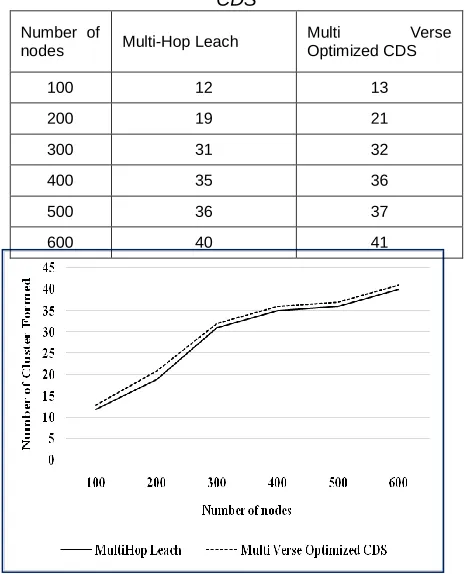
Table 1Number of Clusters Formed for Multi Verse Optimized CDS
Number of
nodes Multi-Hop Leach
Multi Verse Optimized CDS
100 12 13
200 19 21
300 31 32
400 35 36
500 36 37
600 40 41
Figure 1 Number of Clusters Formed for Multi Verse Optimized CDS
Figure 1 shows that the multi verse optimized CDS has higher number of clusters formed by 8%, by 10%, by 3.17%, by 2.81%, by 2.74% and 2.47% for 100, 200, 300, 400, 500 and 600 number of nodes than the multi-hop LEACH respectively.
Table 2 Average End to End Delay for Multi Verse Optimized CDS
Number of nodes
Multi-Hop Leach Multi Verse Optimized CDS
100 0.001569 0.001494
200 0.001652 0.001883
300 0.016158 0.01636
400 0.02511 0.020588
500 0.052513 0.048613
600 0.068226 0.049817
412 Figure 2 Average End to End Delay for Multi Verse Optimized
CDS
Figure 2 shows that the multi verse optimized CDS has lower average end to end delay by 4.89%, by 13.07%, by 1.24%, by 19.79%, by 7.71% and 31.19% for 100, 200, 300, 400, 500 and 600 number of nodes than the multi-hop LEACH respectively.
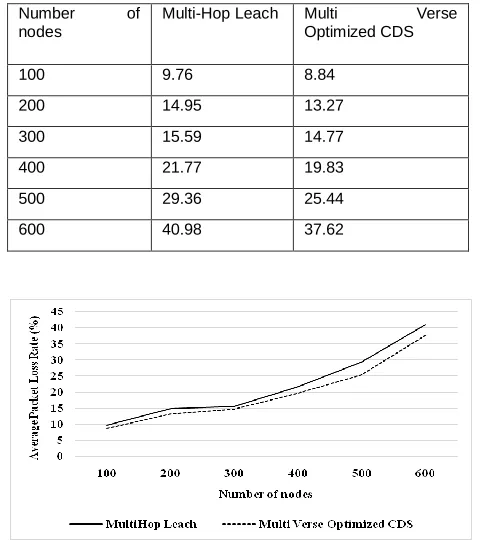
Table 3 Average Packet Loss Rate for Multi Verse Optimized CDS
Number of nodes
Multi-Hop Leach Multi Verse Optimized CDS
100 9.76 8.84
200 14.95 13.27
300 15.59 14.77
400 21.77 19.83
500 29.36 25.44
600 40.98 37.62
Figure 3 Average Packet Loss Rate for Multi Verse Optimized CDS
Figure 3 shows that the multi verse optimized CDS has lower average packet loss rate by 9.89%, by 11.9%, by 5.4%, by 9.32%, by 14.3% and 8.55% for 100, 200, 300, 400, 500 and 600 number of nodes than the multi-hop LEACH respectively. Table 4Lifetime Computation for Multi Verse Optimized CDS
Number of rounds
Multi-Hop Leach
Multi Verse Optimized CDS
0 100 100
100 100 100
200 90 93
300 71 89
400 74 79
500 26 65
600 8 32
700 2 16
Figure 4 Lifetime Computation for Multi Verse Optimized CDS
Figure 4 shows that the multi verse optimized CDS has higher lifetime computation by 3.27%, by 22.5%, by 1.24%, by 6.53%, by 85.71% and 120% for 200, 300, 400, 500 and 600 number of rounds than the multi-hop LEACH respectively.
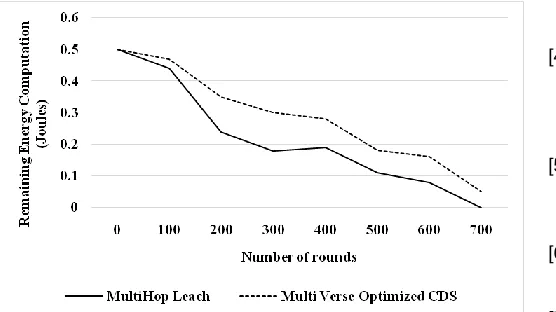
Table 5Remaining Energy Computation for Multi Verse Optimized CDS
Number of rounds
Multi-Hop Leach
Multi Verse Optimized CDS
0 0.5 0.5
100 0.44 0.47
200 0.24 0.35
300 0.18 0.3
400 0.19 0.28
500 0.11 0.18
600 0.08 0.16
700 0 0.05
Figure 5Remaining Energy Computation for Multi Verse Optimized CDS
Figure 5 shows that the multi verse optimized CDS has higher remaining energy computation by 37.28%, by 50%, by 38.29%, by 48.27% and by 66.67% for 200, 300, 400, 500 and 600 number of rounds than the multi-hop LEACH respectively.
5 CONCLUSION
The advances observed in technology recently have made the WSNs possible. They do not have any fixed or pre-defined infrastructure. These nodes are found in the WSN will communicate through the shared medium that makes use of either single or multiple hops. For the original M-LEACH, a CH will be receiving data from cluster members and aggregate them and forward it to the BS. The CH will die earlier in comparison to that of the other nodes owing to the different operations of receiving, overhearing or sending. At the time a CH dies, the cluster will be rendered useless as the data was gathered by the nodes do not reach the BS. Even though has been no infrastructure of physical backbone, there can be virtual backbone that is formed by means of constructing the Connected Dominating Set (CDS). This CDS will limit the actual number of such communicating nodes thus ensuring reduction of the consumption of energy. For the purpose of this work, the CDs of an optimized protocol of routing (the multiverse optimized CDS) had been used for the WSNs were proposed. Their results had proved that the multi verse optimized CDS has higher number of clusters formed by 8%, by 10%, by 3.17%, by 2.81%, by 2.74% and 2.47% for 100, 200, 300, 400, 500 and 600 number of nodes than the multi-hop LEACH respectively.
ACKNOWLEDGMENT
NA
REFERENCES
[1] Tiwari, P., Saxena, V. P., Mishra, R. G., & Bhavsar, D. (2015). Wireless sensor networks: Introduction, advantages, applications and research challenges. HCTL Open International Journal of Technology Innovations and Research (IJTIR), 14, 1-11.
[2] Sangolgi, N. B., & Zakir, S. K. A. (2013). Energy aware data aggregation technique in WSN. International Journal of Scientific and Research Publications, 3(10).
[3] Ambigavathi, M., & Sridharan, D. (2018). Energy-aware data aggregation techniques in wireless sensor network.
In Advances in Power Systems and Energy Management (pp. 165-173). Springer, Singapore.
[4] Latiff, N. A., Tsimenidis, C. C., & Sharif, B. S. (2007, September). Energy-aware clustering for wireless sensor networks using particle swarm optimization. In 2007 IEEE 18th International Symposium on Personal, Indoor and Mobile Radio Communications (pp. 1-5). IEEE.
[5] Ababneh, A. A., & Al-Zboun, E. (2016). EDAC: A Novel Energy-Aware Clustering Algorithm for Wireless Sensor Networks. International Journal of Advanced Computer Science & Applications, 1(7), 333-338.
[6] Kumar, S., Kumar, S., & Bhushan, B. (2014). Energy aware clustering protocol (EACP) for Heterogeneous WSNs. arXiv preprint arXiv:1408.2910.
[7] Humidi, N. A., & Chowdhary, V. (2019). Lightweight Data Transmission Scheme Based on Data Aggregation Technique in Wireless Sensor Networks. Girish, Lightweight Data Transmission Scheme Based on Data Aggregation Technique in Wireless Sensor Networks (May 17, 2019).
[8] Tabatabaei, S., Rajaei, A., & Rigi, A. M. (2019). A Novel Energy-Aware Clustering Method via Lion Pride Optimizer Algorithm (LPO) and Fuzzy Logic in Wireless Sensor Networks (WSNs). Wireless Personal Communications, 1-23.
[9] Subramanian, S. A., &Krishnasamy, K. (2019). Residual Energy and Time Aware Cluster Based Data Gathering in Wireless Sensor Network. Sensor Letters, 17(2), 150-159. [10]Darabkh, K. A., Odetallah, S. M., Al-qudah, Z., Ala’F, K.,
&Shurman, M. M. (2019). Energy-Aware and Density-Based Clustering and Relaying Protocol (EA-DB-CRP) for gathering data in wireless sensor networks. Applied Soft Computing, 80, 154-166.
[11]Darabkh, K. A., & Al-Jdayeh, L. (2019). AEA-FCP: an adaptive energy-aware fixed clustering protocol for data dissemination in wireless sensor networks. Personal and Ubiquitous Computing, 1-19.
[12]Bouamama, S., Blum, C., &Fages, J. G. (2019). An algorithm based on ant colony optimization for the minimum connected dominating set problem. Applied Soft Computing, 80, 672-686.
[13]Hedar, A. R., Ismail, R., El-Sayed, G. A., &Khayyat, K. M. J. (2019). Two Meta-Heuristics Designed to Solve the Minimum Connected Dominating Set Problem for Wireless Networks Design and Management. Journal of Network and Systems Management, 1-41.
[14]Hedar, A. R., & El-Sayed, G. A. (2018, June). Parallel genetic algorithm with elite and diverse cores for solving the minimum connected dominating set problem in wireless networks topology control. In Proceedings of the 2nd International Conference on Future Networks and Distributed Systems (p. 27). ACM.
[15]Gogu, A., Nace, D., Dilo, A., Meratnia, N., & Ortiz, J. H. (2012). Review of optimization problems in wireless sensor networks. In Telecommunications Networks— Current Status and Future Trends (pp. 153-180). New York, NY, USA: InTech.
[16]Sharma, N., & Verma, V. (2013). Energy efficient LEACH protocol for wireless sensor network. International Journal of Information and Network Security, 2(4), 333.
414 [18]Farooq, M. O., Dogar, A. B., & Shah, G. A. (2010, July).
MR-LEACH: multi-hop routing with low energy adaptive clustering hierarchy. In 2010 Fourth International Conference on Sensor Technologies and Applications (pp. 262-268). IEEE.
[19]Purohit, G. N., & Sharma, U. (2010). Constructing minimum connected dominating set: Algorithmic approach. International journal on applications of graph theory in wireless ad hoc networks and sensor networks, 2(3).
[20]Rai, M., Verma, S., &Tapaswi, S. (2009). A power aware minimum connected dominating set for wireless sensor networks. JNW, 4(6), 511-519.