Volume 2011, Article ID 349756,7pages doi:10.1155/2011/349756
Case Report
Surgical Treatment for Unexplained Severe Pain of
the Thyroid Gland: Report of Three Cases and Concise
Review of the Literature
Jan van Schaik,
1Olaf M. Dekkers,
2Eleonora P. M. van der Kleij-Corssmit,
2Johannes A. Romijn,
2Hans Morreau,
3and Cornelis J. H. van de Velde
11Department of Surgery, Leiden University Medical Center, P.O. Box 9600, 2300 RC Leiden, The Netherlands 2Department of Endocrinology, Leiden University Medical Center, P.O. Box 9600, 2300 RC Leiden, The Netherlands 3Department of Pathology, Leiden University Medical Center, P.O. Box 9600, 2300 RC Leiden, The Netherlands
Correspondence should be addressed to Cornelis J. H. van de Velde,c.j.h.van de [email protected]
Received 14 October 2010; Accepted 13 January 2011
Academic Editor: Nam Jong Paik
Copyright © 2011 Jan van Schaik et al. This is an open access article distributed under the Creative Commons Attribution License, which permits unrestricted use, distribution, and reproduction in any medium, provided the original work is properly cited.
Painful thyroid has a limited differential diagnosis. In rare cases, no clear cause can be found after careful clinical, biochemical, and radiological analysis. This may lead to extensive patient morbidity and frustration when symptomatic treatment proves insufficient. Hemithyroidectomy or total thyroidectomy may then be the last resort for doctor and patient. Three cases of unexplained painful thyroid which were successfully treated with hemi or total thyroidectomy are presented. In two cases extensive histological evaluation did not yield a satisfactory explanation for the extreme thyroid pain. In one case histological evaluation of the thyroid revealed Hashimoto’s thyroiditis. Review of the literature does not mention surgical treatment for unexplained painful thyroid, and only 15 cases of surgical treatment for painful Hashimoto’s thyroiditis are presented. Surgical therapy is a successful final option in the treatment of unexplained painful thyroid and painful Hashimoto’s thyroiditis.
1. Introduction
Painful thyroid has a limited differential diagnosis. In addi-tion to trauma and nodular hemorrhages, subacute thy-roiditis, also known as de Quervain thythy-roiditis, is the most common cause [1]. Subacute thyroiditis is a mostly bilateral inflammatory disorder causing a slightly swollen, tender thyroid gland, frequently accompanied by thyrotoxicosis. Markedly elevated erythrocyte sedimentation rate and ele-vated C-reactive protein levels are hallmarks of this disorder. A viral cause has been proposed, as it is often preceded by an upper respiratory tract infection. The condition is self-limiting and symptomatic treatment with analgetics usually suffices. Sometimes corticosteroids are needed. Rare causes of a painful thyroid gland are infection, radiation induced-thyroiditis, malignancy, and neuralgia of the superior laryn-geal nerve [1–3]. In case of infection, surgical therapy can be indicated when antibiotic therapy is inadequate or drainage of an abscess is necessary. Nodular hemorrhages
and radiation-induced thyroiditis are usually self-limiting conditions [3]. Neuralgia of the superior laryngeal nerve is a complex pain disorder and may require high-dose analgetics and peripheral blockade [2,4,5].
In rare cases, no clear cause for a painful thyroid gland can be found after careful clinical, biochemical, and radio-logical analysis. This may lead to extensive patient morbidity and frustration when symptomatic treatment proves insuffi -cient. Hemithyroidectomy or total thyroidectomy may then be the last resort for doctor and patient. Three cases of unex-plained painful thyroid that were successfully treated with surgical therapy are presented, and the differential diagnosis is discussed.
2. Case 1
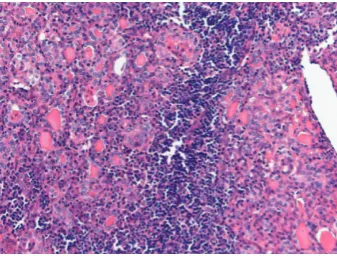
Figure 1: Diffuse hyperplasia with prominent uncomplicated hyperplastic nodes and some lymphocytic thyroiditis (Hematoxy-lin-eosin,×200).
Some weeks before the onset of the pain she suffered from an upper respiratory tract infection. There was no fever. The pain was constant and increased on swallowing. The patient was initially treated by the family physician. Analgetics such as nonsteroidal anti-inflammatory drugs and mor-phinomimetics did not decrease the pain. On physical exam-ination the right thyroid lobe was not enlarged but extremely painful on palpation. There were no obvious thyroid nodes. The left thyroid lobe was normal. There were no enlarged lymph nodes in the neck. Laboratory tests showed euthy-roidism: thyroid stimulating hormone (TSH) level was 0.59 mU/L (normal value 0.4–4.4 mU/L), free thyroxine (T4) level was 19.4 pmol/L (normal value 10–24 pmol/L), and triiodothyronine (T3) level was 1.7 nmol/L (normal value 1.3–2.6 nmol/L). Thyroid peroxidase (TPO) antibody level was low (<10 ku/L). Leukocyte count (6,400/mm3),
erythrocyte sedimentation rate (11 mm/h), and C-reactive protein level (7 mg/dL) were within normal limits. Ultra-sonography showed multiple nodes in the right thyroid lobe with a maximum diameter of 12 mm without any signs of haemorrhage or abscess. The dental surgeon and otolaryn-gologist excluded referred pain from dental or nasopharyn-geal pathology. The patient was treated with analgetics and subsequently corticosteroids for several weeks based on the presumed diagnosis of subacute thyroiditis. However, this did not resolve the symptoms. The pain was increasingly invalidating and led to absence of work. Finally, 6 months after onset of symptoms, a right hemithyroidectomy was performed. The specimen measured 5×3×3 cm. Histological study revealed diffuse hyperplasia with prominent uncom-plicated hyperplastic nodes and some mild lymphocytic thyroiditis (Figure 1). Immediately after surgery the pain had disappeared completely. Up to one year following surgery the patient was free of pain and had a normal thyroid function.
3. Case 2
A 41-year-old Caucasian woman with a history of laparo-scopic gastric banding for morbid obesity and a laparolaparo-scopic cholecystectomy presented with an extremely painful right thyroid lobe. Since several months she had experienced pal-pitations and heat intolerance, and since three weeks extreme
pain had developed in the right thyroid lobe during a period of fever and malaise. She had not noticed any enlargement of the thyroid gland. There had been no weight loss or other physical changes. Analgesic therapy did not relieve the symp-toms. On physical examination there were no signs of thyrotoxicosis. There was a slightly enlarged left thyroid lobe without any palpable nodes and a palpable node of approximately 2 cm in the right lobe, which was very painful on examination. There were no enlarged lymph nodes in the neck. Laboratory tests revealed thyrotoxicosis: TSH level was 0.02 mU/L (normal value 0.4–4.4 mU/L) and free thy-roxine (T4) level 60.7 pmol/L (normal value 10–24 pmol/L). There were no detectable thyroid-stimulating antibodies or TPO antibodies. There was no leukocytosis (4,400/mm3),
erythrocyte sedimentation rate was 29 mm/h, and there was a slight increase in C-reactive protein (23 mg/dL). A Tc-99M scan showed a slightly enlarged thyroid with normal 24-hour uptake, and a cold node on the right side of 4 cm, as well as a node on the left side (3 cm) with normal uptake. Fine-needle aspiration yielded no conclusive diagnosis. The otolaryngologist excluded any pharyngeal or tracheal pathol-ogy. The following causes were considered in the differential diagnosis: subacute thyroiditis of de Quervain or an early hyperthyroid phase of Hashimoto’s thyroiditis (Hashitoxi-cosis). The thyroid function returned to normal within two months without any antithyroid therapy. However, the right hemithyroid remained extremely painful. The patient was treated with nonsteroidal anti-inflammatory drugs and mor-phinomimetics for several weeks without any improvement of symptoms. Finally, four months after onset of pain, a right hemithyroidectomy was performed. The specimen measured 4×4×2 cm. Histological study showed some nodular hyper-plasia with degenerative changes, a limited lymphocytic thy-roiditis, and a focal area with sclerosis. Elsewhere, bleeding and signs of previous bleeding were seen. Remarkable was the presence of adipose metaplasia of thyroid stroma (Figure 2). Immediately after surgery the pain had disappeared com-pletely. Up to several months after surgery, the patient was free of pain and had a normal thyroid function.
4. Case 3
Figure 2: Nodular hyperplasia with degenerative changes, a
lim-ited lymphocytic thyroiditis and adipose metaplasia of thyroid stroma. Some signs of bleeding and previous bleeding are seen (Hematoxylin-eosin,×40).
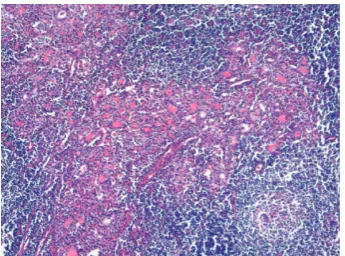
Figure 3: Severe lymphocytic infiltration with formation of
lym-phatic follicles and H¨urthle cells (Hematoxylin-eosin,×100).
thyroxine (T4) level was 13.4 pmol/L (normal value 10– 24 pmol/L), and triiodothyronine (T3) level was 2.1 nmol/L (normal value 1.3–2.6 nmol/L). TPO antibody level was in-creased (459 ku/L). There was no inin-creased leukocyte count (3,400/mm3) or increased erythrocyte sedimentation rate
(5 mm/h). An I-123 scan showed a homogenously enlarged thyroid (slightly more increased on the right side) with a 24-hour uptake of 42%. The otolaryngologist excluded any pharyngeal or tracheal pathology. Esophagogastroscopy revealed no pathology explaining difficulty swallowing or weight loss. Fine-needle aspiration of the thyroid revealed lymphocytic thyroiditis, in accordance with the diagnosis of Hashimoto’s thyroiditis. The patient was treated with nons-teroidal anti-inflammatory drugs and corticosteroids for sev-eral months without any improvement of symptoms. Finally, eight months following onset of pain, a total thyroidectomy was conducted. Histological study indeed showed a very severe lymphocytic thyroiditis with formation of lymphatic follicles (Figure 3). Immediately after surgery the pain had disappeared completely. Up to several years following surgery the patient was free of pain.
5. Discussion
This case series describes three patients with extreme, inval-idating pain located within the thyroid gland, which could
not adequately be managed by symptomatic treatment. The complaints resolved completely and immediately upon surgical removal of the painful thyroid tissue.
The clinical presentation in the first case is reminiscent of subacute thyroiditis which is sometimes preceded by a viral upper respiratory tract infection. However, unilateral pain, normal levels of C-reactive protein, and a normal erythrocyte sedimentation rate are not in agreement with this diagnosis. Moreover, subacute thyroiditis is often characterized by thy-rotoxicosis followed by hypothyroidism. The symptoms usu-ally improve dramaticusu-ally following the administration of nonsteroidal anti-inflammatory drugs. Finally, the histolog-ical specimens did not show the typhistolog-ical changes expected in subacute thyroiditis nor yielded any other cause for the patient’s complaints.
In the second case, the differential diagnosis included early hyperthyroid phase of Hashimoto’s thyroiditis (HT) and subacute thyroiditis. Unilateral pain, however, is not typ-ical for either condition. The absence of thyroid antibodies would support subacute thyroiditis. However, a normal 24-hour I-123 uptake or Tc-99M scan and the only slightly ele-vated erythrocyte sedimentation rate and C-reactive protein levels are more in favour of HT. We could not document histological changes confirming HT nor subacute thyroiditis. Histological evaluation of the thyroid gland of the third case clearly identified HT. This autoimmune disease is char-acterized by painless goiter, and hypothyroidism is some-times preceded by a hyperthyroid phase [1]. TPO antibodies are usually elevated, but they may be low or even absent in HT. Rarely, it may present as a painful goiter and sometimes clinically resembles subacute thyroiditis. Although painful HT often presents with fever, transient thyrotoxicosis, ele-vated erythrocyte sedimentation rate, and eleele-vated levels of C-reactive protein, patients may also be euthyroid or hypothyroid, and infection parameters may be normal [10]. The diagnosis of HT in the case of an extremely painful thyroid is therefore typically based on histological studies. Although painful HT has been previously described, the literature is limited to case series [6–12]. Initial treatment for painful HT is typically symptomatic with nonsteroidal anti-inflammatory drugs and corticosteroids or may be focused on hormone replacement therapy. Quite often this might not be sufficient. In these cases surgical treatment has proven a successful option, in accordance with our observation [6–
9]. Clinical features and pain relief following surgery of all patients presented in the literature that were surgically treated for painful HT are summarized in Tables1and2.
Speculation on the cause of pain in the first two cases includes atypical viral infection since both patients had expe-rienced a prodromal period of fever and malaise. Another speculation is that even uncomplicated thyroid nodes might cause severe pain in exceptional cases.
Table 2: Pain relief to treatment and surgical pathology in fifteen cases of painful Hashimoto’s thyroiditis.
Authors No. Pain relief to T4
Pain relief to steroids
Pain relief to aspirin or NSAIDS
Time from pain onset to surgery (years)
Pain relief after thyroidectomy
Type of
surgery Pathology
Kon and
DeGroot [6] 1 No No Not given 2
Total,
permanent NTT
Focal lymphocytic thyroiditis
2 No No Not given 2
Total, but recurrence after 1 year
NTT
Hashimoto’s thyroiditis, incidental pappilary cancer
3 No Rapid but
relapsing Not given 3.1
Total,
permanent NTT
Near end stage thyroiditis
4 No Rapid but
relapsing No to NSAID 1.1
Total,
permanent STT
Focal lymphoid infiltrates, sparse H¨urthle cells
5 Partial Not given Unable to
tolerate NSAID 6.2
Total,
permanent STT
Fibrosis, large reactive lymphocyte follicles, H¨urthle cell clusters
6 No Not given No 0.5 Partial STT Diffuse lymphocytic
thyroiditis
7 No Rapid but
relapsing Partial 0.6 Total, relapsed STT
Hashimoto’s thyroiditis
Ohye
et al. [7] 1
Yes but relapsing
Rapid but
relapsing NM 2.7
Total,
permanent TT
Severe fibrosis, lymphocytic infiltration
2 No Rapid butrelapsing NM 4.0 Total,permanent TT
Severe fibrosis, lymphocytic infiltration
3 No Rapid butrelapsing NM 2.0 Total,permanent TT
Severe fibrosis, lymphocytic infiltration
4 Not given Rapid but
relapsing NM 0.75
Total,
permanent TT
Giant cells, mild fibrosis, remaining follicular structure
Gourgiotis
et al. [8] 1 No Yes, relapsing NM >10
Total,
permanent TT
Severe fibrosis, lymphocytic infiltration, H¨urthle cells
2 No NM NM 2.1 Total,
permanent TT
Lymphocytic thyroiditis, focal H¨urthle cells Zimmerman
et al. [9] 1 No No Yes, relapsing >5
Total,
permanent TT
Lymphocytic infiltration
2 No Yes, relapsing Not given 0.5 Total,
permanent TT
Lymphocytic thyroiditis
NTT: near total thyroidectomy; STT: subtotal thyroidectomy; TT: total thyroidectomy.
“electrical”. There is usually a trigger point, and episodes may be accompanied by nausea or excessive lacrimation. Treat-ment is symptomatic and may require high-dose analgetics and peripheral blockade [2, 4, 5]. However, none of the above-mentioned clinical presentations resembled superior laryngeal neuralgia.
In conclusion, we describe three patients with extreme invalidating pain which severely interfered with daily activ-ities and work. In all cases symptomatic treatment was not successful. The pain was immediately relieved by hemithy-roidectomy or total thyhemithy-roidectomy. Remarkably, extensive
histological evaluation did not yield a satisfactory explana-tion for the extreme thyroid pain in two cases, and in one case, HT was found. This indicates that surgical therapy is a successful final option in the treatment of unexplained painful thyroid and painful HT.
Conflict of Interest
Funding
This research did not receive any specific grant from any funding agency in the public, commercial, or not-for-profit sector.
References
[1] E. N. Pearce, A. P. Farwell, and L. E. Braverman, “Thyroiditis,”
New England Journal of Medicine, vol. 348, no. 26, pp. 2646–
2655, 2003.
[2] O. Aydin, M. Ozturk, and Y. Anik, “Superior laryngeal neural-gia after acute laryngitis and treatment with a single injection of a local anesthetic,” Archives of Otolaryngology, vol. 133, no. 9, pp. 934–935, 2007.
[3] A. S. Fauci, E. Braunwald, K. J. Isselbacher et al., Eds.,
Harri-son’s Principles of Internal Medicine, McGraw-Hill, Singapore,
14th edition, 1998.
[4] D. Schmidt and I. Strutz, “Superior laryngeal neuralgia,”
Journal of Neurology, vol. 225, no. 3, pp. 223–225, 1981.
[5] K. T. Sato, M. Suzuki, A. Izuha, S. Hayashi, T. Isosu, and M. Murakawa, “Two cases of idiopathic superior laryngeal neuralgia treated by superior laryngeal nerve block with a high concentration of lidocaine,” Journal of Clinical Anesthesia, vol. 19, no. 3, pp. 237–238, 2007.
[6] Y. C. Kon and L. J. DeGroot, “Painful Hashimoto’s thyroiditis as an indication for thyroidectomy: clinical characteristics and outcome in seven patients,” Journal of Clinical Endocrinology
and Metabolism, vol. 88, no. 6, pp. 2667–2672, 2003.
[7] H. Ohye, S. Fukata, S. Kubota et al., “Successful treatment for recurrent painful Hashimoto’s thyroiditis by total thyroidec-tomy,” Thyroid, vol. 15, no. 4, pp. 340–345, 2005.
[8] L. Gourgiotis, N. Al-Zubaidi, M. C. Skarulis et al., “Suc-cessful outcome after surgical management in two cases of the “painful variant” of Hashimoto’s thyroiditis,” Endocrine
Practice, vol. 8, no. 4, pp. 259–265, 2002.
[9] R. S. Zimmerman, M. D. Brennan, and W. M. McConahey, “Hashimoto’s thyroiditis. An uncommon cause of painful thyroid unresponsive to corticosteroid therapy,” Annals of
Internal Medicine, vol. 104, no. 3, pp. 355–357, 1986.
[10] H. Ohye, E. Nishihara, I. Sasaki et al., “Four cases of Graves’ disease which developed after painful Hashimoto’s thyroiditis,” Internal Medicine, vol. 45, no. 6, pp. 385–389, 2006.
[11] A. K. C. Leung and K. Hegde, “Hashimoto’s thryroiditis simulating De Quervain’s thyroiditis,” Journal of Adolescent
Health Care, vol. 9, no. 5, pp. 434–435, 1988.
Submit your manuscripts at
http://www.hindawi.com
Stem Cells
International
Hindawi Publishing Corporation
http://www.hindawi.com Volume 2014
Hindawi Publishing Corporation
http://www.hindawi.com Volume 2014
INFLAMMATION
Hindawi Publishing Corporation
http://www.hindawi.com Volume 2014
Behavioural
Neurology
Endocrinology
International Journal of Hindawi Publishing Corporationhttp://www.hindawi.com Volume 2014
Hindawi Publishing Corporation
http://www.hindawi.com Volume 2014
Disease Markers
Hindawi Publishing Corporation
http://www.hindawi.com Volume 2014
BioMed
Research International
Oncology
Journal of Hindawi Publishing Corporationhttp://www.hindawi.com Volume 2014
Hindawi Publishing Corporation
http://www.hindawi.com Volume 2014
Oxidative Medicine and Cellular Longevity
Hindawi Publishing Corporation
http://www.hindawi.com Volume 2014
PPAR Research
The Scientific
World Journal
Hindawi Publishing Corporation
http://www.hindawi.com Volume 2014
Immunology Research
Hindawi Publishing Corporation
http://www.hindawi.com Volume 2014
Journal of
Obesity
Journal ofHindawi Publishing Corporation
http://www.hindawi.com Volume 2014
Hindawi Publishing Corporation
http://www.hindawi.com Volume 2014
Computational and Mathematical Methods in Medicine
Ophthalmology
Journal ofHindawi Publishing Corporation
http://www.hindawi.com Volume 2014
Diabetes Research
Journal ofHindawi Publishing Corporation
http://www.hindawi.com Volume 2014
Hindawi Publishing Corporation
http://www.hindawi.com Volume 2014
Research and Treatment
AIDS
Hindawi Publishing Corporation
http://www.hindawi.com Volume 2014
Gastroenterology Research and Practice
Hindawi Publishing Corporation
http://www.hindawi.com Volume 2014
Parkinson’s
Disease
Evidence-Based Complementary and Alternative Medicine
Volume 2014