Earth Surf. Dynam., 2, 309–321, 2014 www.earth-surf-dynam.net/2/309/2014/ doi:10.5194/esurf-2-309-2014
© Author(s) 2014. CC Attribution 3.0 License.
Morphological coupling in multiple sandbar systems –
a review
T. D. Price1,*, B. G. Ruessink1, and B. Castelle2
1Department of Physical Geography, Faculty of Geosciences, Utrecht University, Utrecht, the Netherlands 2UMR EPOC, Université de Bordeaux 1, Bordeaux, France
*now at: Department of Ecological Science, Faculty of Earth and Life Sciences, VU University Amsterdam,
Amsterdam, the Netherlands
Correspondence to: T. D. Price ([email protected])
Received: 15 October 2013 – Published in Earth Surf. Dynam. Discuss.: 10 December 2013 Revised: 22 April 2014 – Accepted: 25 April 2014 – Published: 3 June 2014
Abstract. Subtidal sandbars often exhibit alongshore variable patterns, such as crescentic plan shapes and rip channels. While the initial formation of these patterns is reasonably well understood, the morphodynamic mech-anisms underlying their subsequent finite-amplitude behaviour have been examined far less extensively. This behaviour concerns, among other aspects, the coupling of alongshore variable patterns in an inner bar to similar patterns in a more seaward bar, and the destruction of crescentic patterns. This review aims to present the current state of knowledge on the finite-amplitude behaviour of crescentic sandbars, with a focus on morphological cou-pling in double sandbar systems. In this context we include results from our recent study, based on a combination of remote-sensing observations, numerical modelling and data–model integration. Morphological coupling is an inherent property of double sandbar systems, where the inner bar may attain a type of morphology not found in single bar systems. Coupling is governed by water depth variability along the outer-bar crest and by various wave characteristics, including the offshore wave height and angle of incidence. In recent research, the role of the angle of wave incidence for sandbar morphodynamics has received more attention. Numerical modelling results have demonstrated that the angle of wave incidence is crucial to the flow pattern, sediment transport, and thus the emerging morphology of the coupled inner bar. Moreover, crescentic patterns predominantly vanish under high-angle wave conditions, highlighting the role of alongshore currents in straightening sandbars and challenging the traditional conception that crescentic patterns vanish under high-energy, erosive wave conditions only.
1 Introduction
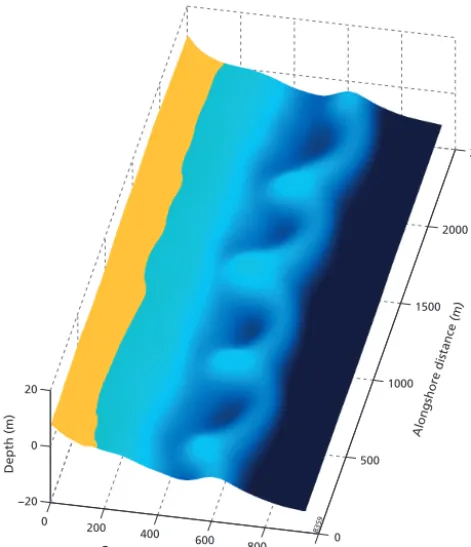
Subtidal sandbars are shore-parallel ridges of sand in less than 10 m water depth fringing wave-dominated coasts along great lakes, semi-enclosed seas and open oceans (e.g. Evans, 1940; Saylor and Hands, 1970; Greenwood and Davidson-Arnott, 1975; Lippmann et al., 1993; Ruessink and Kroon, 1994; Shand et al., 1999; Almar et al., 2010; Kuriyama, 2002; Ruessink et al., 2003; Wijnberg and Terwindt, 1995, and references therein). Sandbars often have multi-annual lifetimes and can occur as a single feature, or as a multi-ple bar (most often two, sometimes up to five) system. In-triguingly, sandbars often exhibit quasi-regular undulations in their height and cross-shore position (Fig. 1). These
so-called crescentic sandbars can be viewed as a more-or-less rhythmic sequence of shallow horns (shoals) and deep bays (cross-shore troughs) alternating shoreward and seaward of an imaginary line parallel to the coast. In addition, crescentic sandbars are often associated with similar rhythmic pertur-bations in onshore morphology, such as the shoreline (e.g. Sonu, 1973; Van de Lageweg et al., 2013) or a more land-ward located inner sandbar (e.g. Ruessink et al., 2007a). De-pending on the wave conditions and the currents they induce in the nearshore zone, these sandbar patterns continuously change, vanish or reappear. It is this perpetual variability of nearshore sandbars that continues to draw the attention of nearshore researchers, just as it has done over the past decades.
500 1000
1500 2000
2500
−20 0 20
0
0 200
400 600
800 1000
Alongshore distance (m)
Cross−shore distance (m)
Depth (m)
8359
Figure 1.Bathymetry of a beach with a crescentic sandbar. This bathymetry was measured during the ECORS-Truc Vert 2008 field experiment (see Almar et al. 2010).
Besides their intriguing morphological appearance and evolution, sandbars are also of significant societal impor-tance by forming a natural barrier between the hinterland and the ocean. Sandbars safeguard beaches by dissipating storm waves before they impact the shore. Morphological coupling, for instance, can lead to alongshore variations in wave dissipation, resulting in localised beach and dune ero-sion and subsequent property loss during storms (Thornton et al., 2007). Many present-day soft engineering measures to improve coastal safety, such as shoreface nourishments, in-volve direct or indirect modifications to sandbars (e.g. Grun-net and Ruessink, 2005; Ojeda and Guillén, 2008). A com-prehensive understanding of the processes that govern sand-bar behaviour and the development of the capability to pre-dict this behaviour are thus of significant importance when it comes to minimising human and economic losses.
A key element to the understanding of morphologi-cal sandbar behaviour is frequent (daily), and long-term (∼years) monitoring of the nearshore zone, and the subse-quent investigation of patterns and regularities in behaviour emerging from this observational data. Numerous observa-tions and long-term monitoring of the nearshore zone have revealed the wide range of shapes that nearshore sandbars may attain (e.g. Wright and Short, 1984; Lippmann and Hol-man, 1990; Van Enckevort et al., 2004; Ranasinghe et al., 2004). Despite each observed sandbar configuration being
unique, and the continuous change in shape under the influ-ence of waves and currents, a certain regularity in sandbar morphology has been observed. For single-barred beaches, Wright and Short (1984) developed the most widely accepted and applied beach state classification model, based on ob-servations of beaches with contrasting environmental condi-tions over a period of 3 years. Such an aggregation facili-tates answers as to when certain behaviour, such as morpho-logical coupling, actually happens. Whereas the Wright and Short (1984) classification model is essentially applicable to single-barred beaches only, Short and Aagaard (1993) de-vised a multi-bar state model where each bar can go through the same states as in the single bar model. The sandbars are essentially treated as independent features and the role of coupling between the bars for the behaviour of the composite double sandbar system is thus disregarded.
Another key approach to the understanding of sandbar dy-namics is the development, use, and validation of simpli-fied exploratory and detailed simulation models. Model stud-ies first explained alongshore sandbar variability from a
hy-drodynamic template in the water motion (Bowen and
In-man, 1971; Holman and Bowen, 1982); present-day models rely on the principle of self-organisation (Hino, 1975; Sonu, 1972; Falqués et al., 2000; Coco and Murray, 2007), in which a crescentic sandbar forms spontaneously through the posi-tive feedback between the flow, sediment processes and the evolving morphology. The genesis of crescentic patterns in single sandbar systems is thus reasonably well understood. In a double sandbar system, with a more landward inner bar and a more seaward outer bar, the distinction between a forc-ing template and self-organisation becomes blurred (Castelle et al., 2010a, b). In this case, the crescentic outer-bar mor-phology acts as a morphological template for the inshore flow patterns through the breaking and focussing of waves across the outer bar. It is obvious that this morphological coupling no longer relates to the initial formation of patterns, but re-lates to finite-amplitude behaviour instead. Here, the mor-phological template of the crescentic outer bar may suppress local self-organisation mechanisms at the inner bar and hence govern the shape of the inner bar.
Although morphological coupling has been observed and finite-amplitude behaviour of sandbars has been shown to be one of the largest sources of nearshore morphodynamic variability, it is not understood when and why morphological variations in an outer bar impact the geometry of an inner bar. The increasing availability of high-resolution (daily), long-term (many years) time series of nearshore video imagery (Holman and Stanley, 2007), together with advances in the non-linear modelling of nearshore morphodynamics and in data–model integration techniques, have recently advanced our knowledge of the finite-amplitude behaviour of along-shore sandbar variability considerably.
T. D. Price et al.: Morphological sandbar coupling 311
0 250 500
−2500 −2000 −1500 −1000 −500 0 500 1000 1500 2000 2500
Alongshore distance (m) Cross−shore distance (m) Horns Bays
Landward perturbations
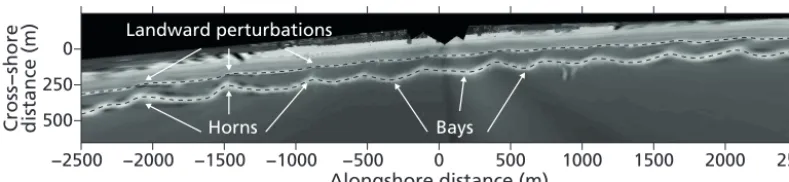
Figure 2.Example of a time-exposure image from the Gold Coast, Australia, showing the Idt coupling type, with a crescentic outer bar and a terraced inner bar with landward perturbations coupled to the alongshore positions of the outer-bar horns. The dotted lines indicate the video-derived inner and outer barlines. Source: Price et al. (2013).
systems. In this context we include results from our recent study, based on an approximately 9.3-year long data set of low-tide time-exposure video images of the double-barred Surfers Paradise, Gold Coast, Queensland, Australia, a swell-dominated site where the waves are usually obliquely inci-dent. Measurements from nearby wave buoys provided con-current wave data, i.e. root-mean-square wave height Hrms,
peak wave periodTp and angle of wave incidence with
re-spect to shore-normal in 15 m depth θ. First, the morpho-dynamic states that characterise a double sandbar system are described in Sect. 2, followed by a discussion of observations and modelling efforts of morphological coupling in double sandbar systems in Sect. 3. In Sect. 4, we conclude with a brief synthesis and perspectives for future research.
2 Alongshore sandbar variability
Although considerable research has been devoted to the state dynamics of a double-barred system, observations were mostly based on data which were either temporally limited to a single accretionary/erosional sequence (e.g. Van Enck-evort et al., 2004; Ruessink et al., 2007a), spatially limited to (an alongshore transect of) the inner bar (e.g. Lippmann and Holman, 1990; Shand et al., 2003; Sénéchal et al., 2009) or based on data acquired at different locations or at irregu-lar intervals (Short and Aagaard, 1993; Castelle et al., 2007). Furthermore, the large relaxation times of outer bars, in re-lation to the offshore wave forcing, have often prevented an abundance of state transitions of the outer bar to occur dur-ing the studied periods (see e.g. Goldsmith et al., 1982; Ferrer et al., 2009). While these observations each provide a varying amount of insight into sandbar behaviour, the use of scarce data or the selective use of data carries the risk of assuming the identified behaviour to be representative of the character-istic system dynamics. With the rise of video monitoring of the nearshore zone over the last 3 decades (Holman and Stan-ley, 2007), the trend towards frequent, long-term monitoring is increasing. The sequential behaviour of the bar states of a double-barred system at a single site, however, had not been studied under a wide range of wave conditions. Accordingly, an important first step in our study of the finite-amplitude
behaviour of crescentic sandbars was to characterise the typ-ical development of alongshore variability within a double sandbar system, based on multiple sequences (see Price and Ruessink, 2011).
The most conspicuous elements in the low-tide time-exposure images mentioned in Sect. 1 are the alongshore continuous white bands that represent the foam created by wave breaking above the sandbars (Lippmann and Holman, 1989; Fig. 2). We tracked this optical breaker line (hereafter referred to as the barline) of both the inner and outer bar in all available (2995) low-tide images, allowing us to quan-tify the alongshore variability of both bars (see Price and Ruessink, 2011). During the 9.3 years studied, the outer bar was predominantly (two thirds of the time) alongshore vari-able, whereas the inner bar existed as a shore-attached terrace with a rhythmic terrace edge almost half of the time (shown in Fig. 2). This alongshore rhythmicity of the inner terrace contrasts with shore-attached terraces in single bar systems, which are mostly uniform. For more alongshore-uniform oubar shapes (a third of the time), an inner ter-race was less common and, instead, rip channels dominated the inner-bar morphology.
As mentioned in Sect. 1, the development of crescentic sandbars has been attributed to self-organisation processes, with the traditional conception that the wave energy alone governs their evolution. The development of crescentic sand-bars has been found to develop during low-energy, accretive wave conditions (e.g. Ranasinghe et al., 2004; Van Enckevort et al., 2004); a so-called downstate sequence (Wright and Short, 1984). Their alongshore variability is associated with wave-driven circulation patterns that consist of weak onshore flow over the horns and strong offshore flow through the bays. Under continuing low waves the horns of the crescentic bar weld to the shore, causing the initially alongshore contin-uous trough to disappear and the bays to evolve into distinct cross-shore troughs (rip channels) with strong currents (up to 2 m s−1) (e.g. Brander, 1999; Houser et al., 2013). On the other hand, the straightening of an alongshore variable sand-bar, called an upstate sequence (Wright and Short, 1984) or morphological reset, has traditionally been associated with
b
a
Figure 3.Mean wave conditions during (a) low-energetic and (b) moderately energetic downstate (circles) and upstate (triangles) transitions of the outer bar, showingH¯rmsversus| ¯θ|. A downstate transition corresponds to the further development of rip channels, an upstate transition
to a sandbar straightening. Adapted from: Price and Ruessink (2011).
high-energy, erosive-wave conditions, without an actual ac-count of which processes lead to straightening.
Observations from the Gold Coast video data set challenge the need for high-energy wave conditions for the straighten-ing of an alongshore variable sandbar; instead, they stress the effect of wave obliquity in morphological evolution. For example, Fig. 3a illustrates that low-energetic wave condi-tions (H¯rms=0.5–1 m) generally resulted in the further
de-velopment of rip channels in the outer bar, especially when
θ is small (say, less than 30◦), while the same waves with a
larger angle of incidence (θ >20◦) were observed to cause
a reset. Similarly, Fig. 3b illustrates that moderately ener-getic wave conditions (H¯rms=1–2 m) generally led to
sand-bar straightening, while the further development of rip chan-nels was observed during smaller angles of wave incidence (θ <30◦). The straightening of a shore-attached crescentic sandbar to a shore-parallel linear bar by obliquely incident waves generally happened gradually (1–5 days). During this transition, the barline straightened and the rip channels be-came obliquely oriented, leading to a characteristic sandbar morphology (Fig. 4).
Whereas the morphodynamics of the outer bar at the Gold Coast could be related to offshore wave conditions (as a single bar system), two types of inner-bar morphodynam-ics were distinguished, governed by the outer-bar state: the inner bar mostly existed as an alongshore variable terrace for alongshore variable outer-bar states. As more wave en-ergy reached the inner bar during alongshore-uniform outer-bar states, the inner-outer-bar behaviour resembled more that of a single-barred system, with its frequent separation from the shoreline and the persistent development of rip channels. This interaction implies that sandbars in a double-barred sys-tem should not be studied as independent features, but that
0
200
400
600
0
200
400
600
−2500 −2000 −1500 −1000 −500
−2500 −2000 −1500 −1000 −500
Distance (m)
Distance (m)
Distance (m)
Distance (m)
eTBR
rLTT
Figure 4.Example of the characteristic sandbar morphology during the straightening of a attached crescentic sandbar to a shore-parallel linear bar by obliquely incident waves. Here, the barline (dashed line) straightens and the rip channels become obliquely ori-ented. Adapted from: Price and Ruessink (2011).
the behaviour of the composite sandbar system should be taken into account.
3 Sandbar coupling
3.1 Observations
T. D. Price et al.: Morphological sandbar coupling 313
a)
b)
c)
d)
0 500 m
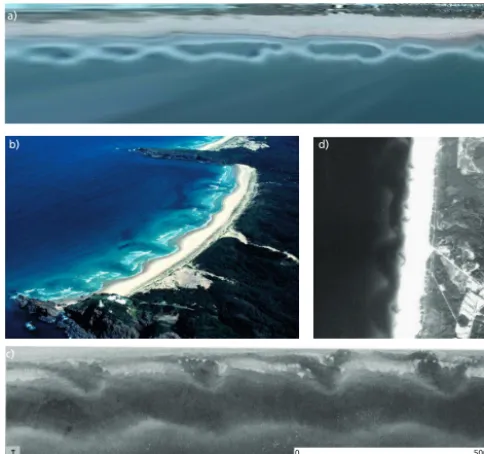
Figure 5.Examples of coupled morphology, showing (a) out-of-phase (180◦) coupled sandbars, (b) out-of-phase coupling between sandbar and shoreline (courtesy of A.D. Short), (c) in-phase (0◦) coupled sandbars (taken from Bowman and Goldsmith, 1983), and (d) two inner-bar rip channels for each outer-bar bay (taken from Castelle et al., 2007).
morphological coupling. Ruessink et al. (2007a), for exam-ple, found that the inner bar increasingly coupled to the outer-bar shape as the outer outer-bar became more crescentic and mi-grated onshore, i.e. during a downstate transition of the outer bar (Wright and Short, 1984; Price and Ruessink, 2011). Coupling examples (Fig. 5) include the systematic occur-rence of two inner-bar rip channels within one outer-bar cres-cent (Castelle et al., 2007; Fig. 5d), that of seaward perturba-tions in the inner bar facing outer-bar horns (a 180◦, or out-of-phase relationship; Van Enckevort and Wijnberg, 1999; Fig. 5a), and that of shoreward perturbations in the inner bar facing outer-bar horns (a 0◦, or in-phase relationship; Bow-man and Goldsmith, 1983; Castelle et al., 2007; Fig. 5c). The out-of-phase relationship is reminiscent of the commonly ob-served relationship between inner-bar patterns and shoreline rhythms (Sonu, 1973; Orzech et al., 2011; Fig. 5b). Addi-tionally, Ruessink et al. (2007a) and Quartel (2009) found coupled sandbar patterns with gradual phase changes (rang-ing from 0 to 180◦), thought to be related to the persistent
non-zero angle of wave incidence and larger alongshore mi-gration rates of the subtidal bar with respect to the inner bar, respectively.
The aforementioned field observations of sandbar cou-pling were either based on sporadic observations (e.g. Bow-man and Goldsmith, 1983; Castelle et al., 2007) or a short single event (e.g. Ruessink et al., 2007a). Although this pre-vious work has provided clear examples of the phenomenon
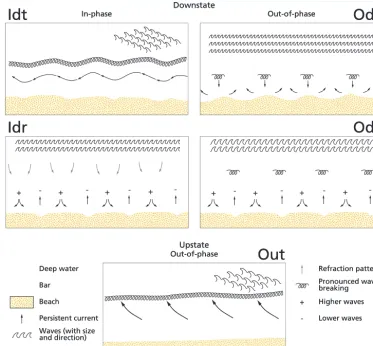
of sandbar coupling, the frequency or predominance of ei-ther of the coupling patterns remained unclear. As a first step towards understanding when and how often certain coupling types develop, we addressed the representativeness of these findings using the barlines derived from the low-tide time-exposure video images. Cross-correlation of the barlines al-lowed detecting coupled inner- and outer-bar morphology (Price and Ruessink, 2013). Intriguingly, 40 % of all observa-tions were found to have statistically significant (at the 98 % confidence level) coupling. The images unveiled five charac-teristic coupling types (Fig. 6). The bars either coupled in-phase, with an outer-bar horn facing a shoreward perturba-tion of the inner barline, or out-of-phase, where the outer-bar horn coincided with a seaward bulge in the inner outer-barline. Four of the five observed coupling types coincided with a downstate sequence of the outer bar. The morphology of the inner bar was found to be either terraced (with no trough or channels intersecting the bar) or characterised by the pres-ence of rip channels. These properties were used to give ab-breviated names to the coupling types (Fig. 6): I or O (in-phase or out-of-(in-phase), d or u (downstate or upstate) and t or r (terraced or with rips). By far the most common cou-pling type at the Gold Coast was, however, the Idt type, with a wavy terraced inner bar showing landward perturbations displaced slightly (≈100 m) alongshore with respect to the outer-bar horns (Fig. 6a and Fig. 2). This coupling type cor-responds to the coupled morphology observed by Ruessink et al. (2007a) at the same site.
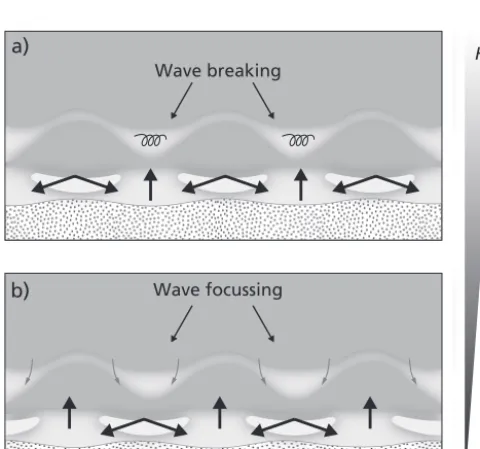
Using a numerical model with synthetic wave-input condi-tions and bathymetries, Castelle et al. (2010a) demonstrated that, under shore-normal waves, coupling processes arise because of alongshore variability in wave height, and as-sociated flow patterns over the inner bar that are induced by the water depth variability along the outer-bar crest. As summarised in Fig. 7, a large fraction of wave breaking over the outer bar leads to out-of-phase coupled sandbars (Fig. 7a). For a small fraction of wave breaking, wave fo-cusing by refraction over the outer-bar horns overwhelms the effect of wave breaking, leading to in-phase coupled sand-bars (Fig. 7b). Figure 8 summarises the Gold Coast observa-tions in a conceptual model, in which the type of coupling is governed by the offshore wave height, the angle of wave incidence and the depth variation along the outer bar. The two coupling types explored in Castelle et al. (2010a), under shore-normal wave incidence, correspond to Odr (Fig. 7a) and Idr (Fig. 7b). The predominance of the Idt coupling type is related to the fairly large waves that persistently arrive with a large angle of incidence (30◦). We hypothesised that
such wave conditions drive a meandering alongshore cur-rent (Sonu, 1972; MacMahan et al., 2010) that prevents the outer-bar horns from welding to the inner bar and leads to downdrift-positioned landward perturbations in the inner ter-race. When the meandering current is less strong (smaller wave height or more shore-normal incidence), the outer-bar horns can weld ashore and lead to the Odt coupling type.
0
250
500
0
250
500
0
250
500
−2500 −2000 −1500 −1000 −500 0
−2500 −2000 −1500 −1000 −500 0
Cross−shore distance (m)
Alongshore distance (m)
In−phase Out−of−phase
a) Idt
b) Idr
c) Odt
d) Odr
e) Out
Figure 6.Examples of observed types of morphological coupling between the inner and outer barlines; low-tide time-exposure plan-view images of in-phase images with (a) an inner terrace and (b) inner rips, out-of-phase coupling with (c) an inner terrace and (d) inner rips in downstate direction, and (e) out-of-phase coupling with a clear alongshore offset between the inner- and outer-barline features in upstate direction. The dotted lines indicate the detected barlines, and the circles indicate a characteristic coupling feature for each coupling type. Source: Price and Ruessink (2013).
Wave focussing Wave breaking
a)
b)
H
8359
Figure 7.Coupling patterns found by Castelle et al. (2010a), show-ing (a) out-of-phase couplshow-ing and (b) in-phase couplshow-ing, dependshow-ing on the wave heightH. The thick black arrows indicate the associate flow patterns, whereas the gray arrows indicate wave refraction.
When the waves are highly energetic and obliquely inci-dent, the outer bar becomes more alongshore-uniform (see also Sect. 2); the outer-bar horns separate from the outer bar to become part of the inner bar (similar to Almar et al., 2010), resulting in an alongshore variable inner terrace, the upstate coupling type Out. If the straightening persists, both bars become alongshore-uniform with alongshore continu-ous troughs. A sudden change toward the end of this straight-ening, however, leads to the Idr coupling type. Now, the small remaining depth variations along the outer bar cause wave focussing through refraction, driving a weak cell-circulation pattern over the inner bar (see also Fig. 7b).
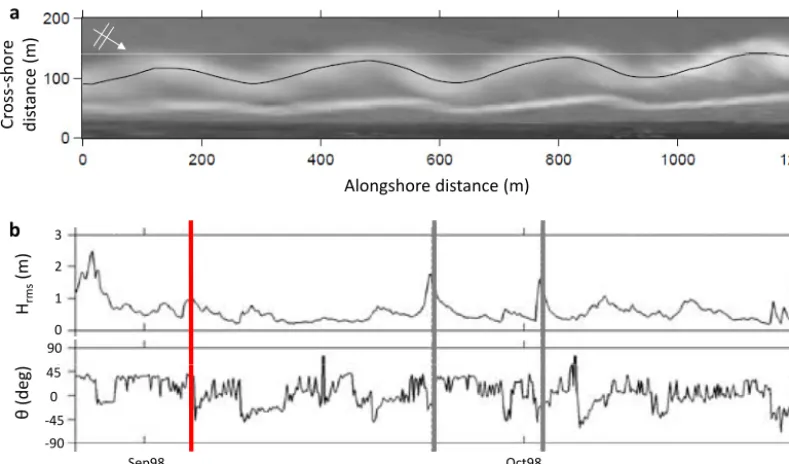
Although the alongshore variability in the inner bar is cou-pled to that in the outer bar for some 40 % of the time at the Gold Coast, it remains unknown to what extent these observations represent the behaviour of other double-barred beaches. Similar to the observed behaviour at the Gold Coast (also see Ruessink et al., 2007a), observations from Duck Beach (North Carolina, USA) show the formation of an Idt coupling type, following a period of obliquely incident, mod-erately energetic waves (Fig. 9).
T. D. Price et al.: Morphological sandbar coupling 315
Faculty of Geosciences
Physical Geography
Layout: C&M - Faculty of Geosciences - ©2013 (8405) Get your copy now
0 10 km
South Stradbroke Island Currigee Broadbeach Study Area Currumbin
Surfers
Paradise
Burleigh Heads Tweed HeadsNerang River
8405 Study Area Melbourne Queensland New South Wales Victoria Sydney Brisbane a) b) c) d)0 500 m
0 250 500
−2500 −2000 −1500 −1000 −500 0 500 1000 1500 2000 2500
Alongshore distance (m)
Cross−shore distance (m) Horns Bays
Landward perturbations Bar Bar Beach Beach Persistent current Persistent current Waves (with size and direction) Waves (with size and direction) Deep water
Deep water Refraction patternRefraction pattern
Higher waves Higher waves Lower waves Lower waves Pronounced wave breaking Pronounced wave breaking + -Downstate Downstate In-phase In-phase
Idt
Idt
Idr
Idr
Odt
Odt
Odr
Odr
Out
Out
Out-of-phase Out-of-phase Out-of-phase Out-of-phaseUpstateUpstate+ - + - + - + - + - + - + - +
-84058405
b)
a) Cross Shore Alongshore
Do y yi z Di yo h wi d Db Dh Ay Az Lx wi
yo yi
Ay x y 8405 0 200 400 −1.5 −1 −0.5 0 0.5 100 200 300 0 2 4 6 0 5
0 500 1000 1500
0 500 1000 1500 2000 2500 3000
y (m) z (m) y (m) x (m) x (m) z (m) Swirl ( * 10 −3s −1) a) Bathymetry
Depth along y = 120m
Swirling strength
b)
c)
Rip channel Rip−head bar
Horn Bay θ = 5˚
8359 0 5 100 200 300 0 1 2 3 4 5 6 7 8 9 10 11 12 13 14 15 16 17 18 19 20 0 5
500 1000 0 1 2
Swirl (s
−1
* 10
−3)
Std Swirl (s−1 * 10−3)
x (m)
θ (deg)
x (m) z (m)
b) Meandering alongshore current Cell-circulation c) a) 8405
Timothy Price
Morphodynamics of a double sandbar system
Timothy Price
1
, Gerben Ruessink
1
, Bruno Castelle
2
1 Utrecht University, 2 Université de Bordeaux 1
Conclusions
• Morphological coupling is an integral part of double sandbar systems.
• Type of coupling controlled by wave angle-dependent fl ow pattern and degree in alongshore variability of outer sandbar.
Background
• Nearshore sandbars continuously change shape in response to wave conditions.
• In double sandbar systems the alongshore variations in inner-bar shape may be similar to those of
the outer bar: morphological coupling (Fig. 1).
• Coupling may lead to localised beach and dune erosion.
• Angle of wave incidence θ likely affects morphological coupling, but unclear how.
Figure 1
Examples of sandbar patterns from different beaches.
Field data
• Gold Coast, Queensland, Australia
• Argus: over 9 years of daily time-exposure images (Fig. 2)
Sandbar morphology
• Outer bar
→
66% in time alongshore variable
• Inner bar
→
44% in time shore-attached terrace
Morphological coupling
• 40% in time
• 5 coupling types (Fig. 3)
Hydrodynamics
•
θ
and H affect current patterns (cell-circulation vs.
meandering alongshore current) and type of coupling.
•
θ
> 30° leads to sandbar straightening and de-coupling.
Observations
Modelling
Model
• 2DH morphodynamic model
a• Constant (averaged) wave forcing
• Crescentic outer bar
• Alongshore-uniform inner bar
• Realistic bathymetrical data, assimilated from video
images (Fig. 4)
Special
Price!
Note
a Castelle, B., Ruessink, B.G., Bonneton, P. Marieu, V., Bruneau, N., Price, T.D., 2010. Coupling mechanisms in double sandbar systems, Part 1: Patterns and physical explanation. ESPL, 35:476-486
Figure 4
We derived the (a) cross-shore and (b) alongshore bathymetric
parameters from video images to use a realistic bathymetry for the
model.
Figure 5
Modelled fl ow patterns during coupling for
θ
= 5
°
, showing
(a) the bathymetry, (b) the depth along the inner bar, and (c) the
swirling strength.
Figure 6
Modelled fl ow patterns over inner bar for different angles of
wave incidence, with (a) the initial bathymetry, (b) the fl ow patterns
and swirling strength over the inner bar, and (c) the std. dev. of the
swirling strength.
Flow patterns inner bar
• Small
θ
(Fig. 5)
→
Circulation patterns with rip channels
(coupling types Idr, Odr and Odt)
• Increasing
θ
(Fig. 6)
→
Meandering alongshore current
(coupling types Idt & Out)
• Quantifi cation: Swirling strength
Figure 2 The dominant coupling type, as seen in an Argus
time-exposure image from the Gold Coast.
Figure 3 Conceptual model of the 5 observed coupling types.
Aim:
To quantitatively understand the morphological coupling in double sandbar systems.
Figure 8.Conceptual model of the development of different coupling types.
self-organisational processes alone, as in single bar sys-tems. They further demonstrated that the relative importance of self-organisation and morphological coupling changes in favour of the latter with an increase in water depth variabil-ity along the outer-bar crest. An analysis of an event dur-ing which an Idt coupldur-ing type formed, however, indicated that, under oblique wave incidence, it was not necessarily the alongshore depth variation but the alongshore shape of the outer bar which is important for altering the wave and cur-rent fields at the inner bar (Price and Ruessink, 2013). In the next section, we further discuss the role of the angle of wave incidence for the development of different coupling types.
3.2 Modelling
Although video observations provide a high-frequency long-term data set of coupled sandbar morphology, numerical models are often used to shed light on the processes un-derlying the observed morphodynamics. So far, numerical studies of sandbar morphology have largely focussed on single-barred beaches (e.g. Ranasinghe et al., 2004; Reniers et al., 2004; Garnier et al., 2006; Tiessen et al., 2011). The
few existing numerical studies of double sandbar systems have mainly focussed on the initial development and sub-sequent evolution of crescentic patterns, either using linear stability analysis (e.g. Klein and Schuttelaars, 2006; Gar-nier et al., 2008; Coco and Calvete, 2009; Brivois et al., 2012), nonlinear depth-averaged models (Klein and Schut-telaars, 2006; Smit et al., 2008, 2012; Thiébot et al., 2012), or quasi-three-dimensional models (Drønen and Deigaard, 2007). Whereas the simulations of Castelle et al. (2010a, b) were performed for shore-normal wave incidence only, Thiébot et al. (2012) performed numerical simulations for a large range of wave angles over initially alongshore-uniform sandbars. For slightly obliquely incident waves (10 and 15◦ with respect to shore normal at 8 m water depth), they found that initially the inner bar did not develop any alongshore variability due to the large alongshore current. However, when the outer bar started to develop alongshore variabil-ity, the alongshore current and the incoming wave field at the inner bar became perturbed, leading to the development of inner-bar features with an alongshore spacing similar to that of the outer-bar horns.
a
re
m
)
Cr
oss
‐
sho
r
dis
ta
n
ce
(m
b
m
)
3
Alongshore distance (m)
Hrms (m 2
1
0 90
Sep98 Oct98
θ
(deg) 0
‐90
45
‐45
p
Time (mmmyy)
Figure 9.Example of the Idt coupling type observed at Duck, NC, USA. The video image in (a) is from 4 September 1998, indicated by the solid red line in the time series in (b), showing the offshore root-mean-square wave heightHrms(top) and angle of wave incidence with
respect to shore normalθ(bottom). The solid grey lines correspond to moments when an existing crescentic pattern was wiped out, see Van Enckevort et al. (2004). Adapted from Van Enckevort and Ruessink (2003) (a) and Van Enckevort et al. (2004) (b).
Building upon the hypotheses from Castelle et al. (2010a) for shore-normal wave incidence and the video observations from the Gold Coast, Price et al. (2013) applied the non-linear 2DH (two horizontal dimensions) numerical model of Castelle et al. (2010a) to explore why different angles of wave incidence lead to the development of different coupling types. Modelling the finite-amplitude behaviour of nearshore bars, however, requires correct estimates of the initial bathy-metric state. As bathybathy-metric surveys of crescentic sand-bar systems are scarce, they used the assimilation model of Van Dongeren et al. (2008) to estimate depth variations from the video images. This contrasts with earlier modelling efforts of double-barred systems, which used synthetic or highly idealised bathymetries. The boundary conditions for the simulations were extracted from a representative 4-day period during which the development of an Idt coupling type was observed in time-exposure video images. Subsequently, the model was run with time-invariant forcing (offshore sig-nificant wave height and period of 1.1 m and 9 s, respec-tively) for angles of wave incidenceθranging from 0 to 20◦, with an initially crescentic outer bar ((see Price et al., 2013, for details)).
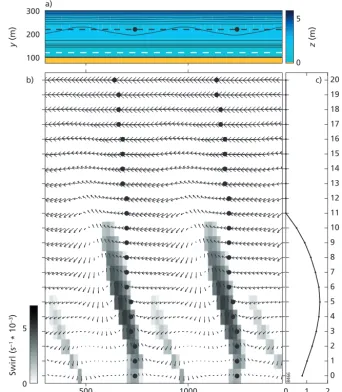
Figure 10 shows the flow pattern along the inner bar for allθ(in 15 m depth) simulations after 2 days of simulation. Here, the grey scaling indicates the strength of the rotational nature of the flow, termed the swirling strength, over the in-ner bar. It can be seen that the flow is rotational (i.e. contains cell-circulation patterns) for angles of wave incidence of up
to≈10◦. Asθ approaches 10◦, the feeder current directly
downdrift of the rip channel becomes weaker and eventually disappears as it becomes overridden by the alongshore cur-rent. Now, the flow field above the inner bar is dominated by a meandering alongshore current. Figure 11 shows the depth perturbations along the inner bar after 2 days of simulation. The most pronounced depth perturbations are found for the simulations withθ=7◦, which are relatively deep and nar-row. As the flow is still rotational (see Fig. 10), these nega-tive perturbations correspond to rip channels. For larger an-gles, the negative depth perturbations decrease and become increasingly wider. Towardθ=20◦, the depth perturbations have hardly developed at all. When we examine the simu-lations forθ=10–20◦in more detail, we find that the me-andering alongshore current erodes the inner terrace down-stream of the outer-bar horns, where more onshore-directed flow and accretion turn to more offshore-directed flow and erosion. This results in a landward perturbation in the ter-race edge, consistent with the observations of the Idt cou-pling type. As such, the landward perturbations in the inner terrace for the Idt coupling type are erosional features. For
T. D. Price et al.: Morphological sandbar coupling 317
0 5
100 200 300
0 1 2 3 4 5 6 7 8 9 10 11 12 13 14 15 16 17 18 19 20 0
5
500 1000 0 1 2
Swirl (s
−1
* 10
−3)
Std Swirl (s−1 * 10−3)
x (m)
θ (deg)
y (m) z (m)
b) c)
a)
8466
Figure 10.Model results, showing (a) the initial bathymetry, with isobaths (0.5 m intervals) contoured in the background, (b) flow velocity U (arrows) and swirling strength (shaded) along the inner bar aty=120 m for all simulations after 2 days of simulation, and (c) the corresponding standard deviation of the swirling strength along the inner bar aty=120 m. The black dots in (a) and (b) indicate the alongshore positions of the outer-bar horns alongy=220 m. The swirling strength is a measure of the rotational nature of the flow. Non-zero values imply the presence of cell-circulation patterns. Source: Price et al. (2013).
It is somewhat surprising that the most pronounced rip channels are found for the simulations with θ around 7◦
(Fig. 11), as previous modelling exercises of single bar sys-tems (e.g. Castelle and Ruessink, 2011) found that rip chan-nels were more pronounced when formed during shore-normal wave incidence. Also notice that the depth pertur-bations are located further to the left (downdrift) for larger angles of wave incidence. These findings may both be ex-plained through the combination of the increased magnitude of the alongshore current on the one hand, and the alongshore migration and evolution of the outer bar (the morphological template for the inner bar) on the other hand (indicated by the black dots in Figs. 10 and 11a, b). Figure 11c shows that for small angles of wave incidence (up toθ=7◦), the alongshore
variability of the outer bar increases with respect to the ini-tial alongshore variability within the 2-day simulation period, whereas the outer bar becomes more alongshore-uniform for larger angles of wave incidence (θ >7◦), corresponding with
our observations (see Sect. 2; Price and Ruessink, 2011). Al-though the inner-bar depth perturbations follow the along-shore migration of the outer-bar horns at first, the straighten-ing of the outer bar reduces the effect of the outer-bar mor-phological template on the inner-bar flow pattern, inhibit-ing the further development of inner-bar features as the flow pattern becomes alongshore-uniform. The numerical model study of Garnier et al. (2013) also stresses the effect of wave obliquity and the associated meandering current pattern in bar straightening. Their results indicated that the rip currents
100 200 300
0 1 2 3 4 5 6 7 8 9 10 11 12 13 14 15 16 17 18 19 20 0
5
−0.4 −0.2 0 0.2
500 1000 0 0.2 0.4
θ (deg)
x (m)
y (m) z (m)
zp
(m)
Std zp (m)
b) c)
a)
8466
Figure 11.Model results, showing (a) the initial bathymetry, with isobaths (0.5 m intervals) contoured in the background, (b) flow velocity U (arrows) and depth perturbationszp(colour) along the inner bar aty=120 m (white dashed line in (a) for all simulations after 2 days
of simulation). (c) depicts the alongshore standard deviation ofzpalong the inner bar aty=120 m (black) and the outer bar aty=220 m
(grey), and the initial standard deviation ofzpalong the outer bar aty=220 m (dashed). The black dots in (a) and (b) indicate the alongshore
positions of the outer-bar horns alongy=220 m. Source: Price et al. (2013).
through the bays weakened in intensity with an increase in
θ and that, at the same time, the strongest current shifted to a location downstream of the deepest part of the bay. As in Fig. 11, this shift causes the rip channels to migrate and cay. Interestingly, the transition from rip growth to rip de-cay at the outer bar takes place at substantially lowerθ(say, 5–10◦) than in the observations (Fig. 3,θ≈30◦). Similarly, Thiébot et al. (2012) showed that under slightly oblique wave incidence inner-bar perturbations did not develop before the growth of outer-bar perturbations.
4 Conclusions and perspectives
T. D. Price et al.: Morphological sandbar coupling 319
and depth variation along the outer bar, the offshore angle of wave incidence is crucial to the type of coupling that emerges. It strongly controls the type of flow pattern over the inner bar, with a change from cell-circulation patterns for approximately shore-normal waves to an alongshore mean-dering current as the angle increases.
Further work is necessary to test the generality of the find-ings from our Gold Coast study. The obtained results and the developed and applied methodology provide a frame-work for studying and describing similar data sets of multiple sandbar systems. In general, we expect intersite variability to arise from differences in sandbar mobility, which, in turn, is ascribed to sandbar volume, grain size, bottom slope, tidal range, and wave climate (e.g. see Wright and Short, 1984; Masselink and Short, 1993; Shand et al., 1999). More gen-erally, as also suggested by Pape et al. (2010), intersite dif-ferences in sandbar behaviour are expected to depend on the ratio between the response time of a sandbar and the vari-ability of the wave climate. Besides identifying the role of these potential variables through intersite comparison, nu-merical modelling becomes essential in testing the concepts formed. For example, a numerical model with different ini-tial inner-bar morphologies, and time-variant wave forcing could shed light on this aspect of morphological coupling be-haviour (see also Drønen and Deigaard, 2007; Garnier et al., 2008; Castelle and Ruessink, 2011; Tiessen et al., 2011; Smit et al., 2012). Moreover, from this, it would be interesting to assess changes in the ratio between self-organisation pro-cesses and outer-bar forced development of the inner bar (see also Castelle et al., 2010b).
In Sect. 3.2, the assimilation model of Van Dongeren et al. (2008) provided the initial bathymetric state for the numer-ical modelling, based on time-exposure images. Although previous work has been devoted to unravel how the ob-served foam relates to, for example, the roller dissipation (Aarninkhof and Ruessink, 2004; Alexander and Holman, 2004), further investigation into the relation between the ob-served foam and the measured wave properties on a natural beach would likely benefit the use of this assimilation tech-nique at other sites with scarce amounts of data (see e.g. Bir-rien et al., 2013). Moreover, it is expected that the inclusion of multiple proxies for the bathymetry, such as wave celerity (e.g. Wilson et al., 2010), wave height (Almar et al., 2012; Gal et al., 2014), and cross-shore wave height profiles from terrestrial laser scanners (Belmont et al., 2007; Blenkinsopp et al., 2012), will enhance the assimilation results (Van Don-geren et al., 2008), and ultimately improve our understanding of finite-amplitude sandbar behaviour.
Although this review focussed on the alongshore variabil-ity of a double sandbar system, the observed effect of the outer bar on the inner-bar morphodynamics implicitly in-cludes a cross-shore aspect. In fact, recent research (Plant et al., 2006; Splinter et al., 2011) has indicated that along-shore variations in bar crest position affect the alongalong-shore- alongshore-uniform behaviour. It was found that the horizontal
cell-circulation coinciding with the growth of alongshore vari-ability facilitates onshore migration under low-energetic con-ditions. Analogously, a decrease in three-dimensionality in the outer bar coincides with offshore migration of the outer bar. Although this offshore migration has been suggested to be driven by the increased undertow over the bar during high-energetic events, it remains unknown whether under-tow leads to the straightening of the bar. Both observations (Sect. 2) and modelling results (Sect. 3.2) show that sand-bars do not necessarily straighten during storms, with large wave heights, but that obliquely incident waves play a crucial role in the straightening of the bar through the generation of an alongshore current. Process-based models that focus on cross-shore migration (e.g. Hoefel and Elgar, 2003; Ruessink et al., 2007b, 2012) or on alongshore variability (e.g. Reniers et al., 2004; Calvete et al., 2005; Drønen and Deigaard, 2007; Castelle and Coco, 2012) alone, have become quite mature. The key challenge will be to integrate both model concepts into a single model that can adequately simulate the complete dynamics of double sandbar systems. As such, understand-ing the alongshore variable sandbar behaviour will also lead to improved understanding of cross-shore behaviour.
Acknowledgements. We wish to thank Giovanni Coco and two anonymous referees for their constructive comments, which significantly improved this review. We acknowledge financial support by the Netherlands Organisation for Scientific Research (NWO) under contract 818.01.009 and by the French BARBEC project under contract ANR N2010JCJC60201. We thank Ian Turner for the use of the Gold Coast video imagery.
Edited by: G. Coco
References
Aarninkhof, S. G. J. and Ruessink, B. G.: Video observations and model predictions of depth-induced wave dissipation, IEEE Trans. Geosci. Remote Sens., 42, 2612–2622, 2004.
Alexander, P. S. and Holman, R. A.: Quantification of nearshore morphology based on video imaging, Mar. Geol., 208, 101–111, 2004.
Almar, R., Castelle, B., Ruessink, B. G., Sénéchal, N., Bonneton, P., and Marieu, V.: Two- and three-dimensional double sandbar system behaviour under intense wave forcing and a meso-macro tidal range, Cont. Shelf Res., 30, 781–792, 2010.
Almar, R., Cienfuegos, R., Catalán, P. A., Michallet, H., Castelle, B., Bonneton, P., and Marieu, V.: A new breaking wave height direct estimator from video imagery, Coast. Engin., 61, 42–48, 2012.
Belmont, M. R., Horwood, J. M. K., Thurley, R. W. F., and Baker, J.: Shallow Angle Wave Profiling Lidar, J. Atmos. Ocean. Technol., 24, 1150–1156, 2007.
Birrien, F., Castelle, B., Marieu, V., and Dubarbier, B.: On a data-model assimilation method to inverse wave-dominated beach bathymetry using heterogeneous video-derived observations, Ocean Engin., 73, 126–138, 2013.
Blenkinsopp, C. E., Turner, I. L., Allis, M. J., Peirson, W. L., and Garden, L. E.: Application of LiDAR technology for measure-ment of time-varying free-surface profiles in a laboratory wave flume, Coast. Engin., 68, 1–5, 2012.
Bowman, D. and Goldsmith, V.: Bar morphology of dissipative beaches: An empirical model, Mar. Geol., 51, 15–33, 1983. Bowen, A. J. and Inman, D. L.: Edge Waves and Crescentic Bars, J.
Geophys. Res., 76, 8662–8671, 1971.
Brander, R. W.: Field observations on the morphodynamic evolution of a low-energy rip current system, Mar. Geol., 157, 199–217, 1999.
Brivois, O., Idier, D., Thiébot, J., Castelle, B., Cozannet, G. L., and Calvete, D.: On the use of linear stability model to characterize the morphological behaviour of a double bar system. Application to Truc Vert beach (France), Comptes Rendus Geosci., 344, 277– 287, 2012.
Calvete, D., Dodd, N., Falqués, A., and van Leeuwen, S. M.: Mor-phological development of rip channel systems: Normal and near-normal wave incidence, J. Geophys. Res., 110, C10006, doi:10.1029/2004JC002803, 2005.
Castelle, B. and Coco, G.: The morphodynamics of rip channels on embayed beaches, Conti. Shelf Res., 43, 10–23, 2012.
Castelle, B. and Ruessink, B. G.: Modeling formation and sub-sequent nonlinear evolution of rip channels: time-varying ver-sus time-invariant wave forcing, J. Geophys. Res., 116, F04008, doi:10.1029/2011JF001997, 2011.
Castelle, B., Bonneton, P., Dupuis, H., and Sénéchal, N.: Double bar beach dynamics on the high-energy meso-macrotidal French Aquitanian Coast: A review, Mar. Geol., 245, 141–159, 2007. Castelle, B., Ruessink, B. G., Bonneton, P., Marieu, V., Bruneau,
N., and Price, T. D.: Coupling mechanisms in double sandbar systems, Part 1: Patterns and physical explanation, Earth Surf. Proc. Landforms, 35, 476–486, 2010a.
Castelle, B., Ruessink, B. G., Bonneton, P., Marieu, V., Bruneau, N., and Price, T. D.: Coupling mechanisms in double sandbar systems, Part 2: Impact on alongshore variability of inner-bar rip channels, Earth Surf. Proc. Landforms, 35, 771–781, 2010b. Coco, G. and Calvete, D.: The use of linear stability analysis to
characterize the variability of multiple sandbar systems, in: Pro-ceedings of Coastal Dynamics 2009, Tokyo, Japan, paper no. 53, doi:10.1142/9789814282475_0055, 2009.
Coco, G. and Murray, A. B.: Patterns in the sand: From forcing tem-plates to self-organization, Geomorphology, 91, 271–290, 2007. Drønen, N. and Deigaard, R.: Quasi-three-dimensional modelling of the morphology of longshore bars, Coast. Engin., 54, 197– 215, 2007.
Evans, O. F.: The low and ball of the eastern shore of lake michigan, The J. Geol., 48, 476–511, 1940.
Falqués, A., Coco, G., and Huntley, D.: A mechanism for the gen-eration of wave-driven rhythmic patterns in the surf zone, J. Geophys. Res., 105, 24071–24087, doi:10.1029/2000JC900100, 2000.
Ferrer, P., Certain, R., Barusseau, J. P., and Gervais, M.: Conceptual modelling of a double crescentic barred coast (Leucate beach, France), in: Proceedings Coastal Dynamics 2009, Tokyo, Japan, 2009.
Gal, Y., Browne, M., and Lane, C.: Long-term automated monitor-ing of nearshore wave height from digital video, IEEE Trans. Geosci. Remote Sens., 52, 3412–3420, 2014.
Garnier, R., Calvete, D., Falques, A., and Caballeria, M.: Gener-ation and nonlinear evolution of shore-oblique-transverse sand bars, J. Fluid Mechan., 567, 327–360, 2006.
Garnier, R., Calvete, D., Dodd, N., and Falqués, A.: Modelling the interaction between transverse and crescentic bar systems, in: River, Coastal and Estuarine Morphodynamics: RCEM 2007, edited by: Dohmen-Jansen, C. M. and Hulscher, S. J. M. H., vol. 2, Taylor and Francis Group, London, 931–937, 2008. Garnier, R., Falqués, A., Calvete, D., Thiébot, J., and Ribas, F.: A
mechanism for sand bar straightening by oblique wave incidence, Geophys. Res. Lett., 40, 2726–2730, 2013.
Goldsmith, V., Bowman, D., and Kiley, K.: Sequential stage de-velopment of crescentic bars: HaHoterim beach, southeastern Mediterranean, J. Sediment. Petrol., 52, 233–249, 1982. Greenwood, B. and Davidson-Arnott, R. G. D.: Marine bars and
nearshore sedimentary processes, Kouchibouguac Bay, New Brunswick, Canada, Nearshore sediment dynamics and sedimen-tation, 16, 123–150, 1975.
Grunnet, N. M. and Ruessink, B.: Morphodynamic response of nearshore bars to a shoreface nourishment, Coast. Engin., 52, 119–137, 2005.
Hino, M.: Theory on formation of rip-current and cuspidal coast, in: Proc. 14th Conf. Coastal Eng., Copenhagen, Denmark, Am. Soc. Civ. Eng., 901–919, 1975.
Hoefel, F. and Elgar, S.: Wave-Induced Sediment Transport and Sandbar Migration, Science, 299, 1885–1887, 2003.
Holman, R. A. and Bowen, A. J.: Bars, bumps, and holes: Mod-els for the generation of complex beach topography, J. Geophys. Res., 87, 457–468, 1982.
Holman, R. A. and Stanley, J.: The history and technical capabilities of Argus, Coast. Engin., 54, 477–491, 2007.
Houser, C., Arnott, R., Ulzhöfer, S., and Barrett, G.: Nearshore cir-culation over transverse bar and rip morphology with oblique wave forcing, Earth Surf. Proc. Landforms, 38, 1269–1279, 2013.
Klein, M. D. and Schuttelaars, H. M.: Morphodynamic evolu-tion of double-barred beaches, J. Geophys. Res., 111, C06017, doi:10.1029/2005JC003155, 2006.
Kuriyama, Y.: Medium-term bar behavior and associated sedi-ment transport at Hasaki, Japan, J. Geophys. Res., 107, 3132, doi:10.1029/2001JC000899, 2002.
Lippmann, T. and Holman, R.: Quantification of sand bar morphol-ogy: a video technique based on wave dissipation, J. Geophys. Res., 94, 995–1011, 1989.
Lippmann, T. C. and Holman, R. A.: The spatial and temporal vari-ability of sand bar morphology, J. Geophys. Res., 95, 11575– 11590, 1990.
Lippmann, T. C., Holman, R. A., and Hathaway, K. K.: Episodic, nonstationary behavior of a double bar system at Duck, North Carolina, U.S.A., 1986-1991, J. Coast. Res., SI15, 49–75, 1993. MacMahan, J., Brown, J., Brown, J., Thornton, E., Reniers, A., Stanton, T., Henriquez, M., Gallagher, E., Morrison, J., Austin, M. J., Scott, T. M., and Senechal, N.: Mean Lagrangian flow be-havior on an open coast rip-channeled beach: A new perspective, Mar. Geol., 268, 1–15, 2010.
T. D. Price et al.: Morphological sandbar coupling 321
Ojeda, E. and Guillén, J.: Shoreline dynamics and beach rotation of artificial embayed beaches, Mar. Geol., 253, 51–62, 2008. Orzech, M. D., Reniers, A. J. H. M., Thornton, E. B., and
MacMa-han, J. H.: Megacusps on rip channel bathymetry: Observations and modeling, Coast. Engin., 58, 890–907, 2011.
Pape, L., Plant, N. G., and Ruessink, B. G.: On cross-shore migra-tion and equilibrium states of nearshore sandbars, J. Geophys. Res., 115, F03008, doi:10.1029/2009JF001501, 2010.
Plant, N. G., Holland, K. T., and Holman, R. A.: A dynamical at-tractor governs beach response to storms, Geophys. Res. Lett., 33, L17607, doi:10.1029/2006GL027105, 2006.
Price, T. D. and Ruessink, B. G.: State dynamics of a double sandbar system, Continen. Shelf Res., 31, 659–674, 2011.
Price, T. D. and Ruessink, B. G.: Observations and conceptual mod-elling of morphological coupling in a double sandbar system, Earth Surf. Proc. Landforms, 38, 477–489, 2013.
Price, T. D., Castelle, B., Ranasinghe, R., and Ruessink, B. G.: Cou-pled sandbar patterns and obliquely incident waves, J. Geophys. Res., 118, 1677–1692, 2013.
Quartel, S.: Temporal and spatial behaviour of rip channels in a multiple-barred coastal system, Earth Surf. Proc. Landforms, 34, 163–176, 2009.
Ranasinghe, R., Symonds, G., Black, K., and Holman, R.: Morpho-dynamics of intermediate beaches: a video imaging and numeri-cal modelling study, Coast. Engin., 51, 629–655, 2004. Reniers, A. J. H. M., Roelvink, J. A., and Thornton, E. B.:
Morpho-dynamic modeling of an embayed beach under wave group forc-ing, J. Geophys. Res., 109, C01030, doi:10.1029/2002JC001586, 2004.
Ruessink, B., Ramaekers, G., and van Rijn, L.: On the parame-terization of the free-stream non-linear wave orbital motion in nearshore morphodynamic models, Coast. Engin., 65, 56–63, doi:10.1016/j.coastaleng.2012.03.006, 2012.
Ruessink, B. G. and Kroon, A.: The behaviour of a multiple bar system in the nearshore zone of Terschelling, the Netherlands: 1965–1993, Mar. Geol., 121, 187–197, 1994.
Ruessink, B. G., Wijnberg, K. M., Holman, R. A., Kuriyama, Y., and van Enckevort, I. M. J.: Intersite comparison of inter-annual nearshore bar behavior, J. Geophys. Res., 108, 3249, doi:10.1029/2002JC001505, 2003.
Ruessink, B. G., Coco, G., Ranasinghe, R., and Turner, I. L.: Cou-pled and noncouCou-pled behavior of three-dimensional morpholog-ical patterns in a double sandbar system, J. Geophys. Res., 112, C07002, doi:10.1029/2006JC003799, 2007a.
Ruessink, B. G., Kuriyama, Y., Reniers, A. J. H. M., Roelvink, J. A., and Walstra, D. J. R.: Modeling cross-shore sandbar be-havior on the timescale of weeks, J. Geophys. Res., 112, F03010, doi:10.1029/2006JF000730, 2007b.
Saylor, J. and Hands, E.: Properties of longshore bars in the Great Lakes, in: Proceedings of the 12th International Conference on Coastal Engineering, 839–853, ASCE, Washington DC, 1970. Sénéchal, N., Gouriou, T., Castelle, B., Parisot, J. P., Capo, S.,
Bu-jan, S., and Howa, H.: Morphodynamic response of a meso- to macro-tidal intermediate beach based on a long-term data set, Geomorphology, 107, 263–274, 2009.
Shand, R. D., Bailey, D. G., and Shepherd, M. J.: An inter-site com-parison of net offshore bar migration characteristics and environ-mental conditinos, J. Coast. Res., 15, 750–765, 1999.
Shand, R. D., Bailey, D. G., Hesp, P. A., and Shepherd, M. J.: Con-ceptual beach-state model for the inner bar of a storm-dominated, micro/meso tidal range coast at Wanganui, New Zealand, in: Pro-ceedings of Coastal Sediments 2003, Miami, USA, 2003. Short, A. D. and Aagaard, T.: Single and multi-bar beach change
models, Journal of Coastal Research, SI15, 141–157, 1993. Smit, M., Reniers, A., and Stive, M.: Role of morphological
vari-ability in the evolution of nearshore sandbars, Coast. Engin., 69, 19–28, 2012.
Smit, M. W. J., Reniers, A. J. H. M., Ruessink, B. G., and Roelvink, J. A.: The morphological response of a nearshore double sand-bar system to constant wave forcing, Coast. Engin., 55, 761–770, 2008.
Sonu, C. J.: Field observation of nearshore circulation and mean-dering currents, J. Geophys. Res., 77, 3232–3247, 1972. Sonu, C. J.: Three-dimensional beach changes, J. Geol., 81, 42–64,
1973.
Splinter, K. D., Holman, R. A., and Plant, N. G.: A behavior-oriented dynamic model for sandbar migra-tion and 2DH evolumigra-tion, J. Geophys. Res., 116, C01020, doi:10.1029/2010JC006382, 2011.
Thiébot, J., Idier, D., Garnier, R., Falqués, A., and Ruessink, B. G.: The influence of wave direction on the morphological response of a double sandbar system, Contin. Shelf Res., 32, 71–85, 2012. Thornton, E., MacMahan, J., and Sallenger, Jr., A.: Rip currents, mega-cusps, and eroding dunes, Mar. Geol., 240, 151–167, 2007. Tiessen, M. C. H., Dodd, N., and Garnier, R.: Development of cres-centic bars for a periodically perturbed initial bathymetry, J. Geo-phys. Res., 116, F04016, doi:10.1029/2011JF002069, 2011. Van de Lageweg, W. I., Bryan, K. R., Coco, G., and Ruessink,
B. G.: Observations of shoreline sandbar coupling on an em-bayed beach, Mar. Geol., 344, 101–114, 2013.
Van Dongeren, A., Plant, N., Cohen, A., Roelvink, J. A., Haller, M. C., and Catalán, P.: Beach Wizard: Nearshore bathymetry es-timation through assimilation of model computations and remote observations, Coast. Engin., 55, 1016–1027, 2008.
Van Enckevort, I. M. J. and Ruessink, B. G.: Video observations of nearshore bar behaviour. Part 2: alongshore non-uniform vari-ability, Contin. Shelf Res., 23, 513–532, 2003.
Van Enckevort, I. M. J. and Wijnberg, K. M.: Intra-annual changes in bar plan shape in a triple bar system, in: Proceedings Coastal Sediments 1999, ASCE, New York, 1094–1108, 1999.
Van Enckevort, I. M. J., Ruessink, B. G., Coco, G., Suzuki, K., Turner, I. L., Plant, N. G., and Holman, R. A.: Observations of nearshore crescentic sandbars, J. Geophys. Res., 109, C06028, doi:10.1029/2003JC002214, 2004.
Wijnberg, K. M. and Terwindt, J. H. J.: Extracting decadal mor-phological behaviour from high-resolution, long-term bathymet-ric surveys along the Holland coast using eigenfunction analysis, Mar. Geol., 126, 301–330, 1995.
Wilson, G., Özkan Haller, H., and Holman, R.: Data assimi-lation and bathymetric inversion in a two-dimensional hor-izontal surf zone model, J. Geophys. Res., 115, C12057, doi:10.1029/2010JC006286, 2010.
Wright, L. D. and Short, A. D.: Morphodynamic variability of surf zones and beaches: a synthesis, Mar. Geol., 56, 93–118, 1984.