Atmos. Meas. Tech., 8, 3903–3922, 2015 www.atmos-meas-tech.net/8/3903/2015/ doi:10.5194/amt-8-3903-2015
© Author(s) 2015. CC Attribution 3.0 License.
PTRwid: A new widget tool for processing PTR-TOF-MS data
R. Holzinger
Institute for Marine and Atmospheric Research, Utrecht, IMAU, Utrecht University, the Netherlands
Correspondence to: R. Holzinger ([email protected])
Received: 5 December 2014 – Published in Atmos. Meas. Tech. Discuss.: 5 February 2015 Revised: 27 June 2015 – Accepted: 25 July 2015 – Published: 24 September 2015
Abstract. PTRwid is a fast and user friendly tool that has been developed to process data from proton-transfer-reaction time-of-flight mass spectrometers (PTR-TOF-MS) that use HTOF (high-resolution time-of-flight) mass spectrometers from Tofwerk AG (Switzerland). PTRwid is designed for a comprehensive evaluation of whole laboratory or field-based studies. All processing runs autonomously, and entire labo-ratory or field campaigns can, in principle, be processed with a few mouse clicks.
Unique features of PTRwid include (i) an autonomous and accurate mass scale calibration, (ii) the computation of a “unified mass list” that – in addition to a uniform data struc-ture – provides a robust method to determine the precision of attributed peak masses, and (iii) fast data analysis due to well considered choices in data processing.
1 Introduction
The development of PTR-TOF-MS (Jordan et al., 2009; Graus et al., 2010) has leaped forward this technology mainly through two key features: (i) the high mass resolution allows distinguishing between ions with a fractional mass difference such as, for example, isoprene and furan that are both de-tected on the same integer mass (69 Da), and (ii) the record-ing of full mass spectra is an inherent feature of time of flight (TOF) mass spectrometers. While the PTR-TOF-MS com-munity is readily exploiting the former feature (e.g., Liu et al., 2013; Veres et al., 2013), there are only a handful publi-cations that evaluate full mass spectra (e.g., Brilli et al., 2014, Park et al., 2013a). One reason for this is that a full evaluation of TOF mass spectra is still challenging and currently only one community based evaluation tool is available (Müller et al., 2013; https://sites.google.com/site/ptrtof/).
The data processing package that is introduced here pur-sues different (and unconventional) approaches in several as-pects. For example, the mass scale calibration does not rely on peaks of known ion masses and subsequent statistical analysis of ion counts as in Müller et al. (2013), but on max-imizing the matches with a library of ion masses. The un-derlying idea is that CxHyO0-5compounds are always
abun-dantly detected either as constituents in the sample or due to contamination in an experimental setup. Another example is the method to determine the peak shape, which is not re-trieved from selected peaks that can be entirely attributed to ions of the same composition (Müller et al., 2013), but from all detected ion peaks – disregarding the fact that many peaks are distorted due to signal from ions with different composi-tion. The underlying idea is that superimposing all detected peaks will envelop the true peak shape. The third and last ex-ample worth mentioning here is the determination of the pre-cision of detected peak masses, which is not based on statis-tics and propagation of errors from calibration peaks (Müller et al., 2013), but on a top-down evaluation of typically hun-dreds of peak lists obtained from entire field or lab cam-paigns. Besides all statistical uncertainties, these precisions also include uncertainties associated with the contribution of ions of different compositions to a detected peak (unresolved ions). These three examples constitute essential parts of the backbone of PTRwid that allows autonomous operation with a minimum of user input (e.g., no calibration peaks need to be defined, and no peaks to retrieve the peak shape need to be identified).
appropriate for eddy covariance analysis (Park et al., 2013b). Using the SumSpectrum for basic analysis largely increases computing speed, but it is not possible to capture drifts in these parameters that might have occurred during the period that is covered by the data in the file. However, under typi-cal operating conditions such drifts should be minor on time scales of 1–2 h. The core of PTRwid performs basic data pro-cessing such as peak detection, mass scale calibration, base-line correction, determination of peak shape and mass reso-lution, signal corrections for ion peaks that are not fully sep-arated due to the limited mass resolving power of the mass spectrometer, and the computation of raw signals (counts per second) and volume mixing ratios (nmol mol−1)for all de-tected peaks. In the current version two “extended process-ing” tools for general use are available: (i) a tool for aver-aging, categorizing, and merging data, and (ii) a tool for at-tributing possible chemical formulas to detected ion masses. In future releases, dedicated analysis tools can be integrated as additional extended processing tools.
PTRwid has been designed for an efficient and consistent analysis of full TOF mass spectra obtained over time pe-riods that range from single lab measurements (> hour) to field campaigns (weeks) and long term monitoring (year). The processing speed of a full mass spectra analysis is com-parable to the processing time required to extract and pro-cess selected ions. PTRwid is programmed in IDL (Inter-active Data Language) and also runs on the free IDL Vir-tual Machine. The code is based on routines that have been used in our earlier publications (e.g., Holzinger et al., 2010a, 2013; Park et al., 2013b), but has now been cast into a user-friendly graphical interface and is ready to be shared with a broader community. The full source code is available at http://www.imau.nl/PTRwid/. The following sections de-scribe the algorithms and evaluate their performance. How-ever a second aim is familiarizing new users with the PTRwid framework so that the brief information in the Appendices is sufficient to successfully start using PTRwid.
2 The key features of PTRwid
During the development of PTRwid, maximizing au-tonomous processing and minimizing required user input was emphasized. The organization of the data processing framework is modular: different tasks are typically per-formed by dedicated procedures. The modular design fa-cilitates adjustments and extensions, e.g., the development and assimilation of new add-on tools that perform dedicated tasks.
2.1 Basic data processing
The basic data processing is controlled by the PTRwid main widget window (Fig. B1). Brief start instructions,
organiza-tion of data, and a brief descriporganiza-tion of interactive elements of PTRwid are provided in Appendices A and B, respectively.
2.1.1 Peak detection
The DetectPeaks routine applies Savitzky–Golay smoothing filters (Vetterling et al., 1992) on the SumSpectrum and scans through the smoothed SumSpectrum and its derivative (re-ferred to as Spec and dSpec hereafter), respectively. Depend-ing on the settDepend-ings of the TOF mass spectrometer, the Sum-Spectrum contains several 105data points which correspond to the signal detected at the TOF bins (typically 10−10s per TOF bin). The following strategy is applied to identify peaks. 1. A potential start of a peak is detected at a TOF bin where dSpec exceeds 6 times the median of the absolute value of dSpec in the neighboring range (±1 Da). This TOF bin marks the point where the signal emerges from the noise and is labeled as “PeakStart”.
2. The corresponding TOF bins of the peak maxi-mum (dSpec=0), and the position at which the slope becomes positive again after the peak maximum (dSpec > 0), are identified and labeled “PeakMax” and “PeakEnd”, respectively1.
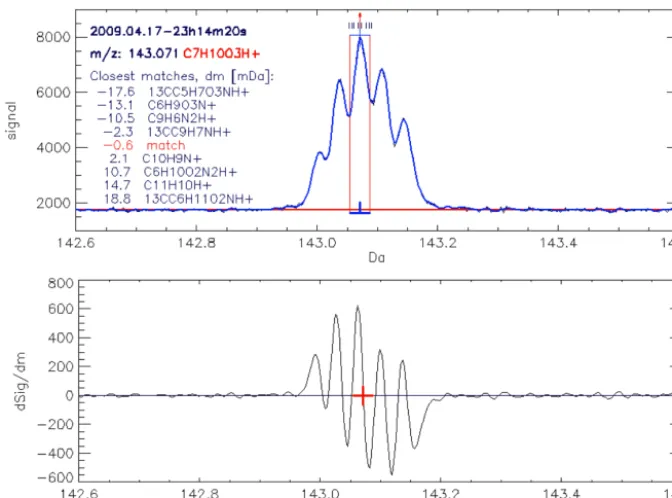
After scanning through dSpec, the TOF-bin scale is converted to an ion-mass scale (see next Sect. 2.1.2). Using the ion masses of “PeakStart”, “PeakMax” and “PeakEnd” the “peak broadness” is calculated, i.e., m[PeakMax]/(m[PeakEnd]−m[PeakStart]). Peaks of which “peak broadness” is outside the range 20–10 000 are dismissed. As a second criterion the signal at “PeakMax” must exceed the background by 8 times the variability of the background. Here, the background in the vicinity of the peak is calculated as the median signal around “PeakMax” in the range ±0.5 Da. The variability of the background is calculated as the standard deviation of all values in the vicinity of “PeakMax” that are below the background. Figure 1 shows a small section of Spec and dSpec (TOF bins 100294–100644) that corresponds to the mass range 142.6–143.6 Da. According to the procedure described above, five peaks were detected in this section. The range “PeakStart” to “PeakEnd” is indicated by horizontal blue lines below and above the peak in the upper chart, and the ticks on these lines mark the position of “PeakMax”.
2.1.2 Mass scale calibration
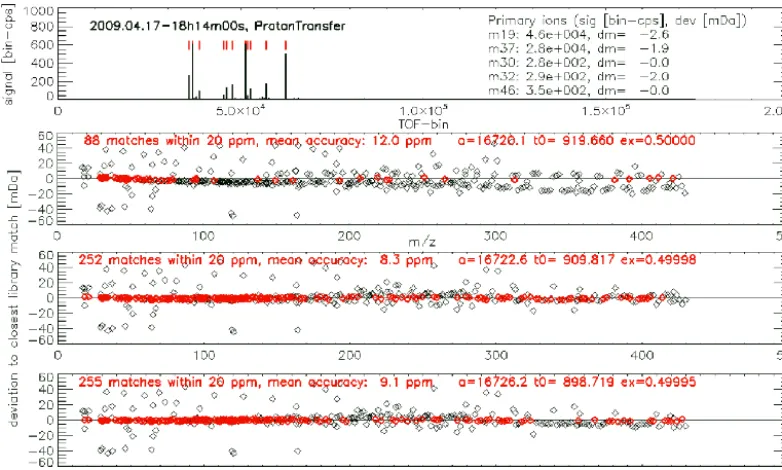
The conversion of the TOF-bin scale to an ion-mass scale is done by three different methods, the quality of which is assessed in Fig. 2. All methods convert the scales according
1Note that algorithm determining PeakEnd relies on the fact that
R. Holzinger: PTRwid: A new widget-tool for processing PTR-TOF-MS data 3905
Figure 1. A small section of Spec (upper chart, smoothed in blue, unsmoothed SumSpectrum in black) and dSpec (lower chart). The baseline
signal (Sect. 2.1.3) is plotted as red line in the upper chart. The peak search routine detected five peaks at 143.002, 143.036, 143.071, 143.105, and 143.142, respectively. The range “PeakStart” to “PeakEnd” is indicated by two horizontal blue lines above thexaxis and in the upper chart area, respectively. The blue ticks on these lines mark the position of “PeakMax”. The vertical red lines in the upper chart indicate the integration boundaries (Sect. 2.1.6.) that correspond to a range of±2σ of the quasi-Gaussian peak shape (Sect. 2.1.4.). The black and red ticks above the selected peak in the upper chart correspond to ion masses of the closest matches in the compound library (see masslib function in Appendix C). The largest peak at 143.071 has been matched to C7H10O3H+; other compounds in the vicinity are plotted in the
chart area together with their deviation from the detected peak.
to Eq. (1),
tTOF=a·mex+t0, (1)
wheremandtTOF represent the ion mass and TOF bin,
re-spectively, and a,t0, and ex are parameters that can be
op-timized. Since the ions enter the TOF region with the same kinetic energy,tTOFshould be proportional to the square root
ofm. Thus ex in Eq. (1) should be equal to 0.5. However, in practice better results are obtained if small deviations from 0.5 are allowed for this parameter.
The first method (CalCrude, Appendix C) builds on the assumption that primary ions are among the 16 largest sig-nals in the mass spectrum. An example spectrum is plotted in the top chart of Fig. 2. The 16 largest peaks are marked by red ticks. For this method the parameter ex is kept con-stant at 0.5. Parametersa andt0are calculated by
combin-ing any two of the largest 16 peaks and assumcombin-ing that these peaks correspond to a pair of primary ions. For the stan-dard operation mode based on proton transfer from H3O+the
pair of primary ions is H3O+(19.018 Da) and H2O·H3O+
(37.028 Da). For operation in the charge transfer mode based on NO+or O+2 ion, four additional pairs of primary ions are checked: NO+ and NO+
2, H3O
+ and NO+, O+
2 and NO + 2,
and H3O+ and O+2. All possible combinations of the 16
largest peaks and the five pairs of primary ions are used to calculate hundreds of mass scale parameters a andt0, among
which at least one set of a andt0should provide a crude but in
principle correct time to mass conversion for the SumSpec-trum.
In order to find the right set ofaandt0(and to further
re-fine it), all these sets of parameters are used to convert the TOF-bin scale to a mass scale. Subsequently it is checked if the scale conversion produces peaks that can be attributed to a second pair of ions – isotope peaks of the primary ion signal or other omnipresent ions, which do not suffer from detector saturation and should thus yield a much improved conversion. For the standard proton transfer mode H183 O+
(21.022 Da) and C3H6OH+(59.049 Da) are used as second
pair, and for operation in the charge transfer mode15NO+ and N18OO+, H183 O+and15NO+,18OO+and N18OO+, and H183 O+and18OO+are used. If positively identified, the pa-rametersa andt0 are re-calculated based on a second pair,
auto-Figure 2. The top chart shows the SumSpectrum, the largest 16 peaks are marked in red. For better visibility the SumSpectrum has been
truncated by setting high values equal to 10 % of the maximum value. Charts 2–4 demonstrate the quality of the three methods of mass scale calibration (see text for details): each point represents a detected peak (ion mass, Da, on thexaxis). The peaks were compared with the compound library. Theyaxis shows deviation to the closest library match (in mDa). The quality of the scale conversion is assessed by the number of matches (red data) with library compounds. The mass scale calibration is the best for method 3 (chart 4).
detection of the operation mode (proton transfer or charge transfer). The second chart in Fig. 2 shows the result of com-paring the obtained peak masses with library compounds. The x axis represents the mass attributed to all detected peaks, and the y axis shows the deviation of the attributed mass to the closest match in the library. The points plotted in red are considered to be matched as their smallest deviation from a library compound is less than 20 ppm. As can be seen clearly in Fig. 2, for masses above 80 Da the deviation starts drifting towards negative values, thereby indicating the limi-tations of this method that relies on a constant ex parameter and two ions with relatively low masses.
The second method (CalFine, Appendix C) uses the pa-rameters a,t0, and ex from the first method and performs
a variation of constants. The parameters are optimized by maximizing the number of matches with library compounds. The improved parameters resulting from this procedure (third chart of Fig. 2) no longer show the obvious drift as in chart two of Fig. 2. The number of matches with library com-pounds increased from 88 to 252.
The third method (Cal3pt, Appendix C) allows the user to specify ion masses (see Appendix D for a list with adjustable parameters) in the low, middle, and high region of the mass scale, respectively. In a first step the parametersa,t0, and ex
are calculated by using the specified ion masses and the cor-responding “PeakMax” values. In a second step the specified ion masses are allowed to vary within given boundaries and
the number of matches with library compounds is maximized by performing a variation of constants. The improved param-eters resulting from this procedure further increased the num-ber of matches with library compounds to 255 (bottom chart of Fig. 2).
These three methods yield three sets of parametersa,t0,
and ex. The set that yields most matches with library com-pounds is chosen for all subsequent analysis.
2.1.3 Baseline signal
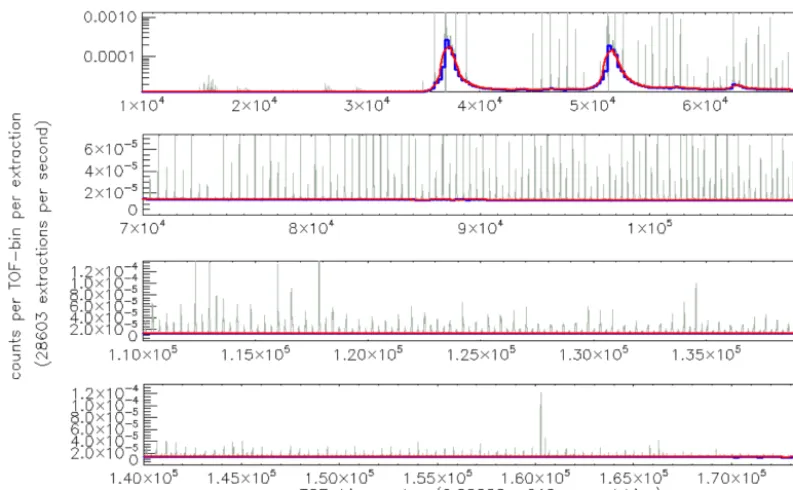
The baseline signal consists of electronic noise that causes signal in the absence of ions. Basically the baseline can be considered the signal between regions where ions are ex-pected to be detected, i.e, the regions between integer masses. This signal has to be subtracted in order to determine the cor-rect peak shape (Sect. 2.1.4) and to calculate the signal that is attributed to an ion (Sect. 2.1.6). Figure 3 show the baseline of a SumSpectrum. The baseline varies over several orders of magnitude and remains enhanced for several 10−7s after ion peaks of high intensity.
R. Holzinger: PTRwid: A new widget-tool for processing PTR-TOF-MS data 3907
Figure 3. An example SumSpectrum zoomed in to the baseline (grey data). The blue stepwise data show the baseline values of individual
90 ns segments (see text for details). The baseline is obtained by smoothing over these individual baseline values (red data).
original data in each segment. The baseline values of the seg-ments are calculated as the mean of the remaining 30 % of the data. In Fig. 3 the baseline values of individual segments can be easily seen at TOF-bin numbers in the range 3.5–5.5×10⁴ (blue data row). If the baseline value for an individual seg-ment is calculated to be zero, it is replaced by the minimum of all non-zero segment values. The baseline is calculated by smoothing over the individual segment values (red data in Fig. 3).
Calculating the baseline signal on basis of the SumSpec-trum can cause high and low biases when high count rates in the SumSpectrum are not caused by a constant high signal at a certain mass but by fluctuating signals ranging from low to very high. During the periods with low count rates the base-line is calculated too high, and during the episode with high count rates the baseline is calculated too low. These artifacts may even result in negative values for the computed volume mixing ratio; however, under most circumstances these ar-tifacts are very minor and hardly noticeable. On the other hand, baseline calculations that rely on single measurements (or shorter periods) can become inaccurate due to poor count-ing statistics.
2.1.4 Peak shape and resolution
Peak shape analysis is needed for three fundamental reasons: (i) to determine the mass resolution, (ii) to set correct bound-aries for peak integration (Sect. 2.1.6), (iii) and for correc-tions of overlapping peaks (Sect. 2.1.6).
In order to determine the peak shape, we consider all peaks with a maximum signal (in counts per TOF bin) in the fol-lowing range: (a) a predefined minimum (the default value is 800 counts, see Appendix D), and (b) a maximum which is the larger of either 10 times the minimum signal or 1 % of the maximum signal of the entire SumSpectrum. The lower boundary is set to avoid distortion of the peak shape due to poor counting statistics, and the upper boundary is set to avoid distortion by the largest signals that cause saturation in the counting electronics of the mass spectrometer.
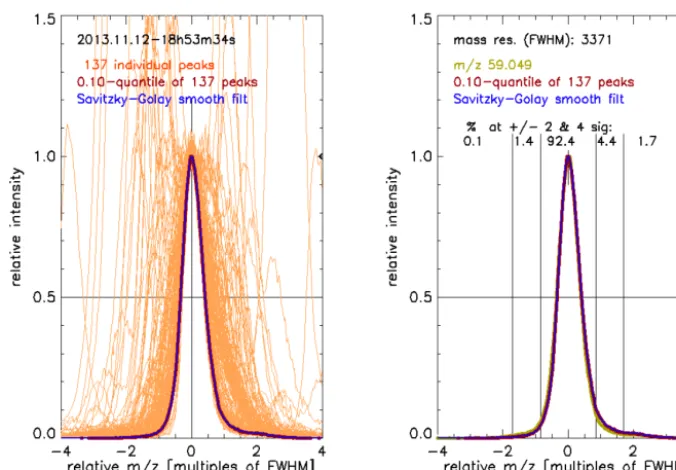
dis-Figure 4. The left hand chart shows 137 normalized and re-scaled individual peaks retrieved from an example mass spectrum. The individual
peaks envelop the true peak shape (blue line) which is retrieved by smoothing the 0.1 percentile of the relative intensity of all 137 peaks (brown line, barely visible because superimposed by the blue line). The right hand chart shows the true peak shape (as in the left hand chart) together with an example peak detected atm/z59.049. The calculated mass resolution (FWHM) and the signal fractions expected within and outside the±2 and±4σboundaries are labeled in the plot area. 92.4 % of the total signal is expected within the±2σboundary. A small shoulder is apparent at the high mass end, and therefore 1.7 % of the signal are detected outside the+4σboundary.
tribution is constant (i.e., 2·(2·ln(2))0.5=2.35). Using this relationship, we calculated the fraction of the total signal that is within and outside the boundaries of±2 and±4σ (right hand chart of Fig. 4). Typically more than 90 % of the total signal is expected within the ±2σ range and these are the standard boundaries for peak integration (Sect. 2.1.6).
2.1.5 Unified mass list
For extended lab and field studies, the problem arises that it is unlikely to retrieve exactly the same set of peaks for dif-ferent measurement intervals. The main reason is trivial; that is, different samples yield different results. Other reasons in-clude the possibility that the operating conditions of the PTR-TOF-MS instrument changed over time, and that – within the limits of precision – the same ion may be attributed to a slightly different mass. The “unified mass list” routine pro-duces an uniform peak lists that is obtained from file peak lists, which in turn are calculated from the SumSpectra of individual HDF5 data files (Sect. 2.1.1). The “unified mass list” routine sequentially calls all routines described above. However, if the maximum signal of a SumSpectrum does not exceed a certain threshold value (the default value is 106 counts, Appendix D), the SumSpectra of the subsequent files are added. The summing of SumSpectra is interrupted when the threshold value is exceeded, or the gap between the end of the last measurement in the current file and the start of the first measurement in the following file exceeds 10 min
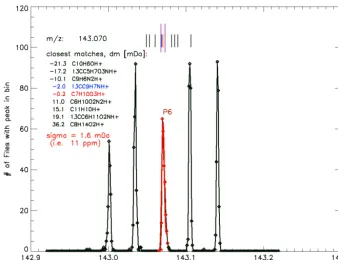
(default value, Appendix D). A preparatory step is the com-putation of a bin-mass scale with bin widths of 1 mDa for ion masses below and 8 ppm bins above 125 Da. Thus, above 125 Da the bin width increases steadily and corresponds to 1.6, 3.2, and 4.8 mDa for ion masses of 200, 400, and 600 Da, respectively. All individual file peak lists (one for each HDF5 raw data file) are subsequently loaded and the peak count value of a mass bin is increased by one for every peak that is detected within the mass range covered by the bin. Figure 5 shows a small section of the detections-per-mass bin data (DpB) corresponding to the range 142.92–143.22 Da. The data are from a∼2-week field campaign with our thermal-desorption proton-transfer-reaction mass spectrometer (TD-PTR-MS, Holzinger et al., 2010a) at a rural site in the Nether-lands. More than 300 peak lists from individual files have been included each covering a period of 75 min.
R. Holzinger: PTRwid: A new widget-tool for processing PTR-TOF-MS data 3909
Figure 5. Histogram of peak detections in 8 ppm mass bins in the range 142.92–143.22 Da. More than 300 peak lists from individual files
each covering a period of 75 min have been included; i.e., the data are from a∼2-week field campaign. The precision of a peak at 143.070 has been determined asσ (standard deviation) of a Gaussian fit. The red markers are the 11 points that have been fitted, and the red line shows the Gaussian fit. The long red and blue vertical lines above the peak mark the±1 and±2σboundaries, respectively. The short vertical lines mark the position of close matches with compounds in the library (also plotted in the chart area). Compounds plotted in red and blue correspond to compounds that are within±1 and±2σ, respectively.
mass attributed to the peak is calculated asσ(standard devi-ation) of a Gaussian fit including 11 data points (i.e., a range of at least 11 mDa or 88 ppm) around a detected peak. An ex-ample fit is shown in Fig. 5, where the precision of the peak at 143.070 Da has been calculated to be±11 ppm. The uni-fied mass list and associated parameters (such as precision and integration boundaries) are saved in the data directory together with a list of possible molecular formulas within the ±2σboundaries for every peak.
2.1.6 Peak integration, applied corrections, calculation of mixing ratios
The export procedure is activated by clicking on the “Export” button, and implements (together with the associated sub-routines CorrPoissDead, Integrate, Overlap, and Calcppb) peak integration, several corrections, and the computation of mixing ratios. The “file mass list” and the “unified mass list” and different formats to store data can be optionally chosen for the data export (Appendices C and D).
First, the CorrPoissDead routine corrects for physical itations of the ion detection system. The reason for these lim-itation are recovery times (dead times up to 2×10⁻⁸s) that follow an ion detection event, and the inability to discrim-inate between single and multiple ion detections in a data
acquisition interval of typically 1−2×10⁻¹⁰s. These ef-fects have been thoroughly studied and appropriate correc-tions have been developed and tested (Titzmann et al., 2010, Cappellin et al., 2011). PTRwid corrects for these issues us-ing the formula for a combined Poisson and dead time cor-rection developed by Titzmann et al. (2010). Since the effect on lower signals is very minor, the corrections are applied only for signals that exceed one detection per 1000 data ac-quisition periods (of typically 35–60 µs). The instrument spe-cific extending and non-extending dead times can be adjusted (Appendix C), 1.3 and 15 ns are used as default values, re-spectively.
raw-data file. This is a consequence of the strategy to calcu-late the time to mass conversion parameters and the resolu-tion per raw-data file (from the SumSpectrum).
Third, the overlap routine corrects for the abovementioned deviancies of the raw signal data. Mathematically, this rep-resents the problem of solving a system of coupled linear equations for each measurement. Knowledge of peak shape and the distance of a close-by neighbor peak allows to calcu-late the fraction of the neighbor’s total signal that is expected within the integration boundaries. Solving the system of lin-ear equations results in a correct attribution of (i) signal (ion counts) from neighbors that are expected within the integra-tion boundaries, and (ii) ion counts outside the integraintegra-tion boundaries that have not been accounted for by the integrate routine. The result of the integration and the overlap routines is a data set that contains the measured signal for every de-tected peak in units of counts per second (cps). Mixing ratios are subsequently calculated from this data set.
Fourth, the Calcppb routine calculates mixing ratios ac-cording to the method outlined in Holzinger et al. (2010b). Input parameter are temperature, pressure and the electrical potential across the PTR-TOF-MS reaction chamber (drift tube), and the electrical potential between the last ring of the drift tube and the entrance lens to the TOF region. The mass-dependent transmission efficiency of ions through the TOF mass spectrometer is the result of the increasing duty cycle for larger ion masses (Chernushevich et al., 2001). The transmission efficiency is by default corrected using the sim-ple parameterization that has been suggested and tested by Cappellin et al. (2012). However, other correction curves can be easily implemented by adjusting the parameters of the 6th order polynomial that defines the mass- dependent trans-mission efficiency (see Appendices C and D). Aging of the front multi-channel plate (MCP, the device detecting ions in the TOF) or an insufficient electrical potential between the MCPs produces non-linear mass dependent discrimination that cannot be corrected (Müller et al., 2014). Therefore, a proper tuning and monitoring of TOF parameters during the measurements (according to the recommendations given in Müller et al., 2014) is essential to obtain correct mixing ra-tios. As default reaction rate constant for the reactions with both H3O+and H2O·H3O+a value of 3×10⁻⁹cm3s−1is
used. Note, that the reaction rate constant for organics with H2O·H3O+can be set to zero (Appendix C), if the reaction
with the water–hydronium cluster should not be considered. The primary ion signal is not measured directly, but calcu-lated from signals at isotope peaks using the natural abun-dance of stable oxygen isotopes: the H3O+ signal is
calcu-lated from the signal measured at 21.022 (mostly H183 O+)by multiplying with 487, and the H2O·H3O+signal can be
ei-ther calculated from the signal measured at 38.033 (mostly H172 O·H3O+or H2O·H173 O
+)by multiplying with 1350 or
from the signal measured at 39.033 (mostly H182 O·H3O+or
H2O·H183 O+)by multiplying with 242 (see Appendix C).
2.2 Extended processing
Extended processing is activated by clicking on the “Ex-tended Processing” button in PTRwid (Fig. B1). A pop-up menu shows the available tools for extended analysis – cur-rently the “Average and Merge Data” tool, the “Attributing Formulas” tool, and the “Filter Sampling” tool. The first two tools are of general use and will be briefly described below. The “Filter Sampling” tool is more specialized since it is ded-icated to process aerosol filter data obtained with our offline-TD-PTR-MS method (Timkovsky et al., 2015) and will not be discussed here. In the future more add-on analysis tools can be integrated here. Note that, so far, all extended analy-sis tools use data exports that are based on the unified mass list (and cannot be used on data based on the file mass list).
2.2.1 The “Average and Merge Data” tool
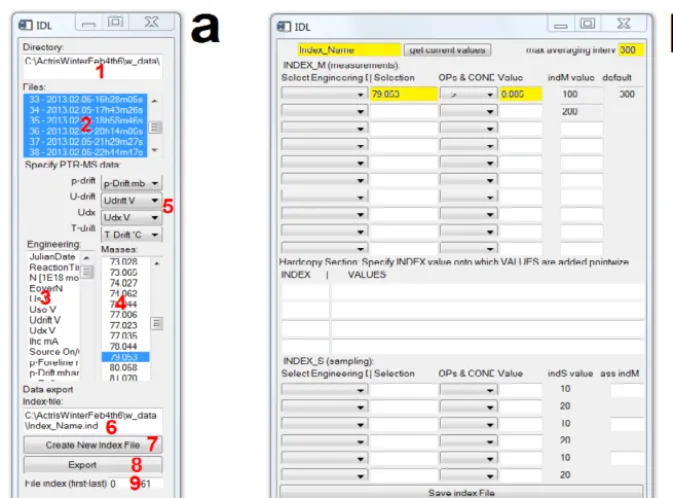
The main purpose of this tool is categorizing data and re-ducing data size by averaging over pre-defined periods. This tool opens a new window (Fig. B2a) that (i) allows display-ing data from multiple selected files, (ii) creatdisplay-ing index files to categorize data, and (iii) export merged, averaged and cat-egorized data. As an example, Fig. 6a shows a 7.5 h timeline of benzene mixing ratios in ambient air at the CESAR ob-servatory (http://www.cesar-obob-servatory.nl/) recorded with 5 s time resolution, which corresponds to six selected data files. Two periods of background measurement (ambient air cleaned through a Pt-catalyst operated at 350◦C) are visi-ble around 1496.7 and 1496.95, and a plume with mixing ratios up to 1 nmol mol−1was observed shortly after 1496.8. The time-period for averaging, and the index that separates background and ambient data can be set in a new window by clicking on the “Create New Index File” button (label 7 in Fig. B2). The index file name and time period of averag-ing (in seconds, i.e., 300 s in Fig. B2b) are set in the first row. In the following rows up to 10 conditions can be de-fined that – if met – assign index values to individual mea-surements. In the example shown in Figs. B2b and 6b only one condition is defined: if the datam/z=79.053 (benzene) is larger than 0.085 nmol mol−1the index value is 100 (am-bient air), otherwise the index value is 300 (zero air). Be-sides ion count data, all collected engineering data can be used to specify conditions. Note that false attributions due to statistical noise are suppressed by considering neighboring data points. Figure 6b shows that the above defined condition (in combination with suppressing noise attributions) is suffi-cient to separate between ambient and zero air. After clicking the “Export” button (Fig. B2a) all data files (specified by file numbers below the “Export” button) are loaded and individ-ual measurements are averaged until (i) the time-period for averaging is reached, or (ii) the index value changes.
R. Holzinger: PTRwid: A new widget-tool for processing PTR-TOF-MS data 3911
Figure 6. A 7 h timeline of m/z=79.053 (benzene) collected at the CESAR observatory (http://www.cesar-observatory.nl/) during the ACTRIS winter campaign in Jan/Feb 2013. The time axis displays days since 1 January 2009; the displayed period (in ordinary date format) is labeled on the top. The upper chart (a) displays the raw data. In the lower chart, markers of different colors correspond to index values as defined in the “New Index File” widget window (Fig. B2b). The black lines correspond to the 300 s means and the error bars indicate the standard error due to counting statistics.
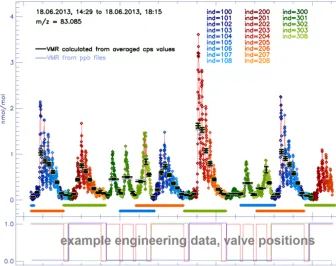
during the SOAS (Southern Oxidant and Aerosol Study)2 campaign in summer 2013. During the campaign the PTR-TOF-MS was switched between three inlets: aerosol sampler A, aerosol sampler B, and a three-stage denuder. The aerosol samplers were described in Holzinger et al. (2010a), and Holzinger et al. (2010b). Briefly, aerosols were collected by impaction on a small surface and desorbed by heating the sur-face up to 350◦C in steps of 50◦C. Desorbed organic com-pounds were transported into the PTR-TOF-MS by means of a N2carrier gas. Each temperature step lasted for 3 min and 2More information at http://climate.envsci.rutgers.edu/SOAS/
SOAS_White_Paper_final.pdf and http://wiki.envsci.rutgers.edu/ index.php/Main_Page
high concentrations of organics were typically observed as the sampler was heated to the next temperature level (blue and red data in Fig. 7). The three-stage denuder sampled semivolatile and volatile organic compounds on three serially assembled denuders. After sampling the denuders were se-quentially heated which was associated with high concentra-tions of organics in the N2carrier gas (green data in Fig. 7).
Figure 7. Mixing ratios detected atm/z83.085 over 4 h period during the SOAS campaign in summer 2013. See text body for more details. The data have been categorized using the index parameters depicted in Fig. B3. The PTR-TOF-MS was connected to three inlets: aerosol sampler A (blue index values, 100–108), aerosol sampler B (red index values, 200–208), and a thermal desorption three-stage denuder inlet (green index values, 300–308) to sample semivolatile compounds in the gas phase. The sampling times for aerosol inlets A (blue), B (red), and the three-stage denuder (green) are indicated as horizontal lines below the zero line. The lower lines indicate sampling of background (i.e., particle free ambient air for the aerosol inlets and zero air for the gas phase inlet), and the upper lines indicate sampling of ambient air. The lower chart shows engineering data that show the status of different valves (i.e., 0 closed, 1 open) in the setup. The blue line, for example, is 1 when aerosol inlet B is analyzed. This data set can thus be used to label data associated with aerosol inlet B.
only if the PTR-TOF-MS was connected to aerosol sam-pler A or B, to which index values of 100 and 200 were assigned, respectively. In the hardcopy section we added 1 to the first 36 measurements (i.e., 3 min since a measurement was recorded every 5 s), 2 for the following 36 measurements and so on (see Fig. B3 and reddish and bluish index values in Fig. 7), whenever the original index value was 100 or 200, re-spectively. In this way the hardcopy section could be used to separate different desorption temperatures even though this parameter was not directly monitored by the PTR-TOF-MS. The last part in the “New Index” window (Fig. B2b) allows to create a “sampling” index for up to three different inlets, which is useful for all in-situ PTR-TOF-MS applications that involve a sampling/pre-concentration step. The sampling in-dex can take two values (10 or 20) which are typically asso-ciated with sampling of ambient or zero air, respectively.
2.2.2 The “Attribute Formulas” tool
The “Attribute Formulas” tool lists possible empirical formu-las in the range±150 ppm around a detected peak. Since the precision of the detected mass peaks is typically in the range
10–25 ppm, this list contains much more compounds than the list saved along with the unified mass list (Sect. 2.1.6). Constraints are provided through the analysis of a data set, which is used to check for consistency with the natural abun-dance of the two stable carbon and nitrogen isotopes, i.e.,
13C/12C≈0.011 and15N/14N≈0.0037. Optionally, the
se-lected data set can be reduced by providing index values, in which case the analysis is limited to the specified subset.
R. Holzinger: PTRwid: A new widget-tool for processing PTR-TOF-MS data 3913 abundant isotopologue (at least by a factor of 3) could not
be matched with the unified mass list (labeled “no parent peak” in Fig. B4). The tool returns a report that lists possi-ble formulas, the fractional mass difference with the detected mass, the maximum fraction of the total signal that can be attributed to the compound (only if constrained by isotopo-logues), and a statistical summary (mean and median) of the data set (Fig. B4).
3 Performance
The performance is demonstrated by processing 54 (17– 20 June 2013) of measurements with our PTR-TOF 8000 instrument (Ionicon Analytik GmbH, Austria) during the SOAS campaign. Throughout the campaign, ions were in-jected into the time of flight region of the mass spectrom-eter every 60 µs and the detector was operated at 10 GHz (0.1 ns time bins). A 5 s time resolution was obtained by in-ternally totalling the signal of 83 333 initial mass spectra. So, throughout the 54 h period, more than 3.8×10⁴mass spec-tra (6×10⁵data points per spectra) were collected and pro-cessed. The data were stored in 43 HDF5 data files each con-taining 900 measurements or 75 min of data.
Processing was done on a laptop computer (purchased in 2013, Dell Latitude E6430) with an Intel (Core™i7-3720QM CPU @2.60 GHz, 4 GB RAM) processor and 32-bit operat-ing system (Windows 7). The analysis based on the Sum-Spectrum of individual files (peak detection, mass scale cal-ibration, baseline signal, peak shape, mass resolution, and unified mass list) was started by clicking the “unified mass list” button (Fig. B1) and completed in less than 15 min. The unified mass list contained 843 ion peaks in the range 16– 820 Da. The extraction of these 843 ion signals from the raw data (including Poisson and dead time corrections, correction of overlapping peaks, and the computation of mixing ratios) was started by clicking the “Export” button (Fig. B1) and completed in 46 min. Note that the processing time of this step is largely independent of the number of ion peaks, since a large fraction of the processing time is consumed by open-ing the compressed HDF5 raw data.
The extended analysis tools require less processing power: averaging and merging according to the categories shown in Fig. 7 is completed in less than 2 min, and creating a report with the “Attribute Formulas” tool is a matter of∼20 s.
4 Conclusions and outlook
PTRwid processes PTR-TOF-MS data and runs under IDL or the free IDL Virtual Machine. Much of the analysis is done on the SumSpectrum; which reduces the processing time sig-nificantly. The main innovative features are the autonomous mass scale calibration, and the computation of a uniform “unified mass list”, which also provides a robust method to determine the precision of attributed ion masses.
Appendix A: Quick-start instructions and PTRwid file structure
A1 Quick-start instructions for the IDL virtual machine
– The IDL virtual machine can be freely downloaded after creating a user account at http://www.exelisvis. com/. Note that the “Download” section is blocked un-til the account verification is completed, which requires ∼24 h and thoroughly completed forms.
– Start the IDL virtual machine and load the PTRwid.sav file.
– Starting up takes∼10 s, time which is needed to com-pute the extended version of the compound library (∼41 000 entries). After this, the empty PTRwid con-trol window (Fig. B1) appears on the screen.
A2 Quick-start instructions for the IDL – Runs on IDL Version: 8.1 or higher.
– Open the PTRwid.pro file. Compile the code (two times!). Type PTRwid in the command line, press en-ter.
– Starting up takes∼10 s, time which is needed to com-pute the extended version of the compound library (∼41 000 entries). After this, the empty PTRwid con-trol window (Fig. B1) appears on the screen.
A3 PTRwid file structure
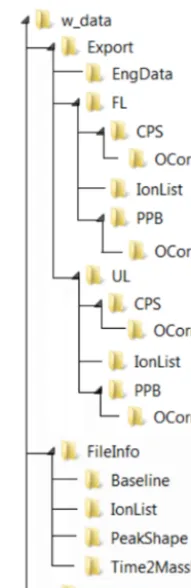
PTRwid creates all sub-directories shown in Fig. A1 in the directory containing the HDF5 raw data. All files created by PTRwid can be linked to the raw data through their spe-cific file names that contains the creation time in the format “YYYY.MM.DD-HHhMMmSSs”.
The FileInfo directory (Fig. A1) contains all information retrieved from the SumSpectrum. This includes the baseline (a jpg picture similar to Fig. 3 and the data in a text file), the IonList (also referred to as file mass list, i.e., parameters of the peak detection routine, Sect. 2.1.1), the PeakShape (a jpg picture similar to Fig. 4 and the data in a text file), and Time2MassPAR (a jpg picture similar to Fig. 2 and a param-eter file containinga,t0, ex, largest mass, resolution, and the
width of a TOF bin).
Figure A1. PTRwid file structure. Explanations are provided in the
text of Appendix A.
R. Holzinger: PTRwid: A new widget-tool for processing PTR-TOF-MS data 3915 Appendix B: Brief description of the elements of the
PTRWID
B1 PTRwid control window (Fig. B1)
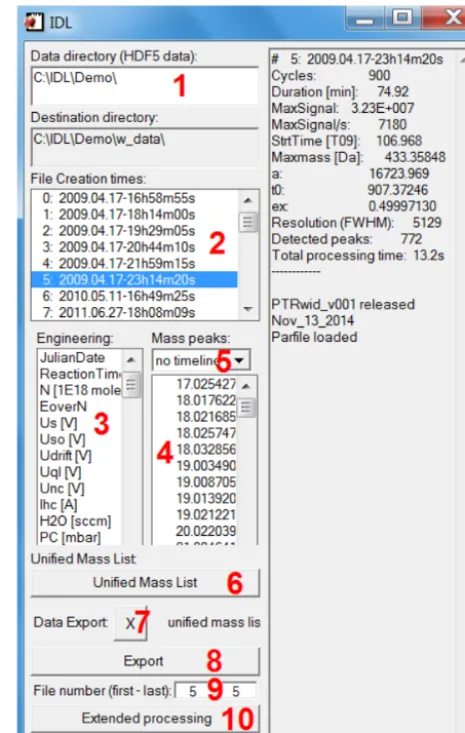
Select data directory field (label 1 in Fig. B1): a click with the right mouse button activates a context menu with two op-tions: (i) “browse” to select a new directory with HDF5- data, and (ii) “last settings” to load the directory used in the previ-ous session.
File list field (label 2 in Fig. B1): after the directory has been specified, all HDF5-data files (including files in sub-directories!) are listed. Note that rather than displaying file names the file-creation times are displayed. The files are chronologically ordered (by creation-time) and an identifier number (file index) is attributed to each file. Individual files can be selected in the list. Available engineering data and detected mass peaks (file mass list) are displayed in the engi-neering data and the mass peaks fields, respectively (labels 3 and 4 in Fig. B1).
Engineering data field (label 3 in Fig. B1) – individual en-gineering data can be selected and are plotted.
Mass peaks field (label 4 in Fig. B1) – individual mass peaks can be selected and are plotted. A drop-down list (label 5 in Fig. B1) allows to select different presentations.
Unified mass list button (label 6 in Fig. B1) – calcu-lates/loads the unified mass list. Calculating requires basic evaluation of all data files and takes some time. Loading is completed within 2–3 s. On the first (3rd , 5th , etc.) click on the unified mass list button, the mass peaks of the unified mass list are displayed in the “Mass peak” field and can be selected and reviewed. On the second (4th, 6th, etc.) click on the unified mass list button, an integer mass list is displayed in the Mass peak field and all mass peaks on the selected integer mass can be reviewed.
The pull-down menu (label 7 in Fig. B1) – allows to select the file mass list (of the file selected in the file list field) or the unified mass list which are displayed in the Mass peak field, respectively.
The Export button (label 8 in Fig. B1) – implements bulk data processing as described in Sect. 2.1.6. The files to be exported can be selected in the text fields below the button (Label 9 in Fig. B1). The export is based on the file list se-lected by the pull-down menu (Label 7 in Fig. B1).
The Extended processing button (label 10 in Fig. B1) – opens a new window from which available extended data processing tools can be started.
Figure B1. Main PTRwid control window. In the top-left text field
Figure B2. The “Average and Merge Data” tool widget windows. The main window (a) allows selecting and displaying data (example in
Figs. 6 and 7) in order to produce and test useful data categorizations (Figs. 6b and 7) by creating an index file. The interactive elements are labeled with bold red numbers and briefly described in Appendix B. The “New Index File” widget window (b) allows creating complex data categories by using up to 10 conditions. Up to four index values can be manipulated in the hardcopy section, and up to three sampling indices can be created for in situ PTR-TOF-MS applications.
B2 “Average and Merge Data” tool widget windows (Fig. B2)
A short description of all interactive elements of the main window (Fig. B2a) is given below. Additional information on the New Index window is provided in Fig. B3.
Select data directory field (label 1 in Fig. B2a): a click with the right mouse button activates a context menu which allows to select a data directory with data exports (usually the “w_data” subdirectory of the HDF5 raw data directory).
File list field (label 2 in Fig. B2a): after the directory has been specified, all available data files are listed. Multiple files can be selected in the list. Available engineering data and the mass peaks of the unified mass list are displayed in the engi-neering data and the mass peaks fields, respectively (labels 3 and 4 in Fig. B2a).
Engineering data field (label 3 in Fig. B2a): individual en-gineering data can be selected and are plotted.
Mass peaks field (label 4 in Fig. B2a): individual mass peaks can be selected and are plotted.
Drop-down lists (label 5 in Fig. B2a): these four drop-down lists allow for the specification of the data for the pa-rameters (pdrift, udrift, udx, Tdrift) which are needed to cal-culate the mixing ratios from ion counts (cps). Note that vol-ume mixing ratios are re-calculated here based on averaged counts of primary and product ion signals.
Index file field (label 6 in Fig. B2a): a click with the right mouse button activates a context menu which allows to select an index file (*.ind). When an index file is selected the dis-played data are categorized according to the index parameter. New Index button (label 7 in Fig. B2a): this button opens a new window (Fig. B2b) in which a new index can be created and saved.
R. Holzinger: PTRwid: A new widget-tool for processing PTR-TOF-MS data 3917
Figure B3. The New Index window with the values that were used
to categorize data from the SOAS campaign (as shown in Fig. 7). The two text fields in the first row allow for the specification of an index name and the maximum length (in seconds) of junk data that are averaged. The get current values button reads the values of the selected index file (label 6 in Fig. B2a) into the respective fields. The three main sections are marked by red brackets: (1) up to 10 con-ditions can be used to categorize the PTR-TOF-MS data, (2) point wise addition of the provided values to specified index values, and (3) 6 conditions to define up to three sampling indices (two con-ditions, i.e., sample and blank, per sampling index). The different types of entry columns are marked by blue letters: (A) droplists that allow selecting engineering data and adding the corresponding in-dex to column B; (B) engineering data indices or ion masses can be provided here and will be processed according the condition se-lected in column C; (C) droplists that allow selecting different rules to compare the selected data (B) with the provided target value (D); in column E index values are provided that are attributed if the con-dition is met; (F) specifies the index value to which sampling in-dices are associated or to which the values provided in column G are added.
Figure B4. The Attribute Formulas tool window and fractions of the
Table B1. Key routines used by PTRwid.
Procedure name Activated by Essential processing
EXPORT PTRWID, button (label 8 Fig. 1) Calls CORRPOISSDEAD, INTEGRATE, OVERLAP, ALCPPB SINGLEFILE PTRWID, list (label 2 Fig. 1) Calls PS1
UNIMASSLIST PTRWID, list (label 6 Fig. 1) Calls PS1, PS2 EXPRT Average and Merge Data tool,
button (label 8 Fig. 7a)
Calls INDEX, AVERAGING, CALCPPB
IDENTIFICATION Attribute Formulas tool Computes possible formulas and evaluated consistency with natural
13C/12C ratio
AVERAGING EXPRT Averages data according to categorization provided by INDEX CAL3PT PS1 Performs a 3 point mass scale calibration and optimization. CALCPPB EXPORT, EXPRT Computation of volume mixing ratios.
CALCRUDE PS1 Performs a crude mass scale calibration based on m/z21.022 and 59.049.
CALFINE PS1 Optimizes the crude mass scale calibration.
CORRPOISSDEAD EXPORT Correction of Poisson statistics and detection of dead times
CORRTR CALCPPB Calculates the mass dependent transmission efficiency according to Tr(m)=P0+mP1+m2P2+m3P3+m4P4+m5P5+m6P6.
The parametersP0. . .P6can be set in the parameter file
(see Appendix D).
DETECTPEAKS PS1 Scans the SumSpectrum for peaks.
INDEX EXPRT Provides index vectors according to the parameters specified in the New Index window
INTEGRATE EXPORT Integration of junks of raw HDF5 data. MASSLIB PTRWID, PS1 Computes library including
C1–40H0–82O0–5 (∼2400 compounds) and C1–40H0–82O0–16N0–2 if
the/EXTENDED keyword is set (∼41 000 compounds). OVERLAP EXPORT Correction of overlapping peaks.
PS1 SINGLEFILE, UNIMASSLIST
Calls DETECTPEAKS, CALCRUDE, CALFINE, CAL3PT. Retrieves baseline signal, peak shape and resolution (FWHM). PS2 UNIMASSLIST Computes parameters of the unified mass list, most importantly the
pre-cision of the computed ion mass.
Appendix C: Overview of key routines
R. Holzinger: PTRwid: A new widget-tool for processing PTR-TOF-MS data 3919 Appendix D: List of adjustable parameters
Table D1. List of adjustable parameters.
Variable name Default value Associated with Comment
Desired_Min_Signal 1.0×10⁶ Unified mass list If the maximum value (unit is counts per TOF bin) in the SumSpectrum is lower, the SumSpectrum of the following file is added.
Max_Time_Gap 10 Unified mass list If the gap between the last measurement of the current file and the first measurement in the following file is larger (unit is minutes), no SumSpectrum is added even if the signal is lower than the value of “Desired_Min_Signal”.
Min_Mass 10 Peak search Peaks below this value (unit is Da) are deleted exMin 0.49 Mass scale
calibration
lowest allowed value for ex
exMax 0.500000015 Mass scale calibration
highest allowed value for ex
M1a 21.0221 3-point mass scale calibration
Low mass, option 1
M1b 42.034 3-point mass scale calibration
Low mass, option 2
M2a 59.0491 3-point mass scale calibration
Medium mass, option 1
M2b 116.906 3-point mass scale calibration
Medium mass, option 2
M3a 205.195 3-point mass scale calibration
High mass, option 1
M3b 355.0731 3-point mass scale calibration
High mass, option 2
tol_ppm 300 3-point mass scale calibration
Boundaries for the variation of constants, i.e., The low, medium, and high mass are varied by the specified value (in ppm)
MinSig 800 Peak shape Minimum signal (unit is counts per TOF bin) of the peak maximum to be included for peak shape computation k19 3 Compute volume
mixing ratio
Reaction rate constant for reaction with H3O+
(unit 10−9cm3s−1). k37 3 Compute volume
mixing ratio
Reaction rate constant for reaction with H2O·H3O+
(unit 10−9cm3s−1). m38 1 Compute volume
mixing ratio
If 1 the signal atm/z=38.033 is used to calculate the H2O·
R. Holzinger: PTRwid: A new widget-tool for processing PTR-TOF-MS data 3921
Table D1. Continued.
Variable name Default value Associated with Comment
P0 1.100155×10⁻¹ Transmission Transmission parameters. The default parameters P0-P6 Produce a mass dependant transmission efficiency suggested by Cappellin et al. (2012).
P1 4.045148×10⁻³ P2 −1.370699×10⁻⁵ P3 3.469004×10⁻⁸ P4 −4.053399×10⁻¹¹ P5 3.624118×10⁻¹⁴ P6 −1.055928×10⁻¹⁷
ExportOne 0 Export If set to 1, only one data file is exported (existing files are overwritten) and jpg pictures depicting the entire data set (similar to Fig. D2 in Holzinger et al., 2010a) are saved for quality control purposes.
CorrectOverlap 1 Export If set to 0, no corrections for the expected signal outside the integration boundaries and from nearby neighbour peaks are applied.
SaveCsv 1 Export If set to 0, exported files are only saved in *.fdt files1(no comma separated values, *.csv files)
JunkSize 1.5×10⁸ Export Maximum number of values that are loaded as one junk from the HDF5 raw data file. Low numbers increase the pro-cessing time, but if the value is too high insufficient virtual memory will cause the program to crash.
CorrectionON 1 Export If set to 0, no Poisson and dead time corrections will be performed.
NonExtendingDeadTime 15 Export Unit is nanoseconds. More information in Titzmann et al. (2010) and Müller et al. (2013). ExtendingDeadTime 1.3 Export Unit is nanoseconds. More information in
Titzmann et al. (2010) and Müller et al. (2013).
Acknowledgements. Valuable and appreciated feedback on draft
manuscripts has been provided by Pawel K. Misztal. PTRwid relies on important research on PTR-TOF-MS. I greatly appreciate the work done by various groups, notably the work presented by Cappellin et al. (2011, 2012), Müller et al. (2013, 2014), and Titzmann et al. (2010). I used the quantile function written and provided by Jarle Brinchmann from Leiden University, NL, which is greatly appreciated. I also want to thank numerous colleagues and students for spotting inconsistencies and bugs which helped to improve the code over the years. Funding of our TD-PTR-MS by the Netherlands Organization for Scientific Research (NWO, Grant 834.08.002) is gratefully acknowledged. The measurements at the CESAR observatory were funded by ACTRIS (FP7- 262254), and measurements for the SOAS campaign were funded by the Electric Power Research Institute (EPRI), grant agreement 00-10000358.
Edited by: F. Stroh
References
Brilli, F., Gioli, B., Ciccioli, P., Zona, D., Loreto, F., Janssens, I. A., and Ceulemans, R.: Proton Transfer Reaction Time-of-Flight Mass Spectrometric (PTR-TOF-MS) determination of volatile organic compounds (VOCs) emitted from a biomass fire devel-oped under stable nocturnal conditions, Atmos. Environ., 97, 54– 67, doi:10.1016/j.atmosenv.2014.08.007, 2014.
Cappellin, L., Biasioli, F., Schuhfried, E., Soukoulis, C., Märk, T. D., and Gasperi, F.: Extending the dynamic range of proton transfer reaction time-of-flight mass spectrometers by a novel dead time correction, Rapid Commun. Mass Sp., 25, 179–183, 2011.
Cappellin, L., Karl, T., Probst, M., Ismailove, O., Winkler, P. M., Soukoulis, C., Aprea, E., Märk, T. D., Gasperi, F., and Biasi-oli, F.: On quantitative determination of volatile organic com-pound concentrations using proton transfer reaction time-of-flight mass spectrometry, Environ. Sci. Technol., 46, 2283–2290, doi:10.1021/es203985t, 2012.
Chernushevich, I. V., Loboda, A. V., and Thomson, B. A.: An intro-duction to quadrupole-time-of-flight mass spectrometry, J. Mass Spectrom., 36, 849–865, 2001.
Graus, M., Muller, M., and Hansel, A.: High resolution PTR-TOF: quantification and formula confirmation of VOC in real time, J. Am. Soc. Mass Spectr., 21, 1037–1044, 2010.
Holzinger, R., Kasper-Giebl, A., Staudinger, M., Schauer, G., and Röckmann, T.: Analysis of the chemical composition of or-ganic aerosol at the Mt. Sonnblick observatory using a novel high mass resolution thermal-desorption proton-transfer-reaction mass-spectrometer (hr-TD-PTR-MS), Atmos. Chem. Phys., 10, 10111–10128, doi:10.5194/acp-10-10111-2010, 2010a.
Holzinger, R., Williams, J., Herrmann, F., Lelieveld, J., Don-ahue, N. M., and Röckmann, T.: Aerosol analysis using a Thermal-Desorption Proton-Transfer-Reaction Mass Spec-trometer (TD-PTR-MS): a new approach to study process-ing of organic aerosols, Atmos. Chem. Phys., 10, 2257–2267, doi:10.5194/acp-10-2257-2010, 2010b.
Holzinger, R., Goldstein, A. H., Hayes, P. L., Jimenez, J. L., and Timkovsky, J.: Chemical evolution of organic aerosol in Los An-geles during the CalNex 2010 study, Atmos. Chem. Phys., 13, 10125–10141, doi:10.5194/acp-13-10125-2013, 2013.
Jordan, A., Haidacher, S., Hanel, G., Hartungen, E., Mark, L., See-hauser, H., Schottkowsky, R., Sulzer, P., and Mark, T. D.: A high resolution and high sensitivity proton-transfer-reaction time-of-flight mass spectrometer (PTR-TOF-MS), Int. J. Mass Spec-trom., 286, 122–128, 2009.
Liu, Y. J., Herdlinger-Blatt, I., McKinney, K. A., and Martin, S. T.: Production of methyl vinyl ketone and methacrolein via the hy-droperoxyl pathway of isoprene oxidation, Atmos. Chem. Phys., 13, 5715–5730, doi:10.5194/acp-13-5715-2013, 2013.
Müller, M., Mikoviny, T., Jud, W., D’Anna, B., and Wisthaler, A.: A new software tool for the analysis of high resolution PTR-TOF mass spectra, Chemometr. Intell. Lab., 127, 158–165, 2013. Müller, M., Mikoviny, T., and Wisthaler, A: Detector aging induced
mass discrimination and non-linearity effects in PTR-ToF-MS, Int. J. Mass Spectrom., 365, 93–97, 2014.
Park, J. H., Goldstein, A. H., Timkovsky, J., Fares, S., Weber, R., Karlik, J., and Holzinger, R.: Active atmosphere-ecosystem ex-change of the vast majority of detected volatile organic com-pounds, Science, 341, 643–647, 2013a.
Park, J.-H., Goldstein, A. H., Timkovsky, J., Fares, S., Weber, R., Karlik, J., and Holzinger, R.: Eddy covariance emission and de-position flux measurements using proton transfer reaction – time of flight – mass spectrometry (PTR-TOF-MS): comparison with PTR-MS measured vertical gradients and fluxes, Atmos. Chem. Phys., 13, 1439–1456, doi:10.5194/acp-13-1439-2013, 2013b. Timkovsky, J., Dusek, U., Henzing, J. S., Kuipers, T. L.,
Röck-mann, T., and Holzinger, R.: Offline thermal-desorption proton-transfer-reaction mass spectrometry to study composition of or-ganic aerosol, J. Aerosol Sci., 79, 1–14, 2015.
Titzmann, T., Graus, M., Müller, M., Hansel, A., and Oster-mann, A.: Improved peak analysis of signals based on count-ing systems: illustrated for proton-transfer-reaction time-of-flight mass spectrometry, Int. J. Mass Spectrom., 295, 72–77, 2010. Veres, P. R., Faber, P., Drewnick, F,. Lelieveld, J., and Williams, J.:
Anthropogenic sources of VOC in a football stadium: assessing human emissions in the atmosphere, Atmos. Environ., 77, 1052– 1059, doi:10.1016/j.atmosenv.2013.05.076, 2013.