80 Page
PROSPECTIVE PRESCHOOL TEACHERS’ BELIEFS ABOUT MATHEMATICS BEFORE AND AFTER A MATHEMATICS TEACHING COURSE
Zvia Markovits1, Helen Forgasz2
1Kibbutzim College of Education, Israel
2Monash University, Australia
Abstract
In this study we reveal the beliefs about mathematics held by 42 prospective preschool teachers prior to and after a one semester course devoted to the teaching of mathematics in the early childhood years. Results suggest that many of the prospective teachers explicitly expressed negative beliefs about mathematics as well as implicitly via the ‘animal metaphor’. The course made a small change in teachers’ beliefs, suggesting that much more has to be done for a meaningful change, so that prospective preschool teachers can engage in mathematics with young children positively.
Key words: prospective preschool teachers, mathematics, beliefs, metaphors
1.INTRODUCTION
Mathematics is an integral part of our lives, and children are engaged in mathematics at a very young age. Already at this young age, children are able to develop extensive mathematical knowledge connected with everyday life, and thus preschool teachers should know how best to integrate mathematics into children’s learning activities. Preschool teachers need to hold positive attitudes and beliefs regarding mathematics and its teaching, since their attitudes and beliefs can impact their willingness to engage in mathematics with young children.
In general, attitudes and beliefs play an important role in teachers’ abilities to help young children to develop mathematical comprehension. Moreover, teachers’ attitudes and beliefs seem to affect not only their pedagogical practices but also the content they teach (Leder, Pehkonen & Torner 2002). However, many prospective preschool teachers have negative beliefs about mathematics (Gresham 2007), beliefs formed during their studies of mathematics in elementary, junior, and high school. Unfortunately, many of the programs for preparing preschool teachers assign only a few courses to mathematics and its teaching in the early years (sometimes only one or two semester length courses), thus not allowing enough time to try and change the prospective teachers’ beliefs.
The purpose of this study was to reveal the beliefs about mathematics held by 42 prospective preschool teachers prior to and after a one semester course, devoted to the teaching of mathematics in the early childhood years. In order to reveal prospective teachers’ beliefs we used direct questions that allowed us to explicitly learn about their attitudes and beliefs, as well as metaphor questions from which the prospective teachers' beliefs could be inferred. We used metaphors following the genre describing metaphors as a means by which a comparison can be made between two non-connected issues that may share common characteristics (Lakoff 1992).
2.THEORETICAL BACKGROUND
2.1 Engagement in mathematics in the early years
81 Page
were surprised at what the children managed to accomplish” (p. 164). Hachey (2013) adds that, “We now know that prior to elementary school, young children engage in surprisingly complex intuitive mathematical thinking with regard to numbers, geometry, measurement, algebraic thinking, and data analysis” (p. 419).
Preschool teachers are the ones who can open the window for young children to the world of mathematics, or they can keep this window closed. Preschool teachers are the ones who determine the way in which young children are engaged in mathematics, engagement that probably will have an important influence on children’s mathematics engagement later, at school. However, it seems that preschool teachers tend to engage young children more in language learning than in mathematics. This may be because they believe that language is more important than mathematics at this age, or because they themselves have no interest in mathematics, or are afraid of it (Copley 2000; Lee & Ginsburg 2007; Ginsburg, Lee & Boyd 2008).
The preparation of prospective preschool teachers and the development of in-service teachers to teach mathematics to young children are crucial. Brendefur et al. (2013) examined the mathematical capabilities of children whose teachers participated in a development mathematics program, as well as of children whose teachers did not participate in such a program. They found higher mathematical understandings demonstrated in some aspects of the concept of number, in problem solving, measurement, and spatial skills among children whose teachers had participated in mathematics development programs. However, the preparation of prospective preschool teachers, and the development of in-service preschool teachers for teaching mathematics to young children, seem to be very limited. Simpson and Linder (2014) conducted a study in which they investigated how and to what extent early childhood teachers are being prepared to develop the mathematics capabilities of young children. They found that preschool teachers’ professional development in mathematics is deficient. This deficit commences in prospective preschool teachers’ preparatory studies, during which many of them learn too little mathematics. In Israel, most prospective preschool teachers learn between one and three semester length courses of mathematics during their four-year study programs. In this limited period, there is the need to focus on mathematical content knowledge, to develop their pedagogical content knowledge and, for many, to try to change their attitudes towards and beliefs about mathematics.
2.2 Preschool teachers’ attitudes and beliefs
Attitudes and beliefs play an important role in teachers’ practices and in the content their students are encouraged to learn (Stipek et al. 2001; Leder, Pehkonen & Torner 2002; Thompson, 1992). Many prospective preschool teachers register to college without a love for mathematics. This is frequently manifested by feelings of hate for, fear of, or anxiety about the subject (Gresham 2007; Zacharos et al. 2007; Markovits 2012). Mathematics anxiety is expressed by a feeling of fear, tension, and panic when asked to perform mathematical tasks. If these feelings are not addressed during their years of study, mathematics anxiety may be evident among in-service preschool teachers as well, and may well prevent them engaging young children in mathematics learning opportunities. Aslan (2013) conducted a study in which he compared prospective and in-service preschool teachers’ mathematical anxiety and beliefs about teaching mathematics to young children. He found that in-service preschool teachers manifested more mathematics anxiety than did prospective preschool teachers. In his study of 31 Head Start teachers, Geist (2015) investigated their attitudes toward mathematics and its effects on how and what they teach in their classrooms. The findings suggested that there was a relationship between mathematics anxiety and negative attitudes towards mathematics. Moreover, the study illustrated that these feelings affected teachers’ curriculum planning choices, as well as their ability to engage young children in mathematics learning. On the other hand, there are studies in which more positive views of preschool teachers’ beliefs and self-confidence in teaching math to young children were identified (Chen et al. 2014).
82 Page
mathematics with young children. Well-structured mathematics courses have the potential to reduce negative attitudes towards and beliefs about mathematics and its teaching (Gresham 2007; Sloan 2010; Markovits 2012), and thus should be part of prospective preschool teachers’ learning program, as well as in-service teachers’ professional development programs.
In some studies, metaphors have been used to reveal attitudes towards and beliefs about mathematics. Keles, Tas & Aslan (2016) used metaphors to investigate 50 prospective preschool teachers’ perceptions of mathematics and its teaching to young children. They found that most of the metaphors used by the teachers were positive (88.8%), suggesting that they have positive beliefs about mathematics and its teaching. Latterell and Wilson (2016) asked 93 prospective elementary teachers to provide metaphors for mathematics and mathematics learning in order to explore beliefs about mathematics. They found that about 25% percent of the metaphors suggested negative views of mathematics and the teaching of mathematics. They pointed out that metaphors are a powerful tool for exploring prospective teachers’ beliefs about mathematics.
2.3 Metaphors in educational research
Lakoff (1992), a cognitive linguist, described metaphors as “the way we conceptualize one mental domain in terms of another” (p. 1). Another way of viewing the metaphor genre is as a means by which a comparison is made between two non-connected issues that may share common characteristics.
Building on the work of Lakoff and colleagues, Chapman (1997) claimed that “metaphors are more than linguistic devices. They represent embodied knowledge grounded in experience” (p. 209), thus providing insight into beliefs held. Metaphors have been used to reveal beliefs about mathematics and its teaching, mainly through explorations of the perceptions of prospective (e.g., Erdogan, Yazlin & Erdik 2014; Latterell & Wilson 2016; Leavy, McSorley & Boté 2007; Noyes 2006; Reeder, Utley & Cassel 2009) and practicing teachers (e.g., Chapman 1997, Oksanen & Hannula 2012). Metaphor has also been used in research to unpack students’ beliefs about mathematics (e.g., Schinck et al. 2008).
For this study, we drew on an item that had been used by Miller-Reilly (2000) in interviews with university level adult learners of mathematics. As respondents would express their views through the description of an animal, Miller-Reilly (2000) claimed that using the “animal metaphor” had the potential to reveal beliefs about mathematics.
In this study we used direct questions as well as metaphor-type questions to reveal the beliefs of prospective preschool teachers, before and after their participation in a one semester length course dealing with the teaching of mathematics to young children.
3.THE STUDY 3.1 Method
The research tool was a questionnaire, administered twice, that is, before and after the semester length course on teaching mathematics to young children. In both versions of the questionnaire, participants were asked to answer two direct questions using closed 5-point Likert-type response formats, and then to explain their answers:
a. How much do you like mathematics?
b. Do you think you will enjoy engaging in mathematics with young children?
The following "animal metaphor" question was also included on both versions of the questionnaire:
c. Which animal do you think mathematics is like? Explain your choice.
83 Page
semester deals with number concepts and the second with geometry. Each course involves about 14 classes of two hours duration.
The participants completed the questionnaires when enrolled in the first semester number concepts course. It was the first mathematics course encountered by these prospective preschool teachers. The course focused on the ways young children develop the concept of number, and on the ways young children think mathematically and discuss mathematical ideas. During the course the participants were exposed to the National Mathematics Curriculum for young children (Ministry of Education 2010) and to a variety of activities with the potential to promote young children’s understanding of the number concept. As part of the course, the prospective teachers are asked to interview young children on several issues connected to the number concept in order to learn more about children’s thinking.
Analyses. Paired t-tests were used to analyze the first two questions, as responses were normally distributed and with similar variances. Qualitative techniques were used to analyze responses to the open-ended animal metaphor question. Previous research findings guided the identification of themes in the written responses. In addition, the researchers were open to unanticipated categories that might emerge from the data.
3.2 Findings
Responses to the first two questions (a. and b. above) are presented first, followed by the responses to the "animal metaphor" question.
How much do you like mathematics?
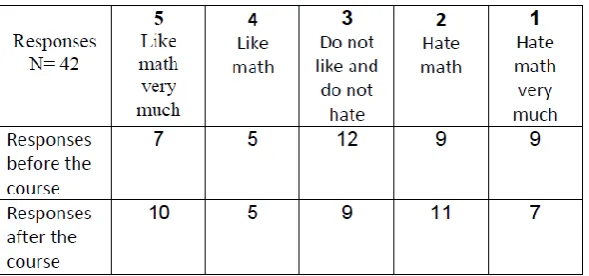
The mean for this item was 2.81 (standard deviation = 1.37) prior to the course. This score indicates that, on average, the participants were generally neutral about mathematics. At the end of the course the mean was 3.02 (sd =1.39) – again indicating a generally neutral view of mathematics. These mean scores were statistically significantly different (p<0.05). Although there was an increase in mean scores on this question, suggesting that at the end of the course the attitudes toward mathematics were better than prior to the course, the main finding seems to be that many of the prospective teachers do not like (in fact, ‘hate’) mathematics. This can be seen in the frequency distribution of their responses shown in Table 1. The data reveal that 18 prospective teachers (43%) said that they hated or very much hated mathematics, both before the course and after studying the course on mathematics and number concepts.
Table 1. Frequency distribution of responses to the item: How much do you like mathematics?
84 Page
Participants who had neutral feelings for mathematics (scores of 3) provided a variety of explanations such as: “Math is difficult for me but I still like to exercise”; “I am in the middle, not like but manage”; “This is the subject I am less good at”; and “I like challenges but sometimes math can be frustrating”.
Most of the participants who said that they liked mathematics (scores of 5 or 4) emphasized their views of the characteristics of mathematics: interesting, challenging, and satisfying. Examples include: “It is like solving a riddle. It gives satisfaction if you succeed and motivation to continue if you do not succeed”; “I like calculations and I like to understand what is behind the exercises”; “It challenges the thoughts”; and “It is interesting. It is nice to reach the answer after you put some thinking into the problem”.
Do you think you will enjoy engaging in mathematics with young children?
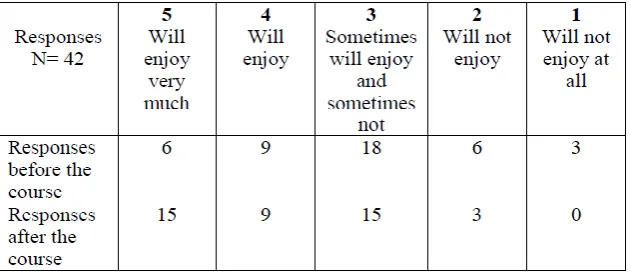
The mean for this item was 3.21 (sd = 1.09) prior to the course and 3.86 (sd = 1.00) at the end of the course. The means were statistically significantly different (p<0.001). This finding suggests that most of the participants were able to connect more closely to the teaching of mathematics to young children than to the subject of mathematics itself. This is seen from the frequency distribution of the responses to the item, presented in Table 2. It can be seen that after studying the course, only three of the prospective teachers said that they would not enjoy engaging in mathematics with young children. In comparison, for the previous question about the liking of mathematics, 18 still indicated that they hated or very much hated mathematics at the end of the course of study.
Table 2. Frequency distribution of responses to the item: Do you think you will enjoy engaging in mathematics with young children?
From the responses provided to this item, it was evident that many of the participants showed a change in beliefs. For example, one prospective teacher chose ‘1’ (will not enjoy at all) at the beginning of the course which changed to ‘2’ (will not enjoy) after the course. Although she still thinks she will not enjoy engaging in mathematics with young children, a small change in her perceptions was noted. It seems that from the course assignment involving interviewing children, she realized that the children enjoyed being engaged in mathematics. Before the course, she wrote: “I chose ‘1’. It is difficult for me to connect to this subject which always caused me stress. That is why everything connected to math makes me think of failure and I do not like to fail but I am always open to try again. Maybe at the end, the outcome will be different.” After the course she wrote: “I chose ‘2’. I do not know if I will enjoy (engaging children in mathematics) but when I interviewed the children for the assignment, and when the children enjoyed and wanted to continue, I realized that it is not so horrible and that through the children I can also try and enjoy numbers, and that the learning of math can be experiential and not boring or stressing.”
85 Page
the child needs to engage in different things, more imaginational things”. After the course, however, she wrote: “I chose ‘3’. Yes, I will do it in a creative way because it will help them in everyday life and also prepare them for first grade.”
At the beginning of the course, another prospective preschool teacher indicated that she would enjoy engaging in math with young children. She wrote: “I chose ‘4’. It will be satisfying to see children who receive basic math skills”. It seems that the course and the interviews with the children helped her decide that she would enjoy it even more. She wrote: “I chose ‘5’. Sure I will enjoy it. I felt curious from the children on the assignments you gave us, especially since it was done in an experiential way. I noticed that children love being asked questions, they felt important.”
Some of the participants made even bigger changes. For example, one chose ‘3’ before the course, saying that “I connect more to other subjects than to mathematics”. She chose ‘5’ after the course, saying: “Very much. I will put a lot of effort in activities with the children. I will learn, plan, and have activities that will enrich the children, even though I am not coming from math”. Another example is from a prospective preschool teacher who chose ‘1’ before the course, without explaining her choice (she had also indicated that she hated mathematics very much). After the course, she selected ‘5’ and wrote: “With children it is more fun to discover things and to enjoy them. If they enjoy math I can enjoy it as well. It will make math less scary and more enjoyable and interesting”.
What animal do you think math is like?
The participants listed a variety of animals to describe mathematics including: owl, lion, cat, ant, hyena, elephant, snake, dog, lizard, shark, turtle, zebra, dragon, eagle, octopus, cockroach, and more others. Forty three percent of the participants listed the same animal before and after the course, while the others changed their choices. The choice of the same animal before and after the course was sometimes for the same reasons, but not always. Some participants viewed mathematics by using the same animal, but for different reasons. For example, three participants chose the lion to describe what mathematics means for them. One saw mathematics as threatening. She wrote: “Lion. It is a big scary lion, something threatening which overcomes me”. The second saw mathematics in an ambiguous way, and said: “Lion. It is a threatening animal but has also a beautiful side”, and the third emphasized the importance of knowing mathematics and looked at mathematics as ‘the queen’ of sciences. She wrote: “Lion, the king of the animals, because it is important to know mathematics”. At the beginning of the course, 31% of the participants, and only 14% at the end of the course, demonstrated very negative beliefs about mathematics through their choice of animal and explanation. For example: “Lizard. It is disgusting like math is”, or “Snake, stressing and scary”, or “Cockroach, worm, disgusting, makes me sick , you want to tread on it to make it go away, but you cannot get rid of it because more always come”.
Some of the participants who had very negative beliefs at the beginning of the course showed much more positive beliefs at the end of the course. Here are four examples:
a. Before the course: “Snake, stressing and scary”. After the course: “Zebra, because math reminds me of numbers. The zebra has stripes. It is interesting to count its stripes”.
b. Before the course: “Hyena. It laughs at me and mocks those who do not know mathematics”. After the course: “Lion, the king of the animals, because it is important to know mathematics”.
c. Before the course: “Dragon with two heads who devour. I am scared of it same as math threatens me and pressures me”. After the course: “Lion. He is the king of the animals. He is the head of the pyramid. Math is an integral part of our lives. Now I get its importance”.
86 Page
The analysis of participants’ metaphors and their explanations suggested four main categories in the expression of beliefs about mathematics:
- Negative beliefs expressing math anxiety (see examples above).
- Positive beliefs, expressed mainly by looking at math as important, or by suggesting that mathematics is a worthwhile subject, or that one has to be bright in order to learn mathematics. For example, “Owl, because math is very valuable and you find out its value when you know math”, or “Elephant, because it is a clever animal”, or “Owl, because it is an animal which symbolizes wisdom and mathematics needs wisdom”.
- Ambivalent beliefs, that is, expressing negative beliefs and as well as positive beliefs. For example, “A dog, because when you first see a dog you are afraid to get close and pat it, but when you know the dog you can pat it gladly”, or “Cat. There are cats that I like and others that I do not like. Same with math. It depends on the subject”, or “It is a butterfly. At first math seems complicated and difficult, but after learning it turns to something beautiful and not horrible at all”, or “Panther. It is a very calculated, curious, and smart animal, and makes me want to learn about it. But it is black and big and it might be scary. When you know it, it is interesting”.
- Beliefs related to the nature of mathematics as seen by the participants. For example, “Ant, because math is hard work”, or “A turtle, because math is a slow process and you reach results after a long journey – the path is the challenge in every mathematics exercise”, or “An ant, because ants are diligent, and in order to succeed in math one has to be diligent” or “Octopus, because math starts from basic numbers and can be deployed like an octopus in many directions”, or “Panther which is quiet, exact, and focused”, or “A kangaroo. It’s jumps remind me of series of numbers in math, and its pouch, mysterious things in math”.
4.CONCLUDING WORDS
This study adds to the existing research and sheds more light on the important issue of beliefs about mathematics and its teaching. In line with other studies (Gresham 2007; Zacharos et al. 2007; Markovits 2012) we found that many prospective preschool teachers have negative feelings about mathematics. In our study, 43% of the teachers said that they hated mathematics or hated it very much. This is a large proportion. Since all of them will have to engage in mathematics with young children, this is of some concern. Moreover, this group of participants did not change their views after the course, although the frequency distribution of their responses changed a little (before the course 9 hated mathematics and 9 hated it very much; after the course 11 hated mathematics and 7 hated it very much).
More encouraging results were obtained on the item asking about the enjoyment that prospective preschool teachers indicated they would have when engaging in mathematics with young children. Before the course, 9 said that they would not enjoy (3 of whom would not enjoy it at all); after the course this number decreased to 3 participants who would not enjoy doing so, with none saying they would not enjoy doing so at all). These results suggest that although prospective preschool teachers might hate mathematics because of the bad experiences they had with the subject in school, they are able to distinguish between their views of mathematics and the teaching of mathematics to young children.
87 Page
Responses to the animal metaphor item also revealed the prospective preschool teachers’ beliefs about mathematics. In contrast to the direct questions used in this study, answers to the animal metaphor item required the participants to think carefully. Not only was this kind of question new to them, but the need to use a metaphor resulted in reflective responses about their beliefs about mathematics. Through the use of metaphor, some were able to articulate their fears of and frustrations towards mathematics. Some perceived characteristics of mathematics were evident from others’ responses. Changes in the participants’ negative beliefs about mathematics were manifest through the animal metaphor. Negative beliefs decreased from 31% before the course to 14% at the end of the course. Participants were quite curious about the animals chosen by their classmates, and this later opened a very fruitful discussion about attitudes and beliefs held toward mathematics, suggesting that the animal metaphor is a powerful tool to use with prospective preschool teachers at the start of a mathematics or a mathematics teaching course.
Our research has demonstrated that a one semester course can result in changes in prospective preschool teachers’ attitudes and beliefs. But, the extent of the change was small. Since all of them will have to engage in mathematics with young children, and since attitudes and beliefs play an important role in teachers’ willingness to engage in mathematics and to engage with children to promote mathematical thinking, the ideal is for all of them to hold positive attitudes towards and beliefs about mathematics. We believe that more time should be allocated to courses dealing with mathematics in preservice preschool teachers’ programs, courses in which the prospective preschool teachers learn to appreciate the beauty of mathematics and experience success and enjoyment in doing mathematics. Young children are interested in mathematics and are able to do a lot of mathematics. They need teachers who do not hate mathematics and who are able to help the children maximize their potential.
REFERENCES
Aslan, D 2013, 'A comparison of pre-and in-service preschool teachers' mathematical anxiety and beliefs about mathematics for young children', Academic Research International, vol. 4, no. 2, pp. 225- 230.
Brendefur, J, Strother, S, Thiede, K, Lane, C, & Surger-Prokop, MJ 2013, 'A professional development program to improve math skills among preschool children in head start', Early Childhood Education Journal, vol. 41, pp. 187-195.
Chapman, O 1997, 'Metaphors in the teaching of mathematical problem solving', Educational Studies in Mathematics, vol. 32, no. 3, pp. 201-228.
Chen, JQ, McCray, J, Adams, M, & Leow, C 2014, 'A survey study of early childhood teachers’ beliefs and confidence about teaching early math', Early Childhood Education Journal, vol. 42, no. 6, pp. 367-377.
Clarke, D, Clarke, B, & Roche, A 2011, 'Building teachers’ expertise in understanding, assessing and developing children’s mathematical thinking: the power of task-based, one-to-one assessment interviews', ZDM–The International Journal on Mathematics Education, vol. 43, no. 6-7, pp. 901–913.
Copley, JV 2000, The young child and mathematics, Reston, VA, and Washington, DC: National Council of Teachers of Mathematics and the National Association for the Education of Young Children.
Erdogan, A, Yazlik, OD & Erdik, C 2014, 'Mathematics teacher candidates’ metaphors about the concept of “mathematics”', International Journal of Education in Mathematics, Science and Technology, vol. 2, no. 4, pp. 289-299.
88 Page
Ginsburg, HP, Lee, JS & Boyd, JS 2008, 'Mathematics education for young children: What it is and how to promote it', Social Policy Report, vol. 22, no. 1, pp. 1-22.
Greenes, C, Ginsburg, HP & Balfanz, R 2004, 'Big math for little kids', Early Childhood Research Quarterly, vol. 19, pp. 159-166.
Gresham, G 2007, 'A study of mathematics anxiety in pre-service teachers', Early Childhood Education Journal, vol. 35, no. 2, pp. 181-188.
Hachey, AC 2013, 'The early childhood mathematics education revolution', Early Education and Development, vol. 24, pp. 419-430.
Keles, O, Tas, I & Aslan, D 2016, 'Metaphor Perceptions of Pre-Service Teachers towards Mathematics and Mathematics Education in Preschool Education', Educational Research and Reviews, vol. 11, no. 14, pp. 1338-1343.
Lakoff, G 1992, The contemporary theory of metaphor, viewed 20 September 2016, https://georgelakoff.files.wordpress.com/2011/04/the-contemporary-theory-of-metaphor-in-ortony-andrew-ed-metaphor-and-thought-lakoff-1992.pdf
Latterell CM & Wilson, Jl 2016, 'Math is like a lion hunting a sleeping gazelle: Preservice elementary teachers’ metaphors of mathematics', European Journal of Science and Mathematics Education, vol. 4, no. 3, pp. 283-292.
Leavy, AM, McSorley, FA & Boté, LA 2007, 'An examination of what metaphor construction reveals about the evolution of preservice teachers’ beliefs about teaching and learning', Teaching and Teacher Education, vol. 23, no. 7, pp. 1217-1233.
Leder, GC, Pehkonen, E & Torner, G 2002, Beliefs and hidden variable in mathematics education, Dordrecht: Kluwer .
Lee, JS & Ginsburg, HP 2007, 'What is appropriate mathematics education for four-year-olds? Pre-kindergarten teachers’ beliefs', Journal of Early Childhood Research, vol. 5, no. 1, pp. 2–31.
Markovits, Z 2012, 'Beliefs hold by preschool prospective teachers towards mathematics and its teaching', Procedia – Social and Behavioral Sciences, vol. 11, pp. 117-121.
Miller-Reilly, BJ 2000, 'Exploration and modelling in a university mathematics course: Perceptions of adult students', In D Corben, J O'Donoghue & GE FitzSimons (eds.), Perspectives on adults learning mathematics, Dordrecht, The Netherlands: Kluwer Academic Publishers, pp. 257-269.
Ministry of Education 2010, Mathematics curriculum for kindergarten in the state and state-religious education frameworks, Jerusalem: Curricula Department, Ministry of Education [Hebrew].
National Association for the Education of Young Children, 2010, Early childhood mathematics: Promoting good beginnings, Washington, DC: NAEYC, viewed 20 September 2016, https://www.naeyc.org/files/naeyc/file/positions/psmath.pdf
National Research Council 2009, Mathematics learning in early childhood: Paths toward excellence and equit, Washington, DC: National Academy Press.
Noyes, A 2006, 'Using metaphor in mathematics teacher preparation', Teaching and Teacher Education, vol. 22, pp. 898–909.
Oksanen, S & Hannula, MS 2012, 'Finnish mathematics teachers’ beliefs about their profession expressed through metaphors', Proceedings of the MAVI-18 conference , Helsinki, Finland: Finnish Research Association for Subject Didactics, pp. 315-326, viewed on 20 September 2016, https://tuhat.helsinki.fi/portal/files/35130054/MAVI_18_proceedings.pdf
89 Page
Simpson, A & Linder SM 2014, 'An examination of mathematics professional development opportunities in early childhood settings', Early Childhood Education Journal, vol. 42, pp. 335-342.
Sloan, TR 2010, 'A quantitative and qualitative study of math anxiety among preservice teachers', The Educational Forum , vol. 74, no. 3, pp. 242-256.
Schinck, AG, Neale, HW, Pugalee, DK & Cifarelli, VV 2008, 'Using metaphors to unpack student beliefs about mathematics', School Science and Mathematics, vol. 108, no. 7, pp. 326-333.
Stipek, DJ, Givvin, KB, Salmon, JM & MacGyvers, VL 2001, 'Teachers’ beliefs and practices related to mathematics instruction', Teaching and Teacher Education, vol. 17, no. 2, pp. 213-226.
Thompson, AG 1992, 'Teachers' beliefs and conceptions: A synthesis of the research', In DA Grouws (ed.), Handbook of Research on Mathematics Teaching and Learning, New York: Macmillan, pp. 127-146.