Page 96
VOCATIONAL AND TECHNICAL EDUCATION IN CURRICULUM AND MOTIVATION FOR SELECTION OF TECHNICAL DISCIPLINES
Veronika Švrčinová1, Josef Malach2, Ivana Fialová3, Dana Vicherková2
1Department of Technical and Vocational Education, Faculty of Education, University of Ostrava, Dvořákova 7, Ostrava 701 03, Czech Republic
2Department of Pedagogy and Andragogy, Faculty of Education, University of Ostrava, Dvořákova 7,
Ostrava 701 03, Czech Republic
3Dean's Office of the Faculty of Education, Faculty of Education, University of Ostrava, Dvořákova 7,
Ostrava 701 03, Czech Republic
Abstract
The aim of the paper is to introduce the issues solved within TAČR project (Technology Agency of Czech Republic). The title of the project is “Education in engineering branches and its optimization for the needs of the labor market”. Its content focuses on the current needs of workers in engineering companies and innovation centers. The project proposal resulted from an analysis of the current situation in the field of technical education and the situation on the labor market in the sphere of technical professions. The paper also brings the partial results of the National Institute for Education’s 2012 survey as a basic insight into the issues solved within TAČR project.
Keywords: labor market, the National Institute for Education, project, technical education, Technology Agency of Czech Republic, vocational education
1. INTRODUCTION
There is a close link between vocational and technical education and the labor market. One of the main goals of education is to provide students with qualifications suitable for an employment. In schools, pupils acquire general and professional knowledge and skills - competences to enable them to work well in the future. In this way, education actually shapes the future supply of skilled labor. Ideally, there should be a balance between labor supply and demand of employers on the other. In order to make this process as effective as possible, it is important that the education sector and other stakeholders at all its decision-making levels have as much information as possible (both for their meetings and strategic or conceptual decision-making) on both the needs and requirements of employers and the labor market, as well as the readiness and success of school absolvents at working life. This information provides the education sector with the necessary feedback and can thus serve to further develop education.
The Faculty of Education succeeded in obtaining the possibility of implementing the TAČR project (Technology Agency of the Czech Republic). This is a significant achievement of the faculty in the framework of research projects and according to the project records it is the first project of this type that the faculty has ever obtained.
The project Education in engineering fields and its optimization for the needs of the labor market is based on the analysis of the current situation in the field of technical education and the labor market situation in the sphere of technical professions. The declining interest of the young generation in technical education is a long-standing problem, which is reflected in the unsatisfied demand of engineering companies for graduates with technical education.
Page 97
If we compare the development in the USA and in our country, we can notice the parallels, albeit with a several-year shift. In the Czech Republic, 2015 became the Year of Industry and Technical Education. As if current social needs in the Czech Republic required similar steps that were previously implemented in the USA. It can be observed that the social needs mentioned tend to grow steadily, with industry and especially the technical sectors calling in vain for skilled workers. It should be noted that their lack is not caused only because the graduates would not be well informed in this respect. It is also caused by population decline, the numbers of the unemployed are at a minimal level. The need for change also results from increasing industrial automation, as highly skilled professionals are desirable on the one hand, and workers who do not need to be specialists on the other are required, but technical literacy and the ability to learn new things are required. As foreign experience shows, these facts need to be considered in curriculum planning at primary, secondary and higher education (Dostál, 2016).
2. CURRICULUM - FRAMEWORK EDUCATIONAL PROGRAMME FOR VOCATIONAL
EDUCATION TRAINING
Curriculum documents in Czech Republic are made up of two levels:
the state level - National Education Programme and Framework Educational Programmes (FEPs) school level - School Educational Programmes (SEPs), under which education is carried out at a
particular school.
FEPs for vocational education training (VET) are:
- state-issued pedagogical (curricular) documents that define obligatory requirements for education in individual levels and fields of education, i.e. in particular, the learning outcomes that the pupil is expected to achieve at the end of his/her studies, the content of education, the basic conditions for the implementation of education and the rules for the creation of school educational programmes;
- obligatory documents for all secondary vocational schools that are obliged to respect it and develop it into their school curricula;
- publicly accessible documents for the educational and non-educational public;
- open document that will be upgraded after a certain period of validity or as needed (MŠMT, 2007).
2.1 Content of education
The content of education in the FEP is conceived in an over-subject way according to educational areas (e.g. language education, social science education, economic education, vocational training); it seeks a functional link between theory and skills training (practice).
The areas of general education are uniform for the whole level of education and follow the FEP for basic education. The area of vocational education is elaborated separately for individual fields of education, although similar fields of content may appear in some fields of education due to their characteristics.
FEPs also define so-called cross-cutting themes (Citizen in Democratic Society, Man and the Environment, Man and the World of Work, Information and Communication Technology), which performs mainly educational and motivational functions. The school can implement them not only in the educational process but as a part of other activities.
2.2 Key and vocational competences
The aim of secondary vocational education is that pupils develop the following key and vocational competences in relation to primary education and at a level appropriate to their abilities and learning abilities.
Key competences:
Page 98 communicative competence;
social and personal competencies;
civic competences and cultural awareness;
competence for employment and business activities; mathematical competencies;
competence to use information and communication technology resources and work with information.
Vocational competences
to design and construct machine parts, mechanisms and parts of machines, tools, instruments and other manufacturing aids, choose elements of technical equipment of buildings, technological equipment of workplaces etc. and design their location;
to design methods, technical equipment, tools and production aids and technological conditions for the transformation of raw materials, preforms and semi-finished products into engineering products; to design systems of care for the technical condition of machines and equipment, ways of
determining their technical condition, workflow of their revisions, maintenance and repairs; to measure basic technical quantities;
to use the resources of information and communication technologies to support effective work; to pay attention to work safety and health protection at work;
to strive for the highest quality of work, products or services;
to act economically and consistently with the sustainable development strategy.
3. PROJECT SOLVED WITHIN TECHNOLOGY AGENCY OF CZECH REPUBLIC (TAČR)
3.1.Basic information about project
The aim of the paper is to introduce the issues solved within TAČR project (Technology Agency of Czech Republic). In the history of the Faculty of Education (University of Ostrava), this is the first project awarded in the grant contest of the Technology Agency. It belongs to the Zeta sub-program, which is focused on supporting academic and business cooperation through the involvement of students and students of master's and doctoral degree programs at universities and young researchers up to 35 years of age.
The title of the project is ‘Education in engineering branches and its optimization for the needs of the labor market’. Its content focuses on the current needs of workers in engineering companies and innovation centers. The project proposal resulted from an analysis of the current situation in the field of technical education and the situation on the labor market in the sphere of technical professions. The target of the research project responds to the problems of engineering companies regarding the lack of workers. The declining interest of the young generation in technical education is a long-standing problem, which is reflected in the unsatisfied demand of engineering companies for graduates with technical education.
Page 99
innovations of the content and methods of technical education with emphasis on the needs of the labor market in the field of engineering.
The project will be co-operated by members of the Department of Technical and Vocational Education and the Department of Pedagogy and Andragogy of the Faculty of Education, University of Ostrava. Research team includes students of master's and doctoral degree programs at the Faculty of Education and Faculty of Science. The project, worth almost CZK 2.8 million, will be implemented in close cooperation with the Project Department from the beginning of April 2019 to the end of March 2022.
3.2.The benefit and impact of the project
The project is based on an analysis of the current situation in the field of technical education and the situation on the labor market in the sphere of technical professions, specifically the problems of engineering firms in terms of staff shortages. The declining interest of the young generation in technical education is a long-standing problem, which is reflected in the unsatisfied demand of engineering companies for graduates with technical education. The benefit and impact of the project will be: to raise awareness of the professional motivation for technical, especially engineering training; identification of motivational factors that are crucial for decision making in the choice of secondary
school or university with engineering specialization;
recognizing of motivation factors and barriers deciding on entering the labor market in the field of engineering;
strengthening the cooperation of all interested parties (Mechanical Engineering Companies and Enterprises, National Engineering Cluster, Department of Vocational and Technical Education, Faculty of Education, University of Ostrava, Department of Pedagogy and Andragogy, Faculty of Education, University of Ostrava).
By implementing the project, we will obtain relevant data that will enable the applicant to propose innovations in the content and methods of technical education with labor market needs in the field of engineering. We will gain relevant data on motivational factors that lead to the selection of technical schools and factors that are crucial for the entry of school graduates into the labor market in technical areas. The analysis of curricular documents will allow comparison with future needs of employers. Acquired information and current data will be usable for:
deeper insight into the professional orientation, career ideas, attitudes and values of the young generation usable for undergraduate and further training of teaching staff;
the interest of young scientists and students in socially relevant topics will be deepened and their competencies to examine using adequate tools will be further developed;
improvement of the investigator's performance (University of Ostrava) in the area of publishing the results of research activities, which is one of the factors contributing to obtaining accreditation for teaching studies, including for study programs of vocational subjects in the specialization of Mechanical Engineering;
the project will provide new up-to-date data useful for upgrading the content of the Specialized Education Counseling;
the solution of the project will deepen the involvement of students to study and contribute to the formation of higher quality interpersonal relationships, effective communication, teamwork, partnership respect and understanding of the need for lifelong learning;
the research experience gained by young researchers will be positively reflected in the quality of their final university theses in terms of linking and applying theory to practice;
Page 100 3.3 Overview of the project phases
Overview of activities
Phase 1
To analyze strategic and monitoring documents focusing on the labor market with an emphasis on the engineering industry.
To carry out surveys among the members of the National Engineering Cluster (engineering companies) focused on the compliance of their requirements with competences of
graduates of technical schools and the needs of their businesses.
Phase 2
To find deficits, weaknesses of current curricular documents of FEP, SEP from the labor market point of view in the field of engineering.
Phase 3
To realize an empirical survey aimed at identifying motivational factors that lead to the selection of technical schools with engineering focus.
To realize an empirical survey aimed at identifying motivational factors that are crucial to entering the labor market in the area of engineering.
Phase 4 To describe, analyze, evaluate outputs from the research. Phase 5 To design application procedures into practice.
Table 1. Phases of project Source: Own construction
The first phase of the project will consist of activities aimed at gathering current supranational and domestic relevant sources and identification key problem areas. This phase will be followed by the study of current curricular documents and their analysis in relation to the needs of the labor market in the engineering area.
Based on the acquired knowledge there will be proposed changes in curricula content and recommended procedures that would lead to changes in the concept of learning to set education closer to the practice.
At the same time, an empirical survey will be prepared. The research team, in collaboration with mentors, will propose an effective research strategy, will select standardized, resp. create his/her own research tools to implement an empirical survey focused on student motivation to choose education at technical schools and motivation to enter the labor market in engineering companies.
The obtained data will be statistically evaluated and processed as a basis for partial research reports and presentations at conferences. The empirical survey will include the analysis of professional orientation and competencies in relation to effective career growth. All acquired data will be processed into the Summary Research Report using statistical tools. One part of the research report will be aimed at proposals and recommendations for application practice. Partial knowledge and results of empirical surveys will be continuously consulted with school principals and application guarantor. The expert team, composed of representatives of the application guarantor and members of the research team, will discuss the possibilities of changes that are relatively quick to apply and that could possibly lead to better preparedness of students for technical professions. This support strategy should change awareness of technical fields and increase interest in studying at technical schools with engineering focus.
4. THE RESULTS OF THE NATIONAL INSTITUTE FOR EDUCATION'S 2012 SURVEY – A BASIC INSIGHT INTO THE SOLVED ISSUES
Page 101
unemployment among school leavers, are prepared. Employees' opinions on the preparedness of school leavers for practice and the opinions of graduates themselves on the use of acquired skills are also examined at intervals of several years. The National Institute for Education employers had the opportunity to comment on the key competences they think schools should focus more on. Although it is assumed that employers' responses will reflect their own experience, the answers may not only relate to the industry in which they operate. The question was defined in general and employers had the opportunity to comment on all levels of education. We present some results according to data collected in 2012 by The National Institute for Education.
4.1 Key competence
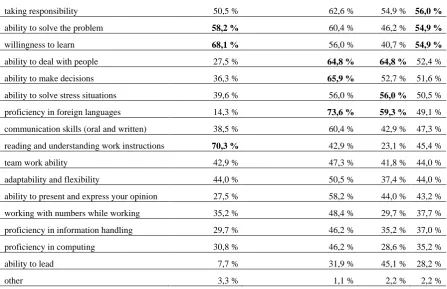
Key competences vocational school high school with graduation universities total
taking responsibility 50,5 % 62,6 % 54,9 % 56,0 %
ability to solve the problem 58,2 % 60,4 % 46,2 % 54,9 %
willingness to learn 68,1 % 56,0 % 40,7 % 54,9 %
ability to deal with people 27,5 % 64,8 % 64,8 % 52,4 %
ability to make decisions 36,3 % 65,9 % 52,7 % 51,6 %
ability to solve stress situations 39,6 % 56,0 % 56,0 % 50,5 %
proficiency in foreign languages 14,3 % 73,6 % 59,3 % 49,1 %
communication skills (oral and written) 38,5 % 60,4 % 42,9 % 47,3 %
reading and understanding work instructions 70,3 % 42,9 % 23,1 % 45,4 %
team work ability 42,9 % 47,3 % 41,8 % 44,0 %
adaptability and flexibility 44,0 % 50,5 % 37,4 % 44,0 %
ability to present and express your opinion 27,5 % 58,2 % 44,0 % 43,2 %
working with numbers while working 35,2 % 48,4 % 29,7 % 37,7 %
proficiency in information handling 29,7 % 46,2 % 35,2 % 37,0 %
proficiency in computing 30,8 % 46,2 % 28,6 % 35,2 %
ability to lead 7,7 % 31,9 % 45,1 % 28,2 %
other 3,3 % 1,1 % 2,2 % 2,2 %
Table 2. Key competencies that schools should focus more on (in % of responses, 2012) Source: NÚV, 2017, p. 31
Engineering companies recommend that, when educating at vocational schools, more focus should be put on developing the ability to read and understand work instructions, learning willingness, and problem-solving skills. At high schools with graduation there is a need to focus more attention on developing proficiency in foreign languages, making decisions and art of dealing with people. Employers also recommend focusing on developing responsibilities, communication skills and problem solving skills.
In the case of university students, the need for greater development of the ability to deal with people, proficiency in foreign languages and the ability to deal with stressful situations is at the forefront.
4.2 Accordance of acquired education and employment
Page 102
Students with apprenticeship certificate (without age differentiation) in 2013 reached relatively high values of full agreement (46 %), for graduates aged 20 – 24 it is almost 49 %. On the other hand, there is a high proportion of those who work in gross disagreement with their acquired education (37 %, 34% for graduates).
Students with apprenticeship certificates from the group of study fields Engineering and Engineering Production have a high degree of full agreement (57 %), 20 – 24 years graduates even 64 % (most of the monitored groups of education). Only 16 % of engineering graduates with apprenticeships show a gross discrepancy between their education and employment. The relatively good employment opportunities of graduates of engineering disciplines in the labor market are also indicated by their long-term lower unemployment rate.
Almost 56 % of graduates (with no age differentiation) work fully or partially with their education (47 % of graduates aged 20 - 24). Similarly, among the economically active population with a school-leaving examination 31 % of those who are involved into the category of gross disagreement, the proportion of graduates aged 20 – 24 working wholly outside their field is even 41 %.
5. DISCUSSION
Engineering is a traditional branch of Czech industry. Often this sector is mentioned in the context of the shortage of available skilled workers in the labor market. This would mean for graduates of engineering disciplines that they will have a good working perspective after school. The available data and information rather confirm these statements.
The number of engineering graduates at secondary schools has been slowly decreasing for a long time. However, this is not due to the loss of interest in engineering courses by pupils, but rather to demographic developments, where the overall number of pupils is decreasing. For the last 10 years, the share of machine engineering graduates has been around 9 -10 %, which means that every tenth graduate of a secondary school (without a follow-up course) has an engineering focus (NÚV, 2017).
Most of the employers in the mechanical engineering industry do not oppose graduates admission, sometimes they even prefer them (about 16 % of employers), because they are not influenced with bad work habits, are willing to learn, can work better with computers and have knowledge of new technologies. On the other hand, however, employers mention that it is not possible for some positions to accept a graduate without previous experience, that graduates have unrealistic ideas about wage levels, job placement or working hours and lack work experiences.
Employers in the mechanical engineering sector tend to prefer professional skills to graduates, while in the case of professional orientation they prefer slightly more focused professional skills. Among the key competencies of graduates, employers respond that the most important required abilities of graduates are to understand work instructions, the willingness to learn, responsibility, problem-solving, flexibility, and teamwork.
In 2016, the largest proportion of pupils in the group of subjects Engineering and Engineering Production was accepted for study with apprenticeship certificate (58 %), another 26 % for GCSE (the General Certificate of Secondary Education - category M) and 17 % for GCSE with vocational training (category L/0).
Page 103 6. CONCLUSIONS
The level of education, skills, abilities and skills of workers is a huge asset for employers. Human resources are rightly seen as one of the cornerstones of business success. This makes education an important requirement for competitiveness, not only at company level, but also at the level of the national economy.
The level of education is one of the conditions for exploiting the potential of human society. It is necessary for economic growth and for improving employment opportunities.
Like most European markets, the Czech labor market is facing the consequences of globalization and an aging population. We note large disparities in the employment of people between different regions and at the same time low labor mobility. We still have a large number of low-skilled workers and high unemployment among the various population groups (referred to as risk groups). Compared to other countries, technological readiness is lower and our businesses are perceived as less innovative and insufficiently sophisticated.
Thanks to the implementation the project ‘Education in engineering branches and its optimization for the needs of the labor market’, relevant data will be obtained. That will enable the design of innovations of the content and methods of technical and vocational education with emphasis on the labor market needs in the field of engineering.
ACKNOWLEDGMENTS
The contribution was made with the support of the project TJ02000083 ‘Education in engineering branches and its optimization for the needs of the labor market’ (funded by Technology Agency of Czech Republic (TAČR)) and project ‘Promoting community practice as a tool for developing key competencies’ (Operational Program Research, Development and Education; Registration number: CZ.02.3.68 / 0.0 / 0.0 / 16_011 / 0000660).
REFERENCES
1. Dostál, J 2016, ‘Technology education at a crossroads – history, present and perspectives’, Journal of Technology and Information Education, vol. 8, no. 2, pp. 5 – 24.
2. NÚV 2017, Absolventi středních škol a trh práce, vieved 10 June 2019, <http://www.nuv.cz/uploads/Publikace/23_Strojirenstvi_2017_fin_pro_www.pdf>.