https://doi.org/10.5194/tc-12-2229-2018
© Author(s) 2018. This work is distributed under the Creative Commons Attribution 4.0 License.
A Bayesian hierarchical model for glacial dynamics based
on the shallow ice approximation and its evaluation
using analytical solutions
Giri Gopalan1, Birgir Hrafnkelsson1, Guðfinna Aðalgeirsdóttir2, Alexander H. Jarosch2, and Finnur Pálsson2 1Faculty of Physical Sciences, School of Engineering and Natural Sciences, University of Iceland, Reykjavik, Iceland 2Institute of Earth Sciences, University of Iceland, Reykjavik, Iceland
Correspondence:Giri Gopalan ([email protected]) Received: 8 December 2017 – Discussion started: 15 March 2018
Revised: 20 June 2018 – Accepted: 23 June 2018 – Published: 11 July 2018
Abstract. Bayesian hierarchical modeling can assist the study of glacial dynamics and ice flow properties. This ap-proach will allow glaciologists to make fully probabilistic predictions for the thickness of a glacier at unobserved spa-tiotemporal coordinates, and it will also allow for the deriva-tion of posterior probability distribuderiva-tions for key physical pa-rameters such as ice viscosity and basal sliding. The goal of this paper is to develop a proof of concept for a Bayesian hierarchical model constructed, which uses exact analytical solutions for the shallow ice approximation (SIA) introduced by Bueler et al. (2005). A suite of test simulations utilizing these exact solutions suggests that this approach is able to ad-equately model numerical errors and produce useful physical parameter posterior distributions and predictions. A byprod-uct of the development of the Bayesian hierarchical model is the derivation of a novel finite difference method for solv-ing the SIA partial differential equation (PDE). An additional novelty of this work is the correction of numerical errors in-duced through a numerical solution using a statistical model. This error-correcting process models numerical errors that accumulate forward in time and spatial variation of numeri-cal errors between the dome, interior, and margin of a glacier.
1 Introduction
The shallow ice approximation (SIA) is a nonlinear par-tial differenpar-tial equation (PDE) that describes ice flow when glacier thickness is relatively small compared to the horizon-tal dimensions. Derived from the principle of mass
conser-vation, the SIA PDE depends on two key physical parame-ters: ice viscosity and basal sliding (sometimes described as basal friction or drag). The primary objective of this paper is to develop a Bayesian hierarchical model (BHM) for glacier flow utilizing the framework espoused by Wikle (2016) and Cressie and Wikle (2015), which allows one to (1) infer ice viscosity and basal sliding parameters and (2) make probabilistic predictions for glacial thickness at unobserved spatiotemporal coordinates. This BHM relies upon a finite difference scheme for solving the SIA that is inspired by the Lax–Wendroff method (Hudson, 1998). To validate this BHM, we utilize exact analytical solutions from Bueler et al. (2005). Hence, in addition to the development of a BHM for shallow glaciers, this paper serves as a case study for the strategy of using exact analytical solutions to validate or tune BHMs governed by physical dynamics. Moreover, the BHM developed can be applied to the general “physical– statistical” problem (Berliner, 2003). This BHM is verified and diagnosed through a combination of assessments of pos-terior probability intervals, checks of predictive accuracy for glacial thickness prediction, and a comparison between ob-served and expected errors due to the numerical solution of the SIA.
distri-2230 G. Gopalan et al.: A Bayesian hierarchical model for glacial dynamics
θ
S
Y
Parameters Latent (unobserved)
scientific quantities Observed data
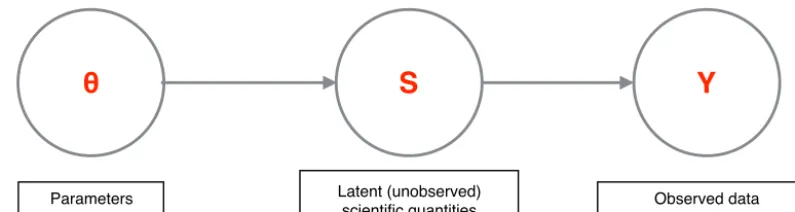
Figure 1.Schematic of a simple Bayesian hierarchical model; here,θ represents physical parameters,Srepresents unobserved scientific
quantities of interest, andYrepresents the observed data.
butions to model parameters thought to be fixed quantities (i.e., scientific constants); this assumption allows one to use rules of conditional probability (i.e., Bayes’ theorem) to de-rive probability distributions for scientific quantities of inter-est, such as physical constants or predictions of future quan-tities of a system being studied. Typically, the major assump-tions required as input to the analysis are prior distribuassump-tions for parameters as well as a probabilistic model for the data. The output is a probability distribution for parameters or pre-dictions conditional on data that have been collected or ob-served; canonically, this is referred to as the posterior distri-bution.
A BHM is a Bayesian model in which the probabilistic model for data is specified in a hierarchy. Working with such a hierarchy has a number of advantages – it is usually easier to conceptualize the probabilistic model for the data, and it is also easier to model various parts of a system of interest mod-ularly instead of all at once. Such an approach is conducive to the construction of a probabilistic model that tightly cor-responds to a scientific system of interest, which is naturally thought of in separate components or modules. In a BHM, the rules of conditional probability can be used to specify the relevant distributions. For example, let us consider a mock system that has parameter vector θ, an intermediate unob-served vectorS, and observationsY.θmight be statistical or physical parameters, S could be a quantity of scientific in-terest, andY could be noisy observations ofS. A schematic for such a model is given in Fig. 1, and the joint probability distribution is
p(Y,S,θ)=p(θ)p(S|θ)p(Y|S,θ). (1) The distributionp(θ)represents prior beliefs about parame-ters before data are collected, whilep(S|θ)represents prior knowledge or assumptions for how S is generated given parameters. For instance, this prior knowledge could en-tail clustering or some dependence between the elements of S. The process that models Y conditional onSandθ is p(Y|S,θ). The posterior distribution of scientific quantities of interest,p(θ,S|Y), is proportional top(Y,S,θ)by Bayes’ theorem. Estimates and assessments of uncertainty of
scien-tific parameters and quantities can be extracted from the pos-terior distribution.
1.2 An overview of physical–statistical modeling with BHMs
The case for applying Bayesian hierarchical modeling and methodology in geophysics is strongly made by Berliner (2003), which he describes as “physical–statistical model-ing”. Particularly, employing the Bayesian hierarchical ap-proach has the primary advantage of incorporating all rel-evant sources of uncertainty and randomness into one co-herent probabilistic framework. The sources typically mod-eled together are (1) measurement errors in the data collec-tion process; (2) lack of full knowledge of the precise func-tional form of the underlying physical equations describing the physical phenomenon being modeled, or else simplifi-cation of the physical system description; (3) numerical er-rors induced while approximating the solution to a system of PDEs; and (4) lack of precise knowledge of fundamen-tal parameters (constants) in the underlying PDEs describing said phenomenon. In the Bayesian hierarchical framework (Berliner, 1996; Wikle, 2016; Cressie and Wikle, 2015) each of these sources of uncertainty is modeled by conditioning on the appropriate quantities, and inference is performed by sampling from or approximating the posterior distribution (the distribution of the unknown quantities of interest con-ditional on the observed data).
quan-Physical parameters
initial conditions + boundary conditions
Numerical PDE solver
Error correcting statistical model
Observations
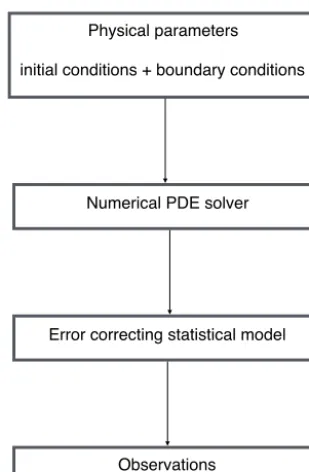
Figure 2.Schematic of a prototypical physical–statistical Bayesian
hierarchical model. At the top layer, physical parameters, initial conditions, and boundary conditions are fed into a numerical solver, and the output of this is corrected with an error-correcting process; finally, the actual observations are dependent on the actual physical process values.
tities, which is proportional to the posterior distribution by the definition of conditional probability. While a traditional analysis may handle each of these disparate sources of un-certainty in an ad hoc and disjointed fashion, the Bayesian hierarchical approach leverages probability measures to co-hesively model major sources of uncertainty and undertake inference in a principled manner. Figure 2 diagrams what a prototypical physical–statistical Bayesian hierarchical model might look like.
While the BHM approach to physical–statistical problems offers many advantages, it is not an infallible approach. In particular, while constructing a BHM may be straightfor-ward, actually fitting a BHM to data can be computation-ally difficult. In the analysis that follows, there are only one to two physical parameters and the likelihood func-tion is tractable, so posterior computafunc-tion is not difficult. In more complex scenarios with many physical parameters (e.g., a basal sliding field with a parameter for each grid point), it becomes more difficult to compute the posterior or draw samples from it. There are now many new tools, how-ever, for Bayesian inference of complicated and high dimen-sional posterior distributions, such as Stan (Stan Develop-ment Team, 2018) and INLA (Rue et al., 2017). Another po-tential difficulty in using BHMs for physical–statistical prob-lems is that solving for a set of dynamical equations with
a numerical method can be computationally onerous, gen-erally speaking; while this is not a detriment in the work that follows, this can be a problem for posterior computation. One way to circumvent this issue is to emulate a numerical solver, using techniques as in Hooten et al. (2011). Another methodology that can be used to efficiently solve PDEs using Bayesian numerical analysis comes from Owhadi and Scovel (2017). Finally, Calderhead et al. (2008) suggest methodol-ogy to avoid explicitly solving ordinary differential equations by using Gaussian processes.
To put the contributions of this work into context, we briefly review glaciology papers that have employed Bayesian modeling. In Berliner et al. (2008), a Bayesian hi-erarchical approach is used to model ice streams in one spa-tial dimension, and an error-correcting process is utilized to account for a simplification in the physical model. A com-bination of Markov chain Monte Carlo and empirical Bayes methodology is used to fit the model, and basal shear stress and resistive stresses are included. Furthermore, wavelets are used for dimensionality reduction purposes in order to make the computations more feasible. In Pralong and Gudmunds-son (2011), a Bayesian model is constructed for an ice stream where the likelihood and prior are Gaussian. The observed data are surface topography, horizontal and vertical surface velocities, and the latent system state is basal topography and slipperiness. The goal is to infer the system state given the observed data, and ultimately a maximum a posteriori point estimate is used for inference in conjunction with an iterative method for posterior maximization. Physics is incorporated by solving for the steady state solution with a finite element method (FEM) solver, given the system state. In Brinkerhoff et al. (2016) a flowline model of the SIA is considered with vertically integrated velocities. Gaussian process priors are used for all unknowns, and the Metropolis–Hastings algo-rithm is used to fit the model. The approach yields convinc-ing results in simulations and a real data set. In Isaac et al. (2015), numerical methods are presented for solving a non-linear Stokes equation boundary value problem for an ice sheet in Antarctica. The method ultimately uses a low rank approximation to a covariance matrix for the posterior distri-bution of a basal parameter field. Finally, and perhaps most directly related to this research, in Minchew et al. (2015) in-terferometric synthetic aperture radar (InSAR) is used to de-termine velocity fields at Langjökull and Hofsjökull in early June 2012. The velocity directions match the surface gradi-ent, but magnitudes do not appear to coincide with the theo-retical predictions of other authors (likely due to the inappro-priate modeling of basal sliding).
errors for an arbitrary scenario, where a numerical solver for a different set of dynamical equations is used. In the SIA context, we can rely on prior studies of Bueler et al. (2005) to tell us something about how the numerical errors will look in the SIA case – i.e., spatial variation in the scale of nu-merical errors between the dome, interior, and margin. This error pattern will not hold in general for other geometries and systems, and so different prior studies must be utilized or, if these do not exist, the hierarchical model must be extended to include a more general model for the error-correcting pro-cess (e.g., a spatially varying field for the log of the scale of numerical errors with a Gaussian process prior).
The main differentiating contribution of this paper is to utilize the exact analytical solutions from Bueler et al. (2005) to evaluate the BHM employed. An additional novelty is the derivation and utilization of a novel finite difference method for solving the SIA PDE that operates in two spatial dimen-sions; consequently, the Bayesian model employed also op-erates in two spatial dimensions, in addition to time. Finally, we explicitly model the errors due to a numerical solver with a spatiotemporal statistical process, which accounts for dif-ferent scales of spatial variability within the dome, within the interior, and within the margin of the glacier, as well as accumulation of numerical errors forward in time.
2 Description of models 2.1 Shallow ice approximation
The physics of glaciers is an extensive topic; hence, only the portions which are most relevant to this paper are described. The reader is pointed to the comprehensive works by Cuf-fey and Paterson (2010) and van der Veen (2017) for further reading on the subject. PDEs for glaciers are derived from the following considerations. First, glaciers are modeled as very slowly moving and viscous fluids. By applying the principle of mass conservation, the net ice flux moving in or out of an infinitesimal column of the glacier located at some spatial coordinate, plus the net mass change due to precipitation or melting, yields the change in the height of the column over an infinitesimal time interval. Such a heuristic argument pro-vides a PDE in two dimensions for a glacier, with averaged velocities in two spatial dimensions. The PDE relates the time derivative of the thickness of the glacier to the flux and net mass change (i.e., mass balance). The main assumptions are that ice is isotropic and homogeneous and also that longi-tudinal and transverse stress terms can be ignored, which is reasonable when the overall thickness of the glacier is small in comparison to its width. Under these assumptions, the ve-locity of the ice is made up of two additive components. The first component of the velocity is based upon deformation due to gravity, which acts in the direction of steepest descent of the surface and is a function of the ice viscosity param-eter. The second component of velocity also acts along the
gradient of the glacier surface and is a function of the basal sliding parameter field. The formulations stem from Glen’s flow law (Glen, 1955, 1958) and Weertman’s sliding relation (Weertman, 1964).
Written in terms of glacial thickness,H (x, y, t ), the SIA PDE is
Ht = −[uH]x−[vH]y+ ˙b
−[uH]x= −−C0γ (−ρgH[H+R]x) H + 2B
n+2(ρgα)
n−1Hn+1(−ρgH[H+R] x)
x −[vH]y= −−
C0γ −ρgH[H+R]y
H
+ 2B n+2(ρgα)
n−1Hn+1 −ρgH[H+R] y y α= q
[H+R]2x+[H+R]2y.
HereH (x, y, t )is the thickness of the glacier at spatial co-ordinate(x, y) and timet,u is the average velocity in the x direction, andvis the average velocity in they direction. This model is vertically integrated, and hence only two spa-tial dimensions are modeled.R(x, y, t )is the bedrock eleva-tion, which is assumed to be constant in time and thus can be written asR(x, y);b(x, y, t )˙ is the mass balance field,B andC0γ are physical parameters governing the viscosity and basal sliding;ρgoverns the mass density of the ice; and fi-nallynis Glen’s flow law constant, typically set to 3. Initial conditions (i.e.,H (x, y,0)) are assumed to be given, and the boundary conditionH≥0 is assumed, just as in Table 2 of Bueler et al. (2005). Additional derivations and details on the SIA are covered in a variety of sources, including Fowler and Larson (1978), Hutter (1982), Hutter (1983), and Flow-ers et al. (2005).
It is important to make explicit that there are some limi-tations of this PDE. Besides ignoring longitudinal and trans-verse stress terms, the PDE does not model subglacial hy-drology, tunneling systems, jökulhlaups, or surges, the dy-namics of which are believed to contribute to dydy-namics of glaciers as a whole. Nonetheless, one hopes these equations may serve as a first approximation for shallow glacier dy-namics. In addition to dynamics, another important physical consideration of glaciers is the relationship between temper-ature and viscosity, which follows an Arrhenius relationship (Cuffey and Paterson, 2010). However, in the context of Ice-landic glaciers like Langjökull, this is not consequential since they are temperate (i.e., their temperature is at melting point). 2.2 Bayesian hierarchical model
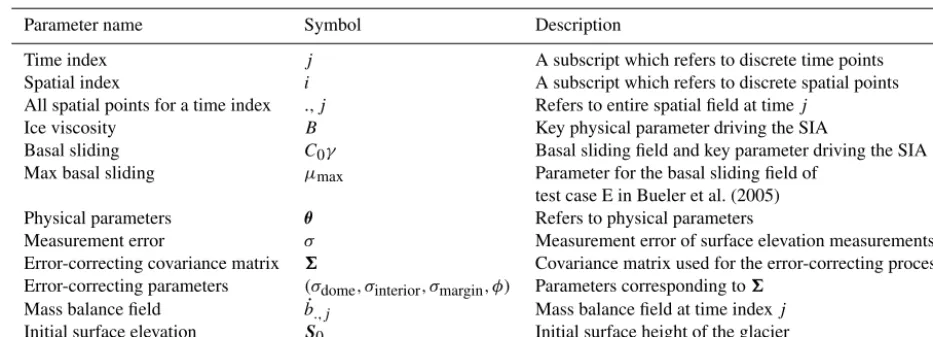
Table 1.A summary of main parameters and notation utilized.
Parameter name Symbol Description
Time index j A subscript which refers to discrete time points
Spatial index i A subscript which refers to discrete spatial points
All spatial points for a time index ., j Refers to entire spatial field at timej
Ice viscosity B Key physical parameter driving the SIA
Basal sliding C0γ Basal sliding field and key parameter driving the SIA
Max basal sliding µmax Parameter for the basal sliding field of
test case E in Bueler et al. (2005)
Physical parameters θ Refers to physical parameters
Measurement error σ Measurement error of surface elevation measurements
Error-correcting covariance matrix 6 Covariance matrix used for the error-correcting process Error-correcting parameters (σdome, σinterior, σmargin, φ) Parameters corresponding to6
Mass balance field b˙.,j Mass balance field at time indexj
Initial surface elevation S0 Initial surface height of the glacier
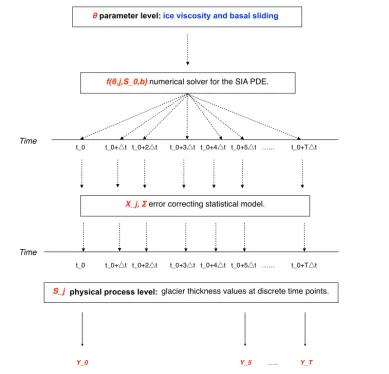
a schematic illustrating the BHM in Fig. 3. We use indexito refer to spatial coordinates (for this model space is assumed to be discretized into squares) and indexjto refer to time co-ordinates. Furthermore, the notationS.,jrefers to the surface elevation at all spatial coordinates for a particular time index j. Keeping in line with the Bayesian hierarchical modeling framework from Wikle (2016) and Cressie and Wikle (2015), we delineate the models used for the data level, process level, and parameter level. The primary inferential goals are to in-fer physical process parameters (i.e., ice viscosity and basal sliding) and to predict the height of the glacier at various time points and spatial locations besides those that have been observed (aligned to a grid for which we have bedrock and initial surface height conditions). Within the Bayesian frame-work, all inferential goals may be achieved by determining the posterior distribution of these quantities (i.e., their prob-ability distributions conditioned on observed data).
At the data level, the observed height for each grid point is modeled with a normal distribution (denoted with the no-tationN (µ,τ2), whereµis the mean andτ2is the variance), where the mean is the physical process value, and the vari-ance is assumed to be known. In particular it is assumed that
Yij ∼N (Sij, σ2), whereYij is the observed surface eleva-tion of the glacier at locaeleva-tion iand time indexj,Sij is the latent (i.e., unobserved) surface elevation at location i and time indexj (equivalent to sum of the glacier thickness and bedrock level), and σ2 is the variance of the measurement errors for the surface height observations, a fixed and known quantity. The number of observed spatial indices is assumed to be much smaller than the number of total spatial indices modeled at the latent level.
At the process level, S.,j=f (S0, B,b, C˙ 0γ , j )+Xj, wheref is a numerical solution to the SIA at time indexj, andXjis an error-correcting process at time indexj. A finite difference version of the SIA PDE is described in full detail in Appendix A. In principle, however, the functionf may be derived from other numerical solvers. Additionally, it should
be made clear thatf is the output of a numerical solver for the underlying dynamics. Also,S0 denotes the glacier sur-face elevation values at the initial time point, which are as-sumed to be known; e.g., with high precision light detection and ranging (lidar) initial conditions provided by the Institute of Earth Sciences at the University of Iceland (IES-UI).b˙.,j is the mass balance field for time indexjat all the grid points, which is assumed to be fixed and known for the purpose of this analysis.Bis the ice viscosity parameter andC0γ is the basal sliding field, which itself is parameterized withµmaxas in Eq. (16) of Bueler et al. (2005) and, furthermore, is static in time. For compact notation,θis used to refer toBin test cases B–D and(B, µmax)jointly in test case E.
Since we believe numerical errors will accumulate over time (Bueler et al., 2005), we define the error-correcting process as follows: Xj+1=Xj+j+1, where j+1 is MVN(0,6). (MVN stands for multivariate normal, and the first argument is the mean and the second is the covariance.)
6 is block diagonal, with three blocks for indices corre-sponding to the margin, interior, and dome of the glacier (the margin is defined as the last grid squares before the glacier drops to 0 thickness, and the dome is the origin grid square), respectively. Each block is defined from a square-exponential kernel with the same length scale, denoted byφ, but distinct marginal variances,σinterior2 , σmargin2 , andσdome2 . The motivation for using different marginal variance param-eters is to account for the widely different errors exhibited at the dome, interior, and margin, as is demonstrated by Bueler et al. (2005) and Jarosch et al. (2013). This error-correcting process leads to a tractable likelihood function, as is shown in Appendix B.
θ parameter level: ice viscosity and basal sliding.
f(θ,j,S_0,b) numerical solver for the SIA PDE.
t_0 t_0+ t t_0+2 t t_0+3 t t_0+4 t t_0+5 t …… t_0+T t
t_0 t_0+ t t_0+2 t t_0+3 t t_0+4 t t_0+5 t …… t_0+T t X_j, Σerror correcting statistical model.
Time
Time
S_j physical process level: glacier thickness values at discrete time points.
Y_0 Y_5 ….. Y_T
Y, σdata level: glacier thickness at regularly spaced time intervals and sparsely sampled and fixed spatial locations.
Figure 3.Schematic of the physical–statistical BHM that has been constructed based on the SIA PDE. The main parameters and variables
for each module of the physical–statistical model are highlighted in red. The main levels of a physical–statistical model shown in Fig. 2 are displayed here, along with the parameters and variables describing each level.
for ice viscosity and Pa−1m s−1for basal sliding.) The prior supports forBandµmaxprovide plausible values for temper-ate ice caps.
It is prudent to discuss the motivations and justifications of the various modeling choices employed in the model pre-viously delineated. The data level is assumed to have inde-pendent normal errors with fixed variance; this is justified because of the uniformity of the measuring technology used from site to site (e.g., digital GPS) and symmetry of errors. In contrast, the precise functional form of the data level is cho-sen somewhat arbitrarily as a Gaussian, which affords one analytical convenience. Similarly, the error-correcting pro-cess at the propro-cess level uses a zero mean Gaussian propro-cess with a parameterized covariance kernel (e.g., square expo-nential), mostly as an analytically manageable way to in-duce spatial correlation in the error-correcting process.
Spa-tial correlation in numerical errors has been demonstrated, for example, in Bueler et al. (2005).
Gen-Figure 4.An illustration marking the 25 measurement sites on the glacier. This is a top level view of the glacier, where the blue points indicate the glacier, the red points indicate the measurement locations, and the black points indicate locations surrounding the glacier with no glacial thickness.
erally, this model can be adapted to any science or engineer-ing system that is driven by physically meanengineer-ingful parame-ters, whose dynamics are solved by noisy numerical meth-ods, and for which noisy and continuous data are collected with well-probed errors.
The mathematical details for how to do posterior compu-tation within this model are given in Appendix B, which in-cludes a derivation of an approximation to the log-likelihood that allows for computational efficiency. In summary, we compute the posterior of physical parameters directly on a grid since there are at most two physical parameters, and we use samples from the posterior distribution of physical pa-rameters to generate predictions for glacier thickness in the future.
3 Experiments to assess the Bayesian hierarchical model
3.1 Analytical solutions
Table 2.Ice viscosity posterior intervals.
Test case Actual viscosity 3 SD credibility interval (10−25s−1Pa−3) (10−25s−1Pa−3)
Bueler B 32 [7,34]
Bueler C 32 [5,33]
Bueler D 32 [11,42]
Table 3.Results of prediction att0+100 years. RMSE stands for
root mean squared error. This is calculated by taking the average of the squared difference between the actual glacial thickness values and predicted glacial thickness values, and then taking the square root.
Test case Dome RMSE Interior RMSE Margin RMSE
(m) (m) (m)
Bueler B 66 20 75
Bueler C 76 22 82
Bueler D 1.4 17 49
Table 4. Error-correcting process hyperparameters; σdome2 is the
error-correcting process variance at the dome,σinterior2 is the error-correcting process variance at the interior, σmargin2 is the error-correcting process variance at the margin, andφis the length scale parameter.
Test case σdome2 σinterior2 σmargin2 φ
(m2) (m2) (m2) (km)
Bueler B 1 0.1 15 71
Bueler C 1 0.15 15 64
Bueler D 0.1 0.1 10 62
Bueler E 0.1 0.1 10 60
for simulating data sets to validate the Bayesian hierarchi-cal approaches developed in this paper. In other words, the exact analytical solutions provide the latent process in the BHM, conditioning on given initial conditions and mass bal-ance functions. Hence to simulate data from the BHM, one can bypass the need to numerically solve the PDE and intro-duce errors.
We make use of four analytical solutions from Bueler et al. (2005) that are summarized here, but the reader is referred to the original paper for the exact mathematical formulation and derivation of these analytical solutions. All of the ana-lytical solutions assume a flat bedrock. Test case B includes no mass balance or basal sliding, and, consequently, the mo-tion of the glacier is only attributable to deformamo-tion due to gravity. Test case C makes use of a mass balance field that is inversely proportional to time and directly proportional to thickness, but there is no basal sliding field modeled. Simi-larly, test case D utilizes a mass balance field with no basal sliding field modeled. In distinction from test case C,
how-Figure 5.Grid map used to interpret the following box plots in
Fig. 6. Eight randomly chosen grid points are selected for testing predictions; these are not the same as the measurement locations. Only one quadrant of the glacier is shown due to symmetry, as is done in Figs. 9, 10, and 12 of Bueler et al. (2005), and the width of each cell is 105m. Additionally, the red squares indicate locations at or close to the margin, the blue squares indicate locations that are between the dome and margin of the glacier, and the black squares indicate locations at or close to the dome of the glacier. Moreover, glacier grid squares with non-zero thickness are shaded in grey to indicate the glacier location.
ever, the mass balance field of test case D is such that the overall solution for glacial thickness is periodic in time. Fi-nally, in contrast to the other tests, test case E has a spatially varying basal sliding field, yet the overall solution is static in time. Note that test A was not utilized in this study because it is a steady state solution without a varying mass balance or basal sliding field.
3.2 Simulation study test details
Figure 6.Thickness prediction samples 100 years fromt0for test case B (i.e., no mass balance field or basal sliding). Triangles indicate the
actual thickness values from the analytical solution. Panel(a)shows predictions that are close to the margin (red squares of Fig. 5), panel (b)shows predictions that are between the dome and margin of the glacier (blue squares of Fig. 5), and panel(c)shows predictions that are towards the dome of the glacier (black squares of Fig. 5). Refer to Fig. 5 for a grid map to spatially reference each of the box plots. As can be expected according to Bueler et al. (2005), the largest errors occur at the dome and the margin. Note on interpretation: the middle of each box is the median, the interquartile range is denoted by the box, and 1.5 of the interquartile range beyond the first and third quartile is illustrated with the whiskers. Those points that are more than 1.5 of the interquartile range beyond the first and third quartiles are outliers, and they are denoted with circles.
choice of unit variance is larger than the errors produced by digital GPS measurements. Remaining physical parameters were chosen using the values from Table 2 in Bueler et al.
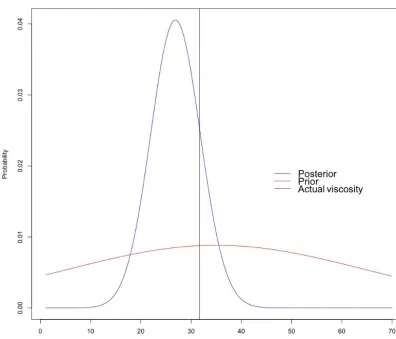
Figure 7.Comparison of posterior and prior distributions of ice viscosity for test case D (i.e., mass balance field producing a periodic SIA solution).
4 Results
Validation and diagnostics of the BHM were achieved through a combination of an assessment of posterior prob-ability intervals, a test of the predictive error of thickness values 100 years from the initial time point t0, and a com-parison between observed and expected values for numeri-cal errors based on the error-correcting process utilized. As is discussed in more detail below, these assessments suggest that the BHM is useful for inference of posterior probabil-ity distributions for physical parameters, prediction of fu-ture glacial thickness values on the order of 100 years, and the modeling of numerical errors at the margin, interior, and dome of the glacier.
Table 2 contains posterior credibility intervals for ice vis-cosity in test cases B–D. A 3 SD credibility interval was com-puted with mean±3 standard deviations of the posterior sam-ples. In all of these test cases, the 3 SD credibility interval covers the actual ice viscosity. Furthermore, as is apparent in Table 3, the predictive error, relative to thickness values on
the order of a kilometer, appears be small overall, particularly at the interior; predictive error is the root mean squared dif-ference between predictions and the exact analytical values for each of the test cases. Note that test E was not included with the predictive checks since it is static in time. Consistent with Bueler et al. (2005) and Jarosch et al. (2013), however, errors are greatest at the margin and dome of the glacier (evi-dent in Fig. 6). Nonetheless, the predictive distributions cover the actual thicknesses even at these extremes. This illustrates the utility of the BHM for accounting for errors induced by the numerical solution of the SIA. Additionally, an illustra-tion comparing the posterior and prior distribuillustra-tions for test case D is shown in Fig. 7.
in-Figure 8.A comparison of posteriors under strong and weak prior information for the error-correcting process in test case D (i.e., mass balance field producing a periodic SIA solution); prior information for the error-correcting process leads to a less biased posterior, though with slightly more posterior uncertainty.
terval is binary; either the actual parameter value is in the interval or it is not. For test case B, in 499 of 500 simulations the 3 SD credibility interval covered the actual value of ice viscosity. In test cases C and D, the 3 SD credibility interval covered the actual value of ice viscosity in all of the simula-tions. This suggests that the frequentist coverage probability of the credibility interval is at least 99 %.
For test case E, one assumes that the field is described by parameterized Eq. (16) of Bueler et al. (2005). That is, in polar coordinates with radiusrand angle2,
C0γ (r, 2)=
µmax4(r−r1)(r2−r)4(2−θ1)(θ2−2) (r2−r1)2(θ2−θ1)2
(2) for θ1< 2 <θ2 and r1< r < r2, andC0γ=0 otherwise. In addition to ice viscosity, the inferential object of inter-est is the scale parameter µmax. The 3 SD posterior
cred-ibility interval for B is [1,43] in units of 10−25s−1Pa−3, and forµmaxit is [1,50]in units of 10−12Pa−1ms−1. The actual values forB andµmax are 32×10−25s−1Pa−3 and 25×10−12s−1Pa−1ms−1, respectively. Hence, the credibil-ity intervals cover both parameters. A figure illustrating the posterior distribution ofµmaxis given in the Supplement.
Figure 9.A comparison of posteriors in test case D (i.e., mass balance field producing a periodic SIA solution) under different sampling periods: data sampled once every 10 years, every 5 years, once a year, and twice a year. The general trend is that the posterior tends to become less biased as the period of sampling decreases, although the posterior becomes more diffuse. The University of Iceland Institute of Earth Sciences Glaciology Team takes measurements twice a year for summer and winter mass balance measurements.
an error-correcting process). To demonstrate that this also holds in the BHM presented in this paper, we consider the following comparison. To assign prior information to the error-correcting process, we consider a discrete parameter set forσinterior2 , σmargin2 , andσdome2 : {0.1,1,10,100}in units of square meters, which corresponds to different orders of magnitude for variability. In one case, we ignore prior infor-mation from Bueler et al. (2005) and put equal probability mass on the parameter space for these parameters. In the sec-ond case, we encode more realistic prior information into the scales of errors at the three regions: equal mass on 10 and 100 at the margin, equal mass on 0.1 and 1 at the interior, and equal mass at 1 and 10 at the dome (all units are square meters). In both cases, the parameterφis fixed at 70 km to place emphasis on the scales of error. The results of inferring the posterior distribution for ice viscosity B are shown in Fig. 8. Consistent with Brynjarsdóttir and O’Hagan (2014), the posterior distribution of the physical parameterBis much
less biased when prior information is encoded into the error-correcting process.
To assess how the posterior distribution for ice viscosity evolves under different sampling plans of the data, we con-ducted a series of simulations in test case D under varying sampling periods. In particular, we considered data samples once every 10 years, once every 5 years, once a year, and twice a year; the resulting posteriors for ice viscosity are in Fig. 9. The general pattern is that the bias of the poste-rior distributions reduces as the period gets shorter, although the posterior becomes more diffuse. The result that some posterior uncertainty does not go away with more collected data is also consistent with the results in Brynjarsdóttir and O’Hagan (2014). The particular period we chose in this anal-ysis (data collected twice a year) was meant to model how the UI-IES Glaciology Team collects data, that is, twice a year due to summer and winter mass balance measurements.
error-Figure 10.An illustration comparing the expected variability of the error-correcting process (as per the Bayesian hierarchical model) to the observed variability of residuals at the interior, margin, and dome for test case B (i.e., no mass balance field or basal sliding). These residuals are the differences between the observed data and the numerical solution.
correcting process for each of the time points with observed data in test case B, by examining the residuals formed by the difference between the numerical solver and the ob-served data. According to the model, the standard deviation of these residuals at the interior of the glacier should grow as
q
σ2+t σ2
interior, wheret is the number of time steps (and likewise at the dome and margin). Figure 10 shows a match between observed and expected in this regard, and, in partic-ular, the 99 % confidence bands appear to cover the expected variability as time progresses. Also apparent from this figure is that, as time progresses, the errors at the margin, dome, and interior contribute more error than measurement error, which is on the order of 1 m. Moreover, this is also evident in Table 4, since after 200 time steps fromt0(i.e., 20 years), the marginal variances will be 200σinterior2 , 200σmargin2 , and 200σdome2 based on the accumulating errors model; all of these values exceed 1, the measurement variance.
5 Summary, discussion, and future work
The primary contribution of this work has been to construct a BHM for glacier flow based on the SIA that operates in two spatial dimensions and time, which successfully
at-tempt to utilize emulator inference (Hooten et al., 2011); this will be crucial to ensure that the methodology scales well computationally, since each posterior sample requires a for-ward PDE solve. Finally, and perhaps most importantly, fu-ture work will involve the application of the modeling and methodologies developed within this paper to real data col-lected by the IES-UI, which includes bedrock elevation and mass balance measurements.
Data availability. R scripts and R data files have been included in
Appendix A: Finite difference method for the shallow ice approximation
Here a finite difference scheme is derived for the SIA PDE. The overarching strategy in developing this finite discretiza-tion scheme is to take a second-order Taylor expansion for H (x, y, t )withx, yfixed, and then equate the resultant time derivatives,HtandHt t, to functions of spatial derivatives by using the original SIA PDE. That is, one starts with the ap-proximationH (x, y, t+1t )≈H (x, y, t )+Ht(x, y, t )1t+ Ht t(x, y, t )1t2/2 and uses the first equation of Sect. 2 to writeHt andHt t in terms of spatial derivatives. Finally, cen-tral differences in space are substituted for the spatial deriva-tives. This finite difference scheme is motivated by the Lax– Wendroff (Hudson, 1998) method, which is generally better than finite difference methods that use only a single-order Taylor expansion (indeed, in the advection–diffusion equa-tion such methods may be uncondiequa-tionally unstable).
In the following derivations, note that the subscripts mean “derivative with respect to” (e.g.,Ht means derivative ofH with respect tot):
Ht= −[uH]x− [vH]y+ ˙b Ht t = −[uH]xt− [vH]yt+ ¨b.
Now we solve for these derivatives in terms of spatial derivatives inH (x, y, t ), the glacier thickness, andR(x, y), the bedrock level. The derivation makes repeated use of the differentiation rule for products, the chain rule for differenti-ation, and equality of partial derivatives. (e.g.,Hxt=Ht x).
−[uH]x= −C0γρgT1+ 2B n+2(ρg)
nT 2
T1=
h
2H Hx(Hx+Rx)+H2(Hxx+Rxx) i
T2=
hh αn−1i
x h
Hn+2Hx+Hn+2Rx i
+αn−1 h
(n+2)Hn+1Hx2+(n+2)Hn+1HxRx +Hn+2Hxx+Hn+2Rxx
ii
By symmetry in x andy,−[vH]y can be analogously de-rived:
−[vH]y= −C0γρgT3+ 2B n+2(ρg)
nT 4
T3=
h
2H Hy(Hy+Ry)+H2(Hyy+Ryy)i
T4=
h αn−1i
y h
Hn+2Hy+Hn+2Ry i
+αn−1
h
(n+2)Hn+1Hy2+(n+2)Hn+1HyRy +Hn+2Hyy+Hn+2Ryy
ii .
Derivatives[αn−1]xand[αn−1]y:
[αn−1]x=n−1 2 (S
2 x+S2y)
n−3
2 (2SxSxx+2SySyx)
[αn−1]y=n−1 2 (S
2 x+S
2 y)
n−3
2 (2SySyy+2SxSxy). Now we derive−[uH]xt:
−[uH]xt= −C0γρgT1t+ 2B n+2(ρg)
nT 2t.
T1t =
h
2HtHx2+4H HxHxt+2H HxtRx+2H HxRxt +2HtHxRx+2H HtHxx+H2Hxxt+2H HtRxx +H2Rxxt
i
T2t =[T5+T6+T7+T8]
T5=
h αn−1
i
xtH n+2Hx
T6=
h αn−1i
xtH n+2R
x
T7=
h αn−1i
x h
(n+2) Hn+1HtHx+Hn+2Hxt +(n+2) Hn+1HtRx+Hn+2Rxt
T8=
h αn−1i
xtH n+2H
x+αnx−1(n+2) Hn +1H
tHx
+αxn−1Hn+2Hxt+ h
αn−1i xtH
n+2R x
+αxn−1(n+2) Hn+1HtRx+αxn−1H n+2R
xt
+hαn−1i t(n
+2) H(n+1)Hx2 +αn−1(n+2) (n+1) HnHtHx2 +αn−1(n+2) Hn+12HxHxt +hαn−1i
t(n
+2) Hn+1HxRx +αn−1(n+2) (n+1) HnHtHxRx +αn−1(n+2) Hn+1HxtRx +αn−1(n+2) Hn+1HxRxt +hαn−1i
tH n+2H
xx
+αn−1(n+2) Hn+1HtHxx +αn−1Hn+2Hxxt
+hαn−1i tH
n+2R xx
+αn−1(n+2) Hn+1HtRxx +αn−1Hn+2Rxxt
Note that terms with a time derivative of bedrock such asRxt can be set to 0 sinceRis assumed to be static in time. How-ever, we keep the time derivatives for Rin the above equa-tion for full generality in case a scenario is revisited where this does not hold. Next we derive
αn−1 t: h
αn−1i t
=n−1 2
S2x+S2y
n−3 2
2SxSxt+2SySyt.
Next we derive αn−1
t x: h
αn−1i t x
= n−1
2
n−3
2
S2x+S2y
n−5 2
2SxSxx+2SySyx
2SxSxt+2SySyt+
S2x+S2y
n−3 2
2SyxSyt+2SySyt x+2SxxSxt+2SxSxt x.
Next we deriveαn−1ty:
h αn−1i
ty =
n−1 2
n−3
2
S2x+S2y
n−5 2
2SxSxy+2SySyy
2SxSxt+2SySyt+
S2x+S2y
n−3 2
2SxySxt+2SxSxty+2SyySyt+2SySyty.
Note thatSt x=Rt x+Ht x=Ht xsinceRis assumed to be fixed as a function oft. Note that the same argument holds for other derivatives ofS with respect tot. Next we derive Ht x, Ht xx, Hty, andHtyy, Htyx:
Ht x= −[uH]xx−[vH]yx+ ˙bt x, Ht xx= −[uH]xxx−[vH]yxx+ ˙bt xx, Hty= −[uH]xy−[vH]yy+ ˙bty, Htyy= −[uH]xyy−[vH]yyy+ ˙btyy, Htyx= −[uH]xxy−[vH]yyx+ ˙btyx.
Hence, these partial derivatives allow us to substitute purely spatial derivatives into the forward in time approximation for H. Without loss of generality, we use a central difference ap-proximation for all spatial derivatives. Furthermore, we used 1t=0.1 years and1x=1y=105m for the analysis in this paper. In total, 441 grid squares were modeled (i.e., 21 by 21) with the dome grid square at the origin. While a coarse grid was chosen for computational convenience, it is expected that numerical errors will go to zero as the grid width goes to zero, as is demonstrated both by Bueler et al. (2005) and Jarosch et al. (2013).
Appendix B: Model fitting
In the following subsections, we go through the key details regarding Bayesian computation for the model used in this work. Assume n total grid points are modeled, of which mn are observed. Let Xj ∈Rn be the error-correcting process at timej,Sj∈Rnbe the latent glacier surface values at timej,f (θ, j )∈Rnbe shorthand for the output of the nu-merical solver at time pointj, andj be an independent and identically distributed (i.i.d) multivariate normal noise term at timejwith mean 0 and covariance matrix6. MVN stands for multivariate normal, and the first argument is the mean and the second is the covariance. Furthermore, assume that data are collected regularly at everykth time point, such that one observesYk,Y2k, . . .,YN k∈Rm, and the corresponding observation errorZk,Z2k, . . .ZN k is i.i.d MVN(0, σ2I ). For convenience, we denoteN kasT. Finally, letA∈Rm×n be a matrix which selects the grid squares of the latent process
B1 Calculating the likelihoodp(Yk, . . ., YT|θ )
In this subsection, we derive both the likelihood of the ob-served data: p(Yk, . . .,YT|θ)and an approximation to the likelihood.
Though Sect. 2.2 specifies the BHM in greater detail, the process and data levels of the BHM (i.e., conditioning onθ) are concisely written as follows.
Xj=Xj−1+j
Sj=f (θ, j )+Xj Yck=ASck+Zck
Assume j∈1,2, . . .T andc∈1,2, . . .N; hence there are N total spatial vectors observed with a period of lengthk. Furthermore,X1is marginally MVN(0,6). That is, the pro-cess level vectors,Sj, are modeled conditional on the param-eter level and the error-correcting process. The data level vec-tors,Yck, are generated conditional on the process levelSck. Throughout the following, we condition onθbeing fixed. B1.1 The exact likelihood
Conditional on θ, the distribution of(Yk, . . .,YT), viewed as one long random vector, is multivariate normal. Also, conditional on θ, the mean of (Yk, . . .,YT) is (Af (θ, k), . . .Af (θ, T )) because both (Xk, . . .,XT) and (Zk, . . .,ZT)have mean 0. It suffices to thus derive the co-variance matrix for(Yk, . . .,YT)conditional onθ. To do this, we note that Var(Yck)=Var(ASck+Zck)=Var(ASck)+ Var(Zck)= [A(ck6)A|] +σ2I. Additionally, fora < b: Cov(Ya,Yb)=Cov(ASa+Za,ASb+Zb)
=Cov(ASa,ASb)
=Cov(A[f (θ, a)+Xa],A[f (θ, b)+Xb]) =Cov(AXa,AXb)
=Var(AXa) = [A(a6)A|]
Therefore, the covariance matrix for the observed data can be written as M⊗(A6A|)+σ2I, where Mij=kmin(i, j ) and M∈RN×N. This is a useful matrix representation be-cause the inverse ofMis band-limited and sparse, for which there exist efficient computationally efficient linear algebraic routines (Rue, 2001).
B1.2 An approximation to the likelihood
The joint distribution p(Yk, . . .,YT|θ) can be written as p(Yk|θ)p(Y2k|Yk,θ). . .p(YT|Yk, . . .,Y(N−1)k,θ). Since we expect that the data level errors are quite small (on the order of 1 m) in comparison to the overall surface elevation measurements (on the order of 1 km), we can approximate p(S(c−1)k|Yk, . . .,Y(c−1)k,θ) with p(S(c−1)k|Y(c−1)k,θ). Consequently, p(Yck|Yk, . . .,Y(c−1)k,θ) will be close to
p(Yck|Y(c−1)k,θ). From the above recursive relationship, we can write
Yck=Y(c−1)k+Af (θ, ck)−f (θ, (c−1)k) +Zck−Z(c−1)k+
ck X
j=(c−1)k+1 Aj.
This expression motivates approximating p(Yck|Yk, . . .,Y(c−1)k,θ) as MVN distribution with meanY(c−1)k+A[f (θ, ck)−f (θ, (c−1)k)]and covariance matrix A(k6)A|+2σ2I. A similar expression shows that p(Yk) is multivariate normal with mean Af (θ, k) and covariance matrix A(k6)A|+σ2I. Nonetheless, we must be clear:p(Yck|Y(c−1)k,θ)does not exactly follow a MVN with mean Y(c−1)k+A[f (θ, ck)−f (θ, (c−1)k)] and covariance matrixA(k6)A|+2σ2I; this is becauseZ(c−1)k and Y(c−1)k are dependent. A simple example illustrating this approximation is presented in the Supplement.
B2 Posterior computation
Posterior inference is accomplished with grid sampling (Gel-man et al., 2013); this approach directly computes the poste-rior distribution,p(θ|Yk, . . .,YT)of the parameter, propor-tional top(Yk, . . .,YT|θ)p(θ), on a grid of plausible values. The likelihood is derived in the previous subsection. Parame-ters for the error-correcting process are selected using knowl-edge elicited from the studies of Bueler et al. (2005). To ver-ify the sensitivity of grid sampling to the grid width, three grid widths forB are considered: 0.25, 0.50, and 1, and the grid’s range is from [1,70] (all in units of 10−25s−1Pa−3). The summary statistics for generating 106posterior samples from more to less fine (0.25, 0.50, 1) are given below.
– The minimum is (5.25,5.00,6.00). – The first quartile is (23.8,23.5,24.0). – The median is (27.0,26.5, 27.0). – The mean is (27.1,26.7,27.1). – The third quartile is (30.5,30.0,30.0). – The max is (51.50,49.0,51.0).
The similarity of summary statistics across grid widths indi-cates that the posterior samples are not very sensitive to grid width; a grid width of 0.50 was used for the analyses within. Moreover, the posterior samples in this check were generated for test case D (i.e., mass balance field producing a periodic solution to the SIA).
B3 Making spatiotemporal predictions of glacial surface elevation
Rn for future glacier elevation values we want to make a prediction for at time point Tend. Our goal is to approxi-mate the posterior predictive distributionp(STend|Yk, . . .YT).
To make this computationally simple, our first assump-tion (as in the computaassump-tion of the likelihood) is to sug-gest thatp(ST|Yk, . . .YT,θ)is approximately equivalent to p(ST|YT,θ). This is because relative to the overall glacier surface elevation values (an average of about 2000 m), the measurement errors are small, on the order of 1 m. More-over, based on the model specified above, we know that
STend=XT+ PTend
j=T+1j+f (θ, Tend). This suggests the fol-lowing iterative procedure to generate a posterior sample for the prediction ofSTend: for each independent sampleθlfrom p(θ|Yk, . . .,YT), generate a sample from a multivariate nor-mal whose mean is 0 and covariance given by(Tend−T )6, add the sample to f (θl, Tend), and then add this sum to a sample fromp(XT|θ=θl,YT).
We must then determine how to sample from the distribution of p(XT|θ=θl,YT). Let XTobs∈Rm be a subvector of XT corresponding to the indices that are observed at the data level, and XTpred∈R
n−m be a subvector of XT corresponding to unobserved in-dices. The distribution for p(XTobs|θ,YT) is
multivari-ate normal due to conjugacy. The precision, denoted by Qobs, is σ−2I+ [A(T6)A|]−1. The mean, denoted by µobs, is Q−obs1(σ
−2IY
Supplement. The supplement related to this article is available online at: https://doi.org/10.5194/tc-12-2229-2018-supplement.
Author contributions. All of the glaciologists contributed equally
to this work.
Competing interests. The authors declare that they have no conflict
of interest.
Acknowledgements. The Icelandic Research Fund (RANNIS) is
thanked for funding this research.
Edited by: Eric Larour
Reviewed by: Lambert Caron and one anonymous referee
References
Berliner, L. M.: Hierarchical Bayesian Time Series Models, in: Maximum Entropy and Bayesian Methods, edited by: Hanson, K. M. and Silver, R. N., Springer Netherlands, Dordrecht, 15– 22, 1996.
Berliner, L. M.: Physical-statistical modeling in
geo-physics, J. Geophys. Res.-Atmos., 108, 8776,
https://doi.org/10.1029/2002JD002865, 2003.
Berliner, L. M., Jezek, K., Cressie, N., Kim, Y., Lam, C. Q., and van der Veen, C. J.: Modeling dynamic controls on ice streams: a Bayesian statistical approach, J. Glaciol., 54, 705–714, https://doi.org/10.3189/002214308786570917, 2008.
Brinkerhoff, D. J., Aschwanden, A., and Truffer, M.: Bayesian Inference of Subglacial Topography Using Mass Conservation, Front. Earth Sci., 4, 8, https://doi.org/10.3389/feart.2016.00008, 2016.
Brynjarsdóttir, J. and O’Hagan, A.: Learning about physical param-eters: the importance of model discrepancy, Inverse Probl., 30, 114007, https://doi.org/10.1088/0266-5611/30/11/114007, 2014. Bueler, E., Lingle, C. S., Kallen-Brown, J. A., Covey, D. N., and Bowman, L. N.: Exact solutions and verification of numeri-cal models for isothermal ice sheets, J. Glaciol., 51, 291–306, https://doi.org/10.3189/172756505781829449, 2005.
Calderhead, B., Girolami, M., and Lawrence, N. D.: Accelerat-ing Bayesian Inference over Nonlinear Differential Equations with Gaussian Processes, in: Proceedings of the 21st Interna-tional Conference on Neural Information Processing Systems, NIPS’08, Curran Associates Inc., 217–224, USA, ISBN: 978-1-6056-0-949-2 , 2008.
Cressie, N. and Wikle, C. K.: Statistics for spatio-temporal data, John Wiley & Sons, 2015.
Cuffey, K. M. and Paterson, W.: The Physics of Glaciers, 4 edn., Academic Press, 2010.
Flowers, G. E., Marshall, S. J., Björnsson, H., and Clarke, G. K.: Sensitivity of Vatnajökull ice cap hydrology and dynamics to cli-mate warming over the next 2 centuries, J. Geophys. Res.-Earth, 110, F02011, https://doi.org/10.1029/2004JF000200, 2005.
Fowler, A. C. and Larson, D. A.: On the Flow of Polythermal Glaciers. I. Model and Preliminary Analysis, Proc. R. Soc. Lon. Ser.-A, 363, 217–242, 1978.
Gelman, A., Carlin, J. B., Stern, H. S., Dunson, D. B., Vehtari, A., and Rubin, D. B.: Bayesian data analysis, 3rd edn., Chapman & Hall/CRC, 2013.
Glen, J.: The flow law of ice: A discussion of the assumptions made in glacier theory, their experimental foundations and con-sequences, IASH Publ., 47, 171–183, 1958.
Glen, J. W.: The Creep of Polycrystalline Ice, Proc. R. Soc. Lon. Ser.-A, 228, 519–538, 1955.
Hooten, M. B., Leeds, W. B., Fiechter, J., and Wikle, C. K.: As-sessing First-Order Emulator Inference for Physical Parameters in Nonlinear Mechanistic Models, J. Agr. Biol. Envir. St., 16, 475–494, https://doi.org/10.1007/s13253-011-0073-7, 2011. Hudson, J.: Numerical Techniques for Conservation Laws with
Source Terms, Tech. rep., Engineering and Physical Science Re-search Council, 1998.
Hutter, K.: A mathematical model of polythermal glaciers and ice sheets, Geophys. Astro. Fluid, 21, 201–224, https://doi.org/10.1080/03091928208209013, 1982.
Hutter, K.: Theoretical Glaciology: Material Science of Ice and the Mechanics of Glaciers and Ice Sheets, Mathematical Approaches to Geophysics, Springer, 548 pp., 1983.
Isaac, T., Petra, N., Stadler, G., and Ghattas, O.: Scalable and ef-ficient algorithms for the propagation of uncertainty from data through inference to prediction for large-scale problems, with ap-plication to flow of the Antarctic ice sheet, J. Comput. Phys., 296, 348–368, https://doi.org/10.1016/j.jcp.2015.04.047, 2015. Jarosch, A. H., Schoof, C. G., and Anslow, F. S.: Restoring mass
conservation to shallow ice flow models over complex terrain, The Cryosphere, 7, 229–240, https://doi.org/10.5194/tc-7-229-2013, 2013.
Minchew, B., Simons, M., Hensley, S., Björnsson, H., and Páls-son, F.: Early melt season velocity fields of Langjökull and Hof-sjökull, central Iceland, J. Glaciol., 61, 253–266, 2015.
Owhadi, H. and Scovel, C.: Universal Scalable Robust Solvers from Computational Information Games and fast eigenspace adapted Multiresolution Analysis, ArXiv e-prints, 142 pp., arXiv:1703.10761, 2017.
Payne, A. J., Huybrechts, P., Abe-Ouchi, A., Calov, R., Fastook, J. L., Greve, R., Marshall, S. J., Marsiat, I., Ritz, C., Tarasov, L., and Thomassen, M. P. A.: Results from the EISMINT model intercomparison: the effects of thermomechanical coupling, J. Glaciol., 46, 227–238, 2000.
Pralong, M. R. and Gudmundsson, G. H.: Bayesian esti-mation of basal conditions on Rutford Ice Stream, West Antarctica, from surface data, J. Glaciol., 57, 315–324, https://doi.org/10.3189/002214311796406004, 2011.
Rue, H.: Fast sampling of Gaussian Markov random fields, J. Roy. Stat. Soc. B Met., 63, 325–338, 2001.
van der Veen, C.: Fundamentals of Glaicer Dynamics, 2nd edn., CRC Press, 2017.
Wasserman, L.: All of statistics: a concise course in statistical infer-ence, Springer Science & Business Media, 2013.
Weertman, J.: The theory of glacier sliding, J. Glaciol., 5, 287–303, https://doi.org/10.1017/S0022143000029038, 1964.