www.clim-past.net/8/79/2012/ doi:10.5194/cp-8-79-2012
© Author(s) 2012. CC Attribution 3.0 License.
Climate
of the Past
Technical note: Late Pliocene age control and composite depths at
ODP Site 982, revisited
N. Kh´elifi1,*, M. Sarnthein1, and B. D. A. Naafs2,3
1Institute of Geosciences, University of Kiel, 24118 Kiel, Germany
2Alfred Wegener Institute for Polar and Marine Research, 27568 Bremerhaven, Germany
3Leibniz Center for Earth Surface and Climate Studies, Institute for Geosciences Potsdam University,
14476 Potsdam, Germany
*present address: Helmholtz Centre for Ocean Research Kiel (GEOMAR), 24148 Kiel, Germany
Correspondence to: N. Kh´elifi ([email protected])
Received: 8 March 2011 – Published in Clim. Past Discuss.: 24 May 2011
Revised: 21 October 2011 – Accepted: 25 November 2011 – Published: 6 January 2012
Abstract. Ocean Drilling Program (ODP) Site 982 provided a key sediment section at Rockall Plateau for reconstructing northeast Atlantic paleoceanography and monitoring benthic
δ18O stratigraphy over the late Pliocene to Quaternary onset of major Northern Hemisphere glaciation. A renewed hole-specific inspection of magnetostratigraphic reversals and the addition of epibenthicδ18O records for short Pliocene sec-tions in holes 982A, B, and C, crossing core breaks in the
δ18O record published for Hole 982B, now imply a major revision of composite core depths. After tuning to the or-bitally tuned reference record LR04, the new compositeδ18O record results in a hiatus, where the Kaena magnetic sub-chron might have been lost, and in a significant age reduc-tion for all proxy records by 130 to 20 ky over the time span 3.2–2.7 million years ago (Ma). Our study demonstrates the general significance of reliable composite-depth scales and
δ18O stratigraphies in ODP sediment records for generating ocean-wide correlations in paleoceanography. The new con-cept of age control makes the late Pliocene trends in SST (sea surface temperature) and atmosphericpCO2at Site 982
more consistent with various paleoclimate trends published from elsewhere in the North Atlantic.
1 Introduction
Several studies used the Pliocene sediment section of Ocean Drilling Program (ODP) Site 982 (Rockall Plateau; 57◦30N, 15◦50W; 1134 m water depth) in the North Atlantic for paleoceanographic reconstructions. In particular, Lisiecki and Raymo (2005) used theδ18O record of Hole 982B on (old) composite depth as basis to establish the LR04 stacked record, Lawrence et al. (2009) for generating a record of Pliocene sea surface temperature (SST) oscillations, and Pagani et al. (2010) for reconstructing the late Pliocene
pCO2drop.
The Leg 162 Shipboard Scientific Party (1996) first es-tablished an age control at Site 982 for the upper Pliocene (∼3.65–2.60 Ma) by means of both magnetic reversals in Hole A (with regard to the Matuyama-Gauss boundary; Channell and Lehmann, 1999; Channell and Guyodo, 2004) and an epibenthicδ18O record mostly obtained from Hole B (Venz and Hodell, 2002).
2 Methods
For the present study we took 345 additional sediment sam-ples from holes 982A, B, and C (Table S1; see Supplement). The samples were weighed, oven-dried at 40◦C, weighed again (to obtain dry bulk density), and washed over a 63-µm mesh-size sieve. The residue was dried at 40◦C and fi-nally sieved into 5 size fractions. Cibicidoides wuellerstorfi and C. mundulus were picked from the >250-µm fraction and analyzed for stable isotopes on a Finnigan MAT251 sys-tem, with a precision of±0.07 ‰ for δ18O and ±0.05 ‰ for δ13C, at the Leibniz Laboratory in Kiel. δ18O values of Cibicidoides spp. were corrected by 0.64 ‰ (Ganssen, 1983) (Table S1; see Supplement) to normalize them toδ18O values of Uvigerina, which are in equilibrium with ambient seawater (Shackleton, 1974). Figure 1S (see Supplement) shows the newly acquiredδ18O data versus (new) composite depth (c.d.).
To establish the orbital age control at Site 982, we used the Analyseries software of Paillard et al. (1996) to tune the new composite benthicδ18O records to the orbitally tuned reference record LR04 (Lisiecki and Raymo, 2005).
To further support the construction of a composite depth-scale for Site 982, the SST record form Lawrence et al. (2009) was supplemented by determining the alkenone unsaturation index (Uk370)in 41 samples from Hole A between 66.925 and 72.4 (new) m c.d. (Fig. 3; Table S3; see Supple-ment). For this purpose, a LECO Pegasus III GC/TOF-MS system was used, which has the advantage over the classical GC/FID methods in that it is more sensitive and reduces in-strumental time (further details in Hefter, 2008 and Naafs et al., 2010). Following Lawrence et al. (2009), we con-verted Uk370 values into SST using the calibration of Prahl et al. (1988) based on laboratory cultures of the marine coccol-ithophorid Emiliania huxleyi.
3 Composite depth record
The original composite-depth scale at Site 982 was derived from sediment records of continuous multi sensor logging (GRAPE density, magnetic susceptibility,pwave velocity) in the four holes 982A–D, and moreover, from records of spectral color reflectance (Shipboard Scientific Party, 1996). However, below 54 m composite depth (m c.d.), color re-flectance was only measured in holes A and B. Between 55 and 72 (old) m c.d., all core fits amongst holes A, B, and C are poorly established as they cannot rely on specific oscil-lations and structures in the color reflectance and magnetic susceptibility records, here dropping to background levels. Also, poor structures in the GRAPE record appear unsatis-factory for composing a composite depth model (see Ship-board Scientific Party, 1996; Fig. 2 in Chapter 4). Thus, most correlations between holes A, B, and C are hardly unique but speculative, in particular amongst cores B5 to B8, A6–A8,
and C7–C10. In contrast, the oscillations of overlapping ben-thicδ18O records of holes 982A–C show numerous marked and unique structures that form a robust basis for establishing a reliable continuous composite depth scale (Fig. 1).
4 Magnetostratigraphy framework
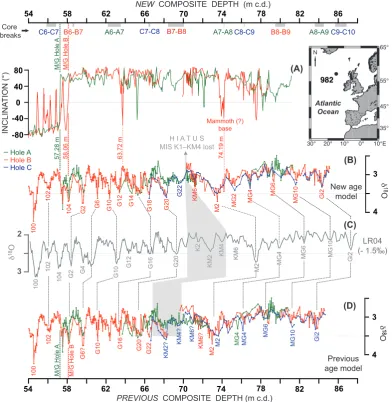
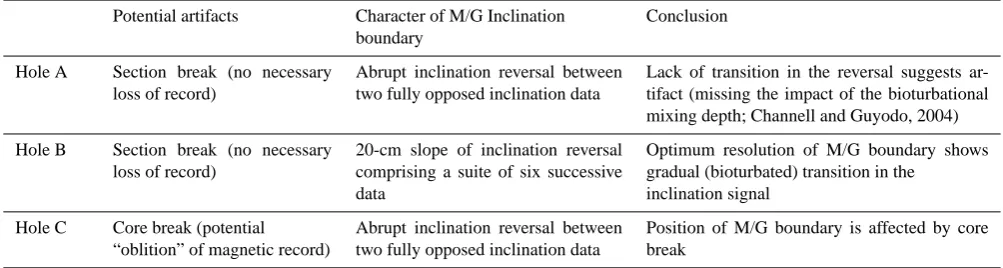
The magnetic polarity of the upper Gauss chronozone (2An) is well reflected at Site 982 by core sections with nor-mal inclination (shipboard data of Channell and Lehmann, 1999; update of Channell and Guyodo, 2004). In Hole A it ends with a sharp change in magnetic polarity at 57.28 m c.d. (50.70 mbsf) (Fig. 1). This midpoint depth of the Matuyama/Gauss (M/G) boundary was by now employed by all authors since Venz and Hodell (2002) for age-calibrating marine isotope stage (MIS) 104 in the Hole-Bδ18O record, where they had bridged the core break B6–B7 by a short piece ofδ18O record from Hole A (57.5–59.69 m c.d.). How-ever, this position of the M/G boundary at 57.28 m c.d. (dated at∼2.608 Ma in LR04) is different from that found by Chan-nell and Lehman (1999) in Hole B, where the midpoint of the reversal occurs at 58.06 m c.d. (∼52.55 mbsf),∼0.8 m deeper. Channell and Guyodo (2004) updated their shipboard magnetic data using u-channel samples, unfortunately with-out measuring the lowermost 100 cm in Core B6 (lowermost sections 6 and 7), and concluded that the M/G boundary in Hole B is located at the same composite depth as in Hole A. However, we now added a new δ18O data set to bridge better the Core B6/B7 gap (Fig. S1; Supplement). These data revealed a clear record of MIS 104–G2 for the crucial section in Core B6 uncovered by u-channel data and for the top of Core B7, between 57.51 and 59.67 m c.d. (Fig. 1; Ta-ble S1, see Supplement). To link properly the evidence from these newly identified marine isotope stages with the mag-netic record, we thus needed to stick to the records of ship-board single-step magnetic data of lowermost Core B6. Ta-ble 1 presents a comparative evaluation of the different qual-ities of the M/G boundary in the shipboard magnetic records of holes A, B, and C. Accordingly, the inclination boundary is best recorded in Core B6, near the top of section 7.
2
3
NEW COMPOSITE DEPTH (m c.d.)
3
4
54 58 62 66 70 74 78 82 86
Mammoth (?) base -80 -40 0 40 80
30° 20° 10° 0° 10°E 35° 45° 55° 65° 982 Atlantic Ocean N IN C LI N AT IO N (° ) Hole A Hole B Hole C
C6-C7 B6-B7 A6-A7 C7-C8 B7-B8 A7-A8C8-C9 B8-B9 A8-A9C9-C10
Core breaks M /G H ol e A M /G H ol e B 63 .7 2 m 58 .0 6 m 57 .2 8 m 74 .1 9 m 10 0 10 2 10 4 G 2 K M 2 K 2 K M 4 G 6 G
10 G12
10 0 10 2 G 14 G
18 G20
G 22 K M 6 M
2 MG
2
M
G
4
10
4 G2 G4 G10 G
12
G
16 G20 K
M
6
M
2 MG 4 MG6
G i2 86 82 78 74 66 62 58 54 10 0 10 2 M /G H ol e A M /G H ol e B G
6? G10 G
16 G 20 G 22 M 2 M
2 MG4 MG
6 δ 18 O (A) (B) (C) (D) 3 4 δ18 O
H I A T U S MIS K1–KM4 lost
M G 6 M G 10 G i2 δ
18O MG
10
K
M
2? KM
4? K M 6? K M 6? M G 10 G i2 New age model M G 4
PREVIOUS COMPOSITE DEPTH (m c.d.)70
Previous age model
LR04 (- 1.5‰)
Fig. 1. Different models of age control for ODP Site 982 (location shown at inserted map). (A) Magnetic polarity reversals are from the shipboard inclination data for holes A (green) and B (red) (Channell and Lehman, 1999; Channell and Guyodo, 2004), plotted on new composite depth (c.d.) scale. M/G = Matuyama/Gauss. (B) Benthicδ18O records of holes 982A, B, and C, plotted over the new c.d. scale (data of Venz and Hodell, 2002; suppl. by Lisiecki and Raymo, 2005, and by this study, as specified in Table S1; see Supplement; Fig. S1). Labeled isotope stages are tuned (hatched lines) to (C) benthicδ18O stack LR04 (Lisiecki and Raymo, 2005). (D) Benthicδ18O records of holes 982A, B, and C plotted over the “previous age model” of the Shipboard Scientific Party (1996), as cited by Lawrence et al. (2009). Small grey bars near the top depth scale mark potential losses of sediment sections at core breaks, which differ on the old and new composite depth scales below 68.36 m c.d. The two different c.d. scales for theδ18O records in holes A, B, and C lead to major age discrepancies at 58–72 (new) m c.d. Major grey bar near 70 m (new) c.d. constrains the stratigraphic interval in LR04, which is lost in a hiatus as a result of the new age model.
5 Stable isotope stratigraphy and composite depths The initial δ18O record from Site 982 of Venz and Hodell (2002), which forms the backbone of Pliocene stratigraphy, was slightly supplemented by Lisiecki and Raymo (2005). These authors already identified a short hia-tus between 2.25 and 2.33 Ma that removed MIS 86, 87, and 88. This gap is important in demonstrating that pelagic sedi-mentation at Site 982 was occasionally discontinuous.
Table 1. Evaluation of uncertainties in the midpoint assignment for definition of the Matuyama/Gauss (M/G) boundary in ODP holes 982 A, B, and C (inclination data of Channell and Lehmann, 1999).
Potential artifacts Character of M/G Inclination boundary
Conclusion
Hole A Section break (no necessary loss of record)
Abrupt inclination reversal between two fully opposed inclination data
Lack of transition in the reversal suggests ar-tifact (missing the impact of the bioturbational mixing depth; Channell and Guyodo, 2004)
Hole B Section break (no necessary loss of record)
20-cm slope of inclination reversal comprising a suite of six successive data
Optimum resolution of M/G boundary shows gradual (bioturbated) transition in the
inclination signal
Hole C Core break (potential “oblition” of magnetic record)
Abrupt inclination reversal between two fully opposed inclination data
Position of M/G boundary is affected by core break
by Lisiecki and Raymo (2005). Admittedly, also the new core splice displays some minor, as yet unexplained, devia-tions in core fit. For example, at 66.37–68.36 m c.d. (MIS G19–20), the absolute δ18O levels in holes B and C are up to >0.3 ‰ higher than in Hole A. On the other hand, the δ18O level in Hole B is up to 0.3 ‰ lower than in holes A and C at∼70.31–70.76 (new) m c.d. (MIS KM5). In general, however, the intercore deviations of δ18O ex-cursions remain within the range of analytical uncertainty (±0.07 ‰; Fig. 1b).
Below 68.36 m c.d., the new splice of composite depths requires an additional downhole shift of the core top B8 by
∼0.5 m. By comparison with holes A and C, core break B7– B8 now covers a gap of∼2 m, from 68.36 to at least∼70.31 (new) m c.d., whereas core break B8–B9 has lost a section between∼79.4 and 80.5 (new) m c.d. (Figs. 1b vs. 1d).
6 Discussion of correlations in stable-isotope stratigraphy
At Site 982, the published definitions of late Pliocene MIS mostly relied on the largely continuous benthicδ18O record of Hole B. Shortδ18O records were measured in Hole A for bridging core breaks B6–B7, B7–B8, and B8–B9 (Venz and Hodell, 2002; supplemented by Lisiecki and Raymo, 2005). We now prolonged the δ18O master record of Hole B for short sections at the base of core B6 and top of B7 between 57.51 and 59.67 m c.d. and replaced the M/G boundary in Hole A at 50.70 mbsf (57.28 m c.d.) by that in Hole B at 52.55 mbsf (58.06 m c.d.) to be consistent with age calibrat-ing MIS 104 now defined in Hole B.
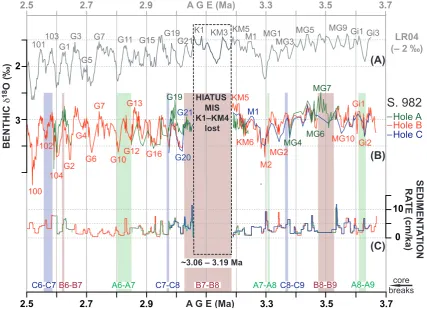
The new tuning is superior to the old stratigraphic record in particular at two depth sections: (1) at 57–62 m c.d. and (2) at 66–72 (new) m c.d. Figure 2 shows the resulting new suite of benthicδ18O oscillations in holes A, B, and C, re-adjusted to the orbitally tuned reference record LR04. Accordingly, the composite depth position of the M/G boundary shifted
0.78 m downcore (Table 1). This shift also implied a redefini-tion of the nomenclature of several preceding marine isotope stages as outlined below.
Different from LR04, the part of theδ18O record that now corresponds to MIS 104 appears bipartite at Site 982, with a second, very short cold excursion in the upper part, a struc-ture likewise found in theδ18O records of holes A and B. A similar bipartite benthic MIS 104 is also found at nearby Site 548 at similar water depths in the northeast Atlantic (Kh´elifi et al., 2009), demonstrating that this feature is not unique to Site 982. Subsequent to MIS 104, the suite of MIS 103–100 closely reflects all details of amplitude and structure as de-fined in LR04 and reported in previous studies.
In addition, all stages of the suite G1 to G10 prior to MIS 104 (redefined at Hole-B depth of 58.06 m c.d.) now re-semble in detail the structures and amplitudes displayed in LR04, when using our new stratigraphic nomenclature. Per-haps, the δ18O excursion at glacial MIS G4 is a little less pronounced than the coeval signal in LR04 (Fig. 2). How-ever, once more it is analogous to the δ18O record at Site 548 (Kh´elifi et al., 2009). In particular, the amplitude of G10 now clearly exceeds that of all preceding “cold” MIS, as suggested by LR04, and thus strongly differs from the previ-ous tuned version (Lisiecki and Raymo, 2005). Further back, from MIS G11 (∼2.83 Ma) back to G20 (∼3.01 Ma), the re-defined MIS oscillations such as MIS G13 and the bipartite MIS G15 likewise resemble closely those of LR04.
In contrast to the outlined general match of MIS structures, the amplitude of MIS G13 appears clearly more negative in
2
3
2.5 2.7 2.9 A G E (Ma) 3.3 3.5 3.7
G3 G1 103 101
G5
G7 G11 G15 G19G21K1 KM3 KM5M1 MG1MG3MG5 MG9 Gi1 Gi3
100 102
104G2 G4
G6 G10G12 G16 G20
KM6
M2 MG2MG4
MG6 MG7
MG10 Gi2
Hole A
Hole B
Hole C LR04 (– 2 ‰)
S. 982
2.5 2.7 2.9 A G E (Ma) 3.3 3.5 3.7
0 10
SE
D
IM
EN
TA
TIO
N
B
EN
TH
IC
δ
18O
(‰
)
(A)
(B)
(C)
HIATUS
R
AT
E (
cm
/k
a)
Gi1 KM5
M1 MIS
K1–KM4 lost
C6-C7
G21
G13 G7
B6-B7 A6-A7 C7-C8 B7-B8 A7-A8 C8-C9 B8-B9 A8-A9 G19
~3.06 – 3.19 Ma
core breaks
Fig. 2. (B) New marine-isotope stage chronology forδ18O records of ODP holes 982A, B, and C versus age (data from Venz and Hodell, 2002, Lisiecki and Raymo, 2005, and this study, as specified in Table S1) vs. (A)δ18O record of global ice volume LR04 (Lisiecki and Raymo, 2005) and (C) sedimentation rate changes.
“excursion” cannot be correlated to the theoretically nearby Kaena event, and thus is discarded. Further downcore, the amplitudes of MIS G19 in holes B and C are as high as suggested by LR04, which is lower than the amplitude of G17. In contrast, the relative amplitude of MIS 19 in Hole A clearly exceeds that of LR04. The broad and marked pos-itiveδ18O excursion of MIS 20 in holes B and C is some-what more distinct and thus comes much closer to that sug-gested by LR04 than the weak G20 excursion found in Hole A (Fig. 2). We do not understand yet the more negativeδ18O levels in the Hole-A record, although the relative amplitudes of theδ18O excursions for G20 are largely the same in all three holes.
The second critical depth section leading to new strati-graphic insights occurs prior to MIS G20, an interval that is particularly important for paleoceanography, since it is matching the PRISM time slice (Dowsett et al., 2010) for late Pliocene climate reconstruction, where Site 982 is form-ing a northeast Atlantic “cornerstone”. The newly defined MIS G20 occurs at the lower end of theδ18O record in core B7; the relative amplitudes of preceding MIS G21 and G22 in the (new) hole-A and C records now match closely the pertinent features in LR04. However, the two hole-A and C
records do not extend beyond the base of MIS G22 and do not reach back to theδ18O spike at the top of core B8, which probably occurs right at the end of KM5. Thus, the joint
δ18O record of the continuous sediment sections in holes A and C do not bridge completely the (now expanded) coring gap at core break B7–B8 between 68.36 and∼70.31 (new) m c.d. (Figs. 1b, 2).
Table 2. Lines of evidence that justify the hiatus between MIS G22 and KM5.
Consecutive rejuvenation of stable-isotope stratigraphy prior to MIS 104 as induced by the replacement of marine isotope stages G5–G9 by G1–G4, which in turn resulted from the substitution of the M/G boundary in Hole A by that in Hole B (Table 1) to match directly theδ18O master record of Hole B. This shift sums up to more than 80 ky.
Our supplementaryδ18O records (Fig. S1; see Supplement) of holes 982 A and C measured to fill the B7/B8 coring gap, revealed the structures of MIS stages G21 and G22 in addition to theδ18O oscillations previously displayed in the stable-isotope stratigraphy of Venz et al. (2002). These additional stages sum up to more than 40 ky.
As compared to the previous age model (Lawrence et al., 2009) the similarity ofδ18O variations with the reference record LR04 appears much improved between MIS G1 and G12, for G14–G16, and G20–G22, hence requiring a continuous sediment record back to the base of MIS G22 and excluding a potential stratigraphic gap further upcore, say, between G1 and G4 (Lawrence, personal communication, 2011).
On the basis of the now completedδ18O records for holes 982A–C (Fig. S1) the composite depths were newly defined between 66 and 85 (old) m c.d. Within this depth range the unequivocal fit of records between 72 and 85 (old) m c.d. and various comparative tests (not depicted) suggest an optimum fit of the threeδ18O records as depicted in Fig. 1. Accordingly, theδ18O records of holes A and C are incapable to fill the total coring gap between B7 and B8 and require a stratigraphic gap for MIS K1–KM4.
3
2.5 2.7 2.9 A G E (Ma) 3.3 3.5 3.7
G3 G1 103 101
G5
G7 G11 G15 G19G21K1 KM3 KM5M1 MG1MG3MG5 MG9 Gi1 Gi3 LR04
S. 982
2.5 2.7 2.9 A G E (Ma) 3.3 3.5 3.7
B
EN
TH
IC
δ
18O
(‰
)
(A)
(B)
(C) HIATUS
SS
T
(°
C
)
SS
T (
°C
)
MIS K1–KM4
lost
4
12 14 16 18 20
12 14 16 18 20
New age model
Age model of Shipboard Scientific Party
Hole A (This study)
Hole B
Hole A Lawrence
et al. (2009)
S. 982
2.5 2.7 2.9 3.3 3.5 A G E (Ma)
(D)
S
S
T (
°C
)
12 14 16 18 20
H I A T U S
S. 609 S. 982
New age model
2.5 2.7 2.9 3.1
14 16 18
S. 984
12
10
3.1 S. 982
(B)
2.5 2.7 2.9 3.3 3.5
A G E (Ma)
(C) 12
14 16 18
20 S. 609S. 982
2.5 2.7 2.9 3.1
14 16 18 S. 984
12
10
3.1 S. 982
(A)
Age model – Shipboard Scientific Party
S
S
T (
°C
)
S
S
T
(°
C
)
SS
T
(°
C
)
A G E (Ma)
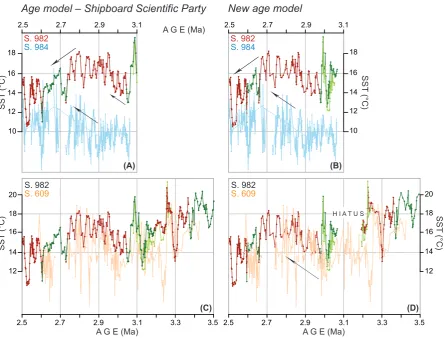
Fig. 4. Comparison of Uk370-based SST records of ODP holes 982A (green and light green) and B (red) (for details see caption of Fig. 3) with Mg/Ca-based SST records analyzed at ODP sites 984 and 609 (Bartoli et al., 2005), plotted both versus the old and new age models discussed in this study.
Prior to KM5, the records of holes A and C require only minor shifts in composite depth near MG2–MG5 to adjust them closely to the MIS record of Hole B (Table S2; see Supplement). The stage chronology of Hole B is retained un-changed back to MIS Gi2 such as previously tuned to LR04 by Lisiecki and Raymo (2005).
Near 74.19 (new) m c.d., the onset of a significant positive excursion inδ18O marks the onset of the extremely cold MIS M2, which can be aligned with a well-resolved broad “event” of negative inclination within the Gauss Chron (Channell and Lehmann, 1999) (Fig. 1a), a coincidence that appears to oc-cur beyond coincidence. Accordingly, we may now consider this magnetic excursion as part of the Mammoth subchron at ∼3.3 Ma (Lisiecki and Raymo, 2005). The upper part of this subchron was probably lost. Unfortunately, the low magnetization intensities do not allow an identification of the Gauss/Gilbert boundary.
7 Implications
Our new stratigraphic correlations imply a revised chronol-ogy for the Uk370-based SST record of Site 982, which covers the late Pliocene onset of major northern Hemisphere glacia-tion (Lawrence et al., 2009). Subsequent to 3.2 Ma, we now have to reduce the ages of SST signals by values that vary between more than 130 and 20 ky, because the age of aδ18O signal formerly assigned to MIS KM4 (∼3.175 Ma) is now replaced by the age of MIS G22 (∼3.045 Ma) (Fig. 3).
Accordingly, we see three late Pliocene main cool-ing events of northeast Atlantic SST, which Lawrence et al. (2009) constrained to ∼4.5◦C each. These events are
asymptotic warming by 3◦C lasted from∼2.98 until 2.7 Ma.
On the basis of our revised chronology, these ages and many SST trends now compare better with coeval trends of SST changes found elsewhere in the northern North Atlantic, for example, at ODP Site 609 to the south of Site 982 and at Site 984 in the Irminger Current (Bartoli et al., 2005) (Fig. 4). In summary, it turns out that most of the northeastern North Atlantic did not cool down but gradually warmed up dur-ing the late Pliocene from∼2.95 to 2.7 Ma, a trend that was induced by the final closure of the Central American Sea-ways, in harmony with various model simulations (Lunt et al., 2007; Sarnthein et al., 2009).
Likewise, our new age model may have implications for other trends in paleoclimate such as the major late Pliocene reduction in atmospheric CO2. At Site 982, Pagani et al.
(2010) placed a (poorly constrained) late Pliocene CO2drop
somewhere between∼3.3 and 2.85 Ma (Fig. S3). On the ba-sis of our new age model, the time span of CO2reduction is
now expanded by more than 80 ky until∼2.75 Ma (MIS G6). The latter timing appears to be in closer harmony than previ-ously assumed with the onset of a major long-term decrease in bottom water temperatures at ODP Sites 609 and 610 in the North Atlantic, then tracing a significant rise in merid-ional overturning circulation and hence, an increased North Atlantic drawdown of atmospheric CO2(Bartoli et al., 2005;
Sarnthein et al., 2009). However, the highly fragmentary CO2evidence of Site 982 (Fig. S3) does not provide yet any
substantial insights into the actual details of leads and lags between the atmosphericpCO2drop and the onset of major
Northern Hemisphere glaciation during the late Pliocene.
8 Conclusions
In our study, we revised the age-calibration of the late Plioceneδ18O master record measured in Hole 982B. In con-trast to previous schemes of age control (Venz and Hodell, 2002; Lisiecki and Raymo, 2005; Lawrence et al., 2009), we replaced – here without changing the composite-depth scale published by the Shipboard Scienific Party (1996) – the M/G boundary in Hole 982A by that in Hole 982B (Channell and Lehmann, 1999), which occurs ∼0.78 m farther downhole and corresponds directly to MIS 104 in the Hole-B δ18O record. Moreover, the δ18O record of Hole 982B near to the core break B6–B7 was prolonged farther up- and down-core. In total, these changes led to a reduction of sediment ages by up to 80 ky and a significantly improved match of MIS G1–G12 structures with those found in the reference record LR04.
Newδ18O records from holes 982A and C between ∼64 and 84 (new) m c.d. were measured in parallel to the master record of Hole B. These records and many additional data helped us to improve the sampling resolution of the Hole-B record and thus, on the definition of stage numbers around core breaks B7–B8 and B8–B9. Here, the optimum
mu-tual overlap amongst all threeδ18O records and their closest-possible match with MIS structures defined in LR04 also re-quire a major revision of the composite-depth scale displayed in Table S2 (see Supplement). Most important, they sug-gest a natural hiatus of more than 130 ky between the base of MIS KM4 and the top of MIS K1. This gap corroborates the outlined age shift at MIS G22–G1. In contrast to the out-lined age shifts, previous definitions of MIS KM5 back to Gi2 are confirmed. Here, it might be possible to identify the Mammoth magnetic subchron in Hole 982B at the base of MIS M2.
The large-scale age reduction subsequent to MIS KM5 im-plies a number of reasonable shifts in the tipping points and gradients of paleoclimatic signals, including North Atlantic SST trends and the atmosphericpCO2 drop, that mark the
late Pliocene onset of major Northern Hemisphere glaciation.
Supplementary material related to this article is available online at:
http://www.clim-past.net/8/79/2012/ cp-8-79-2012-supplement.pdf.
Acknowledgements. We thank Nils Anderson, Kiel, for stable isotope analyses. Hartmut K¨uhn and other students helped with careful sample preparation. We acknowledge constructive comments and questions of Kira Lawrence, Jim Channell, Martin Ziegler, Peter Bloxsom, and an anonymous CPD referee. This study was supported by the Deutsche Forschungsgemeinschaft (DFG) and the Deutscher Akademischer Austausch Dienst (DAAD).
Edited by: P. Ziveri
References
Bartoli, G., Sarnthein, M., Weinelt, M., Erlenkeuser, H., Garbe-Sch¨onberg, D., and Lea, D. W.: Final closure of Panama and the onset of northern hemisphere glaciation, Earth Planet. Sci. Lett., 237, 33–44, doi:10.1016/j.epsl.2005.06.020, 2005.
Channell, J. E. T. and Guyodo, Y.: The Matuyama Chronozone at ODP Site 982 (Rockall Bank): Evidence for decimeter-scale magnetization lock-in depths, in: Timescales of the Paleomag-netic Field, edited by: Channell, J. E. T., Kent, D. V., Lowrie, W., and Meert, J., Geoph. Monog. Series, 145, 205–219, 2004. Channell, J. E. T. and Lehman, B.: Magnetic stratigraphy of North
Atlantic Sites 980–984, in: Proceedings of Ocean Drilling Pro-gram Scientific Results, 162, edited by: Raymo, M. E., Jansen, E., Blum, P., and Herbert, T. D., College Station, Tx, 113–130, doi:10.2973/odp.proc.sr.162.002.1999, 1999.
Dowsett, H. J., Robinson, M., Haywood, A., Salzmann, U., Hill, D., Sohl, L., Chandler, M., Williams, M., Foley, K., and Stoll, D.: The PRISM3D paleoenvironmental reconstruction, Stratigraphy, 7, 123–139, 2010.
Hefter, J.: Analysis of Alkenone Unsaturation Indices with Fast Gas Chromatography/Time-of-Flight Mass Spectrometry, Anal. Chem., 80, 2161–2170, doi:10.1021/ac702194m, 2008. Kh´elifi, N., Sarnthein, M., Andersen, N., Blanz, T., Frank, M.,
Garbe-Sch¨onberg, D., Haley, B. A., Stumpf, R., and Weinelt, M.: A major and long-term Pliocene intensification of the Mediterranean Outflow, 3.5–3.3 Ma ago, Geology, 37, 811–814, doi:10.1130/G30058A.1, 2009.
Lawrence, K. T., Herbert, T. D., Brown, C. M., Raymo, M. E., and Haywood, A. M.: High amplitude variations in North Atlantic sea surface temperature during the early Pliocene warm period, Paleoceanography, 24, PA2218, doi:10.1029/2008PA001669, 2009.
Lisiecki, L. E. and Raymo, M. E.: A Pliocene-Pleistocene stack of 57 globally distributed benthicδ18O records, Paleoceanography, 20, PA1003, doi:10.1029/2004PA001071, 2005.
Lowrie, W. and Alvarez, W.: One hundred million years of geomag-netic polarity history, Geology, 9, 392–397, 1981.
Lunt, D. J., Valdes, P. J., Haywood, A. M., and Rutt, I. C.: Clo-sure of the Panama Seaway during the Pliocene: implications for climate and Northern Hemisphere glaciation, Clim. Dynam., 30, 1–18, 2007.
Naafs, B. D. A., Stein, R., Hefter, J., Kh´elifi, N., De Schep-per, S., and Haug, G. H.: Late Pliocene changes in the North Atlantic Current, Earth Planet. Sci. Lett., 298, 434–442, doi:10.1016/j.epsl.2010.08.023, 2010.
Pagani, M., Liu, Z., LaRiviere, J., and Ravelo, A. C.: High Earth-system climate sensitivity determined from Pliocene carbon dioxide concentrations, Nat. Geosci., 3, 27–30, doi:10.1038/ngeo724, 2010.
Paillard, D., Labeyrie, L., and Yiou, P.: Macintosh program performs time-series analysis, EOS Trans, AGU, 77, 379, doi:10.1029/96EO00259, 1996.
Prahl, F. G., Muehlhausen, L. A., and Zahnle, D. L.: Further evalu-ation of long-chain alkenones as indicators of paleoceanographic conditions, Geochim. Cosmochim. Ac., 52, 2303–2310, 1988. Sarnthein, M., Bartoli, G., Prange, M., Schmittner, A.,
Schnei-der, B., Weinelt, M., Andersen, N., and Garbe-Sch¨onberg, D.: Mid-Pliocene shifts in ocean overturning circulation and the onset of Quaternary-style climates, Clim. Past, 5, 269–283, doi:10.5194/cp-5-269-2009, 2009.
Shackleton, N. J.: Attainment of isotopic equilibrium between ocean water and the benthonic foraminifera genus Uvigerina: isotopic changes in the ocean during the last glacial, Colloques Internationaux du Centre National du Recherche Scientifique, 219, 203–210, 1974.
Shipboard Scientific Party: Site 982: in Proceedings of Ocean Drilling Program Initial Reports, 162, edited by: Raymo, M. E., Jansen, E., Blum, P., and Herbert, T. D., 91–138, 1996.
Tiedemann, R., Sarnthein, M., and Shackleton, N.: Astronomical timescale for Pliocene Atlantic δ18O and dust flux records of Ocean Drilling Program Site 659, Paleoceanography, 9, 619– 638, 1994.