R E S E A R C H A R T I C L E
Open Access
Is increasing complexity of algorithms the price
for higher accuracy? virtual comparison of three
algorithms for tertiary level management of
chronic cough in people living with HIV in a
low-income country
Constance Mukabatsinda
1†, Jasmine Nguyen
2†, Bettina Bisig
2, Lutgarde Lynen
2, Yerma D Coppens
1,
Anita Asiimwe
1and Jef Van den Ende
1,2*Abstract
Background:The algorithmic approach to guidelines has been introduced and promoted on a large scale since
the 1970s. This study aims at comparing the performance of three algorithms for the management of chronic cough in patients with HIV infection, and at reassessing the current position of algorithmic guidelines in clinical decision making through an analysis of accuracy, harm and complexity.
Methods:Data were collected at the University Hospital of Kigali (CHUK) in a total of 201 HIV-positive hospitalised patients with chronic cough. We simulated management of each patient following the three algorithms. The first was locally tailored by clinicians from CHUK, the second and third were drawn from publications by Médecins sans Frontières (MSF) and the World Health Organisation (WHO). Semantic analysis techniques known as Clinical Algorithm Nosology were used to compare them in terms of complexity and similarity. For each of them, we assessed the sensitivity, delay to diagnosis and hypothetical harm of false positives and false negatives.
Results:The principal diagnoses were tuberculosis (21%) and pneumocystosis (19%). Sensitivity, representing the proportion of correct diagnoses made by each algorithm, was 95.7%, 88% and 70% for CHUK, MSF and WHO, respectively. Mean time to appropriate management was 1.86 days for CHUK and 3.46 for the MSF algorithm. The CHUK algorithm was the most complex, followed by MSF and WHO. Total harm was by far the highest for the WHO algorithm, followed by MSF and CHUK.
Conclusions:This study confirms our hypothesis that sensitivity and patient safety (i.e. less expected harm) are proportional to the complexity of algorithms, though increased complexity may make them difficult to use in practice.
Keywords:HIV, chronic cough, algorithms, clinical decision making, harm, complexity
* Correspondence: [email protected] †Contributed equally
1
Department of Internal Medicine, Centre Hospitalier Universitaire, Kigali, Rwanda
Full list of author information is available at the end of the article
Background
The algorithmic approach to guidelines has been intro-duced and promoted on a large scale since the 1970s. This flowchart representation of step-by-step clinical logic guides the management of a patient with symp-toms, clinical signs, or results of technical examinations. The transition from one step to the next is mostly dichotomous, which means that only one out of two choices can be made at each step. Moreover, the logic is serial: only one pathway can be followed by a single patient.
The original purpose of algorithmic guideline imple-mentation was twofold. First, with continuing concern over the rising costs of health care, health policy makers have been impressed by the high levels of variation and inappropriateness in medical care. Second, in resource-poor settings, nurses provide frequently the first-line medical care. To deal with the relative lack of knowl-edge in this medical professional group, algorithms have been used to help rationalise and standardise clinical decision making, an approach considered so far to be effective and efficient [1]. Algorithms have been pivotal in the task-shifting or task-sharing by nurses that has been promoted over the last 10 years to increase access to antiretroviral therapy.
Clinical algorithms are often controversial: on the one hand, they have often been considered with suspicion because of their restrictive, “cookbook"-medicine approach. On the other hand, they have been viewed as a valuable educational tool, providing neophytes with a method for making diagnostic and therapeutic decisions in clinical practice apprenticeship [2]. Although both of these views may make sense, none of them has been validated.
Algorithms usually lead to a single diagnosis, poten-tially neglecting another serious one, leading to delayed investigations and treatment. In some situations, the burden of harm might grow considerably: when we fol-low an algorithmic guideline step-by-step, it is obvious to stop at the first diagnosis corresponding with the patient’s findings. It induces a tunnel-vision and limits the search of certainty in diagnosis.
Epidemiology shows the relevance of the dynamics of the disease spectrum in time as well as in space. The utility of a given clinical algorithm can vary substantially across different epidemiologic and socioeconomic con-texts. As a result, every algorithmic guideline must be adapted to every local context and regularly revised [3]. Moreover, the emphasis on development and deploy-ment of medical guidelines has led to the introduction of multiple versions addressing the same problem: uncertainty is increased with the fact that clinicians have to select among several guidelines. Barak et al.
tried to solve this problem by creating a method of text-to-algorithm conversion [2].
Several studies have evaluated or compared guidelines but none of them has compared them in terms of com-plexity or harm [4-7]. Wabitsch, in his efforts to achieve reproducible, clinically flexible and applicable guidelines, developed a systematic procedure to tailor guidelines to specific settings. Doing this, he compared two modified guidelines with a global one, but he did not consider harm [3]. Because of the impact guidelines may have on clinical practice, Pearson et al. proposed a method to develop, use and compare them [8]. This methodology-the Clinical Algorithm Nosology (CAN)-measures over-all design complexity independent of algorithm content, quantitatively delineates algorithm differences, and qua-litatively estimates the potential impact of such differ-ences on patient care, by scoring the degree of similarity. This simple method may help clinicians to make the best choice between several algorithms about the same subject or complaint in their setting.
At the end of 2007 the global estimate of the number of people living with HIV was about 33,2 million, with more than 96% in low- and middle-income countries [9]. In Rwanda, HIV prevalence turns around 2,9 to 3,2% [10].Except for some countries, the majority of people living with HIV still have no access to highly active antiretroviral therapy (HAART). Chronic cough is a key problem of medical decision making in the man-agement of immune-compromised HIV patients, since a large cluster of dangerous but treatable diseases present this way.
The purpose of this research was to compare virtually three algorithmic guidelines intended for use at a ter-tiary level in terms of sensitivity, delay to diagnosis, harm, complexity and similarity. We intended to evalu-ate how complexity relevalu-ates to accuracy and expected harm. We hypothesized that increasing complexity, thereby approaching the clinician’s intuitive logic, improves accuracy and diminishes expected harm, but that, on the other hand, the degree of complexity can become too high and make the algorithm less useful in practice.
Methods
Patients
known non-infectious cause of chronic cough (chronic obstructive lung disease, bronchial asthma, pleural effu-sion due to cardiac or renal insufficiency) were excluded from the study. The reference standard for the actual disease of each patient was the final diagnosis made by clinicians at the end of the follow-up with the available diagnostic tools (e.g., chest X-ray, Gram and Ziehl-Neel-sen stain, culture; bronchoscopy was done for selected cases).
Clinical care depended only on the clinician’s judg-ment. Moreover, clinicians were blinded to hypothetical results of the application of the algorithms.
For each patient, we collected data through a ques-tionnaire in Epi-Info software 2000: age, sex, history, physical examination, tests done, treatment, outcome and final diagnosis. Data were made anonymous for ana-lysis. Sensitivity was computed with and without consid-ering patients for whom no final diagnosis was made and those with a rare diagnosis not included in the algo-rithms. For the remainder of the analysis they were excluded.
Algorithms
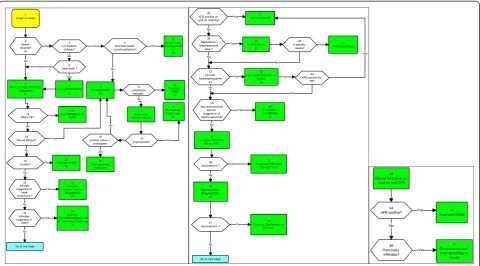
Using the graphic format described by Margolis, a serial and dichotomous flowchart representation adopted by the Harvard Community Health Plan, a locally tailored algorithm was developed based on clinicians’ logic and availability of complementary exams (Figure 1). Two residents, under the supervision of their professor of
internal medicine, created the CHUK algorithm. They were not amongst the clinicians who made the final diagnosis considered as the gold standard. Clinicians only controlled the construction of the algorithm for inconsistencies.
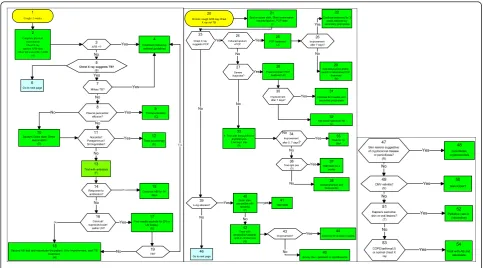
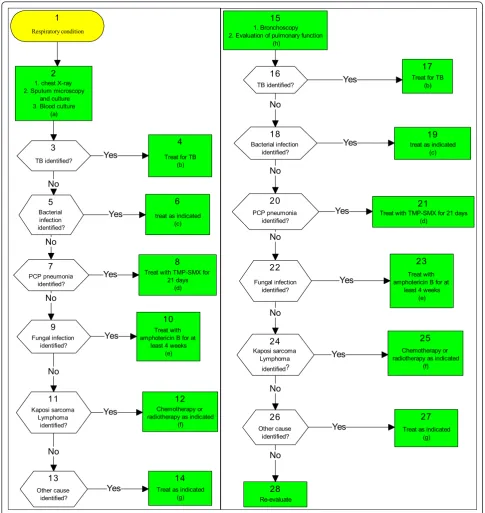
The Médecins sans Frontières (MSF) algorithm was published in 2001 by L. Lynen for management of opportunistic infections in HIV-positive patients, and based on an extensive literature review (Figure 2) [12,13]. The WHO algorithm was published earlier in the 1990s (Figure 3) [14]. Both publications proposed guidelines for care at three levels. In our assessment of the three algorithms we only used the chronic cough algorithm for the tertiary care level.
Evaluation
We virtually applied the three algorithms to each patient, using data from the database, simulating a step-by-step management as would have been done following the algorithm. We calculated the number of patients who found a way through the algorithm ("fit”) and we compared their management in the ward with the path-way they would have followed with the algorithm. Sensi-tivity represents the proportion of correct diagnosis made by an algorithm. We estimated the sensitivity first for each diagnosis, and further for the algorithm as a whole, with the final clinical diagnosis as the“true con-dition”. If the algorithm missed a diagnosis, we consid-ered this as a false negative for the true condition. If
1 Cough >3 weeks
2 Severe dyspnea? (a) 3 uni/ bilateral dullness? 4 Bronchial breath sound/crepitations? 5 Amoxi+/-clav. ac.3x1g/d/10d s (b) 7 AFB,CXR,WBC,TPM/SMX 120mg/kg/d (c) 6 chest drum ? No
8 Treat pneumothorax
(d)
12 Miliary TB ?
13 Stop TMP/SMX,start RHZE 9 Thoracocentesis (e) 10 Lymphocytic exsudate 11 Treat with RHZE (f) 18 Pleural effusion? 14 Chest drain +Amoxi+/-ac.clav 19 Cavities? 20 Treat with RHZE
(g) 22 Infiltrate suggestive of lobar pneumonia ? 23 Treat with Amoxi+/-.clav.ac 3x1/g/dj/10ds (h) 24 Infiltrates suggestive of PCP? 25 Continue TMP/SMX120mg/kg/21d s + steroides if dyspnea
(i) 16 Improvement? 17 Continue with Amoxi+ clav. ac. 15 Positive culture +
antibiogram
21 Treat according
antibiogram
Go to next page
Yes Yes Yes
Yes No No No No No No No No Yes Yes Yes Yes Yes Yes Yes Yes No No No 26 AFB positive on sputum staining?
27 Treat with RHZE
28 Mediastinal lymphadenopat hies ? 32 Cervical lymphadenopathie s? 29 Bronchoscopy (j) 33 Fine needle aspiration +
biopsy (k) Yes 30 If specific results? 31 Treat accordingly 34 AFB positive for
TB?
35 Skin and mucosal
lesions suggestive of Kaposi sarcoma? 36 Treat with Vinblastine (l) 37 Continue TMP/SMX 120mg/d/7ds. 38 Improvement ? 39 Treat with TMP/SMX
120mg/d/ 10ds 40 Erythromycine 20mg/kg/d/7ds. (m) 41 Improvement ? 42 Continue Erythromycine
for 10ds. Yes
Go to next page No No No No No No No No Yes Yes Yes Yes Yes Yes Yes 43 Repeat AFB stain on
sputum and CXR
44 AFB positive? 46 Pulmonary infiltrates? 45 Treat with RHZE
47 Bronchoscopy and treat according to
results No
Yes
Yes
another diagnosis was reached instead of the true condi-tion, it was considered as a false negative for the true condition and as a false positive for the wrong condi-tion. In other words, the false positive is a wrong diag-nosis whereas the false negative is a missed diagdiag-nosis.
Starting from the clinical state box to the action box, we defined for each diagnosis a minimal hypothetical (ideal) delay, depending on the execution of the different investigations. For every patient we compared the time clinicians needed in the ward to reach a therapy, with the delay predicted by the different algorithms. Delays were considered on theoretical grounds, supposing that all steps had to be taken in a sequential way (which clin-icians often don’t do: e.g., if the X-ray shows a miliary pattern, they will not wait for all three sputa examinations).
We compared the algorithms following the Clinical Algorithm Nosology. It is made up of two components [8]. The Clinical Algorithm Structural Analysis (CASA) measures overall design and flow pattern complexity independent of algorithm content. A formula expresses the relative complexity of a clinical algorithm in a score:
CASA complexity score= 2 (n
1Dx) + 1 (n2D0) +
(Lp)i
where n1Dx = number of diagnostic boxes, n2D0 =
number of all other boxes, and∑(Lp)i= the summation
of “loop parameters”(i.e. nodes that send the clinician back to an earlier point). The Clinical Algorithm Patient
Abstraction (CAPA) then accomplishes a clinical com-parison of two algorithms and explains the differences between them. The CAPA has three steps: clinical rule analysis, patient abstraction and patient comparison.
“Identical” (score = 10) means same order of clinical exams and decision, “similar” (score = 8) means the same steps and treatment but in different order and
“different” (score = 0) means a management without the same diagnosis or therapeutic decision.
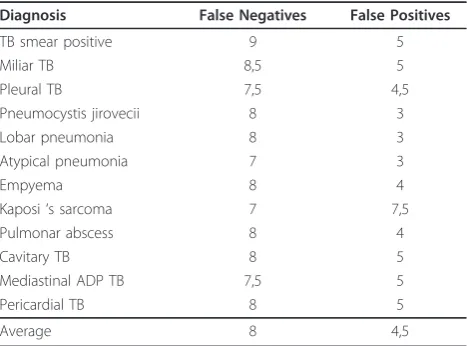
With a questionnaire featuring scoring scales from 0 to 10, nine internal medicine clinicians of CHUK esti-mated intuitively the weight of harm by commission (false positives) and harm by omission (false negatives) in therapeutic decisions compared to natural death [15]. We relied only on intuitive estimations, after a training session explaining the different key factors determining harm: disease and treatment morbidity and mortality, treatment efficacy and cost, stigma, contagiousness. For each algorithm we computed the harm per diagnosis, multiplying false positives and false negatives with their respective harm, and summing these for the overall harm.
Results
Data were recorded for 201 patients. Nine patients had no diagnosis, 9 had a rare diagnosis not included in the algorithms, leaving 183 for analysis. One patient had two probable diagnoses. Sex ratio was 82/119 M/F (0,69), mean age was 35,9 years (range 15-70 years). Cough> 3 weeks
1
Complete physical examination Chest X ray sputum AFB stain Other lab tests(CBC, LDH)
(A) 2
Go to next page
6 Treatment following national guidelines 4 AFB +? 3
Chest X ray suggests TB?
(B) 5 Miliary TB? 7 Pleural pericardial effusion? 8 Thoracocentesis (C) 9
Sputum Gram stain Direct examination (D) 10 Treat accordingly (E) 12 Nocardia? Paragonimus? Strongyloides? 11
Trial with anibiotics (F)
13
Continue AB for 14 days
15
Fine needle aspirate for ZN or LN biopsy
(G)
17
Second AB trial and reevaluate the patient. If no improvement, start TB treatment (H) 18 Response to antibiotics? 14 TB? 19 Cervical/ supraclavicular/ axillar LN? 16 Yes Yes Yes Yes Yes Yes No No No No No No No No Yes Yes
Chronic cough AFB neg Chest X ray not TB
20
Sputum gram stain, Direct examination induced sputum, PCP stain
(I) 21
Continue treatmeny for 3 weeks followed by secondary prophylaxis
22
Chest X ray suggests PCP 23 Induced sputum +PCP 24 Improvement after 7 days? 26 PCP treatment
(J) 25
Add doxycycline and/or switch to alternative PCP treatment (M) 29 Severe dyspnoea? 27 Improvement after 7 days? 30 Pneumothorax? PCP
treatment (K) 28
Continue for 3 weeks and secondary prophylaxis
31
Add broad spectrum AB (L) 32
1. Trial with doxycycline or erythromycin 2.Amoxy= clav (N) 33
Improvement after 5, 7 days?
34
Toxo IgG pos (O) 36
Lung abscess? 39
Treat for 14 days 35
TMP/SMX for 4 weeks 37 Choramphenicol and flucloxacillin 38 Gram stain compatible with nocardia (P) 40 TMP/SMX 41
Go to next page 46
Treat with amoxycillin/clavlanic acid or clindamycin
(Q) 42
Continue for at least 3 weeks 44
Amoxy clav+ (amikacin or ciprofloxacine 45 Improvement? 43 Yes Yes Yes Yes Yes Yes Yes Yes Yes No No No No No No No No No No yes
Skin lesions suggestive of cryptococcal disease or penicilliosis? (R) 47 CMV retinitis? (S) 49 Kaposi's sarcoma: skin or oral lesions?
(T) 51
COPD/asthma(U) or normal chest X
ray 53
Treat with AB and reevaluate
54 Palliative care or
(vincristine) 52 Ganciclovir? 50 penicilliosis cryptococcosis 48 Yes Yes Yes Yes No No No
Baseline characteristics and main diagnostic frequencies are summarized in table 1. (Table 1) All forms of tuber-culosis were by far the most frequent diagnosis (46,4%). Mortality was high (39%).
Of the 184 cases (one patient with 2 diagnoses) we made follow the CHUK algorithm, 183 fit a pathway (99,5%). Comparing the algorithm pathways with the one followed by the clinicians, for 61% the management
was“identical”, for 38% it was “different” and for 1% it was“similar”.
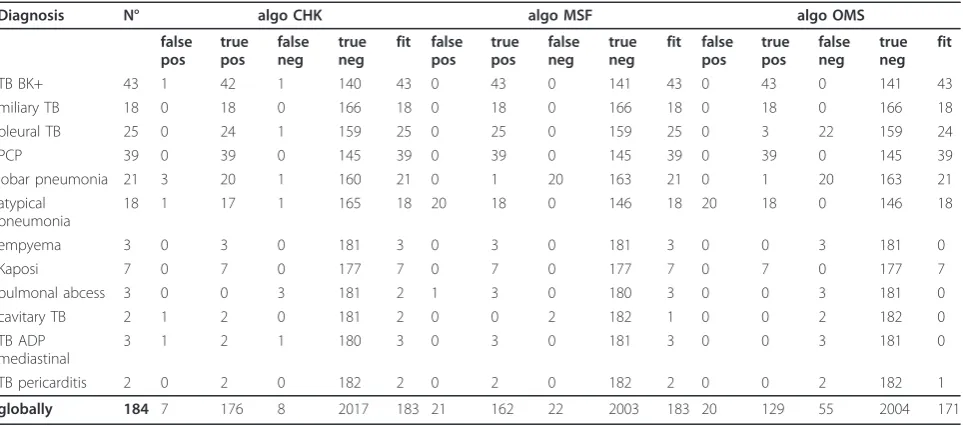
The same procedure was also applied for each of the 184 cases to the other two algorithms under study. A fit was found in 183 (99.5%), 183 (99.5%), and 171 (92.9%) cases for the CHUK, MSF and WHO algorithms, respectively. Sensitivity was 95.7%, 88% and 70.1% for the CHUK, MSF and WHO algorithms, respectively Respiratory condition
1
1. chest X-ray 2. Sputum microscopy
and culture 3. Blood culture
(a)
2
TB identified?
3
Bacterial infection identified?
5
PCP pneumonia identified?
7
Fungal infection identified?
9
Kaposi sarcoma Lymphoma
identified?
11
Other cause identified?
13
Treat for TB (b)
4
treat as indicated (c)
6
Treat with TMP-SMX for 21 days
(d)
8
Treat with amphotericin B for at
least 4 weeks (e)
10
Chemotherapy or radiotherapy as indicated
(f)
12
Treat as indicated (g)
14 Yes
Yes
Yes
Yes
Yes
Yes No
No
No No
No
1. Bronchoscopy 2. Evaluation of pulmonary function
(h)
15
TB identified?
16
Bacterial infection identified?
18
PCP pneumonia identified?
20
Fungal infection identified?
22
Kaposi sarcoma Lymphoma
identified?
24
Other cause identified?
26
Treat for TB (b)
17
treat as indicated (c)
19
Treat with TMP-SMX for 21 days (d)
21
Treat with amphotericin B for at
least 4 weeks (e)
23
Chemotherapy or radiotherapy as indicated
(f)
25
Treat as indicated (g)
27
Re-evaluate
28
Yes
Yes
Yes
Yes
Yes
Yes
No No No No No No
(87.5%, 80.5% and 64.2 while including patients with unknown and rare diagnosis). (Table 2)
Table 3 shows that for most diagnoses a certain delay to appropriate management was present. (Table 3) For
example, for empyema, seven days were lost by the CHUK clinicians before a therapeutic action. When we compare the average delay of CHUK and MSF guide-lines with the hypothetical minimal delay according to the local situation regarding availability and speed of execution of tests and treatments, the CHUK algorithm was the fastest, followed by that of MSF. For the WHO algorithm, delays were difficult to calculate because of missing practical specifications.
The CHUK algorithm was the most complex with a CASA score of 80, followed by MSF with a score of 73 and WHO with a score of 40. The CAPA score was 0 meaning that there is (almost) no similarity between the three algorithms.
Table 4 shows the average intuitive harm for false positives and negatives for each disease, weighted by the nine internal medicine clinicians compared to natural death. On average, the weight of omission error was much higher than the weight of commission error (8 versus 4.5). The total harm was the highest for the WHO algorithm with a score of 487.5. On the other hand, the CHUK algorithm was by far the least harmful followed by MSF algorithm with scores of 91 and 240, respectively. If we split total harm into “false-positive harm” and“false-negative harm”, we obtain, respectively, for CHUK scores of 27 and 63, for MSF 64 and 176 and for WHO 60 and 427.
Discussion
Results
The purpose of this study was to assess the hypothetical utility of three algorithms in terms of sensitivity, delay to action and harm at a tertiary care level. The CHUK guidelines proved to be the most complex, but the most
Table 1 baseline characteristics of patients (n = 201).
Age (years) Count %
15-24 22 11
25-34 72 36
35-44 69 34,5
45-54 29 14
55-64 8 4
65-74 1 0,5
sex
male 82 41
female 119 59
Diagnosis
TB smear positive 43 21,4
Pneumocystis jirovecii 39 19,4
Pleural TB 25 12,4
Lobar pneumonia 21 10,4
Miliar TB 18 9
Atypical pneumonia 18 9
Kaposi‘s sarcoma 7 3,5
Empyema 3 1,5
Pulmonar abscess 3 1,5
Mediastinal adenopathy (ADP) TB 3 1,5
Cavitary TB 2 1
Pericardial TB 2 1
Other diagnosis* 9 4,5
no diagnosis 9 4,5
Other diagnosis: encephalitis, other forms of extra pulmonary TB x 4, (newly diagnosed) heart failure, haemolytic anaemia, pneumothorax, cryptococcal meningitis.
Table 2 details of accuracy of three algorithms.
Diagnosis N° algo CHK algo MSF algo OMS
false pos
true pos
false neg
true neg
fit false pos
true pos
false neg
true neg
fit false pos
true pos
false neg
true neg
fit
TB BK+ 43 1 42 1 140 43 0 43 0 141 43 0 43 0 141 43
miliary TB 18 0 18 0 166 18 0 18 0 166 18 0 18 0 166 18
pleural TB 25 0 24 1 159 25 0 25 0 159 25 0 3 22 159 24
PCP 39 0 39 0 145 39 0 39 0 145 39 0 39 0 145 39
lobar pneumonia 21 3 20 1 160 21 0 1 20 163 21 0 1 20 163 21
atypical pneumonia
18 1 17 1 165 18 20 18 0 146 18 20 18 0 146 18
empyema 3 0 3 0 181 3 0 3 0 181 3 0 0 3 181 0
Kaposi 7 0 7 0 177 7 0 7 0 177 7 0 7 0 177 7
pulmonal abcess 3 0 0 3 181 2 1 3 0 180 3 0 0 3 181 0
cavitary TB 2 1 2 0 181 2 0 0 2 182 1 0 0 2 182 0
TB ADP mediastinal
3 1 2 1 180 3 0 3 0 181 3 0 0 3 181 0
TB pericarditis 2 0 2 0 182 2 0 2 0 182 2 0 0 2 182 1
sensitive and the least harmful. The results confirm that increasing complexity improves sensitivity and diminishes expected harm. But the degree of complexity becomes so high that it might be one of the reasons why clinicians are reluctant to use them. As a matter of fact, none of these algorithms has ever been used in daily practice in CHUK.
Epidemiology
Due to limited diagnostic means, the gold standard in this study is the clinical diagnosis made by the clinicians at CHUK. This might be considered as a weakness. However, the prevalence of final diagnoses is close to the spectrum of diseases that cause chronic cough in people living with HIV in Africa [10]: tuberculosis remains the main diagnosis, found in 46% of cases in our study. It is now well described that tuberculosis is the leading opportunistic infection in most low-resource
settings, unlike industrialised countries in which a pre-ponderance ofPneumocystis jirovecii(formerlycarinii) is seen. Our study reveals a prevalence of 19% of pneumo-cystosis. This is fourfold the prevalence found by Batungwanayo in the same hospital ten years earlier, but this result was based on microbiological evidence after bronchoscopy and was restricted to unsolved cases [16]. In Uganda bronchoscopy in smear negative patients showed pneumocystosis in 38% [17]. Since in our study the diagnosis of pneumocystosis was made mainly radi-ologically, and since we consider all patients with persis-tent cough, these data are difficult to compare. A review in Thailand of causes of all respiratory symptoms in HIV infected patients found 23% cases of pneumocysto-sis, a rate more similar to our data [18].
In our study, mortality rate was high (39%). At that moment in time, ART was not subsidized; patients feared hospitalisation in our wards because they knew beforehand the high mortality, leading to late referral or consultation. Beyond this, some deaths could be attribu-ted to missed diagnosis of uncommon diseases.
Delay
The average delay to appropriate management would be shorter for the CHUK algorithm (1.8 days) than for the MSF (3.4 days). The CHUK delay is therefore closer to that seen in clinical practice at CHUK, as well as to the ideal one (Table 3). The theoretical differences between CHUK and MSF algorithms can be explained by the sequence of investigations: CHUK algorithm focused first on an X-ray to diagnose urgent pathologies, while MSF first focuses on sputum smears to diagnose the most frequent pathology (TB). In practice the X-ray results are read on day 1 while the sputa are being analyzed.
The delay of the WHO algorithm was difficult to evalu-ate because this guideline is mostly theoretical and gives
Table 3 theoretical delay in days if tests were performed in a serial way.
Final Clinical Diagnosis CHUK MSF Actual delay in CHUK Hypothetical minimal delay
TB smear positive 3,14 2,91 2,3 3
Miliary TB 1 3 1,6 1
Pleural TB 2,28 4 3,4 2
Pneumocystis jirovecii 1,03 3,45 0 1
Lobar pneumonia 1,09 3,09 0,8 1
Atypical pneumonia 1,67 4,83 0,2 1
Empyema 1,67 3,67 6,7 2
Kaposi‘s sarcoma 1,57 3,14 1,6 1
Pulmonary abscess 1 3 1 1
Cavitary TB 1,5 3 0 1
Mediastinal ADP TB 4,33 6 3 1
Pericardial TB 2 4 0 1
Average delay 1,86 3,46 1,8 1,3
Table 4 estimation of intuitive harm.
Diagnosis False Negatives False Positives
TB smear positive 9 5
Miliar TB 8,5 5
Pleural TB 7,5 4,5
Pneumocystis jirovecii 8 3
Lobar pneumonia 8 3
Atypical pneumonia 7 3
Empyema 8 4
Kaposi‘s sarcoma 7 7,5
Pulmonar abscess 8 4
Cavitary TB 8 5
Mediastinal ADP TB 7,5 5
Pericardial TB 8 5
Average 8 4,5
no practical details: reading it seems simple, but to put it into practice is more complex and becomes impossible for several diagnoses, leaving a lot of freedom to the clin-ician. To illustrate this, there is no way to distinguish lobar and atypical pneumonia; in pleurisy, they recom-mend doing a tap, but there is no explanation about the interpretation of the results or about steps to take.
Sensitivity, harm and complexity
The analysis of the algorithms brings to the fore that the CHUK algorithm is the one that leads to the highest sen-sitivity and induces the lowest harm in terms of morbid-ity and mortalmorbid-ity. This is probably because we tried to come as close as possible to the intuitive reasoning of the experienced CHUK clinicians. The algorithm was devel-oped by trainees of the CHUK clinicians, and CHUK clinicians are used in this analysis as the gold standard. On the other hand, it is by far the most complex with a high CASA score of 80. Part of the high complexity in the CHUK algorithm is explained by the presence of many loops. We see a clear inverse relation between the increasing sensitivity and the decreasing harm for all three algorithms. In addition, with regards to the sensitiv-ity we note that despite such a complexsensitiv-ity, 8 patients (4,3%) would not reach a correct final diagnosis.
Weaknesses
Epidemiology
Firstly we noticed that in the set of patients and also in the different diagnoses available in the CHUK algorithm, uncommon but treatable diseases such as aspergillosis, nocardiosis, cryptococcosis, and some others are not taken into account. These diseases, however, are well described as opportunistic infections in HIV-positive patients and deserve priority before considering frequent diseases because of their seriousness and treatability. We omitted them from the analysis since algorithms cannot cover all rare diseases.
Secondly, in current practice in low resource settings, diagnosis of pulmonary infection is often a presumption, based on clinical signs and radiological results because of the limited availability of serology, culture or PCR. These presumptive diagnoses were considered as gold standard-not always with formal proof. It casts doubt on the reliability of the comparison of the diagnosis obtained by following the algorithm with the gold stan-dard diagnosis, as the latter may have been false. The ideal situation should offer availability of complementary exams to confirm these presumptive diagnoses, but it would imply submitting patients to invasive procedures and spending much more money. Moreover, in advanced AIDS, more than one pathogen is frequently identified [18,19].
Finally, a large part of the difference in sensitivity of the CHUK and MSF algorithms is due to one single step differentiating between lobar and atypical pneumonia.
Algorithms and CAN
The three algorithms might not be comparable: the WHO algorithm leaves much to the discretion of the clinician, without specifications.
The CAN methodology can be applied easily. By itself, however, it does not judge which of the algorithms is likely to provide better patient care. This sole method of comparison is not really used in practice and remains an elusive concept. It is only a comparative tool to quantify the degree of similarity and complexity with no attention for sensitivity and harm which is the most important quality of a diagnostic aid. The authors men-tion that the ideal objective in the comparison of algo-rithms would involve decision analyses of the management pathways and prospective clinical trials comparing patient outcome in guided care [8]. Decision analysis would include sensitivity analysis of sensitivity and specificity of every finding for every concerned dis-ease, of different sequences of nodes, and expressing global harm in DALY’s or QUALI’s for every disease. An almost impossible task, at least for complex algo-rithms as the ones discussed here. On the other hand, prospective clinical trials would involve huge sample sizes, as for every disease a sufficient number of patients should be included. Moreover, ethical requirements should be met.
So far, a practical way of comparing clinical guidelines proving their reliability before their implementation is still needed to validate any guideline program [8]. In our study, we did not apply algorithms in real patients and evaluate the outcome. We consider that our methodol-ogy is anyhow a necessary first step in validation: a cor-rect scientific output is reached without the risk of increasing harm applying algorithms in real clinical deci-sion making.
Estimation of harm
study and purpose, we relied only on the intuitive one to draw conclusions, conscious of the lack of accuracy.
Impact
Our study has shown that some published algorithms have limited accuracy. This can be overcome by increas-ing the complexity, at the possible expense of user-friendliness. We hope that this study encourages policy-makers to“dry-run”new draft-algorithms with an exist-ing database of a cohort of patients, before organizexist-ing a formal validation in a real situation. The latter is not always possible, given the lack of a gold standard in most situations where the algorithm is to be applied.
A second impact of this study might be that writing algorithms for problems with a large differential diagno-sis at the tertiary care level should be abandoned for many reasons, for instance: the burden of work neces-sary to adapt the algorithm to time and place, the neglect of rare but serious and treatable diseases, the possible coexistence of several pathologies, the reduction of a clinical presentation to only a few signs, and the difficulty in reaching a reasonable accuracy. We might state that at this level of care, medical decision tools based on a serial dichotomous approach may be replaced by the more human parallel and weighed logi-cal approach recently proposed [20-23].
Future research
Little research has been done to evaluate the real-world use of algorithms by health professionals [1,3]. Anecdo-tal evidence shows that most nurse practitioners do not follow their algorithms. As far as we are concerned, doc-tors never follow them for diagnosis; simple therapeutic flow-charts on the other hand, do well.
The concept of threshold approach in clinical deci-sion-making has existed since the 1970s, and this con-cept has been substantiated to the point that ignoring it would be unethical [24-26]. All the more, a threshold approach might solve many conflicts provoked by the algorithmic logic: future studies will have to demon-strate it.
Considering that application of an algorithmic approach involves a short course training, especially for nurses and inexperienced personnel, future studies should assess which logical approach is the most effec-tive for a given amount of training [23].
Conclusion
Inexperienced medical staff could go on using the algo-rithmic approach in order to solve simple problems at the first level of care. The condition is that they should have a short basic training and that the flowchart should be validated, adapted to the local context and regularly revised. But at the tertiary care level, approaching the
competence of specialised clinicians by improving sensi-tivity and diminishing expected harm will increase com-plexity at that point that it turns out almost impossible to apply.
Acknowledgements
The authors wish to thank all clinicians involved in the care of the patients in the internal medicine ward of CHUK.
Author details
1Department of Internal Medicine, Centre Hospitalier Universitaire, Kigali,
Rwanda.2Department of Clinical Sciences, Institute of Tropical Medicine, Antwerp, Belgium.
Authors’contributions
CM contributed to the concept, data collection and analysis, JN contributed to analysis and writing, BB contributed to concept and analysis, LL contributed to analysis and supervision of writing, YC contributed to data collection and analysis, AA contributed to concept, data collection and analysis, JVDE contributed to concept, analysis, writing and overall supervision. All authors read and approved the final manuscript.
Competing interests
The authors declare that they have no competing interests.
Received: 13 January 2011 Accepted: 19 January 2012 Published: 19 January 2012
References
1. Haegeman F, Ledecq JL, Wyffels A, Dama K:[Evaluation of the use of diagnostic/treatment algorithms in the health centers of North Cameroon].Ann Soc Belg Med Trop1994,74:231-247.
2. Barak N, Margolis CZ, Gottlieb LK:Text-to-algorithm conversion to facilitate comparison of competing clinical guidelines.Med Decis Making
1998,18:304-310.
3. Wabitsch R, Margolis CZ, Malkin JE, Abu-Saad K, Waksman J:Evaluating the process of tailoring the global HIV/AIDS practice guidelines for use in developing countries.Int J Qual Health Care1998,10:147-154. 4. Saranchuk P, Boulle A, Hilderbrand K, Coetzee D, Bedelu M, van CG,
Meintjes G:Evaluation of a diagnostic algorithm for smear-negative pulmonary tuberculosis in HIV-infected adults.S Afr Med J2007, 97:517-523.
5. Ferrand RA, Weiss HA, Nathoo K, Ndhlovu CE, Mungofa S, Munyati S, Bandason T, Gibb DM, Corbett EL:A primary care level algorithm for identifying HIV-infected adolescents in populations at high risk through mother-to-child transmission.Trop Med Int Health2011,16:349-355. 6. Horwood C, Vermaak K, Rollins N, Haskins L, Nkosi P, Qazi S:Paediatric HIV
management at primary care level: an evaluation of the integrated management of childhood illness (IMCI) guidelines for HIV.BMC Pediatr
2009,9:59.
7. Horwood C, Liebeschuetz S, Blaauw D, Cassol S, Qazi S:Diagnosis of paediatric HIV infection in a primary health care setting with a clinical algorithm.Bull World Health Organ2003,81:858-866.
8. Pearson SD, Margolis CZ, Davis S, Schreier LK, Gottlieb LK:The clinical algorithm nosology: a method for comparing algorithmic guidelines.
Med Decis Making1992,12:123-131.
9. UNAIDS:HIV and AIDS estimates of 2007.UNAIDS; 2008. 10. ONUSIDA/OMS:Le point sur l’épidémie de SIDAONUSIDA/OMS; 2005. 11. WHO:Interim proposal for a WHO Staging System for HIV infection and
Disease.Wkly Epidemiol Rec1990,65:221-224.
12. Lynen L:Clinical AIDS Care Guidelines For Resource poor SettingsMSF Belgium-Luxembourg; 2001.
13. Lynen L:Treatment and Prevention of opportunistic infections at the level of Referral Hospital in Resource-limited SettingsMSF Belgium-Luxembourg; 2005. 14. WHO:WHO, Guidelines for the clinical management of HIV infection in adult
WHO/GPA/IDS/HCS/91.6; 2008.
16. Batungwanayo J, Taelman H, Lucas S, Bogaerts J, Alard D, Kagame A, Blanche P, Clerinx J, van de PP, Allen S:Pulmonary disease associated with the human immunodeficiency virus in Kigali, Rwanda. A fiberoptic bronchoscopic study of 111 cases of undetermined etiology.Am J Respir Crit Care Med1994,149:1591-1596.
17. Worodria W, Okot-Nwang M, Yoo SD, Aisu T:Causes of lower respiratory infection in HIV-infected Ugandan adults who are sputum AFB smear-negative.Int J Tuberc Lung Dis2003,7:117-123.
18. Mootsikapun P, Chetchotisakd P, Intarapoka B:Pulmonary infections in HIV infected patients.J Med Assoc Thai1996,79:477-485.
19. Martinson NA, Karstaedt A, Venter WD, Omar T, King P, Mbengo T, Marais E, McIntyre J, Chaisson RE, Hale M:Causes of death in hospitalized adults with a premortem diagnosis of tuberculosis: an autopsy study.AIDS
2007,21:2043-2050.
20. Moreira J, Bisig B, Muwawenimana P, Basinga P, Bisoffi Z, Haegeman F, Kishore P, Van den Ende J:Weighing harm in therapeutic decisions of smear-negative pulmonary tuberculosis.Med Decis Making2009, 29:380-390.
21. Van den Ende J, Bisoffi Z, Van Puymbroek H, Van der SP, Van Gompel A, Derese A, Lynen L, Moreira J, Janssen PA:Bridging the gap between clinical practice and diagnostic clinical epidemiology: pilot experiences with a didactic model based on a logarithmic scale.J Eval Clin Pract
2007,13:374-380.
22. Van Puymbroeck H, Remmen R, Denekens J, Scherpbier A, Bisoffi Z, Van den Ende J:Teaching problem solving and decision making in undergraduate medical education: an instructional strategy.Med Teach
2003,25:547-550.
23. Bisoffi Z, Sirima BS, Angheben A, Lodesani C, Gobbi F, Tinto H, Van den Ende J:Rapid malaria diagnostic tests vs. clinical management of malaria in rural Burkina Faso: safety and effect on clinical decisions. A randomized trial.Trop Med Int Health2009,14:491-498.
24. Pauker SG, Kassirer JP:The threshold approach to clinical decision making.N Engl J Med1980,302:1109-1117.
25. Pauker SG, Pauker SP, Wong JB:The utility of thresholds and the threshold utility.Med Decis Making1987,7:201-202.
26. Kassirer JP:Our stubborn quest for diagnostic certainty. A cause of excessive testing [see comments].N Engl J Med1989,320:1489-1491.
Pre-publication history
The pre-publication history for this paper can be accessed here: http://www.biomedcentral.com/1472-6947/12/2/prepub
doi:10.1186/1472-6947-12-2
Cite this article as:Mukabatsindaet al.:Is increasing complexity of
algorithms the price for higher accuracy? virtual comparison of three algorithms for tertiary level management of chronic cough in people living with HIV in a low-income country.BMC Medical Informatics and
Decision Making201212:2.
Submit your next manuscript to BioMed Central and take full advantage of:
• Convenient online submission
• Thorough peer review
• No space constraints or color figure charges
• Immediate publication on acceptance
• Inclusion in PubMed, CAS, Scopus and Google Scholar
• Research which is freely available for redistribution