P R O C E E D I N G S
Open Access
Semantic text mining support for lignocellulose
research
Marie-Jean Meurs
1,2*, Caitlin Murphy
2,3, Ingo Morgenstern
2,3, Greg Butler
1,2, Justin Powlowski
2,4, Adrian Tsang
2,3,
René Witte
1From
ACM Fifth International Workshop on Data and Text Mining in Biomedical Informatics (DTMBio 2011)
Glasgow, UK. 24 October 2011
Abstract
Background:Biofuels produced from biomass are considered to be promising sustainable alternatives to fossil fuels. The conversion of lignocellulose into fermentable sugars for biofuels production requires the use of enzyme cocktails that can efficiently and economically hydrolyze lignocellulosic biomass. As many fungi naturally break down lignocellulose, the identification and characterization of the enzymes involved is a key challenge in the research and development of biomass-derived products and fuels. One approach to meeting this challenge is to mine the rapidly-expanding repertoire of microbial genomes for enzymes with the appropriate catalytic properties. Results:Semantic technologies, including natural language processing, ontologies, semantic Web services and Web-based collaboration tools, promise to support users in handling complex data, thereby facilitating knowledge-intensive tasks. An ongoing challenge is to select the appropriate technologies and combine them in a coherent system that brings measurable improvements to the users. We present our ongoing development of a semantic infrastructure in support of genomics-based lignocellulose research. Part of this effort is the automated curation of knowledge from information on fungal enzymes that is available in the literature and genome resources.
Conclusions:Working closely with fungal biology researchers who manually curate the existing literature, we developed ontological natural language processing pipelines integrated in a Web-based interface to assist them in two main tasks: mining the literature for relevant knowledge, and at the same time providing rich and semantically linked information.
Background
Introduction
Since the early decades of the 20th century, when the internal combustion engine rapidly replaced the steam engine, transport has been almost totally dependent on fossil fuels. As the petroleum reserves decrease, produ-cing sustainable liquid fuels with low environmental impact is one of the major technological challenges the world is facing today. Industrialized and developing countries considerbiofuels, fuels produced from biomass, as a promising alternative to fossil fuels.
There are many advantages of using biofuels in terms of economic, environmental and energy security impacts [1]: from biomass sources, biofuels can be sustainable and con-tribute to reducing carbon dioxide emissions. In the United States, biofuel is produced mainly from the fermentation of hydrolyzed corn starch, a process requiring substantial input of water, fertilizer and energy, and which consumes a food resource. According to the United Nations Environ-ment Programme [2], the global use of biofuels will nearly double during the next ten years. Hence, improving effi-ciency and sustainability of biofuels production from non-food sources is of great interest. Underutilized agricultural and forestry residues, such as agricultural straws, residues from pulp and paper production and other“green” gar-bage, are composed of lignocellulose, which is the most abundant organic material on earth.
* Correspondence: [email protected]
1
Department of Computer Science and Software Engineering, Concordia University, Montréal, QC, Canada
Full list of author information is available at the end of the article
The conversion of lignocellulose into fermentable sugars for biofuels production requires the use of cocktails of bio-logical catalysts, called enzymes. A key challenge lies in the development of enzyme cocktails that can efficiently and economically hydrolyze lignocellulosic biomass. One approach to meeting this challenge is to mine the rapidly-expanding repertoire of microbial genomes for enzymes with the appropriate catalytic properties [3].
Researchers who aim to identify, analyze and develop these enzymes need to extract and interpret valuable and relevant knowledge from the huge number of docu-ments that are available in multiple, ever-growing repositories.
The largest knowledge source available to biological researchers is the PubMed bibliographic database [4], provided by the US National Center for Biotechnology Information (NCBI), which contains more than 19 mil-lion citations from more than 21000 life science
jour-nals. PubMed is linked to other databases, likeEntrez
Genome, which provides access to genomic sequences, andBRENDA, The Comprehensive Enzyme Information System [5], which is the main collection of enzyme functional data available to the scientific community. A biology researcher querying PubMed using keywords typically collects a long list of potentially relevant papers. Reading all the abstracts and full-text of these papers to extract relevant information is a time-consuming task.
The work we present in this paper focuses on the automatic extraction of knowledge from the massive amount of information on fungal biomass-degrading enzymes available from the literature. In our approach, Natural Language Processing (NLP) pipelines brokered through Web services support the extraction of relevant mentions. Detected entities are further enriched with additional information and where possible, linked to external data sources.
Related work
To address the challenges of extracting relevant data from large collections of published papers, NLP and Semantic Web approaches are increasingly adopted in biomedical research [6-8]. During the last decade, several systems combining text mining and semantic processing have been developed to help life sciences researchers in extracting knowledge from the literature. Textpresso [9] enables the user to search for categories of biological concepts and classes relating two objects and/or key-words within an entire literature set. GoPubMed [10] supports the arrangement of the abstracts returned from a PubMed query. iHOP [11] converts the information in PubMed into one navigable resource by using genes and proteins as hyperlinks between sentences and abstracts. BioRAT [12] extracts biological information from
full-length papers. Bio-Jigsaw [13] is a visual analytics system highlighting connections between biological entities or concepts grounded in the biomedical literature. Muta-tionMiner [14] automates the extraction of mutations and textual annotations describing the impacts of muta-tions on protein properties from full-text scientific litera-ture. Finally, Reflect [15] is a Firefox plugin which tags gene, protein and small molecule names in any Web page.
Implementation
Before we describe our overall architecture and the text mining pipelines, we briefly introduce the user groups involved, the semantic entities we analyze and the resources we use.
System application context
User groups
The identification and the development of effective fun-gal enzyme cocktails are key elements of the biorefinery industry. In this context, the manual curation of fungal genes encoding lignocellulose-active enzymes provides the thorough knowledge necessary to facilitate research and experiments. Researchers involved in this curation are building sharable resources, usually by populating dedicated databases containing the extracted knowledge from the curated literature.
The users of our system are populating and using the mycoCLAP database http://cubique.fungalgenomics.ca/ mycoCLAP/[16], which is a searchable database of fungal genes encoding lignocellulose-active proteins that have been biochemically characterized. Thecuratorsare
there-fore the first user group of our system. The biology
researcherswho make decisions about the experiments to
conduct and theexperimentersexecuting them represent
two additional user groups. They are mainly interested in the ability of combining multiple semantic queries to the curated data, thereby semantically integrating the various knowledge resources.
Semantic entities
The system we are developing has to support the man-ual curation process; therefore, the semantic entities have been defined by the curators according to the information they need to store in the mycoCLAP database.
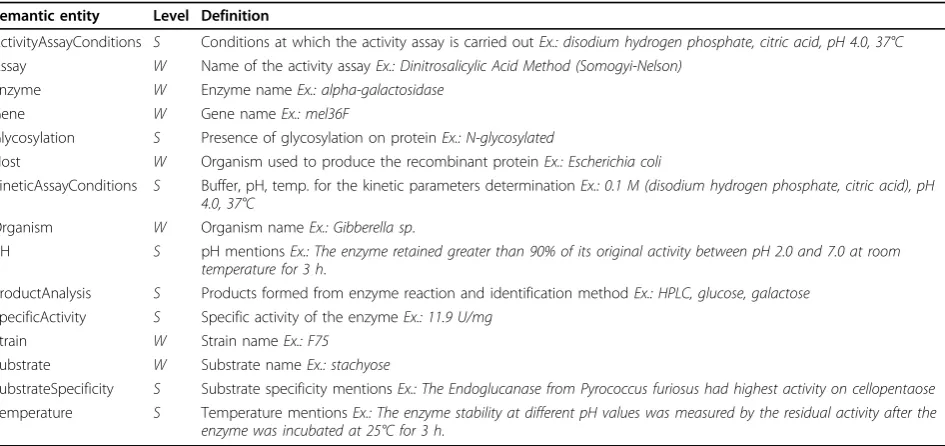
Entities include information that is of particular inter-est for the researchers, such as organisms, enzymes, assays, genes, catalytic properties, substrates, and protein properties. The list of the semantic entities along with the level on which they apply (sentence or word level), their definition and an instance example is provided in Table 1.
half consists of contextual properties captured at the sentence level (e.g., pH and temperature contexts). The entity set was built in the perspective of providing instances of the ontological representation of the domain knowledge. The enzyme names are sought, as well as the names of their source organisms and strain designations. The enzymes have specific biochemical properties, such as optimal temperature and pH, tem-perature and pH stability, specific activity, substrate spe-cificities and kinetic parameters. These experimentally determined properties describe each enzyme’s catalytic ability and capacity, and are a basis for comparison between enzymes. Their mentions are captured from the literature along with the laboratory methods (assay) used and the experimental conditions (activity and kinetic assay conditions). In addition to these properties, the extraction of mentions describing an enzymatic property (glycosylation state) and the products formed (product analysis) is performed to complete the knowl-edge of the reaction.
Semantic resources
In terms of knowledge sources, the system relies on exter-nal and interexter-nal resources and ontologies. TheTaxonomy databasehttp://www.ncbi.nlm.nih.gov/Taxonomy/[17] from NCBI is used for initializing the NLP resources sup-porting organism recognition. BRENDA http://www. brenda-enzymes.org[5] provides the enzyme knowledge along with SwissProt/UniProtKB http://www.uniprot.org/ [18]. References to the original sources are integrated into the curated data, which allows us to automatically create links using standard Web techniques: e.g., links from an organism mention in a research paper to its corresponding
entry in the NCBI Taxonomy database or from an enzyme name to its EC number in BRENDA.
System design
In this section, we provide an overview of our system architecture, the semantic resources we deployed, and the text mining pipelines we developed.
System architecture
With the different user groups and their diverging require-ments, as well as the existing and continuously updated project infrastructure, we needed to find solutions for incrementally adding semantic support without disrupting day-to-day work. Our solution deploys a loosely-coupled, service-oriented architecture that provides semantic ser-vices through existing and new clients.
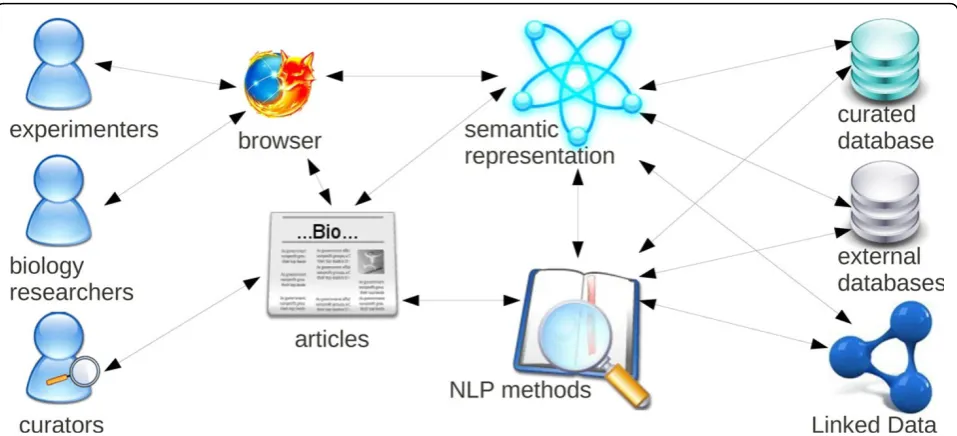
To connect the individual services and their results, we rely on standard semantic data formats, like OWL and RDF, which provide both loose coupling and semantic inte-gration, as new data can be browsed and queried as soon as it is added to the framework (depicted in Figure 1 - Inte-grating semantic support in curation, analysis, and retrie-val). The use of the Semantic Assistants architecture [19] allows us to provide semantic analysis services directly within desktop applications, by leveraging standard SOAP Web services and OWL service descriptions.
Ontology
To facilitate semantic discovery, linking and querying the domain concepts across literature and databases, the entities are modeled in an OWL ontology, which is automatically populated from documents. The system presented in this article makes use of the ontology par-tially depicted in Figure 2 - Domain ontology. The Table 1 Semantic entities, applicable level (sentence, S or word(s), W), definitions and examples
Semantic entity Level Definition
ActivityAssayConditions S Conditions at which the activity assay is carried outEx.: disodium hydrogen phosphate, citric acid, pH 4.0, 37°C
Assay W Name of the activity assayEx.: Dinitrosalicylic Acid Method (Somogyi-Nelson)
Enzyme W Enzyme nameEx.: alpha-galactosidase
Gene W Gene nameEx.: mel36F
Glycosylation S Presence of glycosylation on proteinEx.: N-glycosylated
Host W Organism used to produce the recombinant proteinEx.: Escherichia coli
KineticAssayConditions S Buffer, pH, temp. for the kinetic parameters determinationEx.: 0.1 M (disodium hydrogen phosphate, citric acid), pH 4.0, 37°C
Organism W Organism nameEx.: Gibberella sp.
pH S pH mentionsEx.: The enzyme retained greater than 90% of its original activity between pH 2.0 and 7.0 at room temperature for 3 h.
ProductAnalysis S Products formed from enzyme reaction and identification methodEx.: HPLC, glucose, galactose
SpecificActivity S Specific activity of the enzymeEx.: 11.9 U/mg
Strain W Strain nameEx.: F75
Substrate W Substrate nameEx.: stachyose
SubstrateSpecificity S Substrate specificity mentionsEx.: The Endoglucanase from Pyrococcus furiosus had highest activity on cellopentaose
Temperature S Temperature mentionsEx.: The enzyme stability at different pH values was measured by the residual activity after the enzyme was incubated at 25°C for 3 h.
graph nodes show the main entities and the blue arrows represent the subclass relationships, whereas all the other arrows stand for property relationships. The ontology is used both during the text mining process and for querying the extracted information [14].
Text mining pipelines
Our text mining pipelines are based on the General
Architecture for Text Engineering(GATE) [20]. All docu-ments first undergo basic preprocessing steps using off-the-shelf GATE components. Custom pipelines then extract the semantic entities mentioned above and populate the OWL ontology using the OwlExporter [21] component. The same pipeline can be run for automatic (batch) ontology population, embedded in Teamware (described below) for manual annotation, or brokered to desktop clients through Web services for literature mining and database curation. The general workflow of the pipeline is depicted in Figure 3 - Natural language processing workflow.
PreprocessingThe processing resources (PRs) compos-ing the first part of the system pipeline are generic and independent from the domain. Some of these resources are based on standard components shipped with the GATE distribution. In particular, the JAPE language allows the generation of finite-state language transducers that are processing annotation graphs over documents.
After initializing the document, theLigatureFinder PR
finds and replaces all ligatures, likefi, ff orfl, with their individual characters, thereby facilitating gazetteer-based
analysis. The next PR is the ANNIE English Tokenizer,
which splits the text into very simple tokens, such as numbers, punctuation characters and words of different
types. Finally, theANNIE Sentence Splitter segments the text into sentences by means of a cascade of finite-state transducers and the ANNIE part-of-speech (POS) tagger that is included with GATE adds POS tags to each token.
Organism recognitionOrganism tagging and extraction rely on the open-source OrganismTagger system http:// www.semanticsoftware.info/organism-tagger. The Orga-nismTagger is a hybrid rule-based/machine-learning sys-tem that extracts organism mentions from the biomedical literature, normalizes them to their scientific name, and provides grounding to the NCBI Taxonomy database [22].
The OrganismTagger also comes in the form of GATE pipeline, which can be easily integrated into our system. It reuses the NCBI Taxonomy database, which is auto-matically transformed into NLP resources, thereby ensuring the system stays up-to-date with the NCBI database. The OrganismTagger pipeline provides the flexibility of annotating the species of particular interest to bio-researchers on different corpora, by optionally including detection of common names, acronyms, and strains.
Enzyme recognitionDespite the standards published by the Enzyme Commission [23], enzymes are often described by the authors under various formats, ranging
from their‘Recommended Name’to different synonyms
or abbreviations. Our enzyme recognition process is rule-based: Gazetteer and mapping lists are automatically extracted from the BRENDA database, in addition to a mapping list of SwissProt identifiers extracted from the SwissProt database.
Figure 2Domain ontology. Main entities of the domain ontology and their relationships.
An enzyme-specific text tokenization, along with gram-mar rules written in the JAPE language, analyses tokens with the -aseand -asesenzyme suffixes. The gazetteers allow the finding of the enzyme mentions in the docu-ments by applying a pattern-matching approach.
Some abbreviated forms of enzyme names are not found during the pattern matching step, usually because these forms are created by the authors. The following sentence shows an example excerpted from [24].
The extracellular endoglucanase (EG) was purified to homogeneity from the culture supernatant by ethanol precipitation (75%, v/v), CM Bio-Gel A column chro-matography, and Bio-Gel A-0.5 m gel filtration. The purified EG (specific activity 43.33 U/mg protein) was a monomeric protein with a molecular weight of 27 000.
Here, EG stands for‘endoglucanase’, but this abbrevia-tion is not reported in BRENDA. Such abbreviaabbrevia-tions are meaningful only within the context of a single document. Therefore, our pipeline contains grammar rules identify-ing these author-specific abbreviations and performidentify-ing coreference resolution on each document.
The mapping lists link up the enzyme mentions found in the document and the external resources. Through this grounding step, the system provides the user with the
enzymes’Recommended Names, Systematic Names, EC
Numbers, SwissProt Identifiersand theURLof the related Web pages on the BRENDA website.
Temperature and pH contexts Temperature and pH mentions are involved in several biochemical contexts, like the temperature and pH dependence/stability of the enzyme, or the description of the activity and kinetic assay conditions. Examples are given in the following sentences from [24]:
Temperature: The purified enzyme exhibited maxi-mum activity at 55°C, with 84% relative activity at 60°C and 29% activity at 70°C under the assay con-ditions used.
pH:The enzyme displayed an optimum activity at pH 5.0 and retained 80% activity at pH 3.0 and also at pH 8.0.
Our GATE pipeline contains PRs based on JAPE rules and gazetteer lists of specific vocabulary that enable the detection of these key mentions at the sentence level.
Other entitiesThe detection of the other entities men-tioned in Table 1 is currently implemented through gazetteer lists and grammar rules implemented in JAPE; with the exception of the strain mentions, which are detected by the strain feature provided by the Orga-nismTagger pipeline.
System output and user interfaces
The system output supports two different tasks: the manual annotation of reference papers needed for eva-luation purposes and the database curation manually performed by the biologists. In the context of manual annotation, the original papers are enriched with the system output added as pre-annotations before being submitted to the human annotators. In the context of database curation, all text mining pipelines are brokered as NLP Web services through the Semantic Assistants framework [19]. Users can access these services from their desktop through client plug-ins for common tools, such as the Firefox web browser (Figure 4 - Text mining results displayed in Firefox through the Semantic Assis-tants plug-in) or the OpenOffice word processor. This provides the biologists using our system with the ability to quickly invoke semantic analysis services on scientific documents they browse online or edit in their text pro-cessor, without having to switch to an external text mining application.
External resources can be accessed from the user inter-faces; the system output provides direct links to the rele-vant Web pages, e.g., URLs of the Web pages related to the detected enzymes on the BRENDA website site or the detected organisms on the NCBI Taxonomy website.
Results and discussion
In this section, we first discuss the development of the gold standard corpus and present preliminary results of our system.
Manual annotation process
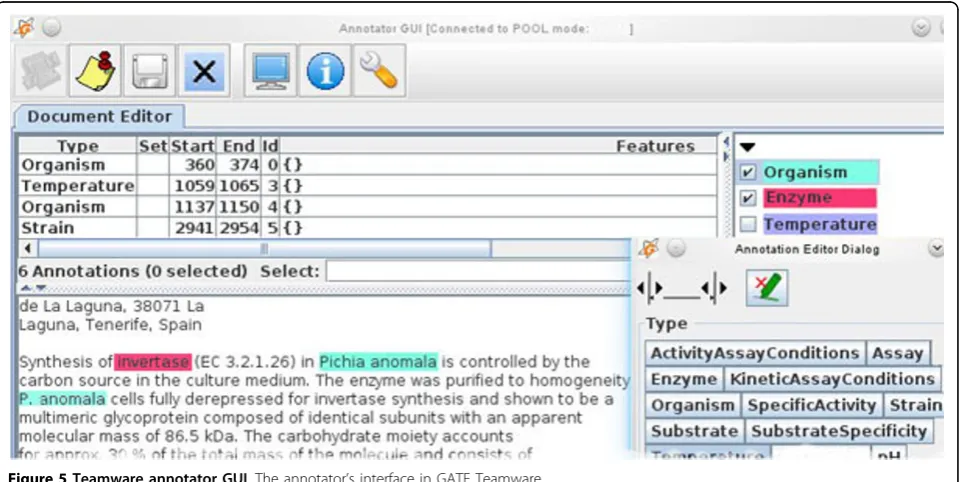
For the intrinsic evaluation of our NLP pipelines, we are building a gold standard corpus of freely accessible full-text articles. These are manually annotated through GATE Teamware [25], a Web-based management platform for collaborative annotation and curation.
The tool reports on project status, annotator activity and statistics. The annotator’s interface (see Figure 5 -Teamware annotator GUI) allows the curator to view, add and edit text annotations that are either manually created using the Teamware interface or pre-annotated. We make use of that ability by providing the annotators with documents we pre-annotate with our NLP pipe-lines throughout its development.
Corpus
The corpus is composed of freely accessible full-text articles containing critical knowledge and technical details the biology researchers aim to store in the
mycoCLAP database which is specifically designed for their needs. The papers are related to classes of enzymes, among them the glycoside hydrolases, the lipases and the peroxidases. Glycoside hydrolase papers
Figure 4Text mining results displayed in Firefox through the Semantic Assistants plug-in. Text mining results are displayed in Firefox through the Semantic Assistants plug-in.
represent 69%, lipase papers account for 12% of the arti-cles, and the remaining 19% are related to peroxidases. The current gold standard corpus is composed of ten full-text papers that have been manually annotated by four biologists each.
At the word level, the two most common entities are enzymes and organisms, while the most common at the sentence level are pH and temperature. Table 2 shows these entities and their counts of occurrence in the cur-rent gold standard corpus. The goal for the curcur-rent annotation task is to include fifty manually annotated papers in the gold standard corpus. This corpus will be available on demand.
Results
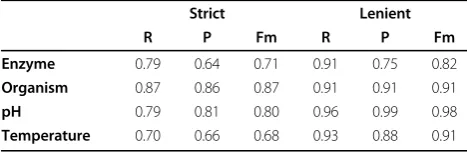
The performance of our text mining pipelines is evalu-ated in terms of precision, recall and F-measure. Here, the reference is provided by the gold standard corpus. Precision is defined as the number of correct tags detected by the system divided by the total number of detected tags. Recall is defined as the number of correct tags detected by the system divided by the total number of reference tags. The F-measure is the harmonic mean of precision and recall. For the ‘strict’ evaluation, we consider all partially correct responses as incorrect, while ‘lenient’considers all partially correct (overlap-ping) responses as correct. In this evaluation, we focus on the four most common entities (Enzyme, Organism, pH and Temperature) in our currently annotated cor-pus. The results of the text mining pipelines are shown in Table 3.
Discussion
The OrganismTagger performance has previously been evaluated on two corpora, where it showed a precision of 95%-99%, a recall of 94%-97%, and a grounding accu-racy of 97.4%-97.5% [22]. Since its results here are lower, we examined the error cases in more detail.
The manual annotation of organisms highlights all the textual mentions referring to an organism as indirect references, non-standard names (e.g., non-binomial names) or generic mentions. In some cases, correct results from the OrganismTagger were not manually
annotated, leading to false positives. The following com-mon sentence:
Soluble protein was determined according to the method of Lowry et al. (1951) usingbovine serum albumin as standard.
shows an example of such a case where the
Organism-Tagger correctly annotates bovine as an organism,
whereas the expert annotators consideredbovine serum
albuminas a stand-alone expression.
In some other cases, human annotations are not
detected by the OrganismTagger. For example,
Tricho-derma viridieandM. incrasataorcellulolytic fungiwere manually annotated as organisms by the experts. These mentions are not detected by the OrganismTagger. In the first two cases, the cause is a spelling difference between the names of the organisms reported in the NCBI Taxonomy database and their mention in the arti-cle. In the last case, the annotation of a generic organism mention that is relevant within the context of our project is not an objective of the OrganismTagger system, which is designed to provide normalization with scientific names and grounding to the NCBI Taxonomy database. Consequently, the results obtained by our pipeline on the organism recognition are lower than the published results of the OrganismTagger system. The text mining pipeline supporting our system needs to be enhanced in its ability to capture generic organism mentions and to discard stand-alone expressions containing organism names.
The results obtained onTemperatureandpHsentence
detection are much better in the lenient evaluation than the strict because of sentence splitter mistakes.
The enzyme recognition pipeline provides state-of-the-art performance. However, wrong detection of abbrevia-tions and acronyms represent 92% of the false negatives found by our pipeline. Further work is needed to reduce this amount by improving the co-reference resolution with approaches as described in [26] and external resources, such as Allie [27].
Table 2 Entities and their counts in the current gold standard corpus
Entity Counts Enzyme 1493
Organism 984
pH 110
Temperature 115
Table 2 shows the most common entities and their counts of occurrence in the current gold standard corpus.
Table 3 Text Mining pipelines results on the gold standard corpus in terms of recall (R), precision (P) and F-measure (Fm)
Strict Lenient R P Fm R P Fm Enzyme 0.79 0.64 0.71 0.91 0.75 0.82
Organism 0.87 0.86 0.87 0.91 0.91 0.91
pH 0.79 0.81 0.80 0.96 0.99 0.98
Temperature 0.70 0.66 0.68 0.93 0.88 0.91
Conclusions
We presented our ongoing development of a semantic infrastructure for enzyme data management. As the first system specifically designed for lignocellulolytic enzymes research, it targets the automatic extraction of knowledge on fungal enzymes from the research literature. The pro-posed approach is based on text mining pipelines combined with ontological resources. Preliminary experiments show state-of-the-art results. Improving the consistency of the extracted knowledge by increasing the use of ontologies is one of the next goals for our system. Therefore, a key objec-tive is the population of the overall ontology of the domain knowledge and its publication in Linked Data format.
The gold standard corpus of manually annotated papers, as well as the presented system, will be available under http://www.semanticsoftware.info/genozymes.
The accessibility of the services through the Semantic Assistants framework allows the users to mine the seman-tically annotated literature from their desktop. Future work is needed to enable the interaction between selected users (e.g., curators) and the presented system in terms of data validation and knowledge acquisition.
In future work, we will further deploy our text mining pipelines to assess the quality of existing manually curated data in the databases. Measuring the overall impact of the semantic system on the scientific discovery workflow will be the target of an extrinsic study.
List of abbreviations
ANNIE: a Nearly-New Information Extraction System; BRENDA: BRaunschweig ENzyme DAtabase; EC: Enzyme Commission; GATE: General Architecture for Text Engineering; GUI: Graphical User Interface; JAPE: Java Annotation Patterns Engine; mycoCLAP: (database of) Characterized Lignocellulose-Active Proteins of fungal origin; NCBI: National Center for Biotechnology Information; NLP: Natural Language Processing; OWL: Web Ontology Language; POS: Part Of Speech; PR: Processing Resource; RDF: Resource Description Framework; SOAP: Simple Object Access Protocol; URL: Uniform Resource Locator.
Acknowledgements
Funding for this work was provided by Genome Canada and Génome Québec. Nona Naderi is acknowledged for her work on the OrganismTagger and the LigatureFinder. Bahar Sateli is acknowledged for help on the Semantic Assistants resources. We also thank Carolina Cantu, Semarjit Shary and Sherry Wu who helped on the annotation task.
This article has been published as part ofBMC Medical Informatics and Decision MakingVolume 12 Supplement 1, 2012: Proceedings of the ACM Fifth International Workshop on Data and Text Mining in Biomedical Informatics (DTMBio 2011). The full contents of the supplement are available online at http://www.biomedcentral.com/bmcmedinformdecismak/supplements/12/S1.
Author details
1
Department of Computer Science and Software Engineering, Concordia University, Montréal, QC, Canada.2Centre for Structural and Functional
Genomics, Concordia University, Montréal, QC, Canada.3Department of
Biology, Concordia University, Montreal, QC, Canada.4Department of Chemistry and Biochemistry, Concordia University, Montréal, QC, Canada.
Authors’contributions
MJM implemented the system, carried out the ontology, provided GATE and NLP expertise, participated in curation and evaluation and drafted the
manuscript. CM carried out the curation, participated in the ontology design and the system evaluation. IM carried out the curation, participated in the ontology design and the system evaluation. GB participated in the concept and approach definitions the study makes use of and participated in the fungal genomics application. JP performed the curation validation, provided expertise on fungal enzymes and their literature and reviewed the manuscript. AT conceived of the study, participated in its design and the fungal genomics application, provided overall direction of the project and reviewed the manuscript. RW participated in the concept and approach definitions the study makes use of, provided GATE and NLP expertise, contributed to the Semantic Assistants framework, and reviewed the manuscript. All authors read and approved the final manuscript.
Authors’information
MJM is a postdoctoral fellow, a member of the Semantic Software Lab and the Centre for Structural and Functional Genomics at Concordia University. CM is a research associate at the Centre for Structural and Functional Genomics at Concordia University. IM is a postdoctoral fellow and a member of the Centre for Structural and Functional Genomics at Concordia University. GB is a professor in computer science and a member of the Centre for Structural and Functional Genomics at Concordia University. He leads the bioinformatics group. JP is an associate professor in biochemistry and a member of the Centre for Structural and Functional Genomics at Concordia University. AT is a professor of biology and the director of the Centre for Structural and Functional Genomics at Concordia University. He is the principal investigator of the project that supports this work. RW is an assistant professor in computer science and software engineering at Concordia University. He is the leader of the Semantic Software Lab.
Competing interests
The authors declare that they have no competing interests.
Published: 30 April 2012
References
1. Demirbas A:Political, economic and environmental impacts of biofuels: a review.Applied Energy2009,86(Suppl 1):S108-S117.
2. Bringezu S, Schütz H, O’Brien M, Kauppi L, Howarth RW, McNelly J:Towards sustainable production and use of resources: assessing biofuels.Tech Rep
United Nations Environment Programme; 2009.
3. Jovanovic I, Magnuson J, Collart F, Robbertse B, Adney W, Himmel M, Baker S:Fungal glycoside hydrolases for saccharification of lignocellulose: outlook for new discoveries fueled by genomics and functional studies.Cellulose2009,16:687-697.
4. Sayers EW, Barrett T, Benson DA, Bolton E, Bryant SH, Canese K, Chetvernin V, Church DM, DiCuccio M, Federhen S, Feolo M, Geer LY, Helmberg W, Kapustin Y, Landsman D, Lipman DJ, Lu Z, Madden TL, Madej T, Maglott DR, Marchler-Bauer A, Miller V, Mizrachi I, Ostell J, Panchenko A, Pruitt KD, Schuler GD, Sequeira E, Sherry ST, Shumway M, Sirotkin K, Slotta D, Souvorov A, Starchenko G, Tatusova TA, Wagner L, Wang Y, John Wilbur W, Yaschenko E, Ye J:Database resources of the National Center for Biotechnology Information.Nucleic Acids Res2009,
38(Suppl 1):D5-D16.
5. Scheer M, Grote A, Chang A, Schomburg I, Munaretto C, Rother M, Söhngen C, Stelzer M, Thiele J, Schomburg D:BRENDA, the enzyme information system in 2011.Nucleic Acids Res2011,39(Database issue): D670-D676.
6. Ananiadou S, McNaught J:Text Mining for Biology and Biomedicine
Norwood, MA, USA: Artech House, Inc; 2005.
7. InSemantic Web: Revolutionizing Knowledge Discovery in the Life Sciences.
Springer;Baker CJO, Cheung KH 2007:.
8. Shadbolt N, Berners-Lee T, Hall W:The semantic web revisited.IEEE Intell Syst21(3):96-101.
9. Müller HM, Kenny EE, Sternberg PW:Textpresso: an ontology-based information retrieval and extraction system for biological literature.PLoS Biol2004,2(11):e309.
10. Doms A, Schroeder M:GoPubMed: exploring PubMed with the Gene Ontology.Nucleic Acids Res2005,33(Web Server issue):W783-W786. 11. Hoffmann R, Valencia A:A gene network for navigating the literature.Nat
12. Bernard DC, Buxton BF, Langdon WB, Jones DT:BioRAT: extracting biological information from full-length papers.Bioinformatics2004,
20:3206-3213.
13. Görg C, Tipney H, Verspoor K, Baumgartner W, Cohen K, Stasko J, Hunter L:
Visualization and language processing for supporting analysis across the biomedical literature.InKnowledge-Based and Intelligent Information and Engineering Systems, Volume 6279 of Lecture Notes in Computer Science.
Springer Berlin/Heidelberg;Setchi R, Jordanov I, Howlett R, Jain L 2010:420-429.
14. Witte R, Kappler T, Baker CJO:Ontology design for biomedical text mining.InSemantic Web: Revolutionizing Knowledge Discovery in the Life Sciences.Springer;Baker CJO, Cheung KH 2007:281-313.
15. Pafilis E, O’Donoghue SI, Jensen LJ, Horn H, Kuhn M, Brown NP, Schneider R:Reflect: augmented browsing for the life scientist.Nat Biotechnol2009,27:508-510.
16. Murphy C, Powlowski J, Wu M, Butler G, Tsang A:Curation of characterized glycoside hydrolases of fungal origin.Database (Oxford)2011,2011: bar020.
17. Federhen S:The Taxonomy Project.InThe NCBI Handbook.National Library of Medicine (US), National Center for Biotechnology Information;McEntyre J, Ostell J 2003:.
18. UniProt Consortium:The Universal Protein Resource (UniProt) 2009.
Nucleic Acids Res2009,37(Database issue):D169-D174.
19. Witte R, Gitzinger T:Semantic assistants - user-centric natural language processing services for desktop clients.3rd Asian Semantic Web Conference (ASWC 2008), Volume 5367 of LNCS, Bangkok, ThailandSpringer; 2009, 360-374.
20. Cunningham H, Maynard D, Bontcheva K, Tablan V, Aswani N, Roberts I, Gorrell G, Funk A, Roberts A, Damljanovic D, Heitz T, Greenwood MA, Saggion H, Petrak J, Li Y, Peters W:Text Processing with GATE (Version 6)
University of Sheffield, Department of Computer Science; 2011 [http:// tinyurl.com/gatebook].
21. Witte R, Khamis N, Rilling J:Flexible ontology population from text: the OwlExporter.The Seventh International Conference on Language Resources and Evaluation (LREC 2010)Valletta, Malta: ELRA; 2010, 3845-3850. 22. Naderi N, Kappler T, Baker CJ, Witte R:OrganismTagger: detection,
normalization, and grounding of organism entities in biomedical documents.Bioinformatics2011,27(19):2721-2729.
23. International Union of Biochemistry and Molecular Biology:Enzyme NomenclatureSan Diego, California: Academic Press; 1992.
24. Saha BC:Production, purification and properties of endoglucanase from a newly isolated strain of Mucor circinelloides.Process Biochemistry2004,
39(12):1871-1876.
25. Bontcheva K, Cunningham H, Roberts I, Tablan V:Web-based collaborative corpus annotation: requirements and a framework implementation.New Challenges for NLP FrameworksValletta, Malta: ELRA; 2010, 20-27. 26. Okazaki N, Ananiadou S, Tsujii J:Building a high-quality sense inventory
for improved abbreviation disambiguation.Bioinformatics2010,
26(9):1246-1253.
27. Yamamoto Y, Yamaguchi A, Bono H, Takagi T:Allie: a database and a search service of abbreviations and long forms.Database (Oxford)2011,
2011:bar013.
doi:10.1186/1472-6947-12-S1-S5
Cite this article as:Meurset al.:Semantic text mining support for lignocellulose research.BMC Medical Informatics and Decision Making2012
12(Suppl 1):S5.
Submit your next manuscript to BioMed Central and take full advantage of:
• Convenient online submission
• Thorough peer review
• No space constraints or color figure charges
• Immediate publication on acceptance
• Inclusion in PubMed, CAS, Scopus and Google Scholar
• Research which is freely available for redistribution