Open Access
Research article
Developing a web-based information resource for palliative care: an
action-research inspired approach
Annette F Street
1, Kathleen Swift
1, Merilyn Annells
2, Roger Woodruff
3,
Terry Gliddon
4, Anne Oakley
5and Goetz Ottman*
1Address: 1Clinical School of Nursing, La Trobe University/Austin Health, Lv 4 Austin Tower, Heidelberg VIC 3084, Australia, 2Nursing & Midwifery,
La Trobe University, Bundoora VIC 3083, Australia, 3Director of Palliative Care Austin Health, Suit 9, 210 Burgundy Street, Heidelberg VIC 3084,
Australia, 4Research and Development, Royal District Nursing Services, 31 Alma Rd, St. Kilda VIC 3182, Australia and 5CEO, Melbourne City
Mission, 471 Nicholson St., North Fitzroy VIC 3068, Australia
Email: Annette F Street - [email protected]; Kathleen Swift - [email protected];
Merilyn Annells - [email protected]; Roger Woodruff - [email protected]; Terry Gliddon - [email protected]; Anne Oakley - [email protected]; Goetz Ottman* - [email protected]
* Corresponding author
Abstract
Background: General Practitioners and community nurses rely on easily accessible, evidence-based online information to guide practice. To date, the methods that underpin the scoping of user-identified online information needs in palliative care have remained under-explored. This paper describes the benefits and challenges of a collaborative approach involving users and experts that informed the first stage of the development of a palliative care website [1].
Method: The action research-inspired methodology included a panel assessment of an existing palliative care website based in Victoria, Australia; a pre-development survey (n = 197) scoping potential audiences and palliative care information needs; working parties conducting a needs analysis about necessary information content for a redeveloped website targeting health professionals and caregivers/patients; an iterative evaluation process involving users and experts; as well as a final evaluation survey (n = 166).
Results: Involving users in the identification of content and links for a palliative care website is time-consuming and requires initial resources, strong networking skills and commitment. However, user participation provided crucial information that led to the widened the scope of the website audience and guided the development and testing of the website. The needs analysis underpinning the project suggests that palliative care peak bodies need to address three distinct audiences (clinicians, allied health professionals as well as patients and their caregivers).
Conclusion: Web developers should pay close attention to the content, language, and accessibility needs of these groups. Given the substantial cost associated with the maintenance of authoritative health information sites, the paper proposes a more collaborative development in which users can be engaged in the definition of content to ensure relevance and responsiveness, and to eliminate unnecessary detail. Access to volunteer networks forms an integral part of such an approach. Published: 14 September 2007
BMC Medical Informatics and Decision Making 2007, 7:26 doi:10.1186/1472-6947-7-26
Received: 7 December 2006 Accepted: 14 September 2007
This article is available from: http://www.biomedcentral.com/1472-6947/7/26
© 2007 Street et al; licensee BioMed Central Ltd.
Background
Several recent reports tabled by government as well as non-governmental health agencies foreground a signifi-cant disparity between the information needs of health professionals, patients and caregivers givers and the avail-ability of such information. In response, the reports urge governments to invest in the information, education, and training resources available to health-care professionals, patients and caregivers, as well as the wider community, in order to foster awareness and capacity regarding pallia-tive care [2-10].
Whereas the increasing demand for consumer health information on the Internet has been also the topic of much recent medical, social science and information sci-ence literature [11-22], there has been a noticeable absence of studies that focus on how to adequately design such online resources. This paper describes the advantages and challenges of a collaborative, action research-inspired approach involving users (doctors, nurses, and consumer and caregiver representatives) that informed the develop-ment of a palliative care website [1] providing accessible information for the general public, along with evidence-based pain, symptom and psycho-social information for health professionals.
The aim of the government-funded study was to improve the existing website of Palliative Care Victoria (PCV), a state-level palliative care organisation. In light of the large volume of inquiries from community doctors, nurses and members of the general public, the Director of PCV was of the view that the organisation's response to such enquiries could be improved by enhancing the information for the general public, along with evidence-based pain, symptom and psycho-social information for health professionals, in particular general practitioners and community nurses available through its website. The study also took into account more global policy issues. For instance, it took into account the key recommendations outlined by the Improving Supportive and Palliative Care for Adults with Cancer report tabled by the United Kingdom-based National Institute for Clinical Excellence in 2004. Among other the report underscored the value of high quality information for patients and caregivers, the importance of ensuring that the views of patients and caregivers are taken into account in developing and evaluating cancer and pal-liative care services, and that patients and caregivers have easy access to a range of easy to read, high quality infor-mation materials about cancer and palliative care services that are provided free of charge [27]. Yet, the study's main aim was to tackle a range of information gaps highlighted in recent national government reports [3,4,6,7]. In partic-ular, the study responded to the policies outlined in the Australian Government National Palliative Care Priori-ties, namely to improve professional awareness and
com-mitment of health professionals to the role of palliative care practices, and to provide quality information to patients and their caregivers [23,24].
Method
As the project was designed to be responsive to feedback from potential user groups an action research approach was undertaken. The actual research design and reporting structure was negotiated with the funding agency at the outset. The action research process enabled the project staff to design an iterative process of continuous improve-ment through trial, analysis, and feedback from key stake-holders in order to adapt and modify the project to meet emergent needs [25-30]. In this project, the study of effects and outcomes of one stage informed the develop-ment process of the next stage and provided guidance for the development of the investigative framework that best addressed the evaluation questions. The following Figure (1) provides an overview of the action research methodol-ogy employed.
Theoretical contributions to the field of educational multi-media design indicate that issues regarding content, language, and 'look and feel' could potentially be resolved through an ongoing consultation with expert user groups [31-33]. In fact, it is widely acknowledged that an ideal design process of educational online resources is based on cybernetic principles of general system theory, which relies on cycles of self-testing, ongoing feedback, and con-stant adjustments [34]. However, this extremely flexible and responsive approach to web design, although able to accommodate changes in and unanticipated effects of the implementation progresses, is seldom employed due to the high cost of cycling back to stages previously com-pleted [34]. In this project, we employed an iterative, formative development process inspired by these princi-ples.
User feedback was collected in the form of focus group discussions, summary grids, written comments, and 'think aloud protocols', a method where users navigate the prototype site delivering verbal comments throughout the process [34]. An audit trail was designed to keep track of user responses.
the Melbourne-based Centre for Online Media and Educa-tional Technology (COMET) for eventual transfer to the Palliative Care Victoria website. The beta (test) site devel-opment was undertaken with input from external experts and the User Working Groups. The beta site was then assessed by key stakeholders as well as consumers. Finally, as last modifications were made to the site the sustainabil-ity plan was implemented in conjunction with PVC. The following Figure (2) gives an overview of the major project stages:
Because our aim was to include, as much as possible, the views and expertise of all potential users of the website, it was attempted to include as many representatives of potential stakeholder groups as possible in the PRG and UWG so that they would be adequately represented dur-ing the various project cycles.
Stage 1 – literature review, pre-development survey, website search
The thematic literature review was based on an extensive search of electronic databases (Medline, CINAHL,
PubMed) as well as web-based searches (Google, Google Scholar) for additional material, such as reports commis-sioned by government as well as non-governmental agen-cies. Due to the limited scope of the literature on palliative care, sources dealing with online cancer information were included in this literature review. Permutations of search terms (Palliative, Cancer, Care, Online, Internet, Informa-tion, Needs) were used to collect a total of 388 biblio-graphical entries in an EndNote file. A researcher scanned the abstracts of these articles for relevance, thus eliminat-ing 314 articles. The remaineliminat-ing 74 articles were sourced for inclusion into the literature review. In addition a sep-arate literature review was conducted focusing on the available clinical evidence in subcategories of palliative care such as pain, medication, and psychosocial needs. For the clinical subject areas systematic reviews submitted to the Cochrane database, clinical guidelines, as well as expert consensus panels were included. The research underpinning the clinical information included on the website was evaluated and ranked by clinical palliative care experts. Due to the dearth of research-based evidence in sub-categories such as psycho-social needs, the PRG decided to include also what is considered 'best practice' in those fields.
A short online survey was designed to provide a cursory overview of users and their palliative care information Main Project Stages
Figure 2
Main Project Stages.
!
"#
Action Research Process
Figure 1
Action Research Process. NEEDS ANALYSIS
COLLABORATION & CONSULTATION EXAMINE EVIDENCE
EXPERT GUIDELINE DEVELOPMENT
IMPLEMENT
EVALUATE
REFLECTION
FORMATIVE USER EVALUATION
RE-DESIGN STRATEGIES
EXPERT-BASED EVALUATION
REFLECT & CONSULT FURTHER
REVIEW PROGRESS
LAUNCHWEBSITE SUSTAINABILITYESTABLISH PLANS COLLABORATION
& CONSULTATION
IMPLEMENT
EVALUATE
Formative/Iterative Cycle
needs. The 10 question survey was posted on the existing PCV website. Participants were asked:
• why they accessed the website
• whether they were health professionals or patients/car-egivers/members of the public,
• what kind of information they were looking for,
• whether they found the desired information,
• to indicate areas that should be considered for inclusion in the website,
• whether it was easy to locate the information on the existing site, and
• to comment information gaps in the current site.
Internet users who accessed the site were asked to com-plete the form online. The survey was posted on the inter-net for a total of five and a half months beginning from 8 October 2003. Response to the survey was anonymous. The webmaster collected the responses and coded and pre-compiled the data. Subsequently, the responses were screened, duplicates or void forms were eliminated, and the pre-compiled data was analysed.
Furthermore, an extensive search of existing health web-sites was undertaken to identify the key features of reputa-ble or 'Health on the Net' (HON) accredited websites. The Economic and Social Council of the United Nations accredited HON Foundation is the leading organization promoting and guiding the deployment of useful and reli-able online medical and health information, and its appropriate and efficient use.
Stage 2 – gap analysis
Taking into account the preliminary findings from the lit-erature review, the web search, and the results of the pre-development survey, both UWGs drafted a detailed gap analysis framework addressing the information needs of the stakeholders they represented. Moreover, the Project Reference Group as well as key stakeholders and the experts from the Centre for Online Multimedia and Edu-cational Technologies (COMET) at La Trobe University, evaluated the original website of Palliative Care Victoria for content, relevance, accessibility, links, search poten-tial, design features and language level. The original web-site catered predominantly for palliative care 'insiders' (mainly general practitioners and physicians) and posted a series of pamphlets and press releases that could be handed on to patients. The literature reviews in conjunc-tion with the website search as well as guidelines provided
an overall framework for content and design, whereas the online survey gave an initial indication of the kind of sub-ject areas health professionals, patients, and caregivers might expect the future site to cover. In this sense, the 'gap analysis' provided very rough guidelines for the construc-tion of a beta site. However, it is important to remember that, because of the formative, iterative process that underpinned the design of the website, needs and gap analyses were ongoing as stakeholder representatives co-designed and debated the content of the site through the numerous iteration cycles.
Stages 3 and 4 – beta development and testing
An effective Project Reference Group was formed. The Project Reference Group (PRG) brought together nine professionals active in a range of palliative care-related fields and who held senior positions in councils, associa-tions, and academia. Moreover, the PRG included a Project Officer who had extensive knowledge of the palli-ative care field. The Project Officer moderated most group discussions. The sizeable networks of these individuals were instrumental during the implementation phase of the project as many of the User Working Group members were recruited through these networks. Moreover, these participants brought to the project expertise in clinical palliative care, project management, team leadership, online educational technology, and research/evaluation techniques that could be drawn upon over the course of the project. Several members of the PRG joined an edito-rial panel that took responsibility for drafting editoedito-rial guidelines and monitoring content. The PRG functioned as the central mediation vehicle and most editorial deci-sions were discussed within this forum.
In addition to the PRG and UWGs, a substantial number of experts in fields such as palliative care, nursing, com-munity support, or allied health made major contribu-tions to the project. Also, a consumer focus group was conducted by a market research firm. This focus group dealt primarily with the look and feel (colour schemes, navigability) of the website. Because representatives of all major stakeholders were involved in the reference and working groups, it is reasonable to suggest that these stake holder groups had a direct input into the design of the web site. Moreover, bearing in mind that 197 and 166 par-ticipants respectively responded to the pre-development and evaluation online surveys, it is likely that over 300 individuals contributed to the design and evaluation of the PCV website.
Stage 5 – evaluation
An evaluation survey was attached to the new website. Not withstanding minor changes, the evaluation survey mir-rored the content of the pre-development survey. Based on the experience with the pre-development survey, it was decided to separate the information for the public and health professionals. The pre-development survey did not make this separation. Moreover, the evaluation survey was more structured providing a list of possible responses that participants could tick in addition to an 'other' cate-gory followed by an open-ended prompt to specify this response.
Results
Stage 1 – literature review and online survey
The literature review revealed a growing recognition of the existence of unmet information needs regarding palliative care practice [6,9,35-44]. Recent evidence suggests that doctors, nurses, patients, and caregivers increasingly turn to the internet to meet some of these information needs [12-14,16,18,20,22,45-51]. One of the key concerns that surfaced in the literature focusing on online health is the issue of quality. A large number of studies express con-cerns with regard to the quality of information provided by web sites that post cancer health information on the Internet [52-58]. Most of these studies alert to the fact that websites commonly display misleading, incomplete, and/ or erroneous information and that the confidentiality of data is often not assured [55,59-64]. Surveys of websites and the way users access them suggest that it is difficult and time consuming to identify good online resources and that the capacity of users to find and access valuable information is limited [65,66]. For most researchers the key problem faced by users is how to evaluate the quality of online information and how to establish the trustwor-thiness of sources.
In particular, researchers [4,6,7,57,64,66-72] identify the following key issues:
• Lack of editorial control,
• misleading or incomplete content,
• inappropriate design,
• inappropriate cultural bias,
• inappropriate commercial content,
• lack of readability (especially for cultural minorities or people with disabilities),
• inappropriate navigation tools,
• overall disorganisation of the site,
• accessibility of audio and visual resources, and
• problems regarding volume management and mainte-nance.
In response to these quality concerns, authors propose the use of tools to evaluate the quality of health information web sites [73,74], and/or to introduce obligatory stand-ards or evidence-based editorial criteria to improve the quality of health information sites [54,66,75,76]. Yet, recent contributions to the field have been critical of eval-uation tools, claiming that they are largely ineffective [77].
Other commentators have recommended the design of designated portal sites or gateway servers that organise and edit web content [78]. To some degree, sites such as OncoLink, the Cancer Net, Cancer Help UK, and others fit into this category. A number of articles give an overview of [79-84] and/or evaluate such sites [85,86]. Designated portal sites or gateway servers generally enjoy impressive approval ratings among clinicians as well as the general public. Nevertheless, recent articles have raised the issue of sustainability and costs, update, and maintenance work faced by online health information providers [87]. More recent evidence questions the proposition that the design of web portals lastingly improves the quality of online health information [88].
accessi-ble, sustainaaccessi-ble, and has to respond to the information needs of potential user groups. Furthermore, the design process benefits from an ongoing involvement of stake-holder groups. However, there is a dearth of evidence regarding the information that should be included in a site providing educational information on palliative care to health professionals as well as to patients and associ-ated caregivers as well as the methodology might be suc-cessfully employed to that end.
Pre-development survey
The survey attached to the existing website generated a total of 197 responses (see Table 1 below). All responses were considered valid, although not all questionnaires were completed in full. The majority of respondents who did not complete all ten questions left out the open ended questions. One hundred and thirty two (67.01%) respondents identified themselves as health professionals and 63 (31.98%) as non-health professionals.
Table 1: Responses to Pre- and Post-Development Surveys
Existing Website New Website
Period of Survey online Oct 2003 – March 2004 May 2006 – March 2007
Responses (n=) 197 166
Health Professionals 132 (67%) 121 (73%)
Caregivers/Patients/Public 63 (32%) 45 (27%) What information were you looking
for on the PCV website?
Public:
• To find information that would assist me in my care giving role (15%)
Health Professionals:
• To find information in support of professional practice (79%)
• To find information that would assist patients in their care-giving role (15)
• Clinical aspects of professional practice (13%) Public & Health Professionals:
• To find resources on palliative care (66%)
Public:
• To understand the health care system better (96%) • About palliative care services in Victoria (40%) • About helping someone who has an illness (33%) • To help the person I care for to receive the best possible treatment (31%)
• To help me deal with my feelings (27%) • To understand what palliative care is (26%) • About living with my illness (11%)
• About palliative care services in Australia (11%) • To help me put my affairs in order (9%) • To help me receive the best care possible (4%) Health Professionals:
• Education available in palliative care (50%) • Symptom Management (37%)
• Advance Care Planning (31%) • Loss and Grief (25%)
• Talking with clients and their families (23%) • Palliative care services in Victoria (22%) • Palliative Care Victoria (21%)
• Death (21%)
• Services available to my clients (21%)
• A website clients and their families could use as a resource (17%)
• The meaning of palliative care (13%) • Palliative care services in Australia (4%) Did you find the information you
wanted?
128 yes (65%) 68 no (35%)
137 yes/some but no all (82%) 18 no (11%)
Was it easy to find the information? 130 yes (66%) 57 no (29%)
122 yes (74%) 38 no (23%) Additional information to be included: • Professional Practice
• Grief
• Advance Care Planning • Volunteering
• Pain • Jobs • Ethics • Home Care • Contact Details
Health Professionals:
• Courses/Workshops/Conferences • Scholarships
• Careers Public:
• List of places to go as a family • Sings of dying/clinical information • Volunteering
• Jobs
• Financial entitlements Comments about the website • the need for better navigation tools,
• the site's limited content,
• the ineffectiveness of the site's search engine, and
• the fact that the site had not been updated.
• Plain, clear and unemotional, but still sensitive – well done.
The most important reasons respondents provided for accessing the existing palliative care website were to seek information in support of their role as health profession-als (79.26%) and professional practice (13%), to find available resources (66.21%), and to find information that would assist them in their care-giving role (15%). Of the respondents 128 (64.97%) indicated that they had found the information they were looking for and 68 (34.52%) stated that they did not. Respondents to the existing website thought that in-depth information about topics such as pain, grief, volunteering and ethical issues should be included. Also noted was the absence of links for volunteers, a site map, a list of recommended publica-tions, a listing of employment opportunities and short courses, comprehensive information for professionals, course information on professional practice, and contact details.
When asked if it was easy to find the information that they were seeking, 130 (65.99%) of the respondents to the existing site gave an affirmative response, whereas 57 (28.93%) responded negatively. Sixty two (31.47%) par-ticipants specified their answer. Of these, 26 (13.20%) gave positive feedback, whereas 20 (10.15%) provided constructive criticism. The issues raised by these respond-ents were:
• the need for better navigation tools,
• the site's limited content,
• the ineffectiveness of the site's search engine, and
• the fact that the site had not been updated.
Stage 2 – gap analysis of existing site
The expert panel discovered limitations in the organisa-tion, content, language, accessibility, design, navigability, and readability of the existing PCV website. To some degree this finding was expected, given the limited resources available for the ongoing support and develop-ment of a site mainly administered by volunteers. Among the most important shortcomings noted by the panel was the very limited scope of the website, the lack of effective search capacity, the complexity of the language used and accessibility issues for people with reading difficulties. It was felt that the website was largely providing informa-tion to 'insiders' in the palliative care community but not to general health professionals nor to a substantial seg-ment of caregivers, patients, and the general public.
The two working parties considered material from the gap analysis, the website search, as well as a preliminary anal-ysis of emerging survey responses. Also the working party members' opinions of unmet needs as identified from
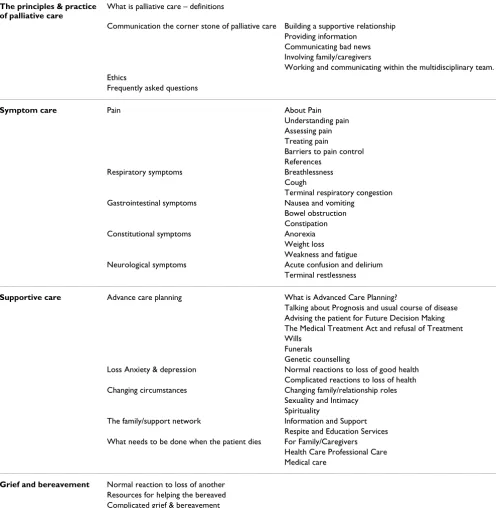
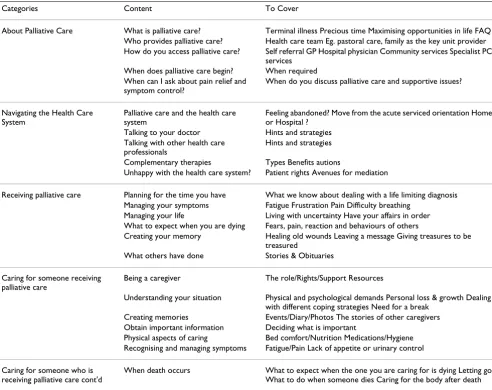
their own experience or from interaction with their peer networks. Discussion ensued about how much informa-tion should be available for a quick scan approach, how much should be printable information sheets or pam-phlets, and what links should be included to provide greater depth of knowledge. Each working party devel-oped a framework for the health professional or the con-sumer web portal respectively. An overview of these frameworks is provided in Tables 2 and 3.
Moreover, working parties in conjunction with the PRG defined the overall scope of the new website delimiting the topics that would be covered by the site. Excluded from the site were topic such as careers and financial enti-tlements.
Stage 3 and 4 – beta development and testing
Because this phase has been published in detail elsewhere only a short summary of its key elements of this phase is given. The formative user evaluation underpinning the project worked exceptionally well. Perhaps the most sur-prising element of this phase was the level of support that participants were willing to invest in the project. Whereas the UWGs provided crucial information during the initial stages of the project, the editorial panel in conjunction with key user groups associated with the representatives participating in the UWGs provided valuable input during the evaluation of the beta test site. As anticipated, feed-back occurred continuously throughout the project and was circulated through the PRG and UWGs. As a result, the PRG and UWGs were able to respond quickly to user feedback and shape the content and overall design of the website accordingly. Expert evaluators became important mediators of conflicts. Referring to 'good practice' guide-lines and by providing their 'expert opinion', they, sup-ported by the PRG, managed to resolve diverging views as well as conflicts of interests that surfaced within UWGs.
Stage 5 – evaluation survey
The online survey posted on the new website resulted in a total of 166 responses (see Table 1 below). A total of 121 (73%) respondents identified themselves as health pro-fessionals and 45 (27%) as care givers, patients, or mem-bers of the public.
Palliative Care Victoria (22%), death (21%), services available to their clients (21%), and a resource website for clients (17%).
Of the respondents, 137 (82%) indicated that they had found all or some of the desired information and 18 (11%) stated that they did not. Respondents of the
evalu-ation survey thought that topics such as further educevalu-ation, conferences, scholarships, as well as lists of places to go to as a family, signs of dying/clinical information, volunteer-ing and financial entitlements should be considered.
Table 2: Framework for health professional portal
The principles & practice of palliative care
What is palliative care – definitions
Communication the corner stone of palliative care Building a supportive relationship Providing information
Communicating bad news Involving family/caregivers
Working and communicating within the multidisciplinary team. Ethics
Frequently asked questions
Symptom care Pain About Pain
Understanding pain Assessing pain Treating pain
Barriers to pain control References
Respiratory symptoms Breathlessness Cough
Terminal respiratory congestion Gastrointestinal symptoms Nausea and vomiting
Bowel obstruction Constipation Constitutional symptoms Anorexia
Weight loss Weakness and fatigue Neurological symptoms Acute confusion and delirium
Terminal restlessness
Supportive care Advance care planning What is Advanced Care Planning?
Talking about Prognosis and usual course of disease Advising the patient for Future Decision Making The Medical Treatment Act and refusal of Treatment Wills
Funerals
Genetic counselling
Loss Anxiety & depression Normal reactions to loss of good health Complicated reactions to loss of health Changing circumstances Changing family/relationship roles
Sexuality and Intimacy Spirituality
The family/support network Information and Support Respite and Education Services What needs to be done when the patient dies For Family/Caregivers
Health Care Professional Care Medical care
A total of 122 (74%) respondents claimed that it was easy to access the desired information, whereas 38 (23%) claimed that it was not.
Comments focusing on the new website were positive regarding content and design.
Discussion
Involving users in the identification of content and links for a palliative care website as well as the evaluation of the site's 'look and feel' is time-consuming and requires initial resources, strong networking skills, and ongoing commit-ment. However, the benefits of engaging key stakeholders in defining and refining the scope and content of such a website outweigh the disadvantages. Over the course of this study, user involvement led to the widening of the scope of the website and alerted the project group to shortcomings regarding content, language, presentation, and usability.
The original intention of the expert re-developed website was to provide information to the consumers and for health professionals in the community who did not have continual access to palliative care expertise. User involve-ment significantly auginvolve-mented these aims. In addition to the original intention, the stakeholder-conducted gap analysis in conjunction with the user online survey iden-tified the need for a site that
• provided reputable expert or evidence-based informa-tion,
• addressed information requirements in areas such as professional practice, ethical dilemmas or practice stand-ards, as well as topics related to managing palliative pain, grief, advanced care planning, or home care,
• provided clinical content in accessible lay language for the general public,
Table 3: Framework for consumer portal
Categories Content To Cover
About Palliative Care What is palliative care? Terminal illness Precious time Maximising opportunities in life FAQ Who provides palliative care? Health care team Eg. pastoral care, family as the key unit provider How do you access palliative care? Self referral GP Hospital physician Community services Specialist PC
services When does palliative care begin? When required When can I ask about pain relief and
symptom control?
When do you discuss palliative care and supportive issues?
Navigating the Health Care System
Palliative care and the health care system
Feeling abandoned? Move from the acute serviced orientation Home or Hospital ?
Talking to your doctor Hints and strategies Talking with other health care
professionals
Hints and strategies
Complementary therapies Types Benefits autions
Unhappy with the health care system? Patient rights Avenues for mediation
Receiving palliative care Planning for the time you have What we know about dealing with a life limiting diagnosis Managing your symptoms Fatigue Frustration Pain Difficulty breathing
Managing your life Living with uncertainty Have your affairs in order What to expect when you are dying Fears, pain, reaction and behaviours of others
Creating your memory Healing old wounds Leaving a message Giving treasures to be treasured
What others have done Stories & Obituaries
Caring for someone receiving palliative care
Being a caregiver The role/Rights/Support Resources
Understanding your situation Physical and psychological demands Personal loss & growth Dealing with different coping strategies Need for a break
Creating memories Events/Diary/Photos The stories of other caregivers Obtain important information Deciding what is important
Physical aspects of caring Bed comfort/Nutrition Medications/Hygiene Recognising and managing symptoms Fatigue/Pain Lack of appetite or urinary control
Caring for someone who is receiving palliative care cont'd
• guided consumers through the health care system
• provided tools to enhance medical and consumer deci-sion making,
• supplied printable pamphlets for patients and caregiv-ers,
• regularly monitored and updated links and material,
• provided key points that can be easily visually scanned, and
• does not contain distracting graphics that increase download time.
These points would have been missed if the project had proceeded with a common, expert-based web-design.
To some extent, the success effect of the iterative, partici-patory design of the website is visible in the evaluation survey posted to the new website. For instance, a compar-ison of the pre-development survey with the evaluation survey shows a decrease of visitors that did not find the information they were looking for from 35% to 11%. Concurrently, the percentage of participants who thought it easy to find the desired information increased from 66 to 74.
Interestingly, since going live, the new website has become an education resource for nursing staff, students, as well as allied health workers. In fact, 46% of the evalu-ation survey respondents were nurses. Moreover, the eval-uation survey suggests that an, albeit small, but nevertheless important number of care givers and patients is accessing the site. Seventeen percent of evaluation sur-vey respondents were care givers or patients. The overall feedback by health professionals as well as patients and caregivers to the new website was, in contrast to the pre-development survey, exclusively positive. What is more, all of the additional topics that health professional thought might be considered for inclusion were outside the scope of the website as defined by UWGs and the PRG.
Yet, the evaluation survey also demonstrates that the por-tal for patients, families, and their caregivers might require some finetuning. The evaluation survey suggests that whereas the information needs of health profession-als are covered by the new site, this is not entirely the case for patients as well as their families and care givers. Given that the information needs of patients and care givers are likely to be more diverse than those of health profession-als, this was expected, however. What is more, only two (1%) of respondents to the evaluation survey were Gen-eral Practitioners (GPs). The reason for this low share in
the overall population of respondents has not been ana-lysed. It has to be born in mind that the evaluation survey reflects only on the first eleven months in the life span of the new website. Future surveys will show whether the site will become a central reference for care givers, patients, and GPs.
What is more, the re-development of the website accom-panied by the positive feedback the organisation received has led to significant changes in the way PCA manages information. Whereas the old website functioned mainly as a provider of pamphlets and leaflets on palliative care, the new website has assumed a much more central role in the overall operation of the organisation providing educa-tion and informaeduca-tion. Moreover, PCA plans to web-cast public relations items on the site. Moreover, encouraged by the re-development of the site, the PCV has applied for additional funding in order to integrate web-based infor-mation more fully into its communication strategy. Hav-ing become aware of the potential of its online strategy, web-support has assumed a more important role in the organisation. This in conjunction with the additional funding PCV was able to attract has impacted positively on the sustainability of the website.
Limitations
Several limitations were recorded. Perhaps the most important, and obvious, limitation is the usefulness of the pre-development survey in scoping possible web content for a future potential audience that is not yet accessing the site. Whereas the pre-development survey indicated that more non-health professionals accessed the site than was expected, the pre-development survey gave only limited indication as to the information needs of patients and their care givers. In fact, the development process relied to large extent on the input of the UWG as well as the itera-tive evaluations to define the portal for non health profes-sionals.
and to involve consumer representatives, this kind of approach requires strong networking skills and only indi-viduals with good links to key user groups will be likely to gain the support of key user representatives.
Also, because of the large number of individuals involved in the project and because of the iterative evaluation cycles, an enormous amount of information will be gen-erated. The administration and processing of this infor-mation requires well-honed project management skills. In part this had to do with the ineffectiveness of one of the research tools: the summary grid. The summary grid asked for an assessment of the content of each of the web pages associated with these questions using the following crite-ria: clarity of information, accuracy of information, use-fulness of links, target audience for the page, and layout and further suggestions. This feedback method was time-consuming and only members of the consumer panel and a few members of the health professional panel provided feedback in this manner. However the written feedback was most thorough and provided excellent guidance to adjust language and content, to provide further informa-tion, and/or to include further links. However, the major-ity of participants provided feed-back in an ad-hoc, unstructured manner that did not correspond with the data-collection time points we had set. This generated an extraordinary amount of information that, at times, threatened to overwhelm our project officer. This prompted us to strengthen the methodology of subse-quent web design projects involving user participation.
For reasons beyond our control, we were unable to gener-ate a denominator for the responses to the initial and sub-sequent surveys, as well as for the subsub-sequent utilisation of the website. As a result we are unable to complete the rhetorical loop demonstrating an improved usage of the website. This clearly limits the explanatory power of the study.
Conclusion
A growing body of literature and government reports highlight the existence of a significant information gap with regard to palliative care. As more and more people use the internet to meet their health information needs, the question of what kind of palliative care information internet users are actually looking for becomes central to any online information strategy. However, research that focuses on the palliative care information needs of inter-net users is scarce. This study illustrates how a user-based methodology involving key stakeholders and potential users can contribute successfully to the development of content, language, and design of the website as well as to its evaluation. Web developers are encouraged to involve potential users in their website development and pay
close attention to the content, language, and accessibility needs of their respective audiences.
Competing interests
The author(s) declare that they have no competing inter-ests.
Authors' contributions
AS and KS conceptualised and designed the project. AS, KS, MA, RW, TG, and AO were involved in the data collec-tion effort and provided critical input through the project. AS and GO conducted the final data analyses and data interpretation and drafted the manuscript. MA, RW, TG, and AO revised the manuscript and contributed to its intellectual content. All authors read and approved the final manuscript.
Additional material
Acknowledgements
The project was funded by the Department of Health and Ageing, Can-berra, Australia. Moreover, to contribute to this project authors were sponsored by their host organisations: Annette F. Street (Prof.) Clinical Nursing La Trobe University, Kathleen Swift Research Assistant Clinical Nursing La Trobe University, Merilyn Annells (Prof.) Community Nursing La Trobe University, Roger Woodruff (Dr) Medical Oncologist and Direc-tor of Palliative Care Austin Health, Terry Gliddon (MA AppSci) Research and Development Manger Royal District Nursing Service, Anne Oakley Manager Melbourne Citymission Palliative Care, and Goetz Ottman (Dr) Research Fellow, Clinical Nursing, La Trobe University.
References
1. Palliative Care Victoria [http://www.pallcarevic.asn.au] 2. Healthcare Management Advisors: Paediatric Palliative Care
Service Model Review. Canberra , The National Palliative Care Program; 2004.
3. National Palliative Care Strategy: A National Framework for Palliative Care Service Development. Canberra , Australian Government: Department of Health and Ageing; 2000.
4. Sullivan K, Johnston L, Colyer C, Beale J, Willis J, Harrison J, Welsh K:
National Indigenous Palliative Care Needs Study. Canberra , The National Palliative Care Program; 2003.
5. Mount Olivet Community Services: Research Study into the Edu-cational, Training and Support Needs of General Practition-ers in Palliative Care. Canberra , The National Palliative Care Program; 2003.
6. Friedman DB, Hoffman-Goetz L, Arocha JF: Readability of cancer information on the internet. Journal of Cancer Education 2004,
19(2):117-122.
7. Birru M, Steinman RA: Online health information and low-liter-acy African Americans. Journal of Medical Internet Research 2004,
6(3):e26.
Additional file 1
Summary Grid
Summary Grid
Click here for file
8. PPR Consulting: Promoting Partnerships in Palliative Care Services. Melbourne , Department of Human Services Victoria; 2004.
9. Davies E, Higginson IJ: The Solid Facts: Palliative Care. World Health Organization; 2004.
10. Thain A, Wales A: Information needs of specialist healthcare professionals: a preliminary study based on the West of Scotland Colorectal Cancer Managed Clinical Network. Health Information & Libraries Journal 2005, 22(2):133-142.
11. Bleakley A, Merzel CR, VanDevanter NL, Messeri P: Computer access and Internet use among urban youths. American Journal of Public Health 2004, 94(5):744-746.
12. Bright MA, Fleisher L, Thomsen C, Morra ME, Marcus A, Gehring W:
Exploring e-Health usage and interest among cancer infor-mation service users: the need for personalized interactions and multiple channels remains. Journal of Health Communication
2005, 10 Suppl 1:35-52.
13. Dickerson S, Reinhart AM, Feeley TH, Bidani R, Rich E, Garg VK, Her-shey CO: Patient Internet use for health information at three urban primary care clinics. Journal of the American Medical Infor-matics Association 2004, 11(6):499-504.
14. Doney L, Barlow H, West J: Use of libraries and electronic infor-mation resources by primary care staff: outcomes from a survey. Health Information & Libraries Journal 2005, 22(3):182-188. 15. Escoffery C, Miner KR, Adame DD, Butler S, McCormick L, Mendell
E: Internet use for health information among college stu-dents. Journal of American College Health 2005, 53(4):183-188. 16. Rees T: More Americans going online looking for health
infor-mation. Profiles in Healthcare Marketing 2005, 21(4):2.
17. Balmer C: The information requirements of people with can-cer: where to go after the "patient information leaflet"? Can-cer Nursing 2005, 28(1):36-44.
18. Basch EM, Thaler HT, Shi W, Yakren S, Schrag D: Use of informa-tion resources by patients with cancer and their compan-ions. Cancer 2004, 100(11):2476-2483.
19. Brotherton JM: Internet is indeed useful source for patients with cancer. BMJ 2004, 328(7444):898.
20. Mick J: Patients used the internet to transform their cancer experiences. Evidence Based Nursing 2004, 7(4):.
21. Ziebland S, Chapple A, Dumelow C, Evans J, Prinjha S, Rozmovits L:
How the internet affects patients' experience of cancer: a qualitative study. BMJ 2004, 328(7439):564.
22. Pereira J, Bruera E, Quan H: Palliative Care on the Net: An online survey of health care professionals. Journal of Palliative Care 2001, 17(1):41-45.
23. Palliative Care Australia: Standards for providing quality pallia-tive care for all Australians. Yarralumla, ACT ; 2005.
24. Palliative Care Australia: A Guide to Palliative Care Service Development: A population based approach. 2005:52. 25. Reason P, Bradbury H: Introduction: Inquiry and participation
in search of a world worthy of human aspiration. In Handbook of action research: participatory inquiry and practices Edited by: Reason P, Bradbury H. London , SAGE; 2001:1-14.
26. Reason P, Bradbury H: Handbook of action research : participa-tive inquiry and practice. London , SAGE; 2001:468.
27. Street A: Action research. In Research methods for nursing and health science Edited by: Minichiello V, Sullivan G, Greenwood K, Axford R. Sydney , Pearson Prentice Hall; 2004:278-294.
28. Dick B: Utopia made practical? Action Research comes of age. Forum: Qualitative Social Research 2002, 3(1):.
29. Kemmis S, McTaggart R: Participatory action research. In Strat-egies of Qualitative Inquiry Edited by: Denzin NK, Lincoln YS. Thousand Oaks , SAGE; 2003:91-102.
30. Williamson GR, Prosser S: Action research: Politics, ethics and participation. J Adv Nurs 2002, 40(5):587-593.
31. Gabbard JL, Hix D, Swan JE: User-centered design and evalua-tion of virtual environments. In Computer Graphics and Applica-tions, IEEEVolume 19. Issue 6 Virginia Polytech. Inst. & State Univ., Blacksburg, VA; 1999:51-69.
32. Weston CMALB T: A Model for Understanding formative eval-uation in instructional design. Education Technology Research and Development 1995, 43(3):29-48.
33. Polson PG, Lewis C, Rieman J, Wharton C: Cognitive walk-throughs: a method for theory-based evaluation of user interfaces. In Int J Man-Mach StudVolume 36. Issue 5 Academic Press Ltd.; 1992:741-773.
34. Wilson B, Jonassen D, Cole P: Cognitive approaches to instruc-tional design. In The ASTD handbook of instructional technology Edited by: Piskurich GM. New York , McGraw-Hill; 1993.
35. Families need more Information about Postmortem Exami-nations. BMJ 2002, 325:1121.
36. Contro N, Larson J, Scofiled S, Sourkes B, Cohen H: Family Per-spectives on the Quality of Pediatric Palliative Care. Archives of Pediatric & Adolescent Medicine 2002, 156(1):14.
37. Coolidge C: Death Wish. Forbes 2001:206.
38. Davies E: What are the Palliative Care Needs of older People and how might they be Met. In Health Evidence Network World Health Organisation; 2004.
39. Fallowfield L: Palliative Care; Dying cancer patients need more information from doctors. Cancerweekly Plus 2002. 40. Foley Pierce S: Improving End-of-Life Care: Gathering
Sugges-tions from Family Members. Nursing Forum 1999, 34(2):5. 41. Kirchhoff KT, Walker L, Hutton A, Spuhler V, Vaughan Cole B,
Clem-mer T: The Vortex: Families' Experiences with Death in the Intensive Care Unit. American Journal of Critical Care 2002,
11(3):200.
42. Murray SA, Boyd K, Kendall M, Worth A, Benton FT, Clausen H:
Dying of lung cancer or cardiac failure: prospective qualita-tive interview study of patients and their carers in the com-munity. BMJ 2002, 325:929-932.
43. Kirk P, Kirk I, Kristjanson LJ: What do patients receiving pallia-tive care for cancer and their families want to be told? A Canadian and Australian qualitative study. BMJ 2004,
328(7452):1343.
44. Wilkes L, White K, O'Riordan L: Empowerment through Infor-mation: Supporting rural Families of Oncology Patients in Palliative Care. Australian Journal of Rural Health 2000, 8(1):41-46. 45. Pereira J, Bruera E, Macmillan K, Kavanagh S: Palliative Cancer Patients and Their Families on the Internet: Motivation and Impact. Journal of Palliative Care 2000, 16(4):13.
46. Wozar JA, Worona PC: The use of online information resources by nurses. Journal of the Medical Library Association 2003,
91(2):216-221.
47. Balmer C: The information requirements of people with can-cer: where to go after the "patient information leaflet"?[see comment]. Cancer Nursing 2005, 28(1):36-44.
48. Brotherton JM: Internet is indeed useful source for patients with cancer.[comment]. BMJ 2004, 328(7444):898.
49. Baker L, Wagner TH, Singer S, Bundorf MK: Use of the Internet and E-mail for Health Care Information: Results From a National Survey. JAMA 2003, 289(18):2400-2406.
50. Pereira J, Bruera E: The Internet as a resource for palliative care and hospice: A review and proposal. Journal of Pain and Symptom Management 1998, 16(1):59-68.
51. Bath PA, Clark D, Wright M: The International Observatory on End of Life Care (IOELC): An Information Resource for Pal-liative Care. Health Informatics Journal 2004, 10(2):121-126. 52. Ekman A, Hall P, Litton JE: Can we trust cancer information on
the Internet?--A comparison of interactive cancer risk sites. Cancer Causes & Control 2005, 16(6):765-772.
53. Felber SH: Re: bladder cancer facts: accuracy of information on the internet.[comment]. Journal of Urology 2004, 171(6 Pt 1):2383; author reply 2383.
54. Ilic D, Risbridger G, Green S: Searching the Internet for infor-mation on prostate cancer screening: an assessment of qual-ity. Urology 2004, 64(1):112-116.
55. Jorgensen KJ, Gotzsche PC: Presentation on websites of possible benefits and harms from screening for breast cancer: cross sectional study.[see comment]. BMJ 2004, 328(7432):148. 56. Molassiotis A, Xu M: Quality and safety issues of web-based
information about herbal medicines in the treatment of can-cer. Complementary Therapies in Medicine 2004, 12(4):217-227. 57. Viswanath K: Science and society: the communications
revo-lution and cancer control. [Review] [62 refs]. Nature Reviews Cancer 2005, 5(10):828-835.
58. Weissenberger C, Schultze-Seemann W: Re: bladder cancer facts: accuracy of information on the internet. Journal of Urology 2004,
172:1544.
Publish with BioMed Central and every scientist can read your work free of charge
"BioMed Central will be the most significant development for disseminating the results of biomedical researc h in our lifetime."
Sir Paul Nurse, Cancer Research UK
Your research papers will be:
available free of charge to the entire biomedical community
peer reviewed and published immediately upon acceptance
cited in PubMed and archived on PubMed Central
yours — you keep the copyright
Submit your manuscript here:
http://www.biomedcentral.com/info/publishing_adv.asp
BioMedcentral
test decisions. Journal of the Medical Library Association 2005,
93(3):363-373.
60. Coleman J, Olsen SJ, Sauter PK, Baker D, Hodgin MB, Stanfield C, Emerling A, Hruban RH, Nolan MT: The effect of a Frequently Asked Questions module on a pancreatic cancer Web site patient/family chat room. Cancer Nursing 2005, 28(6):460-468. 61. Fagerlin A, Rovner D, Stableford S, Jentoft C, Wei JT, Holmes-Rovner
M: Patient education materials about the treatment of early-stage prostate cancer: a critical review. Annals of Internal Medi-cine 2004, 140(9):721-728.
62. Nilsson-Ihrfelt E, Fjallskog ML, Blomqvist C, Ahlgren J, Edlund P, Hansen J, Malmberg L, Villman K, Andersson G: Breast cancer on the Internet: the quality of Swedish breast cancer websites. Breast 2004, 13(5):376-382.
63. Schmidt K, Ernst E: Assessing websites on complementary and alternative medicine for cancer. Annals of Oncology 2004,
15(5):733-742.
64. Simon C, Hegedus S: Exploring websites on cancer clinical tri-als: an empirical review. Contemporary Clinical Trials 2005,
26(5):530-533.
65. Jones SD: "Information Rx" project launched in Virginia. National Network 2005, 29(3):20.
66. Morahan-Martin JM: How internet users find, evaluate, and use online health information: a cross-cultural review. [Review] [61 refs]. Cyberpsychology & Behavior 2004, 7(5):497-510. 67. Nahm ES, Preece J, Resnick B, Mills ME: Usability of health Web
sites for older adults: a preliminary study. CIN: Computers, Infor-matics, Nursing 2004, 22(6):326-34; quiz 335-6.
68. Boulos MN: British internet-derived patient information on diabetes mellitus: is it readable? Diabetes Technology & Therapeu-tics 2005, 7(3):528-535.
69. Changrani J, Gany F: Online cancer education and immigrants: effecting culturally appropriate websites. Journal of Cancer Edu-cation 2005, 20(3):183-186.
70. Fikar CR, Keith L: Information needs of gay, lesbian, bisexual, and transgendered health care professionals: results of an Internet survey. Journal of the Medical Library Association 2004,
92(1):56-65.
71. Zeng X, Parmanto B: Web content accessibility of consumer health information web sites for people with disabilities: a cross sectional evaluation. Journal of Medical Internet Research
2004, 6(2):e19.
72. Weissenberger C, Jonassen S, Beranek-Chiu J, Neumann M, Muller D, Bartelt S, Schulz S, Monting JS, Henne K, Gitsch G, Witucki G: Breast cancer: patient information needs reflected in English and German web sites. British Journal of Cancer 2004, 91(8):1482-1487. 73. Bernstam EV, Sagaram S, Walji M, Johnson CW, Meric-Bernstam F:
Usability of quality measures for online health information: Can commonly used technical quality criteria be reliably assessed? International Journal of Medical Informatics 2005, 74(7-8):675-683.
74. Childs S: Developing health website quality assessment guide-lines for the voluntary sector: outcomes from the Judge Project. Health Information & Libraries Journal 2004, 21 Suppl 2:14-26.
75. Aarimaa M: Telemedicine--contribution of ICT to health. Stud-ies in Health Technology & Informatics 2004, 100:111-116.
76. Gimenez-Perez G, Caixas A, Gimenez-Palop O, Gonzalez-Clemente JM, Mauricio D: Dissemination of 'patient-oriented evidence that matters' on the Internet: the case of Type 2 diabetes treatment. Diabetic Medicine 2005, 22(6):688-692.
77. Bernstam EV, Shelton DM, Walji M, Meric-Bernstam F: Instruments to assess the quality of health information on the World Wide Web: what can our patients actually use? International Journal of Medical Informatics 2005, 74(1):13-19.
78. Darmoni SJ, Dahamna B, Roth-Berghofer TR: Seal of transparency heritage in the CISMeF quality-controlled health gateway. BMC Medical Informatics & Decision Making 2004, 4:15.
79. Chambers L, McDowall J, Gelb B: A global children's hospice and palliative care website. International Journal of Palliative Nursing
2005, 11(6):292-293.
80. Gavrin JR: The web site of the center to advance palliative care. Journal of Pain & Palliative Care Pharmacotherapy 2004,
18(4):77-79.
81. Junghans TB, Sevin IF, Ionin B, Seifried H: Cancer information resources: digital and online sources. Toxicology 2004, 198(1-3):177-193.
82. Lewis D, Gundwardena S, El Saadawi G: Caring connection: devel-oping an Internet resource for family caregivers of children with cancer. CIN: Computers, Informatics, Nursing 2005,
23(5):265-274.
83. Packer BR, Yeager M, Burdett L, Welch R, Beerman M, Qi L, Sicotte H, Staats B, Acharya M, Crenshaw A, Eckert A, Puri V, Gerhard DS, Chanock SJ: SNP500Cancer: a public resource for sequence validation, assay development, and frequency analysis for genetic variation in candidate genes. Nucleic Acids Research
2006, 34(Database issue):D617-21.
84. Williams M: Palliative care web sites. Home Healthcare Nurse
2005, 23(11):736-737.
85. Kosinska J, Slowikowski P: Technical aspects of portal technol-ogy application for e-health systems. [Review] [18 refs]. Studies in Health Technology & Informatics 2004, 105:12-20.
86. Winefield HR, Coventry BJ, Lambert V: Setting up a health edu-cation website: practical advice for health professionals. Patient Education & Counseling 2004, 53(2):175-182.
87. De Moor GJ, Claerhout B, van Maele G, Dupont D: e-Health stand-ardization in Europe: lessons learned. Studies in Health Technol-ogy & Informatics 2004, 100:233-237.
88. Glenton C, Paulsen EJ, Oxman AD: Portals to Wonderland: health portals lead to confusing information about the effects of health care. BMC Medical Informatics & Decision Making
2005, 5(1):7.
Pre-publication history
The pre-publication history for this paper can be accessed here: