WWJMRD 2015; 1(5): 1-9 www.wwjmrd.com e-ISSN: 2454-6615
Makafui R. Agboyi Lecturer MSc Supply Chain Management /MCIPS Accra Polytechnic, School of Business Department of Purchasing & Supply Department, Accra, Ghana
David Ackah
Senior Lecturer & Internal Auditor Ph.D. /MSc / BSc. /Dip. (Economics)
Golden Sunbeam University of Science & Technology
School of Business & General Studies, Accra, Ghana
Correspondence: Makafui R. Agboyi Lecturer MSc Supply Chain Management /MCIPS Accra Polytechnic, School of Business Department of Purchasing & Supply Department, Accra, Ghana
The impact of E-procurement on the improvement
of an Organization
Makafui R. Agboyi, David Ackah
Abstract
This study was about the role of electronic procurement on supply chain management. The purpose of the study was to investigate the role of electronic procurement on supply chain management. The objectives of the study were to ascertain the the impact of e-procurement on the improvement of an organisational operational, find out the information flow as far as e-procurement is concerned and find out the challenges that are faced by the organisations that employ e-procurement. The study used descriptive and explanatory research designs. Both qualitative and quantitative methods were employed to gather data from employees of Coca Cola Company limited. Data was collected from the procurement department, IT department, field staff/employees and the marketing department. A sample size of 60 respondents who were purposive to the study was selected. Self-administered questionnaires with open ended questions, interviews and documentary reviews were the instruments of the study and data was analyzed using narration and tabulation formats. According to the findings from the study, electronic procurement is not yet given much attention in most organizations. In Ghana, but all the same those that have embraced it in this case Coca Cola company limited, it has impacted greatly on purchasing in organizations like short lead time, cost reduction, electronic payment, supplier selection, placing orders among others.
Keywords: E- Procurement, IT in Procurement, Organization Improvement
Introduction
Technology advancement in the purchasing and supply departments in organizations. It is also expected to impact on the nature of supplier governance, either reinforcing market-based relationships (Malone et al. 1989; Barratt & Rosdahl, 2002) or encouraging virtual hierarchies (Brosseau, 1990). Finally, the e-procurement revolution is expected to enhance the status and influence of the purchasing function within organizations (Croom, 2000; Osmonbekov et al, 2002).
With ever-increasing competitive pressures, growing numbers of firms use electronic procurement (e-procurement) in an attempt to reduce costs and increase profitability. Academicians and practitioners alike agree that one of the most important benefits of e-procurement is its ability to facilitate integration within the firm and across the supply chain (Dawn, Delvon and Larry, 2010). However, there is much to be discovered about the prevalence of actual implementation of e-procurement. The purpose of this study is to empirically examine the extent to which firms operating in diverse industries using different e-procurement tools that differ in their ability to facilitate supply chain integration.
The study asserts that supply chain refers to the flow of physical goods and associated information from the source to the customer, key supply chain activities including; production, planning, purchasing, distribution, customer service and sales forecasting. It is also contended by an American professional association that supply chain management involves concerned with sourcing, purchasing or procurement, conversion and logistics management activities. Many areas of conflict are cited between E-Procurement and the supply chain management as far as purchasing is concerned, many organizations like Coca-Cola Bottling Company have embraced E-Procurement without understanding clearly what their expectations are. They have been seen to take it up because all their completers are, and in the end they have lost many resources. Companies like MTN Ghana, AIRTEL Ghana and UTL have exposed the conflicting areas far as E-Procurement and supply chain management are concerned.
Most Companies are aware, they must make some type of transition to digital technology to remain competitive few have the deep understanding or metries to prove the case or make requisite investment.
Literature Review Electronic Procurement
Here the researcher reviews and presents valuable literature on the meaning of e- procurement on supply chain management, e-procurement and efficiency of an organization, effect of e-procurement focusing at a given cost, concept on e-procurement regulations, difference between e-procurement and e-commerce among others. Business can give more control, flexibility, automation and able to save time when manual transaction are turned into electronic. Kalakota and Whinston (1997) define E-Procurement from these perspectives; from communication perspective, e-procurement is the delivery of goods and services, information or payment over computer networks or by any other electronic means. From a collaboration perspective; e-procurement is the frame work for inter
organizational collaboration. Electronic procurement
denotes the seamless application of information and communication technology from its point of origin to its ends point along the entire value change of business processes conducted electronically and designed to enable the accomplishment of a business goal. From a business perspective, e-procurement is the application of technology towards the automation of business transactions and work flow. From a service perspective e-procurement is a tool that address the desire of firm, consumers and management to cut service costs while increasing the speed of services delivery. From the on- line perspective, e-procurement provides the capability of buying and selling products and information on the internet and other online services. According to Wigand (1997), these processes may be partial or complete and may encompass business to business as well as business to consumer and consumer to business transaction. Electronic procurement is a concept that describes the process of buying, selling or exchanging products, services and information using computer networks including the internet. According to Ken (2003), E-procurement is a business activity conducted using electronic data transmitting technology, such as those used on the internet and the World Wide Web (W.W.W).
Benefits of E-Procurement in Organizational Purchase Supplies
Organization and procurement stage differ in degree of uniformity, complexity, number of people involved and movement of efforts required to make a good decision. There are basic activities that must be taken to complete a purchase. Buyers have always had to follow some basic steps. Advancements have provided an alternative to an endless time taking purchase stages because formerly processing a purchase order regardless of the value, size and importance of the item in question required on to strictly follow suits.
Whereas O’Brien, (1990), Chandwich, Rajapal (1995), emphasize that electronic purchasing when complimented by internet and extranet applications guarantee accessibility to inventory data bases especially of large customers, more over a cooperate employed sales representative help to access customers better decisions to regulate inventory
levels are engineered that is, the line of merchandise needs/requirements to be added or disconnected or what kind of investment is needed. This is achieved simply because of electronic procurement feasibility and facilities affected through analysis that is done by internet worked/linked through the electronic data interchange (EDI) Computers.
Organizations are very dynamic in areas of marketing, distribution and manufacturing system. All efforts geared towards ensuring that products are delivered with high degree of customer satisfaction. Lenders, Fearson (1997) asserts that consumers/users can compare products features and prices at a mere look at them and make requisitions/place orders and make purchase online with a purchasing and number via the system link to EDI (Electronic Data Interchange) such link up through direct communication with supplier, buyers can obtain price quotes, determined availability of items in suppliers stock transmit a purchase order, obtain a follow up information about any changes in purchases requirement caused by schedule revision obtain service information and sends letters and memorandum instantly. The closer mutual relationship with suppliers is likely to become the norm rather than the exceptional over the next decades importing for reading change in manner in which buyers and suppliers cope to deal.
Fast growing technology has not attracted manufacturing organizational trends or rails but also fashion, testes and preferences for goods and services have had to adapt to these changes which are sweeping through. Slocum (1995), notes that life cycles of goods are shortening new product development process, critical suppliers function for those who compete in this past high technology market include standardize software for web shopping standards protocol for credit and purchases on web called Secure Electronic Transact (SET) in cases of new merchandise ware for both customers and suppliers digital identification and other technology to make shopping on the web site an easier automation in materials. Working, ware housing and
physical distribution processes is all managed
electronically. For instance, bar coding and radio frequency technologies have reached new levels of sophistication in morning the movement of mates, or example from freshly picked apples to containerized freight on ship.
Information Flow as far as E-Procurement on supply chain management is concerned.
Advancements have changed the way work is organized in business function. Additional recent years have witnessed most work of a funny volume and size managed through a complex hierarchy with narrowly defined time of reporting and decision making. However, to organizations is considerably flatter and less hierarchy as technological capabilities give way for managers to make quick and well informed response to their markets, sources and organizational operation in general.
Information regarding a specific company on mutual fund agreement. In addition you can review property on the screen saving time for you than the broker sorting or organizing properties according to your criteria design of properties, this shortens the research process as detailed information is produced about a variety of properties. The key role of e-procurement is making buying and selling of goods easy and cheap. More over allowing customers to shop in different department stores and individual using one search engine while ensuring that payment is made once in a highly secure system.
Information sites (sometimes known as infomediary), which provide information about a particular industry for its companies and their employees. These include specialized search sites and trade and industry standards organization sites. E-procurement is also sometimes referred to by other terms, such as supplier exchange. Typically, e-procurement Web sites allow qualified and registered users to look for buyers or sellers of goods and services. Depending on the approach, buyers or sellers may specify prices or invite bids. Transactions can be initiated and completed. Ongoing purchases may qualify customers for volume discounts or special offers. E-procurement software may make it possible to automate some buying and selling. Companies participating expect to be able to control parts inventories more effectively, reduce purchasing agent overhead, and improve manufacturing cycles. E-procurement is expected to be integrated with the trend toward computerized supply chain management. Another approach to procurement comes from vendors that have an asset-management heritage, such as Peregrine and MRO. These vendors' offerings primarily help maintenance and repair operations establish maintenance schedules, track in-house availability of products and other assets, and determine when more products are needed. Over time, these offerings have incorporated procurement functions. Turban et al (1990), Martinich (1997), argue that suppliers are supposed to the common sense arguments for doing business through an exchange and stock to join up. Reality has been rather differentiate, many exchanges have come and gone and those that stay are less exuberant in their Promise, consist internal control is reinforced over data entry transaction. Process reporting is applied consistently through out to ensure the variety of operation and protection of financial services.
Needman Dransfield (1995) perceives online buying as being speedy and efficient. The facility help employees to carry out their function quickly and efficiently by modeling customers patter of carry out their function quickly and efficiently by modeling customers pattern of demands and avail products/items which are of their desired quality at the right time and in right place, provides improved service access to such information / data helps employees to deal with specific problem as and when they arise in conjunction with the customer complaints. Organizations
have more information upon which they base, hence enabling organizations to make purchasing efficient and effective. These advances/systems may also keep the organizations updated with current product development hence making organization in general.
According to Hill (1997), suppliers and buying firms are able to communicate to one another in ready time, with no time delay which lastly increased flexibility and responsiveness of the whole supply chain system. Wilson (1993) Norton, Smith (1995) put it forward that linkage of computers of supplier and buyers/customers ensure first hand information for quick decision making and the flow of information in such a way that it is swift and noise free
because of already established protocols among
organization. The effect is very big as far as information flow is concerned, Kenich was once quoted by Wilson (1995) saying that “On a political map the boundaries between countries are as clear as ever but on competitive maps, map showing the real flow financial and industrial activities, those boundaries have largely disappeared, all the forces eating them away perhaps the persistent is the flow of information which requires a very deep pocket. Arjan (2000), asserts that video text systems and e-commerce these technologies enable electronic transaction between retailers, wholesalers and their suppliers. The retailer or wholesaler can see on the screen which products the supplier has in stock, if their special offers among others. Orders are placed electronically, then traced and tracked through advanced computer systems and after delivery, paid electronically.
Challenges Faced by Organizations that employ E-Procurement
Moving E-procurement, or buy-side E-commerce, into these areas means driving it deeper into business-to-business supply-chain relationships. Because of the complexity of these relationships, E-procurement must do more than support ad hoc purchases from a consolidated catalog. Getting real value from E-procurement in supply-chain scenarios requires a raft of additional services. Gone are the days of routing paper forms from desk to desk; the wave of the future is electronic procurement or e-procurement. E-procurement can be defined as the use of electronic technologies to streamline and enable the procurement activities of an organisation. This new process can benefit all facets of procurement, including selecting, bidding, payment, and inventory processes. E-procurement may include such activities like electronic advertising of tenders, electronic submission of tenders, electronic ordering and the so many more. E-procurement may also take many different forms, from already established e-commerce sites, to establishing an online mall where an organisation can purchase items, sell excess goods, and receive bids on outstanding projects. New technology gives organisations a vehicle for completing the complicated task of procurement at a lower per-unit cost.
days. All this takes a lot of time. Where as e-procurement promises to make procurement processes easier, its implementation in developing countries seems to be more of a dream than a reality. This is mainly because of the challenges that arise from using the traditional system of procurement. These challenges are detailed below.
Secondly, procurement involves such processes like e-ordering and e-tendering. In such a case, there can arise a problem of e-evidence especially in cases where a procurement official can claim that he /she mailed the bids or an order yet he did not. In such a case there may be no evidence to prove that the official actually mailed the document. In other words, it is not a reliable system given that the procurement processes is largely dependent on deadlines. Implementation of e-procurement is not practical in Companies today largely because there is no capacity to operate a full fledged e-procurement system. To smoothly operate it, there is need for all prospective suppliers to be web enabled. This means that they ideally must have websites and must be connected to the internet all the time. This is not possible because one can find that so many prospective suppliers don’t even own computers let alone know how to operate one. This means that there is no competence to run such a system in a Companies. A very small percentage of Companies that can afford an internet connection. However, to solve such a problem the government must first ensure that there is some capacity building that is done prior to the introduction of an e-procurement system. It can do this by enabling the concerned parties technologically. For example by offering computers at a half price so that prospective suppliers can get them cheaply; and also offering some computer training schemes still at half price. Although this may not work like magic, with time the results would be visible.
Another challenge that would be faced would be that of signat. There is need of signatures on many documents as they move from one level to another especially in public procurement. The introduction of e-procurement would create a big challenge ures in this area, it could bring about forgery if great care is not taken. To solve this challenge, electronic signatures can be introduced for the different officials so that any cases of malpractice are checked. Another challenge of implementing e-procurement is connected to cultural aspects. Its introduction would create a real challenge because it would not be easy for the people involved to easily accept it having been used to the old system. Getting used to the new system would probably take some years before it is really accepted by the people. However if the system is to be changed, one way of solving this cultural problem would be the introduction of change management programmes before and after the introduction of the new system which would help to orient the concerned parties through it. This would enable them to cope when the new system is finally introduced. Among the gains that stand to arise from using e-procurement are; cost savings, agility of the procurement process, increased competition and transparency and many others. The factors discussed earlier may create a difficult transition from the traditional system to the new. How ever what stands to be gained should be considered and on this basis an organisation or government should weigh the options and make the right choice under the given circumstances, whether to remain with the old system or adopt e-procurement. While most procurement-software vendors
are positioning their products as supply-chain-ready, they still have work to do to support complex B-to-B trading relationships. To respond to buyers' demands for managing supplier relationships, those vendors must acquire or build additional technology and capabilities to augment their offerings.
Procurement systems must support sourcing: the ability to locate suppliers, evaluate their offerings, and make comparisons. They also require contract-management capabilities to facilitate contract negotiation, maintain contract terms and pricing details, and ensure that the proper contractual terms are applied to each order which is really hard. A big part of supporting sourcing operations is the ability to build requests for quotes, share them with suppliers, and manage the bidding process. This requires tools for creating RFQs that include detailed line-item criteria. Finally, sourcing requires interaction with suppliers to get counteroffers whic many procurers have not fully met.
Anderson, Vinez (1993) notes that you have got on the cutting edges of changes. You cannot simply maintain a status quo because somebody is always coming from another country with another product for customer tastes, changes or the cost structure does when there is technology break through. If you are not fast and adoptable you are vulnerable. This is true for every segment of every business in every country in the world. More to that customer’s efficiency and convenience, distribution systems lower costs by selling directly and eliminating middlemen as much as conditions permit which is a big challenge. The cost for estate service support and production can be reduced greatly through the use of internet so it is another very good reason to move business to the internet. Printer manufacture such as canon or Epson uses the internet to distribute print or driver and update. Improve the cost for duplicating floppy disk. The replication cost on internet is almost Zeon although down loading the driver doesn’t cost anything, the infrastructure to do this need to be paid for. Through generating new business on the internet, these infrastructure costs become irrelevant to these companies as they generate additional business and after an instant solution to missing printer driver as one new service. This results in more context customer and less over head.
Concept of E-Procurement Regulations
That is, the law will curb piracy of software and for the first time allows E-Procurement and the country’s foreign exchange earnings. Company then formulate of a set of laws that will enforce and reorganize contracts associated with E-Procurement. Verkoyen, executive director of crystal software limited says that "some organizations are buying my software which is pirated cheaply on the black market and hope that the law will be on my side when issue" crystal clear limited manufactures the loan performer micro finance software which is on sale in over 35 countries worldwide, most of them in Africa.
Different types of Computer crimes
E-Procurement law under the electronic exchange of goods and services for value, computer user and electronics signature bill 2004, the first of its nature in East Africa will recorganize electronic signatures and transactions in national and international business. This law will guarantee the existence of legal flame work and standards covering enforcement, consumer protection, liability assignment, privacy, property rights and security. Revenue authority on how those conducting or wishing to conduct business electronically can be protected.
The study took up much of the transactions and E-signature bill of Company and it is used the Singapore legislation on computer crimes as basis for the proposed legislation. Since it fits in well with the economic climate. The legal fraternity and trade bodies in Company say that the law will curb piracy of software and for the first time allow electronic evidence on court proceeding. Edopo said, "Who will formerise and recorganize electronically advanced evidence in court we have been accepting no photocopies, e-mails and faxes as evidences in court as the only evidence e- procurement encompasses electronic business transactions where computerized data is used by trading parties through networks like the internet’s cable television, automated teller machines and other networks. The computer crime bill will deal with four key computer based crimes, the legal use or an authorized entry into a computer system or computer data in order to temper with, interfere, damage or manipulate the system or data such crimes are a threat to national security, foreign relations, banking and essential public service.
Difference between E-Procurement and E-Commerce
Lonergan Eoin (2005/6) asserts that E-Commerce includes e-procurement but this would also cover the use of the internet to build more collaborative ways of working between the customer and supplier and within companies themselves. E-Procurement using the internet is on the hub and spoke system. The internet is an open network and indeed it was initially designed by the US military to specifically address the drawbacks of the hub and spoke system and it’s over reliance on the hub. If the hub is destroyed the communication process ceases. It therefore is far more attractive to SMEs as entry costs can be very little. In many markets this is leveling the purchasing playing field on which SMEs compute against other large buyers. Ryanai, the Irish airline that started little over a decade ago with only one aircraft, is now the third largest airline in Europe carrying over 25 million passengers. Its intensive and sustained exploitation of e-commerce alongside companies such as Amazon.
E-Procurement and the process of cost reduction
In recent years there has been great deal of interest in e-procurement as a means of e-procurement process cost reduction. Initially the business case for the implementation of e-procurement solutions tended to focus on this benefit and exaggerate the reality. Claims of process cost reduction of 80% were made from e-procurement software and solution providers if their product were adopted. Selective e-procurement can undoubtedly enhance transactional purchasing and reduce process costs by providing end users with quick and easy to use e-system, such as e-catalogues for selecting and placing orders with preferred suppliers. This should reduce transactional costs by improving speed
and efficiency, reducing paperwork and errors and by the reducing of Maverick purchasing that is, purchasing made outside organizations contractual arrangements.
Methodology Introduction
The study employed a descriptive survey design with quantitative and qualitative approaches. In this study the target population involved the 75 employees of the Coca-Cola Company Limited-Accra who had worked for at least two year; administrators who had held offices for at least one year.
Research Design
The study uses both qualitative and descriptive study designs. Both methods are used to help carry out self-report data collection from the interested sample and allowing a thorough and easy analysis of the respondents’ opinion. Both survey designs adequately lead to collection of reliable information by description of the impact of e-procurement on the improvement of an organisation operation in the study area.
Population Description
The research is to evaluate the various views of the staff and management of Coca-Cola Company Limited-Accra, about the impact of e-procurement on the improvement of an organisation operation.
Information processing
The information is assessed, edited to eliminate the errors, the data is then coded and grouped according to the study to ease analysis, it is then analyzed using graphically representation. The findings are interpreted in light of the research objective and reviewed in order to attach meaning to the Data collected.
Sampling Size
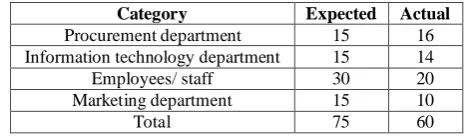
The study sample was composed of 75 respondents.
Table 3.1: showing categorization of respondents
Category Expected Actual
Procurement department 15 16 Information technology department 15 14 Employees/ staff 30 20 Marketing department 15 10
Total 75 60
Source: Primary Data,
Data Collection
The researcher collected data from primary sources. Primary data was collected from selected respondents. The necessary information was got from questionnaires. The questionnaires asked questions concerning E-Procurement on supply chain management.
Questionnaire
Interviewing
In interviewing tools the study involved face to face contact. It provided the advantage of first hand information as a result of the interaction between the researcher and the interviewer. It also helped the interviewer to evaluate the knowledge and attitude towards the topic.
Observation
The researcher observed the different activities taking place in the company to get further information relating to problem. It also allowed judgment by sight about the relationship between variables.
Documentary Review
Review of related literature was done and secondary data was extracted. Among the many documents that were reviewed include: magazines, journals and internet information. The above documents were reviewed and background information pertaining the role of E-Procurement on supply chain management.
Validity and Reliability of Research Instruments
The data collected confirmed to test a validity and reliability. The data was valid because of the use of questionnaires, observation and interview methods in the study designed to capture all the information that fulfilled the study objectives were questionnaire were applied the
researcher used the interviewing techniques and
observations.
Data Processing, Presentation, Analysis And
Interpretation
Having gathered the data from the primary and secondary sources, the data was assembled together, edited, organized by the use of tabulations and statements. Thereby creating a plat form for summarization of the data. Appropriate analytical methods were then applied so as to manipulate the data so that their inter-relationship and quantitative meaning derived. Simple tabulation was some of the statistical tools that are to be used to summarize the data. The researcher also used inductive reasoning to get a clear understanding about the general instructions of the topic.
Limitations of the Study
Respondents were not able to give confidential information, which was sufficient to the researcher. However, the researcher tried to convince staff members that research is intended to help them improve their work.
Presentation, Analysis and Interpretation of Research Findings
This study presents the findings on the role of Electronic Procurement on supply chain management. This finding was from primary sources. The presentation of the findings took two formats. That is the statement format and the tabular format. In this regard, the tabular format was used for countable variables and statements were used to present the responses on respective variables under consideration.
Demograph of the Respondents
The study was to be based on a survey population of 75 respondents consisting of a cross section of management, employees, marketing department, IT department and procurement department of Coca cola Bottling Company
Limited. However the researcher only managed to get 60 respondents. This was due to the busy schedule of most the company’s employees. The data therefore was based on the 60 respondents. The data was sought about Gender, Age group, Length of stay in the company, Education level and marital status of the respond.
General Information of the Respondents Table 2; Distribution by Gender
According to the gender findings, it was discovered that the company employs 80% males and 20% Females. That’s the company employs more males than females.
Table 4.1: Duration of work of respondents
Respondents Frequency Percentage (%)
Less than 1 year 12 20 Between 1-3 years 6 10 Between 3-5 years 12 20
Over 5 years 30 50
Total 60 100
Source: primary data
From the above, findings show that 50% of the employees in the organization had served for o five years and above This thus revealed that most of the employees involved in the supply chain are experienced whence performing their duties with confidence and perfection.
Benefits of E-Procurement in Organizational Purchase Supplies
Organization and procurement stage differ in degree of uniformity, complexity, number of people involved and movement of efforts required to make a good decision. There are basic activities that must be taken to complete a purchase. Buyers have always had to follow some basic steps. Advancements have provided an alternative to an endless time taking purchase stages because formerly processing a purchase order regardless of the value, size and importance of the item in question required on to strictly follow suits.
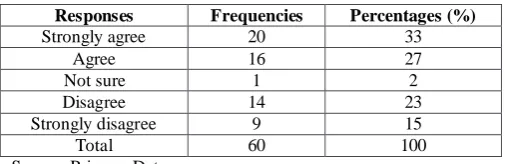
Table 4.2: E-Procurement has eased the buying process of the organization
Responses Frequencies Percentages (%)
Strongly agree 20 33
Agree 16 27
Not sure 1 2
Disagree 14 23
Strongly disagree 9 15
Total 60 100
Source: Primary Data
Table 4.3: Consumers/ Users can Compare Products Features and Prices that a Mare Look at them and Make Requisations Online
Responses Frequencies Percentages (%)
Strongly agree 45 75
Agree 15 25
Not sure 0 0
Disagree 0 0
Strongly disagree 0 0
Total 60 100
Source: Primary Data
All the respondents agree that consumers/users can compare products features and prices by a mare look at them and make requisitions online. Of which 75% strongly agree.
Chart 2: Online Buying Provides Customers with Support and Collaboration for New Product Development Decisions
Responses Frequencies Percentages (%)
Strongly agree 4 7
Agree 6 10
Not sure 3 5
Disagree 17 28
Strongly disagree 10 17
Total 60 100
Source: Primary Data
17% of all the respondents agree that online buying provides customers with support and collaboration for new product development decisions, 45% don’t agree who were the majority and the rest were not sure implying that the statement is true to a small extent.
Information Flow as far as E-Procurement on Supply Chain Management is concerned
Today doing business as usual is ineffective because process such as just in time (JIT) inventory ordering scheduling payments. Manufacture, distribution and so on, change has become the custom and highly predictable unforeseen situations on basic realities for many timeless to develop new model of a networked corporate for
independent organization and entrepreneurs, lean
flexibility, adaptive and responsive to both customers’ needs and market requirements for key features.
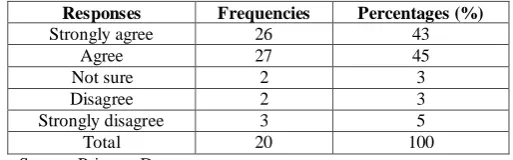
Table 4.4: Suppliers and buying firms are able to communicate to one another in ready time, with no time delay which lastly
increased flexibility and responsiveness.
Responses Frequencies Percentages (%)
Strongly agree 26 43
Agree 27 45
Not sure 2 3
Disagree 2 3
Strongly disagree 3 5
Total 20 100
Source: Primary Data
88% which is the majority of the respondents agree that suppliers and buying firms are able to communicate to one another in ready time, with no time delay which lastly increased flexibility and responsiveness of the whole supply chain system 3% were not sure and 8% do not agree which implies that the the statement is true.
Table 4.5: Procurement web sites allow qualified and registered users to look for buyers or sellers of goods and services.
Responses Frequencies Percentages (%)
Strongly agree 14 23
Agree 9 15
Not sure 1 2
Disagree 16 27
Strongly disagree 20 33
Total 60 100
Source: Primary Data
Following the findings, 23% strongly agree, 15% agree, 2% were not sure, 27% disagree and 33% strongly disagree implying that Procurement web sites allow qualified and registered users to look for buyers or sellers of goods and services to a small extent.
Challenges Faced By Coca-cola through E-Procurement
Moving E-procurement, or buy-side E-commerce, into these areas means driving it deeper into business-to-business supply-chain relationships. Because of the complexity of these relationships, E-procurement must do more than support ad hoc purchases from a consolidated catalog. Getting real value from E-procurement in supply-chain scenarios requires a raft of additional services.
Table 4.6: Where as e-procurement promises to make procurement processes easier, its implementation in developing
countries like Ghana, Nigeria,Uganda seems to be more of a dream than a reality
Responses Frequencies Percentages (%)
Strongly agree 35 58
Agree 23 39
Not sure 2 3
Disagree 0 0
Strongly disagree 0 0
Total 60 100
Source: Primary Data
Table 7: Relationship between Electronic Procurement and Supply Chain Management
From the table above findings revealed that there is a strong positive relationship between electronic procurement and supply chain management at Pearson correlation coefficient r = 0.856. This implies that electronic procurement affects supply chain management by 85.6% and 24.4% by other factors
Discussion, Summary of Findings, Conclusion And Recommendations
This involves; discussion of the findings as presented in the previous chapter, a summary in order to establish the role of e-procurement on purchasing in supply chain management and to make possible recommendations and suggestions.
Discussion of Findings
Challenges faced by organisations that employ E-Procurement
Findings revealed that E-procurement is not practical in Uganda because there is no enabling law that can govern its use, there is need of signatures on many documents as they move from one level to another especially in public procurement, where as e-procurement promises to make procurement processes easier, its implementation in developing countries like Uganda seems to be more of a dream than a reality, that a very small percentage of Ugandans can afford an internet connection, its not clear whether there must be tenders advertised in the local media, bids are then evaluated by the evaluation committee to come up with the best evaluated bidder, then results must be put for a certain number of days and that the introduction of e-procurement would create a real challenge because it would not be easy for the people involved to easily accept it having been used to the old system .
Summary of the Findings
The researcher had undertaken the role of E-Procurement on supply chain management. It was found out that majority of the respondents agreed that the adoption of E-Procurement system by organization since the system guarantees study supply of the organization requirement despite of its impact on profits of an organization hence leading to profit shrinkage as its hard for the organization to control quality yet its an aspect that determines the sales hence profits.
The study established that E-Procurement simplifies the buying process of an organization′s supplies. More to that, a big number of respondents bought the idea that the system eases the buying process of the organization supplies.
The findings also manifested that computerized purchasing fetches much savings by minimizing costs many respondents agree that the system eliminates multiple purchase procedural costs.
The study revealed that computerized purchasing process provides timely information about goods and services available. Significant numbers of respondents agree that computerized buying provides timely information about goods and services available.
Recommendations
Below are practical recommendations and adoption of some or all will yield substantial results in boosting the role played by E-procurement on supply chain management? Electronic procurement systems should be made part and partial of the decision making as a way of availing reliable information in the organizations. Managers should seek to adopt the most appropriate technology that will aid the whole organization to achieve its objectives.
Electronic procurement applications can be used by both manufacturing and processing firms. Organization adopt online purchasing as a way of checking on their total transaction costs since E-procurement aims at reducing operational costs. Organization should ensure that the embracement of E-procurement assists in establishing better working relationships. E-procurent should be geared
at strengthening relationships between employees,
employers and suppliers.
The benefits that accrue from application of E-procurement should be adequately analyzed. That is the organization’s management should be in position to continuously weigh the benefits that accrue from application of E-procurement. Management should ensure strict adherence to the company’s policies and guideline regarding the application electronic procurement. That is the employees should execute their duties following the pre requisites in place. All employees in one way or another should be involved in the purchasing process especially as far as electronic procurement is concerned. E-procurement should be out to bring all the employees on board as far as performing tasks in supply chain is concerned.
Conclusion
In reference to the research objectives set, the researcher concludes that E-procurement plays a positive role on purchasing in supply chain management. Organizations that have E-procurement already in place have enjoyed its benefits like easing purchasing processes, increasing the supply chain awareness, reducing total costs, quality Correlations
1 .856**
. .000
60 60
.856** 1
.000 .
60 60
Pearson Correlation Sig. (2-tailed) N
Pearson Correlation Sig. (2-tailed) N
Electronic Procurement
Supply Chain Management
Electronic Procurement
Supply Chain Management
improvement among others. However despites the many benefits that accrue from the application of E-procurement, the direct network links between computers and trading partners are not widely used because of fear of loss of confidentiality and security due to the different mode of information attack like hijacking of a website, social engineering among others.
References
1. Andrew Erridge Ruth Fee and John Mcllary. Best
practice procurement public and private sector perspective.
2. Arjan J Van Weele, 2000. Purchasing and supply chain
management; Thomson learning, Netherlands.
3. Bob Morton, Roger Treriff, 1995. The internet in
business; licensing agency ltd, USA.
4. Carol H, Anderson, Durtron W, vineze, 1993. Strategic
marketing management; practical hall international edition Inc, USA.
5. Charles W. L. Hill, 1997. Global / business today international edition; UK.
6. Coarse, (1937), Williamson, (1985). Commerce UK.
7. Dave Needman, Rob Dransfield, (2000). Advanced
business; Reed Educational and publishing ltd, Chicago USA.
8. Dawson, 1997. Office information systems strategy in
a financial organization;
9. E fraim Turban, E phram Mcclean, James Wetherbe, 1997. Information Technology for managers; phonic color crop, USA.
10. Elson Sutherland, Yues Morlerx, 1997. Business
strategy and information; Youtledge, Champman hall international, New York America.
11. Gray J. Zenz 1994. Purchasing and management of
materials; Texas USA.
12. Hellriegal Slocum, 1995. Management international,
Thompson publishing, USA.
13. James B. Ayers, 2000. Supply chain management;
CRC press Inc, Florida USA.
14. James Tom Plains, 2002. Supply chain management
W.W.W Supply management
15. Joseph J. Martinch, 1997. Production and Operation management; John Whittey and sons Inc, Canada America.
16. Lender, Fearson, (1997). Purchasing and supply
management; Rob Zuethre New York
17. Lonergan, Eoin, 2005/6. An introduction to supply and
materials management; published by the chartered institute of purchasing and supply Easton house on the hill stamtord lines, UK
18. Louis Boone, David C, 1974. Kutz Dudly Block
contemporary Business communication press
international editions Ink, New Jersey, USA.
19. Micheal K. Herrald. Geondress Fearson, 1997.
Purchasing and supplies management; Mc Grow Hill companies Inc.
20. O′ Brien, (1990), Chandwich, Rajapal (1995). The
internet; USA
21. Roger Lewis, Roger Treriff, 1995. Advanced business
edition, Standley Thrones ltd Chaltenhan, UK.
22. Wilson David 1993. Management information;