©2013 JNAS Journal-2013-2-6/152-156 ISSN 2322-5149 ©2013 JNAS
The study of morphological traits examined in 58 bread wheat lines in
laboratory conditions
Maryam Jafari
Department of Agronomy and Plant Breeding, Ardabil Branch, Islamic Azad University, Ardabil, Iran
Corresponding author Email:
[email protected]
ABSTRACT: Wheat is the most important agriculture goods in international market and also it is one of the strategic agricultural productions which have daily and universal consumption. This study was conducted in a randomized complete block design (CRD) with three replications at the Agricultural Laboratory of Islamic Azad University of Ardabil. Results from analysis of variance for study of morphological traits in laboratory conditions suggest that there was a significant difference between study lines and cultivars in terms of all evaluated traits at 1% probability level. Results of mean comparison showed that the highest value in terms of seedlings fresh weight had belonged to line No. 25 with 0.0997gr. Also results of lines mean showed that line 5 had the highest value in terms of seedling dry weight, in contrast line 50 had the lowest seedling dry weight. Results showed line 8 with an average of 0.0070gr was the best in terms of root dry weight between studied lines; in contrast, lines number 18, 39, 49 and 50 with an average of 0.00017gr had the lowest root dry weight.
Keywords: Wheat ,Morphological Traits , Laboratory Condition.
INTRODUCTION
Wheat is the most important agriculture goods in international market and also it is one of the strategic agricultural productions which have daily and universal consumption (Mobbaser et al., 2008). There is a need to increase in wheat productivity world wide, in particular in developing countries and for further increase wheat yield potential genetically, it is important for us to understand the physiological and genetic basis of yield (Shahryari et al, 2008; Yang et al, 2006). Regarding the fact that the world population as of the beginning of 21st century is already more than 6 billion people which more than 700 millions of them are struggling with the lack of food and famine and up to 3 billion suffer from malnourishment (Aulinger, 2002). Apart from its important commercial aspect in the world, wheat is an increasingly functional tool in political and global relations. Although Iran boasts only around 1% of the world population, it consumes roughly 2.5% of wheat produced in the world Wheat is a strategic good like energy and is considered one of the important indices of agriculture (Akbari et al, 2010). Seed germination is one of the critical steps in seedling establishment and successful plant growth in the later stages of its life (Almansouri et al., 2001). Any plant for germination has urgent need for a specific range of environmental conditions (Lu et al., 2006). Seed quality is very important to optimum growth and yield production in farm which influenced by many factors such as genetic characteristics, viability, germination percent, vigor, moisture content, storage conditions, survival ability and seed health, but their most important is germination percent and vigor (Akbari et al., 2004).
The main objective to the following research is to study of morphological traits in wheat lines and cultivars in laboratory conditions.
MATERIALS AND METHODS
153
included in Table 1. This study was conducted in a randomized complete block design (CRD) with three replications. First, seeds were disinfected in a solution of sodium hypochlorite 15% for 30 seconds. After placing the seeds in Petri (25 seeds per Petri) distilled water (6 mm in each Petri) was poured into the Petri and was prevented tangible changes in water potential until the end of the experiment. To prevent Bunt and disinfection of the all seeds, fungicide Karbuksyn Tyram ratio 2 in a thousand was added and mixed to distilled water. Studied traits included seedlings fresh weight, root fresh weight, seedling length, root length, seedling dry weight and root dry weight.
Then ensuring the normal distribution of data, for data analysis with statistical methods such as analysis of variance and comparison of lines mean by Duncan's test at the 5% level. Computer software MSTAT-C was used for statistical computing.
Table 1: Pedigree and characteristics of 58 wheat lines and cultivars
12Entry Cross CROSS ID ORIGIN
No COUNTRY
check1 BEZOSTAYA CHECK RUS
check2 KATIA1 CHECK BG-KC
check3 KONYA CHECK TR
1 LOCAL CHECK
2 SHARK-1/3/AGRI/BJY//VEE/4/SHARK/F4105W2.1 TCI012033 TCI
3 RSK/CA8055//CHAM6/4/NWT/3/TAST/SPRW//TAW12399.75 TCI-02-47 TCI
4 PYN/PARUS/3/VPM/MOS83-11-4-8//PEW/4/Bluegil TCI011322 TCI
5 F6038W12.1/ERYT25221//F6038W12.1 TCI012174 TCI
6 4WON-IR-257/5/YMH/HYS//HYS/TUR3055/3/DGA/4/VPM/MOS TCI-02-80 TCI
7 Ns46.11/3/Sdy/Ti.Rese1//KtA1/4/55.1744/MEX67.1//NO57/3/ATTILA TCI011413 TCI
8 BSP01/18 (Duzi) SA
9 CH111.14422 WW SWITZERLAND
10 ID800994.W/VEE//PIOPIO/3/MNCH/4/FDL4/KAUZ TCI011378 TCI
11 PBI1013.13.3/3233.35/3/STAR//KAUZ/STAR CMSW01WM00425S MX-TCI
12 PYN/PARUS/3/VPM/MOS83-11-4-8//PEW/4/Bluegil TCI011322 TCI
13 PSK/NAC//SABALAN/3/GUN91/MNCH TCI011656 TCI
14 SONMEZ TE-TCI
15 TRK13 RESEL//TRAP#1/BOW/3/JAGGER 'SIB' TCI-02-678 TCI
16 093.44/N057/3/[258.2.2]/NAD//BEZ/6/IAS58/IAS55//ALD/3/MRNG/4/ALD/IA
S58.103A//ALD/5/BUC/7/KAUZ//KAUZ/STAR CMSW01WM00803S MX-TCI
17 DEMETRA UKR-MIR
18 ECONOMKA UKR-MIR
19 T06/13 SA
20 Olifants SA
21 SULTAN95 MX-OR
22 00*0100-51 US-AGRIPRO
23 POSTROCK US-AGRIPRO
24 KUMA RUS-KRAS
25 ANDIJON1 UZB
Continued table 1: Pedigree and characteristics of 58 wheat lines and cultivars
12Entry Cross CROSS ID ORIGIN
No COUNTRY
26 CORDIALE UK
27 SERI MX
28 SULTAN95 MX-OR
29 HEREWARD UK
30 Bul
5052-1/6/C126-15/Cofn/3/N10B/P14//P101/4/21183/CO652643//Lcr/KS6/5/Rpb 8-68/Chrc TE 5649 TR-TE
31 1-60-1//Emu"s"/Tjb84/3/1-12628/MV17 IR-Karadj
32 Chamran/5/Bez/4/On/6*Ph//Kf/3/Tob"s"/Napo//No66/6/Spn/Mcd//
Cama/3/Nzt/4/Urles*2/Prl"s" IR-Mashhad
33 Alamoot/Shiroodi IR-Mashhad
34 Vopona/Hd2402/3/Tirchmir/Ico//Sabalan IR-Mashhad
35 Alamoot/4/Gv/D630//Ald"s"/3/Azd IR-Ardebil
36 (KS95U522/TX95VA0011)F1/Jagger AP05T2413 AgriPro South
37 HATCHER US-COL
38 MV-TALLER HU-MV
39 DB 66 BG-KC
40 CADET/6/YUMAI13/5/NAI60/3/14.53/ODIN//CI13441/CANON TCI-02-417 TCI
41
154
42 PLK/LIRA/5/NAI60/3/14.53/ODIN//[CI13441]/4/GRK79/6/MNCH/7/CROC_
1/AE.SQUARROSA (213)//PGO CMSW01WM00578S MX-TCI
43 SERI MX
44 SULTAN95 MX-OR
45 JI5418/MARAS//SHARK/F4105W2.1 TCI011194 TCI
46
AGRI/BJY//VEE/3/BUL6687.12/4/F6038W12.1
TCI992137-030YE-0E-1E-0E-2E-0E TR-YE
47 SONMEZ TE-TCI
48 CATBIRD//CNO79*2/HE 1 A-29707 CHL
49 RAINER RAINER AUSTRIA
50 KOMAROM KOMAROM AUSTRIA
51 SOISSANA SOISSANA AUSTRIA
52 GT 4131-2KK GT 4131-2KK BG
53 GT 01N62-62 GT 01N62-62 BG
54 Lau/Agd/3/Odes95//Olv/B16 TE 5402 TR-TE
55 BETTA S.AFRICA
RESULTS AND DISCUSSION
Results from analysis of variance for study of morphological traits in laboratory conditions (Table 2) suggest that there was a significant difference between study lines and cultivars in terms of all evaluated traits at 1% probability level. This indicates that the genetic diversity between lines and cultivars to choose the desired traits. The analysis of variance showed that the effect on the average concentration during coleoptiles mean root length, mean of dry weight was significant in 1% probability level (Alaei et al., 2010).
Jafari et al (2013) reported that there were significant differences between studied lines and cultivars in terms of the germination index at 1% level.
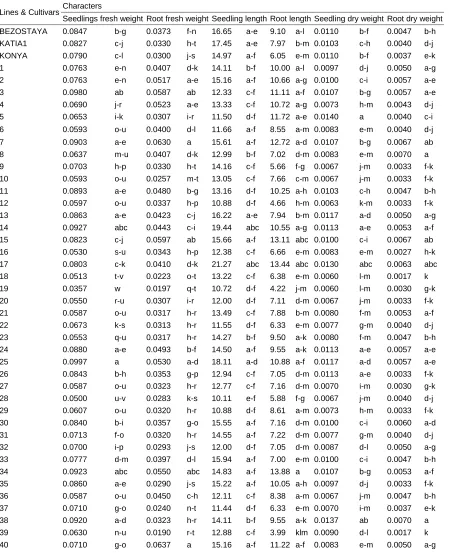
Results of mean comparison showed that the highest value in terms of seedlings fresh weight had belonged to line No. 25 with 0.0997gr and along lines 3, 7, 11, 13, 14, 24, 34, 35, 38, 41, 43 and 47 located in the premier class and there were no differences in terms of these characteristics, in contrast, line 19 had lowest seedling fresh weight (Table 3). Also the results showed that lines 7 and 40 respectively with an average of 0.0630 and 0.0637gr had the most root fresh weight and along lines 2, 3, 4, 15, 25 and 34 located at class A and there were no differences in terms of this characteristic. In contrast, line 46 had lowest root fresh weight and was ranked in the final (Table 3). The results showed that the variation range of seedling length was variable between the studied lines from 21.56 cm (Line No. 55) to 8.59 cm (Line No 50) that line 55 had the highest growth, in contrast line 50 had lower growth; therefore, it had smaller seedlings length (Table 3). The variation range of root length was variable between the studied lines from 13.88 (Line No 34) to 3.55 cm (Line No 44), so that, line 34 had accounted the highest value and along lines 1, 2, 3, 4, 5, 6, 7, 11, 14, 15, 17, 23, 24, 25, 29, 35, 36, 38, 40, 42, 43, 53, 54 and 55 along control variety Bezostaya were placed in superior class and were grouped with Bezostaya control (Table 3). Results of lines mean showed that line 5 had the highest value in terms of seedling dry weight and were grouped along lines 13, 14, 24, 25, 26, 38 and 55 were placed in superior class and there were no differences in terms of this characteristic, in contrast line 50 had the lowest seedling dry weight (Table 3). Results showed line 8 with an average of 0.0070 gr was the best in terms of root dry weight between studied lines; in contrast, lines number 18, 39, 49 and 50 with an average of 0.00017gr had the lowest root dry weight (Table 3).
Average of traits for genotypes showed that genotype originated from nakhjavan3 (Azerbaijan) in coleoptiles length, root length, the average fresh weight and mean dry weight was the maximum average. This genotype seems to be a good potential among genotypes has (Alaei et al., 2010). Alaei et al (2012) in their study concluded that Sardari had the highest shoot length and Gascogne had the lowest shoot length among studied cultivars. On shoot dry weight, Sardari was the best and Zagros was the lowest mean. On root dry weight, Gascogne was the highest and Azar 2 was the lowest mean.
CONCULSION
155
Table 2. Analysis of variance of study morphological traits in laboratory condition for 58 wheat line and cultivar
S.O.V df Mean Square
Seedlings fresh weight Root fresh weight Seedling length Root length Seedling dry weight Root dry weight
Lines 57 0.0006** 0.0004** 19.24** 19.98** 0.00001** 0.000005**
Error 116 0.00005 0.00004 4.25 2.59 0.000002 0.000001
CV% 10.08 18.62 14.78 20.13 16.66 26.44
* and **: Significant at p < 0.05 and < 0.01, respectively
Table 3. Mean comparison of traits being studied for wheat lines and cultivars
Lines & Cultivars Characters
Seedlings fresh weight Root fresh weight Seedling length Root length Seedling dry weight Root dry weight
BEZOSTAYA 0.0847 b-g 0.0373 f-n 16.65 a-e 9.10 a-l 0.0110 b-f 0.0047 b-h
KATIA1 0.0827 c-j 0.0330 h-t 17.45 a-e 7.97 b-m 0.0103 c-h 0.0040 d-j
KONYA 0.0790 c-l 0.0300 j-s 14.97 a-f 6.05 e-m 0.0110 b-f 0.0037 e-k
1 0.0763 e-n 0.0407 d-k 14.11 b-f 10.00 a-l 0.0097 d-j 0.0050 a-g
2 0.0763 e-n 0.0517 a-e 15.16 a-f 10.66 a-g 0.0100 c-i 0.0057 a-e
3 0.0980 ab 0.0587 ab 12.33 c-f 11.11 a-f 0.0107 b-g 0.0057 a-e
4 0.0690 j-r 0.0523 a-e 13.33 c-f 10.72 a-g 0.0073 h-m 0.0043 d-j
5 0.0653 i-k 0.0307 i-r 11.50 d-f 11.72 a-e 0.0140 a 0.0040 c-i
6 0.0593 o-u 0.0400 d-l 11.66 a-f 8.55 a-m 0.0083 e-m 0.0040 d-j
7 0.0903 a-e 0.0630 a 15.61 a-f 12.72 a-d 0.0107 b-g 0.0067 ab
8 0.0637 m-u 0.0407 d-k 12.99 b-f 7.02 d-m 0.0083 e-m 0.0070 a
9 0.0703 h-p 0.0330 h-t 14.16 c-f 5.66 f-g 0.0067 j-m 0.0033 f-k
10 0.0593 o-u 0.0257 m-t 13.05 c-f 7.66 c-m 0.0067 j-m 0.0033 f-k
11 0.0893 a-e 0.0480 b-g 13.16 d-f 10.25 a-h 0.0103 c-h 0.0047 b-h
12 0.0597 o-u 0.0337 h-p 10.88 d-f 4.66 h-m 0.0063 k-m 0.0033 f-k
13 0.0863 a-e 0.0423 c-j 16.22 a-e 7.94 b-m 0.0117 a-d 0.0050 a-g
14 0.0927 abc 0.0443 c-i 19.44 abc 10.55 a-g 0.0113 a-e 0.0053 a-f
15 0.0823 c-j 0.0597 ab 15.66 a-f 13.11 abc 0.0100 c-i 0.0067 ab
16 0.0530 s-u 0.0343 h-p 12.38 c-f 6.66 e-m 0.0083 e-m 0.0027 h-k
17 0.0803 c-k 0.0410 d-k 21.27 abc 13.44 abc 0.0130 abc 0.0063 abc
18 0.0513 t-v 0.0223 o-t 13.22 c-f 6.38 e-m 0.0060 l-m 0.0017 k
19 0.0357 w 0.0197 q-t 10.72 d-f 4.22 j-m 0.0060 l-m 0.0030 g-k
20 0.0550 r-u 0.0307 i-r 12.00 d-f 7.11 d-m 0.0067 j-m 0.0033 f-k
21 0.0587 o-u 0.0317 h-r 13.49 c-f 7.88 b-m 0.0080 f-m 0.0053 a-f
22 0.0673 k-s 0.0313 h-r 11.55 d-f 6.33 e-m 0.0077 g-m 0.0040 d-j
23 0.0553 q-u 0.0317 h-r 14.27 b-f 9.50 a-k 0.0080 f-m 0.0047 b-h
24 0.0880 a-e 0.0493 b-f 14.50 a-f 9.55 a-k 0.0113 a-e 0.0057 a-e
25 0.0997 a 0.0530 a-d 18.11 a-d 10.88 a-f 0.0117 a-d 0.0057 a-e
26 0.0843 b-h 0.0353 g-p 12.94 c-f 7.05 d-m 0.0113 a-e 0.0033 f-k
27 0.0587 o-u 0.0323 h-r 12.77 c-f 7.16 d-m 0.0070 i-m 0.0030 g-k
28 0.0500 u-v 0.0283 k-s 10.11 e-f 5.88 f-g 0.0067 j-m 0.0040 d-j
29 0.0607 o-u 0.0320 h-r 10.88 d-f 8.61 a-m 0.0073 h-m 0.0033 f-k
30 0.0840 b-i 0.0357 g-o 15.55 a-f 7.16 d-m 0.0100 c-i 0.0060 a-d
31 0.0713 f-o 0.0320 h-r 14.55 a-f 7.22 d-m 0.0077 g-m 0.0040 d-j
32 0.0700 i-p 0.0293 j-s 12.00 d-f 7.05 d-m 0.0087 d-l 0.0050 a-g
33 0.0777 d-m 0.0397 d-l 15.94 a-f 7.00 e-m 0.0100 c-i 0.0047 b-h
34 0.0923 abc 0.0550 abc 14.83 a-f 13.88 a 0.0107 b-g 0.0053 a-f
35 0.0860 a-e 0.0290 j-s 15.22 a-f 10.05 a-h 0.0097 d-j 0.0033 f-k
36 0.0587 o-u 0.0450 c-h 12.11 c-f 8.38 a-m 0.0067 j-m 0.0047 b-h
37 0.0710 g-o 0.0240 n-t 11.44 d-f 6.33 e-m 0.0070 i-m 0.0037 e-k
38 0.0920 a-d 0.0323 h-r 14.11 b-f 9.55 a-k 0.0137 ab 0.0070 a
39 0.0630 n-u 0.0190 r-t 12.88 c-f 3.99 klm 0.0090 d-l 0.0017 k
156
41 0.0887 a-e 0.0277 k-t 14.00 c-f 6.08 e-m 0.0093 d-k 0.0020 j-k
42 0.0630 n-u 0.0427 c-j 12.94 c-f 9.16 a-k 0.0073 h-m 0.0043 c-i
43 0.0860 a-e 0.0480 b-g 15.50 a-f 9.77 a-j 0.0110 b-f 0.0057 a-e
44 0.0563 p-u 0.0310 i-r 10.58 e-f 3.35 m 0.0073 h-m 0.0037 e-k
45 0.0593 o-u 0.0267 l-t 11.27 d-f 6.88 e-m 0.0080 f-m 0.0030 g-k
46 0.0697 i-q 0.0150 t 12.38 c-f 3.38 lm 0.0093 d-k 0.0023 i-k
47 0.0870 a-e 0.0373 f-n 15.94 a-f 5.83 f-m 0.0117 a-d 0.0040 d-j
48 0.0617 o-u 0.0167 s-t 11.77 d-f 4.27 i-m 0.0080 f-m 0.0023 i-k
49 0.0573 o-u 0.0217 p-t 13.83 c-f 5.05 g-m 0.0077 g-m 0.0017 k
50 0.0397 v-w 0.0170 s-t 8.59 f 3.96 klm 0.0053 m 0.0017 k
51 0.0603 o-u 0.0280 k-t 13.27 c-f 6.50 e-m 0.0090 d-l 0.0030 g-k
52 0.0853 b-f 0.0170 s-t 16.77 a-e 5.05 g-m 0.0103 c-h 0.0020 j-k
53 0.0697 i-q 0.0487 b-g 15.11 a-f 8.66 a-m 0.0103 c-h 0.0050 a-g
54 0.0840 b-i 0.0500 b-f 14.55 a-f 9.16 a-k 0.0103 c-h 0.0037 e-k
55 0.0800 v-k 0.0393 e-m 21.56 a 9.06 a-m 0.0113 a-e 0.0040 d-j
Total Mean 0.0719 0.0364 13.94 8.01 0.0092 0.0042
Differences between averages of each column which have common characters are not significant at probability level of 5%.
REFERENCES
Akbari GhA, Ghasemi Pirbalouti M, Najaf-Abadi Farahani M, Shahverdi M. 2004. Effect of harvesting time on soybean seed germination and vigor. J of Agr 6:9-18.
Akbari L, Jamshidi B, Chaghamirza K, Farshadfar EA. 2010. Study on response of durum wheat genotypes against drought stress in plantation of immature embryo. 11th conference on agronomy and breeding sciences of Iran. Pp: 410- 412. Alaei M, Zaefizadeh M, Khayatnezhad M, Alaei Z, Alaei Y. 2010. Evaluation of Germination Properties of Different Durum
Wheat Genotypes under Osmotic Stress. Midd- East. J. Sci. Res. 6(6):642-646.
Alaei, Y., Khabiri, E., Moosavi, S.S., Mohammadpour Khanghah, A. and Jafari, M. 2012. Effects of Biological Fertilizers on Morphological traits in Bread wheat varieties under drought stress in Greenhouse. Life Science Journal. 9(4): 3183-3187. Almansouri M., Kinet J.M. and Lutts S. 2001. Effect of salt and osmatic stresses on germination in durum wheat (Triticum durum
Desf.). Plant and Soil. 231:243-254.
Aulinger IE. 2002. Combination of intro anderogenesis and biostic transformation: An approach for breeding transgenic maize. Ph.d Thesis. Swiss Federal Institute of Technology (EHT), Zurich, Switzerland.
Jafari, M., Imani, A.A., Aminzadeh, Gh. and Shahbazi, H. 2013. The Study of lines and Different Cultivars of Wheat in Terms of Germination Index in Laboratory Condition. International Journal of Farming and Allied Sciences. 2(6): 124-128.
Lu P., Sang W. and Ma K. 2006. Effects of environmental factors on germination and emergence of croftonweed (Eupatorium adenophorum). Weed Science. 54:452–457.
Mobbaser, S., L. Zare and F. Mehravar, 2008. Importance and dispersion of Fusarium Graminearum in self- consumption seed of produced wheat from different production areas in Golestan. The First National Iranian Seed Tech and Science Congress, Gorgan, Iran.
Shahryari, R., E. Gurbanov, A. Gadimov and D. Hassanpanah, 2008. Tolerance of 42 bread wheat genotypes to drought stress after anthesis. Pak. J. Biol. Sci., 11(10): 1330-1335.