EXCAVATIONS AT PHLIUS, 1972
(PLATES 19-24)
IN the summer of 1972, the University of Missouri-Columbia in cooperation with
the American School of Classical Studies at Athens returned to ancient Phlius to continue the supplementary excavations begun in 1970.' Work commenced on July 3rd and ended August 11th.2 Emphasis this season was placed on the theater, North Building and attendant areas; nevertheless the upper levels of the Palati were further investigated.
THE PALATI
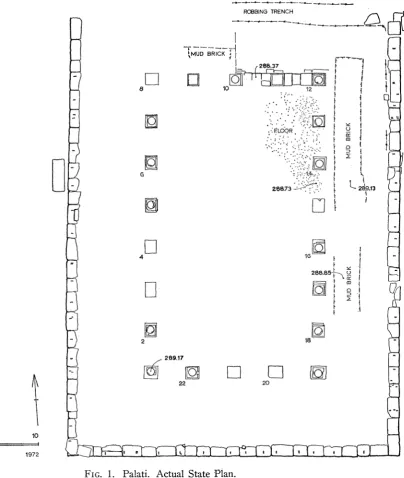
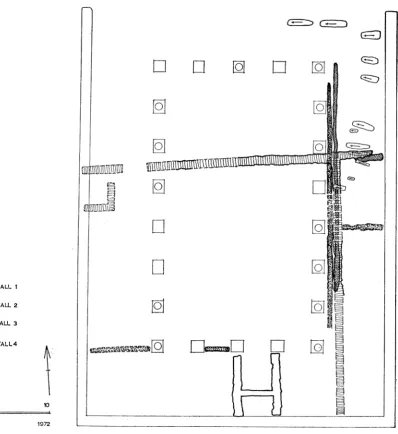
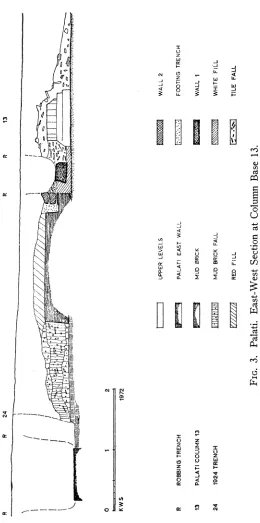
Further attempts were made to unravel the extremely complicated later history of the building alluded to in the 1970 Report.3 Our digging was again centered on the east side of the building, the only place where undug fill in any quantity was to be found. It is now apparent that the Palati has been so badly disturbed at various periods that certainty as to its different phases is far from likely. However, various suggestions can now be offered. The accompanying plans and section are offered in full knowledge of their inadequacy but also as representing the most we can glean both from our own investigations and from the records of the 1924 excavation. Figure 1 shows the building without the late walls and intrusions, while the sketchy Figure 2 indicates these features to the best of our knowledge. In the latter case, our own investigations in the last two seasons were confined to only a portion of the east side of the Palati in the areas of column bases 12-15, 16 and 17, most of the rest of the building having been dug out in 1924. Thus, in Figure 2, walls or extensions of walls which lay outside our area of investigations and which we could reconstruct from the old records are rendered in broken lines. Figure 3-is a simplified east-west section through the late levels in the area of Column Base 13.
I W. Biers, "Excavations at Phlius, 1970," Hesperia, XL, 1971, pp. 424-447. Henceforth,
Report '70.
2 The staff consisted of the writer as Director and, as trench supervisors, Harriet Anne Weis
of Bryn Mawr College, Nancy Reed Eals and Karl Kilinski of the University of Missouri-Columbia. All three graduate students served as Ford Foundation Archaeological Trainees. The architect this season was Kenneth W. Schaar of the University of Illinois (Chicago). The work was financed by grants from the Research Council of the University of Missouri-Columbia and the American Council of Learned Societies.
We must again express our gratitude to the American School of Classical Studies and to Charles K. Williams, Field Director of the Corinth Excavations. We must also express our appreciation to Mrs. Evangelia Deilaki, Ephor of Antiquities for the Argolid and Corinthia, for her interest. Special thanks must go to Professor Henry S. Robinson for so kindly sharing his knowledge with us.
8 Report '70, pp. 424-432.
American School of Classical Studies at Athens is collaborating with JSTOR to digitize, preserve, and extend access to Hesperia
Figure 1 shows little change from the same plan published in the previous report.4 This year we cleared Column Base 13, which proved to be exactly similar to the others in the building, although very worn (P1. 19, a). All the twenty-two column bases have now been cleared, two by us, the rest by the previous excavation. Further, the remaining stretches of the east foundation wall were cleared, finally completing the ground plan of the building as it is now preserved. Within the colonnade the same " floor," suitable as packing under a now vanished flooring, was found.' East of the colonnade we came upon more of the mysterious mudbrick construction we had found the first season.' We confirmed that here on the east, at least, it did not con- tinue to the east wall, for another earth floor, of somewhat different nature from that in the middle of the building, extends from the preserved east face of the mud- brick to close to the wall (Fig. 3). The mudbrick appears to extend north beyond the north line of the colonnade, but whether or not it once extended to the north wall of the building is not yet clear. It is similarly not clear whether the mudbrick also existed on the west and south sides of the building. Our investigations this season indicate that all such traces appear to have been dug away by the previous excavators with the exception of one small section preserved in a mound of undug fill northwest of bases 9 and 10 (Fig. 1). Having only just been recognized at the end of the season, further investigations should be undertaken in this area.
Now that the ground plan of the Palati has been established we can distinguish, if only dimly in some cases, the various periods of its use and re-use. Tests below the floor within the building and the discovery of debris from the destruction or partial destruction of its roof (see below) agree with the evidence cited in 1970 as dating the initial construction of the Palati to the second half of the fifth century B.C.7
Unfortunately, no new evidence has come to light concerning its original function, and, in fact, its most unusual feature, the mudbrick construction, must now no longer be associated with the primary form of the building. Tests in the fabric of the mud- brick recovered sherds, the latest of which are datable to the Late Hellenistic or Early Roman Period, perhaps as late as the first century B.c.8 The construction of the mudbrick feature in the building then represents a modification or perhaps repair. At some time after the erection of the mudbrick, there was a general conflagration which entailed destruction at least of the upper part of the building. Evidence for this was found in a level of destruction fill along the east side of the building in some places over the mudbrick, but most clearly between the mudbrick and the east wall (labelled " mudbrick fall " in Figure 3). Here the fill appeared to have been inten- tionally laid down in three stroses as if from a general cleaning up of the debris. All the layers, especially the lower two, contained much carbon and ash, large numbers
4Ibid., fig. 1, p. 426.
b Ibid., pp. 430431.
"Ibid., p. 431.
104 WILLIAM R. BIERS
ROBBING TRENCH
_ l I ~ ~ E
_ v~~~~~~~MUD BRICK1
10t 0 14 2
268873 l~~~1
4 16'
; ~~~~~~~~~~~~~288a85< U
2 18
289,17
22 20
0 10
WWC, KWS 1972 | L
L
G~D
1:01~ ~ ~~~~~~cE
w ox
WAL 5D 1
1- H
LI
>
zA
<~ ~~~ 0
.LI
~~~~~~~~~ .K S W 1 972
R R 24 R R 13
0 i 2
KWS 1972
UPPER LEVELS WALL 2
R ROBBING TRENCH PALATI EAST WALL FOOTING TRENCH
13 PALATI COLUMN 13 MUD BRICK WALL 1
24 1924 TRENCH MUD BRICK FALL WHITE FILL
RED FILL - TILE FALL
of classical roof tiles including decorated pieces (P1. 19, c),' and pockets of black and white clay which may be fallen mudbricks. Both the plain and the decorated tiles would appear to be from a roof of the fifth century B.C., and so probably belong to the original construction. The date of this destruction is difficult to pinpoint; the greater number of sherds and coins found in it date to the Late Hellenistic Period but a small amount of pottery is definitely Roman, perhaps as late as the second century after Christ. These may represent the period of the clearing of the debris rather than the time of the destruction.'0
An interesting and perhaps unique find came from this level. It is a small, much battered and worn lead statuette which would appear to represent Athena Parthenos
(P1. 19, b).11
The first of the late walls in the Palati perhaps follows closely on the heels of the clearing up of the area noted above, although its date of construction is not entirely clear. This wall, Wall 1 on Figures 2 and 3, stands in, and in some cases is partially covered by, a fill containing some tiles which appears to be identical with the destruc- tion fill just described. Again, this fill appears to have been intentionally laid down or shovelled into place against the wall. Stretches of this wall, preserved in only a single foundation course, have been uncovered by us and references in the 1924 note- books allow us to reconstruct part of its line within the building (Fig. 2), extending at least as far south as Column Base 18. It can perhaps be linked with another line of wall extending east-west at the south end of the building and incorporating the line of the Palati column bases of the south colonnade into its general structure."2
9 Fragment of a decorated eaves tile: Ph72-A5. Single fragment broken on three sides. P.H.
0.11 m., P.L. 0.19 m., Th. 0.055 m. Coarse Corinthian fabric. On face, traces of maeander; on soffit, palmettes in cream on black ground. The style of the palmettes is similar to those on the lion head spout fragment found last year and must also belong to the fifth century B.c., and perhaps to the second half of that century. See E. Mallwitz and W. Schiering, Olympische Forschungen, V, Die Werkstatt des Pheidias in Olympia, Berlin, 1964, p. 114, A4, pl. 41, a.
10 Phlius Lots 111, 112, 114, 143, 144.
Lead figurine: Ph72 MF9. Complete, but mended at neck. H. 0.049 m., W. 0.018 m., Th. 0.008 m. Smooth, slightly concave back. Very worn, especially on sides, deep scratch diagonally down front. Standing, draped figure, wearing helmet with one projection preserved on each side. Rough rounded projection on chest, left hand rests on round projecting object next to feet on left. Although difficult to be sure, the figurine has all the necessary attributes for a representation of the Athena Parthenos-the helmet, gorgoneion on her chest, and shield upon which rests her left hand. Lead figurines would appear to be a speciality of Sparta, seldom being found outside of Laconia. The very large number from Sparta itself is well known but our example does not seem to find a parallel among them, the greatest number of which are of earlier styles. Our example with what appears to be simply a gorgoneion rather than an aegis may be quite late. For the Spartan figurines, see R. Dawkins, et al., The Sanctuary of Artemis Orthia at Sparta (Society for the Promotion of Hellenic Studies, Supplementary Paper No. 5), 1929, pp. 249-284. It is stated in this work that lead figurines are known from Phlius (p. 250), but there appears to be no record of such finds from the 1924 excavations nor, apparently, have any survived.
108 WILLIAM R. BIERS
There is no evidence for the existence of Wall 1 on the north or west where excavation was carried to a low level in 1924.
Associated with Wall 1 is a heavy destruction fill which sloped primarily to the west covering the tops of the column bases (Fig. 3) indicating that the upper drums had probably been removed by this time. This fill contained much re-used material including broken roof tiles, architectural fragments, rough stones, triangular bricks and dissolved mortar. In this debris was found the Trajanic inscription published in the 1970 Report and dated A.D. 116-117.'3 The block had been roughly trimmed
and perhaps was also re-used in Wall 1 giving at least a terminus post quem for its construction. The latest pottery from this destruction fill is datable to the fourth century after Christ."4
Evidence for further re-use of the building following the fourth century after Christ destruction is to be found in a fall of roof tiles and debris towards the middle of the building and two bothroi dug through the floor in the same area. The pottery both from the fall and from the bothroi dates to the 5th-6th century after Christ.'5 No further activity seems to have taken place in the building until Byzantine times. In this period a large number of both built and tile graves was cut down into the earlier levels, in many cases cutting deep into the mudbrick. The built graves are all similar in construction, employing roof tiles, rough stones, and in the larger examples, re-used blocks. All of the built graves contained multiple burials or are re-used. Generally no grave goods are found, but this year a green glazed jug, datable to the 9th-i ith centuries after Christ, was found in a grave evidently used as an osteotheke (P1. 19, d, e).'" Built into the south wall of this grave was a well-preserved fragment of a fifth century B.C. Ionic votive capital (Figure 4, P1. 20 a)."7
131bid., p. 435, no. 12.
14 Phlius Lots 109, 110, 163. This is the destruction debris dated 3rd-4th century after Christ
in 1970 and tentatively associated with the Herulians. It now appears that a fourth century date is more likely from the pottery found this year and from a mid-fourth century coin found deep in the fill. If a culprit must be found for the destruction, an earthquake or Alaric in A.D. 396 could
be blamed.
15 Phlius Lot 142.
16 Trefoil mouth jug: Ph72 P1. Single fragment missing handle and portion of lip. Non-joining
sherd from lip found deep in the grave, while the main portion was lying almost on top of the bones. H. 0.125 mi., Max. D. 0.065 m. White-buff fabric with inclusions. Flat base, ovoid body, trefoil mouth. Uneven, badly fired, green glaze. Date based on C. H. Morgan, Corinth, XI, The Byzantine Pottery, Cambridge, Mass., 1942, pl. XI, e, no. 203.
17 Ionic capital: Ph72 A3. Single fragment preserving capital's entire right volute. Left volute
, if,1
I fi
o
0.3FI c
110 WILLIAM R. BIERS
No graves were found south or west of the Palati's east colonnade suggesting a boundary which we take to have been Wall 2 (Figs. 2 and 3), which is situated ca. 0.60 m.-0.70 m. east of the colonnade. The extent of Wall 2 has again been plotted with the help of the 1924 notebooks. Several other sections of wall which perhaps belonged to the same complex are shown in Figure 2, but in each case only fragments of one course existed, the rest having been dug out or robbed away. The section, Figure 3, indicates the position of Wall 2 in the area of Base 13. The footing trench for Wall 2 was cut down through the accumulated destruction fill in this area exposing in some places the line of Wall 1 and cutting a shelf in the mudbrick upon which the foundations were laid. Characteristic of Wall 2 is the fact that in many places it is bedded on a layer of roof tiles and that it often incorporates the line of Wall 1 in its foundations (P1. 20, c)."8 The removal of stretches of Wall 2 recovered Byzantine coarse-ware sherds."9 Unfortunately we have no evidence for the identification or use of the structure of which Wall 2 was a part, although it is tempting to associate it with the graves.
The later history of the Palati is one of destruction as the building was evidently used as a quarry. Wall 2 was robbed out (perhaps as deep as the foundations of Wall 1 in some places). A third wall, Wall 3 (Fig. 2, P1. 20, b) was built over the line of the earlier walls and apparently extended the entire width and length of the Palati. It must also have been part of a large complex,20 but, where we found it, was poorly built of two courses of field stones. Wall 3 was visible on the surface before excava- tion, and a floor level and destruction level just below topsoil yielded pottery from the very latest Byzantine periods.2" Wall 3, then, represents the last formal occupation of the area of the building.22
At roughly the same time, or perhaps slightly after the construction of Wall 3, found close to a theater suggests a choregic monument. The date should be in the fifth century B.C.,
perhaps the latter half.
The late graves are of common types and so will not be further discussed here. For last season's examples, see Report '70, p. 432.
18 This is not evident from the Section, Figure 3, but showed clearly to the south. The removal
of Wall l's destruction fill from above that wall was either accomplished by the footing trench for Wall 2 or by a later robbing trench, or by both. The upper levels here are so badly churned up by intrusions that certainty is not possible.
19 Phlius Lot 116.
20
Again, much of the evidence for the line of this wall had to be retrieved from the notebooks and no information other than its existence is available.
21
Phlius Lots 107, 108; one or two of the sherds perhaps go as late as the 13th century.
22
two large robbing trenches were dug over the east and north walls of the Palati." On the north the robbing trench apparently removed the whole foundation wall while on the east, and probably on the south and west also, only the upper courses were removed. In the process of robbing out the wall, several of the earlier graves were partially or wholly destroyed and the general area adjacent to the wall was badly disturbed.
In summary, we have been able to distinguish some seven periods in the Palati: (1) the original building of the second half of the fifth century B.C., (2) the addition of the mudbrick construction perhaps in the Early Roman Period, (3) soon there- after a destruction of the building which entailed the burning of at least the roof, (4) reconstruction in the Palati, the destruction fill being purposely cleaned up and dumped to the east of the mudbrick to even out the area. In this period Wall 1 and its attendant walls were established apparently replacing the colonnade. This phase came to an end in the fourth century after Christ but the initial date of the construction of the walls is unclear. We have suggested the second century after Christ. Period 5 is represented by a structure in the central courtyard of unknown shape and purpose which evidently went out of use in the 5th-6th century after Christ. The final two periods are probably datable to the Byzantine Period. Wall 2 and the many graves make up Period 6. The Palati itself was not in direct use at this time but may have formed part of a church complex, the main part of which would have been located to the east. The last period (7) in the life of the area is that of Wall 3 and the robbing- out of the walls of the building.
Two stamped objects of interest were found in fills in the Palati: a stamped tile fragment of usual type for Phlius (P1. 20, d) and a stamped Arretine sherd (P1. 20, e).2"
COURTYARD AND NORTH BUILDING
In 1972 tests were taken in the eastern half of the area betwen the Palati and the North Building. No structures were found but a series of pebble floors were uncovered (Fig. 5, C I-IV, P1. 21, a). Relatively small areas of the three lowest floors
23 The robbing of the Palati foundations was originally thought to have occurred in the Late
Roman Period (Report '70, p. 425) but late Byzantine pottery was recovered this year from deep down in both disturbances (Phlius Lot 113). The blocks from the Palati were probably re-used to the south where the excavators of 1924 found numerous Byzantine constructions almost entirely of re-used material. C. W. Blegen, " Excavations at Phlius 1924," Art anld Archaeology, XX, 1925, p. 27.
24 Fragment of a stamped tile: Ph72 MF1, single fragment broken all around. P. H. 0.075 m.,
P. W. 0.095 m., Th. 0.03 m. Corinthian clay, traces of red slip. In rectangular stamp [-] AEI. See Report '70, p. 432, n. 13.
- -~-
- -~~~~~~~~~~~~~~~~~~~~~~~~~..
BEDROCK CU.TTINGS 1-
291.10 292.0/O/
2909- 929 067 1 29344~~~~~~~~~~~~206
29099 L0> . 290.66-
THEATER t 1^.-3*-ij*
I
6 289.9602 9.7, Z D1322014s 2990
THEATER~~~ . \' ' '''
2I.7) --~ 46l
NORTH BUILDING
!
-DElL C U S k * . L 2 969.66 .
t , ,'C-- V 289.40 ' . - ', .' i:tk.011 -289A5
PALATI !.t5
I~~~~~~~~~~~~~~ I 112 C I
ww?,lntYs~~~~~~~~~~~~~~~~~~~~~~~I~ 162
F
10
LI
Qo
lOwere investigated, making their chronology precarious at best. Floor C-I, however, is to be dated to the Early Roman Period, probably first century after Christ on the basis of the pottery associated with it 25 and is certainly to be considered the same
floor as that found in the North Building in 1970 (N-I on Fig. 5), which predates that building.26 It also extends to the east, north of the robbing trench for the north Palati wall which cuts through it. The only feature to be associated with this floor is a square block (0.60 m. square) with a vertical socket cutting in its top surface, situated some 6.60 m. from the south wall of the North Building against the present west scarp of the area. The exact explanation for the use of this block will have to wait until more can be cleared to the west (P1. 21, a, background).
Floors C-II and III, also pebble floors of varying consistency, yielded little for dating purposes. However, Floor C-II can be traced under the south wall of the North Building and is to be associated with Floor N-II within the building. Floor C-III may have been cut by the North Building's south wall, but the area immediately south of this wall and against its face has been trenched and the exact determination will have to wait until undug fill over the North Building to the west can be tested. It might be tentatively suggested, though, that C-III may be associated with the latest floor in the North Building (N-Ill).
Floor C-IV was fully cleared in the area investigated but again its relation to the North Building is not clear, although it appears to go up to, if not over, its south wall. Pottery from immediately above this floor was clearly Late Roman in character, going as late as the 5th-6th century after Christ.27
Belonging to this floor and actually set down into floor C-III below, is a re-used, Doric, corner epistyle-frieze block (Fig. 6, P1. 21, b).28 Set at angle to the North Building and approximately 1.80 m. south of its southeast corner, the block bears a square cutting (0.07 X 0.07 X 0.20 m. deep) in its badly battered upper surface. The cutting is similar to those in the south wall of the North Building and presumably held wooden uprights.
At the end of the season investigations were carried out at the east end of. the North Building where in 1970 an extension composed of narrow blocks was observed to form a rectangle with the east North Building wall and extend north into the scarp.2 This extension was found to run some 0.60 m. further to the north, at which point it is joined at right angles by a similar narrow (0.50 m. wide) poros block
25 Phlius Lot 153.
26 Report 70, p. 438, " Floor I."
27 Phlius Lot 150.
28 The shape of the flat-topped glyphs would indicate a date in the Hellenistic or Early Roman
Period but the block is so battered, especially at the corners, that it is difficult to be more precise. It evidently came from a construction which used the three triglyph system. Cf. the Northwest Stoa in Corinth, R. Stillwell, Corinth, I, ii, Architecture, "The Northwest Stoa and Shops," Cambridge, Mass., 1941, pl. XII.
114 WILLIAM R. BIERS
forming part of a line of blocks extending E-W across the front of the North Building, 1.56 m. north of the rectangle formed at its eastern end (P1. 21, c). Nearly 5 m. of this wall have been uncovered so far. The new E-W portion is made up of three blocks, well worked and carefully fitted together. The second block to the west bears pry-hole cuttings. Two large, rectangular blocks were found placed against the north face of the new wall. One is at the eastern corner (0.56 m. wide, 1.25 m. long to a broken end), the other 1.20 m. to the west (0.56 m. wide, 1.50 m. long). This second block also bears two raised roughened areas on its upper surface.30 Excavation has not proceeded below the upper surface of the E-W wall of the extension.
Since the excavation of the complex is not complete, only tentative suggestions can be made concerning the North Building and its extension. The plan of the com- plex, as so far revealed, strongly suggests a colonnaded scene building with a pro- skenion extending into the orchestra (Fig. 5). The proskenion would have had only one storey and the rectangular return at the east end of the North Building, which appears to form a narrow room, might have served as support for a stairway giving access through a side door to the stage formed by the roof of the proskenion.3' Thus, the extension to the north, if actually a proskenion, may belong to the period of the construction of the double return at the east end of the building,32 and this would appear to post-date the construction of the main part of the building, although not necessarily by a great length of time.
Many problems need yet to be solved in this area, not the least of which is the chronology. Another problem is the great distance between the scene building and the analemma, or retaining wall of the cavea. This is usually only a few meters wide forming a parados, but here there seems' to be an unnaturally large space even after the construction of the proposed proskenion, which would, in most theaters, reduce the area. Two possibilities suggest themselves to solve this dilemma; either dramatic traditions at Phlius needed such a great space between the scene building and the cavea, or the space was utilized by other buildings, perhaps on east and west as at Thorikos where a temple and other buildings bounded the orchestra at each extremity.33
THE THEATER
Excavation in the theater was concentrated between the 1925 trench reopened in 1970 and the east retaining wall."' A small test trench was also opened to the west (Fig. 5).
80 At south end: 0.45 m. wide, 0.80 m. long, raised approx. 0.01 m. above the surface. At north
end: 0.45 m. wide, 0.20 m. long, 0.01 m. above surface.
81Although there are no exact parallels, the slightly more simplified plan of the theater at Oiniadai offers similarities, E. Fiechter, Die Theater von Oiniadai und Neupleuron (Antike Grie- chische Theaterbauten, Vol. II) Stuttgart, 1931, P1. 6.
82 Period V of the North Building, Report '70, pp. 438-439.
The eastern area revealed that the line of bench theater seats was preserved between the two benches found in the 1925 trench and the one at the extreme east revealed in' 1970 (Pl. 22, a, b). The new seats are similar in construction to those described in 1970, but bedrock rises to the east so that no foundation blocks were needed at that end."5 Approximately 3.00 m. from the east end of the row of seats, the line is interrupted by a smaller, more worn block set approximately 0.05 m. below the upper surfaces of the flanking seats. Immediately south of this slab and ca. 0.15 m. lower is another block, bearing anathyrosis on its west face. Again, south of this block, but separated by a narrow gap (0.30 m.) and again 0.095 m. lower in elevation, a third block spans the drain cutting which runs in front of the seats. Obviously an entrance into the cavea is reflected in this construction but the use of re-used material and the lack of alignment of the blocks with one another probably indicates a later renewal (P1. 23, a). That in an earlier period there was an entrance here is indicated by the fact that the exposed sides of the benches above the worn block are carefully
finished.
North of the seats in the cavea the cuttings in the bedrock previously observed did not continue to the east as expected but are interrupted by a semicircular cutting in the bedrock which runs to the retaining wall of the cavea on the east. Within this cutting and extending from its north wall down towards the seats the area had been filled with a packing of varying makeup and consistency. On the west, four roughly worked stones (approx. 0.20 m. by 0.40 m.) are set vertically in the packing and descend down the slope to the south at intervals of approximately 0.50 m. The lowest and most southerly of the four rests upon a rough wall made up of poros stones with some re-used material included, which appears to act as a boundary and retaining wall for the packing. The poros blocks, extending now to a maximunm height of about 0.38 m. above the packing, appear to continue the line of the preserved bedrock cuttings. Moreover, the surface of the packing'around the blocks is easily differen- tiated into alternating strips of clay and pebbles, the blocks being placed in the clay strips (P1. 23, b). The blocks and the alternating strips of clay and pebbles appear to belong to the seating arrangements of the cavea, the blocks perhaps as supports for wooden boards,88 the pebbled layers representing the floor upon which rested the audience's feet. Unfortunately, the alternating layers could not be discerned at all in the middle of the filling and only appeared in a random fashion further to the east.87
35 Ibid., p. 439.
88 The upper rows of the Hellenistic theater at Mycenae are conjectured to have been of wood
and two blocks of stone are reported "which may perhaps have been the bases for upright timbers siupporting wooden seats." C. A. Boethius, " Hellenistic Mycenae" (" Excavations at Mycenae XI "), B.S.A., XXV, 1921-1923, p. 420.
S7 The east side of our excavation area where work was carried out this season seems to have
CN
>
7
t~~)
aXS
_ 1
Accordingly, a probe trench was dug through the packing up to the semicircular cutting in the central portion of the area (P1. 23, c). This trench showed layers of packing containing some mudbricks over a relatively heavy packing of earth and pebbles. The cutting itself extends down vertically 1.025 m. at the north, where there is a projection from the wall 0.29 m. wide, then descends another 0.30 m. to bedrock which extends towards the south at a slight slope. Approximately 1.60 m. south of the back wall of the cutting the bedrock has been irregularly broken through and a rectangular block (0.13 X 0.32 X 0.50 m.) has been left in the cavity.
The " cistern " within the area of the 1925 trench 88 was further cleaned, revealing
two rectangular cuttings in its bedrock floor 3 and more waterproof plaster on its
east wall (P1. 22, b, foreground). This wall passes beneath the late wall constructed of lumps of bedrock which cuts off the "cistern" from the theater benches (P1. 22, b). This bedrock lump wall rests on a packing of crushed rock 0.15 m. thick which in turn rests on the bedrock floor of the " cistern." The wall extends further to the east between the theater benches and the poros wall to the north, but much of its line has apparently been robbed out.
A test trench was sunk ca. 7.50 m. west of the 1925 trench to investigate the western end of the cavea (P1. 24, a). Here the continuation of the theater benches was picked up, although not perfectly, on the arc formed by the seats to the east. The western seats rest on a bedding block ca. 0.15 m. in height, and are exactly similar to those on the east with the exception of a narrow block between the two preserved examples (0.29 m. E-W, 0.74 m. N-S) which apparently acts as an extension. The west side of the west bench is finished; approximately 0.06 m. below its upper surface is a partially exposed worn poros block. Perhaps this block is a step block for an entrance into the cavea as on the east.
North of the seats in the test trench the same bedrock lump wall was found cutting through packing similar to that found to the east. A square block also similar to those on the east was also found set into the packing but oriented differently. Finally, traces of alternating strips of clay and pebbles could again be discerned.
- Our investigations in the cavea this year seem almost to have raised more ques- tions than they have answered. The chronology of the area has yet to be worked out and should become clearer when the cistern can be further cleaned, the late walls tested and more of the cavea to the west investigated. Some tentative conclusions can, how- ever, be put forth at this time.
The latest sherds from the test trench cut into the packing in the semicircular cutting proved to belong to the first century after Christ.40 This filling would then in the western half of the area which is not directly in the line of any destructive water flow from above.
88 Report '70, p. 440.
" North, 0.26 X 0.24 X 0.07 m. deep. East, 0.40 X 0.38 X 0.05 m. deep.
..2.. ... . . . 4*** -
|
~~~--I~\-
HYPOSTYLE |
X--
H
IALL
THEATER
E 3 M 1: E3 13 M
NORTH BUILDING
U~~~~
r I
~~~~~~~PALATI
0~~
PHLIUS
E El
0
20 M
FIG. 7. Area of Excavat'ion at. End of 1972
appear to date from Early Roman times and it is interesting to note that a similar date was assigned to the anta base which once formed part of the east retaining wall.4' Whether the circular cutting is part of an earlier period of the theater, to which presumably the bench seats belong, or simply indicates soft bedrock which was cut away, is not clear. The theater would appear to have gone out of use in the 3rd or 4th century after Christ when fill began to accumulate over the seats.42 A mass of earlier Roman pottery and small finds, including a fibula of 1st century (after Christ) date (P1. 23, d) , was mixed in with the later sherds, probably the result oL wash from
above and perhaps indicating a collapse of an upper portion of the cavea.
Between the cavea and the North Building in the area of the orchestra, we encountered a series of stroses but nothing yet that one could without hesitation call an orchestra floor. Two candidates by their relative hardness and elevations may be tentatively suggested as fragments of orchestra floor at two different periods (T-I and T-II in Fig. 5).
Floor T-I is represented by a small patch of hard-packed pebble strosis against and just to the south of the block over the drain in front of the cavea bench seats. South of this, in the area tested, it appears that some packing was perhaps used to level the bedrock, thus forming a more or less level floor, which would however have sloped from 290.10 m. near the cavea seats to 289.58 m. in front of the proskenion wall. The date for this extremely tentative orchestra floor is as yet unclear.
More easily recognized and at a higher level is pebble floor T-II, which extends over the whole area and runs over the newly discovered proskenion wall. Pottery evidence suggests that the floor may have been laid as late as the third century after Christ and to have gone out of use in the fourth century after Christ at the same period as the cavea itself."
CONCLUSION
Figure 7 and Plate 24, b show the excavation area at the end of the 1972 season. Conclusions concerning the chronology of the Palati have already been presented. Although much more needs to be done in the theater complex, certain facts concerning the whole area are beginning to emerge. It appears that there was significant activity in the Early Roman Period at Phlius involving apparently not only rebuilding in the Palati after an earlier destruction, but also construction in the theater and probably also in the area of the North Building, which may have been built at this time. This
4' Report '70, p. 441.
42 Phlius Lot 136.
43 Bronze fibula: Ph72 MF3. Complete but deep scratch across surface. L. 0.07 m. Flat bow
ornamented with two slots. Decorated ridges run between slots to just below hinge. Hinged pin. This pin is similar to the Aucissa type, see G. R. Davidson, Corinth, XII, The Minor Objects, Princeton, 1952, p. 270, no. 2167, but closer to Corinth inv. MF 12754 and MF 68-282.
120 WILLIAM R. BIERS
portion of the ancient city appears to have gone out of use in the fourth century after Christ with the exception of some later construction of unknown significance in the Palati and activity between the Palati and the North Building. By the Byzantine Period activity had shifted elsewhere in the ancient city and the site of the Palati, at least, was at first partially used as a graveyard and then later as a quarry. The primary problem that remains is the chronology and architectural history of the theater and its attendant scene building.
WILLIAM R. BIERS
Mr
a. Base 13 from South
b. Figurine of Athena Parthenos
c. Painted Eaves Tile
1Ii-
d. Byzantine Jug in situ in Grave
Palati
'40 ~ ~ ~ ~ ~ ~ ~ ~ :
a. Column Capital in Wall of Grave, from North
..
'0 R T b. Wall 3 from North
A,
At eArretine Sherd
d. Stamped Tile
c. Wall 2, Footing Trench and Tiles, from Palati
North, Wall 1 to Right
r- Z-tt;:t8-ros 2 tt)~~~~~~- - . p t
: ~~~~~~~~ ~ _|Xi - -
b. Epistyle-Frieze Block in situ from East
Wf. ~ ~ ~ -
a. Courtyard Floors from North, North Building in Foreground
c. North Building Extension from Northeast
V'A~ ~ '
Courtyard and North Building - kc r
- 4 A
a. Ctve fromn Southwest 4L
vI~~~
b. Lower Cavea from West
Theater
L
.~~~~~~~~~~~~~~~~~~~~~~'J.v
b. Cavea Packing from North
a. Entrance through Seats from South, Probe Trench in Background
icPX,.~~~~~~ ."..0 W*-U
U.
c. Probe Trench in Cavea Packing from East-.
d. Fibula
Theater
PLATE 24
a. West Test Trench from Northwest
:~~~~~~~~~~~~~~~~~~4
b. Area of Excavations at End of Season, from North