EVALUATION OF SECOND LANGUAGE LEARNERS’ SYNTACTIC
ERRORS IN ESL WRITING
ARLENE D. TALOSA, RUTH N. MAGUDDAYAO, Ph.D., LPT. Cagayan State University, Philippines
ABSTRACT
Writing is considered varied with context and cannot be distilled down to a set of abstract cognitive or technical abilities. It always involves talent and skill and that makes it complex yet writing becomes more complex for ESL learner when they write with using the second language in the academic context. With the growing interest in linguistic accuracy in relation to L2 writing pedagogy, this study generally aimed to evaluate the second language learners’ syntactic errors in ESL writing. data extracted from the fifty-four (54) third year and fourth year ESL students reveal that the ESL learners are seldom exposed in writing. their predominant errors along syntactic structures are on tense, pronoun-antecedent agreement and faulty parallelism. Those who are in the higher year level tend to commit lesser syntactic errors. Furthermore, year level and writing exposure highly relates to ESL learners’ incidence and occurrence of syntactic errors in ESL writing.
INTRODUCTION
The current condition in the world have corresponding significance in the issues of bilingualism and the important role of the English language. The fundamental aim of teaching a language is to make the learners proficient in some or all of the basic language skills. Since fifties onwards, researchers have paid increasing attention to the structural and functional language changes. The modern roots of the syntax can be traced to the pioneering work of Noam Chomsky, who in 1957 wrote syntactic structures.
Representation of syntactic structure is a core area of research. As writing is a continuous complex process of expressions. It is not itself a simple process with its native language and rather even more a complicated process if the language is a foreign language. This is true to Filipinos who learn English as a second language. A number of studies conclude with the impact or interference with their first language during the process of writing in English.
A text is determined legal by the language of syntax and the disagreements with the syntactic rules are called syntax error. This judgment can easily be detected by ones’knowledge of language but one purpose of a theory of syntax is to possess the structural sentence as acceptable or not. Ignacio (2017), describes syntactic complexity as the ability to produce writing that shows how ideas and large chunks of information are represented with the use of subordinate and embedded subordinate clauses. Syntax complexity is one of the most difficult structural elements for students not to exempt college students. This may be highly regarded to the veracity that English is not the country's first language.
The ability to write effectively is very important in second language acquisition. Good English writing competence is widely recognized as an efficient skill for educational reasons. Writing is a difficult process which demands cognitive analysis and linguistic synthesis. It is twice harder to learn to write in a foreign language, and it takes time and effort to become well competent in the proper and accurate usage of foreign language.
According to Mohamed and Darus (2012), writing is an important skill whereby learners are able to progress independently to a higher level of intellectual maturity, especially in the case of
language learning. In addition, “learning to write fluently and expressively are the most difficult of
the macro skills for all language users regardless of whether the language in question is a first,
second or foreign language”
Competence in Writing can be assessed through one’s ability to properly organized thoughts using appropriate structures. Good writing consists not only of a string of varied, correctly-structured sentences. The sentences must also lead from one to the next so that the text is cohesive and the writer's ideas are coherent.
According to Wang and Wen (2002), L2 writers obviously get stuck when writing in the target language because their mother tongue mainly affects the use of the second language; as a result, they may at times combine the systems of the two languages in their L2 writing, which is
As locals, who are used and exposed of various ethnic dialects being spoken and practices in the daily life means of communication, and as per personal experience, students taking up the discipline of English as secondary language, these students encountered malpractice of the functions and structures of the said foreign language which leads the students to derive errors upon coming up a certain ideas in the outputs or products. These unnoticed confusion was brought by how ethnic dialects being affects the student practices. These were the underlying reasons why the researcher
prompt to study the students’ errors on syntactic structure.
OBJECTIVES OF THE STUDY
This study aimed to evaluate the syntactic errors of second language learners in ESL writing.
Specifically, it aimed to answer the following questions:
1. What is the profile of the students with respect to the following characteristics? a. Sex
b. Age
c. Mother Tongue d. Year level
e. Available resources at home f. Frequency of Utilization
2. What is the written exposures of the respondents?
3. What are the syntactic errors committed by the second language learners in their ESL writing? 4. Is there a significant difference on the syntactic errors committed by the second language
learners when grouped according to profile?
5. Is there a significant relationship between the second language learners’ syntactic error, their profile and written exposure?
MATERIALS AND METHODS
The descriptive-correlational method of research employing the survey and correlational techniques was used in this study. Descriptive was used as the study determine the profile of the students and their reading and writing exposure. Correlation method was also employed as the
study evaluated if there exist a significant relationship between the students’ committed error and their profile variables and writing exposures.
The study was conducted at the College of Teacher Education (CTE) of the Cagayan State University, Maura, Aparri, Cagayan for the School year 2015-2016. Cagayan State University-Aparri is one of the satellite campuses of the province of Cagayan situated 2-3 kilometer east of the town proper. Currently, its total enrollment is approximately 5,332 students. Moreover, CSU is one of the public Higher Education Institutions (HEIs) in Northern part of the Philippines and College of Teacher Education is one among the eight colleges in the campus. CTE offers Bachelor in Secondary Education major in English, Mathematics, and Physical Science. It also offers Bachelor in Elementary Education. It has 14 total numbers of Permanent Teachers
The respondents utilized in this study were the third year English major students of the College of Teacher Education duly enrolled for the school year 2015-2016.
The information included age, sex, Mother tongue, available resources at home and average grade in English. Part II dealt on the exposure of the students on reading and writing. To gauge the syntactic errors of the ESL learners, an essay test was given to them which required the construction of a maximum of 200 words composition on the topics of their choice. Frequency, percentage counts, percentage distribution, means and standard deviations were the descriptive statistics utilized to describe the profile variables and number of syntactic errors committed by the English major students.
Moreover, the inferential statistics, the Pearson Product moment correlation was employed to determine if reading and writing exposure is related to their syntactic errors. Furthermore, t-test was used to determine the difference between the syntactic errors committed when grouped according to profile. Analysis of Variance (ANOVA) was also used to determine the difference on the syntactic errors when grouped according to age, mother tongue, available resources at home, average grade and reading and writing exposure.
The data gathered were analyzed with the use of Statistical Software (SPSS) at 0.05 level of significance.
RESULTS AND DISCUSSION
After careful statistical analysis and critical content analysis of the written outputs of the ESL learners, the following presents the thorough results and discussion of the analysis of the specific objectives.
Profile of the ESL learners Sex
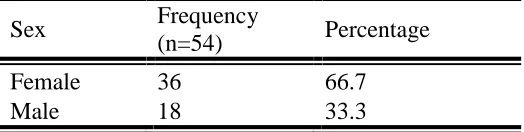
Table 1 shows the distribution of the students in terms of sex. The table reveals that 36 or 66.7 percent of the students are females which comprise the majority while only 18 or 33.3 percent of the students are males. This is supported by the enrollment data of the college that there are more female enrollees as compared to males. Moreover, this finding is also supported by the findings of 2008 functional literacy, Education and Mass media Survey (FLEMMS) on the statistics on
Filipino women and men’s education which reported that school attendance was higher among females than among males.
As exhibited from the data, it can be deduced that the English major students of the College of Teacher Education are predominantly female.
This finding means that majority of those who took teaching course are female. As such, this finding implies that there is feminization in the teaching course as it overwhelmingly attracts female.
Table 1. Distribution of the students in terms of sex
Sex Frequency
(n=54) Percentage
Female 36 66.7
Age
As per regards to the age of the students, Table 2 evidently shows that majority of the students which constitute a frequency of 44 or 81.5 percent have age ranging from 18 to 20 years old. seven or 12.9 percent of the students have 21-23 age range while three or 5.56 percent of them are aged 24-26.
This finding indicates that most of the addressed students fall into teenage group as concretized by the mean of 19.72 and a standard deviation of 2.03. This finding means that they are generally youngsters.
Table 2. Distribution of the students in terms of age
Age (in years)
Frequency
(54) Percentage
18-20 44 81.5
21-23 7 12.9
24-26 3 5.56
Mean = 19.72 S.D. = 2.03
Mother Tongue
The distribution of the students in terms of mother tongue is presented in Table 3.for the
respondents’ first language or mother tongue, Iloco tops two other languages in the list that
includes Ibanag and Tagalog. Iloco is the mother tongue of 42 or 67.7 percent of the students. Eight or14.8 percent of them are tagalogs while only four or 7.40 percent of them are ibanags.
This finding indicates that the population of English majors at the College of Teacher Education is dominated by students whose native language is Iloco. The data in this table insinuates that most of the Ilocano parents still transmit the Iloco language to their children by teaching it as first language. This attitude reflects the loyalty of the parents to their language.
Moreover, this is further attributed to the fact that Cagayan State University at Aparri does not only cater to students from the place but largely with students from the neighboring towns as majority of the English major students are from Allacapan, Buguey, Camalaniugan, Camiquin Lal-lo, and Sta Teresita which are consensusly Iloco speaking towns.
Table 3. Distribution of the students in terms of mother tongue
Mother Tongue
Frequen cy (n=54)
Percenta ge
Tagalog 8 14.8
Ibanag 4 7.40
Year level
Apparent in Table 4 is the distribution of the students in terms of year level. The table exposes that 29 or 53.7 percent of the students belong to fourth year class followed by 25 or 46.3 percent who are third year. This finding means that majority of the students belong to fourth year class as attributed to the general observation that they are the year level with the highest populace.
4. Distribution of the students in terms of year level
Year Level Frequency
(n=54) Percentage
Third 25 46.3
Fourth 29 53.7
Available Resources at home
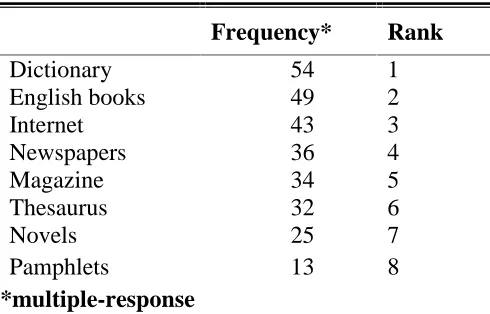
Shown in Table 5 is the distribution of the second language learners in terms of available resources at home. The table reveals that dictionary is the most available reading resource at home with complete frequency of 54 followed by English books (49); internet (43); newspapers (36); magazine (34); thesaurus (32); novels (25) and pamphlets (13) which ranked second to eight. This finding means that the students have enough available resources at home. This finding implies that they have sufficient resource and reference materials at home for language related consultations. This finding further denotes that they have available materials which are considered to be great contributories for language acquisition. Malone (2007) stated that literacy can only be maintained if there is an adequate supply of reading materials. On informal interviews, the learners revealed that some of these materials available at home are built-in installed in their cellular phones. Students specified that they have applications of Webster and Merriam Dictionary. They also have English books in pdf format through WPX application.
Table 5. Available Resources at home
Frequency* Rank
Dictionary 54 1
English books 49 2
Internet 43 3
Newspapers 36 4
Magazine 34 5
Thesaurus 32 6
Novels 25 7
Pamphlets 13 8
*multiple-response
Frequency of Utilization
used their English books with its computed mean of 2.98. Seldom do the students used the newspapers (2.09) and thesaurus (2.01). Meanwhile, magazines (1.77), novels (1.22) and pamphlets (1.12) are never utilized. This finding means that while these print educational materials are available at home. The students seldom utilized them as evidenced by its overall weighted mean frequency of 2.25 with a descriptive value of seldom. Alvarez (2016) found that the more a student reads in English, the better writer, he or she becomes. This is because reading provides models of
English sentence structure that have a positive influence on one’s written work.
Table 6. Frequency of Utilization of the available resources at home.
Mean Descriptive Value
Dictionary 3.31 Sometimes
English books 2.98 Sometimes
Internet 3.57 Often
Newspapers 2.09 Seldom
Magazine 1.77 Never
Thesaurus 2.01 Seldom
Novels 1.22 Never
Pamphlets 1.12 Never
Writing Exposure
The writing exposure of the second language learners is presented in Table 6. The table reveals that as reported, the ESL learners are extremely exposed in reflection making with a computed weighted mean of 4.67. They were found to be very exposed in essay writing obtaining a weighted mean of 3.76; lesson planning (3.50); poem writing (3.50) and journal making (3.40). More so, the learners are moderately exposed in reaction making (2.93) and story making (3.18). The students are slightly exposed with diary with the least mean of 2.01. This finding means that the ESL learners are exposed into variety of written tasks responsive to the development of their syntactical applications as concretized by the overall weighted mean exposure of 3.37 with a descriptive value of moderately exposed.
Hyland (2002) states that teaching writing is a process and thus, ESL students should be exposed to write as much as possible. This might help students’ improve their writing fluency and
quality.
Table 7. Writing exposure of ESL learners
Writing Exposure
Weighted Mean
Descriptive Value
Essay 3.76 Very Exposed
Poem writing 3.5 Very exposed
Exposed
Stories 3.18 Moderately Exposed Lesson Plan 3.5 Very exposed Journal 3.40 Very Exposed
Diary 2.01 Slightly
Overall Weighted Mean
3.37 Moderately Exposed
Syntactic Errors
Shown in Table 8 is the syntactic errors of the students that the most committed syntactic error is along tense (35) which ranked first followed by Pronoun-antecedent agreement (27), faulty parallelism (24); subject-verb agreement (20); fragment (18); fused-sentence (5) and three cases of redundancy which ranked second to seventh. Verb tense is the most reoccurred error on the ESL
students’ written discourse. To note, the following are excerpts lifted from their ESL writing. Our
teachers smile at us even we done wrong; we often have judging our teachers by merely looking for their bad deeds; They’ll bedeposit long term knowledge that would soon invested by the learners to gain profit. Theyjust don’tgo to school to waste their time but to make time productive and giving
what they give to others.
As regards pronoun-antecedent agreement, students wrote the following, “teachers possesses
dispositions and skills to approach all aspects of his or her work reflectively.” Being a teacher is
one of the hardest profession in the world handling 50 unordinary mischievous learners for a school
year half of your lifetime.
As to subject verb agreement, ESL learners wrote “the outputs and learnings of their
students dependson the positivity of their ways of teaching.”; “….at the end of the day, we must not
forget the one’s who stood there 8 hours in front of the class, the one who made us laugh during the
class starts to get dull, the one who yelled, who got angry and who shooked us not because she wanted everyone to know that we are failures but because she want our wrong doings to make it
right and guide us to the right path whenever we tend to make a left turn.” “They are a living proof
of heroism and “Teachers are likea candle”.
More so, they also used the following sentences in their composition, ”Teachers gear
towards everything is the persistence they have”;.”where are the meical practioners? Without or living heroes?.” “we are truly bless to have them to our lives the best things about a teacher is they are act like our best friends. “ They reconstruct our wrecked life, shields us from unwanted manmade phenomena and lights us from our dim path”; “They also give words of wisdom and
teaches us how to overcome trials in our lives.” “They have’d to be jailed inside a classroom the whole day explaining everything under the sun and that would’veworth thanking of, for they never
think of quitting”
“Their existence are what learners needed to be more of” “being second parents to the students”; “It’s about their wildest dream and being true and kind just to help others and bring
change to help the world that is full of bloody realities.” Their ability to inspire is not just a just
because we cannot label it. Nowadays or currently, in the midst and middle of..; roam around.
Sentential Frequency Rank
Tense 35 1
Pronoun Antecedent 27 2
Faulty Parallelism 24 3
Subject-Verb Agreement 20 4
Fragment 18 5
Fused Sentence 5 6
Redundancy 3 7
Difference on the Syntactic Errors Committed when Grouped according to Profile
The study hypothesized that there is no significant difference on the syntactic errors of the students when grouped according to profile variables. Table 10 shows that the syntactic errors of the students vary when grouped according to year level as reckoned by the f-value of 4.896 and a probability of 0.00. This finding means that while second language learners move to higher year level, their knowledge on sentence structure improve differently. This is because as students reach fourth year level, they have more complex curriculum which deals with higher English structures which shapes their thoughts and word and sentence structural perceptions which play a very crucial role in promoting their awareness and consciousness to syntax. Collorary to this effect, year level also goes with maturation, hence, the more mature
Table 10. Difference on the syntactic errors of the students when grouped according to profile
Groups Mean S.D. F-value Prob.*
Age (ANOVA)
18- 20 2.55 2.04
1.272 0.289 19 -23 1.43 1.27
24- 26 3.33 2.51
Sex (t-test)
Male 2.06 1.76
1.012 0.316 Female 2.64 2.10
Mother tongue (ANOVA)
Ybanag 3.00 2.16
0.163 0.850 Iloco 2.40 2.03
Tagalog 2.38 1.92
Year level (t-test)
Third Year 3.84 2.41
4.396 0.000 Fourth Year 1.69 1.21
*tested at 0.05 level of significance
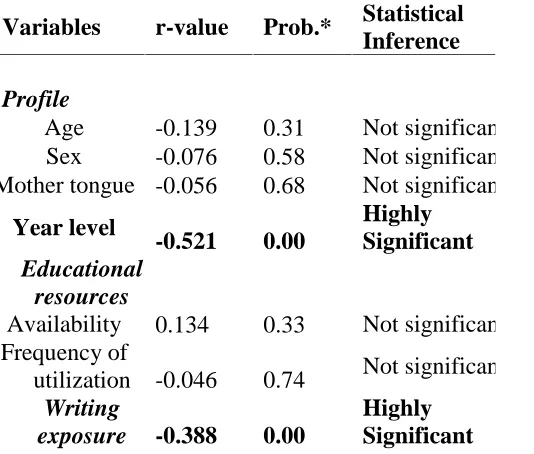
The study theorized that there is no significant relationship between the students syntact errors and selected variables. Result of the correlation analysis (Table 11) indicates that year level significantly relates to students syntactic errors as reckoned by its computed r-value of -0.521 with a probability of 000. The null hypothesis therefore is rejected. This finding means that the lower the year level, the higher the occurrence of syntactic errors.
Moreover, writing exposure also relates with the second language learners syntactic errors as reckoned by its computed r-value of -0.388 and a probability of 0.00. This finding means that the less exposed the students in writing, the higher the incidence of syntactic errors. According to Heder and King (2012), giving students extensive writing during the writing course will help students improve their confidence, speed, fluency and interest in learning English.
Table 11. Relationship of the students’ syntactic errors and the selected variables
Variables r-value Prob.* Statistical Inference
Profile
Age -0.139 0.31 Not significant Sex -0.076 0.58 Not significant Mother tongue -0.056 0.68 Not significant
Year level
-0.521 0.00
Highly Significant
Educational resources
Availability 0.134 0.33 Not significant Frequency of
utilization -0.046 0.74 Not significant
Writing
exposure -0.388 0.00
Highly Significant
*tested at 0.05 level of significance
CONCLUSION
The learners were found to be generally less exposed to ESL writing. More so, the syntactic errors committed by the Second Language learners in ESL writing are significantly related to their year level and writing exposure. These findings underscore the importance of writing activities to bilingual learners at a Higher Education Institution employing English as a medium of Instruction and as a second language.
RECOMMENDATIONS
1. Remediation lessons should be conducted on sentential structures of English to which the learners need reinforcement through differentiated writing tasks.
3. Similar research in bigger scope and/or pertaining to other disciplines should be conducted to
determine other students’ syntactic errors.
REFERENCES
Alvarez, Hermie C (2016). Common
Errors committed by JHS students in grammar and composition. Cagayan State University-Aparri.
Genesee, F. (2004). What do we know
about Bilingual Education for Majority-Language Students? In T. K Bhatia & W. Ritcchie (Eds.), Handbook of bilingualism and multilingualism. Malden, MA: Blackwell.
Herder, S., & King, R. (2012). Extensive
Writing: Another fluency approach for EFL learners . Extensive Reading World Congress Proceedings, 1, 128-130.
Hyland, K. (2007). Genre pedagogy:
Language, literacy, and L2 writing instruction. Journal of Second Language Writing 16, 148-164
Malone, Susan (2007. Mother
Tongue-Based Multilingual Education:Implications For Education Policypresented At The Seminar On Education Policy And The Right To Education: Towards More Equitable
Outcomes For South Asia’s Children Kathmandu, 17-20 September 2007
Myles, J. (2002). Second language writing
and research: The writing process and error analysis in student texts. TESL-EJ 6(2).[on-line available]http://www.cc.kyotosu.ac.jp/info/tesl-ej/ej22/a1.html
Mohamed, A. R., & Darus, N. A. (March
2012). The writing journey of English Second Language (ESL) students with various
levels of English language proficiency. Paper presented at Clute Institute International
Conference in Bangkok, Thailand. Retrieved from http://conferences.cluteonline.com/index.php/IAC/2012BK/paper/viewFile/1058/1068
Sattayatham, A., & Honsa, S. (2007).
Medical students' most frequent errors at Mahidol University, Thailand. The Asian EFL Journal, 9(2), 170-194.
Wang, W., & Wen, Q. (2002). L1 use in the L2 composing process: An exploratory study of
16 Chinese EFL writers. Journal of Second language Writing, 11, 225-246.