
GSJ: Volume 7, Issue 4, April 2019, Online: ISSN 2320-9186
www.globalscientificjournal.com
U
SE OF SEQUENCE
G
N
RH
III
FOR PHILOGENETIC ANALYSIS OF RED
HARD LIPPED BARB CARP
,
GREEN HARD LIPPED BARB CARP
,
MAN-GOT HARD LIPPED BARB CARP AND BEUREUM PANON
Ibnu Dwi Buwono
1*, Junianto
2, Yuli Andriani
31
Faculty of Fisheries and Marine Sciences Universitas Padjadjaran
2Faculty of Fisheries and Marine Sciences Universitas Padjadjaran
3Faculty of Fisheries and Marine Sciences Universitas Padjadjaran
*Corresponding author E-mail: [email protected]
Abstract
The aim of this study was to analyze the relationship between hard lipped barb carp strains based on encoding sequences of GnRH III. This research method uses an explorative method with descriptive analysis. Primers GnRH III-F (5'-GGACCTAAGAGCATGGAGTGG AAAGGAAG-3 ') and GnRH III-R (5'-GGGCTCGAGCACTCTTCCTCGTCTG TTGG-3') used in the GnRH III coding sequence analysis. Based on the coding sequence analysis of GnRH (forward and reverse directions) the genetic distance of red hard lipped barb carp and green hard lipped barb carp is 0.0033 and 0.0049, red hard lipped barb carp, green hard lipped barb carp, with mangot hard lipped barb carp of 0.0054 and 0.0093 and the three hard lipped barb carp with beureum panon of 0.0603 and 0.0558. The coding sequence of GnRH III red, green, mangot hard lipped barb carp has similar amino acid sequences with sGnRH Osteochilus hasselti (no. accession AFH41001.1) of 98% and beureum panon of 96%. The results showed that the coding sequence of GnRH III could be used in determining the kinship relationship of hard lipped barb carp strains.
Key words : Phylogenetic, GnRH III, hard lipped barb carp strain
1.
Introduction
Hard lipped barb an indegenous tropical fish is a synchronous batch spawner fish capable of spawning several time simultaneously between males and females during the peak spawning period. Spawning period for hard lipped barb occurred three months prescribed by the gonadal development and sexual maturation are influenced by the gonadotropin releasing hormone (GnRH) (Lethimonier et al., 2004; Prayogo et al., 2011). In the fish's pituitary gland, the main function of GnRH III is to stimulate the synthesis and release of gonadotropins which further stimulates gonadal development (Dubois et al., 2002). In fish, there is a high diversity of GnRH amino acid sequences in 14 species, but from these variants the asam amino residues 1, 4, 9 and 10 are always conserv (Lethimonier et al., 2004).GnRH gene can be used as a phylogenetic analysis. GnRH gene encoding sequences selected as a determinant of diversity because it can detect the changes in the evolution of GnRH in every type of fish (Guilgur et al., 2007).
In Cyprinidae including hard lipped barb carp there are two types of GnRH, namely GnRH II and GnRH III, the same as salmon have two types of GnRH (GnRH II or cGnRH-II and GnRH III or sGnRH) (Vickers et al., 2004). GnRH II in hard lipped barb carp acts as LH (Luteinizing Hormone) while GnRH-III as FSH ( Folli-cle Stimulating Hormone) (Prayogo et al., 2011).
GnRH III (sGnRH) is related to ovarian and testicular maturation (Nabissi et al., 2000; Fernald & White, 1999). GnRH III expression was detected in gonadal goldfish tissue (Lin & Peter, 1996; Pati & Habibi, 1998), rainbow trout (Uzbekova et al., 2001),
pejerrey (Guilgur et al., 2007) and seabream (Nabissi et al., 2000), shows the role of GnRH III in reproductive control. GnRH III gene expression in rainbow trout gonad tissue showed variations in sexual cycle, indicating that GnRH III in fish varied. This encoding sequence of GnRH can be used in phylogenetic analysis of hard lipped barb carp strains because it can detect nucleotide changes in the GnRH gene sequence which is indicated by the percentage of similarity of sequences between hard lipped barb carp strains.
2.
Materials And Methods
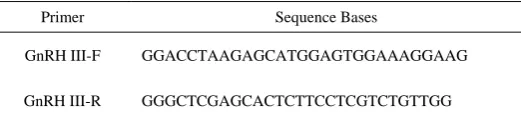
The materials used in this study include: isolation of DNA using wizard® genomic DNA purification kit (Promega), ethanol 70%, isopropanol. Amplification of DNA using gotaq® green master mix, primer GnRH III-F, and GnRH III-R (Table 1) for encoding sequence GnRH III. The sample in this study is the brain tissue of red, green, mangot and javaen hard lipped barb.
Table 1. Primer used with Sequence Bases
Primer Sequence Bases
GnRH III-F GGACCTAAGAGCATGGAGTGGAAAGGAAG
GnRH III-R GGGCTCGAGCACTCTTCCTCGTCTGTTGG
Prayogo et al. (2011)
Unweighted Pair Group Method with Arithmetic Mean) method sequences coding for GnRH III to get fenogram of hard lipped barb carp strains. The nucleotide sequences from GnRH III amplicon sequencing of the four strains of hard lipped barb carp (red, beurem panon, green and mangot) were analyzed on-line
using the BLASTN / P program, especially the sequence of GnRH protein coding for hard lipped barb carp with the Osteochillus
GnRH gene sequence found in genbank.
Fish brain genomic DNA of red hard lipped barb, green hard lipped barb, mangot hard lipped barb and Javaen hard lipped barb was isolated by Wizard® Genomic DNA purification Kit (Promega).
Composition of reaction amplification using PCR method consists of: 12.5 µl go taq® green master mix, 1.5 µl of GnRH III-F and 1.5 µl GnRH III-R primers, 2.0 µl DNA template and 7.5 µl nuclease free water with a total volume of 25 µl. The PCR program used in the amplification was 35 cycles consists of 95ºC for 2 min (predenaturation), 95ºC for 30 sec (denaturation), 55ºC for 30 sec (annealing) and 72ºC for 1 min (extension). After 35 cycles end with a final extension at 72ºC for 5 minutes (Prayogo et al., 2011).
3. Result And Discussion
Genomic DNA Isolation
Electrophoregram of genomic DNA resulting from hard lipped barb carp brain isolation is presented in Figure 1. Based on 1 kb DNA markers, genomic DNA size is above 10000 bp (10 kbp) because DNA consists of exons and introns so that the size of hard lipped barb carp brain genome DNA fragments is longer than with 1 kb DNA marker.
Fig. 1: Electrophoregram resulted from genomic isolation DNA of hard lipped barb carp brains (BNM, BNP, BNH, BNMG)
M = 1 kb DNA ladder marker (Promega), BNMG = brain of mangot hard lipped barb carp, BNM = brain of red hard lipped barb carp, BNBP = brain of bereum panon hard lipped barb carp, BNH = brain of green hard lipped barb carp
Amplification of GnRH III
Electrophoresis of PCR results on red hard lipped barb carp, panon, green and mangot samples produced a DNA fragment, and a relatively thick fragment of 500 bp for red, green and mangot nilem samples, while 600 bp of hard lipped barb carp beureum panon (Figure 2). The fragment is thought to be a sequence of encoding GnRH hard lipped barb carp, in accordance with the results of the study (Prayogo et al., 2011). The target fragment is 500 bp fragment specific.
Fig. 2. Results of sequencing of PCR products coded BNMG, BNM, BNBP,
BNH
M = 1 kb DNA ladder marker (Promega), BNMG = brain of mangot hard lipped barb carp, BNM = brain of red hard lipped barb carp, BNBP = brain of bereum panon hard lipped barb carp, BNH = brain of green hard lipped barb carp
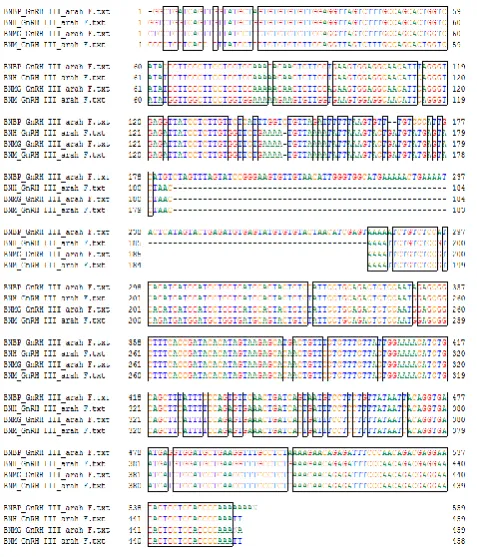
Fig. 3. Alignment of the nucleotide bases of the sequences encoding GnRH III-forward
Alignment of the nucelotide base sequence of the coding sequence GnRH III forward direction in each hard lipped barb carp strain has many similarities, especially in hard lipped barb carp mangot, green and red. The position of nucleotides to 179 to 282 in beureum panon showed different nucleotide variations from the three hard lipped barb carp, this indicates the distant genetic relationship with mangot, green and red strains (Figure 3). Alignment of the nucleotide bases of the sequences encoding the GnRH III gene reverse direction is presented in Figure 4.
Fig. 4. Alignment of the nucleotide bases of the coding sequence of GnRH
III-reverse
The nucleotide base sequence of the GnRH coding sequence III reverse direction in green, mangot, and red strains has many similarities. The composition of beureum panon nucleotide bases at nucleotide positions 257 to 354 has different nucleotide variations from the three nilem (Figure 4). Mangot strains have different nucleotide variations in the nucleotide sequence to 470 to 531. The differences in nucleotide variations indicate differences in genetic relationships in the four strains.
Phylogenetic Analysis of Hard Lipped Barb Carp Strains
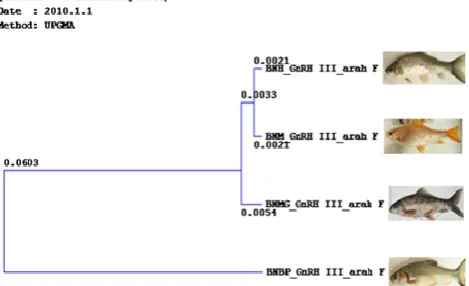
Fig. 5. Phenogram of the hard lipped barb carp strain using a III-forward GnRH primer
Phenogram analysis of the hard lipped barb carp strain using the GnRH III sequence reverse direction showed a pattern similar to the forward direction (Figure 6).
Fig. 6. Phenogram of the hard lipped barb carp strain using the GnRH
III-reverse primer
The genetic distance between green nilem and red is very close at 0.0049 (close kinship). The results of this phenogram are consistent with the results of the nucleotide base alignment analysis using Genetyx R software (Figure 6). The genetic distance of red and green with mangot strains is 0.0093 indicating the third genetic kinship of hard lipped barb carp is close. Furthermore, the genetic distance of beureum panon with red, green and mangot strains of 0.0558 showed a distant genetic relationship .
Based on the alignment of the coding sequence of the GnRH III gene, the genetic kinship of red, green and mangot hard lipped barb carp is close, whereas bereum panon showed a distant genetic relationship .
Bioinformatic Analysis of GnRH III Encoding Genes
The results of GnRH III sequence of red, beureum panon, green and mangot hard lipped barb carp were then processed using bioinformatic analysis with the Blast-X program on-line to obtain the similarity of the gene encoding sequence from genbank. Based on the alignment of the amino acid sequence of the GnRH
AFH41001.1) 98%, 98%, 98% and 96% respectively of the reverse direction.
Based on this, the encoding sequence of GnRH III can be used to determine the kinship of hard lipped barb carp strains, as shown in the phylogenetic analysis using GnRH III of the pejerrey (Silverside) fish, Odontesthes bonariensis (Atheriniformes) (Guilgur et al., 2007).
4. Conclusion
Based on the results of the study, it can be concluded that the genetic distance of red and green hard lipped barb carp is 0.0033 and 0.0049, whereas red, green, with mangot hard lipped barb carp is 0.0054 and 0.0093 and the three hard lipped barb carps with beureum panon is 0.0603 and 0.0558. The coding sequence of GnRH III can be used to determine the phylogenetic strains of hard lipped barb carp.
Acknowledgement
Thank you to the research team (Prof. Junianto and Dr. Yuli Andriani) for research technical assistance.
References
Dubois, E. A., Zandbergen, M. A., Peute, J., & Goos, H. J. T. (2002). Evolutionary development of three gonadotropin- releasing hor-mone (GnRH) systems in vertebrates. Brain Research Bulletin, 57(1), 413–418.
Fernald, R. D., & White, R. B. (1999). Gonadotropin-Releasing Hormone Genes : Phylogeny, structure , and functions. Frontiers in Neuro-endocrinology, 20, 224–240.
Guilgur, L. G., Ortı, G., Strobl-mazzulla, P. H., Fernandino, J. I., Miranda, L. A., & Somoza, G. M. (2007). Characterization of the cDNAs encoding three GnRH forms in the pejerrey fish Odontesthes bon-ariensis (Atheriniformes) and the evolution of GnRH precursors.
Journal of Molecular Evolution, 64, 614–627.
https://doi.org/10.1007/s00239-006-0125-8
Lethimonier, Christele, Thierry Madigou, Jose-Antonio Munoz-Cueto, Jean-Jacques Lareyre, and O. K. (2004). Evolutionary aspects of GnRHs , GnRH neuronal systems and GnRH receptors in teleost fish. General and Comparative Endocrinology, 135, 1–16. https://doi.org/10.1016/j.ygcen.2003.10.007
Lin, X., & Peter, R. E. (1996). Expression of salmon gonadotropin-releasing hormone (GnRH) and chicken GnRH-II precursor mes-senger ribonucleic acids in the brain and ovary of goldfish. General and Comparative Endocrinology, 101(31), 282–296.
Nabissi, M., Soverchia, L., Polzonetti-magni, A. M., & Habibi, H. R. (2000). Differential splicing of three gonadotropin-releasing hor-mone transcripts in the ovary of seabream (Sparus aurata). Biology of Reproduction, 62, 1329–1334.

![6 (4 Methylphenyl) 3 (3,4,5 trimethoxyphenyl) 1,2,4 triazolo[3,4 b][1,3,4]thiadiazole](data:image/gif;base64,R0lGODlhAQABAIAAAP///wAAACH5BAEAAAAALAAAAAABAAEAAAICRAEAOw==)