PERFORMANCE IMPROVEMENT OF
URBAN BUS SYSTEM: ISSUES AND
SOLUTION
AGARWAL, P. KAssociate Professor , Department of Civil Engineering, Maulana Azad National Institute of Technology, Bhopal 462051, India
SINGH, A.P.
P.G. student (Transportation Engg.), Department of Civil Engineering, Maulana Azad National Institute of Technology, Bhopal 462051, India
Abstract:
There is a widespread reliance on buses for public transport, providing important mobility with in urban area throughout the world. However, the private vehicles vying for limited road space along with buses has resulted in congestion, accidents and vehicular pollution in urban areas. The problem of pollution, safety and inefficiency have reached at a alarming level in most of the major cities in India due to unabated growth of its population -both of people and motor vehicles, combined with inefficient public transport system and poor enforcement of environmental laws etc. Improved performance of urban bus service could essentially contribute to improve environment in Indian cities by shifting mobility from private mode of transport towards more efficient environmental friendly and safe travel modes. This study briefly discusses the issues related with inefficient operation of existing bus system in Indian cities and also identifies some solutions for improvement in performance of the urban bus system. This study also presents some indicators which can be used to evaluate efficiency and effectiveness of urban bus service.
Key words: Bus Services, Urban Transportation, Performance Indicators
1. Introduction
Efficient operation of urban bus system is central to development of any city. There is a widespread reliance on buses for public transport, providing important mobility with in urban area throughout the world. However, public prefer to use privately-owned vehicles due to the inefficient operation of city bus service in most of the Indian cities. The private vehicles vying for limited road space along with buses has resulted in congestion, accidents and vehicular pollution in most of the Indian cities. The problem of pollution, safety and inefficiency have reached at a alarming level in most of the major cities in India due to unabated growth of its population -both of people and motor vehicles, combined with inefficient public transport system and poor enforcement of environmental laws etc. Thus, there is a great need to improve in the performance of bus system to reduce these problems. Further, to retain the passengers and discourage the use of private vehicles, the city bus services needs to be improved.
In the above context, this study identifies some of the important issues related with inefficient performance of existing bus system in Indian cities and also suggests some solutions for improvement in the performance of the urban bus system. Rapidly rising operating cost in the urban bus services have placed increasing emphasis on improved management and better utilization of existing facilities. It is required to evaluate how well the existing urban bus system is providing services to the public. Therefore, techniques to assist in evaluating performance of urban bus service are needed. Thus, this study also presents some indicators which can be used to evaluate efficiency and effectiveness of urban bus service. It is expected that this study will be useful to improve the efficiency and effectiveness of bus system in urban area.
2. Issues for Performance Improvement of Urban Bus System.
Some of the important issues for inefficient performance of public transportation system in Indian cities as identified for this study are as follows:
Environmental Issues-Detrimental Effects of Urban Bus System on City Environment
Operational Issues-Inefficient Operation of Urban Bus System o Overcrowding due to inadequate system
o Inefficient & uneconomic bus routes o Irrational location of bus stop
o Frequency of service & schedule is not strictly adhered o Inefficient design of buses
o Traffic congestion, frequent stopping & starting needs more fuel consumption, wear & tear of vehicle
o Higher fleet strength of buses o Higher overall operational cost
o Public transport system is less attractive mainly due to unsafe and inconvenient vehicles etc. These issues are briefly discussed as follows:
2.1 Detrimental effects of urban bus system on city environment
The major detrimental effect of inefficient public transport system on city environment is air pollution and noise pollution. The transport sector is the major contributor to air pollution in urban India. With tremendous growth of public transport vehicles the problem is bound to become serious. The exhaust gas emitted by the internal combustion engine of public transport vehicles makes the city environment unpleasant. The major pollutants are Carbon dioxide, Water vapour, Unburnt petrol, Organic compounds produced from the petrol, Carbon monoxide, Oxide of nitrogen, Leads compounds and Carbon particles (smoke) (Kadiyali, 2008). With deteriorating levels of mass transport services and increasing use of personalized modes, vehicular emission has reached an alarming level in most Indian cities. 72 percent of air pollution in Delhi is caused by vehicular emission. According to studies by the Central Pollution Control Board (CPCB, 1996) of India, 76.2 percent of CO, 96.9 percent of hydrocarbons, and 48.6 percent of NOx are caused by emissions from the transport sector in Delhi. The ambient air pollution in terms of Suspended Particulate Matter (SPM) in all metropolitan cities in India exceeds the limit set by the World Health Organization (WHO) For example, in Kolkata, the average annual emission of SPM is 394 micrograms per cubic meter, while the WHO standard is 75.
also increases the pollution level (Singh, 2005). Thus, there is a great need to reduce congestion to improve city environment.
The increasing urbanization and the tremendous growth of public transport vehicles have also contributed to the mounting volume of noise. The detrimental effects of traffic noise are annoyance, disturbance, dissatisfaction, interference with sleep , speech, or any general task (Kadiyali, 2008). If the noise level is extreme it may produce deafness. These detriment effects may assume serious proportions in Indian cities. Therefore, there is also an urgent need for abatement of noise generated by public transport (Agarwal & Singh, 2010).
2.2 Inefficient operation of urban bus system
Urban bus systems in Indian cities have not been able to keep pace with the rapid and substantial increases in demand over the past few decades. Greater congestion and delays are widespread in Indian cities and indicate the seriousness of transport problems. A high level of pollution is another undesirable feature of overloaded streets. The transport crisis also takes a human toll. Statistics indicate that traffic accidents are a primary cause of accidental deaths in Indian cities. The main reasons for these problems are the prevailing imbalance in modal split, inadequate transport infrastructure, and its suboptimal use. Bus services in particular have deteriorated, and their relative output has been further reduced as passengers have turned to personalized modes and intermediate public transport. Individual cities, A few metropolitan cities are served by well-organized bus services. Services are mostly run by publicly owned State Transport Undertakings (STUs). Private bus services operate mainly in Delhi and Kolkata. All passenger buses use the standard truck engine and chassis; hence, they are not economical for city use. There are virtually no buses in India specifically designed for urban conditions. Qualitatively, available urban bus services are overcrowded, unreliable, and involve long waiting periods (Agarwal & Singh, 2010).
Overcrowding in the public transport system is more pronounced in large cities where buses, which are designed to carry 40 to 50 passengers generally, carry double the capacity during peak hours. As a result, there is a massive shift to personalized transport, especially two-wheelers, and proliferation of various types of intermediate public transport modes (three-wheeler auto-rickshaws and taxies).
The trends of decline in the share of public transport over the past 14 years in different city category are given in the Table-1 (MOUD, 2008). The Table-1 indicates that share of urban bus system has generally declined, while the share of personalized modes especially of two wheelers have gone up leaps. Consequently street congestion has dramatically increased and overall speeds on major corridors have dropped. (However, note that a high percentage of urban bus shares (50.8%) are observed in category- 3, as Kochi falls in this category, which is supplied with very good public transport).
Table-1Trends of Decline in Share of Public Transport
City category City population (in lakhs)
% share of Public Transport
(Year 1994) (Year 2007)
Category-1 <5.0 14.9-22.7 0.0-15.6
Category-2 5.0-10.0 22.7-29.1 0.0-22.5
Category-3 10.0-20.0 28.1-35.6 0.0-50.8
Category-4 20.0-40.0 35.6-45.8 0.2-22.2
Category-5 40.0-80.0 45.8-59.7 11.2-32.1
Category-6 80.0 and above 59.7-78.7 35.2-54
motor vehicles, combined with inefficient public transport system and poor enforcement of environmental laws etc. Thus, there is a great need to improve in the performance of bus system to reduce these problems. Further, to retain the passengers and discourage the use of private vehicles, the city bus services needs to be improved. Thus, this study identifies some strategies to improve performance of public transport system, to ensure clean, efficient, affordable, effective and safe public transport system, to attract employment and facilitate growth, in urban areas. These identified strategies are presented in the following section.
3. Performance Improvement of Urban Bus System
As discussed earlier, efficient urban bus system can play an essential role in reducing urban travel, congestion, air quality, and energy consumption, and, in the long run, effective use of buses can decrease highway investment and associated impacts (Yu.). Some of the measures identified for improvement in performance of urban bus system are as follows:
3.1 Development of environment friendly urban bus system
Applications of innovative technologies must be investigated for developing new environmental friendly bus services in major cities of India. This study identify the following measures for development of environment friendly urban bus system
Promoting alternative clean fuels in the public transport vehicles.
Buses use a lot of fuel as they are big and are driven constantly. The exhaust gas emitted by the internal combustion engine of buses makes the city environment unpleasant. Use of alternative clean fuels may reduce local air pollution, greenhouse gas emissions, and dependence on imported oil. Because of their centralized fueling and maintenance and predictable routes, they are well-suited to alternative fuel use. Therefore, In the case of public transport vehicles, the use of alternative fuels (such as bio-fuels, natural gas) should be promoted, together with the production, storage and supply infrastructure. Biodiesel, a renewable fuel, can be used in any diesel engine and is typically blended with traditional diesel to maintain performance while cutting use of petroleum. Other alternative fuels that can be used in buses are compressed or liquefied natural gas, bio-methane (biologically produced natural gas), clean propane fuel which may reduces local air pollution, greenhouse gas emissions, and dependence on imported oil.
Improving the vehicle design and maintenance
Necessary improvement in vehicle design and maintenance needs to be carried out to reduce the pollutants at the source, which is the exhaust, the evaporation losses, and crank case losses. Advanced, energy efficient and innovative vehicles i.e. hybrid electric vehicle etc. needs to be introduced for developing environment friendly public transport system.
Restraining the use of polluting vehicles and fuels
Large numbers of inefficient, polluting, noisy and uncomfortable vehicles make public transportation unattractive. Thus, there is a need to harmonize public transport vehicles with environmental standards. Some steps to ensure that these vehicles operate more efficiently and cleanly include:
o Phasing out of older vehicles and increases in number of new vehicles.
o A relatively high annual motor vehicle tax, which may be increasing with the age of vehicle
o Congestion pricing, parking fees, fuel taxes, and other measures could be used to restrain the use of Polluting Vehicles and fuels.
o Reduce petroleum consumption by promoting smarter driving practices, idle reduction, and the use of more fuel-efficient vehicles and advanced technologies
o Eliminate petroleum use by encouraging the use of mass transit, trip elimination measures, and other congestion mitigation approaches
Reducing congestion
Congestion has long been recognized as an environmental problem. Other than causing delay, it causes noise and fumes and increases health risks of road users and residents. It is normally considered that safety, environment, economic developments are degraded by increasing levels of roadway congestion. Efforts required to reduce congestion are as follows (MOE, 1997):
o Staggering work hours, to reduce peak hour traffic. o Restraining traffic through road pricing.
o By constructing bypasses and ring roads to reduce traffic in mid town. o Construction of expressways and grade separated intersections (flyovers). o Introduction of one way streets and
o Introduction of synchronized signals and area traffic control systems.
o Construction of metro rail transport system to reduce congestion on city roads and augment the current public transport, which is a primarily bus.
Patronage of public transport system
Indian cities cannot afford to cater only to private cars and two-wheelers and there has to be a general recognition that policy should be designed in such a way that it reduces the need to travel by personalized modes and boosts public transport system. Given the present concerns of pollution, fuel security and urban land as a scarce resource, there is a consensus that public transport has to be promoted to ensure sustainable mobility to all. Public transport systems in Indian cities have to compete with the mobility offered by a motorized two wheeler and economics of running a para-transit system by the informal sector. Two wheelers provide convenient and economical mobility, however also the highest safety risks for the user have. Motorized para-transit systems (four-ten seaters three wheeled vehicles) move like fixed route taxi systems. Operators in the informal sector compromise on environmental and safety regulations to compete in the free market. The result is in terms of increased safety risks and polluted environment. It is amply clear from Table 2 (Agarwal and Singh, 2010) that among the variousmodes of road based passenger transport, bus occupies less road space and causesless pollution per passenger-km than personalized modes. Therefore, urban transport plans should emphasize bus transport.
Table 2: Pollution Rate and Congestion Effect of Private and Public Transport Vehicles
Type of vehicle Average Passenger
Vehicle
Pollution load (gm/pass.-km)
Congestion Effect (PCU/Pass)
2-stroke 2w petrol engine 2 7.13 0.375
4-stroke 2w petrol engine 2 4.76 0.375
Car with catalytic converter petrol engine 4 0.93 0.25
Bus with diesel engine 40 1.00 0.075
Note: PCU = Passenger Car Unit where 1 car = 1 PCU, 1 bus = 2.5 PCU, 1 scooter = 0.75 PCU
Reducing noise level of public transport vehicles
Noise is also an unwanted sound and has there is also an urgent need for abatement of noise generated by public transport. Some of the strategies identified to reduce noise level are as follows (Kadiyali, 2008):
o Changes in the design of vehicles o Changes in tyres or road surfaces o Elimination of noisier vehicles o Modification in traffic operation
Some other measures for developing an environment friendly transport system are as follows (Singh, 2010):
o In conjunction with degradation of air quality, increased vehicular traffic on dirt roads also increases the dust and particulate emissions. Paving roads will help control and reduce air pollution.
Exclusive Right of Way
In Indian cities with wide roads, one lane in each direction can be designed for exclusive use of buses (Public Transport vehicles) especially for major arteries. The objectives of the National Urban Transport Policy, (NUTP 2006) is also a more equitable allocation of road space, investing in transport system that encourages greater use of public transport and non motorized modes instead of personal motor vehicles. Bus Rapid Transit System (BRTS) as one of the preferred alternatives for improving performance in public transportation system, has been already in use in several cities the world over. In India itself it is in different stages of implementation in Delhi, Pune, Ahmadabad and Indore and several other cities are actively considering introducing this system within their city limits BRTS can provide high quality transit service at a fraction of the cost of other options. BRTS is a transport system, where a dedicated lane is provided for BRTS buses. The lanes are suitably barrier (at grade) with an estimated carrying capacity of 25000 people per hour per direction (PPHPD). It consists of several components designed to function together so as to generate superior services, which are comparable other mass rapid transit system including metro rail systems. Some or all of these elements are integrated to forms BRTS, which will ensure fast, reliable, safe, high-capacity service, which also has a distinct identity (Singh, 2010). Photograph 1 clearly illustrate that the use of exclusive right of way is useful for improving the performance of Public Transport system (http://en.wikipedia.com, 2010).
Photograph 1: Use of Exclusive Right of Way for Improving the Performance of Public Transport System
4. Performance Indicators
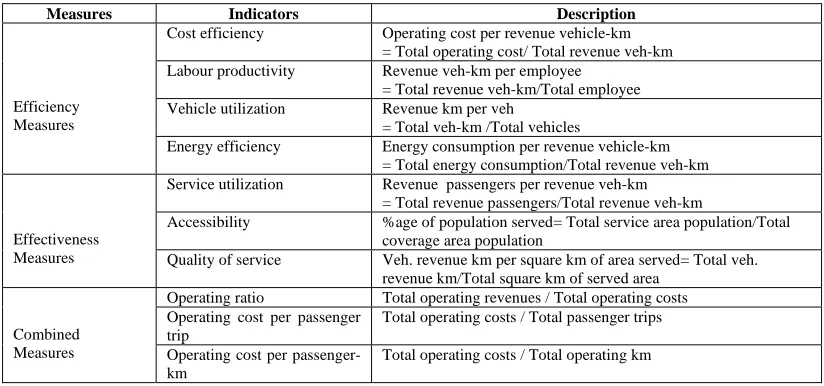
Rapidly rising operating cost in the urban bus services have placed increasing emphasis on improved management and better utilization of existing facilities. Therefore, techniques to assist in evaluating performance of urban bus service are needed. Therefore, this study also presents some indicators which can be used to evaluate efficiency and effectiveness of urban bus service. The performance measures of a urban bus system is comprised with the system capacity supplied, the quality of service produced, comparison of costs versus benefits and environmental impact. It gives a clear indication of how well it is providing urban bus service to the public (Fielding, G.J., et al., 1977). Some of the important indicators describing different aspects of performance of urban bus service are presented in Table-3
Table 3 Details of the Performance Indicators to Evaluate the Performance of Urban Bus System
Measures Indicators Description
Efficiency Measures
Cost efficiency Operating cost per revenue vehicle-km = Total operating cost/ Total revenue veh-km Labour productivity Revenue veh-km per employee
= Total revenue veh-km/Total employee Vehicle utilization Revenue km per veh
= Total veh-km /Total vehicles
Energy efficiency Energy consumption per revenue vehicle-km = Total energy consumption/Total revenue veh-km
Effectiveness Measures
Service utilization Revenue passengers per revenue veh-km = Total revenue passengers/Total revenue veh-km
Accessibility %age of population served= Total service area population/Total coverage area population
Quality of service Veh. revenue km per square km of area served= Total veh. revenue km/Total square km of served area
Combined Measures
Operating ratio Total operating revenues / Total operating costs Operating cost per passenger
trip
Total operating costs / Total passenger trips
Operating cost per passenger-km
Total operating costs / Total operating km
5. Conclusions
This study identifies the issues related with inefficient operation of existing bus system in Indian cities and also identifies some solutions for improvement in performance of the urban bus system. This study also presents some indicators which can be used to evaluate efficiency and effectiveness of urban bus service. Some of the important conclusions drawn from the present study may be summarized as follows:
Private vehicles vying for limited road space along with public transport vehicles has resulted in congestion, accidents and vehicular pollution in most of the Indian cities Some of the important issues for inefficient performance of public transportation system in Indian cities are:
o Environmental Issues- The major detrimental effect of inefficient public transport system on city environment are air pollution and noise pollution.
o Operational Issues-Inefficient Operation of Urban Bus System Over crowding due to inadequate system
Inefficient & uneconomic bus routes Irrational location of bus stop
Frequency of service & schedule is not strictly adhered Inefficient design of buses
Traffic congestion, frequent stopping & starting needs more fuel consumption, wear & tear of vehicle
Higher fleet strength of buses Higher overall operational cost
Some of the strategies identified for improvement in performance of public transport system are identified as follows:
o The transport sector is the major contributor to air pollution in urban India. Public transport could essentially contribute to improve environment in Indian cities by shifting mobility from private mode of transport towards more efficient and environmental friendly travel modes. Policy should be designed in such a way as to reduce the need to travel by personalized modes and boost the public transport system Thus, there is a urgent need to improve existing urban public transport systems to be more environment friendly and efficient in terms of their travelspeed, reliability and quality. This study identify the following environmental management measures to promote the adoption of clean and efficient technologies in the urban bus system:
To promote alternative clean fuels in the public transport vehicles Improving the vehicle design and maintenance
Restraining the Use of Polluting Vehicles and Fuels Reducing congestion
Patronage of public transport system
Reducing noise level of public transport vehicles Other miscellaneous measures
Exclusive right of way for urban bus service.
This study also presents some indicators which can be used to evaluate efficiency and effectiveness of urban bus service. Some of the important indicators describing different aspects of performance of urban bus service are cost efficiency, labour productivity, vehicle utilization, energy efficiency, service utilization, accessibility, quality of service and financial performance.
It is expected that this study will be useful to improve the efficiency and effectiveness of urban bus system in Indian cities.
References
[1] Agarwal, P.K., and Singh, A.P.,(2010), ‘Application of Clean Technology for Development of Environment Friendly Urban Public Transport System,’ Proceeding of National conference on Mission Clean technology, Pune.
[2] CPCB (1996), ‘Urban Statistics’. Central Pollution Control Board, New Delhi.
[3] Fielding, G.J., et al., 1977.’ Developments of performance Indicators for Transit,’ Irvine. UC/PT, Inc., and APTA. Proceedings of the first National Conference on Transit Performance, Norfolk, Virginia, Washington, D.C..
[4] http://en.wikipedia.org/wiki/Mass_Rapid_Transit_System (Chennai) cited on 20/07/2010
[5] Kadiyali, L. R., (2008) ‘Traffic Engineering and Transport Planning’, Seventh Edition, Khanna Publishers, New Delhi .
[6] MOE (1997), White Paper on’ Pollution in Delhi with an Action Plan,’ Ministry of Environment and Forests, Government of India, New Delhi .
[7] MOUD (2008),’ Traffic & Transportation Policies and Strategies in Urban Areas in India,’ Final report, Ministry of Urban Development (MOUD),GOI, New Delhi.
[8] NUTP (2006.), ‘National Urban Transport Policy’, Ministry of Urban Development, Government of India, New Delhi.
[9] Sarvareddy P.R., (2008), ‘Operational Improvements For Buses On Urban Roadways,’ Proceedings of the International Conference on Best Practices to Relieve Congestion on Mixed Traffic Urban Streets in Developing Countries, IIT Madras, Chennai.
[10] Singh, A.P., (2010), ‘Strategies for Development of Environment Friendly, Safe and Efficient Public Transport System,’ M. Tech. Thesis, Department of Civil Engineering, Maulana Azad National Institute of Technology, Bhopal.