Prehospital: Emergency Care
Eleventh Edition
Chapter 46
EMS Response to Terrorism Involving
Weapons of Mass Destruction
Learning Readiness
• EMS Education Standards, text p. 1340.
• Chapter Objectives, text p. 1340.
• Key Terms, text p. 1340.
• Purpose of lecture presentation versus textbook reading
Setting the Stage
(1 of 2)• Overview of Lesson Topics
– Weapons of Mass Destruction
– Prehospital Response to Terrorism Involving WMD
– Conventional Explosives and Incendiary Devices
– Chemical Agents
– Biological Agents
Setting the Stage
(2 of 2)• Overview of Lesson Topics
– Personal Protection and Patient Decontamination
– Active Shooter Incident
Case Study Introduction
EMTs Louis Fine and Alvin Hahn are called to a report of a
sick person at a baseball stadium. Before they arrive, three more calls are reported to dispatch for additional sick
people at the baseball stadium. Dispatch advises all
responding units to use caution and to stage outside the
stadium. An EMS supervisor is en route to establish
Case Study
(1 of 3)• Why should arriving units use caution in this situation?
• What could be responsible for several reports of sick
people at an event?
Introduction
• Weapons of mass destruction (WMD) are a possibility
Weapons of Mass Destruction
(1 of 4)• WMD are intended to cause widespread death and
destruction.
• The mnemonics CBRNE and B-NICE can be used to
Weapons of Mass Destruction
(2 of 4)• CBRNE is commonly used to remember the types of
WMDs.
– C – Chemical
– B – Biological
– R – Radiological
– N – Nuclear
Weapons of Mass Destruction
(3 of 4)• B-NICE is also commonly used to remember the types of
WMDs.
– B – Biological
– N – Nuclear/radiological
– I – Incendiary
– C – Chemical
Weapons of Mass Destruction
(4 of 4)• Dissemination means bringing the WMD agent into
contact with its intended target population.
• The general approach to a WMD incident is the same as
Prehospital Response to Terrorism
Involving W
M
D
(1 of 8)• Supplies and Equipment
– To ensure adequate equipment and response, there
must be a community response to the disaster.
– Each type of WMD requires different specialty
equipment and supplies.
– A plan must allow immediate deployment of
Prehospital Response to Terrorism
Involving W
M
D
(2 of 8)• Medical Direction
– There must be a plan to establish medical direction
and verify credentials of responders from outside areas.
– Communications may be unreliable, requiring reliance
Prehospital Response to Terrorism
Involving W
M
D
(3 of 8)• Provider Preparation
– As always, EMS provider safety is the highest priority.
– You must be aware of the indications of the weapons
Prehospital Response to Terrorism
Involving W
M
D
(4 of 8)• Responding to the Scene
– The earlier a WMD incident is recognized, the better.
– The incident command system is used in WMD
attacks.
– Hazardous materials principles are used if the agent
Prehospital Response to Terrorism
Involving W
M
D
(5 of 8)• Issues of Scene Safety
– Signs of a toxic and unsafe environment include:
▪ Respiratory distress.
▪ Dyspnea.
▪ Cough.
▪ Burning chest.
Prehospital Response to Terrorism
Involving W
M
D
(6 of 8)• Issues of Scene Safety
– Wear HEPA or N-95 masks, gloves, eye protection,
and gowns for suspected communicable illnesses.
– Approach from upwind.
– Avoid confined spaces.
– Entry must be made only by those with specialized
training and protection.
Prehospital Response to Terrorism
Involving W
M
D
(7 of 8)• Role of the EMT at the Terrorist Incident Involving a WMD
– Initial incident command and scene size-up
– Sector leader or officer, such as triage, treatment, or
transportation
Prehospital Response to Terrorism
Involving W
M
D
(8 of 8)• Role of the EMT at the Terrorist Incident Involving a WMD
– Recognize locations or events that may be terrorist
targets and use caution when responding to those locations.
– The dead from terrorist incidents are now considered
evidence.
Conventional Explosives and Incendiary
Devices
(1 of 8)• Conventional explosives and incendiary devices are the
most widely used WMDs.
• Explosives
– Ignition of fuels that burn rapidly, causing hot gases to
displace air, creating a shock wave
– The blast moves out in all directions at supersonic
Conventional Explosives and Incendiary
Devices
(2 of 8)• Explosives
– Improvised Explosive Devices
▪ Improvised from easily obtainable products
▪ Vehicle-Borne Improvised Explosive Device (VBIED)
– Car or truck bomb.
– Commonly use an explosive called ANFO
Conventional Explosives and Incendiary
Devices
(3 of 8)• Explosives
– Common Explosive Compounds
▪ EGDN
▪ HMTD
▪ PETN
▪ RDX
▪ Semtex
Conventional Explosives and Incendiary
Devices
(4 of 8)• Primary, Secondary, Tertiary, Quaternary, and Quinary
Effects
– The explosion blast is the primary effect.
– The secondary effects result from flying debris or
shrapnel.
– Tertiary effects are injuries produced by the
propulsion of the person’s body.
– Quaternary effects include burn, crush, and inhalation
Conventional Explosives and Incendiary
Devices
(5 of 8)• Types of Injuries
– Lungs
▪ Blast lung and pneumothorax may occur.
▪ Look for altered mental status, dyspnea, bloody
sputum, chest pain, and stroke-like signs and symptoms.
▪ Use caution with positive pressure ventilation to
Conventional Explosives and Incendiary
Devices
(6 of 8)• Types of Injuries
– Abdomen
▪ Bowel may bleed or leak contents into the
abdomen.
▪ Evisceration is possible.
– Ears
▪ The eardrum may rupture and the inner ear bones
may be disrupted.
Conventional Explosives and Incendiary
Devices
(7 of 8)• Types of Injuries
– Crush injuries
▪ They may occur from structural collapse and
entrapment.
▪ Complications occur when the pressure on the
crushed area is relieved.
• Shrapnel injuries
– Penetrating injuries can cause bleeding, hollow organ
Conventional Explosives and Incendiary
Devices
(8 of 8)• Incendiary Devices
– Be cautious of secondary and undetonated devices.
– They primarily cause burns.
– Assess burns according to the Rule of nine’s
– Pay attention to airway and breathing.
Chemical Agents
(1 of 16)• Properties of Chemical Weapons
– Can be dispersed using munitions or aerosol devices
– The tendency of an agent to evaporate and create
vapors is its volatility.
– Agents that do not evaporate are characterized as
persistent.
Chemical Agents
(2 of 16)• Types of Chemical Agents
– Nerve agents
– Vesicants
– Cyanide
– Pulmonary agents
– Riot-control agents
Chemical Agents
(3 of 16)• Types of Chemical Agents
– Nerve Agents
▪ Potent and easily made
▪ Block the enzyme that breaks down the
neurotransmitter acetylcholine (ACh), allowing
accumulation of ACh
▪ overstimulation of the muscles, smooth muscles,
Table 46-1 Nerve Agents
• Tabun (GA)
• Sarin (GB)
• Soman (GD)
• GF
• Methylphosphonothioic acid (VX)
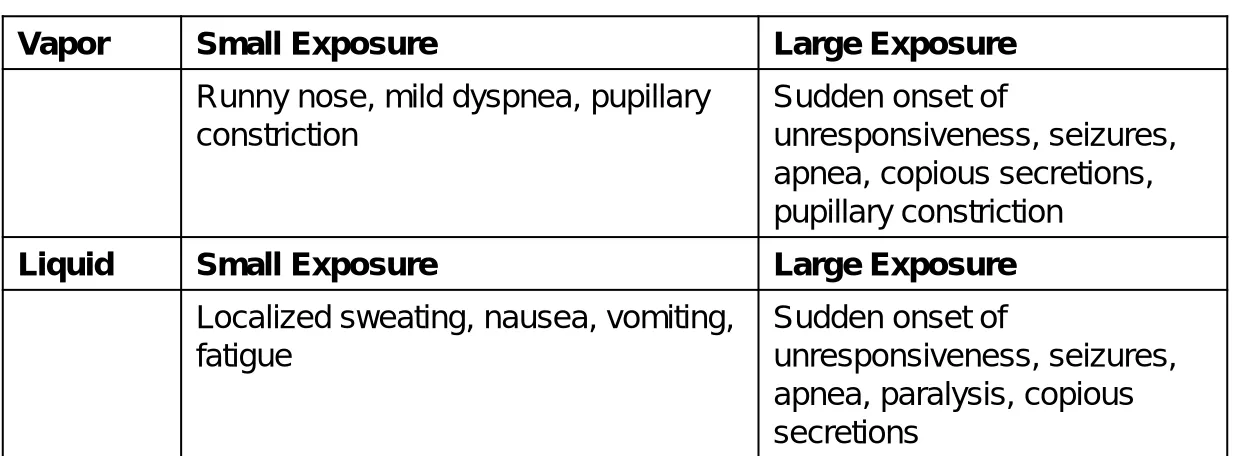
Table 46-2 Signs and Symptoms of Nerve
Agent Exposure
Vapor Small Exposure Large Exposure
Blank Runny nose, mild dyspnea, pupillary constriction
Sudden onset of
unresponsiveness, seizures, apnea, copious secretions, pupillary constriction
Liquid Small Exposure Large Exposure
Blank Localized sweating, nausea, vomiting, fatigue
Sudden onset of
Chemical Agents
(4 of 16)• Types of Chemical Agents
– Nerve Agents
▪ Signs and symptoms:
– Respiratory failure from paralysis of respiratory
muscles.
– Copious airway secretions and
bronchoconstriction.
– SLUDGE—salivation, lacrimation, urination,
Chemical Agents
(5 of 16)• Types of Chemical Agents
– Nerve Agents
▪ Emergency Medical Care
– Ensure an adequate airway and ventilation; be
prepared to suction.
– The medications atropine and pralidoxime are
antidotes.
– To combat seizures, benzodiazepine
Chemical Agents
(6 of 16)• Types of Chemical Agents
– Vesicants
▪ Cause blistering, burning, and tissue damage
▪ Agents include sulfur and nitrogen mustards,
Chemical Agents
(7 of 16)• Types of Chemical Agents
– Vesicants
▪ Signs and symptoms:
– Burning, redness, blistering, and necrosis.
– Stinging, tearing, and development of ulcers in
the eyes.
– Shortness of breath, coughing, wheezing, and
pulmonary edema.
Chemical Agents
(8 of 16)• Types of Chemical Agents
– Vesicant
▪ Emergency medical care
– Irrigation
– Manage chemical burns
– Apply a dry, sterile dressing
– Lewisite, an arsenic-based agent, has an
Chemical Agents
(9 of 16)• Types of Chemical Agents
– Cyanide
▪ Rapidly disrupts the ability of the cells to use
oxygen
▪ May be inhaled and ingested
Chemical Agents
(10 of 16)• Types of Chemical Agents
– Cyanide
▪ Signs and symptoms:
– Anxiety.
– Weakness and dizziness.
– Nausea.
– Muscular trembling.
Chemical Agents
(11 of 16)• Types of Chemical Agents
– Cyanide Exposure
▪ Emergency treatment:
– Manage the airway, breathing, and
oxygenation.
– There are antidotes available.
• Nitrites and sodium thiosulfate
Chemical Agents
(12 of 16)• Types of Chemical Agents
– Pulmonary Agents
▪ Include phosgene, other halogen compounds, and
nitrogen-oxygen compounds
Chemical Agents
(13 of 16)• Types of Chemical Agents
– Pulmonary Agent Exposure
▪ Signs and symptoms:
– Tearing and runny nose.
– Throat irritation.
– Dyspnea and wheezing.
– Cough.
Chemical Agents
(14 of 16)• Types of Chemical Agents
– Pulmonary agent exposure
▪ Emergency medical treatment:
– Manage the airway and breathing; be prepared
Chemical Agents
(15 of 16)• Types of Chemical Agents
– Riot Control Agents
▪ Tear gas and pepper spray
▪ cause extreme irritation of the eyes, nose, mouth,
skin, and respiratory tract.
▪ Emergency medical care is supportive and may
Chemical Agents
(16 of 16)• Types of Chemical Agents
– Toxic Industrial Chemicals
▪ They may be obtained from hijacking rail or truck
transportation of chemicals or sabotage of chemical plants.
▪ The approach and treatment depends on the agent
Case Study
(2 of 3)Case Study
(3 of 3)• What should be the approach to this situation?
• Where should EMS units be located?
Biological Agents
(1 of 13)• They consist of living organisms or their toxins.
• Small amounts can cause widespread illness and may
take days to detect.
• Dispersal methods vary.
Biological Agents
(2 of 13)• Specific Biological Agents
– Groups of biological agents include:
▪ Pneumonia-like agents.
▪ Encephalitis-like agents.
▪ Biological toxins.
Biological Agents
(3 of 13)• Specific Biological Agents
– Pneumonia-Like Agents
▪ Present with fever and difficulty breathing, and
include:
– Anthrax.
– Plague.
– Tularemia.
▪ Encephalitis-Like Agents include:
Biological Agents
(4 of 13)• Specific Biological Agents
– Biological Toxins
▪ Botulinum
– Descending paralysis
– Double vision
– Blurred vision
– Dry mouth and throat
Biological Agents
(5 of 13)• Specific Biological Agents
– Biological Toxins
▪ Ricin
– Weakness
– Fever
– Cough
– Hypothermia
Biological Agents
(6 of 13)• Specific Biological Agents
– Biological Toxins
▪ Staphylococcus enterotoxin 13
– Fever
– Chills
– Headache
– Body aches
Biological Agents
(7 of 13)• Specific Biological Agents
– Biological Toxins
▪ Epsilon toxin
– Cough, wheezing, and shortness of breath
– Respiratory failure
Biological Agents
(8 of 13)• Specific Biological Agents
– Biological Toxins
▪ Trichothecene myotoxins
– Pain
– Itching and lesions
– Runny nose, and sneezing
– Sloughing skin
Biological Agents
(9 of 13)• Specific Biological Agents
– Other Biological Agents
▪ Cholera
– Vomiting, abdominal distention, and profuse
diarrhea
– Severe dehydration
Biological Agents
(10 of 13)• Specific Biological Agents
– Other Biological Agents
▪ Viral hemorrhagic fevers
– Malaise
– Body aches
– Headache
– Vomiting
Biological Agents
(11 of 13)• Specific Biological Agents
– Other Biological Agents
▪ Brucellosis
– Fever
– Malaise
– Body aches
– Joint pain
Biological Agents
(12 of 13)• Specific Biological Agents
– Emergency medical care for biological agent
▪ Prehospital care is supportive.
▪ Recognition and contacting public health officials is
crucial.
▪ Smallpox, plague, and Ebola are highly
Biological Agents
(13 of 13)• Specific Biological Agents
– Emergency medical care for biological agent
▪ Hospital care includes antibiotics and antitoxin.
▪ Immunizations and prophylactic treatment are
Click on the W
M
D Agent Below That is a
Biological Agent
A. Phosgene
B. Nerve agents
C. Ricin
Nuclear Weapons and Radiation
(1 of 11)• Three primary mechanisms of death
– Radiation
– Blast
– Thermal burns
• Radiation
– Energy released from radioactive atoms passes
Nuclear Weapons and Radiation
(2 of 11)• Radiation
– The cells may die, repair, or produce mutated cells.
– X-ray/gamma radiation is the most penetrating type
and can travel long distances.
– Neutron radiation is a powerful, damaging particle
Nuclear Weapons and Radiation
(3 of 11)• Radiation
– Beta radiation is a low-speed, low-energy particle that
is easily stopped by 6 to 10 feet of air, clothing, or the first few millimeters of skin, but poses a serious
hazard if ingested.
– Alpha radiation is heavy, slow-moving, and easily
Nuclear Weapons and Radiation
(4 of 11)• Radiation
– Exposure associated with a nuclear explosion
▪ Primary exposure
– Radiation injury that occurs during or shortly
after the detonation
▪ Fallout
– Radioactive dust and particles that can be life
Nuclear Weapons and Radiation
(5 of 11)• Blast Injuries
– Nuclear detonation causes a rapid heating of air and
an explosively expanding gas cloud.
– Injuries are the same as those from conventional
explosives.
Nuclear Weapons and Radiation
(6 of 11)• Thermal burns
– Cause most deaths and injuries from nuclear
explosion
– Heating is a short duration, but very intense.
Nuclear Weapons and Radiation
(7 of 11)• Radiological Dispersal Devices/Radiological Exposure
Devices
– “Dirty Bomb”
▪ A conventional explosive attached to radioactive
materials
▪ Risk of widespread radiation illness and
contamination of the environment
– A Radiological Exposure Device
Nuclear Weapons and Radiation
(8 of 11)• Improvised Nuclear Device
– Assembled and built specifically for a terrorist
incident.
– Low-quality materials
Nuclear Weapons and Radiation
(9 of 11)• Assessment and Care for Nuclear Detonation and
Radiation Injuries
– Assessment
▪ Most destruction and death is nearest the center of
the blast.
▪ There is less death and injury further from the
blast.
▪ Identify the time after exposure that the patient
Nuclear Weapons and Radiation
(10 of 11)• Assessment and Care for Nuclear Detonation and
Radiation Injuries
– Signs and symptoms:
▪ Nausea, fatigue, malaise, and clotting disorders.
▪ Vomiting, no appetite, diarrhea, and fluid loss.
▪ Reddening of the skin.
▪ Rapid onset of incapacitation, cardiovascular
Nuclear Weapons and Radiation
(11 of 11)• Assessment and Care for Nuclear Detonation and
Radiation Injuries
– Emergency Medical Care
▪ Protect yourself and patients from further
radioactive exposure.
▪ Treat thermal and blast injuries.
▪ Manage airway, breathing, and oxygenation.
▪ Iodine tablets can help protect against long-term
Personal Protection and Patient
Decontamination
• Personal protective equipment is required for chemical,
biological, and radiological/nuclear exposure.
• Apply the principles of hazardous material response.
• Apply the principles of time, distance, and shielding for
radiation exposure.
• Apply the principles of decontamination as for hazardous
Active Shooter Incident
• Tactical EMS
– Tactical emergency medicine(TEM) is not normally
taught as part of most EMT or paramedic curriculums.
Cyberterrorism
• The use of computer network tools to shut down critical
national infrastructure.
• Medical devices and technology rely on networked
computer systems.
• Protected health information (PHI) can be illegally
Case Study Conclusion
(1 of 4)Louis and Allan, along with other responding units, are relocated to a position upwind from the stadium.
Case Study Conclusion
(2 of 4)Case Study Conclusion
(3 of 4)In all, nearly 100 people are decontaminated by hazardous materials personnel at the scene. Hazardous materials
crews confirm that the substance involved was a riot control agent.
Case Study Conclusion
(4 of 4)Lesson Summary
(1 of 2)• WMD are intended to produce widespread death and
destruction.
• WMD may be chemical, biological, radiological, nuclear,
or explosive agents.
• Conventional explosive agents have the greatest
Lesson Summary
(2 of 2)• Preplanning is crucial to management of the incident and
the patients.
• Preplanning must consider supplies and equipment,
Correct!
Ricin is a biological toxin.
Incorrect
(1 of 3)Phosgene is a chemical agent.
Incorrect
(2 of 3)Nerve agents are chemical agents.
Incorrect
(3 of 3)Hydroxocobalamin is an antidote to cyanide, a chemical agent.