A NOVEL APPROACH TO TRANSFORM
CLASSICAL DATABASE TO USER
FRIENDLY WEB DOCUMENT FOR
MEDICAL APPLICATION IN
PEER-TO-PEER ENVIRONMENT
E. Anupriya *
M. Sri Harsha
School of Computing Science and Engineering, VIT University, Vellore – 632 014, India
ABSTRACT
Due to the increasing popularity of the XML (eXtensible Markup Language) as a common data standard for information interchange across Web, XML is commonly being used as an underlying data model for many applications to deal with the heterogeneity of data and nodes. This paper presents a novel approach to extract data from classical database systems like relational database systems, convert it into XML documents, and exchange XML documents among peer nodes in the network. Many hospitals have branches in different geographical locations. The chief doctors need to travel to different locations and give consultation. If the peer hospital nodes are connected in peer-to-peer network, then the consultation can be provided from any peer hospital node even under emergencies. Peer-to-Peer network is implemented via Byzantine-Resilient Secure Multicast Routing in Multihop Wireless Networks (BSMR) protocol enhanced with security. Also, we have considered and emulated a system for one such medical application in which the consultant can enter details like insulin dosage to be given or any pre or post sugar measurements need to be taken for any in patients available in the peer hospitals. The concerned duty doctor and nurses can carryout the task based on instruction in any peer hospital node. To make it easily readable, the information is presented in browser as a XML document.
Key words: XML, XML documents, Peer- to- Peer Networks (P2P), Byzantine-Resilient Secure Multicast Routing
in Multihop Wireless Networks (BSMR), Document Object Model (DOM)
1. INTRODUCTION
Peer nodes like palmtops and laptops in peer-to-peer networks (P2P) can communicate with each other directly if they are within the signal range of each other. [1], [5], [11] Documents can be exchanged among them without any central coordination. Recent developments in peer-to-peer (P2P) computing have made the P2P applications feasible just with the knowledge of end points. And it has attracted many academicians and researchers to find deep roots in this domain. The existing P2P systems are more predominant for file sharing applications, but in long run the P2P systems will be powerful in sharing any application with near by, accessible peer nodes. Today, the XML (eXtensible Markup Language) [12] is popular and well accepted data representation for information interchange across the Web. XML standard [16] remains applicable even for peer-to-peer systems as these systems are built on already existing internet. Also, XML representation is meant primarily for transfer across the network. Therefore, after exchange between peers, the peer node application may take it up for further processing suited for any application built on it.
condition. An instruction exchange may the need for the time. We have proposed a new peer-to-peer system in which, the chief consultant can be in any of the peer hospital nodes or at home, provided with laptop or palmtop connected in peer-to-peer network to instruct the duty doctors or nurses. We have designed a small application, in which the consultants can provide instructions on insulin dosage details, pre or post sugar levels to be collected and emergency tests to be taken and prepare the patient on emergencies so that the chief consultant can resolve emergency situations as soon as he arrives at the spot. In this application, diabetes related information is intended for exchange in the form of user friendly and easily readable instructions.
Nowadays, the commercial database systems like Oracle, DB2 provide XML support. We use SQL (Structured Query Language) [13] and XML parser for retrieving data from hospital repository by peer nodes on need. An XML parser converts values retrieved from SQL table into XML documents. Modern browsers have a built in XML parser to store retrieved data from database in XML format. [14] Which is further passed on to target peer node for use. The rest of the paper is organized as follows: Section 2 describes the related work and how our work differs from others. Section 3 discusses about our proposed peer-to-peer system architecture. Section 4 includes the implementation details and section 5 includes conclusion of our work.
2. RELATED WORK
In the current hospital scenario, patient records are stored either in books or in complex databases repositories that requires specifically trained personnel to maintain them. This causes strain on hospital resources and also involves the cost of recruiting/training specific people for the job. Also, several human errors may be caused due to lack of training or negligence, and there is always the risk of patient information leaking out. To avoid such issues, we have developed a user-friendly application that runs on a P2P network, and integrates all the aspects of conventional hospital data management software, yet can be used by novice and untrained users.
In many peer-to-peer (P2P) systems [11], there exists high security threat while exchanging or transferring data files across peer nodes, i.e., without being attacked by an intruder. The security problem may not be alleviated completely but we have attempted to resolve the issue by encryption and decryption techniques on XML documents to transfer them securely between peers using RSA (Ron Rivest, Adi Shamir and Len Adleman) [10] algorithm. In “Multihop Wireless Networks” [2], packet loss during data transmission, data confidentiality, authenticity and node comprimisation are more common problems. We have resolved these issues to some extent using enhanced “BSMR: Byzantine-Resilient Secure Multicast Routing in Multihop Wireless Networks” [2] proposed by us.
3. SYSTEM ARCHITECTURE
In P2P architecture, any peer connected in the network can communicate with other peer nodes directly. In this particular model, clients and servers are not distinguished from one another; instead, all nodes (i.e., peers nodes) within the system can either act as client or as a server, depending on whether it is requesting for a service or providing a service. The proposed P2P system establishes a peer-to-peer network using enhance BSMR. After that, the replicated application existing on peer nodes is ready for exchange of XML files. The process is initiated at one peer node with the target peer node and information (i.e. XML patient file) needs to be passed on to the target node. The local peer node application extracts the information present in the traditional database system using SQL query. The DOM parser parses the result set and converts it into the XML file. The XML file is now ready for transfer to the target peer node.
3.1. p2p Network Setup
The basic requirement is to establish a peer-to-peer network to facilitate data or file exchange between peer nodes. Byzantine attacks are arbitrary attacks in distributed environment. BSMR protocol supports multicasting among groups. This utility is used to build the peer-to-peer network. BSMR facilitates secure delivery of data to group members. The BSMR protocol is built on authentication framework, in which only peer nodes with valid group identity can alone participate in network. We have modified the protocol to adapt RSA algorithm to ensure secure transfer of XML files. The XML file at sender peer node is encrypted and decrypted with the same RSA algorithm at the target peer node.
The procedure used to setup peer-to-peer network is
Step1: Within a peer, find out all neighbouring peers connected to network by initiating Route discovery. Step2: Store all the peers discovered in route discovery in a list. Step3: If the list is not empty then, select a peer in the list to which XML document is to be sent. Step4: Select a route
Step5: After selecting a route, activate route using route activation message. Step6: Send/forward data and receive data.
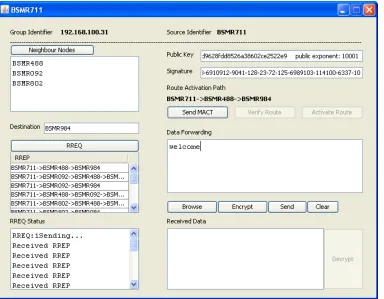
Figure 2 illustrates route discovery and activation of peer-to-peer network. Once the underlying network is formed, data forwarding and transfer to target peer gets initiated.
XML DOCUMENT
XML DOM PARSER
PATIENT DATA REPOSITORY
XML DOCUMENT
APPLICATION SERVER / SERVLETS
BROWSER
DATA ACESS & XML CONVERSION INFORMATION PRESENTATION
PEER NODE
P 2 P NETWORK PEER NODE
PEER NODE
PEER NODE
Figure 3 shows the snapshot of BSMR implemenation to establish peer-to-peer network and data transfer path of the route activated.
Figure 2. Route discovery and activation in P2P network
3.2 Data access and conversion to XML
Each peer hospital node contains huge repository of patient’s data. The patients’ record of a peer hospital node is identified by the peer hospital id (group valid id) and the patient’s id. Per day or Per hour data or Per session data is queried using SQL. The data retrieved from table is shown in Table 1.
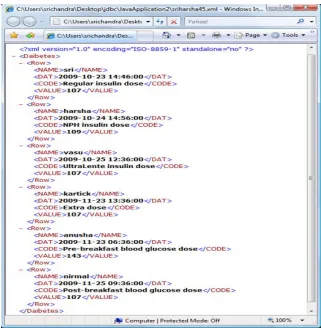
The data retrieved is converted to XML data using XML DOM. XML DOM is a standard object model for XML. Using DOM properties, the document containing records are converted in to XML by XML encoding method. The XML file generated and the display of the XML source file in the browser is shown in Figure 4. The file is now ready for transfer to the target peer node.
3.3 User Interaction
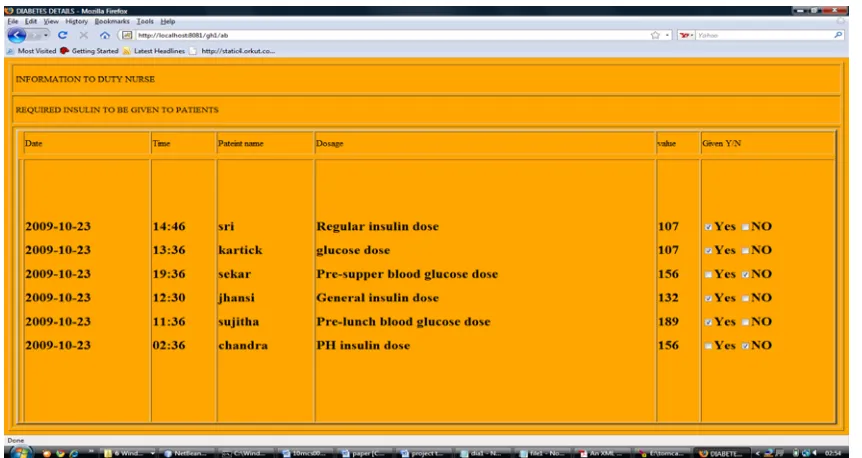
On the receiving side, using XML parser the values retrieved from XML document is sent to another process. The results are refined according to the date and time. The application server TOMCAT locally resolves the servlets to be called for presentation. The data is presented to the intended duty doctors or nurses in more readable and discriminative form. Even a novice or an untrained user can view the details and proceed further with the clinical procedures. Figure 5 shows the browser display of diabetes patient records. It includes date, time, patient name, dosage of insulin to be given, dosage volume, and option button to check whether the insulin has been given or not. The latter is meant for follow-up and the nurses can check it once the dose is given.
4. IMPLEMENTATION AND DISCUSSION
The emulation of P2P consultation system is developed using BSMR on Java platform. The classical database used is Oracle 10g. Application part is designed and implemented using Net Beans IDE 6.1. Diabetes data set is an empirical data set collected from experienced doctor. Diabetes data set [15] consist of four fields per record. An additional field patient id is added to it for ease of processing.
Fields of data sets: (1) Patient name
(2) Date in MM/DD/YYYY and Time in XX: YY format (3) Code
(4) Value
The Code field is used to indicate what type of dose should be given to patient and is described as follows:
Regular insulin dose, NPH insulin dose, UltraLente insulin dose, unspecified blood glucose dose, Unspecified blood glucose dose , Pre-breakfast blood glucose dose , Post-breakfast blood glucose dose” [15].
Existing BSMR [2] deals with security issues in Multihop Wireless Networks. But, in enhanced version of BSMR, we have considered only three phases i.e., Route discovery, Multicast Route Activation, Selective Data Forwarding Mitigation [2] and appended with additional peer-to-peer functionality.
We tested our system with few records in the beginning and slowly increased the number of records in terms of 100. The time taken to transfer data between two peer nodes is shown in Figure 6. It illustrates 4700 records transferred in 53s.
5. CONCLUSION
The paper presents a novel approach to extract data from classical database systems like relational database systems, convert it into XML documents, and exchange XML documents among peer nodes in the network. The BSMR protocol used is enhanced to accommodate peer-to-peer functionality. Not all the failures are accounted in our work. However, we intend to extend our work to improve the robustness and speed of our system in future.
6. REFERENCES
[1] Praveen R. Rao, Bongki Moon, ” Locating XML Documents in a Peer-to-Peer Network using Distributed Hash Tables”, IEEE Transactions on Knowledge and Data Engineering, vol. 21.Issue 12, 2009.
[2] Reza Curtmola, Student Member, IEEE, and Cristina Nita-Rotaru, Senior Member, IEEE, “BSMR: Byzantine-Resilient Secure Multicast Routing in Multihop Wireless Networks”, IEEE Transactions on Mobile Computing, vol. 8, 2009.
[3] Xuebin Chen, Guolin Duan,Hongcan Yan, Shufen Zhang, Yuee Che,” Schema-based Constrained XML data indexing and storage Technique”, NISS ’09, Proceedings of International Conference on new trends in information and service science, ISBN: 978-0-7695-3687-3, 2009.
[4] Wansa Paoin, Pranot Boonchai-Apisit, “Development of Surgical Operation Data Interchange Model Using XML and Relational Database”, 8th International symposium on NLP, ISBN: 978-1-4244-4139-6/09, 2009.
[5] John F. Buford, Gabriel Jakobson and Lundy Lewis,” Peer-to-peer coupled agent systems for distributed situation management”, Journal of Information Fusion, vol.11,pp 233-242, 2010.
[6] Ibrahim Dweib, Ayman Awadi, Seif Elduola Fath Elrhman, Joan Lu, “Schemaless Approach of Mapping XML Document into Relational Database”, Proceedings of IEEE International Conference CIT 2008, ISBN: 978-1-4244-2358-3, 2008.
[7] Masatoshi Yoshikawa ,Toshiyuki Shimizu, “A New Ranking Scheme and Result Representation for XML Information retrieval Based on Benefit and Reading Effort”, ICKS ’08 Proceedings of International Conference on Informatics Education and research for knowledge, ISBN: 0-7695-3128-8, 2008.
[8] De Rezende.I and Siqueira.F,”XOP: Sharing XML Data Objects through Peer-to-Peer Networks”, AINA 2008, Proceedings of International Conference on Advanced Information Networking and applications, ISBN: 978-0-7695-3095-6, 2008.
[9] Adam Wright, Dean F. Sittig,”SANDS: A service-oriented architecture for clinical decision support in a National Health Information
Network”, Journal of Biomedical Informatics, vol.14, pp 962-981, 2008. [10] Jones, J. 2008,”The RSA algorithm (abstract only)”, ACM Communications on Computer Algebra, vol 42, 2008.
[11] G. Koloniaria and E. Pitoura, “Peer-to-Peer Management of XML Data: Issues and Research Challenges”, SIGMOD Record, vol. 34, no. 2, pp. 6-17, Jun. 2005.
[12] Extensible Markup Language (XML) 1 .0, http://www. w3.org/TR/1998/REC-xml-19980210
[13] Structured Query Language (SQL), http://www.w3schools.com/SQl/
[14] Document Object Model (DOM) Level 1 Specification Version 1 .0, http://www.w3.org/TR/REC-DOM-level-1,1998. [15] Diabetes data sets, http://archive.ics.uci.edu/ml/datasets/Diabetes
[16] XML documents, http://r.web.umkc.edu/raopr/reading.cs5590ld.pdf