R E S E A R C H A R T I C L E
Open Access
Evaluation of parameter uncertainties in nonlinear
regression using Microsoft Excel Spreadsheet
Wei Hu
1, Jing Xie
1, Henry Wai Chau
2and Bing Cheng Si
1*Abstract
Background:Nonlinear relationships are common in the environmental discipline. Spreadsheet packages such as Microsoft Excel come with an add-on for nonlinear regression, but parameter uncertainty estimates are not yet available. The purpose of this paper is to use Monte Carlo and bootstrap methods to estimate nonlinear parameter uncertainties with a Microsoft Excel spreadsheet. As an example, uncertainties of two parameters (αandn) for a soil water retention curve are estimated.
Results:The fitted parameters generally do not follow a normal distribution. Except for the upper limit ofαusing the bootstrap method, the lower and upper limits ofαandnobtained by these two methods are slightly greater than those obtained using the SigmaPlot software which linearlizes the nonlinear model.
Conclusions:Since the linearization method is based on the assumption of normal distribution of parameter values, the Monte Carlo and bootstrap methods may be preferred to the linearization method.
Keywords:Bootstrap; Monte Carlo; Soil water retention; Parameter uncertainty; Excel
Background
Nonlinear relationships are common in natural and envir-onmental sciences (Wraith and Or 1998; Luo et al. 2003; Cwiertny and Roberts 2005). As a result, there are many software packages (such as SAS and MathCAD) that imple-ment nonlinear parameter estimation. However, spread-sheet techniques are easier to learn than other specialized mathematical programs for nonlinear parameter estimation, because no programming skills are needed in spreadsheets to develop their own parameter estimation routines (Wraith and Or 1998). In addition, spreadsheets have the merits of wide accessibility and powerful computation in terms of fit-ting nonlinear models. For these reasons, spreadsheets such as Microsoft Excel are widely suggested to make nonlinear parameter estimation (Harris 1998; Smith et al. 1998; Wraith and Or 1998; Brown 2001; Berger 2007).
Parameter uncertainty refers to lack of knowledge re-garding the exact true value of a quantity (Tong et al. 2012). Different observations are usually obtained when experiments are repeated, resulting in different values of parameters. It is usually expressed as an interval of
parameter values at a certain confidence level, say, 95%. It is also expressed as the standard error of the mean by as-suming normal distribution of parameter values. Param-eter uncertainty can be used to judge the degree of reliability of the parameter estimates, which is important to making decisions for environmental management. For these reasons, estimation of parameter uncertainties is sig-nificant for nonlinear parameter estimates. However, rela-tively less work has focused on the nonlinear parameter uncertainty estimates using spreadsheet packages.
Parameter uncertainty can be obtained exactly by assum-ing normal distribution of a parameter in linear regression, but not in nonlinear regression. Nonlinear regression pro-grams usually give the parameter uncertainty by calculating the standard error of the mean, and assuming linear rela-tionship between variables in the vicinity of the estimated parameter values and normal distribution of parameter values. Furthermore, this method usually involves evaluat-ing a Hessian matrix (a square matrix of second-order par-tial derivatives of a scalar-valued function to describe the local curvature of a function of many variables) or an in-equality, which makes it more complicated and time de-manding (Brown 2001). More general methods such as Monte Carlo and bootstrap simulation can be used to esti-mate the parameter uncertainties. Both methods have their
* Correspondence:[email protected] 1
Department of Soil Science, University of Saskatchewan, Saskatoon, SK S7N 5A8, Canada
Full list of author information is available at the end of the article
own advantages: while the Monte Carlo method is based on a theoretical probability distribution of a variable, the bootstrap method has no assumption on the probability distribution of a variable and thus has no limits on sam-pling size. Among numerous related applications are testing fire ignition selectivity of different landscape characteristics using the Monte Carlo simulation (Conedera et al. 2011) and estimating uncertainty of greenhouse gas emissions using the bootstrap simulation (Tong et al. 2012). However, parameter uncertainties estimation in spreadsheets using the Monte Carlo and bootstrap methods has been rarely discussed.
Both nonlinear parameter values and their associated un-certainties are important for decision making and thus should be implemented in spreadsheet program like Excel. Microsoft Excel spreadsheets have other advantages includ-ing their general facility for data input and management, ease in implementing calculations, and often advanced graphics and reporting capabilities (Wraith and Or 1998). These advantages are likely to make the use of spreadsheets to quantify parameter uncertainties more desirable.
The objective of this paper is to apply the Monte Carlo and bootstrap simulations to obtain parameter uncer-tainties with a Microsoft Excel spreadsheet. In addition, the influences of number of simulation on uncertainty estimates are also discussed. For this, we use as an ex-ample, a common soil physical property - soil water
retention curve, which has been widely used in soil, hydrological, and environmental communities.
Results and discussion
Nonlinear regression parameters estimation
Here are the steps to estimate parameters α and n in Excel using nonlinear regression.
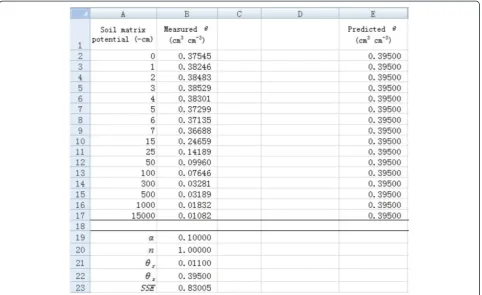
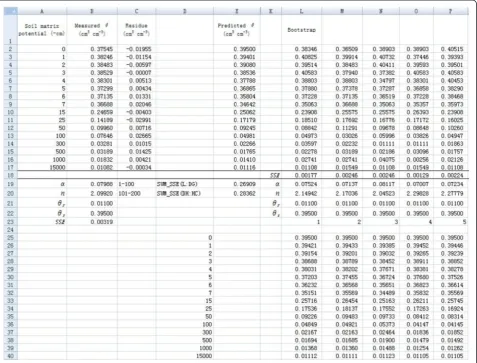
1. List the applied suction pressure as the independent variable in column A and measured soil water content (θ) as the dependent variable in column B (Figure 1).
2. Temporarily set the value of α as 0.1 andn as 1 in cells B19 and B20, respectively (Figure 1). It is important to set an appropriate initial value because an obviously un-reasonable initial value will lead to an unanticipated value. Please refer to related document for initial value estima-tion (e.g., Delboy 1994). List the measured θr and θs in
cells B21 and B22, respectively. Then the predictedθvalue can be calculated with the van Genuchten soil water re-tention curve model (Eq. 5) using suction pressure and all parameter values. For example, the predictedθ in cell E2 (^θE2) is calculated by the following formula:
^
θE2¼$B$21þ ð$B$22−$B$21Þ ð1þ ð$B$19
$A2Þ^$B$20Þ^ð−1þ1=$B$20Þ ð1Þ
As Figure 1 shows, all the predictedθvalues are 0.395 given the initial values.
Figure 1Data input and initial value set forαandnin a spreadsheet.
3. Calculate the sum of squared residuals (SSE) using Excel function SUMXMY2 in cell B23 by entering “SUMXMY2(B2 : B17, E2 : E17)”. We obtain 0.83005 for
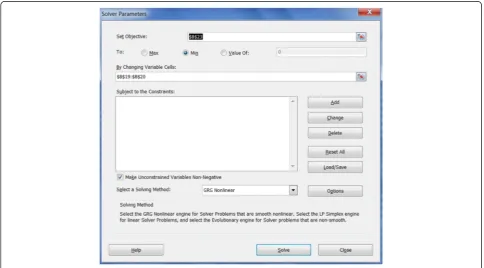
SSEfor the given initial parameter values (Figure 1). 4. The model obtains the maximum likelihood when the SSE is minimized, which is the principle of least-square fitting method. TheSolver tool in Excel can be used to minimize theSSEvalues. TheSolvertool can be found under the Data menu in Excel. If not found there, it has to be added from File menu through the path File- > Options- > Add-Ins- > Solver Add-in. As Figure 2 shows, the“Set Objective”box is the value to be optimized, which is the SSEvalue in cell B23. Click “Min” to minimize the objective SSE by changing the values of α and n as shown in the “By Changing Variable Cells”.
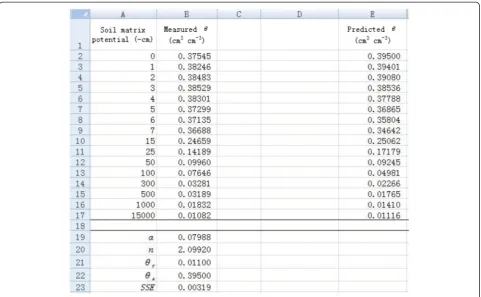
5. TheSolverwill then find the minimumSSE(in cell B23) and corresponding α (in cell B19) and n (in cell B20) values (Figure 3). The measured θ values are in agreement with the predictedθ values (Figure 4), indi-cating a good nonlinear curve fitting.
Using Monte Carlo method to estimate parameter uncertainty
Stepwise application of the Monte Carlo method in esti-mating parameter uncertainties with 200 simulations is demonstrated below:
1. Resampleθusing the Monte Carlo method in differ-ent columns. Take cell L2 for example, the simulated θ (θL2) is calculated by the following formula:
θL2¼$E2þNORM:INV RANDð ðÞ;0;SQRTðSSE=dfÞÞ
ð2Þ
where $E2 refers to the corresponding predicted θ. SSE
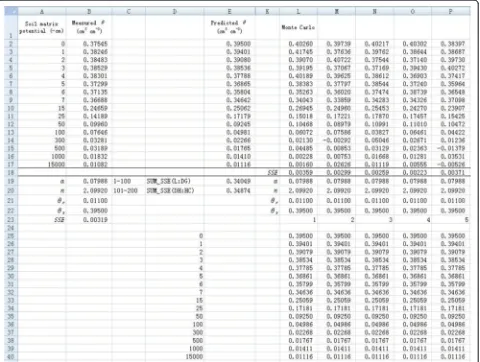
is the value calculated above, which is the value in cell B23 in Figure 5. The degree of freedom (df) equals 14. The θ values in the other rows in column L are simu-lated in a similar way. The simusimu-lated values for a new dependent variable θ are demonstrated in cells L2-L17 (Figure 5). The same Monte Carlo simulations are per-formed from column M to column HC. Therefore, a total of 200 sets of simulatedθare obtained (Figure 5).
2. Use the same procedure as introduced before to conduct nonlinear regression for each new data set ofθ.
Note that the new data set of θ will change during optimization, which will result in errors in fitting. There-fore, we copy the simulated θ data to a new sheet by right-clicking “Paste Special” and selecting “Values” in the dialogue of “Paste Special”. For better display, pre-dictedθarray, all the parameter values, and correspond-ingSSEvalue are presented in the same column for each simulation (Figure 5). Optimization of parametersαand
n is made independently for each simulation using the
Solver tool. The initial values are set as the fitted values
obtained before for all simulations to reduce the time re-quired during the optimization. Therefore, initial values of 0.07988 and 2.09920 are set for α and n, respectively (Figure 5). Because the maximum number of variables
Solver can solve is 200, we can minimize theSSEvalues for 100 simulations at one time by minimizing the sum of SSE values of 100 simulations. For example, the pa-rametersαandnfor the first 100 simulations can be op-timized by minimizing cell E19 by entering“=SUM(L18:
DG18)” (Figure 5). Similarly, the parameters for the sec-ond 100 simulations can be optimized in cell E20 by en-tering “=SUM(DH18:HC18)”. Therefore, we obtain 200 values for both parameters (α and n) as shown in cells from L19 to HC20 (Figure 6). The frequency distribution ofαandnare shown in Figure 7. Visually, both of them follow a normal distribution. However, the Shapiro-Wilk test shows that the parameter α does not conform to a normal distribution, whereas parameter ndoes. This in-dicates that the fitted parameters may not necessarily be normally distributed even if the dependent variable is normally distributed, due to the nonlinear relations be-tween them.
3. Calculate the 95% confidence interval of α or n
values with 200 simulations. We copy all the fittedα or
n values, then paste them to a new sheet by right-clicking “Paste Special” and selecting“Transpose”in the dialogue of “Paste Special” to list all the fitted α or n
values in one column. Select the transposed data, and rank them in an ascending order usingSorttool inData
tab. Find the value of α and ncorresponding to the 2.5 percentile and 97.5 percentile, which are the lower limit and upper limit, respectively, at a 95% confidence. The 95% confidence interval are (0.0680, 0.0939) and (1.9185, 2.3689) for α and n, respectively (Table 1). The differ-ence between upper limit and lower limit is 0.0259 and 0.4504 forαandn, respectively.
Figure 3A spreadsheet for estimating nonlinear regression coefficientsαandn.
Figure 4Measured and predicted soil water content versus soil suction pressure.
Using bootstrap method to estimate parameter uncertainty
Stepwise application of the bootstrap method in estimat-ing parameter uncertainties with 200 simulations is demonstrated as follows:
1. Resampleθusing the bootstrap method in different columns (Figure 8). Take cell L2 for example, the simulated θ (θL2) can be calculated by the following
formula:
θL2¼$E2þINDEXð$C: $C;INTðRANDðÞ 16þ2ÞÞ
ð3Þ
where the function INDEX is used to randomly select a residue value from row 2 to row 17 in column C (the re-sidual is calculated by subtracting predicted θ from the original θ). The θvalues at other rows in column L and in other columns (column M to column HC) are simu-lated in a similar way. Here, 2 in the right hand side of Eq. (3) means that data start at second row.
2. Similar to the Monte Carlo method, parameters α and n for all simulations are fitted by minimizing the sum of every 100 SSE values using the Solver tool (Figures 8 and 9). Therefore, we can also obtain 200 values for both parameters (α and n) as shown in cells from L19 to HC20 (Figure 9). The frequency distribution ofαandnare shown in Figure 10. They also visually fol-low a normal distribution. However, the Shapiro-Wilk test shows that the parameter α does not conform to normal distribution, whereas parameterndoes.
3. Similar to the Monte Carlo method, the 95% confi-dence intervals for these two parameters are calculated. They are (0.0680, 0.0925) and (1.9172, 2.3356), forαand
n respectively (Table 1). The corresponding difference between upper limit and lower limit is 0.0245 and 0.4183 forαandn, respectively.
Influences of number of simulation on parameter uncertainty analysis
Datasets of fitted values with different numbers of simula-tions are obtained using a similar method as demonstrated
before (data not shown). According to Shapiro-Wilk test, both parameters do not follow a normal distribution with different numbers of simulations except for a few cases that the number of simulations ≤400. This may indicate that the assumption of normality in the linearization method does not hold true.
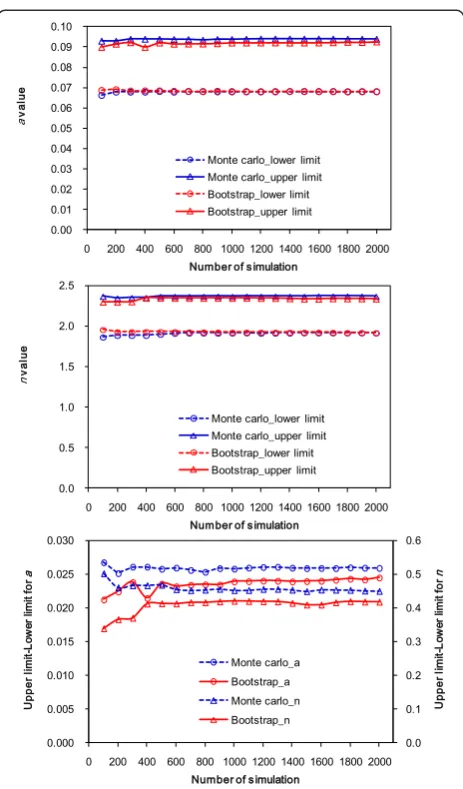
The lower limit, upper limit, and their difference change slightly with the number of simulations. However, they are almost constant beyond a certain number of simulations (Figure 11). Here, we determine the number of simula-tions required for both methods according to the change in difference between the upper limit and lower limit. If
Figure 6Nonlinear regression fitting for resampledθusing Monte Carlo method (only the first 5 simulations are shown).
Figure 7Frequency distribution of (a)αand (b)nobtained using Monte Carlo method with 200 simulations.The heights of bars indicate the number of parameter values in the equally spaced bins. The curve is the theoretical normal distribution.
the relative difference (RD%) of the difference between the upper limit and lower limit under a certain number of simulation is less than 5% compared with that under 2000 simulations, the number of simulations tested is taken to be the required number of simulations. The RD% can be calculated as
RD%¼ Vm−V2000 V2000
100% ð4Þ
where Vm and V2000 are the differences between the upper limit and lower limit under m simulations and 2000 simulations, respectively.
For the Monte Carlo method, the RD% is less than 5% for α and n when the numbers of simulation are ≥100 and 200, respectively. For the bootstrap method, the RD % is less than 5% for α and n when the numbers of simulation are ≥500 and 400, respectively. Therefore, simulation number of 200 and 500 are needed to pro-duce reliable data at the 95% confidence interval of pa-rameters for the Monte Carlo and bootstrap methods, respectively. In this sense, the Monte Carlo method may be better than the bootstrap method. However, the opti-mal number of simulation may also differ with specific situations. For example, Efron and Tibshirani (1993) stated that a minimum of approximately 1000 bootstrap re-samples was sufficient to obtain accurate confidence
Table 1 Comparison of parameter uncertainties calculated by different methods
Parameter Monte
Carlo
Bootstrap Linearization
α Lower limit 0.0680 0.0680 0.0670 Upper limit 0.0939 0.0925 0.0928
Upper limit-Lower limit
0.0259 0.0245 0.0258
n Lower limit 1.9185 1.9172 1.8758 Upper limit 2.3689 2.3356 2.3218
Upper limit-Lower limit
0.4504 0.4184 0.4460
interval estimates. In order to obtain reliable confidence interval estimates, we suggest increasing the simulation times by 100 at each step, and the final results can be obtained when the values stabilize within consecutive steps.
Comparison with parameter uncertainty approximated by linear model
The valuesαandnare estimated to be 0.0799 and 2.0988, respectively, by SigmaPlot 10.0 (Figure 12), which are exactly the same as the estimates made by nonlinear
Figure 9Nonlinear regression fitting for resampledθusing bootstrap method (only the first 5 simulations are shown).
Figure 10Frequency distribution of (a)αand (b)nobtained using bootstrap method with 200 simulations.The heights of bars indicate the number of parameter values in the equally spaced bins. The curve is the theoretical normal distribution.
regression in Excel. Based on the linear model, the associ-ated standard errors are estimassoci-ated to be 0.0066 and 0.1138, respectively (Figure 12). Then the 95% confidence intervals of α and n are (0.0670, 0.0928) and (1.8758, 2.3218), re-spectively. As Table 1 shows, the difference between upper limit and lower limit by the Monte Carlo and bootstrap methods are comparable, although the Monte Carlo
method produces a slightly greater uncertainty than the bootstrap method. The slight difference is due to the differ-ences in re-sampling residues. While the Monte Carlo simulation generates residues based on a theoretical nor-mal distribution, the bootstrap method randomly takes the residues with replacement and no assumption is made about the underlying distributions. They are also compar-able to those approximated by the linear model obtained from the SigmaPlot software. However, by comparing the results of these three methods, the lower limit and upper limit of αand n obtained by the Monte Carlo and boot-strap methods are slightly greater than those obtained based on a linear assumption except for upper limit ofαby the bootstrap method. Because the linearization method is based on the assumption of normal distribution of parame-ters and linearity at the vicinity of the estimated parameter value, and it is more complicated in terms of calculation, the Monte Carlo and bootstrap methods may be preferred to the linearization method to calculate the parameter un-certainties in spreadsheets. Furthermore, the Monte Carlo method may be preferred to the bootstrap method considering the less number of simulations required for the Monte Carlo method. However, if the number of mea-surements is too small to determine the probability distri-bution for Monte Carlo method, the bootstrap method may be superior.
Conclusions
This paper shows step-by-step how to use a Microsoft Excel spreadsheet to fit nonlinear parameters and to esti-mate their uncertainties using the Monte Carlo and boot-strap methods. Both Monte Carlo and bootboot-strap methods can be applied in Excel spreadsheets to resample a large number of measurements for dependent variable from which different values of parameters can be obtained. Our results clearly show that the Monte Carlo and bootstrap methods can be used to estimate the parameter uncertain-ties using spreadsheet methods. The main limitation is that one execution of standard Microsoft Excel Solver has a limit of 200 simultaneous optimizations. This limit can be overcome by multiple independent executions of Solver. Due to the wide accessibility of Microsoft Excel software and ease of use for these two methods, employing the
Figure 11Influences of number of simulation on the lower limit, upper limit, and difference of upper limit and lower limit.
Monte Carlo and bootstrap methods in spreadsheets is strongly recommended to estimate nonlinear regression parameter uncertainties.
In this paper, we demonstrated the methodology with the van Genuchten water retention curve. The method can be applied to any mathematical functions or models that can be evaluated by Excel. Therefore, the method-ology presented in this paper has wide applicability. Fur-ther, with little modification, the Monte Carlo method or bootstrap method can be used in Microsoft Excel to estimate the uncertainty of hydrologic or environmental predictions with single or multiple input parameters under different degrees of uncertainty.
Methods
Soil water retention curve
Soil water content is a function of soil matric potential ψ under equilibrium conditions, and this relationship θ(ψ) can be described by different types of water retention curves. The soil water retention curve is a basic soil prop-erty and is critical for predicting water related environmen-tal processes (Fredlund et al. 1994). Among various soil water retention curve models, the van Genuchten (1980) model is the most widely used one (Han et al. 2010). It is highly nonlinear and can be expressed as:
θð Þ ¼ψ θrþðθs−θrÞð1þðαj jψÞnÞ−1þ 1
n ð5Þ
where θ(ψ) is the soil water content [cm3 cm−3] at soil water potential ψ(−cm of water), θris the residual water
content [cm3cm−3], θs is the saturated water content
[cm3cm−3],αis related to the inverse of the air entry suc-tion [cm−1], andnis a measure of the pore-size distribution (dimensionless). We measuredθ(ψ) at 16 soil water poten-tials for a sandy soil using Tempe pressure cells (at soil matrix potentials ranging from 0 to−500 cm) and pressure plates (at soil water potentials of−1000 and−15000 cm).θs
is measured using oven drying method after saturation, and θris estimated as water content of soil approaching air-dry
conditions (Wang et al. 2002). θs and θr are 0.395 and
0.011, respectively. Note that the soil water content (0.375) at zero matrix potential is lower than θs due to the soil
water movement under gravity. This paper will focus on the estimation of parametersαandn and their associated 95% confidence intervals.
Parameter uncertainty estimation by linearization of nonlinear model
We express the van Genuchten model (Eq. 5) as:
θi¼f β;ψi
þεi ð6Þ
whereθi is the i th observation for the dependent
vari-ableθ(ψ) (i= 1, 2,…16),ψiis theith observation for the
predictor |ψ|.βis a vector of parameters which includes
parameters α and n. εi is a random error, which is
as-sumed to be independent of the errors of other observa-tions and normally distributed with a mean of zero and variance ofσ2.
The sum of squared residuals (SSE) for nonlinear re-gression can be written as:
SSEð Þ ¼β X θi−f β;ψi
2 ð
7Þ
The model has the maximum likelihood when theSSE
is minimized. Namely, when the partial derivative
∂SSEð Þβ ∂β ¼−2
X
θi−f β;ψi
∂fβ;ψi
∂β ð8Þ
is zero, parametersβ are optimized. Once the optimum values ofβare obtained, the parameter uncertainties can be estimated by linearizing the nonlinear model function at the optimum point using the first-order Taylor series expansion method (Fox and Weisberg 2010).
Let
Fij¼∂f
^ β;ψi
∂βj
ð9Þ
where ^β is the optimized value,jrefers to thejth of pa-rameters (j= 1, 2, andβ1=α,β2=n).
Assume matrixF= [Fij]. In our case,
F¼
∂f β^;ψ1
∂α
∂f β^;ψ1
∂n ∂f β^;ψ2
∂α
∂f β^;ψ2
∂n
⋮ ⋮
∂f ^β;ψ16
∂α
∂f ^β;ψ16
∂n 2 6 6 6 6 6 6 6 6 6 6 4 3 7 7 7 7 7 7 7 7 7 7 5
ð10Þ
where∂fð Þ^β;ψi
∂α and
∂fð Þβ;^ψi
∂n can be calculated by the follow-ing formulae:
∂f ^β;ψi
∂α ¼ðfððα^þΔ^αÞ;n^;ψiÞ−fððα^−Δα^Þ;n^;ψiÞÞ=ð2Δα^Þ
ð11Þ
∂f ^β;ψi
∂n ¼ðfð^α;ðn^þΔ^nÞ;ψiÞ−fðα^;ðn^−Δn^Þ;ψiÞÞ=ð2Δn^Þ
ð12Þ
whereΔ= 0.015,α^ and^nare optimized value ofαandn, respectively.
The estimated asymptotic covariance matrix (V) of the estimated parameters can be obtained by (Fox and Weisberg 2010):
V¼ δ 2
αα δ2αn δ2
nα δ2nn
¼σ2F0F−1 ð13Þ
where (F0F)−1is the inverse ofF0F, andF0is a transpose ofF.
The σ2 can be approximated by dividing the SSE by the degree of freedom,df, as in the form (Brown 2001):
σ2¼SSE
df ð14Þ
where dfis calculated as the number of observations in the sample minus the number of parameters. In this study,dfequals 14 (i.e., 16 minus 2).
Therefore, δ2αα, δ2nn, δ2αn ( or δ2nα) in Eq. (13) are the estimated variance ofα, variance ofn, and covariance ofα andn, respectively. Specifically,δααandδnnare the
stand-ard errors used to characterize the uncertainties ofαand
n, respectively. At 95% confidence, the intervals ofαandn
are α^ ±1.96δαα, n^ ±1.96δnn, respectively. SigmaPlot 10.0
is used to estimate the parameters and associated standard errors.
Monte Carlo method to estimate parameter uncertainty
Monte Carlo method is an analytical technique for solv-ing a problem by performsolv-ing a large number of simula-tions and inferring a solution from the collective results of the simulations. It is a method to calculate the prob-ability distribution of possible outcomes.
In this paper, Monte Carlo simulation is performed to obtain residues of dependent variableθ. The residues fol-low a specified distribution with a mean of zero and stand-ard deviation of pffiffiffiffiffiffiffiffiffiffiffiffiffiffiffiffiSSE=df . The simulated residues are added to the predictedθ(^θ) to reconstruct new observa-tions for dependent variableθ. The expression for obtain-ing new observations for dependent variableθin Excel is:
θ¼θ^þNORM:INV RANDðÞ;0;SQRT SSE
df
ð15Þ
where function NORM.INV gives a value which follow a normal distribution with a mean of zero and standard deviation of pffiffiffiffiffiffiffiffiffiffiffiffiffiffiffiffiSSE=df at a probability of RAND(). Therefore, normal distribution on the θ is assumed for Monte Carlo method. Excel function RAND produces a random value that is greater than or equal to 0 and less than 1. SQRT is a function to obtain the square root of a variable.
Monte Carlo simulations are performed 2000 times. Nonlinear regression is made on the simulated θ values versus |ψ| to obtain 2000 values for parametersαand n. The fitted values with different numbers (from 100 to 2000 with intervals of 100) of simulation is analyzed sep-arately to determine the influences of number of simula-tion on uncertainty estimates. For each dataset, the
probability distribution ofαand nwill be determined by the Shapiro-Wilk test using SPSS 16.0, and the 95% con-fidence intervals of α and n will be calculated to repre-sent their uncertainties. For simplification, only 200 simulations are shown as an example. Readers can run different numbers of simulation by analogy.
Bootstrap method to estimate parameter uncertainty
Bootstrap method is an alternative method first intro-duced by Efron (1979) for determining uncertainty in any statistic caused by sampling error. The main idea of this method is to resample with replacement from the sample data at hand and create a large number of “phantom samples” known as bootstrap samples (Singh and Xie 2013). Bootstrap method is a nonparametric method which requires no assumptions about the data distribution.
Residues ofθ are calculated by subtracting theθ^ from the original θ measurements. Bootstrap method is used to resample the residues with replacement for each θ from the calculated residues. The re-sampled residues are added to the θ^ to reconstruct new observations for dependent variable θ. The expression for obtaining new observations for dependent variable θ using bootstrap method in Excel is:
θ¼θ^þINDEX Range of residualð ;INT RANDð ðÞ Row numberÞ
ð16Þ
where function INDEX is used to randomly return a cal-culated residual from a certain array. Range of residual refers to the calculated residues. INT is a function to round a given number, which is randomly produced by RAND() multiplied by row number.
The non-parametric bootstrap method is a special case of Monte Carlo method used for obtaining the dis-tribution of residues ofθwhich can be representative of the population. The idea behind the bootstrap method is that the calculated residues can be an estimate of the population, so the distribution of the residues can be obtained by drawing many samples with replacement from the calculated residues. For the Monte Carlo method, however, it creates the distribution of residues of θ with a theoretical (i.e., normal) distribution. From this aspect, the bootstrap method is more empirically based and the Monte Carlo method is more theoretic-ally based.
Competing interests
The author declares that there are no competing interests associated with this research work.
Authors’contributions
WH analyzed the data and wrote the draft. JX and HC participated in the data analysis. BS designed the study. All authors read and approved the final manuscript.
Authors’information
Wei Hu is a professional research associate at the University of Saskatchewan and specialist for soil hydrology. Jing Xie is a PhD student in University of Saskatchewan who is investigating legume fertilization. Henry Wai Chau is a lecturer in environmental physics in Lincoln University. Bing Cheng Si is a full professor in University of Saskatchewan and specializes in soil physics.
Acknowledgements
The project was funded by the Natural Sciences and Engineering Research Council (NSERC) of Canada.
Author details
1Department of Soil Science, University of Saskatchewan, Saskatoon, SK S7N
5A8, Canada.2Department of Soil and Physical Science, Lincoln University, PO Box 84Lincoln, Christchurch 7647, New Zealand.
Received: 22 January 2015 Accepted: 11 March 2015
References
Berger RL (2007) Nonstandard operator precedence in Excel. Comput Stat Data An 51:2788–2791
Brown AM (2001) A step-by-step guide to non-linear regression analysis of experimental data using a Microsoft Excel spreadsheet. Comp Meth Prog Bio 65:191–200
Conedera M, Torriani D, Neff C, Ricotta C, Bajocco S, Pezzatti GB (2011) Using Monte Carlo simulations to estimate relative fire ignition danger in a low-to-medium fire-prone region. Forest Ecol Manag 26:2179–2187 Cwiertny DM, Roberts AL (2005) On the nonlinear relationship between k(obs)
and reductant mass loading in iron batch systems. Environ Sci Technol 39:8948–8957
Delboy H (1994) A non-linear fitting program in pharmacokinetics with Microsoft® Excel spreadsheet. Int J Biomed Comput 37:1–14
Efron B (1979) Bootstrap method: another look at the Jackknife. Ann Stat 7:1–26 Efron B, Tibshirani R (1993) An introduction to the Bootstrap. Champman & Hall,
London, UK
Fox J, Weisberg S (2010) Nonlinear regression and nonlinear least squares in R: An appendix to an R companion to applied regression, second edition. http://socserv. socsci.mcmaster.ca/jfox/Books/Companion/appendix/Appendix-Nonlinear-Regression.pdf.
Fredlund DG, Xing AQ, Huang SY (1994) Predicting the permeability function for unsaturated soils using the soil-water characteristic curve. Can Geotech J 31:533–546
Han XW, Shao MA, Hortaon R (2010) Estimating van Genuchten model parameters of undisturbed soils using an integral method. Pedosphere 20:55–62
Harris DC (1998) Nonlinear least-squares curve fitting with Microsoft Excel Solver. J Chem Educ 75:119–121
Luo B, Maqsood I, Yin YY, Huang GH, Cohen SJ (2003) Adaption to climate change through water trading under uncertainty - An inexact two-stage nonlinear programming approach. J Environ Inform 2:58–68
Singh K, Xie M (2013) Bootstrap: A statistical method. From Rutgers University. http://www.stat.rutgers.edu/home/mxie/rcpapers/bootstrap.pdf.
Smith LH, McCarty PL, Kitanidis PK (1998) Spreadsheet method for evaluation of biochemical reaction rate coefficients and their uncertainties by weighted nonlinear least-squares analysis of the integrated Monod equation. Appl Environ Microbiol 64:2044–2050
Tong L, Chang C, Jin S, Saminathan R (2012) Quantifying uncertainty of emission estimates in National Greenhouse Gas Inventories using bootstrap confidence intervals. Atmos Environ 56:80–87
van Genuchten MT (1980) A closed-form equation for predicting the hydraulic conductivity of unsaturated soils. Soil Sci Soc Am J 44:892–898
Wang QJ, Horton R, Shao MA (2002) Horizontal infiltration method for determining Brooks-Corey model parameters. Soil Sci Soc Am J 66:1733–1739
Wraith JM, Or D (1998) Nonlinear parameter estimation using spreadsheet software. J Nat Resour Life Sci Educ 27:13–19
Submit your manuscript to a
journal and benefi t from:
7 Convenient online submission 7 Rigorous peer review
7 Immediate publication on acceptance 7 Open access: articles freely available online 7 High visibility within the fi eld
7 Retaining the copyright to your article