IMPROVING PERFORMANCE OF
BUSINESS INTELLIGENCE
THROUGH CASE BASED REASONING
Vivek Jaglan
Research Scholar Suresh Gyan Vihar University
Jaipur, India
Surjeet Dalal
Asst. Professor CSE Dept Manav Rachna International University
Faridabad, India
Dr. S. Srinivasan
Professor Department of Computer Applications, PDMCE Bahadurgarh
Jhajjar, India
Abstract :
The managers should be skilled to make better decisions in the business organization. They also need a supportive environment where they won’t be unfairly criticised for making wrong decisions. Decision-making increasingly happens at all levels of a business. Business Intelligence delivers the appropriate data at the proper time and in the precise arrangement. It offers user-friendly information openly to users where they can work, team up, and make resolutions. Although the business intelligence have own button necks, hence the performance of business intelligence system goes down rapidly.
In this paper, we are applying case-based reasoning (CBR) technologies in the business intelligence that overcomes the deficiencies of existing system. The business decision are being taken through the concept of case base reasoning approach.
Keywords: Business Intelligence; Case based reasoning; Failure of Business intelligence; Business case;
Business decision making.1. Introduction
In this rapidly changing world consumers are now demanding faster more efficient service from businesses. To stay competitive companies must meet or exceed the prospect of consumers. In the age of business competition, the nature of business process becomes so much complex. The managers have to takes the critical decision at every phase of business activities. Managers are constantly required to evaluate alternatives and make decisions regarding a wide range of matters. Just as there are different managerial styles, there are different decision-making styles. Due to this complex nature of business process, then intelligence of business is a new field of the investigation of the application of human cognitive faculties and artificial intelligence technologies to the management and decision support in different business problems.
future trends or economic conditions. Once business intelligence is gathered effectively and used proactively then the firms can make decisions that benefit the firms.
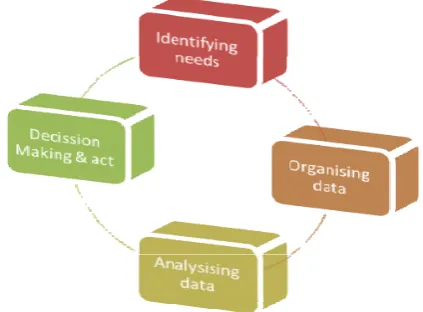
Figure 1.1: Business Intelligence Cycle
There are four stages in the development of business intelligence. The first three steps are often repeated several times before the fourth step is taken and the cycle is completed.
Identify needs of the organization. The needs should be cleared first.
Organizing data using various the techniques that provide consistency & reliability in accessing the data information.
Analyzing data in which information is examined, the data should be analyzed on basis of company needs.
Decision making &Action after analyzing information, decision is being made. At this stage, the cycle stops and action is taken. Then action is taken based on your analysis. Once you have acted, it's a good idea to evaluate the results of your actions and determine what new intelligence needs have developed. The Business Intelligence (BI) can only be culled from complete information - information that spans across the range of functional silos that make up the enterprise, organizes for clarity and reliability, provides true decision support, and lays the base for competitive superiority and action. It is involved with various applications such like ERP, CRM and SCM applications which organize the vast amount of information for analyzing the business activities. Every decision must be customized to the company’s own requirements and resources.
There are major advantages of business intelligence that can help any organization increase profitability by conveying BI system across the firm as given below:
Simplify teamwork and allocation: Business intelligence and partnership expertise enhances managerial efficiency. Firm incorporation of BI enables the employee to share data in a security improved.
Unite employee to access data competently: The initiation of business intelligence has made decision making a lot simpler. The manager can access and evaluate data at any given point of time and place.
Convey business intelligence to the entire firm: BI backs the width of the firm's business intelligence requirements. The intended planning is straightforward when familiar equipments are used, data supervision is easier and expansion is more profitable.
These facts are basic advantages of business intelligence in the organizations.
2. Related Work
The concept of Business Intelligence (BI) is brought up by Gartner Group since 1996. It is defined as the application of a set of methodologies and technologies, such as J2EE, DOTNET, Web Services, XML, data warehouse, OLAP, Data Mining, representation technologies, etc, to improve the enterprise operation effectiveness, support management /decision to achieve competitive advantages. Business Intelligence by today is never a new technology instead of an integrated solution for companies, within which the business requirement is definitely the key factor that drives technology innovation. How to identify and creatively address key business issues is therefore always the major challenge of a BI application to achieve real business impact.
variables of efficiency, quality, effectiveness, customer satisfaction and decision-making are useful in measuring the potential contribution that group support technologies offer. This paper presents finding from a recent field study that used business case concepts as its design approach. The paper explores the infrastructure development requirements for building a business case study. Such a framework is useful to business deciswn-makers and researchers interested in the deployment of these technologies in complex business environments
In 2003 Celina M. Olszak focused on the Business Intelligence systems. At the beginning, knowledge as an important and strategic asset that determines a success of an enterprise is presented. Next, some characteristics of the Business Intelligence systems are discussed and their architecture is described. Purposefulness of applying such solutions in an enterprise is highlighted. An integrated approach to build and implement business intelligence systems is offered. The systems are shown in four dimensions: business, functional, technological and organizational. In 2006 Samo Bobek showed to make qualified decisions managers combine information arriving from BI applications with disperse information about global economic state, their customers, partners and competitors
In 2009 Leo Sennott worked on the architecture of the business intelligence solutions used at Skyworks and details how this integrated system is being used to improve our competitiveness in a global marketplace. In 2010 A. TEJASWI & J.N.V.V.S. PRAKASH introduced business intelligent decisions that take place from the data-warehouse through the Actionable-Knowledge Discovery (AKD) in Domain Driven Data Mining (D3M for short). The general architecture of D3M for enterprise decisions was proposed and the model storage was presented, and its characteristics would be analysed.
In 2009 Reza Khajavinia presented the paper titled “THE BASIS FOR BUILDING A BUSINESS CASE IN SOFTWARE DEVELOPMENT, A CASE STUDY” in which in many software companies, software engineers and business decision makers live in separate worlds, using their own terminology, decision criteria, and working methods. Building a business case is one possible way to bridge the gap between business and software engineering and to increase the quality and the profitability of software development. Main empirical findings of this study are that case companies used a software business case to allocate resources between concurrent projects, to support sales and pricing activities and to identify the technical platform of their customers' products.
Venkatadri. M [2010] presented the paper titled as A Novel Business Intelligence System Framework that states Business Intelligence (BI) systems plays a vital role in effective decision making in order to improve the business performance and opportunities by understanding the organization’s environments through the systematic process of information. The development of BI systems is limited due to its huge development costs. Developing the complex systems with Self Organized Multi Agent technology would reduce the building cost without affecting the scalability and reliability of the system. Hence, this paper presented a novel framework based on Self Organized Multi Agent technology for building the low cost BI systems.
3. Failure of Business Intelligence
Although the business intelligence plays very important role in the organization but it have many disadvantages. The main disadvantages are given as below:
Cost: These days cost of using business intelligence is out of beyond the budget for small as well as for medium sized enterprises. The use of such system can be expensive for basic business transactions
Complexity: Another disadvantage of BI could be its complexity in implementation of data. It can be so complex that it can make business techniques inflexible to deal with. In the view of such premise, many business experts have predicted that these particulars can ultimately stifle any business.
Limited use: Even today BI system cannot be afforded by most of the companies. Although, traders in the past few years have started modifying their services towards medium and small sized industries, but the fact is that many of such firms does not consider them to be highly essential, for its complexity.
Time Consuming Implementation: The time required for implementing is more as firm expectations. Many firms have not patient enough to wait for the execution of Business intelligence in their organization. It takes around 18 months for data warehousing system to completely implement the system.
The facts show the drawbacks of applying the business intelligence in the various level of the organization. These decencies of the business intelligence are due to various reasons. There are following reasons for being failure of business intelligence as given below:
Solutions that are found are rarely appropriate. Business intelligence is mainly used to identify trends and problems within the data at their disposal. However, the solutions they propose may not incorporate the business needs and objectives of the company.
There is a lack of high-quality data. There is unavailability of relevant or high quality data in order to make effective analysis of the information. In addition, if the architecture is wrong to start with then the data you are getting back will be imperfect. Focus on getting the data architecture right and then gradually building up analysis.
These teams are not governed/project managed correctly. Business intelligence activities are usually embed within data warehousing administration and rarely have a dedicated project manager, set delivery cycles and project goals.
Staffs have little or no BI/data warehousing training. Tasks are usually allocated to individuals within database administration teams who cannot be expected to be able to fully support the actual demands of business intelligence work without sufficient training assistance (by providing them with training or using consultants).
Due to these reasons, the failures of business intelligence have taken place. The major reason of failure is the unavailability of good business cases. Hence we should use such approach that motivates the usage of business cases in decision making process. After this, there will be availability of good business case. The case based reasoning approach is most suitable for this situation.
4. Case Base Reasoning
Case-Based Reasoning (CBR) is a problem-solving approach that simulates the human problem-solving behaviour. In this approach, the problem is being solved out on basis of past experiences gained from during solving the problem in the past. In case of complex system, it is very difficult to formulate the situations with domain rules. Other drawback is that the rules require more input information than is typically available, because of incomplete problem specifications or because the knowledge needed is simply not available at problem-solving time. But in case of CBR approach, if general knowledge is not sufficient because of too many exceptions, or when new solutions can be derived from old solutions more easily than from scuff, then on basis of past experiences, the problem is being solved.
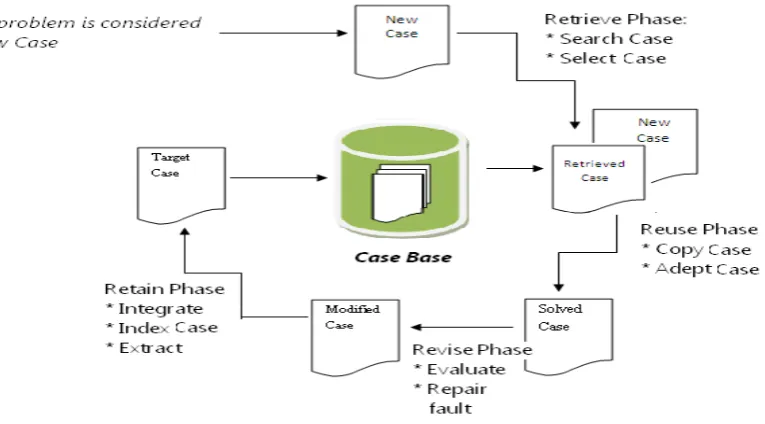
The case based reasoning involves four phases in the problem solving. Each problem specification & its solution are stored in form of the cases. It maintains the collect of the cases that is known as the case base. In this system, every problem is considered as the new case. In the retrieve phase according the new case, approximate solution case is being searched from the case base & selected. After the selection of the case, that case is adapted with the new case. It generates the solved case. Now the solved case is evaluated in the revise phase & the faults in that case are being repaired. Now modified case is the solution of the problem. This solution is stored in the case with proper index. This action is mandatory for extracting the cases very efficiently & fast access to the cases in future. Figure 4.1 show the case based reasoning as given below.
Case-Based Reasoning is not restricted to the reuse of experience. Another very important feature of case-based reasoning is its coupling to learning. As the human beings learns from the past experience, the case base reasoning supports learning from the past experience. Learning in CBR occurs as a natural by invention of problem solving. When a problem is successfully solved, the experience is retained in order to solve similar problems in the future. When an attempt to solve a problem fails, the reason for the failure is identified and remembered in order to avoid the same mistake in the future.
5. Role of Business cases in Business intelligence
The business case provides a mechanism for mitigating and guiding a business project. The business case is the basis for deciding the most profitable venture of exertion. For the particular business process, the business case should correspond the following information to the business team:
The business process’s goals
The amount of the business process’s investment (time and money)
The expected or desired business benefits
The investigation’s scope
Expectations on the desired process’s scope
The business case knowledge should come from the business, it is mandatory to have the essential analytical skills to produce a well-specified business case. A well-defined business case has proper explanation of the requirements. Before you define any detailed requirements, gather whatever information you have about the business case, it means that you need to discover the scope of the problem, the goals for the business process, and the relevant stakeholders. Hence the business case document can include information about the project's resource requirements, investment costs, revenue projections and market acceptance. Business cases include expectations of future events. Even with the best of processes, a business case is still no more than a snapshot at a point in time. It should not be created and reviewed only once to determine whether to proceed with an investment, and then ignored or, at best, revisited in the post implementation review.
Business Intelligence business case can be a simple subject, when a business function is looking for creating a data-mart. In this case the demand comes from business and business has worked out their arithmetic to justify the requirements. Enterprise Business Intelligence foundation investments include
Purchasing of enterprise BI Data Warehouse, OLAP, Enterprise reporting, analytics tools
Enterprise wide meta-data management initiative
Enterprise wide foundation Data Warehouse Dimensional Model development
Process-based/business objective based ( and not function based) BI initiatives
The business cases play very important role in business decision making through the business intelligence. The business case provides justification for a business to invest time and money into a particular project deliverable. These business cases provide the platform on which the Managers can analysis the business situations to take the decisions. Before taking the action, the decisions are rectified on availabilities of various business cases. Hence the business cases summarize the status of business process.
6. Utilizing business cases through case based reasoning
In case-based reasoning, knowledge representation covers the cases stored in the expert system’s database (case representation), and the adaptation strategies used to adapt these cases to fit a new situation. Each case has a semantic and a syntactic representation. The core idea of CBR is case, which is depiction of analyzed situation (problem) together with its solution (decision, plan, etc.). The case is situation, which occurred in the past, remembered by the computer and later reused in another similar problem. The concept of case here is very wide. In medicine it may by a set of symptoms occurring during patient examination together with doctor’s diagnosis. In HelpDesk systems it will be description of error in supported product together with specification of what kind of action the user needs to take. In this approach the knowledge is stored without changes. CBR requires selection of good knowledge representation at first. The individual cases, consisting of problems and their solutions should be encoded in a way allowing for efficient search.
Moreover, knowledge representation must support the possibility to modify or adjust the existing solution so that it can be applied in the specific case under consideration. Thus the reuse of knowledge must comprise elements of creativity. Some further elements consist in appropriate revision of the final solution and storing it in an appropriate form in the knowledge base for further use.
search in databases storing such cases is based on checking for satisfaction of logical conditions given in the SQL query.
We define a case of a Hotel searching for business tour by using given SQL query. First we create the particular table that contains the all information stored in a case
create table travel(caseId VARCHAR(15), HolidayType VARCHAR(20), Price INTEGER, NumberOfPersons INTEGER, Region VARCHAR(30), Transportation VARCHAR(30), Duration INTEGER, Season VARCHAR(30), Accommodation VARCHAR(30), Hotel VARCHAR(30));
Each case has own caseId that is unique in the the nature. Using insert SQL command, we can create various cases that build the case base that will be used for solving the new problem.
insert into travel values("Journey1", "Bathing", 4278, 4, "Egypt", "Plane", 14, "April", "TwoStars", "Hotel White House, Egypt");
insert into travel values("Journey2", "City", 2658, 2, "Cairo", "Plane", 7, "May", "ThreeStars", "Hotel New Marwa Palace, Cairo");
insert into travel values("Journey3", "Bathing", 499, 4, "Belgium", "Car", 3, "August", "HolidayFlat", "H.Flat, Belgium");
These SQL commands insert the parameters values in travel table having unique ID. In case base, these cases are stored in following way as given below:
Journey1; Bathing; 2498; 2 ; Egypt; Plane; 14; April; TwoStars; Hotel White House, Egypt Journey2; City; 2658; 2; Cairo; Plane; 7; May; ThreeStars; Hotel New Marwa Palace, Cairo Journey3; Bathing; 499; 4; Belgium; Car; 3; August; HolidayFlat; H.Flat, Belgium
CBR systems have more specific domain knowledge built into them than ordinary database systems. The main part of this supplementary knowledge is implemented in a similarity measure, a function that assesses the similarity of a given query to the cases in the case base. The similarity values are ordinal values that are often normalized to the interval [0, 1]. A value of 0 means “does not satisfy the query at all” and a value of 1 says “that’s exactly what you asked for”. To understand how such a similarity measure is used to find the best solutions for a given problem, consider the cases being represented as a fixed length vector of n attributes. These attributes can have numerical values or their values can be arranged to reflect some kind of order
Conclusion & Future Work
The case based approach make very impact on performance of business intelligence system. It tries to overcome the bottom necks of business intelligence. It has various effects on business intelligence system. First, it builds the business cases & stores them in its case base. Hence the various business cases are defined at various level of organization. Second, the solutions that are found are mostly appropriate. In Revise phase, the solutions are analysed & found faults are repaired. CBR can be used to remind decision makers of many specific factors which were considered relevant in past cases which may now have been forgotten. If the combination of human decision maker and computer leads to better decisions, the evolving human-machine relationship may help reduce users’ reluctance to engage with CBR. Hence the faults do not propagate further in future. So the solutions may corporate the business needs and objectives of the company. Third, although there is a lack of high-quality data, then the business decision are made on basis of business cases that make effective analysis of the incomplete information.
References
[1] J. Kolodner, “Case Based Reasoning. Morgan Kaufmann,” San Francisco, 1993.
[2] S. W. Changchien, M. C. Lin, “Design and implementation of case based reasoning system for marketing plans,” Expert Systems with Applications, vol. 28, pp. 43–53, 2005
[3] Suefert Andhreas and Schiefer Josef. (2005) “Enhanced Business Intelligence- Supporting Business Processes with Real-Time Business Analytics”, Proceedings of the 16th international workshop on Database and Expert System applications-DEXA’05. Retrieved 19 June 2006 from www.ieee.org
[4] Zeng, L., Xu, L., Shi, Z., Wang, M. and Wu, W.(2007), “Techniques, process, and enterprise solutions of business intelligence”, 2006 IEEE Conference on Systems, Man, and Cybernetics October 8-11, 2006, Taipei, Taiwan, Vol. 6, pp. 4722.
[5] Farhi Marir and Selma Liman Mansar, “An Adapted framework and Case-based Reasoning for Business Process Redesign”, Proceedings of the 2005 Seventh IEEE International Conference on E-Commerce Technology Workshops(CECW’05),pp. 179-183 [6] K. Kim, I. Han, “Maintaining case based reasoning systems using agenetic algorithms approach,” Expert Systems with Applications,
vol.21, pp. 139-145, 2001.
[7] Franois Bouffard, Member, IEEE 2010 “The Challenge with Building a Business Case for Smart Grids” 2010 IEEE POWER & ENERGY SOCIETY GENERAL MEETING, MINNEAPOLIS, MN
[8] H. Li, H. Huang, J. Sun, Ch. Lin, “On sensitivity of case-based reasoning to optimal feature subsets in business failure prediction,” Expert Systems with Applications, 2010.
[10] B. U. Haque, R. A. Belecheanu, R. J. Barson, , and K. S. Pawar, “Toward the application of case based reasoning to decision-making in concurrent product development ,” Knowledge- Based Systems, vol. 13, pp. 101–112.
[11] D. W. Aha, “ The omnipresence of case-based reasoning in science and application,” Knowledge-Based Systems, vol.11, pp.261–273, 1998.
[12] Aamodt, K. D Althoff, R. Magaldi, and R. Milne, “Case-Based Reasoning: A New Force In Advanced Systems Development,” Unicom Seminars & AI Intelligence,1995.
[13] R.D. Deters, “CBR for maintenance of telecommunication networks,” Proceedings Second European Workshop on Case-Based Reasoning, pp.23-32, 1994.
[14] A. Varma, N. Roddy, “ ICARUS: a case-based system for locomotive diagnostics,” Engineering Applications of Artificial Intelligence, vol.12(6), pp.681–690, 1999.
[15] Aamodt, E. Plaza,”Case-Based Reasoning; Foundational Issues, Methodological Variations, and System Approaches,” AI Communications. IOS Press, Vol. 7:1, pp. 39 -59, 1994.
[16] Watson, “Applying Case-based Reasoning: Techniques for Enterprise Systems,” Morgan Kaufmann Publishers, San Francisco, CA, 1997.
[17] Allen, B.P. (1994): “Case-based reasoning: business applications”, Communications of the ACM, vol.37, n.3:40-42.
[18] Curet, O., and Jackson, M. (1997): “A Case-Based Learning and Reasoning Agent in Unstructured Decision Making”, Paper presented at the III International Meeting on AI in Accounting, Finance and Tax, Huelva
.
AUTHORS PROFILE
Mr. Vivek Jaglan obtained his B.E (CE-2004) from M.D. University, M.Tech (CE-2008) C.D.L.U Universityand Ph.D (CE) Pursuing From Suresh Gyan Vihar University. He has attended various national, international seminars, conferences and presented research papers on Artificial Intelligence and Multi-Agent Technology.
Mr. Surjeet Dalal obtained his B.Tech CE (2005) from Kurukshetra University, M.Tech CE (2010) M.D.U University. Currently he is working as Asst. Professor in Department of Computer Science & Engg., Manav Rachna International University Faridabad. He has presented research papers on Artificial Intelligence and Multi-Agent Technology