https://doi.org/10.5194/esurf-7-491-2019 © Author(s) 2019. This work is distributed under the Creative Commons Attribution 4.0 License.
Automatic detection of avalanches combining array
classification and localization
Matthias Heck1, Alec van Herwijnen1, Conny Hammer2, Manuel Hobiger2, Jürg Schweizer1, and Donat Fäh2
1WSL Institute for Snow and Avalanche Research SLF, Davos, Switzerland
2Swiss Seismological Service SED, ETH Zurich, Zurich, Switzerland
Correspondence:Matthias Heck ([email protected])
Received: 24 April 2018 – Discussion started: 3 May 2018 Revised: 22 March 2019 – Accepted: 1 April 2019 – Published: 3 June 2019
Abstract. We used continuous data from a seismic monitoring system to automatically determine the avalanche activity at a remote field site above Davos, Switzerland. The approach is based on combining a machine learning algorithm with array processing techniques to provide an operational method capable of near real-time classifi-cation. First, we used a recently developed method based on hidden Markov models (HMMs) to automatically identify events in continuous seismic data using only a single training event. For the 2016–2017 winter period, this resulted in 117 events. Second, to eliminate falsely classified events such as airplanes and local earthquakes, we implemented an additional HMM-based classifier at a second array 14 km away. By cross-checking the results of both arrays, we reduced the number of classifications by about 50 %. In a third and final step we used multiple signal classification (MUSIC), an array processing technique, to determine the direction of the source. As snow avalanches recorded at our arrays typically generate signals with small changes in source direction, events with large changes were dismissed. From the 117 initially detected events during the 4-month period, our classifica-tion workflow removed 96 events. The majority of the remaining 21 events were on 9 and 10 March 2017, in line with visual avalanche observations in the Davos region. Our results suggest that the classification workflow presented could be used to identify major avalanche periods and highlight the importance of array processing techniques for the automatic classification of avalanches in seismic data.
1 Introduction
During the winter seasons, snow avalanches are a common threat in mountainous regions. Therefore, avalanche warning services inform the public of the avalanche danger. To assess the danger, warning services rely on information about the snowpack, the amount of new snow, the weather conditions and avalanche activity (e.g., McClung and Schaerer, 2006). While the first three parameters can be measured or modeled, avalanche activity data are often hard to obtain, especially during snow storms or at night. Monitoring systems could possibly fill this gap by providing information on avalanche activity independent of the time of day or visibility.
Snow avalanches, like any other mass movement, gener-ate seismic and infrasound waves (e.g., van Herwijnen and Schweizer, 2011b; Suriñach et al., 2005; Marchetti et al.,
re-ance), classical HMMs also require a large number of train-ing sets for each event class (e.g., avalanche, airplane or earthquake). This classical approach was successfully used to automatically identify events in continuous seismic data (Ohrnberger, 2001; Beyreuther et al., 2012). Avalanches, however, are relatively rare events and obtaining a large set of training events is time consuming. To circumvent this, Ham-mer et al. (2012) developed an approach exploiting the abun-dance of data containing mainly background signals to ob-tain general wave-field properties. From these properties, a widespread background model can also be trained and only one training event was required. In contrast to the classical HMM approach, the abovementioned classification system consists of a background model and one event model for each implemented event class. Using this approach, Hammer et al. (2017) were able to identify 43 destructive avalanches during an exceptional 5 d avalanche period in February 1999 within a radius of 30 km of the broadband seismic station. Heck et al. (2018) recently adapted this HMM approach to automatically detect smaller avalanches in data recorded by a seismic array consisting of seven less sensitive verti-cal geophones during the 2009–2010 winter season. Despite the large differences in model performance for the individual sensors, their model performed best when pooling the data from the entire array and requiring a minimal event dura-tion for the detecdura-tions. These results highlighted that array-based processing is likely to improve the automatic detection of avalanches in continuous seismic data.
Array processing techniques have been used to exploit in-frasound signals for the automatic detection of avalanches (Scott et al., 2007; Marchetti et al., 2015; Thüring et al., 2015). By comparing the back-azimuth with the directions of known avalanche paths, possible avalanche events were identified (Marchetti et al., 2015). Thüring et al. (2015) used a similar approach for automatic detection, but re-lied on support vector machines (SVMs), a machine learn-ing algorithm. The success of array processlearn-ing techniques on infrasound signals led to the development of opera-tional avalanche detection systems to automatically iden-tify avalanches (Steinkogler et al., 2016). A recent com-prehensive study on the performance of these systems has shown that, in the absence of major topographic barriers, in-frasound avalanche detection systems relying on array
pro-correlation (Schmidt, 1986; Rost and Thomas, 2002). Heck et al. (2019) subsequently applied this method to manually identified avalanches during a 2 d period in March 2017 and were able to reconstruct the avalanche path of several recorded events. They concluded that their seismic array mostly recorded infrasound signals due to the limited dis-tance between the sensors. While both Lacroix et al. (2012) and Heck et al. (2019) showed that avalanches within a distance of approximately 3 km of their seismic monitor-ing systems were detected, seismic array processmonitor-ing tech-niques have not yet been used for the automatic detection of avalanches in seismic data.
Our aim is to design a workflow to automatically identify avalanches in continuous seismic data. Our method consists of using the machine learning techniques based on hidden Markov models presented by Heck et al. (2018) in combina-tion with seismic array processing techniques to locate the source of avalanches presented by Heck et al. (2019). The goal is to assess the performance of a fully automatic classi-fier in view of possible future operational use. To develop and test the automatic classification method, we used continuous seismic data recorded during the 2016–2017 winter season at two field sites above Davos, Switzerland.
2 Field site and instrumentation
arranged (Fig. 1). The maximum distances between two sen-sors at the Dischma and Wannengrat field sites were 64 and 74 m, respectively, and the average distances were 36 and 45 m, respectively.
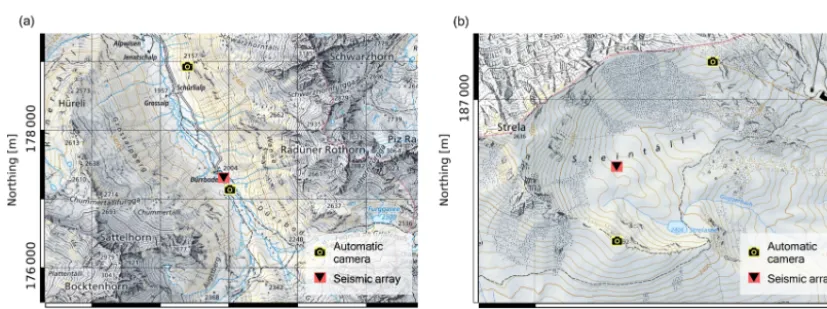
The instrumentation and data logging systems were iden-tical for both arrays. Data were continuously recorded at a sampling rate of 500 Hz. Due to technical problems, only two sensors from the Wannengrat array recorded data through-out the entire winter (sensors 4 and 5 in Fig. 1b), and no data were collected between 12 and 20 January 2017. Both field sites were also equipped with several automatic cameras (eight at Dischma and six at Wannengrat) to monitor the sur-rounding slopes (Fig. 2). Images were recorded every 10 min throughout the winter. In addition, we also performed a field survey at the Dischma site on 15 March 2017 shortly after a period of high avalanche activity to identify avalanches and map their outlines (Fig. 3) (Heck et al., 2019).
3 Methods
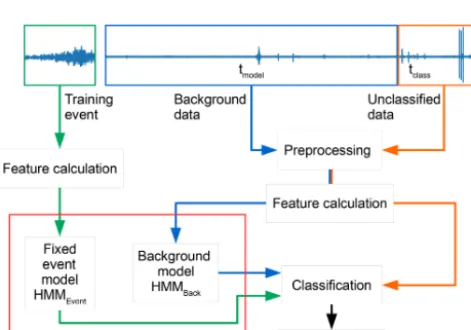
The overall goal was to develop a processing workflow to automatically identify avalanches in seismic data from the Dischma field site by combining HMMs with seismic array processing techniques. The developed workflow consists of five steps which are described in more detail below (Fig. 4): (1) preprocessing, (2) feature calculation, (3) HMM con-struction, (4) classification and (5) post-processing.
3.1 Data preprocessing
The continuous seismic data mostly consisted of noise, which for the current application was of little interest. There-fore, we applied a simple threshold-based event detector to reduce the total amount of data (Heck et al., 2018). For a windowiwith a length of 1024 samples, we determined the mean absolute amplitude Ai. When Ai≥5A, with A
be-ing the daily mean amplitude, the data within the window were kept. If the amplitude threshold for the following win-dow was also reached, data were concatenated. Furthermore, a section of t=60 s before and after the threshold passing were kept to ensure that the onset and coda of events were incorporated. Following this process, data were reduced by 80 % to data windows of various lengths. In addition, we tered the data using a fourth-order Butterworth bandpass fil-ter with corner frequencies of 1 and 50 Hz.
3.2 Feature calculation
Raw seismic time series are not suited for the HMM classi-fication, as information which characterizes seismic signals generated by avalanches in the time and frequency domain cannot be exploited. Therefore, we used specific features of the seismic time series as input for the HMMs. Features rep-resent different aspects of the time series such as spectral, temporal or polarization characteristics. These are calculated
using a sliding window; thus, the time series is represented in a compressed form. As we used data from single component geophones, we only used the spectral and temporal features suggested by Heck et al. (2018): central frequency (Barnes, 1993), dominant frequency (Kramer, 1996), instantaneous bandwidth (Barnes, 1993), instantaneous frequency (Taner et al., 1979), cepstral coefficients (Kanasewich, 1981) and half-octave bands (Joswig, 1994). We used six half-octave bands for the classification, and the first half-octave band had a central frequency of 3.9 Hz. To calculate the features from the preprocessed data, we used a sliding window with a width ofw=512 samples and a step size of 25 samples, resulting in an overlap of 97 %.
3.3 HMM construction
The hidden Markov models that we used to automatically identify avalanches in the continuous seismic data consisted of a background model and an event model for each event class (Hammer et al., 2017; Heck et al., 2018). In our appli-cation we only used one event class, either avalanches at the Dischma field site or airplanes at the Wannengrat field site.
The background model can also be trained using fea-tures extracted from the preprocessed data. Previous work has shown that a background model which is regularly up-dated provides better classification results throughout a sea-son (e.g., Heck et al., 2018). Hence, in our case, we used the preprocessed data from a 24 h window to train the back-ground model and recalculated it every hour, i.e., we used a sliding window with a length of tmodel=24 h and then shifted it forward by 1 h (background data in Fig. 4).
In contrast to the background model, the event model was only calculated once for the entire season (training event in Fig. 4). For the Dischma field site, our training event con-sisted of a signal generated by an avalanche that was re-leased on 9 March 2017 at 06:47 LT (Fig. 5a), an unambigu-ous event that was analyzed in detail by Heck et al. (2019). For the Wannengrat field site, our training event consisted of a signal generated by an airplane on 31 January 2017 at 21:46 LT (Fig. 5b).
3.4 Classification
Figure 1.(a)Map of the Davos area, Switzerland. The two seismic arrays are indicated by black triangles on different colored backgrounds: red represents the Wannengrat array, yellow represents the Dischma array. The wind wheel at the top of the panel indicates the location of the Weissfluhjoch weather station.(b)The deployment geometry of the Dischma array.(c)The deployment geometry of the Wannengrat array. The open red circles indicate the positions of malfunctioning sensors during winter 2017. Reproduced with permission from Swisstopo (JA100118).
Figure 2.(a)Detailed map of the Dischma field site showing the position of the seismic array and the automatic cameras.(b)Same as(a), but for the Wannengrat field site. Reproduced with permission from Swisstopo (JA100118).
3.5 Post-processing
As the classification algorithm is not perfect, several post-processing steps were applied to reduce the number of false detections. Detections with a duration≤12 s were dismissed (Heck et al., 2018), and we only considered an event as an avalanche when it was detected by at least five sensors of the array, as proposed by Heck et al. (2018). Two additional steps were also implemented in the classification workflow and are described in the following.
3.5.1 Combined array detection
Figure 3.Picture of the Dischma field site facing south. The pic-ture was taken on 15 March 2017 shortly after a period of high avalanche activity and several recent avalanches were observed (red areas). The triangle indicates the location of the seismic array, and the camera icon indicates the location of the automatic camera.
Figure 4.Flow chart of the classification process. Green lines show the construction of the event model, blue lines show the construction of the background model and orange lines show how the data to be classified are processed.
subsequently used the same post-processing steps mentioned earlier. However, as only two sensors recorded data at the Wannengrat array, we only considered events detected by these two sensors. Classification results from the Dischma and Wannengrat arrays were then combined to remove all events recorded simultaneously at both arrays, which meant that the time difference between the detections at both field sites was less than 1 min.
3.5.2 Source localization
Array processing methods provide information on the sig-nal source and can provide additiosig-nal parameters to clas-sify events as avalanches, as is commonly undertaken when
exploiting infrasound signals (Scott et al., 2007; Marchetti et al., 2015; Thüring et al., 2015). To locate the source of events, we used the MUSIC algorithm, as suggested by Heck et al. (2019). The MUSIC method was applied to nonoverlap-ping data windows for four frequency bands between 6 and 7.5 Hz to determine the back-azimuth angle and the apparent velocity of the incoming wave-field with time. The length of the windows was set to five cycles of the lower corner of the analyzed frequency band, meaning that the data were divided into more windows for higher frequencies. By combining the back-azimuth values for all four frequency bands, we then applied a median smoothing filter on a moving window of 8 s to determine a median back-azimuth path with time, as in Heck et al. (2019) (Fig. 6a).
To decide whether a classification was associated with an avalanche or not, we applied a threshold value to the derivative of the median back-azimuth path. The assumption was that avalanche events have a relatively smooth median back-azimuth path with little variation, whereas other sig-nal sources show larger variations in back-azimuth, which is also the case for earthquakes and airplanes for our specific array geometry. Indeed, the training event at the Dischma ar-ray had a duration of around 50 s and a median back-azimuth path with slight changes in the angle (black line in Fig. 6a), whereas before and after the event the back-azimuths were more erratic, as expected for noise. For the training event, the derivative of the median back-azimuth path stayed be-low 10◦s−1for 50 s, while before and after the event it was much larger (Fig. 6b). Other avalanche events had very sim-ilar results (not shown). Events with derivatives of the me-dian back-azimuth path smaller than 10◦for a minimum du-ration of 20 s were then classified as avalanches. As we used 8 s windows for the calculation of the median back-azimuth path, we had to increase the minimal event duration to 20 s.
4 Results
We applied our automatic avalanche detection workflow on data recorded at the Dischma field site from 1 January to 30 April 2017. We then compared the results with an avalanche catalogue obtained from visual observations by local observers compiled by the avalanche warning service at the SLF. The visual observations in the Davos area could be incomplete and cover an area much larger than the area monitored with our seismic system at the Dischma site. Nev-ertheless, comparison with this avalanche catalogue remains indicative.
4.1 Overview of the winter season
Figure 5.An avalanche released on 9 March 2017 at 06:47 LT, and an airplane detected on 28 January 2017 at 09:17 LT used as the training event for the classifier.(a)Time series of the avalanche recorded at the seven sensors of the Dischma array, and(b)time series of the airplane recorded at the two working sensors of the Wannengrat array. The red area indicates the section of the time series used as the training event.
(b, d)Corresponding average spectrogram of all sensors.
Figure 6.Localization results for an avalanche event recorded on 9 March 2017 at 06:47 LT.(a)Polar plot representation of the back-azimuth calculated using the MUSIC method. Red dots are the back-azimuth values for single time windows. The black line represents the median back-azimuth path. The solid part of the line has variations below the threshold value for the derivative, whereas the dotted line refers to strong variations.(b)The derivative of the median back-azimuth path. The dotted lines represents the threshold value of 10◦. The section between 52 and 113 s corresponds to the solid line in(a).
subjected to large temperature gradients for an extended pe-riod of time, a poorly bonded layer of depth hoar formed at the base of the snow cover.
During the winter season, four pronounced snowfall peri-ods occurred: between 1 and 15 January, around 1 February, from 1 to 10 March and around 15 April (blue line in Fig. 7). Each snowfall was associated with increased avalanche ac-tivity in the Davos region, except for the snowfall in April (red bars in Fig. 7b).
In addition to these visual avalanche observations by lo-cal observers, we inspected pictures taken by the automatic cameras installed at the Dischma field site. Surprisingly, avalanche activity was very low in January and February, and only a few avalanches were identified on 1 February 2017. During the early March snow storm, visibility was poor and very few avalanches were identified from the automatic cam-era images. However, once the storm had passed, the inten-sity of the avalanche cycle became clear as many avalanche deposits were visible on the images. Five days after the storm we mapped 24 avalanches within a 4 km radius of the
Figure 7.(a)Snow height measured (blue line) at the automatic weather station at Weissfluhjoch 12 km to the northwest of the Dischma array at 2540 m a.s.l. for the 2016–2017 winter season. Red bars are the height of new snow measured each day at 08:00 LT.
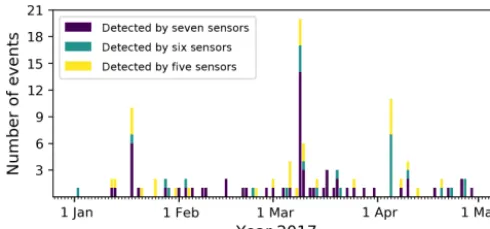
Figure 8. Classification results after post-processing (including voting-based classification) at the Dischma array. The colored bars indicate the number of classified events per day depending on the number of sensors: the violet bar indicates detection by seven sen-sors, turquoise bars indicate detection by six sensors and yellow bars indicate detection by five sensors.
Dischma field site (for more details see Heck et al., 2019). Later in the season, we did not observe any more avalanches on the images. Thus, the avalanche cycle between 9 and 10 March was the most prominent avalanche period at the Dischma field site.
4.2 Classification performed at a single array
Using the classifier trained using the avalanche event from 9 March 2017 at 06:47 LT (Fig. 5a), we classified the data from each single sensor of the Dischma array and post-processed the results to remove events with a duration≤12 s and all classifications that were classified by less than five sensors. This resulted in a total of 117 automatically detected events between 1 January and 30 April 2017 (Fig. 8). A quar-ter of the events were detected by five sensors, a quarquar-ter by six and about half by seven sensors.
Most events occurred on 9 and 10 March 2017. In addi-tion, peaks were visible in the middle of January and early April. The peak in January corresponded with the avalanche activity period visually recorded in the Davos region (Fig. 7). For the peak in April, however, no avalanches were observed in the Davos area. Furthermore, several single detections were distributed over the season showing no clear link to the avalanche observations in the Davos region. Therefore, we visually inspected the time series and spectrograms of each of the 117 classifications and found that the HMM also classified∼50 airplanes (Fig. 9a) and regional earthquakes (Fig. 9b) as avalanches.
Although these misclassified events can be distinguished from avalanches via visual inspection (e.g., the sharp onset visible for earthquakes), the classifier identified these events as belonging to the avalanche class. We attribute these false classifications to the fact that these earthquake and airplane signals were more similar to the avalanche training event than to the background model and no earthquake or airplane event type was included in the system. Indeed, the temporal trends
Table 1. Number of analyzed events, events classified as an avalanche and dismissed events for the different steps in the classifi-cation workflow. For the single array classificlassifi-cation, the total number of analyzed and dismissed events cannot be provided as the entire time series was classified.
Single Combined Location-based array detection detection Total analyzed 117 64 Classified as avalanche 117 64 21
Dismissed 53 43
in the features exhibited many similarities (Fig. 10). Using different training events did not substantially change these results (not shown).
4.3 Classification performed at both arrays
The vast majority of the misclassifications were produced by two types of events: airplanes and earthquakes. Davos lies in an approach corridor for the Zürich international airport and numerous commercial airplanes pass by every hour. Similar to avalanches, airplanes also have a moving source charac-ter. However, due to the high altitude (typically>5 km) and fast movement of the source, airplanes are likely recorded at both arrays. Furthermore, based on the earthquake cata-log of the Swiss Seismocata-logical Service (SED), we concluded that regional earthquakes within a range of 120 km were recorded by both arrays. Thus, airplanes and earthquakes were recorded almost simultaneously at both arrays (Fig. 9). To eliminate these false classifications, we used data from the Wannengrat array classified using the HMM trained with the airplane event of 31 January at 21:46 LT (Fig. 5b). As the transient signals of airplanes and earthquakes were very similar (Fig. 10), this HMM also detected earthquakes.
The number of detected events at the Wannengrat array varied strongly per day (blue bars in Fig. 11). Fifty-three of these events coincided with events classified at the Dischma array and were dismissed (yellow bars in Fig. 11; Table 1). The remaining 64 potential avalanches were again mostly concentrated in January, around 9 and 10 March and in early April. The distribution of these events was somewhat similar to the visually observed avalanches (compare to red bars in Fig. 7b), except for the detections in April and the absence of detections at the beginning of February. Hence, we expected some misclassifications among the remaining 64 avalanche events.
4.4 Localization post-processing
an-Figure 9.Time series and corresponding spectrograms for two false classifications: an airplane detected at(a)Dischma and(b)at Wannen-grat, and an earthquake detected at(c)Dischma and(d)Wannengrat.
Figure 10.Instantaneous frequency with normalized time (normal-ized with event duration) for signals generated by an airplane (yel-low), an earthquake (green) and an avalanche (blue). The black lines are the moving mean. The black vertical dashed lines at zero and one indicate the start and the end of the events.
other 43 events were dismissed and only 21 events remained (Fig. 12; Table 1). The majority of these events (i.e., 13 of 21) were observed on 9 and 10 March 2017, whereas the other events showed no clear link to the visual observations (red bars in Fig. 12).
For each of the 21 events we determined a mean back-azimuth, which is the mean direction that the signals came from. The mean back-azimuths were all pointing towards the surrounding slopes where we expected avalanches to release (Fig. 13). Events with a duration longer than 100 s were de-tected coming from either the northwest or the southeast.
Figure 11.Number of events during the season. Yellow bars in-dicate the events detected at both arrays, turquoise bars show the events only recorded at the Dischma array and blue bars show the events automatically detected at the Wannengrat array. Between 5 and 20 January no data were recorded at the Wannengrat array.
5 Discussion
Figure 12.Turquoise bars are the number of events per day that are locatable and are considered to be avalanches. Yellow bars are the number of events per day which could not be located and were therefore dismissed. Red bars are the number of avalanches visually observed in the Davos area.
Figure 13.Polar plot representation overlaid on a map section of the field site. The angle represents the direction of the origin of the event, the thin lines represent events with a duration<60 s and the thick lines represent events with a duration ≥60 s. The different colored lines represent the time of the year. Reproduced with per-mission from Swisstopo (JA100118).
is true for signals generated by snow avalanches (e.g., Ru-bin et al., 2012). The classification workflow we presented used hidden Markov models (HMMs) to automatically de-tect avalanches in data from seismic systems deployed above Davos, Switzerland. The approach builds on the work of Heck et al. (2018), who adapted the HMM method devel-oped by Hammer et al. (2017) to detect avalanches in contin-uous seismic data from a small aperture geophone array. A major benefit of this approach is that only one training event is required. This has substantial advantages, as the workflow could be implemented at a newly instrumented site without the need to first establish an extensive training data set. Still, a pre-operational training phase, typically one winter season,
is needed to acquire at least one training event and to identify any site-specific peculiarities. Using training events recorded at different arrays might be unreliable due to possible differ-ences in the instrumentation or heterogeneities in the local geology.
For the training event, we only used the first section of the avalanche signal, up to the maximum amplitude (Fig. 5). Us-ing the entire length of the avalanche signal resulted in poorer classification results (not shown) as there were very few vari-ations in the transient feature behavior after the maximum in the signal. Therefore, including larger parts of the training event did not provide any useful additional information for the classification. Heck et al. (2018) also investigated using different avalanche signals to represent different classes (i.e., dry- and wet-snow avalanches). However, this also did not improve the classification results, as in the feature space dry-and wet-snow avalanches are very similar.
Heck et al. (2018) highlighted difficulties involved with obtaining a reliable classifier with the HMM approach ap-plied to a geophone array. They obtained large differences in model performance with the number of detections per sensor ranging from about 150 to over 2000. This was at-tributed to local heterogeneities as the sensors were packed in a styrofoam housing and inserted within the snow. In our deployment, the geophones were buried about 50 cm below the ground in a flat meadow. This approach resulted in a much more consistent number of detections per sensor, rang-ing from 125 to 169, showrang-ing that the deployment strategy can have substantial influence on the performance of the clas-sifier.
avalanches have similarities (Fig. 10), the results obtained for the second classification based on the airplane event model likely also include avalanches and earthquakes. However, this was not a drawback as we assume that it was very un-likely that two avalanches released simultaneously at both field sites. Typically, signals generated by airplanes either have clear overtones or at least a clear Doppler effect in the signal (van Herwijnen and Schweizer, 2011a). The airplane signals that were falsely classified as avalanches with our method did not have such obvious features (Fig. 9). While we do not know when or why airplanes generate such signals, and we have not identified a clear pattern explaining their presence, we have seen multiple signals like these recorded at both arrays and are confident that these signals are gen-erated by airplanes. Comparing the time series of detected events at both arrays allowed us to dismiss about 50 % of the classified events (Fig. 11). Therefore, in our case, identifying co-detections across arrays is an efficient approach to reduce the number of false alarms, as the weak signals generated by avalanches were only recorded at one array because the distance between both arrays was about 14 km.
Combining the classification results from two separate arrays allowed us to reduce the number of classifications. Nevertheless, some uncertainty remained regarding the ori-gin of the identified events. Thus, in a final step, we used the MUSIC method to estimate the median back-azimuth path, as suggested by Heck et al. (2019), to further dismiss false detections. Similar approaches have been suggested for the automatic detection of avalanches in infrasonic data by Marchetti et al. (2015) and Thüring et al. (2015). In these studies, the back-azimuth of continuous infrasound data was calculated using cross-correlation techniques, and only events with slight changes in back-azimuth over a prede-fined minimal duration were assumed to be avalanche events. In contrast, we only determined the back-azimuth using the MUSIC method for those events that were already identi-fied by the HMM, as the pair-wise cross-correlation tech-nique (beam forming) did not result in robust back-azimuth estimates for our instrumentation (Heck et al., 2019). This last processing step further reduced the number of classified events to 21 (Fig. 12).
The majority of the remaining 21 automatic classifica-tions occurred during a period which coincided with the ob-served high avalanche activity in March (Fig. 12). However,
sequently possible to reconstruct the main avalanche activity period in March. Results from the localization showed that avalanches released from many different slopes at the field site during the season, in particular during the avalanche pe-riod in March (Fig. 13). Therefore, a seismic monitoring sys-tem is a suitable tool to monitor an area with many slopes and not just one single slope. Although the detection range is rather limited at 2–3 km (Heck et al., 2019), the seismic monitoring system in combination with an automatic classi-fier provide great potential for identifying at least the major avalanche periods. These results suggest that the detection capabilities of seismic monitoring systems are very similar to those of infrasound monitoring systems (Mayer et al., 2018). Although we were able to identify one major avalanche activity period in the 2016–2017 winter season, the method presented here has its limitations. Our suggested work-flow requires two arrays to eliminate events by finding co-detections. This is clearly a limiting factor, as it increases the cost for the instrumentation as well as deployment and maintenance time. However, we could have directly applied the MUSIC method to all detections from the Dischma ar-ray to reduce the number of events. Indeed, after applying the localization-based step to all detections, 32 events were identified as avalanches, 11 more than with the combined array and the localization-based classification. Although we decided to implement a combined array classification step to save computational time, directly localizing every automati-cally detected event is also possible.
of the authors independently identified possible avalanches, resulting in 44 and 23 events, respectively. Thus, the only events we could use to assess the performance of our classi-fier were the 13 manually identified avalanches by Heck et al. (2019) on 9 and 10 March. Twelve of these were automati-cally identified using our approach, suggesting good perfor-mance in terms of the probability of detection and the num-ber of missed events. However, we cannot make any state-ments regarding the false alarm rate, which from an opera-tional point of view is also very important.
Based on the approach presented here, a near real-time classification of the seismic data and hence a near real-time detection of avalanches seems possible. The computational times on a standard personal computer (with an 8-core pro-cessor and 12 GB ram) are reasonably short as feature calcu-lation can be performed in near real-time for all sensors si-multaneously as well as the HMM construction and the clas-sification. The MUSIC method, in comparison, is very costly (three times real time). However, as the number of detections for the entire season was very low, a near real-time detection could be provided with or without the combined array clas-sification. In future systems, the preprocessing steps can be integrated in the data logging unit to substantially reduce the data transmission.
6 Conclusions
During the 2016–2017 winter season we used a seismic array to continuously monitor avalanche activity in a remote area above Davos, Switzerland. By training a machine learning algorithm based on hidden Markov models (HMMs), we de-tected 117 events in the seismic data from January to April. Subsequent visual inspection revealed a false alarm rate of at least 50 %, and most of the false detections were associated with airplanes or earthquakes. Therefore, we trained a second HMM with data from a seismic array at a distance of 14 km to remove any co-detections. Finally, we applied a multiple signal classification (MUSIC) approach to define threshold criteria for automatic avalanche identification by considering avalanches as a moving source. Overall, this workflow re-sulted in 21 automatic classifications. The majority of these events occurred on 9 and 10 March 2017, in accordance with a period of high avalanche activity observed in the area sur-rounding Davos.
Our results show that seismic monitoring systems in com-bination with an automatic classifier provides great potential for identifying at least the major avalanche periods. In our workflow, using an array processing method to determine the source of the seismic events was of crucial importance to re-duce falsely classified events. In future experiments we want to introduce an additional array within a shorter distance to improve the localization and to remove the need for the com-bined array classification approach.
Data availability. The raw seismic data are available upon request. Results from the HMM classification as well as the MUSIC analysis are available at https://doi.org/10.16904/envidat.73 (Heck, 2019).
Author contributions. AvH, JS and DF initiated this study and MH processed and analyzed the data. CH developed the code for the hidden Markov model, and MH developed the code for the MUSIC method. AvH and MH were responsible for the field instrumenta-tion. MH prepared the paper with contributions from all co-authors.
Competing interests. The authors declare that they have no con-flict of interest.
Special issue statement. This article is part of the special issue “From process to signal – advancing environmental seismology”. It is a result of the EGU Galileo conference, Ohlstadt, Germany, 6–9 June 2017.
Acknowledgements. We thank numerous colleagues from SLF for help with field work and instrument maintenance.
Financial support. This research has been supported by the Schweizerischer Nationalfonds zur Förderung der Wis-senschaftlichen Forschung (grant no. 200021_149329).
Review statement. This paper was edited by Michael Dietze and reviewed by Florian Fuchs and three anonymous referees.
References
Barnes, A. E.: Instantaneous spectral bandwidth and dominant fre-quency with applications to seismic reflection data, Geophysics, 58, 419–428, 1993.
Bessason, B., Eiriksson, G., Thorarinsson, O., Thorarinsson, A., and Einarsson, S.: Automatic detection of avalanches and debris flows by seismic methods, J. Glaciol., 53, 461–472, https://doi.org/10.3189/002214307783258468, 2007.
Beyreuther, M., Hammer, C., Wassermann, J., Ohrnberger, M., and Megies, T.: Constructing a Hidden Markov Model based earthquake detector: application to induced seismicity, Geo-phys. J. Int., 189, 602–610, https://doi.org/10.1111/j.1365-246X.2012.05361.x, 2012.
Esposito, A. M., Giudicepietro, F., Scarpetta, S., D’Auria, L., Mari-naro, M., and Martini, M.: Automatic discrimination among landslide, explosion-quake and microtremor seismic signals at Stromboli Volcano using neural networks, B. Seismol. Soc. Am., 96, 1230, https://doi.org/10.1785/0120050097, 2006.
Earth Syst. Sci., 18, 383–396, https://doi.org/10.5194/nhess-18-383-2018, 2018.
Heck, M., Hobiger, M., van Herwijnen, A., Schweizer, J., and Fäh, D.: Localization of seismic events produced by avalanches using multiple signal classifications, Geophys. J. Int., 216, 201–217, https://doi.org/10.1093/gji/ggy394, 2019.
Hibert, C., Mangeney, A., Grandjean, G., Baillard, C., Rivet, D., Shapiro, N. M., Satriano, C., Maggi, A., Boissier, P., Fer-razzini, V., and Crawford, W.: Automated identification, lo-cation, and volume estimation of rockfalls at Piton de la Fournaise volcano, J. Geophys. Res.-Earth, 119, 1082–1105, https://doi.org/10.1002/2013JF002970, 2014.
Joswig, M.: Knowledge-Based Seismogram Processing by Mental Images, IEEE T. Syst. Man. Cyb., 24, 429–439, 1994.
Kanasewich, E. R.: Time Sequence Analysis in Geophysics, The University of Alberta Press, Edmonton, Alberta, Canada, 1981. Kramer, S.: Geotechnical Earthquake Engineering, Always
learn-ing, Prentice-Hall international series in Civil Engineering and engineering mechanics, Upper Saddle River, New Jersey, 1996. Lacroix, P., Grasso, J.-R., Roulle, J., Giraud, G., Goetz, D., Morin,
S., and Helmstetter, A.: Monitoring of snow avalanches using a seismic array: Location, speed estimation, and relationships to meteorological variables, J. Geophys. Res.-Earth, 117, F01034, https://doi.org/10.1029/2011JF002106, 2012.
Leprettre, B., Navarre, J., and Taillefer, A.: First results from a pre-operational system for automatic detection and recognition of seismic signals associated with avalanches, J. Glaciol., 42, 352– 363, https://doi.org/10.3189/S0022143000004202, 1996. Li, Z., Meier, M.-A., Hauksson, E., Zhan, Z., and Andrews, J.:
Machine Learning Seismic Wave Discrimination: Application to Earthquake Early Warning, Geophys. Res. Lett., 45, 4773–4779, https://doi.org/10.1029/2018GL077870, 2018.
Marchetti, E., Ripepe, M., Ulivieri, G., and Kogelnig, A.: Infra-sound array criteria for automatic detection and front veloc-ity estimation of snow avalanches: towards a real-time early-warning system, Nat. Hazards Earth Syst. Sci., 15, 2545–2555, https://doi.org/10.5194/nhess-15-2545-2015, 2015.
Mayer, S., van Herwijnen, A., Ulivieri, G., and Schweizer, J.: Eval-uating the performance of an operational infrasound avalanche detection system at three locations in the Swiss Alps during two winter seasons, in: Proc. 2018 Int. Snow Sci. Workshop, Inns-bruck, Austria, 611–615, 7–12 October 2018.
McClung, D. and Schaerer, P. A.: The Avalanche Handbook, The Mountaineers Books, Seattle WA, USA, 2006.
Nishimura, K. and Izumi, K.: Seismic signals induced by snow avalanche flow, Nat. Hazards, 15, 89–100, https://doi.org/10.1023/A:1007934815584, 1997.
Deep Learning, J. Geophys. Res.-Sol. Ea., 123, 5120–5129, https://doi.org/10.1029/2017JB015251, 2018.
Rost, S. and Thomas, C.: Array seismology: meth-ods and application, Rev. Geophys., 40, 2.1–2.27, https://doi.org/10.1029/2000RG000100, 2002.
Rubin, M., Camp, T., van Herwijnen, A., and Schweizer, J.: Au-tomatically detecting avalanche events in passive seismic data, IEEE International Conference on Machine Learning and Ap-plications, 1, 13–20, https://doi.org/10.1109/ICMLA.2012.12, 2012.
Schaerer, P. A. and Salway, A. A.: Seismic and impact-pressure monitoring of flowing avalanches, J. Glaciol., 26, 179–187, https://doi.org/10.1017/S0022143000010716, 1980.
Schmidt, R.: Multiple emitter location and signal parame-ter estimation, IEEE T. Antenn. Propag., 34, 276–280, https://doi.org/10.1109/TAP.1986.1143830, 1986.
Scott, E., Hayward, C., Kubichek, R., Hamann, J., Pierre, J., Comey, B., and Mendenhall, T.: Single and multiple sensor identifica-tion of avalanche-generated infrasound, Cold Reg. Sci. Technol., 47, 159–170, https://doi.org/10.1016/j.coldregions.2006.08.005, 2007.
Steinkogler, W., Meier, L., Langeland, S., and Wyssen, S.: Opera-tional radar and infrasound systems for avalanche detection, in: Proc. 2016 Int. Snow Sci. Workshop, Breckenridge, Colorado, USA, 309–315, 3–7 October 2016.
Suriñach, E., Furdada, G., Sabot, F., Biescas, B., and Vilaplana, J.: On the characterization of seismic signals generated by snow avalanches for monitoring purposes, Ann. Glaciol., 32, 268–274, https://doi.org/10.3189/172756401781819634, 2001.
Suriñach, E., Vilajosana, I., Khazaradze, G., Biescas, B., Fur-dada, G., and Vilaplana, J. M.: Seismic detection and charac-terization of landslides and other mass movements, Nat. Haz-ards Earth Syst. Sci., 5, 791–798, https://doi.org/10.5194/nhess-5-791-2005, 2005.
Taner, M. T., Koehler, F., and Sheriff, R.: Complex seismic trace analysis, Geophysics, 44, 1041–1063, 1979.
Thüring, T., Schoch, M., van Herwijnen, A., and Schweizer, J.: Ro-bust snow avalanche detection using supervised machine learn-ing with infrasonic sensor arrays, Cold Reg. Sci. Technol., 111, 60–66, https://doi.org/10.1016/j.coldregions.2014.12.014, 2015. van Herwijnen, A. and Schweizer, J.: Seismic sensor ar-ray for monitoring an avalanche start zone: design, de-ployment and preliminary results, J. Glaciol., 57, 257–264, https://doi.org/10.3189/002214311796405933, 2011a.
van Herwijnen, A., Dreier, L., and Bartelt, P.: Towards a basic avalanche characterization based on the generated seismic signal, Proceedings 2013 International Snow Science Workshop, Greno-ble, France, 1033–1037, 2013.