Cell Unit Practice Test
Completion
Complete each statement.
1. According to the cell theory, all cells come from existing ____________________.
2. Electrons pass through thin slices of cells or tissues and produce flat, two-dimensional images in ____________________ electron microscopy.
3. Depending on whether they have a ____________________, unicellular organisms are classified as either eukaryotes or prokaryotes.
Figure 7–7
4. The small, dense region indicated in Figure 7–7 by the letter D is called the ____________________.
5. Most of the time, the cell’s genetic information is found as threadlike _________________________ in the cell’s nucleus.
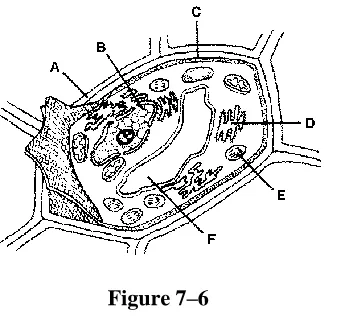
Figure 7–6
6. The storage structure indicated in Figure 7–6 by the letter F is a(an) ____________________ .
8. In plants, ____________________ capture energy from sunlight and convert it into chemical energy, whereas ____________________ convert chemical energy into compounds that are convenient for the cell to use.
9. The cell takes in food and water and eliminates wastes through its selectively permeable _________________________.
10. Molecules tend to move from an area where they are more concentrated to an area where they are less concentrated. This process is called ____________________.
11. Large molecules, such as glucose, that cannot cross the lipid bilayer can still move across the membrane through a type of passive transport called _________________________.
12. Some materials can move across the cell membrane against a concentration gradient by ____________________.
13. A cell’s relatively constant internal physical and chemical conditions are called _________________________.
14. The cells in a multicellular organism have specific jobs. This is called cell _________________________.
15. The levels of organization in a multicellular organism listed from simplest to most complicated are ____________________, tissues, ____________________, and organ systems.
16. Cells keep only a small amount of ____________________ on hand and regenerate it as needed using energy stored in carbohydrates and other molecules.
17. Organisms, such as hawks and leopards, that obtain energy from the foods they consume are called ____________________.
18. Photosynthesis requires light, water, carbon dioxide, and light absorbing ____________________.
19. If you separate the pigments found in a typical plant cell’s chloroplasts, you will find ____________________, orange, and red pigments.
20. ____________________ are saclike photosynthetic membranes inside chloroplasts.
21. Thylakoids are arranged in stacks known as ____________________.
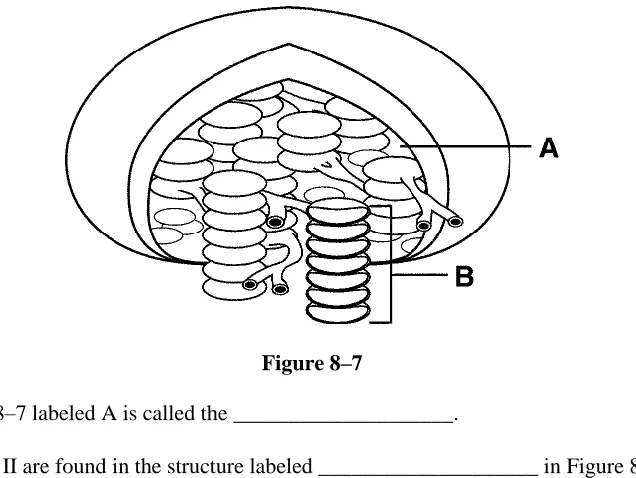
Figure 8–7
23. The area in Figure 8–7 labeled A is called the ____________________.
24. Photosystems I and II are found in the structure labeled ____________________ in Figure 8–7.
25. The electron carrier _________________________ is converted to NADPH during the light-dependent reactions.
26. Photosynthesis uses the energy of sunlight to convert water and carbon dioxide into oxygen and _________________________.
27. A membrane protein called _____________________ allows H+ ions to pass through the thylakoid membrane and into the stroma.
28. The electrons that chlorophyll loses to the electron transport chain are replenished by ____________________ molecules.
29. During the Calvin cycle, molecules of ____________________ supply the carbon component of carbohydrates.
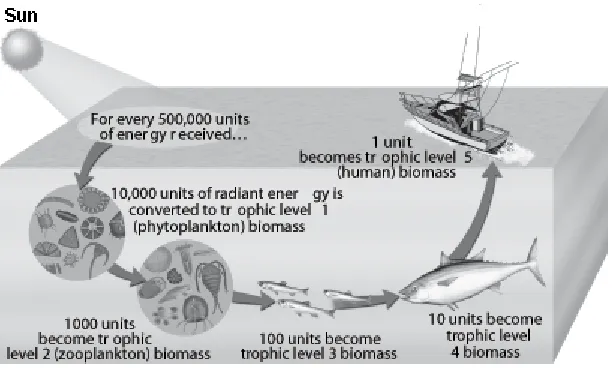
Figure 9–5
31. Figure 9–5 shows that the original source of energy for all organisms in an ocean food chain is ____________________.
32. The three main stages of cellular respiration are _____________________, the Krebs cycle, and ________________________.
33. Cellular respiration in nearly all organisms depends on autotrophs performing the process of _________________________.
34. Photosynthesis occurs only in plants, algae, and some bacteria. In contrast, ______________________________ occurs in all eukaryotic cells.
35. Glycolysis rearranges a 6-carbon glucose molecule into two 3-carbon molecules of _________________________.
36. Two pyruvic acid molecules going through the Krebs cycle will result in ____________________ ATP molecule(s), as well as the energy carriers FADH2 and NADH.
37. When ____________________ pass through ATP synthase, ATP molecules are produced from ADP molecules.
38. The _____________________________ is a series of carrier proteins that use high-energy electrons to create a buildup of H+ ions on one side of the inner mitochondrial membrane.
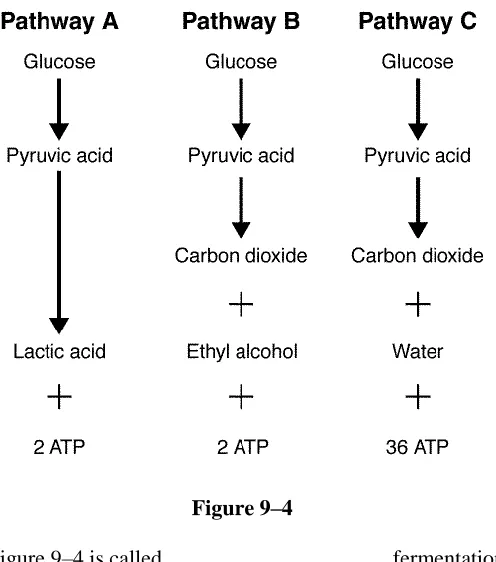
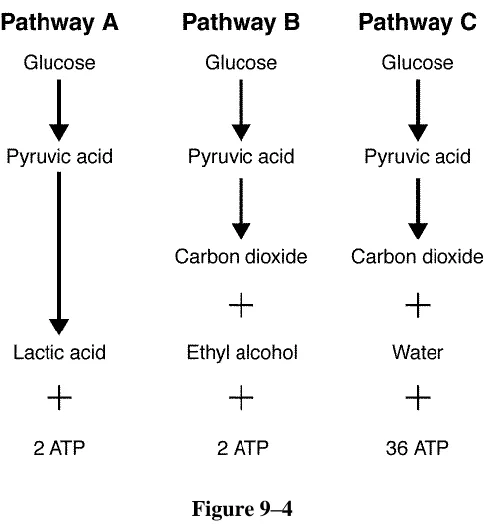
Figure 9–4
40. The pathway labeled B in Figure 9–4 is called ____________________ fermentation.
41. Based on Figure 9–4, ____________________ ATP molecules per glucose molecule are generated through fermentation.
42. In Figure 9–4, only the pathway labeled ____________________ requires oxygen.
43. The body gets rid of lactic acid in a chemical pathway that requires ____________________.
44. A high level of lactic acid in the body is a sign that ______________________________ fermentation has occurred.
45. A person who regularly does aerobic exercise probably takes in ____________________ oxygen than a sedentary person.
46. The larger a cell becomes, the ____________________ efficiently it is able to function.
47. During ____________________ reproduction, cells can produce genetically different offspring, whereas during ____________________ reproduction, cells produce genetically identical offspring.
48. The number of sister chromatids in a human body cell that is entering cell division is ____________________.
49. Cell division occurs in two main stages, the first of which is called _________________________.
50. Together, the G1 phase, S phase, and G2 phase are called ____________________.
Figure 10–7
52. The phase of mitosis shown in step C in the Figure 10–7 above is called ____________________.
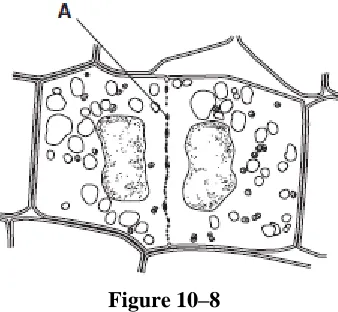
Figure 10–8
53. Look at Figure 10–8. Once structure A has completely formed, another phase of the cell cycle will start. This phase will be called ___________________.
54. The structure labeled A in Figure 10–8 is called the _________________________.
56. During normal development, the cells between toes and fingers die by ____________________, a process of programmed cell death.
57. In all forms of ____________________, the diseased cells fail to respond to the signals that regulate growth and the cell cycle.
58. Adult skin cells can no longer become other types of cells because they have already undergone _________________________.
59. Embryonic stem cells gathered from the inner cell mass of the blastocyst are called ____________________ because they can develop into most, but not all human cell types.
60. Harvesting ____________________ stem cells from a willing donor is not as controversial as harvesting techniques that involve the destruction of an embryo.
Short Answer
61. What does the cell theory say?
62. What kinds of microscopes could you use to look at the structure of DNA? Could you study the structure of DNA in a living specimen? Why or why not?
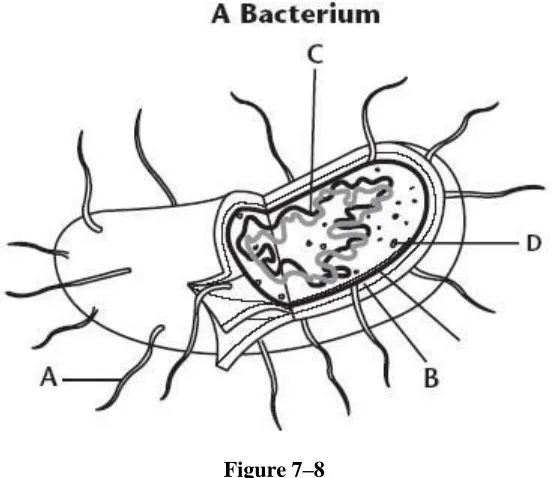
Figure 7–8
63. Is the cell in Figure 7–8 above a prokaryote or a eukaryote? What features help you determine your answer?
64. How do prokaryotes and eukaryotes differ?
66. List two functions of the cytoskeleton.
Figure 7–7
67. Identify each of the cell structures indicated in Figure 7–7. Use these terms: nucleus, mitochondrion, ribosome, cell membrane, smooth endoplasmic reticulum, rough endoplasmic reticulum, nucleolus, Golgi apparatus, cytoplasm.
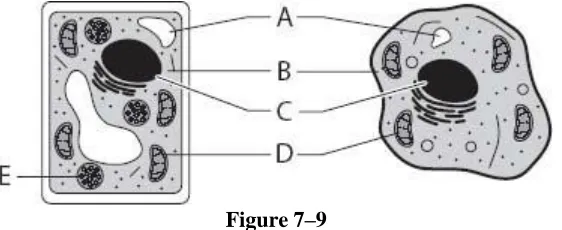
Figure 7–9
68. Which structures in the cells shown in Figure 7–9 above are responsible for meeting the cells’ energy needs? Based on the presence or absence of these structures, identify which cell is a plant cell.
69. What advantages do cell walls provide plant cells that contact fresh water?
70. What would happen if a cell’s membrane became impermeable?
71. Define diffusion.
72. Explain, in terms of osmosis, why a raisin placed in a cup of pure water overnight will puff up with water.
73. What would happen to an animal cell with an internal salt concentration of 0.8% if it were placed in a salt solution with a concentration of 0.2%? Why?
74. How are endocytosis and exocytosis similar? How are they different?
77. What is ATP, and when is energy released from it?
78. What is the difference between an autotroph and a heterotroph? Give an example of each type of organism.
79. Explain how the ultimate source of energy for heterotrophs is the sun even though they cannot make their own food.
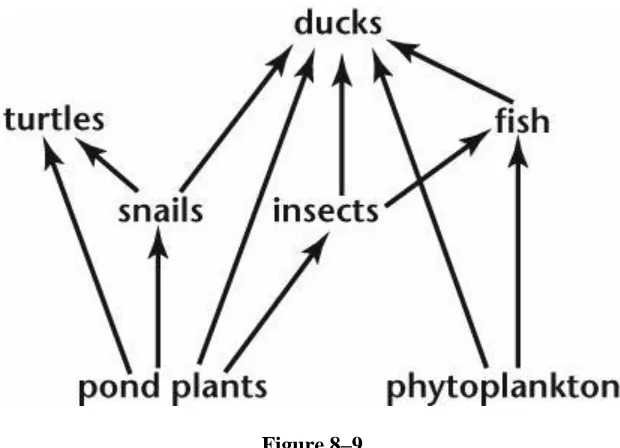
Figure 8–9
80. Examine the food web in Figure 8–9 and identify whether each organism is an autotroph or a heterotroph.
81. A student exposed two plants to only red light and two plants to only green light. Which plants should grow better? Why?
82. Explain the role of electron carriers in photosynthesis and give one example.
83. Write the overall equation for photosynthesis in both symbols and words.
84. Why are six carbon dioxide molecules required to make one glucose molecule?
85. In what ways are photosystems I and II similar?
86. Why is it important that a membrane seperate the cellular regions on either side of an ATP synthase molecule in order for the protein to perform its function?
87. What is the role of hydrogen ions in the conversion of ADP to ATP?
88. What does the Calvin cycle do?
89. Describe the relationship between the light-dependent and the light-independent reactions.
91. What is the relationship between a calorie and a Calorie? If a person eats 2000 calories, how many Calories has he eaten?
92. What is cellular respiration?
93. List the three main stages of cellular respiration in order. Where does each stage take place in the cell?
Figure 9–6
94. Figure 9–6 shows how energy flows among the sun, plants, animals, and fossil fuels. Which arrow represents cellular respiration? Explain your reasoning.
95. What roles does oxygen play in photosynthesis and in cellular respiration?
96. What happens to a molecule of glucose that undergoes glycolysis?
97. Describe glycolysis in terms of energy input, energy output, and net gain of ATP.
98. Why is the Krebs cycle also known as the citric acid cycle?
99. The electron transport chain uses the energy stored in high-energy electrons to pump H+ ions across the inner mitochondrial membrane. Why?
100. What role does oxygen play in the electron transport chain?
102. What are the two types of fermentation? How do their products differ?
Figure 9–4
103. Given the inefficiency of two of the pathways shown in Figure 9–4, what advantage could there be to using these pathways to produce energy?
104. Based on Figure 9–4, which pathway is most efficient at producing energy for a cell? Explain your answer.
105. What three sources of ATP does your body use during a long aerobic exercise session?
106. List two problems that growth causes for cells.
107. What effect does cell size have on a cell’s ability to efficiently carry out its activities?
108. Which type of reproduction, sexual or asexual, is best suited for organisms that live in a place where environmental conditions are stable? Explain.
109. How does packaging genetic information into chromosomes help the process of cell division?
Figure 10–3
111. The main events of the cell cycle are labeled A, B, C, and D in Figure 10–3. Name these events. Then, briefly state what happens during each event.
Figure 10-9
112. Identify each phase of mitosis shown in Figure 10-9 above and the order in which they occur.
113. How are metaphase and anaphase different?
114. Explain the difference between cytokinesis in plant cells and animal cells.
115. The level of cyclins in a cell increases during the M phase of the cell cycle. What might happen to a cell if no cyclins were present during the M phase?
116. How do cancer cells differ from normal cells?
117. Normal cells grown in a petri dish tend to divide until they form a thin layer covering the bottom of the dish. How would you expect cancer cells to behave in this situation?
120. Why is harvesting adult stem cells less controversial than harvesting embryonic stem cells?
Other
A student put together the experimental setup shown below. The selectively permeable membrane is permeable to water, but not the solute shown.
Figure 7–10
121. Interpret Visuals Describe the experimental setup shown in Figure 7–10.
122. Compare and Contrast How does the solution on Side A of the apparatus shown in Figure 7–10 differ from the solution on Side B?
123. Predict Look at Figure 7–10. Describe the movement of water in the experimental setup. What will happen to the concentration of water over time?
124. Predict What will the apparatus shown in Figure 7–10 look like when equilibrium is reached?
125. Predict Once equilibrium is reached in the apparatus shown in Figure 7–10, will the water molecules continue to move? Explain your answer.
126. Interpret Visuals Which drawing in Figure 7–11, I or II, contains structures that carry out photosynthesis? What is this structure labeled in the diagram?
127. Compare and Contrast Look at Figure 7–11. Which structure in drawing I corresponds to structure L in drawing II? What is the name of this structure?
128. Compare and Contrast Which three structures are found in drawing II of Figure 7–11 but not in drawing I? What are the names of these structures?
129. Interpret Visuals Which organelle is labeled K in Figure 7–11? What is the function of this organelle?
130. Interpret Visuals Do the drawings in Figure 7–11 represent prokaryotes or eukaryotes? How do you know?
The experimental setup below shows an osmometer. An osmometer is a device used to measure the amount of osmotic pressure exerted by a liquid passing through a semipermeable membrane. The graph shows one lab group’s results compared with the results of the rest of the class combined. Line A represents the results of the single lab group. Line B represents the data of the rest of the class.
Figure 7–12
131. Compare and Contrast Look at the graph in Figure 7–12. Compare the lab results of the single lab group with those collected by the rest of the class.
132. Analyze Data Which results in the graph in Figure 7–12 are more likely to be accurate, those represented by line A or by line B? Why?
133. Evaluate and Revise What could account for the difference in lines A and B in the graph in Figure 7–12?
135. Calculate How might you use the graph in Figure 7–12 to calculate the rate of osmosis observed? What units would you use to report the rate?
A student prepared two beakers with identical sprigs of a water plant as shown below. She placed one beaker in the shade and the other beaker beside a fluorescent lamp. She then systematically changed the distance from the beaker to the lamp. She counted the bubbles given off by the plants in each beaker. Shown here is the graph of the data for the beaker she placed beside the lamp.
Figure 8–10
136. Control Variables In the experiment described in Figure 8–10, which beaker is the student’s control?
137. Apply Concepts Look at Figure 8–10. If the student later tested the bubbles collected in the test tube, what would she find they are made of? How do you know?
138. Interpret Graphs Look at the graph in Figure 8–10. At what distance from the light source was the greatest number of bubbles produced?
139. Analyze Data Look at the graph in Figure 8–10. What do the student’s data show?
140. Predict In the experiment described in Figure 8–10, if the lamp were placed closer than 5 centimeters from the water plant, would the plant give off many more bubbles? Why or why not?
Figure 8–11
141. Design an Experiment Look at Figure 8–11. What factor is the student varying? What might the student be trying to test?
142. Control Variables Suggest an appropriate control for the experiment shown in Figure 8–11.
143. Predict In Figure 8–11, assume that the student placed Plant A in indirect sunlight for two days. How would the rate of photosynthesis of this plant compare with that of a plant grown under normal conditions?
144. Predict In Figure 8–11, assume that the student placed Plant B in indirect sunlight for two days. How would the rate of photosynthesis of this plant compare with that of a plant grown under normal conditions?
Figure 8–12
146. Interpret Visuals What process is shown in Figure 8–12?
147. Interpret Visuals What organelle is shown in Figure 8–12?
148. Interpret Visuals Look at Figure 8–12. What are the products of the light-dependent reactions?
149. Interpret Visuals What are the products of the Calvin cycle shown in Figure 8–12?
150. Interpret Visuals In Figure 8–12, what provides the carbon needed to make sugars?
A scientist set up a respiration chamber as shown below. She placed a mouse in flask B. Into flasks A, C, and D, she poured distilled water mixed with the acid-base indicator phenolphthalein. In the presence of CO2,
phenolphthalein turns from pink to clear. She allowed the mouse to stay in the chamber for about an hour.
Figure 9–7
151. Infer Write the equation for cellular respiration. Based on this equation and the setup shown in Figure 9–7, what substance(s) would you expect the mouse in flask B to give off?
153. Interpret Visuals Based on Figure 9–7, how will the scientist be able to detect whether the mouse is carrying out cellular respiration?
154. Apply Concepts Assume that the scientist set up an identical respiration chamber, except that in this setup she placed a cricket in flask B instead of a mouse. At the end of one hour, she measured the amount of CO2
given off by the cricket and the mouse. A small amount of CO2 had been given off by the mouse, but little to
no CO2 had been given off by the cricket. Was the cricket carrying out cellular respiration? Explain these
results.
155. Predict Assume that the scientist set up an identical respiration chamber, except that in this setup she placed a mouse that had been exercising on a hamster wheel. Then, the scientist measured the amount of CO2 given off
by both mice at the end of 15 minutes. Predict which setup produced the most CO2. Explain your answer.
Figure 9–8
156. Interpret Visuals What process does Figure 9–8 show?
157. Interpret Visuals Look at Figure 9–8. Where do the electrons moving along the inner membrane come from?
158. Interpret Visuals Where do the electrons moving along the inner membrane in Figure 9–8 end up?
159. Infer Look at the arrows and H+ ions in Figure 9–8. Which direction do most of the H+ ions move in? What is the result of this movement?
160. Interpret Visuals ATP synthase is an enzyme. Find ATP synthase in Figure 9–8. What reaction does ATP synthase catalyze when an H+ ion passes through its channel?
Figure 9–9
161. Apply Concepts Look at Figure 9–9. Which process or processes would you expect the organisms in the test tubes to carry out—cellular respiration, photosynthesis, or both? When would you expect each process to occur?
162. Infer What is the purpose of the bromthymol blue in Figure 9–9? How can the student use this indicator to draw conclusions about the processes that the aquatic plants are carrying out? Explain your answer.
163. Predict Predict what will happen to the test tubes in Figure 9–9 after 24 hours in the dark.
164. Predict Assume that after 24 hours in the dark, the bromthymol blue in test tubes 2 and 3 in Figure 9–9 had turned yellow. The student then placed test tube 3 in a sunny window. He left test tube 2 in the dark. Predict what color the solution in each test tube will be after the next 24 hours.
Figure 10–10
166. Interpret Visuals What does Figure 10–10 represent? How do you know if this is an animal cell or a plant cell?
167. Infer What is the chromosome number of the cell shown in Figure 10–10?
168. Infer Identify the structures labeled X and Y in Figure 10–10.
169. Apply Concepts List the correct order for the diagrams in Figure 10–10.
170. Predict After the steps shown in Figure 10–10 are arranged in the correct order, what would a diagram of the next step show?
A student placed three cubes of agar that contained the indicator phenolphthalein in a beaker of vinegar. The sides of the cubes were the following lengths: 3 cm, 2 cm, and 1 cm. In the presence of an acid, such as vinegar, phenolphthalein turns from pink to clear. After 10 minutes, the student cut each cube open and measured the distance that the vinegar had diffused into each cube. She then started to complete the data table.
Comparison of Agar Cubes
Cube Size (length
in cm)
Surface Area (cm2)
Volume (cm3)
Ratio of Surface Area to Volume
Depth of Diffusion (mm)
Time (minutes)
Rate of Diffusion (mm/minute)
3 54 27 10
2 10
1 6 1 10
171. Design an Experiment What is the student probably trying to test? What do the cubes in Figure 10–11 probably represent?
172. Calculate Look at the data table in Figure 10–11. What are the surface area, volume, and ratio of surface area to volume for the cube that is 2 cm in length?
173. Compare and Contrast Compare the cubes in Figure 10–11 with respect to their sizes and their ratios of surface area to volume.
174. Infer Look at the experimental setup in Figure 10–11. How will the student know how far the vinegar has diffused into each cube?
175. Predict Examine Figure 10–11. In which cube will the vinegar take the longest time to diffuse into the center? In which tube will the vinegar take the shortest time to diffuse into the center?
Figure 10–12
176. Interpret Visuals Look at Figure 10–12. Which diagram shows cancer cells? How do you know?
177. Compare and Contrast Explain how cancer cells are different from normal cells. Then, relate these characteristics to the diagram in Figure 10–12 that shows cancer cells.
178. Predict Look at the cancer cells shown in Figure 10–12. What can happen if these cells are left untreated?
179. Apply Concepts Explain the role that p53 might have had in the growth and division of the cells shown in each diagram in Figure 10–12.
180. Problem Solving How might the cancer cells shown in Figure 10–12 be prevented from doing more harm to the organism they are a part of?
Essay
181. Summarize three statements from the cell theory. Explain the significance of the cell theory to biology.
183. Distinguish between microtubules and microfilaments. Describe two functions of each kind of structure.
184. Compare and contrast the structure and function of the cell wall with that of the cell membrane.
185. Why is the cell membrane sometimes compared to mosaic art?
Figure 7-13
186. The diagrams in Figure 7-13 above show a normal blood cell before and after it is placed in a solution. Describe what could cause the cell to react the way that it did.
187. Imagine a container separated into two compartments by a membrane that is permeable to sugar. Describe what happens when sugar solutions with two different concentrations are placed on opposite sides of the membrane.
188. How do facilitated diffusion and active transport differ? Is osmosis an example of facilitated diffusion or active transport?
189. Compare a cell from a unicellular organism with a cell from a multicellular organism in terms of cell specialization.
190. Discuss the levels of organization in multicellular organisms and explain why these levels are not used to describe unicellular organisms.
191. Compare the storage capacity of ATP and glucose. How does the cell use each of these molecules to store energy?
192. Discuss the relationship between autotrophs and heterotrophs. Do heterotrophs depend on autotrophs for their survival? Explain your answer.
193. Describe how pigments obtain energy from light. Use chlorophyll as an example of the process you describe.
194. Describe the kinds of light that chlorophyll and carotene pigments absorb. What is the advantage for a plant to have more than one kind of pigment?
196. What happens to the electrons in a chlorophyll molecule when light shines on it? Does the chlorophyll molecule ever run out of electrons? Explain your answer.
197. Some people informally call the light-dependent reactions the “light reactions” and the light-independent reactions the “dark reactions.” Why is this naming system misleading?
198. Describe the activities that take place in the stroma in (a) bright sunlight and in (b) darkness.
199. Identify three factors that affect the rate of photosynthesis and explain the effect of each.
200. Describe how photosynthesis in CAM plants differs from photosynthesis in more typical plants. Why is it unlikely that you would find a CAM plant in an aquatic environment?
201. What would happen if all the energy in glucose were released in just one step instead of gradually as it is in cellular respiration? How is the gradual process of cellular respiration advantageous to the cell?
202. Compare photosynthesis with cellular respiration.
203. List the main events of glycolysis. How many ATP molecules are produced and consumed by glycolysis? What effect does the presence of oxygen have on the events that follow glycolysis?
204. Describe the main steps and the results of the Krebs cycle.
205. Identify the electron carriers of cellular respiration. Discuss the relationship between the electron carriers and the electron transport chain.
206. Explain how high-energy electrons are used by the electron transport chain to produce ATP.
207. Compare lactic acid fermentation with alcoholic fermentation. Where does each process occur? What are the products of each process?
208. People who suffer from a heart attack often have an increased ratio of lactic acid to pyruvic acid in their hearts. What does this observation say about the availability of oxygen in the heart muscle cells of someone who has had a heart attack? How could you use this information to screen people who might be at risk for a heart attack?
209. Which pathways does the body use to release energy during exercise? Discuss these pathways in terms of a footrace.
210. Why does lactic acid fermentation “kick in” during a sprint race?
211. Relate ratio of surface area to volume to cell growth and cell division.
212. What kinds of problems does growth cause for cells? How does cell division help a cell solve these problems?
213. List and describe the main events of the cell cycle. Illustrate your description with a diagram of the cell cycle.
215. Assume that prophase begins with eight chromatids in the nucleus of a cell. When telophase ends, how many chromosomes will be present in each new nucleus? Explain your answer.
216. Discuss the relationship between mitosis and cytokinesis. What would be the result if one happened without the other?
217. Describe how the skin cells near a cut behave. What role does contact with other cells have in the behavior of cells near a cut?
218. Describe how the cell cycle is regulated.
219. Describe how cancer cells are different from other cells. Based on these differences, explain why cancer has been such a difficult condition to cure.
Cell Unit Practice Test
Answer Section
COMPLETION
1. ANS: cells
PTS: 1 DIF: L2 REF: p. 191 OBJ: 7.1.1 State the cell theory. STA: UT.BIO.2.3.b TOP: Foundation Edition
BLM: comprehension 2. ANS: transmission
PTS: 1 DIF: L2 REF: p. 192
OBJ: 7.1.2 Describe how the different types of microscopes work. TOP: Foundation Edition BLM: comprehension 3. ANS: nucleus
PTS: 1 DIF: L3 REF: p. 194
OBJ: 7.1.3 Distinguish between prokaryotes and eukaryotes. STA: UT.BIO.2.3.d BLM: synthesis
4. ANS: nucleolus
PTS: 1 DIF: L1 REF: p. 196
OBJ: 7.2.1 Describe the structure and function of the cell nucleus. STA: UT.BIO.2.3.d TOP: Foundation Edition BLM: knowledge
5. ANS: chromosomes
PTS: 1 DIF: L2 REF: p. 197
OBJ: 7.2.1 Describe the structure and function of the cell nucleus. STA: UT.BIO.2.3.d BLM: comprehension 6. ANS: vacuole or central vacuole
PTS: 1 DIF: L3 REF: p. 198
OBJ: 7.2.2 Describe the role of vacuoles, lysosomes, and the cytoskeleton. STA: UT.BIO.2.3.d BLM: synthesis
7. ANS: ribosomes
PTS: 1 DIF: L2 REF: p. 200
OBJ: 7.2.3 Identify the role of ribosomes, endoplasmic reticulum, and Golgi apparatus in making proteins. STA: UT.BIO.2.3.d TOP: Foundation Edition
BLM: analysis
8. ANS: chloroplasts, mitochondria
PTS: 1 DIF: L3 REF: p. 202
OBJ: 7.2.4 Describe the function of the chloroplasts and mitochondria in the cell. STA: UT.BIO.2.3.d BLM: synthesis
PTS: 1 DIF: L2 REF: p. 204
OBJ: 7.2.5 Describe the function of the cell membrane. STA: UT.BIO.2.3.d TOP: Foundation Edition BLM: comprehension
10. ANS: diffusion
PTS: 1 DIF: L1 REF: p. 208 OBJ: 7.3.1 Describe passive transport.
STA: UT.BIO.2.3.c BLM: knowledge
11. ANS: facilitated diffusion
PTS: 1 DIF: L3 REF: p. 209 OBJ: 7.3.1 Describe passive transport. STA: UT.BIO.2.3.c BLM: synthesis
12. ANS: active transport
PTS: 1 DIF: L2 REF: p. 212 OBJ: 7.3.2 Describe active transport. STA: UT.BIO.2.3.c TOP: Foundation Edition
BLM: comprehension 13. ANS: homeostasis
PTS: 1 DIF: L1 REF: p. 214
OBJ: 7.4.1 Explain how unicellular organisms maintain homeostasis. STA: UT.BIO.2.3.c TOP: Foundation Edition BLM: knowledge
14. ANS: specialization
PTS: 1 DIF: L1 REF: p. 215
OBJ: 7.4.2 Explain how multicellular organism maintain homeostasis. STA: UT.BIO.2.3.c TOP: Foundation Edition BLM: knowledge
15. ANS: cells, organs
PTS: 1 DIF: L1 REF: p. 216
OBJ: 7.4.2 Explain how multicellular organism maintain homeostasis. STA: UT.BIO.2.3.c TOP: Foundation Edition BLM: knowledge
16. ANS: ATP
PTS: 1 DIF: L2 REF: p. 227
OBJ: 8.1.1 Describe the role of ATP in cellular activities. STA: UT.BIO.2.1.a TOP: Foundation Edition BLM: comprehension
17. ANS: heterotrophs consumers
PTS: 1 DIF: L1 REF: p. 228
OBJ: 8.1.2 Explain where plants get the energy they need to produce food. STA: UT.BIO.2.2.a TOP: Foundation Edition BLM: knowledge
chlorophyll
PTS: 1 DIF: L2 REF: p. 230
OBJ: 8.2.1 Explain the role of light and pigments in photosynthesis. STA: UT.BIO.2.2.b | UT.BIO.2.3.d TOP: Foundation Edition BLM: application
19. ANS: green
PTS: 1 DIF: L2 REF: p. 231
OBJ: 8.2.1 Explain the role of light and pigments in photosynthesis. STA: UT.BIO.2.2.b | UT.BIO.2.3.d BLM: application 20. ANS: Thylakoids
PTS: 1 DIF: L2 REF: p. 231
OBJ: 8.2.1 Explain the role of light and pigments in photosynthesis. STA: UT.BIO.2.2.b | UT.BIO.2.3.d TOP: Foundation Edition BLM: comprehension
21. ANS: grana
PTS: 1 DIF: L1 REF: p. 231
OBJ: 8.2.1 Explain the role of light and pigments in photosynthesis. STA: UT.BIO.2.2.b | UT.BIO.2.3.d TOP: Foundation Edition BLM: knowledge
22. ANS: green
PTS: 1 DIF: L2 REF: p. 230 | p. 231 OBJ: 8.2.1 Explain the role of light and pigments in photosynthesis. STA: UT.BIO.2.2.b | UT.BIO.2.3.d BLM: application 23. ANS: stroma
PTS: 1 DIF: L1 REF: p. 231
OBJ: 8.2.1 Explain the role of light and pigments in photosynthesis. STA: UT.BIO.2.2.b | UT.BIO.2.3.d TOP: Foundation Edition BLM: knowledge
24. ANS: B
PTS: 1 DIF: L2 REF: p. 235 | p. 237 OBJ: 8.3.1 Describe what happens during the light-dependent reactions. STA: UT.BIO.2.2.b | UT.BIO.2.3.d TOP: Foundation Edition BLM: application
25. ANS: NADP+
PTS: 1 DIF: L2 REF: p. 232
OBJ: 8.2.2 Explain the role of electron carrier molecules in photosynthesis. STA: UT.BIO.2.2.b TOP: Foundation Edition BLM: comprehension
26. ANS:
PTS: 1 DIF: L1 REF: p. 232 OBJ: 8.2.3 State the overall equation for photosynthesis.
STA: UT.BIO.2.1.b | UT.BIO.2.2.b | UT.BIO.2.2.c TOP: Foundation Edition BLM: knowledge
27. ANS: ATP synthase
PTS: 1 DIF: L2 REF: p. 236 | p. 237 OBJ: 8.3.1 Describe what happens during the light-dependent reactions. STA: UT.BIO.2.2.b | UT.BIO.2.3.d TOP: Foundation Edition BLM: application
28. ANS: water
PTS: 1 DIF: L3 REF: p. 236 | p. 237 OBJ: 8.3.1 Describe what happens during the light-dependent reactions. STA: UT.BIO.2.2.b | UT.BIO.2.3.d BLM: synthesis
29. ANS: carbon dioxide
PTS: 1 DIF: L2 REF: p. 239
OBJ: 8.3.2 Describe what happens during the light-independent reactions. STA: UT.BIO.2.2.b | UT.BIO.2.3.d TOP: Foundation Edition BLM: comprehension
30. ANS: decreases
PTS: 1 DIF: L2 REF: p. 240
OBJ: 8.3.3 Identify factors that affect the rate at which photosynthesis occurs. STA: UT.BIO.2.2.b BLM: application
31. ANS: the sun
PTS: 1 DIF: L2 REF: p. 250
OBJ: 9.1.1 Explain where organisms get the energy they need for life processes. STA: UT.BIO.2.2.b TOP: Foundation Edition
BLM: application
32. ANS: glycolysis, electron transport
PTS: 1 DIF: L1 REF: p. 252 OBJ: 9.1.2 Define cellular respiration. STA: UT.BIO.2.2.b | UT.BIO.2.2.c TOP: Foundation Edition
BLM: knowledge 33. ANS: photosynthesis
PTS: 1 DIF: L3 REF: p. 253
OBJ: 9.1.3 Compare photosynthesis and cellular respiration. STA: UT.BIO.2.2.b BLM: synthesis
34. ANS: cellular respiration
PTS: 1 DIF: L1 REF: p. 253
OBJ: 9.1.3 Compare photosynthesis and cellular respiration. STA: UT.BIO.2.2.b TOP: Foundation Edition BLM: knowledge
OBJ: 9.2.1 Describe what happens during glycolysis. STA: UT.BIO.2.2.b TOP: Foundation Edition BLM: knowledge
36. ANS: 2
PTS: 1 DIF: L3 REF: p. 256 | p. 257
OBJ: 9.2.2 Describe what happens during the Krebs cycle. STA: UT.BIO.2.2.b BLM: synthesis
37. ANS: H+ ions
PTS: 1 DIF: L3 REF: p. 258
OBJ: 9.2.3 Explain how high-energy electrons are used by the electron transport chain. STA: UT.BIO.2.2.b BLM: synthesis
38. ANS: electron transport chain
PTS: 1 DIF: L2 REF: p. 258
OBJ: 9.2.3 Explain how high-energy electrons are used by the electron transport chain. STA: UT.BIO.2.2.b TOP: Foundation Edition
BLM: comprehension 39. ANS: 2
PTS: 1 DIF: L2 REF: p. 254
OBJ: 9.2.4 Identify how much ATP cellular respiration generates. STA: UT.BIO.2.2.b | UT.BIO.2.2.c TOP: Foundation Edition BLM: comprehension
40. ANS: alcoholic
PTS: 1 DIF: L2 REF: p. 263
OBJ: 9.3.1 Explain how organisms get energy in the absence of oxygen. STA: UT.BIO.2.2.b TOP: Foundation Edition BLM: analysis
41. ANS: 2
PTS: 1 DIF: L1 REF: p. 254 | p. 263 OBJ: 9.3.1 Explain how organisms get energy in the absence of oxygen. STA: UT.BIO.2.2.b TOP: Foundation Edition BLM: knowledge
42. ANS: C
PTS: 1 DIF: L2 REF: p. 252 | p. 263
OBJ: 9.1.2 Define cellular respiration. STA: UT.BIO.2.2.b | UT.BIO.2.2.c TOP: Foundation Edition BLM: analysis
43. ANS: oxygen
PTS: 1 DIF: L1 REF: p. 265
OBJ: 9.3.2 Identify the pathways the body uses to release energy during exercise.
STA: UT.BIO.2.2.b BLM: knowledge
44. ANS: lactic acid
PTS: 1 DIF: L2 REF: p. 265
STA: UT.BIO.2.2.b TOP: Foundation Edition BLM: application
45. ANS: more
PTS: 1 DIF: L3 REF: p. 252
OBJ: 9.3.2 Identify the pathways the body uses to release energy during exercise. STA: UT.BIO.2.2.b BLM: synthesis
46. ANS: less
PTS: 1 DIF: L1 REF: p. 274
OBJ: 10.1.1 Explain the problems that growth causes for cells. STA: UT.BIO.2.3.a BLM: knowledge
47. ANS: sexual, asexual
PTS: 1 DIF: L2 REF: p. 277
OBJ: 10.1.2 Compare asexual and sexual reproduction. STA: UT.BIO.4.1.b TOP: Foundation Edition BLM: comprehension
48. ANS: 92
PTS: 1 DIF: L3 REF: p. 280 | p. 282 OBJ: 10.2.1 Describe the role of chromosomes in cell division. STA: UT.BIO.2.3.a TOP: Foundation Edition BLM: synthesis
49. ANS: mitosis
PTS: 1 DIF: L1 REF: p. 282
OBJ: 10.2.2 Name the main events of the cell cycle. STA: UT.BIO.2.3.a TOP: Foundation Edition BLM: knowledge
50. ANS: interphase
PTS: 1 DIF: L2 REF: p. 281
OBJ: 10.2.2 Name the main events of the cell cycle. STA: UT.BIO.2.3.a TOP: Foundation Edition BLM: comprehension
51. ANS: 10
PTS: 1 DIF: L3 REF: p. 281 | p. 282
OBJ: 10.2.2 Name the main events of the cell cycle. STA: UT.BIO.2.3.a TOP: Foundation Edition BLM: synthesis
52. ANS: metaphase
PTS: 1 DIF: L2 REF: p. 282
OBJ: 10.2.3 Describe what happens during the four phases of mitosis. STA: UT.BIO.2.3.a TOP: Foundation Edition BLM: comprehension
53. ANS: G1 phase, Interphase
PTS: 1 DIF: L3 REF: p. 284
PTS: 1 DIF: L2 REF: p. 284
OBJ: 10.2.4 Describe the process of cytokinesis. STA: UT.BIO.2.3.a TOP: Foundation Edition BLM: application
55. ANS: plant
PTS: 1 DIF: L2 REF: p. 284
OBJ: 10.2.4 Describe the process of cytokinesis. STA: UT.BIO.2.3.a TOP: Foundation Edition BLM: analysis
56. ANS: apoptosis
PTS: 1 DIF: L1 REF: p. 288
OBJ: 10.3.1 Describe how the cell cycle is regulated. STA: UT.BIO.2.3.a TOP: Foundation Edition BLM: knowledge
57. ANS: cancer
PTS: 1 DIF: L1 REF: p. 289
OBJ: 10.3.2 Explain how cancer cells are different from other cells. STA: UT.BIO.2.3.a TOP: Foundation Edition BLM: comprehension
58. ANS: differentiation
PTS: 1 DIF: L2 REF: p. 293
OBJ: 10.4.1 Describe the process of differentiation. STA: UT.BIO.2.3.d TOP: Foundation Edition BLM: comprehension
59. ANS: pluripotent
PTS: 1 DIF: L2 REF: p. 294 | p. 295
OBJ: 10.4.2 Define stem cells and explain their importance. STA: UT.BIO.2.3.d TOP: Foundation Edition BLM: comprehension
60. ANS: adult
PTS: 1 DIF: L3 REF: p. 297
OBJ: 10.4.3 Identify the possible benefits and issues relating to stem cell research. STA: UT.BIO.4.2.d BLM: evaluation
SHORT ANSWER
61. ANS:
The cell theory says that all living things are composed of cells. It also says that cells are the basic units of structure and function in living things and that new cells come from existing cells.
PTS: 1 DIF: L1 REF: p. 191 OBJ: 7.1.1 State the cell theory. STA: UT.BIO.2.3.b TOP: Foundation Edition
BLM: knowledge 62. ANS:
PTS: 1 DIF: L3 REF: p. 191 | p. 193 OBJ: 7.1.2 Describe how the different types of microscopes work. BLM: application
63. ANS:
This cell is a prokaryote. It has a cell wall, indicated by the letter B, and its DNA, indicated by the letter C, is not enclosed in a nucleus.
PTS: 1 DIF: L3 REF: p. 194
OBJ: 7.1.3 Distinguish between prokaryotes and eukaryotes. STA: UT.BIO.2.3.d BLM: evaluation
64. ANS:
Prokaryotes are generally simpler and smaller than eukaryotes, whereas eukaryotes enclose their DNA in a nucleus and have other specialized organelles.
PTS: 1 DIF: L2 REF: p. 194
OBJ: 7.1.3 Distinguish between prokaryotes and eukaryotes. STA: UT.BIO.2.3.d TOP: Foundation Edition BLM: analysis
65. ANS:
The nucleus is the control center of the cell and contains nearly all the cell’s DNA.
PTS: 1 DIF: L1 REF: p. 197
OBJ: 7.2.1 Describe the structure and function of the cell nucleus. STA: UT.BIO.2.3.d TOP: Foundation Edition BLM: knowledge
66. ANS:
The cytoskeleton helps the cell maintain its shape and internal organization. It is also involved in many forms of cell movement.
PTS: 1 DIF: L1 REF: p. 199
OBJ: 7.2.2 Describe the role of vacuoles, lysosomes, and the cytoskeleton. STA: UT.BIO.2.3.d TOP: Foundation Edition BLM: knowledge
67. ANS:
(A) rough endoplasmic reticulum; (B) cytoplasm; (C) smooth endoplasmic reticulum; (D) nucleolus; (E) nucleus; (F) mitochondrion; (G) Golgi apparatus; (H) ribosome; (I) cell membrane
PTS: 1 DIF: L2 REF: p. 196 | p. 202
OBJ: 7.2.3 Identify the role of ribosomes, endoplasmic reticulum, and Golgi apparatus in making proteins. STA: UT.BIO.2.3.d TOP: Foundation Edition
BLM: application 68. ANS:
The structure identified with the letter E is a chloroplast, which captures energy from sunlight and converts it into chemical energy. The structures identified with the letter D are mitochondria, which convert chemical energy into compounds more convenient for the cell to use. The cell with the chloroplasts is a plant cell.
PTS: 1 DIF: L2 REF: p. 202
OBJ: 7.2.4 Describe the function of the chloroplasts and mitochondria in the cell. STA: UT.BIO.2.3.d TOP: Foundation Edition
69. ANS:
Cell walls protect the plant cells from expanding even under tremendous osmotic pressure.
PTS: 1 DIF: L3 REF: p. 211
OBJ: 7.2.5 Describe the function of the cell membrane. STA: UT.BIO.2.3.d BLM: synthesis
70. ANS:
The cell would die because needed nutrients, such as food and water, could not get inside the cell and wastes would accumulate inside the cell.
PTS: 1 DIF: L3 REF: p. 204 | p. 205
OBJ: 7.2.5 Describe the function of the cell membrane. STA: UT.BIO.2.3.d BLM: evaluation
71. ANS:
Diffusion is the movement of molecules from an area of higher concentration to an area of lower concentration.
PTS: 1 DIF: L1 REF: p. 208 OBJ: 7.3.1 Describe passive transport. STA: UT.BIO.2.3.c TOP: Foundation Edition
BLM: knowledge 72. ANS:
Because the concentration of water in the cup is greater than the concentration of water in the raisin, water will flow from the cup into the raisin.
PTS: 1 DIF: L3 REF: p. 208 | p. 210 OBJ: 7.3.1 Describe passive transport. STA: UT.BIO.2.3.c BLM: application
73. ANS:
The cell would swell and burst, because the 0.2% salt solution is hypotonic with respect to the cell, causing a net movement of water into the cell.
PTS: 1 DIF: L3 REF: p. 210 | p. 211 OBJ: 7.3.1 Describe passive transport. STA: UT.BIO.2.3.c BLM: synthesis
74. ANS:
Both are forms of active transport of large molecules carried out by movements of the cell membrane. Endocytosis involves taking material into the cell, whereas exocytosis involves moving material out of the cell.
PTS: 1 DIF: L2 REF: p. 213 OBJ: 7.3.2 Describe active transport. STA: UT.BIO.2.3.c TOP: Foundation Edition
BLM: analysis 75. ANS:
cell, tissue, organ, organ system
PTS: 1 DIF: L1 REF: p. 216
OBJ: 7.4.2 Explain how multicellular organism maintain homeostasis. STA: UT.BIO.2.3.c TOP: Foundation Edition BLM: knowledge
When a phosphate group is removed from ATP, energy that was strored in the bond between phosphate groups is released and ADP is formed.
PTS: 1 DIF: L2 REF: p. 226 | p. 227
OBJ: 8.1.1 Describe the role of ATP in cellular activities. STA: UT.BIO.2.1.a TOP: Foundation Edition BLM: comprehension
77. ANS:
ATP is the chief energy-storing molecule used by organisms. Energy is released when the bonds between phosphate groups are broken, converting ATP into ADP.
PTS: 1 DIF: L2 REF: p. 227
OBJ: 8.1.1 Describe the role of ATP in cellular activities. STA: UT.BIO.2.1.a TOP: Foundation Edition BLM: comprehension
78. ANS:
Autotrophs are organisms that can make their own food; one example is grass. Heterotrophs are organisms that get energy by consuming other organisms or organic matter; an example is a rabbit.
PTS: 1 DIF: L1 REF: p. 228
OBJ: 8.1.2 Explain where plants get the energy they need to produce food. STA: UT.BIO.2.2.a TOP: Foundation Edition BLM: knowledge
79. ANS:
Heterotrophs get energy by eating autotrophs and/or other heterotrophs. They obtain the sun’s energy that is stored in the autotrophs they eat or by feeding on animals that eat autotrophs.
PTS: 1 DIF: L2 REF: p. 228
OBJ: 8.1.2 Explain where plants get the energy they need to produce food. STA: UT.BIO.2.2.a TOP: Foundation Edition BLM: application
80. ANS:
Pond plants and phytoplankton are autotrophs. Ducks, turtles, snails, insects, and fish are heterotrophs.
PTS: 1 DIF: L3 REF: p. 228
OBJ: 8.1.2 Explain where plants get the energy they need to produce food. STA: UT.BIO.2.2.a BLM: synthesis
81. ANS:
The plants exposed to red light should grow better because chlorophyll absorbs red light well but does not absorb green light well.
PTS: 1 DIF: L3 REF: p. 230 | p. 231 OBJ: 8.2.1 Explain the role of light and pigments in photosynthesis. STA: UT.BIO.2.2.b | UT.BIO.2.3.d BLM: synthesis
82. ANS:
Electron carriers accept pairs of high-energy electrons and transfer them, along with their energy, to other molecules. NADP+ is one example of an electron carrier.
PTS: 1 DIF: L2 REF: p. 232
83. ANS:
PTS: 1 DIF: L2 REF: p. 232
OBJ: 8.2.3 State the overall equation for photosynthesis.
STA: UT.BIO.2.1.b | UT.BIO.2.2.b | UT.BIO.2.2.c TOP: Foundation Edition BLM: application
84. ANS:
Each carbon dioxide molecule contains one carbon atom, and a glucose molecule contains six carbon atoms.
PTS: 1 DIF: L3 REF: p. 232
OBJ: 8.2.3 State the overall equation for photosynthesis.
STA: UT.BIO.2.1.b | UT.BIO.2.2.b | UT.BIO.2.2.c BLM: synthesis 85. ANS:
Sample answer: Both are found in the electron transport chain withitn the thylakoid membranes. They both absorb light and use the light’s energy to excite electrons.
PTS: 1 DIF: L3 REF: p. 235 | p. 236 OBJ: 8.3.1 Describe what happens during the light-dependent reactions. STA: UT.BIO.2.2.b | UT.BIO.2.3.d BLM: synthesis
86. ANS:
The two cellular regions must have a difference in concentration of hydrogen ions in order for ions to flow through the protein and cause it to turn ADP into ATP. Without the membrane separating these regions, there could not be a concentration gradient.
PTS: 1 DIF: L3 REF: p. 236 | p. 237 OBJ: 8.3.1 Describe what happens during the light-dependent reactions. STA: UT.BIO.2.2.b | UT.BIO.2.3.d BLM: analysis
87. ANS:
Hydrogen ions pass through ATP synthase, causing it to spin. As ATP synthase rotates, ADP is converted to ATP.
PTS: 1 DIF: L2 REF: p. 236 | p. 237 OBJ: 8.3.1 Describe what happens during the light-dependent reactions. STA: UT.BIO.2.2.b | UT.BIO.2.3.d TOP: Foundation Edition BLM: analysis
88. ANS:
The Calvin cycle uses ATP and NADPH from the light-dependent reactions to convert carbon dioxide molecules into high-energy sugars.
PTS: 1 DIF: L1 REF: p. 238 | p. 239
OBJ: 8.3.2 Describe what happens during the light-independent reactions. STA: UT.BIO.2.2.b | UT.BIO.2.3.d TOP: Foundation Edition BLM: comprehension
89. ANS:
The light-dependent reactions use energy from the sun to produce ATP and NADPH, and the
PTS: 1 DIF: L2 REF: p. 235 | p. 239
OBJ: 8.3.2 Describe what happens during the light-independent reactions. STA: UT.BIO.2.2.b | UT.BIO.2.3.d TOP: Foundation Edition BLM: synthesis
90. ANS:
water, light intensity, temperature
PTS: 1 DIF: L1 REF: p. 240
OBJ: 8.3.3 Identify factors that affect the rate at which photosynthesis occurs. STA: UT.BIO.2.2.b TOP: Foundation Edition
BLM: knowledge 91. ANS:
There are 1000 calories in 1 Calorie. Eating 2000 calories is the same as eating 2 Calories.
PTS: 1 DIF: L3 REF: p. 250
OBJ: 9.1.1 Explain where organisms get the energy they need for life processes. STA: UT.BIO.2.2.b BLM: synthesis
92. ANS:
Cellular respiration is the process that releases energy by breaking down food molecules in the presence of oxygen.
PTS: 1 DIF: L1 REF: p. 251 OBJ: 9.1.2 Define cellular respiration. STA: UT.BIO.2.2.b | UT.BIO.2.2.c TOP: Foundation Edition
BLM: knowledge 93. ANS:
The three stages are as follows: glycolysis (which occurs in the cytoplasm), the Krebs cycle (which occurs in the matrix of the mitochondria), and electron transport (which occurs in the inner mitochondrial membrane).
PTS: 1 DIF: L2 REF: p. 252 OBJ: 9.1.2 Define cellular respiration. STA: UT.BIO.2.2.b | UT.BIO.2.2.c TOP: Foundation Edition
BLM: synthesis 94. ANS:
Arrow B represents cellular respiration, because it shows the flow of energy from plants to animals. Plants produce food (sugars), which animals use to fuel cellular respiration.
PTS: 1 DIF: L3 REF: p. 253
OBJ: 9.1.3 Compare photosynthesis and cellular respiration. STA: UT.BIO.2.2.b BLM: analysis
95. ANS:
Photosynthesis releases oxygen into the atmosphere as a product, whereas cellular respiration uses oxygen as a reactant to release energy from food.
PTS: 1 DIF: L1 REF: p. 253
OBJ: 9.1.3 Compare photosynthesis and cellular respiration. STA: UT.BIO.2.2.b TOP: Foundation Edition BLM: knowledge
96. ANS:
During glycolysis, the bonds of glucose are broken and rearranged to produce 2 molecules of pyruvic acid.
TOP: Foundation Edition BLM: knowledge 97. ANS:
Glycolysis requires an initial input of 2 ATP molecules and produces an output of 4 ATP molecules, for a net gain of 2 ATP molecules.
PTS: 1 DIF: L3 REF: p. 255
OBJ: 9.2.1 Describe what happens during glycolysis. STA: UT.BIO.2.2.b BLM: analysis
98. ANS:
Citric acid is the first compound formed in the process.
PTS: 1 DIF: L1 REF: p. 256
OBJ: 9.2.2 Describe what happens during the Krebs cycle. STA: UT.BIO.2.2.b TOP: Foundation Edition BLM: knowledge
99. ANS:
The movement of H+ ions back across the inner mitochondrial membrane through ATP synthase converts ADP into ATP.
PTS: 1 DIF: L1 REF: p. 258
OBJ: 9.2.3 Explain how high-energy electrons are used by the electron transport chain. STA: UT.BIO.2.2.b TOP: Foundation Edition
BLM: knowledge 100. ANS:
Oxygen is the final electron acceptor in the electron transport chain, which means that it is needed to get rid of low-energy electrons and H+ ions.
PTS: 1 DIF: L2 REF: p. 258
OBJ: 9.2.3 Explain how high-energy electrons are used by the electron transport chain. STA: UT.BIO.2.2.b TOP: Foundation Edition
BLM: comprehension 101. ANS:
Sample answer: Lactic acid fermentation occurs in the muscles, and alcoholic fermentation occurs in rising bread dough.
PTS: 1 DIF: L2 REF: p. 263
OBJ: 9.3.1 Explain how organisms get energy in the absence of oxygen. STA: UT.BIO.2.2.b TOP: Foundation Edition BLM: application
102. ANS:
Alcoholic fermentation produces carbon dioxide, alcohol, and NAD+, whereas lactic acid fermentation produces lactic acid and NAD+.
PTS: 1 DIF: L2 REF: p. 263
OBJ: 9.3.1 Explain how organisms get energy in the absence of oxygen. STA: UT.BIO.2.2.b TOP: Foundation Edition BLM: analysis
103. ANS:
PTS: 1 DIF: L3 REF: p. 262 | p. 263 OBJ: 9.3.1 Explain how organisms get energy in the absence of oxygen. STA: UT.BIO.2.2.b BLM: synthesis
104. ANS:
Sample answer: Cellular respiration, shown in pathway C, is most efficient, because it produces the most ATP using the same amount of glucose as the other two pathways.
PTS: 1 DIF: L3 REF: p. 252
OBJ: 9.2.4 Identify how much ATP cellular respiration generates. STA: UT.BIO.2.2.b | UT.BIO.2.2.c BLM: analysis
105. ANS:
The body uses ATP that is already present in the muscle cells, ATP released from lactic acid fermentation, and ATP released from cellular respiration.
PTS: 1 DIF: L2 REF: p. 264 | p. 265
OBJ: 9.3.2 Identify the pathways the body uses to release energy during exercise. STA: UT.BIO.2.2.b TOP: Foundation Edition
BLM: comprehension 106. ANS:
As a cell grows larger, more demands are placed on its DNA, and the cell has more trouble moving enough nutrients and wastes across the cell membrane.
PTS: 1 DIF: L2 REF: p. 274 | p. 276
OBJ: 10.1.1 Explain the problems that growth causes for cells. STA: UT.BIO.2.3.a TOP: Foundation Edition BLM: comprehension
107. ANS:
A large cell carries out its activities less efficiently than a small one does.
PTS: 1 DIF: L2 REF: p. 274
OBJ: 10.1.1 Explain the problems that growth causes for cells. STA: UT.BIO.2.3.a BLM: application
108. ANS:
Because the offspring of asexual reproduction are genetically identical to parents, they have the characteristics that help them survive in the conditions in which the parent cells survived. They might not have
characteristics to survive should the conditions change.
PTS: 1 DIF: L3 REF: p. 278
OBJ: 10.1.2 Compare asexual and sexual reproduction. STA: UT.BIO.4.1.b TOP: Foundation Edition BLM: evaluation
109. ANS:
Packaging genetic material into chromosomes helps the cell separate the DNA precisely during cell division. If the genetic material was spread out into smaller pieces, some of the material might get lost more easily when the cell divided into two cells.
PTS: 1 DIF: L2 REF: p. 280
Chromatids are two identical DNA strands joined by a centromere, and chromatin is the material (DNA and proteins) that makes up chromosomes.
PTS: 1 DIF: L3 REF: p. 280 | p. 282 OBJ: 10.2.1 Describe the role of chromosomes in cell division. STA: UT.BIO.2.3.a TOP: Foundation Edition BLM: synthesis
111. ANS:
A: G1 phase, cell growth; B: S phase, DNA replication; C: G2 phase, preparation for mitosis; D: M phase, cell
division (mitosis and cytokinesis).
PTS: 1 DIF: L2 REF: p. 281 | p. 282
OBJ: 10.2.2 Name the main events of the cell cycle. STA: UT.BIO.2.3.a TOP: Foundation Edition BLM: analysis
112. ANS:
1 is anaphase. 2 is prophase. 3 is interphase (or G2 phase). 4 is telophase. 5 is metaphase.
They occur in the following order: 3, 2, 5, 1, and 4 (or: 2, 5, 1, 4, 3).
PTS: 1 DIF: L3 REF: p. 280 | p. 282 OBJ: 10.2.3 Describe what happens during the four phases of mitosis. STA: UT.BIO.2.3.a TOP: Foundation Edition BLM: analysis
113. ANS:
In metaphase the sister chromatids are still attached to one another and are found in the middle of the cell, whereas in anaphase the sister chromatids have separated and are beginning to move to opposite sides of the cell.
PTS: 1 DIF: L2 REF: p. 280 | p. 282 OBJ: 10.2.3 Describe what happens during the four phases of mitosis. STA: UT.BIO.2.3.a TOP: Foundation Edition BLM: analysis
114. ANS:
In plant cells, a cell plate forms in the cytoplasm midway between each new nucleus. The cell plate gradually develops into a separating membrane, and a cell wall begins to appear in the cell plate. In animal cells, there is no cell plate. The cell membrane is drawn inward until the cytoplasm is pinched into two nearly equal parts.
PTS: 1 DIF: L3 REF: p. 284
OBJ: 10.2.4 Describe the process of cytokinesis. STA: UT.BIO.2.3.a TOP: Foundation Edition BLM: synthesis
115. ANS:
A cell that lacked cyclins would probably not undergo mitotic division, and then it would continue to grow, have DNA overload, and exchange materials inefficiently until it dies.
PTS: 1 DIF: L3 REF: p. 286
OBJ: 10.3.1 Describe how the cell cycle is regulated. STA: UT.BIO.2.3.a BLM: evaluation
116. ANS:
PTS: 1 DIF: L2 REF: p. 289
OBJ: 10.3.2 Explain how cancer cells are different from other cells. STA: UT.BIO.2.3.a TOP: Foundation Edition BLM: comprehension
117. ANS:
Cancer cells are not constrained by crowding and would probably continue to grow after forming a thin layer covering the bottom of the petri dish.
PTS: 1 DIF: L3 REF: p. 289
OBJ: 10.3.2 Explain how cancer cells are different from other cells. STA: UT.BIO.2.3.a BLM: synthesis
118. ANS:
Differentiation is the process by which cells become specialized.
PTS: 1 DIF: L1 REF: p. 293
OBJ: 10.4.1 Describe the process of differentiation. STA: UT.BIO.2.3.d TOP: Foundation Edition BLM: knowledge
119. ANS:
Embryonic stem cells come from embryos and are pluripotent, whereas adult stem cells come from adults and are only multipotent.
PTS: 1 DIF: L2 REF: p. 295
OBJ: 10.4.2 Define stem cells and explain their importance. STA: UT.BIO.2.3.d TOP: Foundation Edition BLM: analysis
120. ANS:
Harvesting adult stem cells do not generally harm the donor, whereas harvesting embryonic stem cells usually destroys the embryo.
PTS: 1 DIF: L2 REF: p. 297
OBJ: 10.4.3 Identify the possible benefits and issues relating to stem cell research. STA: UT.BIO.4.2.d BLM: evaluation
OTHER
121. ANS:
The experimental setup shows a solution with differing concentrations of solute separated by a selectively permeable membrane. The membrane is permeable to water but not the solute.
PTS: 1 DIF: L2 REF: p. 208 | p. 210 OBJ: 7.3.1 Describe passive transport. STA: UT.BIO.2.3.c BLM: analysis
122. ANS:
The solution on Side A has fewer solute particles than the solution on Side B. Both solutions have the same amount of water, so the solution on Side A is hypotonic compared to the solution on Side B.
PTS: 1 DIF: L2 REF: p. 210 OBJ: 7.3.1 Describe passive transport. STA: UT.BIO.2.3.c BLM: analysis
123. ANS:
PTS: 1 DIF: L2 REF: p. 208 | p. 210 OBJ: 7.3.1 Describe passive transport. STA: UT.BIO.2.3.c BLM: application
124. ANS:
At equilibrium, Side A will have less water than Side B and the concentration of solute molecules will be equal on either side of the selectively permeable membrane.
PTS: 1 DIF: L2 REF: p. 208 | p. 210 OBJ: 7.3.1 Describe passive transport. STA: UT.BIO.2.3.c BLM: analysis
125. ANS:
Yes, the water molecules will continue to move across the membrane; however, there will not be a net movement from one side to the other.
PTS: 1 DIF: L2 REF: p. 208 | p. 210 OBJ: 7.3.1 Describe passive transport. STA: UT.BIO.2.3.c BLM: application
126. ANS:
Drawing II—a plant cell—contains the structure described (a chloroplast). The structure is labeled N.
PTS: 1 DIF: L1 REF: p. 202
OBJ: 7.2.4 Describe the function of the chloroplasts and mitochondria in the cell. STA: UT.BIO.2.3.d TOP: Foundation Edition
BLM: knowledge 127. ANS:
Structure I. They both represent the cell membrane.
PTS: 1 DIF: L3 REF: p. 200
OBJ: 7.2.5 Describe the function of the cell membrane. STA: UT.BIO.2.3.d BLM: analysis
128. ANS:
Structures J, N, and O. Structure J is the cell wall, structure N is a chloroplast, and structure O is a vacuole.
PTS: 1 DIF: L3 REF: p. 203
OBJ: 7.2.2 Describe the role of vacuoles, lysosomes, and the cytoskeleton. STA: UT.BIO.2.3.d BLM: analysis
129. ANS:
The organelle labeled K is the nucleus. The nucleus stores DNA and directs the activities of the cell.
PTS: 1 DIF: L1 REF: p. 197
OBJ: 7.2.1 Describe the structure and function of the cell nucleus. STA: UT.BIO.2.3.d TOP: Foundation Edition BLM: knowledge
130. ANS:
Both drawings represent eukaryotes, as shown by the presence of a nucleus.
PTS: 1 DIF: L2 REF: p. 193
131. ANS:
Line A shows that the single group’s results are quite different from the results of the rest of the class. Over a half-hour period, the lab group found that the solution traveled 25 mm, whereas the rest of the class found a distance of only 12 mm over the same period of time. The distance traveled in the lab group’s data also kept increasing, whereas the class’ data leveled out at about 10 minutes.
PTS: 1 DIF: L2 REF: p. 210 | p. 211 OBJ: 7.3.1 Describe passive transport. STA: UT.BIO.2.3.c TOP: Foundation Edition BLM: analysis 132. ANS:
The rest of the class’s results (line B) are more likely to be accurate because they represent a larger sample size.
PTS: 1 DIF: L3 REF: p. 210 | p. 211 OBJ: 7.3.1 Describe passive transport. STA: UT.BIO.2.3.c BLM: evaluation
133. ANS:
The lab group (line A) might have used a more concentrated solution of sucrose or a membrane with a different permeability.
PTS: 1 DIF: L3 REF: p. 210 | p. 211 OBJ: 7.3.1 Describe passive transport. STA: UT.BIO.2.3.c BLM: evaluation
134. ANS:
The more concentrated the solution, the longer distance the solution will travel over the same period of time. Thus, a more concentrated solution would produce a longer distance.
PTS: 1 DIF: L3 REF: p. 210 | p. 211 OBJ: 7.3.1 Describe passive transport. STA: UT.BIO.2.3.c BLM: synthesis
135. ANS:
The rate of osmosis could be calculated by dividing the distance traveled by time. The units would be mm/min.
PTS: 1 DIF: L3 REF: p. 210 | p. 211 OBJ: 7.3.1 Describe passive transport. STA: UT.BIO.2.3.c BLM: analysis
136. ANS:
The beaker she placed in the shade is the control.
PTS: 1 DIF: L2 REF: p. 240
OBJ: 8.3.3 Identify factors that affect the rate at which photosynthesis occurs. STA: UT.BIO.2.2.b TOP: Foundation Edition
BLM: application 137. ANS:
The bubbles are probably oxygen gas, which is a product of photosynthesis.
PTS: 1 DIF: L2 REF: p. 232
BLM: application 138. ANS:
5 cm
PTS: 1 DIF: L2 REF: p. 240
OBJ: 8.3.3 Identify factors that affect the rate at which photosynthesis occurs. STA: UT.BIO.2.2.b TOP: Foundation Edition
BLM: application 139. ANS:
The student’s data show that as the water plant gets closer to the light, the water plant gives off more bubbles.
PTS: 1 DIF: L2 REF: p. 240
OBJ: 8.3.3 Identify factors that affect the rate at which photosynthesis occurs. STA: UT.BIO.2.2.b TOP: Foundation Edition
BLM: analysis 140. ANS:
Sample answer: Probably not; the graph shows that the effect is leveling off. Also, we know that light intensity increases the rate of photosynthesis up to a certain point and then levels off.
PTS: 1 DIF: L3 REF: p. 240
OBJ: 8.3.3 Identify factors that affect the rate at which photosynthesis occurs. STA: UT.BIO.2.2.b BLM: evaluation
141. ANS:
The student is varying the concentration of carbon dioxide in the environment of two similar plants. The student is probably trying to test the effect of carbon dioxide concentration on plants.
PTS: 1 DIF: L2 REF: p. 232
OBJ: 8.2.3 State the overall equation for photosynthesis.
STA: UT.BIO.2.1.b | UT.BIO.2.2.b | UT.BIO.2.2.c TOP: Foundation Edition BLM: analysis
142. ANS:
The student might set up a similar geranium plant under a bell jar with a tube that allows air to enter and leave the plant’s environment freely.
PTS: 1 DIF: L3 REF: p. 232
OBJ: 8.2.3 State the overall equation for photosynthesis.
STA: UT.BIO.2.1.b | UT.BIO.2.2.b | UT.BIO.2.2.c BLM: evaluation 143. ANS:
Plant A is being grown with a carbon dioxide absorbant. A plant grown in an environment with depleted carbon dioxide would not be able to carry out the Calvin cycle—its rate of photosynthesis would likely be slower than that of a plant grown under normal contitions. Photosynthesis may even stop all together.
PTS: 1 DIF: L3 REF: p. 239
OBJ: 8.3.2 Describe what happens during the light-independent reactions. STA: UT.BIO.2.2.b | UT.BIO.2.3.d BLM: evaluation
144. ANS:
This plant has been in a carbon-dioxide-rich environment. It will probably have a higher rate of photosynthesis than a plant under normal conditions because carbon dioxide is plentiful.
OBJ: 8.3.2 Describe what happens during the light-independent reactions. STA: UT.BIO.2.2.b | UT.BIO.2.3.d BLM: evaluation
145. ANS:
Plants require carbon dioxide to produce starches. A higher concentration of carbon dioxide surrounding a plant can increase the production of starches. If the area surrounding a plant is depleted of carbon dioxide, a plant may not be able to produce any starches.
PTS: 1 DIF: L3 REF: p. 239
OBJ: 8.3.2 Describe what happens during the light-independent reactions. STA: UT.BIO.2.2.b | UT.BIO.2.3.d BLM: evaluation
146. ANS: photosynthesis
PTS: 1 DIF: L1 REF: p. 233
OBJ: 8.2.3 State the overall equation for photosynthesis.
STA: UT.BIO.2.1.b | UT.BIO.2.2.b | UT.BIO.2.2.c TOP: Foundation Edition BLM: knowledge
147. ANS: a chloroplast
PTS: 1 DIF: L1 REF: p. 231
OBJ: 8.2.1 Explain the role of light and pigments in photosynthesis. STA: UT.BIO.2.2.b | UT.BIO.2.3.d TOP: Foundation Edition BLM: knowledge
148. ANS:
Oxygen gas, ATP, and NADPH are the products of the light-dependent reactions.
PTS: 1 DIF: L1 REF: p. 233
OBJ: 8.3.1 Describe what happens during the light-dependent reactions. STA: UT.BIO.2.2.b | UT.BIO.2.3.d TOP: Foundation Edition BLM: knowledge
149. ANS:
sugars, NADP+, ADP, and P
PTS: 1 DIF: L1 REF: p. 233
OBJ: 8.3.2 Describe what happens during the light-independent reactions. STA: UT.BIO.2.2.b | UT.BIO.2.3.d TOP: Foundation Edition BLM: knowledge
150. ANS: carbon dioxide
PTS: 1 DIF: L1 REF: p. 233
OBJ: 8.3.2 Describe what happens during the light-independent reactions. STA: UT.BIO.2.2.b | UT.BIO.2.3.d TOP: Foundation Edition BLM: knowledge
151. ANS:
Sample answer: The equation for cellular respiration is 6O2 + C6H12O6 6CO2 + 6H2O + Energy. The mouse
STA: UT.BIO.2.2.b | UT.BIO.2.2.c TOP: Foundation Edition BLM: application
152. ANS:
Sample answer: The mouse requires oxygen and sugar from food (glucose) to carry out cellular respiration. Fresh air containing oxygen flows in through the tubes from outside the flasks into flasks B, C, and D. Air mixed with whatever the mouse gives off flows from flask B into flask A. The mouse receives fresh air and should be able to survive in the chamber for the duration of the experiment.
PTS: 1 DIF: L2 REF: p. 251 OBJ: 9.1.2 Define cellular respiration. STA: UT.BIO.2.2.b | UT.BIO.2.2.c TOP: Foundation Edition
BLM: analysis 153. ANS:
Sample answer: If the mouse is carrying out cellular respiration, it will give off CO2. The CO2 will flow into
flask A, and the phenolphthalein in flask A will change from pink to clear.
PTS: 1 DIF: L2 REF: p. 251 OBJ: 9.1.2 Define cellular respiration. STA: UT.BIO.2.2.b | UT.BIO.2.2.c TOP: Foundation Edition
BLM: application 154. ANS:
Sample answer: The cricket, like all living organisms, is carrying out cellular respiration. However, the mouse is larger than the cricket and gives off more CO2 than the cricket. After one hour, the cricket probably has not
given off enough CO2 to measure. If the scientist allows the experiment to continue for several hours, she will
see that more CO2 is given off by the cricket over time.
PTS: 1 DIF: L3 REF: p. 251 OBJ: 9.1.2 Define cellular respiration. STA: UT.BIO.2.2.b | UT.BIO.2.2.c BLM: synthesis
155. ANS:
Sample answer: The mouse that had been exercising should give off more CO2 because this mouse will be
breathing more heavily. This mouse might even have an oxygen debt to repay, which means it is making up for the oxygen and energy it used up during the exercise.
PTS: 1 DIF: L2 REF: p. 265
OBJ: 9.3.2 Identify the pathways the body uses to release energy during exercise. STA: UT.BIO.2.2.b BLM: analysis
156. ANS:
The figure shows the electron transport chain.
PTS: 1 DIF: L1 REF: p. 258
OBJ: 9.2.3 Explain how high-energy electrons are used by the electron transport chain. STA: UT.BIO.2.2.b TOP: Foundation Edition
BLM: knowledge 157. ANS:
The electrons come from NADH and FADH2, electron carriers that come from the Krebs cycle.
PTS: 1 DIF: L1 REF: p. 258
OBJ: 9.2.2 Describe what happens during the Krebs cycle. STA: UT.BIO.2.2.b TOP: Foundation Edition BLM: knowledge
158. ANS: