Shelve in Mobile Computing User level:
BOOKS FOR PROFESSIONALS BY PROFESSIONALS®
Android Application Development
for the Intel
®
Platform
The number of Android devices running on Intel processors has increased since Intel and Google announced, in late 2011, that they would be working together to optimize future versions of Android for Intel Atom processors. Today, Intel processors can be found in Android smartphones and tablets made by some of the top manufacturers of Android devices, such as Samsung, Lenovo, and Asus.
The increase in Android devices featuring Intel processors has created a demand for Android applications optimized for Intel architecture: Android Application Development for the Intel® Platform is the perfect introduction for
software engineers and mobile app developers. Through well-designed app samples, code samples, and case studies, the book teaches Android application development based on the Intel platform—including smartphones, tablets, and embedded devices—covering performance tuning, debugging, and optimization.
This book is jointly developed for individual learning by Intel Software College and China Shanghai JiaoTong University.
What You’ll Learn:
• Comprehensive introduction to the Intel® embedded and mobile hardware platform
• Android app GUI design principles and guidelines • The latest Intel Android development tools, including Intel
Beacon Mountain version 0.6 and the Intel Compiler
• NDK and C/C++ optimization
• Designing and optimizing for low power consumption
Cohen
Wang
For your convenience Apress has placed some of the front
matter material after the index. Please use the Bookmarks
and Contents at a Glance links to access them.
Contents at a Glance
About the Lead Project Editor ��������������������������������������������������������
xvii
About the Lead Contributing Author �����������������������������������������������
xix
About the Technical Reviewer ��������������������������������������������������������
xxi
Introduction ����������������������������������������������������������������������������������
xxiii
Chapter 1: Overview of Embedded Application Development
■
for Intel Architecture ����������������������������������������������������������������������
1
Chapter 2: Intel Embedded Hardware Platform
■
����������������������������
19
Chapter 3: Android Application Development Processes
■
and Tool Chains for Intel
®Architecture
��������������������������������������������
47
Chapter 4: Real Device Environment Installation
■
�������������������������
85
Chapter 5: The Android OS
■
����������������������������������������������������������
131
Chapter 6: Customization and Installation of Android
■
����������������
191
Chapter 7: GUI Design for Android Apps, Part 1:
■
General Overview �����������������������������������������������������������������������
203
Chapter 8: GUI Design for Android Apps, Part 2:
■
The Android-Specific GUI ������������������������������������������������������������
235
Chapter 9: GUI Design for Android Apps, Part 3:
■
Designing Complex Applications ������������������������������������������������
271
Chapter 10: GUI Design for Android Apps, Part 4:
■
■ Contents at a GlanCe
Chapter 11: Performance Optimization for Android
■
Applications on x86 �����������������������������������������������������������������������
335
Chapter 12: NDK and C/C++ Optimization
■
����������������������������������
391
Chapter 13: The Low-Power Design of Android Application
■
and Intel Graphics Performance Analyzers (Intel GPA):
Assisted Power Optimization ���������������������������������������������������������
445
Introduction
The number of Android devices running on Intel processors has gradually increased ever since Intel and Google announced, in late 2011, that they would be working together to optimize future versions of Android for Intel Atom processors. Today, Intel processors can be found in Android smartphones and tablets made by some of the top manufacturers of Android devices, such as Samsung, Lenovo, and Asus.
The increase in Android devices featuring Intel processors has created a demand for Android applications optimized for Intel architecture. This book was written to help introduce developers of all skill levels to the tools they need to develop and optimize applications for the Intel platform.
Chapter 1
This chapter discusses principles for embedded systems, the architecture of SoC, and some pros and cons of platforms such as ARM and x86/x64.
Chapter 2
This chapter goes into detail about specific Intel hardware platforms. It covers Intel Atom processors, Intel SoCs, and retail devices.
Chapter 3
This chapter introduces Android application development on Intel hardware platforms. It also covers installing the development environment tools for an emulator target machine by showing each tool and application and how to download and install them.
Chapter 4
■ IntroduCtIon
Chapter 5
This chapter covers the Android OS and helps build your understanding for subsequent development of embedded applications.
Chapter 6
This chapter discusses customization in an embedded OS and then explains how to customize Android, specifically.
Chapter 7
This chapter introduces the general GUI design method for desktop systems and then shows how designing the UI and UX for embedded systems is different. It also discusses general methods and principles of GUI design for Android applications.
Chapter 8
This chapter introduces Android interface design by having you create a simple application called GuiExam. You learn about the state transitions of activities, the Context class, intents, and the relationship between applications and activities. Finally, the chapter shows how to use the layout as an interface by changing the layout file activity_main.xml, and how the button, event, and inner event listeners work.
Chapter 9
In this chapter, you learn how to create an application with multiple activities. This application is used to introduce the explicit and implicit trigger mechanisms of activities. Next, you see an example of an application with parameters triggered by an activity in a different application, which will help you understand of the exchange mechanism for the activity’s parameters.
Chapter 10
■ IntroduCtIon
Chapter 11
This chapter introduces the basic principles of performance optimization, optimization methods, and related tools for Android application development.
Chapter 12
This chapter introduces the Android NDK for C/C++ application development, along with related optimization methods and optimization tools. It talks about how the Intel mobile hardware and software provide a basis for low-power design and how the Intel Atom processor provides hardware support for low power, which is a major feature of the Android operating system.
Chapter 13
This chapter provides an overview of and introduction to low-power design, followed by a discussion of Android power-control mechanisms. Finally, it covers how to achieve the goal of low-power application design.
The hope is that this book will help developers to create amazing Android applications that are optimized for the Intel platform. You can find further information on developing applications for Intel architecture at the Intel Developer Zone web site
Chapter 1
Overview of Embedded
Application Development
for Intel Architecture
Embedded systems, an emerging area of computer technology, combine multiple technologies, such as computers, semiconductors, microelectronics, and the Internet, and as a result, are finding ever-increasing application in our modern world. With the rapid development of computer and communications technologies and the growing use of the Internet, embedded systems have brought immediate success and widespread application in the post-PC era, especially as the core components of the Internet of Things. They penetrate into every corner of modern life from the mundane, such as an automated home thermostat, to industrial production, such as in robotic automation in manufacturing. Embedded systems can be found in military and national defense, healthcare, science, education, and commercial services, and from mobile phones, MP3 players, and PDAs to cars, planes, and missiles.
This chapter provides the concepts, structure, and other basic information about embedded systems and lays a theoretical foundation for embedded application development, of which application development for Android OS is becoming the top interest of developers.
Introduction to Embedded Systems
Since the advent of the first computer, the ENIAC, in 1946, the computer manufacturing process has gone from vacuum tubes, transistors, integrated circuits, and large-scale integration (LSI), to very-large-scale integration (VLSI), resulting in computers that are more compact, powerful, and energy efficient but less expensive (per unit of computing power).
Chapter 1 ■ Overview Of embedded appliCatiOn develOpment fOr intel arChiteCture
occurring, more people wanted to embed them into specific systems to intelligently control the environment. For example, microcomputers were used in machine tools in factories. They were used to control signals and monitor the operating state through the configuration of peripheral sensors. When microcomputers were embedded into such environments, they were prototypes of embedded systems.
As the technology advanced, more industries demanded special computer systems. As a result, the development direction and goals of specialized computer systems for specific environments and general-purpose computer systems grew apart. The technical requirement of general-purpose computer systems is fast, massive, and diversified computing, whereas the goal of technical development is faster computing speed and larger storage capacity. However, the technical requirement of embedded computer systems is targeted more toward the intelligent control of targets, whereas the goal of technical development is embedded performance, control, and reliability closely related to the target system.
Embedded computing systems evolved in a completely different way. By emphasizing the characteristics of a particular processor, they turned traditional electronic systems into modern intelligent electronic systems. Figure 1-1 shows an embedded computer processor, the Intel Atom N2600 processor, which is 2.2 × 2.2 cm, alongside a penny.
Figure 1-1. Comparison of an embedded computer chip to a US penny. This chip is an Intel
Atom processor
Chapter 1 ■ Overview Of embedded appliCatiOn develOpment fOr intel arChiteCture
Today, embedded systems are an integral part of people’s lives due to their mobility. As mentioned earlier, they are used everywhere in modern life. Smartphones are a great example of embedded systems.
Mobile Phones
Mobile equipment, especially smartphones, is the fastest growing embedded sector in recent years. Many new terms such as extensive embedded development and mobile development have been derived from mobile software development. Mobile phones not only are pervasive but also have powerful functions, affordable prices, and diversified applications. In addition to basic telephone functions, they include, but are not limited to, integrated PDAs, digital cameras, game consoles, music players, and wearables.
Consumer Electronics and Information Appliances
Consumer electronics and information appliances are additional big application sectors for embedded systems. Devices that fall into this category include personal mobile devices and home/entertainment/audiovisual devices.
Personal mobile devices usually include smart handsets such as PDAs, as well as wireless Internet access equipment like mobile Internet devices (MIDs). In theory, smartphones are also in this class; but due to their large number, they are listed as a single sector.
Home/entertainment/audiovisual devices mainly include network television like interactive television; digital imaging equipment such as digital cameras, digital photo frames, and video players; digital audio and video devices such as MP3 players and other portable audio players; and electronic entertainment devices such as handheld game consoles, PS2 consoles, and so on. Tablet PCs (tablets), one of the newer types of embedded devices, have become favorites of consumers since Apple released the iPad in 2010.
The affordability of consumer electronics truly reflects the cost-effectiveness of embedded system design.
Table 1-1. Comparison of General-Purpose Computers and Embedded Systems
Item
General-purpose
computer systems
Embedded systems
Hardware High-performance hardware,
large storage media
Diversified hardware, single-processor solution
Software Large and sophisticated OS Streamlined, reliable, real-time systems
Development High-speed, specialized development team
Chapter 1 ■ Overview Of embedded appliCatiOn develOpment fOr intel arChiteCture
Definition of an Embedded System
So far, you have a general understanding of embedded systems from the examples given. But what is the embedded system? Currently, there are different concepts for embedded system in the industry.
According to the Institution of Engineering and Technology (IET), embedded systems are devices used to control, monitor, or assist the operation of equipment, machinery, or plants. Smartphones, as an important sector of embedded systems, have the following characteristics:
Limited Resources
The majority of embedded systems have extremely limited resources. On one hand, the resources referred to here are hardware resources, including computing speed and processing capability of the CPU, size of the available physical memory, and capacity of the ROM or flash memory that stores code and data. On the other hand, resources are also the functions provided by the software. Compared with general operating systems, embedded operating systems have comparatively simple functions and structure. Embedded systems’ resource constraints lead to designs that are sufficient, instead of powerful.
Real-Time Performance
The real-time aspect of embedded systems means tasks must usually be executed in a certain, predictable amount of time, and maximum execution time limits must be ensured.
Real time is divided into soft real time and hard real time. Soft real time has less-stringent requirements; even if the time limit cannot be met in some cases, it won’t have a fatal impact on the system. For example, a media player system is soft real time. The system is supposed to play 24 frames in one second, but it is also acceptable when the system fails in some overloaded conditions. Hard real time has strict requirements. The execution of tasks must be absolutely ensured in all situations; otherwise the consequences will be catastrophic. For example, aircraft autopilot and navigation system are hard real-time systems. They must accomplish a specific task within the certain time limit; otherwise a major accident, collision, or crash could occur.
Chapter 1 ■ Overview Of embedded appliCatiOn develOpment fOr intel arChiteCture
Robustness
Some embedded systems require high reliability. Reliability is also known as robustness, which is the ability to continue operating in abnormal or dangerous situations. For example, when an embedded system encounters input errors, network overload, or intentional attacks, the system must be robust enough that it doesn’t hang or crash, but operates as usual.
Integrated Hardware and Software
General-purpose computers install software dynamically. The software can be installed and uninstalled according to the users’ demands. But for embedded systems, software and hardware are often integrated and sold as a package. This trend is shifting for devices that are always connected via the Internet, such as smartphones and the Internet of Things (wearables, for example). In these cases, original device manufacturers (ODMs) can do regular software updates.
Embedded software is usually built into the hardware ROM and runs automatically when the system is started. Under normal circumstances, the user cannot easily modify or delete the software without the aid of special tools to ensure the integrity of the embedded system. Due to the integration of hardware and software, embedded systems usually do not have the intellectual property rights issues that general computer systems have to address. For example, software piracy on consumer electronics such as mobile phones and digital cameras is almost impossible due to the way the software is installed. However, this feature also leads to slow upgrading of system software, because it is difficult to do so.
Power Constraints
General-purpose computers are often directly connected to AC power. Therefore, general-purpose computer hardware and software designers can assume that the power supply is inexhaustible. But for embedded systems that cannot be directly connected to AC power—for example, mobile phones, electric toys, and cameras—the only power source is the battery. This means their power consumption is constrained, and so energy efficiency is important. Cooling is another key factor. In general, more power consumption within a certain time period causes more heat to be generated, which can cause problems in some cases such as battery fires, malfunctioning components due to overheating, and quick losses of electricity.
Difficult Development and Debugging
Chapter 1 ■ Overview Of embedded appliCatiOn develOpment fOr intel arChiteCture
Typical Architecture of an Embedded System
Figure 1-2 shows a configuration diagram of a typical embedded system consisting of two main parts: embedded hardware and embedded software. The embedded hardware primarily includes the processor, memory, bus, peripheral devices, I/O ports, and various controllers. The embedded software usually contains the embedded operating system and various applications.Embedded system
Application Embedded OS
Software
Hardware
Input Output
Embedded
microprocessor Peripheraldevice
Figure 1-2. Basic architecture of an embedded system
Input and output are characteristics of any open system, and the embedded system is no exception. In the embedded system, the hardware and software often collaborate to deal with various input signals from the outside and output the processing results through some form. The input signal may be an ergonomic device (such as a keyboard, mouse, or touch screen) or the output of a sensor circuit in another embedded system. The output may be in the form of sound, light, electricity, or another analog signal, or a record or file for a database.
Typical Hardware Architecture
Chapter 1 ■ Overview Of embedded appliCatiOn develOpment fOr intel arChiteCture
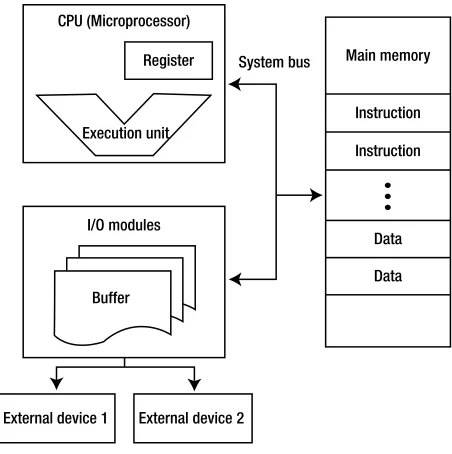
In embedded systems, the microprocessor’s role and function are usually the same as those of the CPU in a general-purpose computer: control computer operation, execute instructions, and process data. In many cases, the microprocessor in an embedded system is also called the CPU. Memory is used to store instructions and data. I/O modules are responsible for the data exchange between the processor, memory, and external devices. External devices include secondary storage devices (such as flash and hard disk), communications equipment, and terminal equipment. The system bus provides data and controls signal communication and transmission for the processor, memory, and I/O modules.
There are basically two types of architecture that apply to embedded systems: Von Neumann architecture and Harvard architecture.
Von Neumann Architecture
Von Neumann architecture (also known as Princeton architecture) was first proposed by John von Neumann. The most important feature of this architecture is that the software and data use the same memory: that is, “The program is data, and the data is the program” (as shown in Figure 1-4).
Main memory CPU (Microprocessor)
Register System bus
Execution unit
I/O modules
Buffer
External device 1 External device 2
Instruction
Instruction
Data
Data
Chapter 1 ■ Overview Of embedded appliCatiOn develOpment fOr intel arChiteCture
In the Von Neumann architecture, an instruction and data share the same bus. In this architecture, the transmission of information becomes the bottleneck of computer performance and affects the speed of data processing; so, it is often called the Von Neumann bottleneck. In reality, cache and branch-prediction technology can effectively solve this issue.
Harvard Architecture
The Harvard architecture was first named after the Harvard Mark I computer. Compared with the Von Neumann architecture, a Harvard architecture processor has two
outstanding features. First, instructions and data are stored in two separate memory modules; instructions and data do not coexist in the same module. Second, two independent buses are used as dedicated communication paths between the CPU and memory; there is no connection between the two buses. The Harvard architecture is shown in Figure 1-5.
Memory
Instruction Instruction register
Controller
Data channel
Input Output
CPU
Instruction 0 Instruction 1 Instruction 2 Instruction 3
Data
Data 0 Data 1 Data 2 Data 3
Chapter 1 ■ Overview Of embedded appliCatiOn develOpment fOr intel arChiteCture
Because the Harvard architecture has separate program memory and data memory, it can provide greater data-memory bandwidth, making it the ideal choice for digital signal processing. Most systems designed for digital signal processing (DSP) adopt the Harvard architecture. The Von Neumann architecture features simple hardware design and flexible program and data storage and is usually the one chosen for general-purpose and most embedded systems.
To efficiently perform memory reads/writes, the processor is not directly connected to the main memory, but to the cache. Commonly, the only difference between the Harvard architecture and the Von Neumann architecture is single or dual L1 cache. In the Harvard architecture, the L1 cache is often divided into an instruction cache (I cache) and a data cache (D cache), but the Von Neumann architecture has a single cache.
Microprocessor Architecture of Embedded Systems
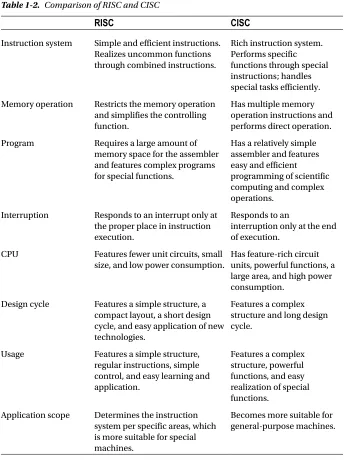
The microprocessor is the core in embedded systems. By installing a microprocessor into a special circuit board and adding the necessary peripheral circuits and expansion circuits, a practical embedded system can be created. The microprocessor architecture determines the instructions, supporting peripheral circuits, and expansion circuits. There are a wide range of microprocessors: 4-, 8-, 16-, 32-, and 64-bit, with performance from MHz to GHz, and ranging from a few pins to thousands of pins.In general, there are two types of embedded microprocessor architecture: reduced instruction set computer (RISC) and complex instruction set computer (CISC). The RISC processor uses a small, limited, simple instruction set. Each instruction uses a standard word length and has a short execution time, which facilitates the optimization of the instruction pipeline. To compensate for the command functions, the CPU is often equipped with a large number of general-purpose registers. The CISC processor features
Program memory
Instruction register
Controller
Data channel
Input Output Address
Data Address Instruction CPU Instruction 0 Instruction 1 Instruction 2 Instruction 3 Data memory Data 0 Data 1 Data 2 Data 3
Chapter 1 ■ Overview Of embedded appliCatiOn develOpment fOr intel arChiteCture
a powerful instruction set and different instruction lengths, which facilitates the pipelined execution of instructions. A comparison of RISC and CISC is given in Table 1-2.
Table 1-2. Comparison of RISC and CISC
RISC
CISC
Instruction system Simple and efficient instructions. Realizes uncommon functions through combined instructions.
Rich instruction system. Performs specific functions through special instructions; handles special tasks efficiently.
Memory operation Restricts the memory operation and simplifies the controlling function.
Has multiple memory operation instructions and performs direct operation.
Program Requires a large amount of
memory space for the assembler and features complex programs for special functions.
Has a relatively simple assembler and features easy and efficient programming of scientific computing and complex operations.
Interruption Responds to an interrupt only at the proper place in instruction execution.
Responds to an
interruption only at the end of execution.
CPU Features fewer unit circuits, small
size, and low power consumption.
Has feature-rich circuit units, powerful functions, a large area, and high power consumption.
Design cycle Features a simple structure, a compact layout, a short design cycle, and easy application of new technologies.
Features a complex structure and long design cycle.
Usage Features a simple structure,
regular instructions, simple control, and easy learning and application.
Features a complex structure, powerful functions, and easy realization of special functions.
Application scope Determines the instruction system per specific areas, which is more suitable for special machines.
Chapter 1 ■ Overview Of embedded appliCatiOn develOpment fOr intel arChiteCture
RISC and CISC have distinct characteristics and advantages, but the boundaries between RISC and CISC begin to blur in the microprocessor sector. Many traditional CISCs absorb RISC advantages and use a RISC-like design. Intel x86 processors are typical of them. They are considered CISC architecture. These processors translate x86 instructions into RISC-like instructions through a decoder and comply with the RISC design and operation to obtain the benefits of RISC architecture and improve internal operation efficiency. A processor’s internal instruction execution is called micro operation, which is denoted as micro-OP and abbreviated mu-op (or written m-op or mop). In contrast, the x86 instruction is called macro operation or macro-op. The entire mechanism is shown in Figure 1-6.
Macro-ops
Processor
Decoder Micro-ops (Internal instruction)
(x86 instruction) Execution unit
Execution result
Figure 1-6. Micro and macro operations of an Intel processor
Normally, a macro operation can be decoded into one or more micro operations to execute, but sometimes a decoder can combine several macro operations to generate a micro operation to execute. This process is known as x86 instruction fusion (macro-ops fusion). For example, the processor can combine the x86 CMP (Compare) instruction and the x86 JMP (Jump) instruction to produce a single micro operation—the compare and jump instruction. This combination has obvious benefits: there are fewer instructions, which indirectly enhances the performance of the processor execution. And the fusion enables the processor to maximize the parallelism between the instructions and consequently improve the implementation efficiency of the processor.
Currently, microprocessors used in most embedded systems have five architectures: RISC, CISC, MIPS, PowerPC, and SuperH. The details follow.
RISC: Advanced RISC Machines (ARM) Architecture
Chapter 1 ■ Overview Of embedded appliCatiOn develOpment fOr intel arChiteCture
CISC: x86 Architecture
The x86 series CPUs are the most popular CPUs for desktop PCs. The x86 architecture is considered CISC. The instruction set was specially developed by Intel for its first 16-bit CPU (i8086), which was adopted by IBM when it launched the world’s first PC in 1981. As Intel launched the i80286, i80386, i80486, Pentium, and other products, it continued to use the x86 instruction set to ensure that legacy applications could be run and protect and integrate diversified software resources. Therefore, those CPUs are called the x86 architecture.
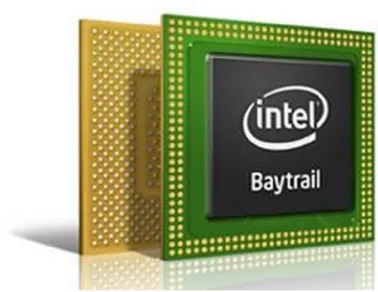
In addition to Intel, AMD, Cyrix, and other manufacturers have also produced CPUs based on the x86 instruction set. Those CPUs can run a variety of software developed for Intel processors, so they are called x86-compatible products in the industry and belong to the x86 architecture. Intel specifically launched the Intel Atom x86 32-bit processor for embedded systems. Chapter 2 describes and presents the benefits of the 64-bit Intel Atom processor, code-named Bay Trail.
Note
■
ia-32, ia-64, intel 64, ia-32, ia-64, and intel64 are intel’s architecture types,
which apply to its processors as well as compatible Cpus.
IA-32 (Intel Architecture-32) means Intel’s 32-bit architecture processor. The number 32 is the working width of a processor; it can process 32 bits of binary data at a time. If other processors (for example, the AMD 32-bit CPU) are compatible with this architecture, they belong to the IA-32 architecture.
IA-64 (Intel Architecture-64) is Intel’s 64-bit architecture. With the 64-bit working width, its microarchitecture is completely different from the x86 architecture. IA-64 is not compatible with x86 software, so the x86 software must use various forms of emulation to run on IA-64, often leading to low efficiency. The architecture is created by HP and co-developed by HP and Intel. Intel Itanium is a typical IA-64 processor.
Intel64 is a 64-bit x86 architecture with a 64-bit working width. After it was introduced by AMD, Intel launched a compatible processor named EM64T, officially renamed Intel64. Almost all Intel CPUs are now Intel64: Xeon, Core, Celeron, Pentium, and Atom. Contrary to the IA-64 architecture, it can also run x86 instructions.
MIPS Architecture
Microprocessor without Interlocked Piped Stages (MIPS) is also a RISC processor. Its mechanism is to make full use of the software to avoid data issues in the pipeline. It was first developed by a research team led by Professor John Hennessy of Stanford University in the early 1980s and later was commercialized by MIPS Technologies.
Like ARM, MIPS Technologies provides MIPS microprocessor cores to
Chapter 1 ■ Overview Of embedded appliCatiOn develOpment fOr intel arChiteCture
PowerPC Architecture
PowerPC is a CPU in the RISC architecture. It derives from the POWER architecture, and its basic design comes from the IBM PowerPC 601 microprocessor Performance Optimized with Enhanced RISC (POWER). In the 1990s, IBM, Apple, and Motorola successfully developed the PowerPC chip and created a PowerPC-based multiprocessor computer. The PowerPC architecture features scalability, convenience, flexibility, and openness: it defines an instruction set architecture (ISA), allows anyone to design and manufacture PowerPC-compatible processors, and freely uses the source code of software modules developed for PowerPC. PowerPC has a broad range of applications from mobile phones to game consoles, with wide application in the communications and networking sectors such as switches, routers, and so on. The Apple Mac series used PowerPC processors for a decade until Apple switched to the x86 architecture.
SuperH
SuperH (SH) is a highly cost-effective, compact, embedded RISC processor. The SH architecture was first developed by Hitachi and was owned by Hitachi and ST Microelectronics. Now it has been taken over by Renesas. SuperH includes the 1, SH-2, SH-DSP, SH-3, SH-3-DSP, SH-4, SH-5, and SH-X series and is widely used in printers, faxes, multimedia terminals, TV game consoles, set-top boxes, CD-ROM, household appliances, and other embedded systems.
Typical Structure of an Embedded System
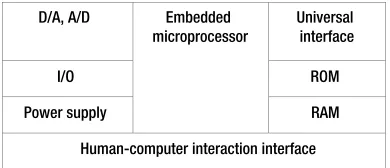
The typical hardware structure of an embedded system is shown in Figure 1-7. A microprocessor is the center of the system, with storage devices, input and output peripherals, a power supply, human-computer interaction devices, and other necessary supporting facilities. In an actual embedded system, the hardware is generally tailor-made for the application. To save cost, the peripherals may be quite compact, and only the basic peripheral circuits are retained for the processor and applications.
D/A, A/D Embedded
microprocessor Universal interface
I/O ROM
Power supply RAM
Human-computer interaction interface
Chapter 1 ■ Overview Of embedded appliCatiOn develOpment fOr intel arChiteCture
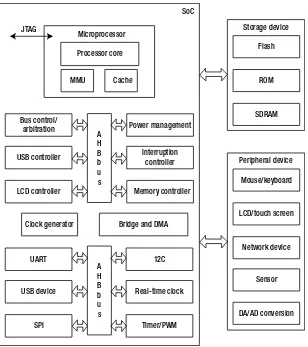
With the development of integrated circuit design and manufacturing technology, integrated circuit design has gone from transistor integration, to logic-gate integration, to the current IP integration or system on chip (SoC). The SoC design technology integrates popular circuit modules on a single chip. SoC usually contains a large number of peripheral function modules such as microprocessor/microcontroller, memory, USB controller, universal asynchronous receiver/transmitter (UART) controller, A/D and D/A conversion, I2C, and Serial Peripheral Interface (SPI). Figure 1-8 is an example structure of SoC-based hardware for embedded systems.
Microprocessor JTAG SoC Storage device Peripheral device Mouse/keyboard LCD/touch screen Network device Sensor DA/AD conversion Flash ROM SDRAM Processor core MMU Cache Bus control/ arbitration USB controller Power management Interruption controller Memory controller LCD controller Clock generator UART USB device SPI 12C Real-time clock Timer/PWM Bridge and DMA A H B b u s A H B b u s
Chapter 1 ■ Overview Of embedded appliCatiOn develOpment fOr intel arChiteCture
A system on a programmable chip (SoPC) advocates that an electronic system be integrated onto a silicon chip with programmable logic technology. Therefore, SoPC is a special type of SoC, in that the main logic function of the entire system is achieved by a single chip. Because it is a programmable system, its functions can be changed via software. It can be said that the SoPC combines the benefits of the SoC, programmable logic device (PLD), and field-programmable gate array (FPGA).
One of the development directions of embedded system hardware is centered on SoC/SoPC, where a hardware application system through the minimum external components and connectors is built to meet the functional requirements of applications.
Typical Software Architecture
Like embedded hardware, embedded software architecture is highly flexible. Simple embedded software (such as electronic toys, calculators, and so on) may be only a few thousand lines of code and perform simple input and output functions. On the other hand, complex embedded systems (such as smartphones, robots, and so on) need more complex software architecture, similar to desktop computers and servers. Simple embedded software is suitable for low-performance chip hardware, has very limited functionality, and requires tedious secondary development. Complex embedded systems provide more powerful functions, need more convenient interfaces for users, and require the support of more powerful hardware. With the improvement of hardware integration and processing capabilities, the hardware bottleneck has gradually loosened and even broken, so embedded system software now tends to be fully functional and diversified. Typical, complete embedded system software has the architecture shown in Figure 1-9.
Application Application layer
System service layer
OS layer
Hardware abstraction layer
File system
Bootloader Board supportpackages Device drivers
Hardware
Task management GUI
OS
Figure 1-9. Software architecture of an embedded system
An embedded software system is composed of four layers, from bottom to top:
1. Hardware abstraction layer
2. Operating system layer
3. System service layer
Chapter 1 ■ Overview Of embedded appliCatiOn develOpment fOr intel arChiteCture
Hardware Abstraction Layer
The hardware abstraction layer (HAL), as a part of the OS, is a software abstraction layer between the embedded system hardware and OS. In general, the HAL includes the bootloader, board support package (BSP), device drivers, and other components. Similar to the BIOS in PCs, the bootloader is a program that runs before the OS kernel executes. It completes the initialization of the hardware, establishes the image of memory space, and consequently enables the hardware and software environment to reach an appropriate state for the final scheduling of the system kernel. From the perspective of end users, the bootloader is used to load the OS. The BSP achieves the abstraction of the hardware operation, empowering the OS to be independent from the hardware and enabling the OS to run on different hardware architectures.
A unique BSP must be created for each OS. For example, Wind River VxWorks BSP and Microsoft Windows CE BSP have similar functions for an embedded hardware development board, but they feature completely different architectures and interfaces. The concept of a BSP is rarely mentioned when various desktop Windows or Linux operating systems are discussed, because all PCs adopt the unified Intel architecture; the OS may be easily migrated to diversified Intel architecture-based devices without any changes. The BSP is a unique software module in embedded systems. In addition, device drivers enable the OS to shield the differences between hardware components and peripherals and provide a unified software interface for operating hardware.
Operating System Layer
An OS is a software system for uniformly managing hardware resources. It abstracts many hardware functions and provides them to applications in the form of services. Scheduling, files synchronization, and networking are the most common services provided by the OS. Operating systems are widely used in most desktop and embedded systems. In embedded systems, the OS has its own unique characteristics: stability, customization, modularity, and real-time processing.
Chapter 1 ■ Overview Of embedded appliCatiOn develOpment fOr intel arChiteCture
System Service Layer
The system service layer is the service interface that the OS provides to the application. Using this interface, applications can access various services provided by the OS. To some extent, it plays the role of a link between the OS and applications. This layer generally includes the file system, graphical user interface (GUI), task manager, and so on. A GUI library provides the application with various GUI programming interfaces, which enables the application to interact with users through application windows, menus, dialog boxes, and other graphic forms instead of a command line.
Application Layer
The application, located at the top level of the software hierarchy, implements the system functionality and business logic. From a functional perspective, all levels of modules in the application aim to perform system functions. From a system perspective, each application is a separate OS process. Typically, applications run in the less-privileged processor mode and use the API system schedule provided by the OS to interact with the OS.
Special Difficulties of Embedded Application
Development
As mentioned earlier in this chapter, embedded systems are generally resource
constrained, real time, and robust. These characteristics make application development on embedded systems more difficult than development on general-purpose computers.
The resource-constrained nature of embedded systems means they have fewer resources, lower CPU operation speed and processing, and less RAM than general-purpose systems. Embedded systems store code and data in ROM or flash instead of on hard drives and have less capacity than hard disks. Most dedicated-purpose embedded systems, especially embedded operating systems, also feature very simple functions compared to general-purpose computers. These resource constraints require developers of embedded hardware to select more rational configurations for chips and peripherals. They must consider resource utilization more carefully than they would when developing for the desktop environment.
Chapter 1 ■ Overview Of embedded appliCatiOn develOpment fOr intel arChiteCture
The special user experience and reliability features of embedded systems add to the difficulty of the application development. For example, users expect the startup time for embedded systems to be much shorter than for general-purpose computers. Compared with general-purpose computer systems, it is also more difficult for embedded systems to ensure reliability. When a task problem occurs, embedded systems do not have the Task Manager, Kill command, or similar tools to terminate the faulty process. Obviously, embedded systems have less tolerance for errors than general systems.
Embedded systems generally do not support native code development. Software development on general-purpose computers usually has native development, compiling, and operation. It is not suitable for embedded systems because they do not have enough resources to run development and debugging tools. Therefore, embedded system software usually uses cross-compile development, which generates execution code on another hardware platform.
The cross-compile development environment is built on the host, whereas the embedded system is called the target machine. The cross-compile, assemble, and link tools on the host create the executable binary code, which is not executable on the host: only on the target machine. The executable file is downloaded to the target machine. The development environment on the host doesn’t completely reflect the environment on the target machine, so debugging and fault diagnosis of the target machine can be time consuming. The nonnative development model of embedded systems leads to certain challenges for application development.
Summary
Chapter 2
Intel Embedded Hardware
Platform
Application developers on general-purpose computers can often ignore the hardware and focus completely on their software because the two entities have become quite independent. However, developers cannot ignore embedded system hardware. Due to the embedded system’s specialized features, constrained resources, and integration of hardware and software, you need to understand the working principles and mechanisms of the hardware and hardware layers in order to design efficient applications for the embedded environment.
As the world’s leader in silicon innovation, Intel has been designing high-performance processors and related hardware for general-purpose computers and embedded systems. This chapter focuses on Intel technologies for embedded systems, paving the way for the subsequent application development.
Intel Atom Processor
Intel specifically designed Intel Atom processors for embedded and mobile devices starting in 2008. As the smallest and lowest-power processor, it uses an entirely new microarchitecture for embedded devices to reduce power consumption and yet maintain instruction-set compatibility with Intel Core 2 processors.
The Intel Atom processor is the current Intel-based architecture for embedded systems. It is compatible with Intel architecture instruction software. Compared to Intel processors for desktop systems, its size, power consumption, and other features are more suitable for embedded applications.
Today’s generation of Intel Atom processors delivers energy-efficient performance to power a range of computing devices. Thin and light smartphones and tablets. Intelligent cars. Innovative healthcare devices. Smart city infrastructure monitoring. High-performance microservers for the cloud. These are just some of the ways Intel Atom processor innovation drives higher performance at ultra-low power—connecting people, enriching lives, and fueling the Internet of Things.
Chapter 2 ■ Intel embedded hardware platform
Intel Atom Processor Architecture
Until the Intel Atom Clover Trail platform, the Intel Atom processor is based on a microarchitecture code-named Saltwell that applies the two-issue wide and in-order pipeline; it also supports Intel Hyper-Threading Technology. The microarchitecture is shown in Figure 2-1.
Figure 2-1. Intel Atom architecture
The front-end area is an optimized pipeline, including
32 KB, 8-way set-associative, L1 Cache •
Branch-prediction unit and instant translation look-aside •
buffer (ITLB)
Chapter 2 ■ Intel embedded hardware platform
In each cycle, the front end may transmit two instructions at most to the instruction queue for scheduling. Also in each cycle, the scheduler may transmit two instructions at most to the integer or SIMD/floating-point execution area through the two-way port. (Single instruction, multiple data [SIMD]) is introduced in the next section.)
The ports for the integer or SIMD/floating-point areas have the following binding features:
Integer execution area
1. Port 0: Arithmetic logic unit 0 (ALU0), shift/rotate unit, and load/store unit.
2. Port 1: Arithmetic logic unit 1, bit-processing unit, jump unit, and LEA.
3. Effective waiting time of “load-to-use” in cycle 0.
SIMD/floating-point execution area
4. Port 0: SIMD arithmetic logic unit, shuffle unit, SIMD/ floating-point multiplication unit, and division unit.
5. Port 1: SIMD arithmetic logic unit and floating-point adder.
6. In the SIMD/floating-point execution areas, the SIMD arithmetic logic unit and shuffling unit are 128 bits wide, but the 64-bit integer SIMD calculation is limited to port 0.
7. The floating-point adder can perform Add packed
single-precision (ADDPS)/ Subtract packed single-precision (SUBPS) in the 128-bit data path, whereas other floating-point addition operations are performed in the 64-bit data path.
8. The security-instruction-recognition algorithm of floating-point/SIMD operations can directly execute new, shorter integer arithmetic instructions without waiting for old floating-point/SIMD instructions (which may cause some abnormality).
9. The floating-point multiplication pipeline also supports the storage load.
10. The floating-point addition instruction with load/store reference is distributed through two ports.
The instruction queue conducts the static partition in order to schedule the
Chapter 2 ■ Intel embedded hardware platform
Silvermont: Next-Generation Microarchitecture
Intel’s Silvermont microarchitecture was designed and co-optimized with Intel’s 22 nm SoC process using 3D tri-gate transistors. By taking advantage of this industry-leading technology, Silvermont microarchitecture includes
A new out-of-order execution engine that enables best-in-class, •
single-threaded performance.
A new multi-core and system fabric architecture scalable up •
to eight cores and enabling greater performance for higher bandwidth, lower latency, and more efficient out-of-order support for a more balanced and responsive system.
New Intel architecture instructions and technologies bringing •
enhanced performance, virtualization, and security management capabilities to support a wide range of products. These
instructions build on Intel’s existing support for 64-bit and the breadth of the Intel architecture software installed base.
Enhanced power-management capabilities including a new •
intelligent burst technology, low-power C states, and a wider dynamic range of operation taking advantage of Intel’s 3D transistors. Intel Burst Technology 2.0 support for single- and multi-core offers great responsiveness scaled for power efficiency.
Chapter 2 ■ Intel embedded hardware platform
Chapter 2 ■ Intel embedded hardware platform
Silvermont provides the following benefits and features:
• High performance without sacrificing power efficiency: Out-of-order execution pipeline, macro-operation execution pipeline with improved instruction latencies and throughput, and smart pipeline resource management
• Power and performance: Efficient branch processing, accurate branch predictors, and fast-recover pipeline
• Faster and more efficient access to memory: Low latency, high-bandwidth caches, out-of-order memory transactions, and multiple advanced hardware prefetchers, balanced-core, and memory subsystems
Features of the Intel Atom Processor
Intel Atom processors have features for mobile Internet device (MID), netbook, nettop, and embedded systems, as outlined in this section.
Small Form Factor
The latest Intel Atom processor Z3740 (code name Bay Trail) has a package size of only 17 mm × 17 mm and is a multi-core SoC that integrates the next generation Intel processor core, graphics, memory, and I/O interfaces into one solution. It is also Intel’s first SoC that is based on the 22 nm processor technology (see Figure 2-3).
Chapter 2 ■ Intel embedded hardware platform
Low Power Consumption
As mentioned earlier, embedded systems are power constrained. The Intel Atom processor features energy-saving technologies such as Enhanced Intel SpeedStep Technology (EIST),1 low thermal design power, dynamic cache sizing, and deeper sleep. Devices with Intel Atom processors feature very limited heat dissipation, much less than common “full power” devices.
It should be noted that different Intel Atom processor series have different low-power processing strategies. For example, the N series does not support EIST, nor does it conduct automatic frequency reduction in standby state.
Dynamic Low-Voltage Technology for Mobile and Embedded
Devices
Many mobile and embedded systems are powered by battery; so the voltage doesn’t have the stability of systems with AC power supplies, for which the voltage maintains a certain range. Intel Atom processors also have adopted the technology to dynamically adjust operating voltage per processor activity states and support the Intel Mobile Voltage Positioning (IMVP)-6 standard for mobile and embedded systems.
High Performance
The Intel Atom processor is an embedded microprocessor, delivers the performance of traditional general-purpose processors, and provides a performance similar to Intel Pentium 4 processors. The high performance is mainly reflected in the following aspects:
Quad core supports four-core / four-thread out-of-order •
processing and 2 MB of L2 cache, which makes the device run faster and more responsively by allowing multiple apps and services to run at the same time.
Intel Burst Technology 2.0 lets the system tap extra cores when •
necessary, which allows CPU-intensive applications to run faster and more smoothly
Performance improved by using the 22 nm processor technology: •
Maximizes current flow during ON state for better •
performance
Minimizes leaks during OFF state, leading to more energy •
efficiency
Chapter 2 ■ Intel embedded hardware platform
64-bit OS capable •
Supports dynamic power sharing between the CPU and IP •
(graphics), allowing for higher peak frequencies
Total SoC energy budget is dynamically assigned according to •
application needs
Supports fine-grained low-power states, which provides better •
power management and leads to longer battery life
Supports cache retention during deep sleep states, leading to •
lower idle power and shorter wakeup times
Offers more than 10 hours of active battery life •
SSE3 Instruction Set Enhances the Processing Power
of Digital Media
Software applications like CAD tools, 3D/2D modeling, video editing, digital music, digital photography, and games all require massive floating-point parallel computing. They are called floating-point-intensive applications. For example, video processing often requires multiplication of two data sets of n length, so the common arithmetic instruction has to operate n times (n cycle). To that end, the SIMD architecture was created.
Compared with traditional processors, SIMD processors have more arithmetic units, which are controlled by a controller, while conducting the same data operation in each data set (also known as vector data) to achieve spatial parallelism. In the example shown in Figure 2-4, if the CPU uses the eight processing elements, the n/8 SIMD instructions can complete the calculation so the operation time is shortened to 1/8 of the original time, and the speed is increased 8 times. The essence of SIMD is to transfer from one data process to a data set process.
Chapter 2 ■ Intel embedded hardware platform
Streaming SIMD Extensions (SSE) in Intel processors accelerate the streaming floating-point calculations and greatly improve the performance in floating-point-intensive applications. Intel Atom processors support SSE3 and SSSE3 (Supplemental Streaming SIMD Extension 3; Supplement SSE 3). The version history of the SSE instruction set is shown in Table 2-1.
Table 2-1. Development History of the SSE Instruction Set
Version
SSE
SSE2
SSE3
SSSE3
SSE4
AVX
Date 1999 2000 2004 2006 2007 2008
Instructions 70 144 13 32 47 256
Enhancement Single-precision vector Flow • opera-tion Dual-precision vector 128-bit • vector integer Complex arithmetic Decoding Video acceleration Graphics • module Coprocessor • acceleration SSE extension float-point operations
Intel Virtualization Technology (Intel VT)
Intel Atom processors support Intel VT, which is a kind of CPU virtualization technology. Intel VT allows one CPU to simulate the parallel operation of multiple CPUs, lets a platform run multiple operating systems, and enables applications to run independently in separate spaces, thereby increasing application efficiency.
Intel Hyper-Threading Technology (Intel HT Technology) and
Multi-Core Technologies
Chapter 2 ■ Intel embedded hardware platform
Other Technologies Used by the Intel Atom Processor
In addition, Intel Atom processors use a few other technologies that often go unnoticed but that increase processor performance:Smart cache: Intel Atom processors use the more intelligent, more efficient cache and bus technologies to effectively support data sharing and provide enhanced performance, response, and energy-saving capability.
Power-optimized FSB: Intel Atom processors support up to 1910 MHz frequency (E3845) to meet the needs of demanding applications. In addition, the Intel architecture instruction (macro-ops) fusion technology allows faster execution of instructions in the low-power state.
Enhanced data pre-fetch technology: This technology can effectively predict which data will specifically be used and automatically load it into the L2 cache in advance.
Burst mode: Burst mode, as enhanced hardware technology, is used in Intel Atom processors after the Z5xx series. It automatically sets the processor performance level based on system load without compromising the thermal design so that the user can select processor performance on demand.
Low cost: To meet the needs of embedded systems, Intel Atom processors use low-cost design strategies, one of which is applying the in-order execution of Intel architecture. Compared with the out-of-order execution of general desktop processors, the in-order execution design in Intel Atom processors can reduce the number of transistors and manufacturing costs, but results in lower performance. To compensate for the lower performance involved, Intel Atom processors use the higher operating frequency.
In addition to these features, Intel Atom processors have some unique benefits compared to other embedded processors. Because they are based on Intel architecture, Intel Atom processors have a huge number of compatible Intel architecture-based software applications. Many of these applications can be easily and seamlessly migrated to Intel Atom processor-based devices.
Chapter 2 ■ Intel embedded hardware platform
Intel Embedded Chipset
A chipset, one of the core components of computer motherboards, maximizes the integration of complex circuits and components within a few chips. The chipset determines the functions, level, and grade of the motherboard. If it fails to work correctly with the CPU, the chipset seriously affects overall performance and can even cause hardware failure. If the CPU or microprocessor is the brain, the chipset is the nervous system of the device.
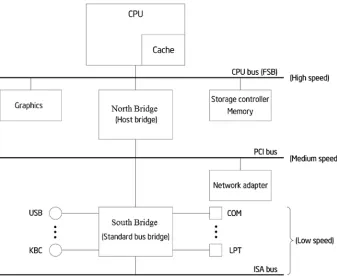
A typical example of a computer system structure is shown in Figure 2-5. The CPU is connected to the main memory RAM, graphics, and other components through FSB, which has high frequency. The network adapter and other components are connected to a medium-speed bus (PCI bus with much lower frequency than FSB). North Bridge (the host bridge chip) realizes the connection of high-speed FSB and the medium-speed bus. Low-speed devices, such as COM, LPT, and USB, as well as the lower-speed ISA bus, are connected to the low-speed bus through South Bridge (the standard bus bridge chip).
Figure 2-5. Example of computer system architecture
Chapter 2 ■ Intel embedded hardware platform
Tip
■
PCI and ISA
the two types of pC bus standards are pCI and ISa. peripheral
Component Interconnect (pCI) is the standard for the local bus and was launched by Intel in
1992. pCI buses are either 32-bit or 64-bit, and 33 mhz or 66 mhz in speed. a 32-bit, 33
mhz pCI bus has a bandwidth of 32/8 × 33 mhz = 132 mb/s. Industry Standard architecture
(ISa) is based on the Ibm pC bus and is the bus standard developed in the early 1980s. the
bus has a width of 8/16 bits and an operating frequency of 8 mhz, which are far below pCI.
most new computers do not support the ISa bus.
The main chips in the chipset and their functions are as follows:
North Bridge chip: Determines the type of CPU, clock speed, bus frequency of the motherboard system, type of memory, maximum capacity, performance, graphics slot specifications (ISA/PCI/AGP slot), ECC error correction support, and so on. North Bridge plays a leading role in the chipset, so it is also known as the host bridge.
South Bridge chip: The South Bridge chip provides the support for the keyboard controller (KBC), real-time clock controller (RTC), Universal Serial Bus (USB), Ultra DMA/33 (66) EIDE data transmission mode, advanced energy management (ACPI), and so on. It determines the type and quantity of expansion slots and expansion interface (such as USB2.0/1.1, IEEE1394, serial port, parallel port, and VGA output interface of a notebook). South Bridge is also known as the standard bus bridge.
Other chips: Some chipsets combine a 3D acceleration display (integrated graphics chip), AC’97 audio decoding, and other functions, and determine the display performance and audio playback performance of the computer system.
The latest Intel Atom processor includes a seventh-generation Intel GPU with burst technology to provide an improved graphics and media experience. The new processor supports high-resolution displays up to 2,560 × 1,600 at 60 Hz and supports Intel Wireless (Intel WiDi) technology through Miracast. Seamless video playback is supported by high-performance, low-power hardware acceleration of media encode and decode.
Intel System on Chip (SoC)
Chapter 2 ■ Intel embedded hardware platform
memory, bus, frequency generator, and A/D or D/A conversion on a single chip, SoC provides the benefits of small size, energy efficiency, high reliability, and simple peripheral circuit design. Intel has gradually embarked on SoC as the development direction for Intel Atom processors. A description of the recent designs follows.
Medfield
Medfield, released in 2012, is Intel’s first SoC processor for smartphones. The core of the Medfield platform is the SoC chip (code-named Penwell). In fact, the previous Moorestown platform requires a two-chip solution to achieve the same functionality. As a true SoC, Medfield is different from the single-chip layout of Intel Atom processors but is equivalent to previous chipsets. As a result, it becomes a more compact, energy-efficient processor. The Medfield SoC processor adopts package on package (POP), and the entire chip area is about 12 × 12 mm. The internal architecture of Medfield SoC is shown in Figure 2-6.
Figure 2-6. Internal architecture of Penwell SoC
Chapter 2 ■ Intel embedded hardware platform
The Z2460 may reduce the minimum frequency to 100 MHz, features 1.3 GHz standard operating frequency, and only operates in 1.6 GHz during acceleration mode. As the second Medfield SoC core, the Z2610 maintains operation at 1.6 GHz clock speed.
The Intel Atom processor Z2460 consumes 50 mW of power at 100 MHz clock speed (lowest frequency); 175 mW at 600 MHz clock speed; 500 mW at 1.3 GHz clock speed (standard frequency); and 750 mW at 1.6 GHz clock speed (highest frequency). Compared with desktop processors, the Z2460 has very low power consumption.
Today, the Android OS completely supports Medfield. Intel works with Google to develop software for compiling applications for ARM and Intel architectures.
Bay Trail
Bay Trail, the new Intel multi-core SoC built on the Silvermont architecture, is from Intel’s powerful processor family for mobile and desktop devices. Bay Trail is manufactured on Intel’s industry-leading tri-gate 22 nm process technology.
Bay Trail is a multi-core SoC that integrates the next-generation Intel processor core, graphics, memory, and I/O interfaces into one solution. It is also Intel’s first SoC that is based on the 22 nm processor technology. This multi-core Intel Atom processor provides outstanding computing power and is more power efficient compared to its predecessors. In addition to the latest Intel architecture core technology, it provides extensive platform features such as graphics, connectivity, security, and sensors, which enable developers to create software with unlimited user experiences.
64-Bit Android OS on Intel Architecture
On a generic level, there are not many significant differences between 64-bit and 32-bit processors. But compute-intensive applications (later, the chapter discusses software workloads that run faster on 64-bit processors) can see significant improvements when moved from 32-bit to 64-bit. In almost all cases, 64-bit applications run faster in a 64-bit environment than 32-bit applications in a 64-bit environment, which is a good enough reason for developers to care about it. Utilizing platform capabilities can improve the speed of applications that perform a large number of computations.
64 Bits vs. 32-bit Android
A 64-bit architecture means the width of the integer registers and pointers is 64 bits. The three main advantages of a 64-bit operating system are as follows:
Increased number of registers •
Extended address space •
Chapter 2 ■ Intel embedded hardware platform
It’s not hard to imagine Android phones with 64-bit chips in the not-too-distant future. Because the Android kernel is based on a Linux kernel, and Linux has supported 64-bit technology for years, the only thing Android needs to fully support 64-bit processing is to make the Dalvik VM 64-bit compatible. A Dalvik application (written only in Java) will work without any changes on a 64-bit device because the bytecode is platform independent.
Native application developers can take full advantage of the capabilities offered by the underlying processor. For example, Intel Advanced Vector Extensions (Intel AVX) has been extended to support a 256-bit instruction size on 64-bit processors.
Memory and CPU Register Size
Memory is extremely slow compared to the CPU, and reading from and writing to memory can take a long time compared to how long it takes the CPU to process an instruction. CPUs try to hide this with layers of caches, but even the fastest layer of cache is slow compared to internal CPU registers. More registers means more data can be kept purely CPU-internal, reducing memory accesses and increasing performance.
Just how much difference this makes depends on the specific code in question, as well as how good the compiler is at optimizing the code to make the best use of available registers. When the Intel architecture moved from 32-bit to 64-bit, the number of registers doubled from 8 to 16, and this made for a substantial performance improvement.
Sixty-four-bit pointers allow applications to address larger RAM address spaces: typically, on a 32-bit processor, the addressable memory space available to a program is between 1 and 3 GB because only 4 GB is addressable. Even if 1–3 GB is available, a single program cannot use all the memory that is addressable unless it resorts to a technique like splitting the program into multiple processes, which takes a lot of programming effort. On a 64-bit operating system, this is of no concern because the addressable memory space is pretty large.
Memory-mapped files are becoming more difficult to implement on 32-bit
architectures because files over 4 GB are increasingly common. Such large files cannot be memory-mapped easily to 32-bit architectures—only part of the file can be mapped into the address space at a time. To access such a file, the mapped parts must be swapped into and out of the address space as needed. This is a problem because memory mapping, if properly implemented by the OS, is one of the most efficient disk-to-memory methods.
Sixty-four-bit pointers also come with a substantial downside: most programs use more memory because pointers need to be stored and they consume twice as much memory. An identical program running on a 64-bit CPU takes more memory than on a 32-bit CPU. Because pointers are very common in programs, this can increase cache sizes and have an impact on performance.
Register count can strongly influence performance of an application. RAM is slow compared to on-CPU registers. CPU caches help to increase the speed of applications, but accessing cache does result in a performance hit.
Chapter 2 ■ Intel embedded hardware platform
Contrast this with an unoptimized application that might see a decrease in computer performance because 64-bit pointers require twice the bandwidth. However, in a mobile environment, the OS and installed applications should be engineered to avoid this. A famous example of a large program that runs slower on a 64-bit environment is the Oracle JVM.
Both ARM and Intel 64-bit CPUs have a 32-bit compatibility mode. Although 32-bit applications will run on 64-bit processors, compiling with a 64-bit optimizing compiler allows them to take advantage of the architectural benefits of a 64-bit environment.