IJIRT 144818
INTERNATIONAL JO URNAL OF INNOVATIVE RESEARCH IN TECHNOLOGY139
Evolution of policer to enhance NGN Router using
MATLAB
Pallavi R. Patil
1, Dr. Mrs. S. V. Sankpal
2,
Santosh D. Bhopale
31
Research scholar, Electronics Engg. Dept., D. Y. Patil College of Engg. & Tech. Kolhapur, Maharashtra
2
Professor, Electronics Engg. Dept., D. Y. Patil College of Engg. & Tech. Kolhapu r, Maharashtra
3
Assistant Professor, Electronics Engg. Dept., Tatyasaheb Kore Institute of Engg. & Tech. Warananagar,
Maharashtra
Abstract-Next generation Networks (NGN) are required to support the seamless delivery of voice, video and data with high quality. The advantages of the proposed method, in terms of QoS gains, are demonstrated through modeling of the main QoS parameters. Among the many issues faced by NGN is the quality of service (QoS ) issue as would be with any IP based network; which is measured in terms of network latency, throughput, packet delay variation, packet loss etc. S everal techniques try to solve this issue in a best effort environment. Multi Protocol Label S witching (MPLS ) was found to be the technology which seems to solve the problem better than others primarily due to its traffic engineering capabilities.It proposes the framework for cross-layer Quality of S ervice (QoS ) adaptation in Next Generation Networks (NGN) based on S ervice-Oriented Architecture (S OA) principles of system design. With the development of network technology, people's demand on real-time and multimedia feature of the network services has become more and more sophisticated, that requiring Quality of S ervice of Next Generation Networks with high features. Firstly, this thesis systematically analyzes the characteristics and limitations of IntS erv and DiffS erv which supports the mechanisms of QoS . S econdly, describes the basic principles of MPLS , analyzes the guarantee and support for QoS by MPLS technology, and proposes the QoS solution based
on MPLS collaboration. Lastly, this thesis sums up the role and prospects of QoS mechanism of MPLS in the future Internet.
Index terms- NGN, QoS , admission control, transport resource, IP/MPLS .
I. INTRODUCTION
The rapid development of the network technologies and multimedia applications has created the platform for the Next Generation Networks (NGN) or Future Network Vision implementation. The Quality of Service (QoS) support has become one of the major
issues involved in structural and transportation design of today’s networks. Current research activities are
Oriented towards the internetworking of
heterogeneous technologies and integrated “end-to-end” QoS support through IP-based domains. The QoS framework for heterogeneous networking should encompass various QoS mechanisms (schemes for resource reservation, QoS routing protocols, admission control policies, packet scheduling algorithms, QoS on data link layer, QoS for middleware, application QoS requirements and mapping, etc.) [1]. The trend in recent years has been the creation of open platforms and frameworks with adaptive and modular structure that enables flexible
addition, reuse or removal of necessary
functionalities and services.Next Generation
Networks are packet-based with capabilities to support multiple broadband networks and provide end-to-end Quality of Service (QoS) guarantees across multiple access networks. However, each technology implements its proprietary QoS solutions to satisfy its own network requirements. They define QoS classes based on their standard specifications which makes right mapping of QoS classes over
heterogeneous networks a difficult task.
IJIRT 144818
INTERNATIONAL JO URNAL OF INNOVATIVE RESEARCH IN TECHNOLOGY140
which might include giving preferential treatment to some traffics over others e.g. voice and video traffics are more sensitive to delay and packet delay variation and loss as compared to file transfer or email. QoS can be provided by resource over-provisioning which in many cases is not possible or by network management which is the task of the QoS techniques. ATM was the first technology for providing QoS [2] but has the disadvantage of a large overhead (5 bytes to 48 in an ATM cell). IntServ provides guaranteed services but has scalability problems due to large number of RSVP messages going on in the network to reserve the resources for each flow separately [2]. DiffServ is the other way round having good scalability (class based QoS rather than flow based) but only provides coarse quality of service; providing only the preferential treatment to some traffic classes over the others [3]. Multi Protocol Label Switching (MPLS) is a new emerging technique where the packets are fast switched across the interfaces of a router i.e. the layer 2 functionality using 32-bit labels instead of routing by IP header which is a comparatively slow proces s. Besides this, Traffic Engineering (TE) is also possible through MPLS which leads to balancing the network traffic and efficient use of network resources, thereby making it possible to achieve higher network throughput. MPLS on the other hand is much like DiffServ in that the service differentiation takes place at the ingress only and all routing decisions are taken there.[3] Next-generation network (NGN) is a new concept commonly used by network designers to depict their vision of future telecommunications networks. Even if the required resources are successfully reserved, the delay, jitter, and other QoS parameter values may be out of range because of the interference of other traffic. [5] Another thing is that NGN should have the interoperability with the existing networks. The important issues that need to be addressed in NGN are reliability, addressing (given its heterogeneous nature), security and quality of service(QoS) which
has been discussed in this paper. Various
technologies available for providing QoS are ATM, DiffServ, IntServ, and MPLS. MPLS was found to be the most promising technology with regards to QoS in NGN primarily due to its traffic engineering capabilities. However MPLS DiffServ combo gives us more control in providing QoS as has been shown in the simulations conducted.[3] MPLS is a packet
forwarding scheme in which the packets are assigned labels and based on these labels forwarding decisions at routers are taken instead of the IP address contained in the IP header. All the routing decisions are taken just once that is when a packet enters the MPLS network.
II.LITERATURE SURVEY
Cherif Ghazel, Leila Saïdane, in “Satisfying QoS Requirements in NGN Networks using an Optimized Resource Control and Management Method” proposed an extension of RTCP called SubRTCP that enabled middle nodes to monitor an RTP session and to report the result using the same RTCP session.Cherif Ghazel and Leila Saïdane proposed and demonstrate an efficient NGN QoS-Aware resource and admission control and management
methodology which guarantees the QoS
requirements. In this paper, we proposed a QoS resource-based admission control method which guarantees QoS for the transport of real-time multi-service traffic in next generation networks. It is applied at the edge level under the control of the RACM as a basis component for the proposed large scale QoS guarantee architecture. More importantly the proposed method ensures that QoS guarantees are always provided to incoming and already established sessions. In this paper, we proposed a QoS resource-based admission control method which guarantees QoS for the transport of real-time multi-service traffic in next generation networks. This QoS control method is based on service differentiation using pre-emptive and non pre-pre-emptive priority disciplines . Xi Zhang, Wenchi Cheng, and Hailin Zhang, “Heterogeneous statistical QoS provisioning over 5G Mobile Wireless Networks” explained that the 5G mobile wireless networks are expected to provide different delay-bounded QoS guarantees for a wide spectrum of services, applications, and users with extremely diverse requirements. Since the time-sensitive services in 5G multimedia wireless networks may vary dramatically in both a large range from milliseconds to a few seconds and diversity
from uniform/constant delay-bound to
IJIRT 144818
INTERNATIONAL JO URNAL OF INNOVATIVE RESEARCH IN TECHNOLOGY141
challenging issues not encountered before in 4G
wireless networks. To overcome these new
challenges, they proposed a novel heterogeneous statistical QoS provisioning architecture for 5G mobile wireless networks. they develop and analyze the new heterogeneous statistical QoS system model by applying and extending the effective capacity theory.
Umer Mushtaq Mir, Ajaz H. Mir, Adil Bashir, “DiffServ-Aware Multi Protocol Label Switching Based Quality of Service in Next Generation Networks” described that Next Generation Networks (NGN) is the future of communication which will provide each and every service over the same network. The network will only act as a bit highway or a packet highway, forwarding packets of each and every kind over the internet protocol or IP.Among the many issues faced by NGN is the quality of service (QoS) issue as would be with any IP based network; which is measured in terms of network latency, throughput, packet delay variation, packet loss etc. Several techniques try to solve this issue in a best effort environment. Multi Protocol Label Switching (MPLS) was found to be the technology which seems to solve the problem better than others primarily due to its traffic engineering capabilities. Besides priorities can be given to some traffic using DiffServ aware MPLS as certain applications require so. So it is concluded that MPLS over DiffServ will provide the quality of service in NGN.
Yasusi Kanada, “Policy-based End-to-End QoS Guarantee Using On-Path Signaling for Both QoS Request and Feedback”, proposes in his research as the QoS parameters in reservation and feedback messages should coincide and the mechanisms for these two can be similar. Therefore, we designed a protocol called SNSLP for both QoS request and feedback messages. SNSLP was implemented on the top of RTCP for both an experimental network with policy-based QoS control and a voice application called voiscape. In addition, an implementation method using routers without an SNSLP stack for policy-based routing is described and the result of implementation is reported. To achieve end-to-end QoS, applications must declare QoS parameters to be guaranteed or send a request resource reservation to the network. The Resource Reservation Protocol (RSVP) [Bra 97] was developed for this purpose. RSVP allows applications to communicate implicitly
with the network (nodes) for reserving
communication bandwidth and several other network resources. The Resource Reservation Protocol (RSVP) [Bra 97] was developed for this purpose.To meet the request, the network nodes or servers must receive and forward RSVP messages and configure the nodes to reserve resources for the flow.
Boyoung Rhee, Sungchol Cho, Jin Xianshu, Sunyoung Han, “QoS-Aware Router Combining Features of Conventional Routing and Flow-aware Routing Based on Resource Management over NGN” explained RACF (Resource and Admissio Control Functions) provides QoS control functions including a resource reservation, admission control and gate control in order to get the desired QoS for communication and permission to access needed resources. RACF is composed of PDF(Policy Decision Function) and TRCF(Transport Resources Control Function). TF (Transport Functions) is the set of functions that support the transmission of media information and control information. QoE means end to- end QoS from the point of view of a subscriber, and it makes subscribers be served with suited services for each one. The router in this paper sets itself up with QoS policies, and communicates with TRCF in order to receive QoS policies, and to report the data state which this router collects and analyzes This mechanism could be used in any network services for guaranteeing QoS such as real-time services. In addition, one main aspect of NGN services is to grasp the receiver’s situation and feeling of satisfaction about services in order to analyze and provide QoE(Quality of Experience). GianmarcoPanza,SaraGrilli,EsaPiri,JanneVehkapera ”QoS provisioning by cross-layer feedback control” is expressed that Next-Generation Networks (NGNs), comprising for example, 4G and 5G cellular systems, will support Quality of Service (QoS) over a
heterogeneous wired and wireless IP-based
IJIRT 144818
INTERNATIONAL JO URNAL OF INNOVATIVE RESEARCH IN TECHNOLOGY142
leverage feedbacks from the lower layers about the actual delays experienced by packets in order to tune at run-time the priority of the IP service classes in a closed-loop control. Their objective is to implement a PDM on the whole at the network interface, as relevant for the endusers. Cons iderations on the required functionality and possible deployment scenarios highlight the scalability and backward compatibility of the designed solution. Next-Generation Networks (NGNs), e.g., B4G and 5G cellular systems, are IP-based networks with Quality of Service (QoS) support and able to efficiently deliver a variety of traffic. Typically, the real-time applications are delay and loss sensitive, which challenges the network, especially over wireless.[6] .
IIISYSTEM DESIGN
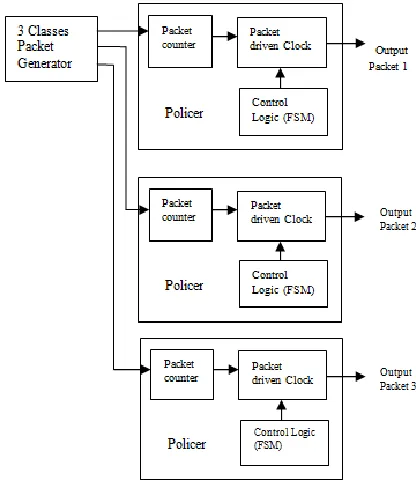
In the first block 3 class packet classifier three high density signals are generated by time based entity generator and given to the first in first out (FIFO) queue. The queue will provide the buffering as required in the transmission as per the traffic conditions. The three signals then multiplexed and given to the packet counters. At packet counter signal converted to bits and packet and then gives the count of packets, packets/sec and Gigabits/sec.
Fig. 1: System Digram for simulation
Then these three different signals with high density are given to policer where different policies are defined in the charts as logic for controlling with
packet driven clock. Here in the first block the bandwidth is allocated as 50%, 25% and 25% for channel of traffic and the different policies as required are applied on the signals in policer, and performance of the signal with respect to the confirmed packets and unconfirmed packets is analysed.
MPLS: MPLS got its name because it works with the IP,ATM,& frame relay network protocols. It was created in the late 1990’s to avoid having routers waste time by having to stop &look up routing tables. MPLS is a type of data carrying technique for high performance telecommunication networks that directs data from one network node to the next based on short path lables. MPLS is a packet forwarding scheme in which the packets are assigned labels and based on these labels forwarding decisions at routers are taken instead of the IP address contained in the IP header. All the routing decisions are taken just once that is when a packet enters the MPLS network. A four octets label is assigned when the packet enter into the network. The assignment of a packet to what is called an FEC (Forwarding Equivalence Class) is done just once when the packet enters in the MPLS network at the ingress node. The label is inserted between the layer 2 header and the IP header. Existing protocols are extended to enable to piggyback on MPLS labels. MPLS on the other hand is a frame forwarding mechanism based on the application, treatment and exchange of labels that provide efficient forwarding of traffic within the MPLS domain. MPLS is not designed to replace IP or IP routing protocols but instead works in conjunction with IP routing protocols to provide a simple and less process intensive approach for determining the next best hop.
GMPLS: (Generalized Multiprotocol Label
Switching), also known as Multiprotocol Lambda
Switching, is a technology that provides
enhancements to Multiprotocol Label Switching (MPLS) to support network switching for time, wavelength, and space switching as well as for packet switching.
IJIRT 144818
INTERNATIONAL JO URNAL OF INNOVATIVE RESEARCH IN TECHNOLOGY143
It detects the resource status of transport network to secure a correct and reasonable usage of transport network resources. This accordingly ensures there are sufficient resources available to guarentee the appropriate level of Quality of Service (QoS) and avoid bandwidth and service stealing
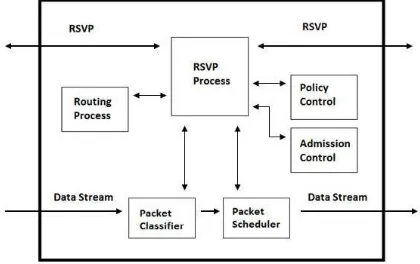
RSVP: The reservation setup control is RSVP. Figure 2 illustrates the procedure within a router to implement IntServ. If a RSVP path message reaches the router, the admission control checks if the required resources are available and the policy control verifies if the user has administrative permissions to request for a particular QoS. Once the resource reservation is done, parameters in the packet classifier and the packet scheduler are set, in order to assure the requested QoS for packets according to the respective flow.
Fig. 2:RSVP Traffic control model
IV. RESULTS
In this section, we shall discuss the development of simulation scenarios consisting of modeling and evaluating the main QoS parameters over an NGN transport network based-MPLS and controlled by a resource and admission control and management layer.
class Total
Bits
Responsive (Confirmed)
bits
Nonresponsive (unconfirmed)
bits
D1 3882 1921 1961
D2 1941 957 984
D3 1941 957 984
Table 1: Proposed Policer outcome
classes Passed
Packets
Randomly buffered
packets
Tail buffered
packets
D1_queue 1906 15 0
D2_queue 913 44 0
D3_queue 914 43 0
D1_control 58 01 1902
D2_control 118 03 863
D3_control 153 04 827
Table 2. Outcomes of WRED
As listed in Table 1, for the various simulations scenarios, we generated Real Time traffic (RT) as C1, C2 and C3 traffic, responsive (confirmed) bits by resource reservation as connection-oriented data traffic and non-responsive (non confirmed) bits over an NGN nsport network based IP/MPLS and controlled by the proposed method. As pointed out earlier, buffer management using packet drop schemes are always biased against responsive bits sources. This biased performance results from the action taken by responsive bits sources when they experience packet losses. Usually, these losses are interpreted as congestion and network overflow, and accordingly, responsive sources tend to reduce their transmission rate. Unfortunately, this does not take place in non-responsive bits sources. They keep sending packets at the required rate regardless of the packet losses they may experience. An equal treatment for both bits types at the buffer management node is not appropriate and another solution has to be found
Fig 3.Delay Variations based on arrival pack et rate
IJIRT 144818
INTERNATIONAL JO URNAL OF INNOVATIVE RESEARCH IN TECHNOLOGY144
packet waiting delay per second, while the x-axis represents the incoming packet rate per second. According to different periods of observation, wecan deduce that the variation of the waiting delay (QoS criteria) especially for low priority traffic closely depends on the arrival rate of different categories of services. Accordingly, we can determine the exact moment when the admission control shall intervene and make the decision to protect the QoS offered to priority incoming and already established services.
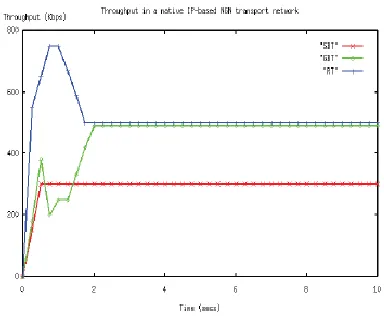
Fig 4.Throughput in a native IP-based NGN
In view of Fig. 4 we observe that an IP/MPLS based NGN transport network under the control of the Resource and admission control provides “better” QoS support for real time traffic. Hence, this network architecture has the capacity to satisfy the expected real-time traffic needs, such as the required throughput and lower jitter and packet loss. It has “simpler” core functionalities since computationally expensive processing is pushed to the edge level. This results in better QoS guarantees and efficient network management, and justifies the choice of MPLS in the NGN transport level.
Fig 5.Data rate in evolved routers of NGN
Figure 5 illustrates the average data rate of terminals in a mobile network. We can see that the data rate is high between 60-second point and 120-second point; and after that, the rate goes low a little.
Fig. 6. Loss rate for priority traffic in NGN
The QoS guarantee for priority traffic is also clearly illustrated by Fig. 6. The packets loss graph variation justifies that the QoS degradation affects lower priority classes but did not influence real time services. Fig. 6 also illustrates the small variations of packet loss values obtained for priority traffic, confirming that these variations are negligible and don’t significantly affect the guaranteed QoS.
V. CONCLUSİON
In this work we presented a working example of NGN router using the model-based control approach in achieving throughput guarantees and fairness as two parameters of QoS. Although the model used in this example is optimum, we were keen to choose an accurate model that can be trusted in generating the control decision. A policer for better QoS with resource-based admission control method and MPLS which guarantees QoS for the transport of real-time multi-service traffic in next generation networks. This QoS control method is based on service differentiations.
REFERENCES
[1]Cherif Ghazel, Leila Saïdane, “Satisfying QoS Requirements in NGN Networks using an Optimized Resource Control and Management Method” IEEE Proceeding 978-1-4799-8784 September 2015.
[2]Xi Zhang, Wenchi Cheng, and Hailin Zhang, “Heterogeneous statistical QoS provisioning over 5G Mobile Wireless Networks”, IEEE Network Magazine 0890-8044 Nov/Dec 2014.
IJIRT 144818
INTERNATIONAL JO URNAL OF INNOVATIVE RESEARCH IN TECHNOLOGY145
“DiffServ-Aware Multi Protocol Label Switching Based Quality of Service in Next Generation Networks”, IEEE Proceeding 978-1-4799-2572 August 2014.
[4]Yasusi Kanada, “Policy-based End-to-End QoS Guarantee Using On-Path Signaling for Both QoS Request and Feedback”, IEEE sponsored ICOIN 2008, Korea,Jan 2008.
[5]Boyoung Rhee, Sungchol Cho, Jin Xianshu, Sunyoung Han, “ QoS-Aware Router Combining Features of Conventional Routing and Flow-aware Routing Based on Resource Management over NGN”, IEEE Computer Society ICAINA 2009 978-0-7695-3639-Feb 2009.
[6]Gianmarco Panza, Sara Grilli, EsaPiri,
JanneVehkapera,“QoS provisioning by cross-layer feedback control” IEEE 978-1-4799-8030-7/14 ©2014.
[7]Gordana Gardasevic, Dejan Stjepanovic,
Aleksandar Damljanovic, Dejan Cvijanovic, “A SOA-based Framework for Cross-layer QoS Adaptation in Next Generation Networks”, IEEE 978-1-4673-0012-4/11 ©2011.
[8]Alex Vallejo, Agustín Zaballos, Josep Maria Selga, Jordi Dalmau, “Next-Generation QoS Control Architectures for Distribution Smart Grid
Communication Networks” IEEE
Communications Magazine May 2012.
[9]Xiaoling Sun, “Research on QoS of Next Generation Network Based on MPLS” IEEE International Conference on Information Science and Technology Wuhan, Hubei, China; March 23-25, 2012
[10]Angel Gomez-Sacristan, Victor M. Sempere-Paya, Miguel A. Rodriguez-Hernandez, “Virtual Laboratory for QoS Study in Next-Generation Networks With Metro Ethernet Access” IEEE Transactions on education,vol. 59, No. 3, August 2016.