Fostering New Computer Science Graduates Capabilities through
Software Engineering Class
Wanwipa Titthasiri
Department of Computer Science, Rangsit University, PathumThani, 90112, Thailand
ABSTRACT
The growth of Asian Economic Community (AEC) and software market survey in Thailand are widely acknowledged that higher educations have to improve their ICT students with skills that will give them the best capabilities to the work place. A CS department as the importance of the logistic pillar of ICT, strives to provide the best possible ICT graduates in self-evidence. It is found that employers tend to be dissatisfied with the communication skills of new CS graduates. This study is to include communication skills into CS studies through a software engineering class. Researcher implemented software project-based practices under the real-world problems in software engineering class. Twenty nine students in a class were divided into three groups. At the end of course, the students’ views were solicited through informal interviews and by survey. Most of the outcomes confirmed that an agile methodology and close collaboration with communication skills practices under the real-world problem project in software engineering class could be a short cut to foster CS capabilities.
Keywords: Agile Methodology, Communication Skills, CS Graduates.
1. INTRODUCTION
The occupational pathways in ICT continue to expand as technology penetrates more and more aspects of daily life. Employment opportunities for ICT graduates are strong growth in the coming years. ICT skills transfer easily from one country to another ones, so experienced ICT professionals can expect to find career opportunities almost anywhere in the developed world.[3] SIPA(Software Industry Promotion Agency-Public organization- in Thailand reveals software market survey 2016, production value grows 1.2%.[1] Furthermore, AEC(Asian Economic Community) is coming in a few years. Thailand may encounter crisis. But if Thai graduates prepare thoroughly, the AEC would not affect them badly. In the opposite way, they may find good opportunities in their ICT career path. However, it seems no concrete move towards preparing ICT graduates for the AEC by the governments. This paper
is a shared concern for the quantity and quality of the future ICT graduates.
2. RATIONALE
There is an increasing demand for CS graduates who will be experts in developing software.[5] However those graduates work today with in ICT realm probably goes without saying.[6] Despite the fact that good communication skills are important to being an effective ICT experts, the communication skills of recent CS graduates typically fall short of employers’ expectations. [4] It is found that a high level of technical skill is focused in most of CS currently curriculum to drive the demand for ICT skills. But an ability to interpret technical requirements and communicate them to non-technical people is forgotten. The university sector must expand if this demand is to be satisfied.
To design and implement a CS curriculum that bridges this gap, it may take at least four years. So the new generation of Thai CS graduates with communication skills actually needs a shortcut to develop these skills, instead of updating a whole curriculum.
3. OBJECTIVES
4. REVIEW LITERATURES
4.1 Software Engineering Course
“Software engineering is the discipline concerned with the application of theory, knowledge and practice to effectively and efficiently build reliable software systems that satisfy the requirements of customers and users… It encompasses all phases of the lifecycle of a software system.(p.172)” [2]
Some prerequisite courses of the software engineering are programming, data structures, data base systems, and system analysis and design. The student who takes this course, come with complete technical knowledge and skills. It is therefore selected to do the experiment to develop new CS graduates capabilities of communi-cation skills before graduation.
4.2 Agile Methodology Concepts
Agile methodology is a practice that promotes continuous iteration of development and testing throughout the software development lifecycle of the project. The agile software development emphasized on four core values, as follows:
(1) Individual and team interactions over processes and tools.
(2) Working software over comprehensive documentation.
(3) Customer collaboration over contact negotiation.
(4) Responding to change over following plan.
Agile method proposes incremental and iterative approach to software design. The agile process is broken into individual models that designers work on. The customer has early and frequent opportunities to look at the product and make decision and changes to the project. Documentation attends less priority than software development. Iteration has its own testing phase. Users, testers, and developers work together. It requires close communication between users and developers.[4] There are various methods present in agile testing and these are listed as follows: scrum, crystal methodologies, DSDM (Dynamic Software Development Method), FDD (Feature Driven Development), learn software development and XP (Extreme Programming).
In this paper, scrum was used in the experiment of student practice. Scrum is an agile development popular method which concentrates specifically on how to manage tasks within a team-based development environment. A team consists of three roles, explained as bellows:
(1) Scrum master: master is responsible for setting up the team, sprint meeting and removes obstacles to progress.
(2) Product owner: the product owner creates product backlog, prioritizes the backlog and is responsible for the delivery of the functionality at each iteration.
(3) Scrum team: team manages its own work and organizes the work to complete the sprint or cycle. Process flow of scrum methodologies is as follows:
Each iteration of a scrum is known as sprint.
Product backlog is a list where all details are entered to get end product.
During each sprint, top items of product backlog are selected and turned into sprint backlog.
Team works on the defined sprint backlog. Team checks for the daily work.
At the end of the sprint, team delivers product functionality. [4]
4.3 Communication Skills
Agile practice needs communication skills to accomplish the project. Customer collaboration is over contact negotiation. To design a software engineering course through an agile project practice that bridges the gap between users and developers, it is needed to know which communication skills are expected in the workplace. The work of Ruff and Carter [8], Vest, D., Long, M., Thomas, L., and Palmaquist [2], and Pfeiffer [7] proposed the communication skills of software engineers, as follows:
(1) Design communication: evaluate communication situations and design communication appropriately for different purposes and contexts. (2) Explain clearly: present information in a way that
goes beyond the specific details of a project to provide the big picture, a higher level of summary. (3) Discuss productively: lead a productive group
discussion.
(4) Receive communication: listen actively; ask clarifying questions.
(5) Communicate professionally: give opinions with a balance of confidence and humility, avoid complaining, and participate in meetings.
5. RESEARCH METHODOLOGY
To develop the communication skills as an important skill of CS students in the future workplace, the researcher selected the experiment methodology through project-based practice in software engineering class, CS department, Rangsit University, Thailand. The researcher divided 29 students who registered in software engineering course into three teams and assigned each team to work on each software development. All of projects are based on real-world problems, appearing in campus or local community and students are stakeholders. So, students easily understood those problems. During projects going on, scrum was applied. Evolutionary software process was used to design each sprint. Meeting had occurred in every week. Students could learn to communicate with users. They had been trained as software engineers by their projects. Finally, the researcher solicited the students’ views through informal interviews and by survey.
5.1 Informal Interviews
A student who is scrum master of each group, is selected as a team’s representative to be interviewed, three individually. Open-ended questions were used to elicit interviewees’ thoughts about the communication skills needed for software engineers’ capabilities. The examples of questions were:
What are some of the key problems you find in the communication with users? And How do you manage those?
How do you think about every week meeting with users through agile methodology? Is it good or bad idea?
How do you think about agile concepts, having meeting with working software over comprehensive documentation?
How do you compare traditional software process to agile approach? And do you think that communication skills are necessary for CS graduates, and how?
What is the relationship of agile and communication skills?
Although questions are answered by students, responses tended to be based on experiences with real users. The researcher as interviewer took notes during the interviews.
5.2 Survey
All of students who were not scrum master of projects’ team offered their thoughts via survey, in person. The questions are divided into three sections: agile
methodology, communication skills, and CS graduates’ capabilities.
6. RESULTS
6.1 Attitudes from Interviews
The responses of the participants via interview were concluded as follows:
Some key problems in the communication with users are conflictions with users, users’ emotion, making understand in technical knowledge to users, and users’ complain. They managed those by explaining clearly, listening actively, proposing a solution, fixing the problem, and remaining silent. They agreed with agile methodology concept to have often meeting with working software over comprehensive documentation. And they also agreed that the communication skills coupled with agile approach are important attributes for CS graduates. It is accepted that agile could reduce time development and increase the quality of software (meet users’ requirement). In addition, change requirements could be allowed over plan. Therefore, users’ demand is satisfied.
In conclusion, the findings from interviews show that all of students agree with agile methodology and the existing of communication skills in CS graduates are necessary in their future workplace. A shortcut of practicing team-based project under real-world problems in software engineering course is an effective way to rapidly develop CS graduates’ capabilities.
6.2 Survey Results
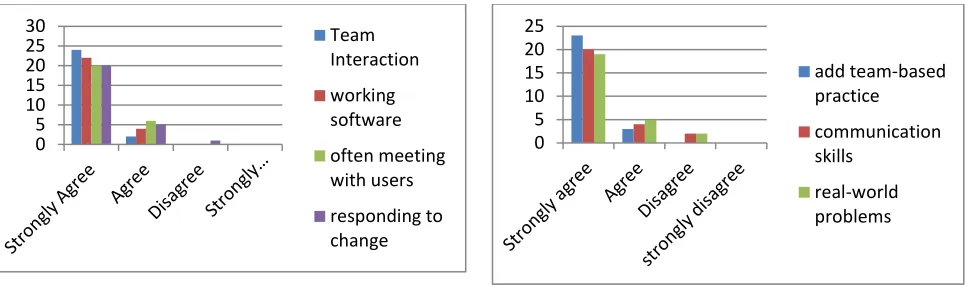
Fig. 1. Agile Methodology Questions.
When asked about their personal communication skills, based on the literature review in section 4.3, 80-90% of students agreed that as a result of this course project, they faced the problems of their communication skills in workplace and they agreed that these skills are important keys of the success of project. They also felt that more incentive to improve their communication skills for future work. Fig. 2 supports the view of communication skills.
Fig. 2. Communication Skills Questions.
Additionally, fig. 3 summarizes attitudes towards a new learning process of software engineering class, which team-based projects with agile, communication skills, and real-world problem practices are used. More than 90% of students have agreed that using a team-based project under real-world problem in software engineering class could be a short-cut to rapidly develop new CS graduates’ capabilities.
Fig. 3. CS Graduates’ Capabilities.
7. CONCLUSION
The aim of this work was to foster new CS graduates’ capabilities through software engineering class, instead of modifying a whole curriculum. The practice of team-based project under real-world problem in software engineering class is to keep pace with the developing of new CS graduates’ capabilities in the impacts of the coming AEC in Thailand. CS career is a practice-based profession. Therefore, an agile methodology and close collaboration with communication skills between users and developers are focused with strong practice, applying in software engineering course. The researcher believes that this can be a short-cut giving learning experience to produce the capable CS graduates….. It could be suddenly implemented.
REFERENCES
[1] Digital Economy Promotion Agency, under the Administrative Supervision of the Minister of Digital Economy and Society, 2016.
Avialable at: “http://www.sipa.or.th”
[2] D. Vest, M. Long, L. Thomas, and M. E. Palmquist, "Relating Communication Training to Workplace Requirements: The perspective of New Engineers", IEEE Trans on Prof. Commun., Vol. 38, No. 1, 1995, pp. 11-17.
[3] GraduateCareer(GCA), 2016.
Available at: “http://www.graduateopportuities.com” [4] GURU99, "Agile Model and Methodology: Guide for
Developers and Testers”, 2017. Available at: “http://www.guru99.com”
[5] H. L. Carol, S. Mary, and R. M. Nancy, “The Carnegie Mellon University Master of Software Engineering Specialization Tracks”, in Proceeding of 9th Conference on Software Engineering Education, 1998, p 100-118.
[6] L A. Jessica, H. Richard, T. Corel, C. Steve, L. Jessica, W. Anneliese, . W. Mark, and M. W. Julia, "Communicating Sustainability: Sustainability and
0 5 10 15 20 25
30 Team
Interaction
working software
often meeting with users
responding to change
0 5 10 15 20 25
30 Strongly agree
Agree
Disagree
Stronglydisagre e
0 5 10 15 20 25
add team-based practice
communication skills
Communication in the Engineering, Science, and Technical Communication Classrooms", in IEEE International professional Communication Conference, 2008, pp. 1-7.
[7] P. Phil, "What Employers Want from Students: A Report from OOPSLA",SIGCSE Bulletin, Vol.31, No.2, 1999,pp. 69-70.
[8] R. Susan, and C. Michael, "Communication Learning Outcomes from Software Engineering Professionals: A Basis for Teaching Communication in the Engineering curriculum", in 39th ASGE/IEEE Frontiers in Education Conference W1E-1 Session, 2009, Oct 18-21.