Abstract—The sustainable development of mining occupational health and safety management system is inseparable from its internal and external environment. Through IFE and EFE matrix models, the key internal and external factors affecting the sustainable development of some mining in the Southwest of the Hubei Province are analyzed. Then entropy method is adopted to determine the weight of each key factor. According to the weighted total score ranking, the most important internal and external key factors affecting China's sustainable development include the following: not enough detailed degree of hazard identification, not enough safety awareness, lack of contingency plans to assess the timely exercise, not enough deep mining of internal audit, impact of relevant laws and regulations on enterprises, impact of the interested parties on the changing requirements of the enterprise, risk management brought by interested parties, risk management of product life cycle, and changes in the market environment for enterprises to put forward new requirements. In this paper, combined with OHSAS18001 operation condition of the mining in the Southwest of Hubei Province, seven suggestions for improvement are put forward which provide valuable reference for the sustainable development of mining OHSAS18001.
Index Terms—OHSAS18001, sustainable development, IFE and EFE Matrix, entropy method.
INTRODUCTION
Occupational health and safety management system (OSHAS18001) [1] was a modern safety production management standard in the late 1980s in the world. It is known as the post industrial era of effective management methods just as ISO9001 quality management system and ISO14001 environmental management system. OSHAS18001 takes the system theory as the guide, establishing the procedural and institutional management, identifying the hazard and risk assessment, setting up the corresponding target plan, building personnel ability confirmation and training system and identifying and evaluating the laws and regulations and other requirements for the development of enterprises with the model of Plan-Do-Check-Act (PDCA)[2]. The aim of OHSAS18001 is to achieve continuous improvement of management system,
Manuscript received December 7, 2016; revised March 1, 2017. Jiangdong Bao and Jan Johansson are with Centre of Advanced Mining and Metallurgy, CAMM, Department of Human Work Science, Luleå
University of Technology, Luleå 97751, Sweden (e-mail:
[email protected], [email protected]).
Jingdong Zhang is with Research Center for Environment and Health, Zhongnan University of Economics and Law, Wuhan, 430000, China, corresponding author: Jingdong Zhang (e-mail: [email protected]).
to continuously promote the enterprise to comply with laws and regulations and other requirements, to protect the health and safety of employees and to promote green healthy and sustainable development of enterprises [3].
The acceleration of China's economic development and economic restructuring will have a huge impact on the "Green Barrier", that is, occupational health and safety management system in the international trade. At the same time, our country has accelerated the pace of occupational safety and health legislation, more and more strict requirements on the safety production of enterprises and a large number of safety regulations are introduced. Especially in July 2016, the "occupational disease prevention law" [4] was revised which put forward mandatory regulatory requirements and standards for safety and health. "People oriented and pay attention to employee health and safety" has increasingly become an important symbol and a good image of modern enterprises, which is also the focus of the occupational health and safety management system.
Some common problems including not enough detailed degree of hazard identification, not enough safety awareness and risk management brought by interested parties, etc. were always found during the auditing of hundreds of companies by the author of this paper. Therefore, the entropy method [5] is adopted to carry out the IEF and EFE matrix [6] empirical analysis on the standard terms of OSHSAS18001 with the mining of Southwest of Hubei Province as an example which will explore the healthy development of OHSAS18001 in our country.
II.STATUS ANALYSIS OF OHSAS18001OPERATION IN THE
MINING OF SOUTHWEST HUBEI
A. Safety Investment, Loss and Benefit Analysis
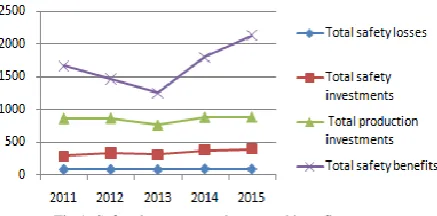
OHSAS18001 operation involves safety technical measures, industrial hygiene measures, safety management and training, labor protection supplies etc. According to the summary of the mining in the Southwest of Hubei Province, the total safety investments from2011 to 2015 were 2.884 million RMB, 3.326 million RMB,3.015 million RMB,3.788 million RMB and 3.972 million RMB;The total safety losses were 0.893 million RMB,0.904 million RMB,0.875 million RMB,0.983 million RMB and 0.953 million RMB; Total production investments were 8.673 million RMB,8.743 million RMB,7.697 million RMB,8.901 million RMB and 8.904 million RMB and total safety benefits were 1.235 million RMB,1.4721 million RMB,1.2615 million RMB,1.8056 million RMB and 2.1365 million RMB as shown in Fig.1.
Research on the Sustainable Development of Mining
Industry OHSAS18001 Based on IFE and EFE Matrix
Fig.1. Safety investments, losses and benefits.
From the enterprise data and Fig.1, it can be analyzed that the total safety investment has not changed much, showing a gradual slow growth trend, the total safety loss has not been stable as well as the total safety benefit in the first three years, while it has showed a rising trend in the last two years. All the results make it clear that the safety management of the mining is passive and OHSAS18001 doesn’t runs smoothly.
B. Analysis of Interested Parties and External Invironment
In accordance with the definition of OHSAS18001 standardization, interested parties include suppliers, customers, residents, shareholders, government departments, etc. According to the statistical data of environment and safety management department, from 2011 to 2015 the numbers of residents' complaints were 3, 5, 7, 4, and 3. The numbers of patients in occupational disease physical examination were 8, 7, 8, 5 and 6. The numbers of corrective action of safety assessment were 9, 8, 11, 10 and 10. The numbers of external relevant laws and regulations and other requirements were 132, 132, 135, 135, 135 and 135 and the numbers of risk sources from suppliers, customers and other risk management were 0, 0, 20, 20, and 20 as shown in Fig. 2.
Fig. 2. Statistics of external laws and regulations, risk sources, correction action, complaints and patients in occupational disease physical
examination.
From the enterprise data and Fig. 2, the numbers of residents' complaints, patients with occupational disease physical examination and corrective action of safety assessment showed a small wave of instability from 2011 to 2015. The numbers of risk sources from suppliers, customers and other risk management kept zero in the first two years and stayed the same in the last three years. Additionally, the numbers of external relevant laws and regulations and other requirements almost had no change in the past five years. But in fact, national and local laws and regulations are added and updated every year. According to the analysis from the enterprise audit experience of the author, the number of laws and regulations and other requirements of a medium-sized enterprise shall be increased by more than 20. So it can be concluded that OHSAS18001 of the mining keeps in a
stagnant state which needs targeted analysis and rectification.
III. IFE AND EFEMATRIX ANALYSIS OF OHSAS18001
STANDARD TERMS OF SOME MINING IN SOUTHWEST OF
HUBEI PROVINCE
A. The Determination of Internal and External Key Factors and Evaluation Criteria
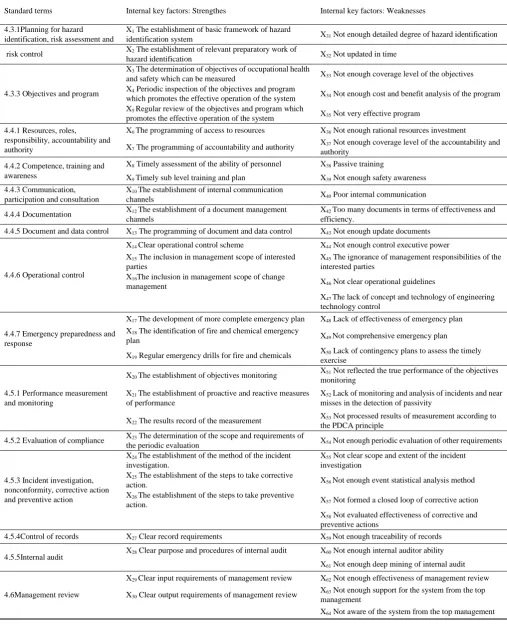
IFE (EFE) is the internal (external) key factor affecting the development of a specific unit.IFE and EFE matrix is a tool for the comprehensive evaluation and analysis of the internal advantages and disadvantages, and the external opportunities and threats faced with the development of a specific unit. IFE (EFE) matrix analysis of the mining in Southwest of Hubei Province is the evaluation way of the internal strengthes (external opportunities) and weaknesses (external threats).In this study, 5 senior staff as well as 1 auditor and 4 experts are invited to conduct interviews and questionnaires, to determine the final 64 internal key factors (which contains 30 strengthes and 34 weaknesses as shown in Table 1) and 21 external key factors (which contains 8 opportunities and 13 threats as shown in Table 2) after layers of screening, and to score the key factors using the expert scoring method[7-8]. According to the reaction degree of the internal and external key factors, each key factor is scored by the score criterion as shown follows: 1= not important, 2=general important, 3=more important, 4=particularly important[9].
B. Determination of Weight[1]
The entropy method is used to determine the weight of each key factor, and the steps are as follows:
Step1. Standardization of the data. Standardize the score of internal and external key factors X1, X2,…Xi(i=1,2,3,…n)
affecting the development of OHSAS18001, the value is as follows:
* min( )
( , , ,... ).
max( ) min( )
1
1 1 2 3
i i
i
i i
X X
X i n
X X
(1) Step 2. Information entropy of key factors. According to the definition of information entropy in information theory, the information entropy is as follows:
* 1
1 *
0
ln( )
ln
,
;
0,
lim
ln
0
i
n
i
i i ji ji ji n
i
i ji ji
P
X
E
n
P
P where P
X
If P
then
P
P
(2) Step 3. Determination of the weight of the key factors. After getting the information entropy of the internal key of n item, suppose the information entropy of the internal key of n item are E1, E2,… Ek, then the weight of the key factors can
be calculated as follows:
1 1
, 1, 2,3,... .
i
i n
i i
E
W where i k
k E
TABLE I: IFEMATRIX ANALYSIS FACTORS TABLE
Standard terms Internal key factors: Strengthes Internal key factors: Weaknesses
4.3.1Planning for hazard identification, risk assessment and
X1 The establishment of basic framework of hazard
identification system X31 Not enough detailed degree of hazard identification
risk control X2 The establishment of relevant preparatory work of
hazard identification X32 Not updated in time
4.3.3 Objectives and program
X3 The determination of objectives of occupational health
and safety which can be measured X33 Not enough coverage level of the objectives
X4 Periodic inspection of the objectives and program
which promotes the effective operation of the system X34 Not enough cost and benefit analysis of the program
X5 Regular review of the objectives and program which
promotes the effective operation of the system X35 Not very effective program
4.4.1 Resources, roles,
responsibility, accountability and authority
X6 The programming of access to resources X36 Not enough rational resources investment
X7 The programming of accountability and authority
X37 Not enough coverage level of the accountability and
authority
4.4.2 Competence, training and awareness
X8 Timely assessment of the ability of personnel X38 Passive training
X9 Timely sub level training and plan X39 Not enough safety awareness
4.4.3 Communication, participation and consultation
X10 The establishment of internal communication
channels X40 Poor internal communication
4.4.4 Documentation X12 The establishment of a document management
channels
X42 Too many documents in terms of effectiveness and
efficiency.
4.4.5 Document and data control X13 The programming of document and data control X43 Not enough update documents
4.4.6 Operational control
X14 Clear operational control scheme X44 Not enough control executive power
X15 The inclusion in management scope of interested
parties
X45 The ignorance of management responsibilities of the
interested parties X16The inclusion in management scope of change
management X46 Not clear operational guidelines
X47 The lack of concept and technology of engineering
technology control
4.4.7 Emergency preparedness and response
X17 The development of more complete emergency plan X48 Lack of effectiveness of emergency plan
X18 The identification of fire and chemical emergency
plan X49 Not comprehensive emergency plan
X19 Regular emergency drills for fire and chemicals
X50 Lack of contingency plans to assess the timely
exercise
4.5.1 Performance measurement and monitoring
X20 The establishment of objectives monitoring
X51 Not reflected the true performance of the objectives
monitoring
X21 The establishment of proactive and reactive measures
of performance
X52 Lack of monitoring and analysis of incidents and near
misses in the detection of passivity
X22 The results record of the measurement
X53 Not processed results of measurement according to
the PDCA principle
4.5.2 Evaluation of compliance X23 The determination of the scope and requirements of
the periodic evaluation X54 Not enough periodic evaluation of other requirements
4.5.3 Incident investigation, nonconformity, corrective action and preventive action
X24 The establishment of the method of the incident
investigation.
X55 Not clear scope and extent of the incident
investigation X25 The establishment of the steps to take corrective
action. X56 Not enough event statistical analysis method
X26 The establishment of the steps to take preventive
action. X57 Not formed a closed loop of corrective action
X58 Not evaluated effectiveness of corrective and
preventive actions
4.5.4Control of records X27 Clear record requirements X59 Not enough traceability of records
4.5.5Internal audit X28 Clear purpose and procedures of internal audit X60 Not enough internal auditor ability X61 Not enough deep mining of internal audit
4.6Management review
X29 Clear input requirements of management review X62 Not enough effectiveness of management review
X30 Clear output requirements of management review
X63 Not enough support for the system from the top
management
X64 Not aware of the system from the top management
TABLEII: EFEMATRIX ANALYSIS FACTORS TABLE
Standard terms External key factors: Opportunities External key factors: Threats
4.3.2 Legal and other requirements
U1 The escort for enterprise development from relevant
laws and regulations of local and national health and safety
U9 Less capital investment on relevant laws and
regulations
U10 Impact of relevant laws and regulations on
U11 Impact of relevant laws and regulations on other
requirements
U12 Impact of up-to-date relevant laws and regulations on
enterprises
4.4.3 Communication, participation and consultation
U2 The establishment of channels of consultation with
interested parties Uparties and enterprises 13 Too single a communication between the interested
4.4.6 Operational control
U3 A fixed communication between the interested parties
and enterprises
U14 Impact of the interested parties on the changing
requirements of the enterprise
U15Conflict of interest between interested parties and
enterprises
U16 Risk management brought by interested parties
U17 Risk management of product life cycle
4.1General requirements U4 Vitality of enterprises brought by the market economy U18 Changes in the market environment for enterprises to
put forward new requirements.
External audit
U5 OHSAS18001 certificate of global passport
U6 The increase of business orders
U7 The cancellation of second party audit
U8 More smooth and corporate Communication between
interested parties and enterprises
U19 The form of a crisis of confidence from the interested
parties to enterprises with the health and safety issues of the product
U20 A crisis of confidence of the enterprise certificate
from the interested parties to enterprises with accidents in enterprises
U21 The elimination of the enterprise from the market due
to certificate failure
C.IFE and EFE Matrix Analysis
According to the formula (1), (2) and (3), the weights of strengthes, weaknesses, opportunities, and threats of the internal and external key factors can be calculated, whose sum equals 1. And according to the scoring criteria,
evaluation number of people can be listed. The weight is multiplied by the total score to get the weighted total score which is used to analyze and evaluate the standard terms as shown in Table III and Table IV.
TABLEIII: SUMMARY TABLE OF IFEMATRIX ANALYSIS
Standard terms
Streng
thes 1 2 3 4
Total
score Weight
Weighted total score
Weaknes
ses 1 2 3 4
Total
score Weight
Weighted total score
4.3.1 X1 1 1 4 4 31 0.0172 0.5327 X31 1 1 1 7 34 0.0397 1.3514
X2 1 2 3 4 30 0.0095 0.2847 X32 1 1 3 5 32 0.0194 0.6220
4.3.3
X3 2 1 3 4 29 0.0095 0.2752 X33 1 2 2 5 31 0.0148 0.4579
X4 2 3 2 3 26 0.0018 0.0467 X34 2 1 1 6 31 0.0265 0.8219
X5 2 3 1 4 27 0.0095 0.2562 X35 1 2 1 6 32 0.0265 0.8484
4.4.1 X6 2 2 3 3 27 0.0018 0.0485 X36 1 2 2 5 31 0.0148 0.4579
X7 1 2 3 4 30 0.0095 0.2847 X37 1 1 2 6 33 0.0265 0.8749
4.4.2 X8 3 2 2 3 25 0.0018 0.0449 X38 1 2 1 6 32 0.0265 0.8484
X9 1 2 4 3 29 0.0095 0.2752 X39 1 1 1 7 34 0.0397 1.3514
4.4.3 X10 2 1 3 4 29 0.0095 0.2752 X40 1 1 3 5 32 0.0194 0.6220
X11 2 2 2 4 28 0.0048 0.1351 X41 1 2 1 6 32 0.0265 0.8484
4.4.4 X12 2 2 2 4 28 0.0048 0.1351 X42 1 1 2 6 33 0.0265 0.8749
4.4.5 X13 2 2 3 3 27 0.0018 0.0485 X43 1 2 2 5 31 0.0148 0.4579
4.4.6
X14 2 2 2 4 28 0.0048 0.1351 X44 1 1 2 6 33 0.0265 0.8749
X15 2 2 3 3 27 0.0018 0.0485 X45 1 1 3 5 32 0.0194 0.6220
X16 1 2 3 4 30 0.0095 0.2847 X46 1 2 2 5 31 0.0148 0.4579
X47 2 1 1 6 31 0.0265 0.8219
4.4.7
X17 2 2 3 3 27 0.0018 0.0485 X48 1 1 3 5 32 0.0194 0.6220
X18 1 4 2 3 27 0.0095 0.2562 X49 1 1 2 6 33 0.0265 0.8749
X19 3 2 2 3 25 0.0018 0.0449 X50 1 1 1 7 34 0.0397 1.3514
4.5.1
X20 3 3 2 2 23 0.0018 0.0413 X51 3 1 1 5 28 0.0194 0.5442
X21 2 1 3 4 29 0.0095 0.2752 X52 1 1 4 4 31 0.0172 0.5327
X22 3 2 2 3 25 0.0018 0.0449 X53 1 1 2 6 33 0.0265 0.8749
4.5.2 X23 1 2 2 5 31 0.0148 0.4579 X54 1 2 2 5 31 0.0148 0.4579
X25 3 2 2 3 25 0.0018 0.0449 X56 1 1 3 5 32 0.0194 0.6220
X26 2 1 3 4 29 0.0095 0.2752 X57 2 1 1 6 31 0.0265 0.8219
X58 1 1 3 5 32 0.0194 0.6220
4.5.4 X27 3 2 2 3 25 0.0018 0.0449 X59 1 1 2 6 33 0.0265 0.8749
4.5.5 X28 3 2 1 4 26 0.0095 0.2467 X60 1 2 1 6 32 0.0265 0.8484
X61 1 1 1 7 34 0.0397 1.3514
4.6
X29 1 1 4 4 31 0.0172 0.5327 X62 1 1 2 6 33 0.0265 0.8749
X30 1 2 3 4 30 0.0095 0.2847 X63 1 3 2 4 29 0.0095 0.2752
5.7535 X64 3 1 1 5 28 0.0194 0.5442
TABLEIV:SUMMARY TABLE OF EFEMATRIX ANALYSIS
Standard
terms Strengthes 1 2 3 4
Total
score Weight
Weighted total score
Weaknesses 1 2 3 4 Total
score Weight
Weighted total score
4.3.2
U1 1 1 3 5 32 0.0406 1.3000 U9 2 1 1 6 31 0.0554 1.7180
U10 1 1 1 7 34 0.0831 2.8250
U11 1 1 4 4 31 0.0359 1.1140
U12 1 2 2 5 31 0.0309 0.9570
4.4.3 U2 3 1 3 3 27 0.0135 0.3650 U13 2 1 1 6 31 0.0554 1.7180
4.4.6
U3 1 2 3 4 29 0.0198 0.5750 U14 1 1 1 7 34 0.0831 2.8250
U15 1 2 2 5 31 0.0309 0.9570
U16 1 1 1 7 34 0.0831 2.8250
U17 1 1 1 7 34 0.0831 2.8250
4.1 U4 1 3 4 2 26 0.0198 0.5160 U18 1 1 1 7 34 0.0831 2.8250
External audit
U5 2 3 3 2 29 0.0038 0.1090 U19 1 2 1 6 32 0.0554 1.7740
U6 1 2 1 6 31 0.0554 1.7180 U20 1 2 1 6 32 0.0554 1.7740
U7 1 1 3 5 31 0.0406 1.2600 U21 3 1 1 5 28 0.0406 1.1380
U8 2 1 2 5 30 0.0309 0.9260
IV. RESULTS
A. The Results of IFE Internal Strengthes and Weaknesses
It can be concluded from Tab.3 that the weighted total score of internal weaknesses is 25.751 which is nearly 5 times as much as the one of internal strengthes. Additionally, the weighted total score of more than 1 point in the 64 terms of the key factors of the most impact on the development of OHSAS18001 as follows: X31 Not enough detailed degree
of hazard identification, X39 Not enough safety awareness,
X50 Lack of contingency plans to assess the timely exercise
and X61 Not enough deep mining of internal audit.
B. The Results of EFE External Opportunities and Threats
It can be concluded from Tab.4 that the weighted total score of external threats is 25.276 which is 4 times as much as the one of external opportunities. Additionally, the weighted total score of more than 2 point in the 21 terms of the key factors of the most impact on the development of OHSAS18001 as follows: U10 Impact of relevant laws and
regulations on enterprises, U14 Impact of the interested
parties on the changing requirements of the enterprise, U16
Risk management brought by interested parties, U17 Risk
management of product life cycle and U18 Changes in the
market environment for enterprises to put forward new requirements.
V. SUGGESTIONS
According to the current operation status of the mining OHSAS18001 together with the analysis results of internal and external matrix, 7 suggestions are put forward for the sustainable and healthy development of the mining 18001 as follows:
A. Understanding the Leading Role and People Oriented Training [3]
It can be concluded from Tab.3 that the direct reason for not enough safety awareness is the lack of safety and training which needs relevant financial support. That is to say, it is closed related to the leadership. The direct reason for not enough deep mining of internal audit is the lack of enough ability for internal auditor which needs to be trained and also to be thought highly of by the leader. Leading role is a prerequisite, while safety training is an enhancement.
B. Understanding the Perfect Planning [3]
method of Plan-Do-Check-Act (PDCA) cycle which makes the system continuously improved.
C.Understanding the Periodic Checking and Assessing [3]
It can be concluded from Tab.3 that the lack of contingency plans to assess the timely exercise results from the lack of understanding the 4.4.7standard terms. According to 4.4.7 terms, the organization shall establish and maintain plans and procedures to identify the potential for, and responses to, incidents and emergency situations, and for preventing and mitigating the likely illness and injury that may be associated with them. The organization shall review its emergency preparedness and response plans and procedures, in particular after the occurrence of incidents or emergency situations. Additionally, the organization shall also periodically test such procedures where practicable.
D.Understanding the Legal and other Requirements [3]
The organization shall establish, implement and maintain a process to:
1) Identify and have access to current legal requirements and other requirements to which the organization subscribes related to its OHSAS risks and OHSAS management system;
2) Determine how to apply and meet these requirements. The organization shall maintain and retain documented information of: legal requirements and other requirements to which the organization subscribes, ensuring this documented information is updated to reflect changes; how compliance with its legal requirements and other requirements to which the organization subscribes will be achieved.
E. Understanding the Organization and its Context [10]
The organization shall determine external and internal issues that are relevant to its purpose and objectives and that affect its ability to achieve the intended outcome(s) of its OHSAS management system. External and internal issues relate to the business environment in which the organization seeks to achieve its objectives (reference to “business” in this International Standard can be interpreted broadly to mean those activities that are core to the purposes of the organization’s existence).
F. Understanding the Needs and Expectations of Interested Parties [10]
The organization shall determine:
1) The interested parties that are relevant to the OHSAS 18001;
2) The relevant requirements of these interested parties, and which of these become applicable legal and other requirements to which the organization subscribes.
G.Assessment of OHSAS Risks [10]
The organization shall establish, implement and maintain a process to:
1) Assess and prioritize OHSAS risk;
2) Identify opportunities to lower OHSAS risk;
3) Determine controls, taking into account legal requirements and other requirements and considering the
4) Maintain and keep current, documented information on its assessment of OHSAS risks, methodology(ies) used, outcomes of the assessment and controls identified.
The organization shall analyze the underlying causes of incidents and update its assessment of OHSAS risks as necessary.
The organization’s methodology(ies) for assessment of risk shall be defined with respect to its scope, nature and timing, to ensure it is proactive rather than reactive and used in a systematic way.
VI. CONCLUSIONS
U6 The increase of business orders of EFE external analysis result ranked first in the external key factors, from which it can be concluded that the mining industry attaches more importance to the economic benefits than people-oriented management. While U14 Impact of the interested parties on the changing requirements of the enterprise, U16 Risk management brought by interested parties, U17 Risk management of product life cycle and U18 Changes in the market environment for enterprises make it clear that the mining industry should pay attention to the internal and external environment of the organization and the related risk management, which is consistent with the requirement of the new edition ISO45001(DIS)of OHSAS18001.
In this paper, the entropy method is used to refine the OHSAS18001 standard terms into quantitative indicators. The weight of each key factor and weighted score are calculated by the scores from senior staff, auditors and experts. Compared with those subjective valuation methods, the entropy method is of high precision and more objective which can better explain the results, ensures the reliability of the results and provides a direction for diagnosis and improvement of OHSAS18001.
The interested parties, the background of organization, management mode and single system or multi system of different minings in China vary greatly. There are many different ways to evaluate the key factors of OHSAS1801 which also lead to various results. Thus, this method allows for necessary adjustments according to the actual situation and experience when the key factors are chosen and evaluated. For future work, the research in this area should be strengthened, the constructed model should be optimized, and in the selection of evaluation methods, 2-tuple Linguistic Information, Grey Relationa Analysis and AHP, etc. should be effectively integrated to lay the foundation for sustainable green development of mining OHSAS18001.
ACKNOWLEDGMENT
Authors thank the statistical personnel of the case study area for their cooperation in the study and leaders of the mining for the guidance.
REFERENCES
[1] General Administration of Quality Supervision, Inspection and Quarantine of People's Republic of China, National Standards of the People's Republic of China, “GB/T28001-2011 Occupational Health and Safety Management Systems Requirements.”
[3] Y.G. Cao., “Analysis on the influencing factors of HSE management system in Enterprises,” Safety, vol.02, pp. 34-36, 2009.
[4] Occupational Disease Prevention Law (Hubei Provincial Safety Production Supervision Authority). [Online]. Available: http://www.hubeisafety.gov.cn/ajj_new/shuxingcaidan/articlemore.as p?menuid=152 &menu1=%D6%B0%D2%B5%CE%C0%C9%FA [5] P. Z. Tang, D. Chen, and Y. S. Hou, “Entropy method combined with
extreme learning machine method for the short-term photovoltaic power generation forecasting,” Chaos, Solitons & Fractals, vol. 89, pp. 243-248, 2016.
[6] H. Zhao and L. J. Guan, “Research on the sustainable development of higher education in our country based on IFE and EFE matrix,” Modern education management, vol. 9, pp. 87-92, 2016.
[7] X. J. Xie, “Quantitative study of SWOT analysis,” Science and Technology Information Publishing House, vol.12, pp.133-139, 2009. [8] Y. D. Li, “Research on the competition strategy of civil aviation company based on SWOT analysis,” Shopping mall modernization, vol.05, pp. 136-137, 2008.
[9] Y. Y. Wang and C. M. Kong, “SWOT analysis of human resource strategy based on FEI and EEF matrix Taking N M aviation ground services Co. Ltd as an example,” Economic Forum, vol. 07, pp. 119-123, 2013.
[10]ISO/DIS 45001 Occupational health and safety management systems -Requirements with guidance for use. [Online]. Available: http://www.iso.org/iso/catalogue_detail?csnumber=63787
Jiangdong Bao is currently working toward the Ph.D degree at Centre of Advanced Mining and Metallurgy, CAMM, Department of Human Work Science, Luleå University of Technology, and Research Center for Environment and Health, Zhongnan University of Economics and Law for another Ph.D degree. His current research interests include Quality, Environment and Occupational Health and Safety Management System (that is, Standardization Engineering).
Jan Johansson is a professor of the Department of Business Administration, Technology and Social Sciences, Luleå University of Technology. He is also leading a big division in Industrial Work Environment. His publications achieve more than 200. And his current research interests include Industrial Work Environment, etc.
Jingdong Zhang is a head of School of Information and Safety Engineering, Zhongnan University of Economics and Law. Her publications achieve more than 200 as a leading professor. And her current research interests include Environmental Safety Management, Environmental Quality and Safety Assessment, Occupational Health Engineering and Management, etc.