Volume 1, Issue 6 (October2012) PP: 40-48
Effects of Catalyst Amount, Reaction Temperature and
Methanol/Oil Molar Ratio on Conversion Rate of Soybean Oil
Assisted by Ultrasonic Mixing and Closed Microwave Irradiation
Chin-Chiuan Lin
1, Ming-Chien Hsiao
21Department of Business Administration, Kun-Shan University 2
Department of Environment Engineering, Kun-Shan University
Abstract––This study investigated the factors that might affect the transesterification of soybean oil and the optimal reaction process assisted by ultrasonic mixing and closed microwave irradiation. Results showed that the catalyst amount, reaction temperature, methanol/oil molar ratio and their interaction effects all significantly affected the mean yield of soybean oil after 1 min ultrasonic mixing and 2 min closed microwave irradiation. The optimal reaction levels were a catalyst amount of 1.0 wt%, a reaction temperature at 333 K and a methanol/oil molar ratio of 6:1, the mean yield achieved was 97.49 %.
Keywords––Catalyst amount, Reaction temperature, Methanol/oil molar ratio, Ultrasonic mixing, Closed microwave irradiation.
I.
INTRODUCTION
Biodiesel shows numerous advantages including decreased greenhouse gas emissions, lower sulfide emissions, being biodegradable and non-toxic fuel, and possible production from agricultural surplus that can also help improve rural economies (Lopez et al., 2005; Vicente et al., 2004). There are four primary ways to make biodiesel, direct use and blending, microemulsions, thermal cracking and transesterification (Meher et al., 2006). The most commonly used method for producing biodiesel is transesterification (Ma and Hanna, 1999; Hanh et al., 2009a). Transesterification is comprised of a number of consecutive and reverse reactions between a vegetable oil and an alcohol over a catalyst to yield biodiesel (fatty acid melkyl esters, FAMEs) and glycerol (Colucci et al., 2005; Hanh et al., 2009a). Soybean oil is one of the most important vegetable oils to produce biodiesel due to its high oil content (around 20 %). Considerable research has been done on the use of soybean oil (Adams et al., 1983; Freedman et al., 1986; Schwab et al., 1988) for biodiesel production. Ultrasonic field induced an effective emulsification and mass transfer so that the rate of ester formation under ultrasonic mixing condition was higher than that under stirring condition (Colucci et al., 2005; Stavarache et al., 2007b; Hanh et al., 2008; Hanh et al., 2009a). Researches indicated that ultrasonic mixing is efficient, time-saving and economically functional, offering a lot of advantages over the classical procedure (Stavarache et al., 2005; Ji et al., 2006). Microwave irradiation has been an alternative heating system in transesterification over the past few years (Azcan and Danisman, 2008). As a result, a drastic reduction in the quantity of by-products and a short separation time are obtained (Hernando et al., 2006). Microwave irradiation also provides a comfortable, safe and clean way of working in chemical reactions (Koopmans et al., 2006). Today, microwave irradiation is widely used in many areas including assisting transesterification of vegetable oils to produce biodiesel (Azcan and Danisman, 2007; Azcan and Danisman, 2008). Most previous studies focused on transesterification only assisted by ultrasonic (Colucci et al., 2005; Stavarache et al., 2005; Ji et al., 2006; Stavarache et al., 2006; Stavarache
et al., 2007a; Stavarache et al., 2007b; Georgogianni et al., 2008; Hanh et al., 2008; Hanh et al., 2009b; Koc, 2009) or open
microwave irradiation (Leadbeater and Stencel, 2006; Azcan and Danisman, 2007; Barnard et al., 2007; Biswas et al., 2007; Leadbeater et al., 2008; Lertsathapornsuk et al., 2008; Perin et al., 2008). Compared with open microwave irradiation, closed microwave irradiation not only reduces volatilization of alcohol, it also reduces energy consumption due to lower reaction temperature. Studies focused on transesterification assisted by closed microwave irradiation are rare. Many studies indicated that the catalyst amount (Colucci et al., 2005; Hanh et al., 2008; Hanh et al., 2009b; Koc, 2009), reaction temperature (Colucciet al., 2005; Hanh et al., 2009b; Koc, 2009; Tan and Lee, 2009) and methanol/oil molar ratio (Colucci
et al., 2005; Barnard et al., 2007; Hanh et al., 2008; Hanh et al., 2009b; Tan and Lee, 2009) are the most significant factors
on the yield of vegetable oil, and their optimal reaction levels should be around catalyst amount, 1.0 wt%; reaction temperature, 333 K; and methanol/oil molar ratio, 6:1 (Hsiao et al., 2010). There is a need, therefore, to evaluate the effects of catalyst amount (CA), reaction temperature (RT) and methanol/oil molar ratio (MR) on the yield of soybean oil assisted by closed microwave irradiation and ultrasonic mixing.
II.
EXPERIMENTAL
2.1 Material
2.2 Equipment
Ultrasonic equipment used in the experimental had a working frequency of 20 kHz (Mixsonix Sonicator 3000) and an output power of 600 W.
The reactions were also performed using a commercial microwave apparatus (Milestone). The machine comprised a continuous microwave power delivery system, with a working frequency of 2.45 GHz, power output from 0 to 900 W, and the temperature and time setting.
The samples were analyzed with a Perkin Elmer GC Clarus 600 equipped with a capillary column (SPBTM-WAX, 30 m × 0.75 m × 1.0 μm) and a flame ionization detector (FID).
2.3 Reaction process
The reaction process of transesterification includes two discrete steps. In the first step, reaction of reagents was assisted by ultrasonic mixing. The temperature during ultrasonic mixing was about 303-305 K (just about 2 K higher than room temperature after ultrasonic mixing). The spherical glass reactors had volumes of 250 ml that was modified by the introduction of a water condenser for conducting atmospheric pressure experiments.
In the second step, reaction of reagents was assisted by closed microwave irradiation. The reaction temperature was set in this step.
The effects of reaction process (ultrasonic mixing and closed microwave irradiation) on the mean yield of soybean oil are shown in Table 1. The constant reaction conditions were: catalyst amount, 1.0 wt%; reaction temperature, 333 K; and methanol/oil molar ratio, 6:1. All the experiment combinations were carried out three times. Table 1 shows that the mean yield achieved at 1 and 2 min by closed microwave irradiation alone (without ultrasonic mixing) were only 11.24 and 13.31 %, respectively. The mean yield was increased when increasing the ultrasonic mixing time. The mean yield was significantly high with ultrasonic mixing for 1 min and closed microwave irradiation for 1 (91.64 %) and 2 (97.49 %) min, because ultrasonic mixing causes cavitations of bubble near the phase boundary between soybean oil and methanol (Santos et al., 2009). In short, if the soybean oil and methanol are not miscible enough, the mean yield is very low. On the contrary, if the soybean oil and methanol are miscible enough after ultrasonic mixing for 1 min, the mean yield is very high with closed microwave irradiation for 2 min. In summary, the optimal reaction process included 1 min of ultrasonic mixing and 2 min of closed microwave irradiation. Further, the total reaction time (3 min) was less than previous studies which only assisted by ultrasonic mixing (Hanh et al., 2008; Hanh et al., 2009b); or open microwave irradiation (Azcan and Danisman, 2007; Perin
et al., 2008).
Insert Table 1 about here.
2.4 Analytical methods
The acid value (AV, KOH mg/g) and saponification value (SV, KOH mg/g) were determined by a standard titrimetry method (AOCS: American Oil Chemists’ Society). The molecular weight (MW) of soybean oil was calculated from its saponification value (SV) and acid value (AV). The experimental results of AV, SV and MW were 0.06, 194.98 and 863.31, respectively.
After reaction, the top layer contained mainly FAMEs. The FAMEs were removed in separating funnel after settle half an hour, and the FAMEs were washed at least three times with acetate 30% and deionized water, and finally dried in an oven at 378 ± 3 K. The sample was injected under the following conditions: carrier gas, nitrogen; injector temperature, 553 K; split ratio, 1:20; and temperature of detector, 573 K. Oven temperature started at 483 K for 2 min, increased to 513 K at a rate of 4 K/min and held for 8 min. Methyl laurate was used as the internal standard. The yield (Shuit et al., 2010) of FAME in the samples was calculated as expressed in the following equation:
Yield (%) =
sample
in the
oil
of
weight
Total
layer)
upper
of
(Volume
component)
each
of
ion
Concentrat
(
1002.5 Experimental design
According to previous studies, the present study evaluated three independent variables: catalyst amount, reaction temperature and methanol/oil molar ratio. Further, the optimal reaction levels should be around catalyst amount, 1.0 wt%; reaction temperature, 333 K; and methanol/oil molar ratio, 6:1. Therefore, three levels of catalyst amount were used: 0.5, 1.0 and 1.5 wt%; three levels of reaction temperature were used: 328, 333, and 338 K; and three levels of methanol/oil molar ratio were used: 3:1, 6:1 and 9:1.
All the experiment combinations were carried out three times in order to determine the variability of the results and to assess the experimental errors.
2.6 Dependent measures and data analysis
Analysis of variance (ANOVA) and calculation of effect size (2) were conducted using Statistical Products &
Service Solutions (SPSS 13.0).
III.
RESULTS AND DISCUSSION
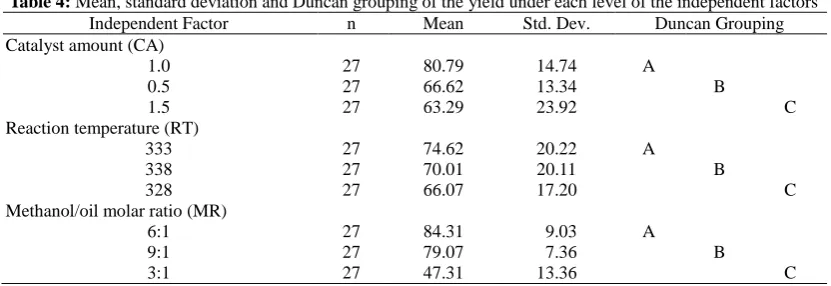
Insert Table 2 about here.
The results of ANOVA with effect size measures for the mean yield of the independent variables (Table 3) indicated that all main effect catalyst amount (F2, 54= 2803.50, p<.0001), reaction temperature (F2, 54= 593.81, p<.0001) and
methanol/oil molar ratio (F2, 54= 13014.34, p<.0001) had significant effect on the mean yield. Further, the effect size showed
that methanol/oil molar ratio (0.7236) had the most effect on the mean yield, followed by catalyst amount (0.156) and reaction temperature (0.033). The model F-value of 1376.67 implies that the model is significant. The p-value is less than 0.0001, i.e., there is less than 0.01 % chance that this error is caused by noise. In this case, the value of R2 (= 0.998) indicated that the model does not explain only 0.2 % of the total variation (Box and Draper, 1986; Khuri and Cornell, 1987).
Insert Table 3 about here.
Table 4 shows that the mean yield increased when the catalyst amount was increased from 0.5 to 1.0 wt%. On the contrary, the mean yield decreased significantly when the catalyst amount exceeded 1.0 wt%. Two reasons may be offered to explain why catalyst amount 0.5 and 1.5 wt% resulted in lower mean yield. First, soybean oil contains a trace of FFA. During the transesterification reaction, some of the catalysts were neutralized by FFA. Therefore, increasing the amount of catalyst used can improve the yield. This might explain why the mean yield was only 66.62 % when 0.5 w/w% of the catalyst was used and why the mean yield increased with when catalyst amount was increased from 0.5 to 1.0 wt%. Second, too much catalyst used might initiate a saponification reaction. This might explain why the use of 1.5 wt% of the catalyst resulted in a lower mean yield than 1.0 wt%. In short, there is an optimal amount of catalyst to be used and 1.0 wt% might be the optimal level of catalyst amount. The result was consistent with earlier findings that catalyst amount (Colucci et al., 2005; Hanh et al., 2008; Hanh et al., 2009b; Koc, 2009) is the significant factor on the yield of vegetable oil, and the optimal reaction levels should be around 1.0 wt%.
Insert Table 4 about here.
Table 4 shows that the mean yield increased when the reaction temperature increased from 328 to 333 K. Higher reaction temperature can improve the efficiency of transesterification, which in turn enhances the mean yield. On the contrary, the mean yield decreases significantly when the reaction temperature is higher than 333 K. One reason may be offered to explain why the reaction temperature at 338 K resulted in a lower mean yield than at 333 K. The boiling temperature of methanol is about 337.5 K. The methanol started volatilization when the reaction temperature exceeded 337.5 K. The volatilization of methanol might reduce the yield. In short, the optimal level of reaction temperature should be less than 337.5 K and 333 K might be the optimal level of reaction temperature. The result was consistent with earlier findings that reaction temperature (Colucci et al., 2005; Hanh et al., 2009b; Koc, 2009; Tan and Lee, 2009) is the significant factor on the yield of vegetable oil, and the optimal reaction levels should be around 333 K.
Table 4 shows that the mean yield increased when the methanol/oil molar ratio increased from 3:1 to 6:1. Increasing methanol/oil molar ratio can improve the efficiency of transesterification, which in turn enhances the yield. On the contrary, the mean yield decreased significantly when the methanol/oil molar ratio exceeded 6:1. Two reasons may be offered to explain why the methanol/oil molar ratio at 9:1 resulted in a lower mean yield. First, excessive methanol increases the solubility of the by-product (glycerol). This might initiate a reverse reaction to reduce the yield. Second, excess solute of the by-product might increase the separation difficulty of biodiesel (Azcan and Danisman, 2007). In short, there is an optimal level of methanol/oil molar ratio which might be 6:1. The result was consistent with earlier findings that methanol/oil molar ratio (Colucci et al., 2005; Barnard et al., 2007; Hanh et al., 2008; Hanh et al., 2009b; Tan and Lee, 2009; Hsiao et al., 2010) is the significant factor on the yield of vegetable oil, and the optimal reaction levels should be around 6:1.
The results of ANOVA (Table 3) also showed that all the interaction effects among the three independent factors catalyst amount reaction temperature (F4, 54= 27.14, p<.0001), catalyst amount methanol/oil molar ratio (F4, 54= 575.79,
p<.0001), reaction temperature methanol/oil molar ratio (F4, 54= 87.70, p<.0001) and catalyst amount reaction
temperature methanol/oil molar ratio (F8, 54= 25.94, p<.0001) had significantly effect on the mean yield.
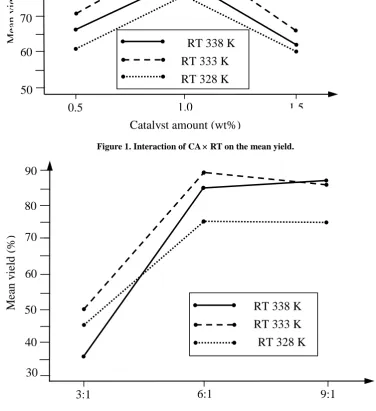
The interaction effect of catalyst amount reaction temperature had significant effect on the mean yield. Table 3 shows that the 2 of catalyst amount reaction temperature was only 0.003 and the 2 of catalyst amount (0.156) was greater than reaction temperature (0.033). The effect size indicated that catalyst amount had more effect on the mean yield than reaction temperature. As can be seen, Figure 1 shows that the mean yield had a positive correlation with catalyst amount from 0.5 to 1.0 wt%. On the contrary, the mean yield had a negative correlation with catalyst amount from 1.0 to 1.5 wt%.
Insert Fig. 1 about here.
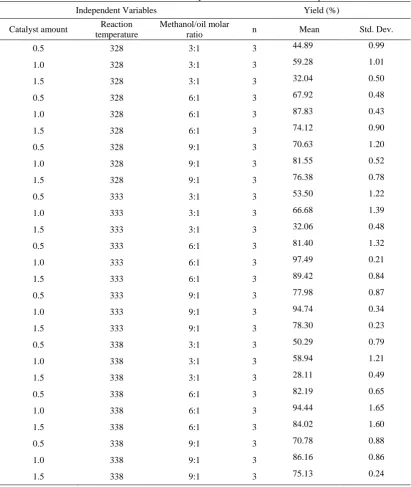
The interaction effect of reaction temperature methanol/oil molar ratio had a significant effect on the mean yield. Table 3 shows that the 2
the reaction temperature at 338 K under the methanol/oil molar ratio at 9:1 resulted in a slightly better mean yield than at 333 K under the methanol/oil molar ratio at 9:1. One reason may be offered to explain this result. The boiling temperature of methanol is about 337.5 K. The methanol was starting volatilization when the reaction temperature exceeded 337.5 K. The volatilization of methanol might reduce the mean yield. Therefore, higher methanol/oil molar ratio might replenish the volatilization of methanol and thus increase the mean yield.
Insert Fig. 2 about here.
The interaction effect of catalyst amount methanol/oil molar ratio had a significant effect on the mean yield. Table 3 shows that the 2 of catalyst amount methanol/oil molar ratio was 0.064 and the 2 of methanol/oil molar ratio (0.726) was greater than catalyst amount (0.156). The effect size indicates that the methanol/oil molar ratio had more effect on the mean yield than catalyst amount. This result indicates that the effect of catalyst amount was dependent on methanol/oil molar ratio. Figure 3 shows that the mean yield had a positive correlation with methanol/oil molar ratio from 3:1 to 6:1. On the contrary, the mean yield had a slight negative correlation with methanol/oil molar ratio from 6:1 to 9:1. Further, the catalyst amount at 1.5 wt% under the methanol/oil molar ratio at 3:1 resulted in very low mean yield (saponification). One reason may be offered to explain this result. High catalyst amount and low methanol/oil molar ratio levels might initiate the saponification reaction.
Insert Fig. 3 about here.
The interaction effect of catalyst amount reaction temperature methanol/oil molar ratio also had a significant effect on the mean yield. Table 2 shows that catalyst amount of 1.0 wt%, reaction temperature at 333 K, and methanol/oil molar ratio of 6:1 resulted in the highest mean yield (97.49 %). Table 2 also shows that under catalyst amount at 1.5 wt% and methanol/oil molar ratio at 3:1 resulted in very low mean yield (saponification) regardless of reaction temperature levels. Table 3 shows that the of catalyst amount reaction temperature methanol/oil molar ratio was only 0.006. Further, the interaction of catalyst amount methanol/oil molar ratio (0.064) had the highest effect on the mean yield, followed by reaction temperature methanol/oil molar ratio (0.010), catalyst amount reaction temperature methanol/oil molar ratio (0.006) and catalyst amount reaction temperature (0.003), respectively. These results indicate that the effect of catalyst amount reaction temperature was dependent on reaction temperature methanol/oil molar ratio and catalyst amount methanol/oil molar ratio.
IV.
CONCLUSIONS
The results show that the catalyst amount, reaction temperature, methanol/oil molar ratio and their interactions all significantly affected the mean yields after 1 min of ultrasonic mixing and 2 min of closed microwave irradiation. The total reaction time was less than that reported in previous studies, which only used either ultrasonic mixing or open microwave irradiation. The optimal reaction levels were catalyst amount of 1.0 wt%, reaction temperature at 333 K, and methanol/oil molar ratio of 6:1. The mean yield achieved was 97.49 %. The yield is within the limits prescribed by the standard of EN-14214, which specifies that the yield of methyl esters should be 96.4%. Further, the effect size shows that methanol/oil molar ratio had the most effect on the mean yield, followed by catalyst amount and reaction temperature.
REFERENCES
1. Adams, C., Peters, J. F., Pand, M. C., Schroer, B. J. and M. C. Ziemke. (1983). Investigation of soybean oil as a diesel fuel extender: Endurance tests. Journal of the American Oil Chemists Society 60:1574-1579.
2. Azcan, N. and A. Danisman. (2007). Alkali catalyzed transesterification of cottonseed oil by microwave irradiation. Fuel 86:2639-2644.
3. Azcan, N. and A. Danisman. (2008). Microwave assisted transesterification of rapeseed oil. Fuel 87:1781-1788.
4. Barnard, T. M., Leadbeater, N. E., Boucher, M. B., Stencel, L. M. and B. A. Wilhite. (2007). Continuous-flow preparation of biodiesel using microwave heating. Energy & Fuels 21:1777-1781.
5. Biswas, A., Adhvaryu, A., Stevenson, D. G., Sharma, B., Willet, J. L. and S. Z. Erhan. (2007). Microwave irradiation effects on the structure, viscosity, thermal properties and lubricity of soybean oil. Industrial Crops and Products 25:1-7.
6. Box, G. E. P. and N. R. Draper. (1986). Empirical Model-building and Response Surfaces. New York: John Wiley & Sons.
7. Colucci, J., Borrero, E. E. and F. Alape. (2005). Biodiesel from an alkaline transesterification reaction of soybean oil using ultrasonic mixing. Journal of the American Oil Chemists Society 82:525-530.
8. Freedman, B., Butterfield, R. O. and E. H. Pryde. (1986). Transesterification kinetics of soybean oil. Journal of the American Oil Chemists Society 63:1375-1380.
9. Georgogianni, K. G., Kontominas, M. G., Pomonis, P. J., Avlonitis, D. and V. Gergis. (2008). Conventional and in situ transesterification of sunflower seed oil for the production of biodiesel. Fuel Processing Technology 89:503-509.
10. Hanh, H. D., Dong, N. T., Okitsu, K., Starvarache, C., Okitsu, K., Maeda, Y. and R. Nishimura. (2008). Methanolysis of trioleinby low frequency ultrasonic irradiation. Energy Conversion and management 49:276-280.
11. Hanh, H. D., Dong, N. T., Okitsu, K., Nishmura, R. and Y. Maeda. (2009a) Biodiesel production by esterification of olein acid with short-chain alcohols under ultrasonic irradiation codition. Renewable Energy 34:766-768.
transesterification of triolein with various alcohols in an ultrasonic field. Renewable Energy 34:780-783.
13. Hernando, J., Leton, P., Matia, M. P., Novella, J. L. and J. Alvarez-Builla. (2006). Biodiesel and fame synthesis assisted by microwaves: Homogeneous batch and flow process. Fuel 86:1641-1644.
14. Hsiao, M.-C., Lin, C.-C., Chang, Y.-H. and Chen, L.-C. (2010). Ultrasonic Mixing and Closed Microwave Irradiation Assisted Transesterification of Soybean Oil, Fuel, 89:3618-3622.
15. Ji, J., Wang, J., Li, Y., Yu, Y. and Z. Xu. (2006). Preparation of biodiesel with the help of ultrasonic and hydrodynamic cavitation. Ultrasonics 44:e411-e414.
16. Khuri, A. L. and J. A Cornell. (1987). Response Surface: Design and Analysis. New York: Marcel Dekker.
17. Kirk, R. E. ( 1982). Experimental design: Procedures for the behavioral sciences. CA: Brooks/Cole, 2nd ed., Belmont.
18. Koc, A. B. (2009). Ultrasonic monitoring of glycerol setting during transesterification of soybean oil. Bioresource Technology 100:19-24.
19. Koopmans, C., Iannelli, M., Kerep, P., Klink, M., Schmitz, S., Sinnwell, S. and H. Ritter. (2006). Microwave-assisted polymer chemistry: Heck-reaction, transesterification, baeyer-villiger oxidation, oxazoline polymerization, acrylamides, and porous materials. Tetrahedron 62:4709-4714.
20. Leadbeater, N. E. and L. M. Stencel. (2006). Fast, easy preparation of biodiesel using microwave heating. Energy & Fuels 20:2281-2283.
21. Leadbeater, N. E., Barnard, T. M. and L. M. Stencel. (2008). Batch and continuous-flow preparation of biodiesel derived from butanol and facilitated by microwave heating. Energy & Fuels 22:2005-2008.
22. Lertsathapornsuk, V., Pairintra, R., Aryusuk, K. and K. Krisnangkura. (2008). Microwae assisted in continuous biodiesel production form waste frying palm oil and its performance in a 100 KW diesel generator. Fuel Processing Technology 89:1330-1336.
23. Lopez, D. E., Goodwin J. G., Bruce, D. A. and E. Lotero. (2005). Transesterification of triacetin with methanol on solid acid and base catalysts. Applied Catalysis A: General 295:97–105.
24. Ma, F. and M. A. Hanna. (1999). Biodiesel production: a review. Bioresource Technology 70:1-15.
25. Meher, L. C., Sagar, D. V. and S. N. Naik. (2006). Technical aspects of biodiesel production by transesterification- a review. Renewable and Sustainable Energy Reviews 10:248-268
26. Perin, C., Álvaro, G., Westphal, E., Viana, L. H., Jacob, R. G., Lenardão, E. J. and M. G. M. D’Oca. (2008).
Transesterification of castors oil assisted by microwave irradiation. Fuel 87:2830-2841.
27. Santos, F. F. P., Rodrigues, S. and A. N. Fernandes. (2009). Optimization of the production of biodiesel from soybean oil by Ultrasound assisted methanolysis. Fuel Processing Technology 90:312-6.
28. Schwab, A. W., Dykstra, G. J., Selke, E., Sorenson, S. C. and E. H. Pryde. (1988). Diesel fuel from thermal decomposition of soybean oil. Journal of the American Oil Chemists Society 65:1781-1786.
29. Shuit, S. H., Lee, K. T., Kamaruddin, A. H. and S. Yusup. (2010). Reactive extraction and in situ esterification of Jatropa Curcas L. seeds for the production of biodiesel. Fuel 89:527-530.
30. Stavarache, C., Vinatoru, M., Nishmura, R. and Y. Maeda. (2005). Fatty acids methyl esters from vegetable oil by means of ultrasonic energy. Ultrasonics Sonochemistry 12:367-372.
31. Stavarache, C., Vinatoru, M. and Y. Maeda. (2006). Ultrasonically versus silent methylation of vegetable oils. Ultrasonics Sonochemistry 13:401-407.
32. Stavarache, C., Vinatoru, M. and Y. Maeda. (2007a). Aspects of ultrasonically assisted transesterification of various vegetable oil with methanol. Ultrasonics Sonochemistry 14: 380-386.
33. Stavarache, C., Vinatoru, M. M., Maeda, T. and H. Bandow. (2007b). Ultrasonically driven continuous process for vegetable oil transesterification. Ultrasonics Sonochem 14:413-417.
34. Tabachnick, B. G. and L. S. Fidell. (1989). Using multivariate statistics. New York: Harper & Row, 2nd ed.
35. Tan, K. T. and K. T. Lee. (2009). Production of FAME by palm oil transesterification via supercritical methanol technology. Biomass and Bioenergy 33:1096-1099.
36. Vicente, G., Martınez, M. and J. Aracil. (2004). Integrated biodiesel production: a comparison of different
Figure 1. Interaction of CA RT on the mean yield.
Figure 2. Interaction of RT MR on the mean yield.
1.5
1.0
0.5
Catalyst amount (wt%)
50
60
70
80
90
Mea
n yield (
%
)
RT 338 K
RT 333 K
RT 328 K
9:1
6:1
3:1
30
40
50
60
95
Methanol/oil molar ratio (MR)
RT 338 K
RT 333 K
RT 328 K
70
80
90
Mea
n yield (
%
Figure 3. Interaction of CA MR on the mean yield.
Table 1 : Effects of reaction process (ultrasonic mixing and closed microwave irradiation) on the mean conversion rate Ultrasonic (min) n Microwave (min) Mean yield (%)
0.0 3 1.0 11.24
3 2.0 13.31
0.5 3 1.0 50.03
3 2.0 57.13
1.0 3 1.0 91.64
3 2.0 97.49
CA 1.5 wt%
CA 1.0 wt%
CA 0.5 wt%
65
35
45
55
Methanol/oil molar ratio (MR)
9:1
6:1
3:1
75
85
95
25
Mea
n yield (
%
Table 2: Mean and standard deviation of the yield under each level of the independent factors Independent Variables Yield (%)
Catalyst amount Reaction temperature
Methanol/oil molar
ratio n Mean Std. Dev.
0.5 328 3:1 3 44.89 0.99
1.0 328 3:1 3 59.28 1.01
1.5 328 3:1 3 32.04 0.50
0.5 328 6:1 3 67.92 0.48
1.0 328 6:1 3 87.83 0.43
1.5 328 6:1 3 74.12 0.90
0.5 328 9:1 3 70.63 1.20
1.0 328 9:1 3 81.55 0.52
1.5 328 9:1 3 76.38 0.78
0.5 333 3:1 3 53.50 1.22
1.0 333 3:1 3 66.68 1.39
1.5 333 3:1 3 32.06 0.48
0.5 333 6:1 3 81.40 1.32
1.0 333 6:1 3 97.49 0.21
1.5 333 6:1 3 89.42 0.84
0.5 333 9:1 3 77.98 0.87
1.0 333 9:1 3 94.74 0.34
1.5 333 9:1 3 78.30 0.23
0.5 338 3:1 3 50.29 0.79
1.0 338 3:1 3 58.94 1.21
1.5 338 3:1 3 28.11 0.49
0.5 338 6:1 3 82.19 0.65
1.0 338 6:1 3 94.44 1.65
1.5 338 6:1 3 84.02 1.60
0.5 338 9:1 3 70.78 0.88
1.0 338 9:1 3 86.16 0.86
Table 3: ANOVA with effect size measures for the yield of the independent factors
Source SS DF MS F-value Pr>F Effect size ()a Corrected Model 29774.75 26 1145.18 1376.67 <0.0001 0.998 CA 4664.19 2 2332.10 2803.50 <0.0001 0.156 RT 987.92 2 493.96 593.81 <0.0001 0.033 CART 90.30 4 22.58 27.14 <0.0001 0.003 MR 21652.04 2 10826.02 13014.36 <0.0001 0.726 CAMR 1915.87 4 478.97 575.79 <0.0001 0.064 RTMR 291.82 4 72.96 87.70 <0.0001 0.010 CARTMR 172.61 8 21.58 25.94 <0.0001 0.006
Error 44.92 54 0.83
Total 429356.03 81 Corrected Total 29819.67 80
a
Effect size, Eta square (2) = SS effect / SS total (Kirk, 1982; Tabachnick and Fidell, 1989)
Table 4: Mean, standard deviation and Duncan grouping of the yield under each level of the independent factors Independent Factor n Mean Std. Dev. Duncan Grouping Catalyst amount (CA)
1.0 27 80.79 14.74 A
0.5 27 66.62 13.34 B
1.5 27 63.29 23.92 C
Reaction temperature (RT)
333 27 74.62 20.22 A
338 27 70.01 20.11 B
328 27 66.07 17.20 C
Methanol/oil molar ratio (MR)
6:1 27 84.31 9.03 A
9:1 27 79.07 7.36 B