Doppler Reduction Effect on the Performance of
IEEE 802.11a Based on Sub-Frequency Band
Algorithm
Abdullah S. Almuttiri
School of Engineering and Sustainable Development, De Montfort University, the Gateway, Leicester, LE1 9BH. UK
Abstract— Over the last decade, the development of IEEE 802.11a which referred to as Local Area Network (LAN) standard is rapidly advancing. This is due to the limitation and what Orthogonal Frequency Division Multiplexing (OFDM), which is used in the heart of LAN standard, susceptible to like carrier frequency offset and hence higher Bits Error Rate (BER). In this paper, the performance of IEEE 802.11a based on a sub-frequency band algorithm was investigated and tested over Additive White Gaussian Noise and Rician channels and under different Doppler frequency effects. The proposed system was investigated over the physical layer of IEEE 802.11a. Within the transmitter, the data vector of 64-bits is divided into three equal vectors of 21 bits each, with the last bit discarded. Each vector was then processed by fast Fourier transform block, with the output of each block processed by a proposed algorithm and then the total vector of length 64-bits converted to a time domain signal via the inverse fast Fourier transform. Within the receiver, the inverse procedure is used to recover the transmitted signals. The results show that the proposed algorithm outperforms the standard OFDM model in terms of Bit Error Rate (BER) versus Signal to Noise Ratio (SNR).
Index Term-- OFDM Orthogonal Frequency Division Multiplex, IEEE 802.11a LAN, BER Bit Error Rate, SNR Signal to Noise Ration, Fast Fourier Transform FFT, IFFT.
1.INTRODUCTION
In multicarrier communication systems, the original data stream is divided into N number of parallel streams; each stream is then modulated with different carrier frequencies and transmitted down the channel. This actually reduces Inter-Symbol Interference (ISI), as each stream travels at a different frequency. Given the number of users, a multicarrier approach will likely be the best choice for 4G wireless systems. Further research carried out in recent years has aimed at reducing the Bit Error Rate (BER) by using channel estimation techniques. Due to the lack of orthogonality between the real and imaginary parts in Orthogonal Frequency Division Multiplexing (OFDM) signals at the receiver side, which caused by the channel effect, the demodulated real-value OFDM/QAM (Quadrature Amplitude Modulation) symbol always has imaginary valued intrinsic interference from neighboring symbols; this limits conventional channel estimation methods for OFDM in being directly applied to OFDM/QAM. Therefore, channel estimation is a major concern for OFDM/QAM in dispersive channels and has attracted any number of serious research efforts. In order to
keep intrinsic interference to a minimum, a pilot-based channel estimation scheme and a preamble-based channel estimation method have both been proposed; in each case a group of adjacent symbols are carefully selected so that the intrinsic interference at the central symbol position can be greatly reduced [1].
In OFDM systems, we focus on three kinds of synchronization: symbol synchronization, carrier frequency offset synchronization and sampling clock deviation synchronization; the symbol synchronization means the initial position of OFDM symbol. On the condition that the synchronous offset exists, the initial position of symbol synchronization is closer than the best regular position or lags behind. We regard leading as that the initial position falls into protective interval, under using circulation prefix as protective interval, the perpendicularity among the sub carriers can still get assurance, just introduce the rotation of the phase place of all sub carriers. Lag will cause the tail of Discrete Fourier Transform (DFT) window to enter the data sampled point of OFDM symbol, which will destroy perpendicularity, introduce interference among signal carriers, and cause OFDM demodulation mistakes. IEEE 802.11a Wireless Local Area Networks (WLANs), which support high-speed data transmissions of up to 54Mbps, employ burst-mode transmission and OFDM as transmission techniques. Although OFDM is well known for its ability to combat the ISI introduced by multi-path channels, the incorrect positioning of the Fast Fourier Transform (FFT) window within an OFDM symbol reintroduces the ISI during data demodulation, which cause a serious degradation of performance. Therefore, symbol synchronization is one of the most important tasks performed by receivers in IEEE 802.11a WLANs.
determine the precise packet arrival time. Therefore, authors have proposed performing symbol timing after employing these algorithms. Furthermore, these techniques were originally developed for general OFDM systems, not specifically for IEEE 802.11a WLANs. Recently, symbol synchronization techniques designed specifically for IEEE 802.11a WLANs have been reported in [5]. The received signal is correlated with a pre-known training-symbol sequence and the absence of the expected correlation peak is detected. Despite the advantage that a simple correlator can be easily implemented at the receiver, its performance is poor in the dispersive channel, indicating that more sophisticated synchronization algorithms are required [5].
In this paper, we assume that the residual Inter Carrier Interference (ICI) of an OFDM system is limited only by direct neighbors after proper Doppler compensation. We thus propose an OFDM signal design that decouples channel estimation and data demodulation. Specifically, pilot and data subcarriers are separated by at least two null subcarriers so that they do not interfere with each other. For this system, we investigate eight receivers that are categorized into three groups [6].
Multi-carrier modems employing baseband OFDM are increasingly becoming desirable for high-speed mobile digital transmission systems. The basic principle of OFDM is to divide a high-rate data stream into a number of lower-rate streams that are transmitted over a number of multiplexed orthogonal subcarriers. The orthogonality property of subcarriers makes the spectral efficiency ofOFDM very high. Lower-rate symbol stream of subcarriers and insertion of the guard time interval to each symbol enable the system to deal with channel time desperation caused by multipath time delay spread [1]. As specified by IEEE 802.11a [5], the physical layer is based on a 52-carrier OFDM modulation scheme including 48 subcarriers for data symbols and 4 pilot subcarriers for channel estimation process In the standard model, the transmitter includes a symbol map per Inverse Fast Fourier Transform (IFFT) and cyclic extension blocks. The IFFT block generates subcarriers and the cyclic extension block adds the guard time interval into the OFDM symbol. The receiver consists of the guard time removal, FFT, symbol demapper, and synchronizer blocks. Accurate channel estimation is important for the application of simple channel equalization for broadband multi-carrier OFDM systems and the accuracy of channel estimation is crucial to the
performance of the overall OFDM systems in terms of the symbol error rate (SER), including OFDM-based WLAN systems [7]. Therefore, there have been many papers that deal with the problem of channel estimation for different OFDM systems under different assumptions for packet-oriented applications like IEEE 802.11a, a training sequence in the form of a preamble is sent at the beginning of the transmission; packet detection is the initial task of the synchronization process. A training sequence also achieves frequency synchronization to avoid ICI and estimates symbol timing to determine the position of the FFT window. An autocorrelation-based scheme for maximum Doppler-frequency estimation was proposed for Single-carrier systems, where the estimate is obtained by using the envelope of the received signal; a method based on the differentials of the channel estimates is employed for the estimation process. Another method based on level-crossing rates has also been proposed. In most OFDM systems, a Cyclic Prefix (CP), which is the replica of the OFDM symbol tail, is used as the guard interval. The correlation between the tail of the OFDM symbol and the guard interval is exploited to estimate where the effects of ISI were not considered [8].
The advancement of reducing Doppler effect in mobile channels, where mobile device is simultaneously moving, is rapidly developing. This paper investigates the effectiveness of Doppler effect on mobile devices and propose an algorithmic procedure to reduce Doppler effect for OFDM systems over mobile channel. This paper taken into account ISI, guard interval and channel estimation.
2.PROPOSED MODEL ANALYSIS
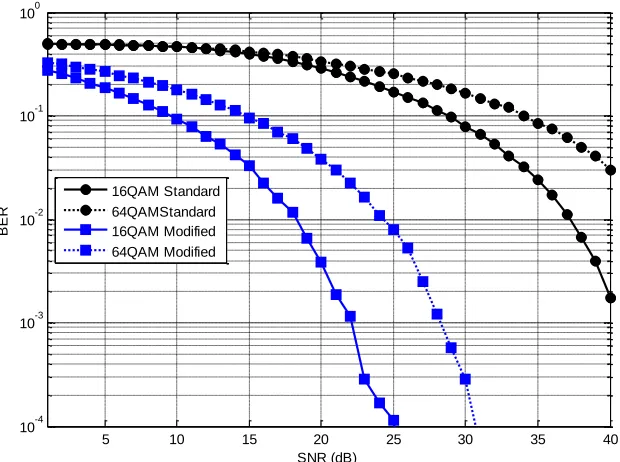
Fig. 1. Performance of standard and modified model at the AWGN channel (M=16, 64)
The block diagram of the modified OFDM model is shown in Figure 1. Note that the standard size of 64 bits for IEEE 802.11a is divided into three equal parts of 21 bits after QAM modulation, with the remaining bit discarded. A sliding window technique is applied to each part. A new algorithm of OFDM is used for reducing the effect of Doppler frequency; authors applied the sliding window on the frame length of 64 bits in addition to the other FFT and IFFT blocks added at the transmitter and the receiver sides, respectively. In this work, the authors do not use FFT at the transmitter and its inverse at the receiver side; rather, only the main blocks of IFFT at the transmitter and FFT at the receiver side are employed. The additional blocks in used to increase the orthogonality of subcarriers and reduce the round off error come from the block of sliding window. To reduce the round of error, the sliding window is divided into sub-sliding window of length 21-bits each. The new algorithm of OFDM technique is used for enhancing the system performance under the Doppler frequency effect. Note that non-coherent combining of four short correlation periods instead of a single long block correlation is due to the potential high round off error which may occur at any bit that spreads to the other adjacent bits due to the mixing property of the suggested algorithm. Also the frequency offset results in phase rotation or shifts to the sampled signals causing reduced correlation performance between the received signal and the transmitted waveform. The longer correlation period leads to larger phase shift and poorer correlation performance. A shorter correlation period thus helps mitigate the frequency offset effect and the round off error. The output data vector after the QAM modulator
2.1 The Performance of Models in Flat Fading
The performance of proposed models in flat fading channel will be shown under different Doppler frequencies. The Doppler frequencies considered here are, 4 Hz, 250 Hz inspired by [5]. It can be seen from Figure. 2 that there exists a wide difference in BER curves between the suggested model referring to the conventional model, where the gain at BER=10-2 is about 15dB can be obtained from the proposed model relative to the conventional model (M=16). As M increases from 16 to 64 points, the BER for both models increases. In all range of SNR the suggested model outperforms the other one. The BER is slightly increases as the system swapped from the AWGN channel to flat fading channel, because the Doppler frequency used in Figure 4 is 4Hz, which is so low and the performance of both cases approximately the same.
5 10 15 20 25 30 35 40
10-4 10-3 10-2 10-1 100
SNR (dB)
BER
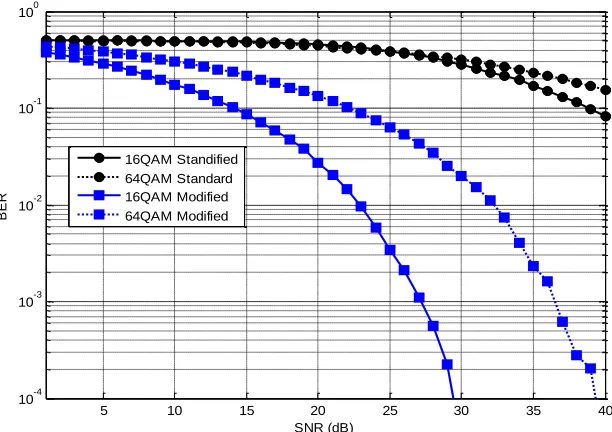
Fig. 2. Performance of standard and modified models in flat fading channel, Doppler frequency=5 Hz
Figure 5 shows the performance of both models as the Doppler frequency increases to 250Hz. The BER for both models increases as the Doppler frequency increases, but the suggested model still outperforms the other standard model in all range of SNR. The SNR required maintaining BER=10-2 increased by about 5dB as the Doppler frequency. The performance of proposed models in flat fading channel will be shown under different Doppler frequencies. The Doppler frequencies considered here are,5 Hz, 200 Hz. It can be seen from Figure2 that there exists a wide difference in BER curves between the suggested model referring to the
conventional model, where the gain at BER=10-2 is about 15dB can be obtained from the proposed model relative to the conventional model (M=16). As M increases from 16 to 64 points, the BER for both models increases.
In all range of SNR the suggested model outperforms the other one. The BER is slightly increases as the system swapped from the AWGN channel to flat fading channel, because the Doppler frequency used in Figure 2 is 4Hz, which is so low and the performance of both cases approximately the same.
Fig. 3. Performance of standard and modified models in flat fading channel (Doppler frequency=200 Hz)
5 10 15 20 25 30 35 40
10-4 10-3 10-2 10-1 100
SNR (dB)
BER
16QAM Standified 64QAM Standard 16QAM Modified 64QAM Modified
5 10 15 20 25 30 35 40
10-5 10-4 10-3 10-2 10-1 100
SNR (dB)
BER
Figure. 2 shows the performance of both models as the Doppler frequency increases to 250Hz. The BER for both models increases as the Doppler frequency increases, but the suggested model still outperforms the other standard model in all range of SNR. The SNR required maintaining BER=10-2 increased by about 5dB as the Doppler frequency increased from 4Hz to 200Hz in the proposed model, and approximately the same increasing in the conventional model. As the number of constellation mapping increases the BER also increases for both models.
3. Proposed System Doppler Shift Reduction
When a wave source and a receiver are moving relative to one another the frequency of the received signal will not be the same as the source. When they are moving toward each other the frequency of the received signal is higher than the source, and when they are approaching each other the frequency decreases. This is called the “Doppler Effect”. An example of this is the change of pitch in a car’s horn as it approaches then passes by. This effect becomes important when developing mobile radio systems. The amount the frequency changes due to the Doppler effect depends on the relative motion between the source and receiver and on the speed of propagation of the wave. The Doppler shift in frequency can be written as
(1)
Doppler shift can cause significant problems if the transmission technique is sensitive to carrier frequency offsets or the relative speed is higher, which is the case for OFDM. If we consider now a link between two cars moving in opposite directions, each one with a speed of 80 km/hr for example, the Doppler shift will be double [8].
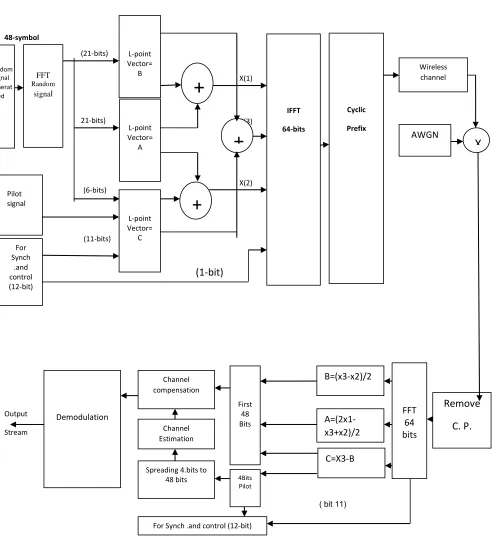
The proposed system block diagram of the OFDM work in decreasing effect of Doppler the brand new algorithm work to divide the data to three parts, the data content random signal data, pilot and synchronization, control the random signal is 48 Bits and pilot is 4 bits and control 12 bits all data 64 bit the new algorithm to divide three part all part 21 Bits and final bit is (0) bit all parts take FFT the first part and second content of random signal and final part content random 6 bits and pilot 4 bits and 11bits control. Then vector (A) and vector (B) are added, the result of the addition is (X1) and vector (A) is also added together with vector (C), the result is (X2). For the vector (B) added with the vector (C) the result is (X3). Now, all (Xn) and final bit is input to IFFT block where it is converted to time-domain. Then after, the cyclic prefix is added. The output stream is then sent over the channel to the receiver after being converted to a frame structure (serial data stream). The frame structure consists of modulated data and the pilot signal is used for estimation and compensation. The channel consists of a multipath fading (flat fading channel or frequency selective fading channel) with AWGN; at the receiver the inverse operation is employed. The cyclic prefix is removed and a serial to parallel conversion is performed. FFT with N points is used to convert the signal from time back to frequency domain. Then the effect of channel is
compensated after the OFDM demodulation, the signal de-mapper is then used to recover the transmitted bits stream.
The block diagram of the OFDM to decreasing effect of Doppler the new algorithm work to divide the data to three part .the data content Random Signal data, pilot and synchronization And control the random signal is 48 Bits and pilot is 4 bits and control 12 bits all data 64 bit the new algorithm to divide three part all part 21 Bits and final bit is( 0)bit all part take FFT the first part and second content of random signal and final part content random 6 bits and pilot 4 bits and 11bits control .the algorithm is add vector (A) and vector(B)the result is(X1) and vector(A)add with vector (C) the result is (X2) and the vector (B)and the vector (C) the result is(X3) all (Xn) and final bit take the IFFT and input to cyclic prefix The data are sent to the receiver over the channel after being converted to a frame structure (serial data stream). The frame structure consists of modulated data and the pilot signal is used for estimation and compensation. The channel consists of a multipath fading (flat fading channel or frequency selective fading channel) with AWGN, at the receiver the inverse operation is employed. The cyclic prefix is removed and a serial to parallel conversion is done for the signal. A FFT with N points is used to convert the signal from time to frequency domain. Then the effective channel is compensated after the OFDM demodulation, the signal de-mapper is used to recover the transmitted signal.
The output data vector after the QAM modulator is:
[x(n)] = [X1 X2 X3 . . . X64]
The block diagram of the fig ( ) will be divided into three vectors according to the following step. The vector(B)content 21-bit in the equation (1):
Vector (B) from bit 1 to 21
[B] = [x1 x2 x3 . . . x21] (1)
Vector (A) from bit 22 to 42
[X] = [x22 x23 x24 . . . x42] (2)
Vector (C) from bit 43 to 63
[C] = [x43 x44 x45 . . . x63] (3)
The step one added vector (A) with vector (B) content vector (X1)
[X1] = [A]+[B] (4)
The step two added vector (A) with vector (C) content vector (X2)
[X2] = [A]+[C] (5)
The step two added vector (B) with vector (C) content vector (X3)
[X3] = [B]+[C] (6)
c
v
f
f
0FFT
Random
signal
Remove
C. P.
FFT 64 bits B=(x3-x2)/2
A=(2x1-x3+x2)/2
C=X3-B
First 48 Bits
4Bits Pilot
Channel compensation
Spreading 4.bits to 48 bits Channel Estimation
Demodulation
For Synch .and control (12-bit)
(1-bit)
(11-bits)(6-bits) 21-bits) (21-bits)
X(1)
X(3)
X(2)
( bit 11 ) Output
Stream
Random Signal Generat
ed
L-point Vector=
B
L-point Vector=
A
L-point Vector=
C Pilot
signal
For Synch
.and control (12-bit)
+
+
+
IFFT 64-bits
Cyclic Prefix
Wireless channel
X
AWGN
48-symbol
The equation (1) to (6) this in the transmitter .all form(X1) ,(X2),(X3) in the block IFFT. And in received equation to get the vector (A) vector (B) and vector (C) by using equation:
B = (X3-[(X1+X2-X3) /2] (7)
A = (X1+X2-X3) /2 (8)
C=X2-[(X1+X2-X3)/2] (9)
4.CONCLUSION
In conclusion, the history of IEEE 802.11a Local Area Networks was revised and the recent development and proposals were refined. The suitability of OFDM system, within LAN standards, to carrier frequency offset and Doppler Effect are well-known and still being researched. The designed system based on sub-frequency algorithm has shown a better performance compared to the conventional OFDM system in LAN standard. The investigation included the usage of two modulators, 16-QAM and 64-QAM over Additive White Gaussian Noise and also Rician wireless channels with 5Hz in the first case then 200Hz in the second case. This rational chose was based on LAN standard and then compared with the same standard’s genuine performance.
The results showed a clear outperformance of the proposed system versus conventional LAN performance for the cases specified previously. The performance was measured based on Bit Error Rate versus Signal to Noise Ration. Overall results showed that the proposed system has less error rate than the conventional system for the same signal to noise ration. This conclusion has led the authors to investigate other standards and widening the investigation to include the effectiveness on peak to average power ratio and carrier frequency offset.
REFERENCES
[1] R. Van Nee, and R. Prasad, “OFDM for Wireless Multimedia Communications”. Arthec House, Boston, MA, 2000.
[2] Moose, Paul H., "A Technique for Orthogonal Frequency Division Multiplexing Frequency Offset Correction" IEEE Transactions on Communications, vol.42, no.10, pp.2908-2914, Oct 1994. [3] M. Schmidl and D. C. Cox, "Robust frequency and timing
synchronization for OFDM," IEEE Trans. Commun., vol. 45, pp. 1613-1621, Dec. 1997.
[4] Allert van Zelst and Tim C. W. Schenk, “Implementation of a MIMO OFDM-Based Wireless LAN System”. IEEE TRANSACTIONS ON SIGNAL PROCESSING, vol. 52, no. 2, Feb 2004.
[5] IEEE Standard for Wireless LAN Medium Access Control (MAC) and Physical Layer (PHY) Specifications, IEEE 802.11 Standard, 1999.
[6] IEEE Standard for Air Interface for Broadband Wireless Access Systems, IEEE 802.16e Standard, 2005.
[7] Zi-Wei Zheng, “Robust channel estimation for the OFDM-based WLAN systems with imperfect synchronization”. Wireless Personal Communication, October 2007, Volume 43, Issue 2, pp 703-709.
[8] T. Wang, J. Proakis, E. Masry, and J. Zeidler, ”Performance Degradation of OFDM System Due to Doppler Spreading” IEEE Transactions on Wireless Communication, vol. 5, no. 6, pp. 14221432, Jun. 2006.
[9] P. Robertson and S. Kaiser, “Analysis of the loss of orthogonality Through Doppler spread in OFDM system”. Proc. Globecom, Dec 1999.
[10] B. Farhang-Boroujeny and R. Kempter, “Multicarrier Communication Techniques for Spectrum Sensing and Communication in Cognitive Radios”. IEEE Communications Magazine, Special Issue on Cognitive Radios for Dynamic Spectrum Access, vol. 46, no 4, April 2008, pp. 80-85.
[11] T. Wang, J. Proakis, and J. Zeidler “Interference Analysis of Filtered Multitone Modulation Over Time-Varying Frequency- Selective FadingChannels,” IEEE Transactions on Communications, VOL. 55, NO. 4, April 2007
[12] A. Tonello, “Exact matched filter performance bound for multitoned modulation in fading channels,” in Proc. WPMC, Yokosuka, Japan, Oct. 2003, vol. 3, pp. 361365.
[13] B. Farhang-Boroujeny, “Multicarrier modulation with blind detection capability using cosine modulated filter banks,” IEEE Transactions on Communications, vol. 51,no. 12, pp. 2057-2070, Dec. 2003.
[14] B. Farhang-Boroujeny, “A Square-Root Nyquist (M) Filter Design for Digital Communication Systems,” IEEE Transactions on Signal Processing, vol. 56, no. 5, May 2008