435 Abstract—In this study, we propose a novel method of mining web usage within a local area network (LAN). The proposed method makes use of Taiwanese Yahoo! (i.e. Yahoo! Kimo) to create a topic hierarchy and classifies the most visited websites for users within a LAN into the hierarchy. Each of the websites will have a unique category path. According to the category path, web usage statistics can be accumulated from the bottommost level, i.e. a single website, to the topmost level, i.e. the set of all websites. Thus, web surfing demands of users within the LAN can be analyzed at various levels of detail. Experimental results strongly support the effectiveness of the proposed method.
Index Terms—Web usage mining, Yahoo! Directory, Yahoo! Search.
I. INTRODUCTION
Once Tim Berners-Lee of the Conseil European Pour Recherches Nucleaires (CERN) announced the World Wide Web (WWW) in 1991, the amount of web pages is growing exponentially. A new information world that exceeds the limit of time and space forms gradually as a result of the World Wide Web. According to the report of R. H. Zakon [1] at July 2009, the amount of web hosts on the Internet have reached to about 250,000,000. Each of the web hosts may have several websites, thus exhibiting an abundance of and a variety of information. As a result, retrieving useful information quickly and effectively from WWW has become a key lesson in the information world. To provide more precise and relevant information, Internet service providers (ISPs) are required not only to provide web surfers with effective navigation services, but also to develop powerful tools for gathering intelligence from web surfing activities.
Web navigation services are generally classified into two types, including search engines and web directories. A search engine allows users to pose a keyword (or a phrase) and then replies a list of relevant websites sorted according to their similarities to the keyword. A web directory is a tree or hierarchical structure of web topic categorization. The homepage of the web directory may consist of several main topic categories. Each main category is then separated into smaller topic categories called sub-categories. This tree structure extends until each website belongs a category of the website itself. Undoubtedly, Google has gained the lion's share of search engine market in the world. And according to the study of Baeza-Yates and Ribeiro-Neto [2], the other
Manuscript received August 11, 2010.
Hsin-Chih Lin is with the Department of Information and Learning Technology, National University of Tainan, Tainan, Taiwan 70005. (E-mail: [email protected]).
Mei-San Choi received her bachelor’s degree in Information Management in 2004 from Chang Jung Christian University, Tainan, Taiwan 711.
largest search engines on the Internet are AltaVista [3], HotBot [4], Northern Light [5], Excite [6], and so on; and the largest web directories are Yahoo! [7], LookSmart [8], eBLAST [9], NewHoo [10], and so on. Generally speaking, most of portals that provide a web directory also provide a search engine. As a user pose a keyword (or a phrase), the search engine will reply a title, a description, and the URL of each relevant website. Besides, the search engine will also reply the category path of each website. Accordingly, the user can understand the categorization of website topics and the characteristics of each website. Although both search engines and web directories can improve the efficiency of web surfing, it is not facile sometimes for users to find a target website from such a long list of websites. Moreover, most of web navigation services mainly support users from the Internet or users speaking the same language. These services have not considered access patterns and special interests of users within a local area network (LAN).
E-commerce (EC) has become a necessary and a valuable element of doing business. Competitions among businesses or ISPs are increasing rapidly; search engines and web directories are no more capable of satisfying information demands required by various professionals. For example, end users may need a prompt and effective guide for searching more relevant websites, and for extracting more implicit but more important intelligence. ISPs will have an urgent demand to understand usage patterns of their customers, so as to personalize their services and perform mass customization. The understanding of usage patterns can also be used as a reference to design web pages and contents. Furthermore, it can be used in reducing the load of networks and enhancing the quality of services. Business analysts are seeking for tools to predict special demands of their customers, and to automatically perform knowledge management and decision making. The above-mentioned tools can help business analysts to gain competitive advantages for their organizations. Because of the EC trend, web mining is becoming one of the most popular and important research topics in these years.
In 1996, Etzioni [11] issued the term “Web Mining,” which means the use of data mining techniques to automatically discover and extract useful information from web documents and services [12-13]. According to Kosala and Blockeel [13], web mining can be categorized into three areas, including web content mining, web structure mining, and web usage mining. Web content mining describes the automatic discovery of useful information from web contents, data (including texts and multimedia objects), and documents. Web structure mining, based on the topology of hyperlinks, discovers the link structure within a website or among websites. Web usage mining describes the utilization of data
Mining Web Usage within a Local Area Network
436 mining techniques to discover and analyze access patterns and special interests of users while interacting with the website. Web usage mining can improve the design or management of websites as well as web contents and the way of interaction. Generally speaking, web content and structure mining utilize the primary data of websites, whereas web usage mining makes use of logs resulted from interactions of users with websites. These logs are secondary data, which may include web server logs, proxy server logs, browser logs, user profiles, and so on. The analysis of web server logs can be used to interpret web surfing activities of users who visit the same website from any hosts on the Internet. Proxy server logs can be analyzed and used to understand web surfing activities of users within a LAN or those who are using the same ISP. The analysis of browser logs can be utilized to understand web surfing behaviors of a single user.
Web usage mining analyzes logs of web surfing activities and interprets usage patterns and special interests of users. In the information age, we believe in “Customers are Paramount” and “Knowledge is Power”. Web usage mining is becoming more important for academic researchers and business analysts. Detailed surveys on web usage mining can be referred to [12-16]. Web mining techniques, which are derived from the traditional techniques of data mining, can be separated into categories as follows: statistical analysis [14], association rules [17-21], clustering [22], classification [23-27], similar sequences [28-29], sequential patterns [30-32], dependency modeling, etc. Web mining applications may include personalization or mass customization [33], marketing intelligence discovery [34], intelligent agents [35], adaptive web sites [36], and so on.
In this study, we propose a novel method of mining web usage within a LAN. The proposed method makes use of Taiwanese Yahoo! (i.e. Yahoo! Kimo [37]) to create a topic hierarchy and classifies the most visited websites for users within a LAN into the hierarchy. Each of the websites will have a unique category path. According to the path, web usage statistics can be accumulated from the bottommost level, i.e. a single website, to the topmost level, i.e. the set of all websites. Thus, web surfing demands of users within the LAN can be analyzed at various levels of detail.
The proposed method consists of three phases, including data cleaning, hostname lookup, and statistics computation. In the data-cleaning phase, our method is responsible to check every request sent to the proxy server and then removes unavailable requests, so as to improve the effectiveness of the method. In the hostname-lookup phase, our robot program carries the hostname of each available request to Yahoo! Search and fetches the title as well as the category path of the requested website. In the statistics-computation phase, our system computes the web usage statistics from the bottommost level category to the topmost level category. Accordingly, we are able to know the most visited websites under a certain category, as well as the number of times visited and the sub-category of each website. We can also view the most visited sub-categories under a certain category, and the number of times that each sub-category was visited. Experimental results strongly support the effectiveness of the proposed method.
The organization of this paper is as follows. In Section 2, we introduce the proxy server and the format of a log file. In Section 3, we introduce the search engine and the web directory of Yahoo! Kimo. In Section 4, we describe the three phases of the proposed method. In Section 5, we demonstrate parts of achievements of the proposed method. Finally, we conclude this study and discuss further research.
II. PROXY SERVER
A proxy server, also called a cache server, is usually located between servers on the WWW and end-user browsers within a LAN. The proxy server is used to store web pages that have been downloaded through it in advance. When a browser requests to download a web page, the proxy server checks if the web page is already stored. If yes, the proxy server replies the web page to the browser; otherwise, the request is passed to the web server. After that, the web page is downloaded, stored at the proxy server, and sent to the browser. The goal of a proxy server is to improve the efficiency in fetching web pages and to filter web pages according to their contents.
When a browser fetches a web page from a proxy server, each of the requested information will be stored in a text file “access.log,” as shown in Fig. 1. The native format of each request is as follows.
Timestamp Elapsed Client Action/Code Size Method URI Ident Hierarchy/From Content
Each of the fields in the format is described as follows:
1) Timestamp: The time when the request is completed (socket closed). The format is “Unix time” (seconds since Jan. 1, 1970) with millisecond resolution.
2) Elapsed: The elapsed time of the request, in milliseconds. This is the time between accept() and close() of the client socket.
3) Client: The IP address of the connecting client.
4) Action: This field describes how the request was treated locally (hit, miss, etc).
5) Code: The HTTP reply code taken from the first line of the HTTP reply header. For ICP requests this is always “000.” If the reply code was not given, it will be logged as “555.”
6) Size: For TCP requests, the amount of data written to the client. For UDP requests, it is the size (in bytes) of the request.
7) Method: The HTTP request method (GET, POST, etc), or ICP_QUERY for ICP requests.
8) URI: The requested Uniform Resource Identifier. 9) Ident: The result of the RFC931/ident lookup of the
client username. If RFC931/ident lookup is disabled (default: “ident_lookup off”), it is logged as - .
10) Hierarchy: A description of how and where the requested object was fetched.
11) From: The hostname of the machine where we got the object.
437
989830333.057 74872 r311h4.dorm1.cju.edu.tw TCP_MISS/000 0 POST http://sinamail.sina.com.tw/cgi-bin/mail/login.cgi - DIRECT/sinamail.sina.com.tw - 989830333.557 74545 r311h4.dorm1.cju.edu.tw TCP_MISS/000 0 POST http://sinamail.sina.com.tw/cgi-bin/mail/login.cgi - DIRECT/sinamail.sina.com.tw - 989830334.187 9302 210.70.156.144 TCP_MISS/304 103 GET http://www.kimo.com.tw/wmadcmd_www.js - DIRECT/www.kimo.com.tw -
989830348.971 30391 210.70.147.203 ERR_CLIENT_ABORT/000 0 GET http://zuojun.hypermart.net/ - TIMEOUT_DIRECT/zuojun.hypermart.net - 989830359.401 3073 210.70.147.203 TCP_MISS/200 304 GET http://zuojun.hypermart.net/images/top-bg.gif - DIRECT/zuojun.hypermart.net image/gif 989830370.112 193 r532h4.dorm2.cju.edu.tw TCP_MISS/304 103 GET http://www.kimo.com.tw/ - DIRECT/www.kimo.com.tw -
989830371.763 346 210.70.160.127 TCP_MISS/200 1677 GET http://ms1.mail2000.com.tw/adv/images/1000.gif - DIRECT/ms1.mail2000.com.tw image/gif 989830372.096 678 210.70.160.127 TCP_MISS/200 4511 GET http://www.openfind.com.tw/img/logo.gif - DIRECT/www.openfind.com.tw image/gif 989830372.377 546 210.70.160.127 TCP_MISS/200 3062 GET http://www.openfind.com.tw/images/free12.gif - DIRECT/www.openfind.com.tw image/gif 989830372.450 284 210.70.160.127 TCP_MISS/200 1691 GET http://ms1.mail2000.com.tw/adv/images/1300.gif - DIRECT/ms1.mail2000.com.tw image/gif 989830372.951 279 210.70.160.127 TCP_MISS/200 1648 GET http://ms1.mail2000.com.tw/adv/images/600.gif - DIRECT/ms1.mail2000.com.tw image/gif 989830372.992 326 210.70.160.127 TCP_MISS/200 1669 GET http://ms1.mail2000.com.tw/adv/images/1600.gif - DIRECT/ms1.mail2000.com.tw image/gif 989830373.650 235 210.70.160.127 TCP_MISS/304 143 GET http://cia.openfind.com.tw/image/cia0.gif - DIRECT/cia.openfind.com.tw -
989830373.747 145 r532h4.dorm2.cju.edu.tw TCP_MISS/200 513 GET http://www.kimo.com.tw/b5.css - DIRECT/www.kimo.com.tw text/plain
989830375.841 453 r532h4.dorm2.cju.edu.tw TCP_MISS/200 3504 GET http://www.kimo.com.tw/wmadcmd_www.js - DIRECT/www.kimo.com.tw text/plain
Fig. 1. An example of “access.log” file.
The “Client” field in the “access.log” file shows the IP address of the connecting client; the “From” field represents the hostname of the host that provides objects; and the “Content” field indicates the content-type of the object. Regarding the proposed method, information of the above-mentioned three fields is useful in identifying user sessions and category paths of the requested websites. In Section 4, we will explain how the proposed method tackles the “access.log” file.
III. YAHOO!KIMO
Yahoo! Kimo is one of the most famous portals in Taiwan. It provides seven types of services, including (1) Web Contents, (2) Transaction Services, (3) Communication Services, (4) Yahoo! Anywhere, (5) Marketing Services, (6) Business Services, and (7) Value-Added Services. Since the proposed method makes use of the web directory (also called Yahoo! Kimo Directory) and the search engine (also called Yahoo! Kimo Search) of Yahoo! Kimo, we discuss these two web navigation services in this section.
Yahoo! Kimo Directory is an online navigation guide to websites; it has a topic-based tree (or hierarchical) structure that can be browsed. The homepage of Yahoo! Kimo Directory contains links to 16 main topic categories, including (1) Arts & Culture, (2) Entertainment, (3) Sports, (4) Education, (5) Science & Technologies, (6) Regional, (7) Reference, (8) Internet Guides, (9) Life Information, (10) Business & Finance, (11) Computers & Telecommunication, (12) Healthcare, (13) News & Media, (14) Society & Humanities, (15) Government, and (16) Recreation. Each of the main topic categories is separated into smaller topic categories, i.e. their sub-categories. For example, the “Arts & Culture” category is separated into Companies, Artists, “Museums, Galleries & Centers”, and so on. Next, the “Arts & Culture > Companies” category is separated into Handicrafts, Business Design, Recording Companies, and so on. This hierarchical structure extends until each website becomes a category itself. Each website stored in Yahoo! Kimo Directory has its own category path such as “Arts & Culture > Companies > Handicrafts > … ” If a user stays at a certain category, he/she can make use of the search engine, i.e. pose a keyword (or a phrase) and retrieve relevant websites from either “All Categories” or “Just This Category.” Notice that Yahoo! Kimo Directory is created manually. A staff of editors on Yahoo! Kimo visits and evaluates websites daily, and then organizes these websites
into topic-based categories. In Yahoo! Kimo Directory, some websites or small categories may reside in more than one category. Although these exceptions do not totally meet the tree (or hierarchical) structure, we consider that Yahoo! Kimo Directory has a tree-based taxonomy for websites.
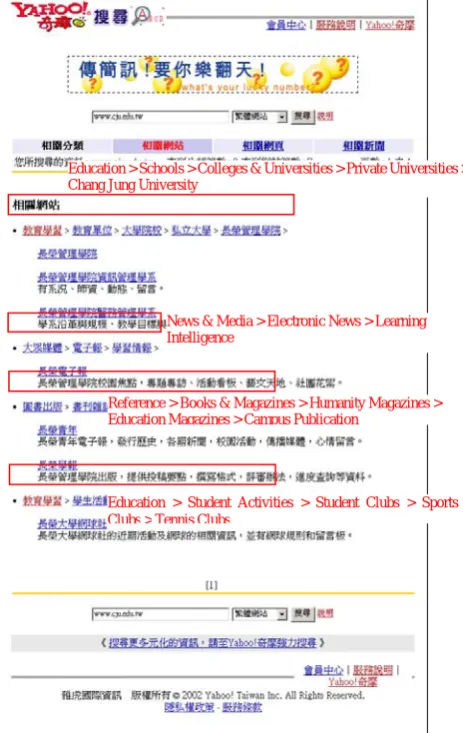
Yahoo! Kimo Search releases a group of robot (or spider) programs into the WWW for crawling websites. The crawled websites will be compared with the Yahoo! Kimo Directory and organized into topic-based categories. When a user poses a keyword (or a phrase) for making queries, Yahoo! Kimo Search immediately replies a title, a description, and the URL of each relevant website. Also, Yahoo! Kimo Search provides every website with a category path. Although other search engines may support the same function, we found that Yahoo! Kimo Search provides an interesting function that other search engines do not support. If we pose a hostname in Yahoo! Kimo Search, each relevant website together with its category path will be replied. For instance, if we pose “www.cju.edu.tw” (the hostname of URL of Chang Jung University, Taiwan) in Yahoo! Kimo Search, four category paths will be replied, as enclosed by red rectangles in Fig. 2. These four paths are:
1) Education > Schools > Colleges & Universities > Private Universities > Chang Jung University
2) News & Media > Electronic News > Learning Intelligence
3) Reference > Books & Magazines > Humanity Magazines > Education Magazines > Campus Publication
4) Education > Student Activities > Student Clubs > Sports Clubs > Tennis Clubs
Among the four paths, the exact website of CJU is located at the first one. Others are websites in which their URLs may contain “www”, “cju”, “edu”, or “tw”. Besides, these websites are resided in the administration offices, academic departments or student clubs at CJU. According to our survey, we would like to emphasize that Yahoo! Kimo Search is the only search engine in Taiwan that allows users to pose a hostname and replies relevant websites together with their category paths.
438 Yahoo! Kimo Directory possesses great reference value for academic researches. The hostname lookup function in Yahoo! Kimo Search inspires us to develop the proposed method. In Section 4, we will explain how the proposed method makes use of Yahoo! Kimo.
IV. PROPOSED METHOD
The proposed method is composed of three phases, including data cleaning, hostname lookup, and statistics computation, as shown in Fig. 3. In this section, we illustrate the three phases respectively.
access.log
Y ahoo! K im o
w ebsite categorization available
requests
w ebsite titles & category paths hostnam es
H ostnam e L ookup
Statistic C om putation
W W W D ata
C leaning
The proposed method
Fig. 3: Diagrams of the proposed method.
In the data-cleaning phase, our method parses the fields of each request in the “access.log” file, and identifies the availability of the request. To improve the effectiveness of the proposed method, we must remove unavailable requests, which may contain invalid URL syntax, unreachable remote sites, non-text data (possibly the attached multimedia objects in a web page), etc. The size of the “access.log” file will be
then dramatically reduced. Furthermore, we have made a statistics beforehand of the number of requests sending to the same “From” field, i.e. the field that records the original hostname of the website containing the requested web page. This step is to reduce the load in the next phase and the load of Yahoo! Kimo.
In the hostname-lookup phase, we designed a robot program which carries the “From” field, i.e. the hostname, of each available request to Yahoo! Kimo and carries back the “optimal” title as well as the category path of the website. The above-mentioned task is similar to the previous one described in Section 3, as shown in Fig. 2. That is, when a user poses the hostname “www.cju.edu.tw” in Yahoo! Kimo manually, four category paths are shown on the replied web page. Instead of doing the task manually, our robot program performs each available request automatically. Besides, what the robot program carried back is definitely a web page, as shown in Fig. 2, and there may be more than one website and category path. We have designed a heuristic matching method which allows the robot program to select the “optimal” website and category path automatically as follows: We compare the URLs of all the websites with the “From” field of the request. The website that has a high degree of similarity will be the “optimal” website, and the category path that the website belongs to will be the “optimal” path.
The robot program carries the hostname of a website to Yahoo! Kimo and carries back an “optimal" website and an “optimal” category path. In the statistics-computation phase, we can build a topic hierarchy of web categorization according to the category path gradually. Also, from the bottommost level category, i.e. the website, to the topmost level category, i.e. the set of all websites, along the category path, we can add up the number of times that the visited websites. As a result, we will know the number of times that each category or website of the topic hierarchy was visited. In addition, we would like to emphasize that although related statistical methods of counting the number of times that each website was visited have been proposed in some of the literatures, the topic hierarchical method in this study is definitely an innovative idea of statistical analysis to mine web usage at various levels of detail.
V. EXPERIMENTAL RESULTS
The effectiveness of the proposed method is demonstrated with examples in this section. The proposed method was implemented on a PC (CPU: AMD Athlon 1G, RAM: 512MB, and OS: Microsoft Windows 2000, DBMS: Microsoft SQL 2000). The data-cleaning program was written in C language; the hostname-lookup program, i.e. the robot program, was written in VB language; and the statistics-computation program was written in ASP language. The user interface program was written in VB language; its appearance was further designed by using Ulead PhotoImpact and Adobe Flash. The “access.log” file was obtained from the Computer Center at CJU; it recorded one-year access information from May 2001 and its size was 484MB. After the data-cleaning phase was performed, its size shrank to 47MB and contained 3,234,517 available requests to 18,938 hosts. In the hostname lookup phase, we Fig. 2: Results of posing “www.cju.edu.tw” in Yahoo! Kimo Search.
Education > Schools > Colleges & Universities > Private Universities > Chang Jung University
News & Media > Electronic News > Learning Intelligence
Reference > Books & Magazines > Humanity Magazines > Education Magazines > Campus Publication
439 made use of two PCs to tackle the “access.log” file in parallel to improve the efficiency of the proposed method. The time required to perform all the three phases was about 12 hours.
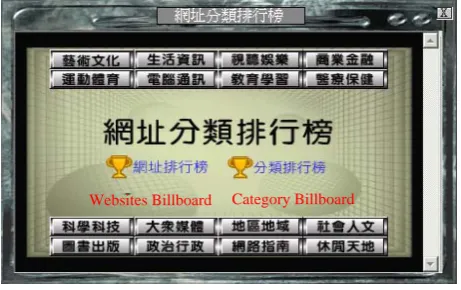
Fig. 4 shows the user interface of the system. There are totally 16 buttons displayed at the top and bottom of the user interface. These 16 buttons indicate the 16 main topic categories of Yahoo! Kimo Directory. A user can click on the button to browse a topic category or search for rankings of websites under that specific category. There are two buttons in the middle of the user interface, indicating “Websites Billboard” (left) and “Category Billboard” (right). In what follows, we demonstrate the function and characteristics of the two billboards with examples.
Fig. 4. User interface of the proposed method.
When a user clicks on the “Website Billboard” button, the most visited websites under all topic categories of Yahoo! Kimo, as well as the number of times visited and the category of each website are displayed, as listed in Table 1. For the sake of conciseness, only the top 10 visited websites are displayed in this table. Notice that by using a robot program to search websites on Yahoo! Kimo, the proposed system is capable to retrieve the category of each website. Table 1 shows that “Yahoo! Kimo”, “Chang Jung University”, “PChome Online”, “Sina Taipei”, “Taiwan.com”, and so on are the most visited websites for CJU users. This table may imply:
TABLE 1. UNDER ALL CATEGORIES OF YAHOO!KIMO, THE MOST VISITED
WEBSITES FOR CJUUSERS,THE NUMBER OF TIMES VISITED AND THE
CATEGORIES THEY BELONG TO.
Website Number of Visits Category
Yahoo! Kimo 89,141 Computers & Telecom. Chang Jung University 51,233 Education
PChome Online 29,563 Computers & Telecom. SINA Taipei 26,511 Computers & Telecom.
Taiwan.com 19,562 Internet Guides
Tennis Club in CJU 14,900 Education SINA Fortune-Telling 12,949 Recreation
GeoCities 12,246 Internet Guides
PC home Online Chat
Room 11,363 Recreation
Department of Information
Management in CJU 10,449 Education
1) once CJU users get online, they first visit a portal (such as “Yahoo! Kimo”, “PChome Online”, “Sina Taipei”, and so on), and make use of their web navigation services to find target websites;
2) most of CJU users set a portal or the CJU website as their browser homepage;
3) the CJU website is often visited because of the daily affairs at the university.
Furthermore, when a user clicks on any of the websites displayed on the table, our system starts a new session and downloads that website. When the user clicks on a topic category, the most visited websites under that category for CJU users are listed. Also, the number of times visited and the topic category each website belongs to are displayed. For example, if the user clicks on the “Education” category, the most visited websites under the “Education” category for CJU users, as well as the number of times visited and the category that each website belongs to are displayed, as listed in Table 2. Under the “Education” category, “Chang Jung University”, “Tennis Club in CJU”, “Department of Information Management in CJU”, “WuKoon Digital School”, and so on are the most visited websites for CJU users. When the user clicks on the “Schools” category, the most visited websites under the “Education > Schools” category for CJU users, the number of times each website was visited, and the category each website belongs to are displayed, as listed in Table 3.
TABLE 2. UNDER THE “EDUCATION”CATEGORY, THE MOST VISITED
WEBSITES FOR CJUUSERS, THE NUMBER OF TIMES VISITED, AND THE
CATEGORIES THEY BELONG TO.
Website Number of Visits Category
Chang Jung University 51,233 Schools Tennis Club in CJU 14,900 Student Activities Department of Information
Management in CJU 10,449 Schools
Wukon Digital School 3,422 Online Learning Special Education in Long
Shan Elementary School 3,280 Special Education Shih Hsin University 2,038 Schools
National Cheng Kung
University 1,756 Schools
ALE Online 1,503 Supplement Education ERP Center in Chung Yuan
University 1,207 Schools
Yuan Ze University 1,196 Schools
TABLE 3. UNDER THE “EDUCATION >SCHOOLS”CATEGORY, THE MOST
VISITED WEBSITES FOR CJUUSERS, THE NUMBER OF TIMES VISITED, AND THE CATEGORIES THEY BELONG TO.
Website Number of Visits CATEGORY
Chang Jung University 51,233 Colleges & Universities Department of Information
Management in CJU 10,449 Colleges & Universities Shih Hsin University 2,038 Colleges & Universities National Cheng Kung
University 1,756 Colleges & Universities ERP Center in Chung Yuan
University 1,207 Colleges & Universities Yuan Ze University 1,196 Colleges & Universities Fu Jen Catholic University 1,186 Colleges & Universities Ming Shuan University 1,112 Colleges & Universities
National Sun Yat-Sen
University 1,076 Colleges & Universities Chinese Culture University 963 Colleges & Universities
440 are the most visited websites for CJU users. Once the user clicks on a category, the most visited sub-categories under that specific category for CJU users, and the number of times visited are displayed. For example, if a user clicks on the “Education” category, he/she will be able to view the most visited sub-categories under the “Education” category for CJU users, and the number of times that each of those sub-categories were visited, as listed in Table 5. Table 5 shows that under the “Education” category, “Schools”, “Student Activities”, “Online Learning”, “Further Education”, and so on are the most visited categories for CJU users. Furthermore, if a user clicks on the “Schools” category, he/she will be able to view the most visited sub-categories under the “Education > Schools” category for CJU users, and the number of times that each of them was visited, as listed in Table 6.
TABLE 4. UNDER ALL CATEGORIES OF YAHOO!KIMO, THE MOST VISITED
CATEGORIES FOR CJUUSERS, AND THE NUMBER OF TIMES EACH OF THOSE
CATEGORIES WERE VISITED.
Category Number of Visits
Computers & Telecom. 276,892
Education 118,116 Recreation 100,610 Business & Finance 94,670
Internet Guides 88,935
Life Information 78,029 News & Media 56,918
Regional 32,154 Reference 20,420 Government 14,967
Sports 14,626 Arts & Culture 14,527
Society & Humanities 12,758
Entertainment 12,725 Healthcare 9,636 Science & Technologies 4,247
TABLE 5. UNDER THE “EDUCATION”CATEGORY, THE MOST VISITED
SUB-CATEGORIES FOR CJU USERS, AND THE NUMBER OF TIMES EACH OF THE
SUB-CATEGORIES WAS VISITED.
Category Number of Visits
Schools 88,582 Student Activities 14,931
Online Learning 5,813
Further Education 4,271 Special Education 3,763
Skill Training 461
Organizations 192 Examinations 57
Teaching Resource 32
Internet 9 Regional 3 Finance & Investment 1
Shopping Guides 1
TABLE 6. UNDER THE “EDUCATION >SCHOOLS”CATEGORY, THE MOST
VISITED SUB-CATEGORIES FOR CJUUSERS, AND THE NUMBER OF TIMES
EACH OF THE SUB-CATEGORIES WAS VISITED.
Category Number of Visits
Colleges & Universities 88,452
Junior Colleges 119
Foreign Schools 11
VI. CONCLUSIONS AND FURTHER RESEARCH
A novel method of mining web usage for users within a LAN has been proposed in this study. The contribution of this
study is threefold. (1) We point out an innovative idea of utilizing the search engine and the web directory of Yahoo! Kimo. (2) We proposed a topic hierarchy that is able to compute not only the number of times a specific website was visited, but also the number of times any topic category was visited. (3) We analyzed usage patterns and special interests of users at various levels of detail. The analytical results will be very useful for LAN management, the establishment of regional policies, and the planning of group activities. Finally, experimental results strongly support the above-mentioned claims.
Further research may be directed to the following issues. (1) Combining the proposed method with data mining techniques, such as association rules or sequential patterns, to analyze web usage patterns at various levels of detail. (2) Designing an intelligent web browser to recommend users for the next possible websites or categories, and assist users in organizing the websites in their bookmark of a web browser under a specific topic. (3) Designing content-based tools that can filter and control network flows according to web categories.
REFERENCES
[1] R. H. Zakon, Hobbes' Internet Timeline, Available: http://www.zakon.org/robert/internet/timeline/.
[2] R. Baeza-Yates and B. Ribeiro-Neto, Modern Information Retrieval, Addison Wesley, New York, USA, 1999.
[3] AltaVista, Available: http://www.altavista.com/. [4] HotBot, Available: http://www.hotbot.com/.
[5] Northern Light, Available: http://www.northernlight.com/. [6] Excite, Available: http://www.excite.com/.
[7] Yahoo!, Available: http://www.yahoo.com/. [8] LookSmart, Available: http://www.looksmart.com/. [9] eBLAST, Available: http://www.eblast.com/. [10] NewHoo, Available: http://www.newhoo.com/.
[11] O. Etzioni, “The World Wide Web: quagmire or gold mine?”
Communications of the ACM, Vol. 39, No. 11, pp. 65-68, Nov. 1996. [12] B. Cooley, B. Mobasher, and J. Srivastava, “Web mining: information
and pattern discovery on the World Wide Web,” IEEE International Conference on Tools with Artificial Intelligence, Newport Beach, CA, USA, Nov. 3-8, 1997.
[13] R. Kosala and H. Blockeel, “Web mining research: a survey,” SIGKDD Explorations, Vol. 2, No. 1, pp. 1-15, Jun. 2000.
[14] R. Cooley, Web Usage Mining: Discovery and Application of Interesting Patterns from Web Data, Ph.D. Thesis, Department of Computer Science, University of Minnesota, May 2000.
[15] S. Chakrabarti, “Data mining for hypertext: a tutorial survey,”
SIGKDD, Vol. 1, No. 2, pp. 1-11, Jan. 2000.
[16] S. Madria, S. S. Bhowmick, W. K. Ng, and E. P. Lim, “Research issues in web data mining,” International Conference on Data Warehousing and Knowledge Discovery, pp. 303-312, 1999.
[17] R. Agrawal, T. Imielinski, and A. Swami, “Mining association rules between sets of items in large database,” SIGMOD, pp. 207-216, May 1993.
[18] R. Agrawal and R. Srikant, “Fast algorithms for mining association rules in large database,” International Conference on Very Large Data Bases, pp. 478-499, Sep. 1994.
[19] J. Han and Y. Fu, “Discovery of multiple-level association rules from large database,” International Conference on Very Large Data Bases, pp. 420-431, Sep. 1995.
[20] J. S. Park, M. S. Chen, and P. S. Yu, “An effective hash based algorithm for mining association rules,” SIGMOD, pp. 175-186, May 1995.
[21] J. S. Park, M. S. Chen, and P. S. Yu, “Efficient parallel data mining for association rules,” International Conference on Information and Knowledge Management, Nov. 29-Dec. 3, 1995.
[22] R. Cooley, B. Mobasher, and J. Srivastava, “Data preparation for mining World Wide Web browsing patterns,” Knowledge and Information Systems, Vol. 1, No. 1, pp. 5-32, 1999.
441 [24] T. M. Anwar, H. W. Beck, and S. B. Navathe, “Knowledge mining by
imprecise querying: a classification-based approach,” International Conference on Data Engineering, pp. 622-630, Feb. 1992.
[25] J. Han, Y. Cai, and n. Cercone, “Knowledge discovery in database: an attribute-oriented approach,” International Conference on Very Large Data Bases, pp. 547-559, Aug. 1992.
[26] G. Piatetsky-Shpario, “Discovery, analysis and presentation of strong rules,” Knowledge Discovery in Databases, pp. 229-248, 1991. [27] J. R. Quinlan, “Induction of decision trees,” Machine Learning, Vol. 1,
pp. 81-106, 1986.
[28] R. Agrawal, C. Faloutsos, and A. Swami, “Efficient similarity search in sequence databases,” International Conference on Foundations of Data Organization and Algorithms, Oct. 1993.
[29] J. T. L. Wang, G. W. Chirn, T. G. Marr, B. Shapiro, D. Shasha, and K. Zhang, “Combinatorial pattern discovery for scientific data: some preliminary results,” SIGMOD, Minneapolis, MN, pp. 115-125, May 1994.
[30] R. Agrawal and R. Srikant, “Mining sequential patterns,” International Conference on Data Engineering, pp. 3-14, Mar. 1995.
[31] M. S. Chen, J. S. Park, and P. S. Yu, “Data mining for path traversal patterns in a web environment,” International Conference on Distributed Computing Systems, pp. 385-392, 1996.
[32] M. S. Chen, J. S. Park, and P. S. Yu, “Efficient data mining for path traversal patterns,” IEEE Transactions on Knowledge and Data Engineering, Vol. 10, No. 2, pp. 209-221, Mar./Apr. 1998.
[33] B. Mobasher, R. Cooley, and J. Srivastava, “Automatic personalization based on web usage mining,” Communications of the ACM, Vol. 43, No. 8, pp. 142-151, 2000.
[34] A. G. Buchner and M. D. Mulvenna, “Discovering internet marketing intelligence through online analytical web usage mining,” SIGMOD Record, Vol. 27, No. 4, pp. 54-61, 1998.
[35] D. W. Cheung, B. Kao, and J. Lee, “Discovering user access patterns on the World Wide Web,” Pacific-Asia Conference on Knowledge Discovery and Data Mining, pp. 23-24, Singapore, Feb. 1997. [36] M. Perkowitz and O. Etzioni, “Adaptive sites: automatically learning
from user access patterns,” Technique Report TR-97-03-01, Department of Computer Science and Engineering, University of Washington, Seattle, WA, USA, 1997.