348
(General article)
Future Air Conditioning with Solar Technology: A Technical Overview
Shashi Reddy a*, P. SarkarbaDepartment of Mechanical Engineering, Andhra University, Visakhapatnam, India
bDepartment of Mechanical Engineering AVC College of Engineering, Mayiladuthurai , Tamilnadu, India Received 3 Oct. 2011; accepted 27 Nov. 2011, Available online 1 Dec. 2011
Abstract
This paper presents an analysis of the general cost associated with various solar air conditioning systems which includes performance and cost comparison of different solar refrigeration Systems. The cost analysis covers the initial costs and the operating costs of each of the three systems. Various solar air conditioning systems have also been studied. A short overview about the state-of-the-art of available technologies, such as closed thermal driven cooling cycles (e.g., absorption, adsorption) and open cooling cycles (e.g., desiccant employing either solid or liquid sorbents) is given and needs and perspectives for future developments are described.
Keywords: Solar air conditioning, Cost comparison
1.1 Introduction
1
Summer air conditioning represents a growing market in building services world-wide in both commercial and residential buildings. Main reasons for the increasing energy demand for summer air-conditioning are the increased thermal loads, increased living standards and occupant comfort demands as well as building architectural characteristics and trends, like an increasing ratio of transparent to opaque surfaces in the building envelope to even the popular glass buildings. Air conditioning includes both temperature and humidity control of indoor air. Particularly for large systems in the range of about 50 kW and above, different heat driven cooling technologies are available in the market, which can be used in combination with solar thermal collectors. The main obstacles for large scaleapplication, beside the high first cost, are the lack of practical knowledge on design, control and operation of these systems. For small scale systems, many years no appropriate technology was available on the market. However, recently several companies started development of water chillers in the power range below 50 kW down to 5 kW and first commercial systems are now available.
In the 80s of the last century many activities on the development of solar energy systems for air conditioning application have been carried out, particularly in the United States and Japan. Important steps have been achieved in the development of components and systems, but finally the activities stopped mainly because of
* Email [email protected]
economic reasons. Recently, several new activities in this field have started and both research and demonstration projects are carried out in many countries and also in international co-operative projects for instance in the framework of the Solar Heating and Cooling Programme of the International Energy Agency (IEA). Particularly the development of the market of high efficient solar thermal collectors, which are nowadays produced on a semi-industrial or industrial level, provides a good starting point for new attempts.
1.2 Advantages of solar air conditioning
There are a number of reasons to consider Solar Air Conditioning cooling over conventional cooling technology. The more intense the sun's solar radiation, the higher the ambient temperature so the more we need air-cooling. Solar air-conditioning's cooling capacity will be at its peak then also. This is the ideal state of harmony between machine and nature. The machines generally utilize environmentally friendly refrigerants. Instead of Chlorofluorocarbon refrigerants used in compression vapor cooling machines, in most cases water is utilized which has no greenhouse potential. Because the systems merely require auxiliary energy for the operation of pumps and heat rejection they utilize significantly less power (or no other power). Solar machines have few moving parts and a long life if designed correctly. The electricity grid is also relieved, since the mass operation
International Journal of Engineering, Science and Metallurgy
of electrical air-conditioning in summer occasionally leads to sever strain on the electric grid.
Fig.1 performance and cost comparison of different solar refrigerator systems
In addition to cooling, energy for domestic hot water preparation and heating support which leads to a further reduction of emissions. Furthermore, noise emissions are significantly lower since most of the machines work without compressors. Some of the disadvantages are so far are the systems are not real efficient, costs are high and many systems have high maintenance. Even with these problems solar powered air cooling and refrigeration is increasing and encouraged by governments. The United States with the Energy Independence and Security Act of 2007(Public Law 110-140) and specifically Solar Air Conditioning Research and Development Program (Sec. 606) is using taxpayer funding of research and development of solar energy through 2012. Solar irradiation must first be converted into a secondary energy in order to be useful for cooling purposes. The two choices are to electricity by photovoltaic modules or to heat by solar thermal collectors.
2.1 Photovoltaic Cell
A PV air-conditioning system consists of PV cells providing electrical energy to run a vapor compression system.
2.2 Solar Split Cool DC Air Conditioning
Some advantages of this system are that after the solar array power is changed to AC, through an inverter, off the shelf products can be used, even for very small systems. Excess power can easily be used in the internal grid or sold to the public grid. Decentralized systems can be used. An already existing conventional vapor compression system, even if decentralized, can easily be converted to a solar-assisted system by simply adding PV cells to the internal grid. Another solar option is to directly use the DC array current and charge up a battery bank and feed a DC air conditioning system. Some solar test air cooling machines have used photovoltaics to run a Peltier system. A Peltier system is a solid state refrigerator, or thermoelectric cooler. Thermoelectric elements are made of semiconducting materials such as bismuth telluride and antimony telluride alloys (Bi2Te3 and Sb2Te3). Since they have neither moving parts nor refrigerant and can be made very small, they have been used in electronic chip cooling, portable refrigerators and in space applications like satellite and space ships where physical size of a cooling system is extremely limited. COP of this system is currently very low, ranging from 0.3 to 0.6. Small thermoelectric air- conditioners with a few hundred Watt capacities are available in the market.
2.3 Absorption: NH3/H2O or Ammonia/Water
296 except copper and its alloys that get corroded in the presence of ammonia. Efficiency of ammonia/water
Fig.2 Solar split DC AC
Fig.3 Ammonia water absorption system
absorption chillers require water of at least 190 °F (88°C). Ammonia is toxic and its usage is limited in some countries to the large capacity systems, or secondary heat exchangers to isolate the ammonia. Single, double or triple absorption cooling cycles are used in different solar-thermal-cooling system designs. Possibly, the more cycles, the more efficient they are. The various parts are:
1) Evaporator: It is in the evaporator where the refrigerant pure ammonia (NH3) in liquid state produces the cooling effect. It absorbs the heat from the substance to be cooled
and gets evaporated. From here, the ammonia passes to the absorber in the gaseous state
2) Absorber: In the absorber the weak solution of ammonia-water is already present. The water, used as the absorbent in the solution, is unsaturated and it has the capacity to absorb more ammonia gas. As the ammonia from evaporator enters the absorber, it is readily absorbed by water and the strong solution of ammonia-water is formed. During the process of absorption heat is liberated which can reduce the ammonia absorption capacity of water; hence the absorber is cooled by the cooling water. Due to absorption of ammonia, strong solution of ammonia-water is formed in the absorber.
3) Pump: The strong solution of ammonia and water is pumped by the pump at high pressure to the generator.
4) Generator: The strong solution of ammonia refrigerant and water absorbent are heated by the external source of heat such as steam or hot water. It can also be heated by other sources like natural gas, electric heater, waste exhaust heat etc. Due to heating the refrigerant ammonia gets vaporized and it leaves the generator. However, since water has strong affinity for ammonia and its vaporization point is quite low some water particles also get carried away with ammonia refrigerant, so it is important to pass this refrigerant through analyzers
5) Analyzer: One of the major disadvantages of the ammonia-water vapor absorption refrigeration system is that the water in the solution has quite low vaporizing temperature, hence when ammonia refrigerant gets vaporized in the generator some water also gets vaporized. Thus the ammonia refrigerant leaving the generator carries appreciable amount of water vapor. If this water vapor is allowed to be carried to the evaporator, the capacity of the refrigeration system would reduce. The water vapor from ammonia refrigerant is removed by analyzer and the rectifier. The analyzer is a sort of the distillation column that is located at the top of the generator. The analyzer consists of number of plates positioned horizontally. When the ammonia refrigerant along with the water vapor particles enters the analyzer, the solution is cooled. Since water has higher saturation temperature, water vapor gets condensed into the water particles that drip down into the generator. The ammonia refrigerant in the gaseous state continues to rise up and it moves to the rectifier.
6) Rectifier or the reflex condenser: The rectifier is a sort of the heat exchanger cooled by the water, which is also used for cooling the condenser. Due to cooling the remaining water vapor mixed with the ammonia refrigerant also gets condensed along with some particles of ammonia. This weak solution of water and ammonia drains down the generator.
7) Condenser and expansion valve: The pure ammonia refrigerant in the vapor state and at high pressure then enters the condenser where it is cooled by air or water. The refrigerant ammonia gets converted into the liquid state and it then passes through the expansion valve where its temperature and pressure falls down suddenly. Ammonia refrigerant finally enters the evaporator, where it produces the cooling effect. This cycle keeps on repeating continuously. Meanwhile, when ammonia gets vaporized in the generator, weak solution of ammonia and water is left in it. This solution is expanded in the expansion valve and passed back to the absorber and the cycle repeats. Some examples of NH3/H2O are Solar Next chillii PSC12.
Fig.4 Water/Lithium Bromide system
2.4 Absorption: Water/Lithium Bromide
First tested in the 1940's with the water-lithium bromide absorption refrigeration system, water is used as the refrigerant while lithium bromide (Li Br) is used as the absorbent. The first solar LiBr based air conditioning system was installed in an experimental solar house in University of Queensland, Australia in 1966.Parts of Lithium Bromide/Water Absorption cooler as follows:
1) Evaporator: Water as the refrigerant enters the evaporator at very low pressure and temperature. Since very low pressure is maintained inside the evaporator the
water exists in the partial liquid state and partial vapor state. This water refrigerant absorbs the heat from the substance to be chilled and gets fully evaporated. It then enters the absorber.
2) Absorber: In the absorber concentrated solution of lithium bromide is already available. Since water is highly soluble in lithium bromide, solution of water-lithium bromide is formed. This solution is pumped by the pump to the generator.
3) Generator: The heat is supplied to the refrigerant water and absorbent lithium bromide solution in the generator from the steam or hot water. Due to heating water gets vaporized and it moves to the condenser, where it gets cooled. As water refrigerant moves further in the refrigeration piping and though nozzles, it pressure reduces and so also the temperature. This water refrigerant then enters the evaporator where it produces the cooling effect. This cycle is repeated continuously. Lithium bromide on the other hand, leaves the generator and reenters the absorber for absorbing water refrigerant
2.5 Absorption: Water/Lithium Chloride
This machine does not need the temperature or flow rate controlled, but will charge with different power depending on the temperature and flow.
Fig.5 Climate Well Chiller
Climate Well 10 is a modular absorption machine that differs from the “standard” Lithium Bromide type absorption in three main types:
298 that this is chemical energy, not thermal energy that is stored.
2. It works intermittently with two parallel accumulators.
3. It is designed to use relatively low temperatures and is hence optimized for usage with solar thermal collectors. Climate Well 10 is made up of two “barrels” each consisting of a reactor and condenser/evaporator. The two barrels can operate in parallel.
2.6 Absorption Chiller: Water/Silica Gel or Water/Zeolite
This adsorption chiller is a closed system. It is powered by 55-85°C hot water and is suitable to be driven by solar water heater or waste heat from other sources and for small mass production 10 kW, 20kW, 50kW, 100kW, 200kW. The Silica Gel/Water chiller uses water as it’s cooling agent. Water evaporates in a vacuum at room temperature and thereby extracts heat from its surroundings (evaporation energy). Through this process, a cooling takes place in the circuit.
Compared to open systems, the evaporated water is not released as steam into the surroundings, but recondensed within the machine. The direct and quick condensation of the evaporated water is thermodynamically difficult, requiring large heat removal and steady pressure. Therefore, the water is first adsorbed by a solid carrier material. This material consists of silica-gel, a material related to quartz or sand. In refrigeration engineering the principle of adsorption" the collection of water vapour in the air by a hydroscopic material (silica-gel, zeolithe)" is commonly used to dehumidify the air. Utilizing the warm waste air in such systems, the material used is constantly regenerated (disc wheels). The same process takes place in the packaged chiller. With the use of hot water, the adsorbed water on the carrier material (silica-gel) is again evaporated and thereby the carrier material is regenerated. Condensation of the secondary evaporated water (off the carrier material) is, opposed to the primary evaporated water (out of the cooling circuit), now easy.
Fig.6Silica Gel Solar Air Conditioning SWAC-10
The adsorption chiller utilizes the following
properties:
a) The reversible adsorption and desorption process of water on silica gel.
b) The spontaneous evaporation of water on silica-gel c) The easy condensation
Advantages: There is no danger of crystallization and thus no limitation in temperatures. There is no internal solution pump and electricity consumption is reduced to a minimum. Examples of H20/Silica gel are SorTech ACS 08, SorTech ACS 15, SJTU SWAC-10 Example of H2O/Zeolith are InvenSor HTC 10
2.7 Adsorption: Activated Carbon/Methanol
An adsorption Activated Carbon/Methanol air conditioning system was developed by Wang in 2001 to be powered by heat sources with temperatures close to 100 °C. Evacuated tube collectors could be used to supply hot water at this level of temperature. The system, had two absorbers with 26 kg of carbon inside each one and used methanol as refrigerant. The COP and the SCP of this system were significantly influenced by the cycle time. The operation of the system with a cycle time of 30 minutes leads to a COP of 0.15 and a cooling power of 3.84 kW while operation with a cycle time of 60 minutes leads to a COP of 0.21 and cooling power of 3.03 kW. In both situations, the evaporation temperature was close to 6 °C. To improve the performance of the system, the authors changed the absorbers, keeping the same charge of carbon, and used a tube and plate heat exchanger being the carbon placed outside the tubes, between the plates. With this new design, the COP obtained was 0.4 and the cooling power was 3.80 kW. The experimental conditions in this case were: a heat source temperature of 100 °C, an evaporation temperature of 10 °C, a condensing temperature of 24 °C and a cycle time of 50 minutes. In the mid 1980’s Pons and Guilleminot developed a prototype solar powered activated carbon-methanol ice maker. This machine produced almost 6 kg of ice per m2 of solar panel when the insolation was about 20 MJ day 1, with a solar COP of 0.12. This rate of ice production remains one of the highest obtained by a solar powered icemaker.
2.8 Open Loop Sorption, Solid Desiccant
Water silica gel or water lithium chloride open cycle systems allow complete air-conditioning by supplying cooled and dehumidified air. The “refrigerant” is always water, which is brought into open direct contact with the atmosphere. The most common open systems are desiccant cooling systems with a rotating dehumidification wheel and a solid sorbent.
Fig.6 Activated Carbon/Methanol air conditioning system
Fig.7 Open loop Sorption system solid desiccant
Warm and humid air enters the slowly rotating desiccant wheel and is dehumidified by adsorption of water (1-2). Since the air is heated up by the adsorption heat, a heat recovery wheel is passed (2-3), resulting in a significant pre-cooling of the supply air stream. Subsequently, the air is humidified and thus further cooled by a controlled humidifier (3-4) according to the set-values of supply air temperature and humidity. The exhaust air stream of the rooms is humidified (6-7) close to the saturation point to exploit the full cooling potential in order to allow an effective heat recovery (7-8). Finally, the sorption wheel has to be regenerated (9-10) by applying heat in a comparatively low temperature range from 50 °C-75 °C and to allow a continuous operation of the dehumidification process. Flat plate solar thermal
collectors are normally applied as heating system in solar assisted desiccant cooling systems. The solar system may consist of collectors using water as fluid and a water storage, which will increase the utilization of the solar system. This configuration however requires an additional water/air heat exchanger, to connect the solar system to the air system.
Special design of the desiccant cycle is needed in case of extreme outdoor conditions such as the high humidity of ambient air, a standard configuration of the desiccant cooling cycle is not able to reduce the humidity down to a level that is low enough to employ direct evaporative cooling. More complex designs of the desiccant air handling unit employing for instance another enthalpy wheel or additional air coolers supplied by chilled water can overcome this problem. A novel approach is the dehumidification and simultaneously cooling of the supply air in an air-to-air heat exchanger, in which the supply air is dehumidified through sorptive coatings at the heat exchanger wall, and cooled by the returned air, which was humidified close to saturation in order to lower the return air temperature before entering the heat exchanger. The simultaneously dehumidification and cooling improves the efficiency of the system. As a consequence, the supply air humidification may be avoided in moderate climates. Since the sorption material in the supply side of the heat exchanger will be saturated after some time, a periodic operation with two heat exchangers of which one is regenerated, is required.
2.9 Open Loop Sorption, Liquid Desiccant
They may utilize water/calcium chloride or water/ lithium chloride. These systems have a typical very low driving temperature of 50- 70 °C. It has been called a DER (Dehumidifier–Evaporator– Regenerator). It consists of six major components; an indirect contact evaporative cooler, an air dehumidifier or absorber, a solution regenerator or desorber, two air/air heat exchangers and a solution/solution heat exchanger desiccant can be mixed with water to create an attractive recirculating waterfall, that dehumidifies a room using solar thermal energy to regenerate the liquid, and a PV powered flow rate water pump.
2.10(a) Rankine and Stirling thermal heat pump/heat engine
300 Fig.8 (a) Open loop Sorption system liquid desiccant
Fig.8 (b) Open loop Sorption system liquid desiccant
Fig.9 Rankine & Stirling Thermal Heat Pump, Heat Engine
The steam temperature at the inlet of turbomachine is 250? with the inlet pressure is 2MPa. The analysis of four typical working processes under the different weather conditions is as follows: (1) When the weather is fine, the steam at the outlet of collector with high temperature can satisfy the request of steam admission. Then open the valve V1, V2, and parts of steam required enter the turbomachine for generating, while the other steam enter the heat storage facility and deposited. The boiler is out of work, and the valves V3, V4 are both closed. (2) When the weather is not good enough, the steam or water at the outlet of collector cannot satisfy the request of steam admission of turbomachine. Now open the valve V2 and V4, and close the valve V1 and V3. The fluid at the collector outlet enters the heat storage facility directly, mixed with the original water in the container. The preheated water enters the gas boiler, for heating to the required steam of turbomachine for generating. (3) When the weather is bad or it’s at night, the CPC collector arrays are out of work nearly. Now close the valve V1, V2, and open the valve V3, V4. The circled water is delivered to the heat storage facility directly and is mixed with the original hot water, and then enters the gas boiler. This method can reduce the resistance loss when the water flows through the CPC collector array. (4) When the volume of saturated water in the heat storage facility reaches to the 90% of the designed and the temperature reaches to the saturation temperature, close the valve V2 and open the blow-off valve, emptying the redundant steam for protecting the heat storage facility. This kind of state is rare, it appears only in several hottest weeks every year. The electricity generation flow processes of this paper can ensure the system keeps generating steady under four typical work conditions above in conjunction with the switch of automatic valves. This mechanical work can either be used directly to power a mechanical heat pump or be converted into electricity. The electricity is then used to power a electrically driven heat pump. It can also be used to power a decentralized system. Excess electricity can just as in the PV cell air-conditioning system, be feed to the grid. An electric generator/motor can be connected to the power cycle, the refrigeration cycle, or both by means of clutches. In this way excess power can be taken out to be feed to the grid and auxiliary power can be feed to the refrigeration cycle. Solar Rankine systems were investigated in the 1970s and 1980s. Prigmore and Barber (1975) designed a water-cooled organic Rankine cycle based on R-113 to produce turbine shaft work from 101.7oC water from solar collector. Stirling engines can operate at a very high temperature at which a Rankine engine cannot. In order for a solar thermo-mechanical refrigeration system to be competitive, the combination of a solar collector and a heat engine should be at least comparable to a solar electric panel in terms of price.
(b)Steam Jet Heat Engine
Ejector refrigeration technology was used for air conditioning of trains and large buildings (Garris et al., 1998). With a generator temperature between 85 and 950C, COPs reported are in the range of 0.2–0.33 for a condenser temperature between 28. The solar panels must create a steam of 120°C-180°C to drive a steam turbine that does mechanical work. If water is sprayed into a chamber where a low pressure is maintained, a part of the water will evaporate. The enthalpy of evaporation will cool the remaining water lower pressure. Water freezes at 0°C hence temperature lower than 4°C cannot be obtained with water. In this system, high velocity steam is used to entrain the evaporating water vapor. High-pressure motive steam passes through either convergent or convergent-divergent nozzle where it acquires either sonic or supersonic velocity and low pressure of the order of 0.009 kPa corresponding to an evaporator temperature of 4°C. The high momentum of motive steam entrains or carries along with it the water vapor evaporating from the flash chamber. Because of its high velocity it moves the vapors against the pressure gradient up to the condenser where the pressure is 5.6-7.4 kPa corresponding to condenser temperature of 35-45°C. The motive vapor and the evaporated vapor both are condensed and recycled. This system is known as steam jet refrigeration system. Figure 1.7 shows a schematic of the system. It can be seen that this system requires a good vacuum to be maintained. Sometimes, booster ejector is used for this purpose. This system is driven by low- grade energy like solar concentrating collectors can supply.
2.11 Hybrid Solar Air Conditioning or (Solar Assisted Air Conditioning)
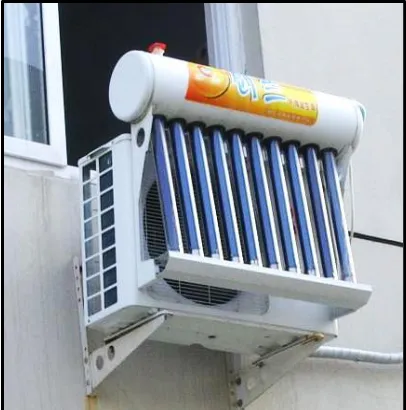
A conventional air conditioning system uses the compressor (powered by electricity) to pressurize and heat the refrigerant gas up to about 170 degree.
Hybrid Solar Air Conditioning
A standard air conditioning system uses a compressor to increase the pressure on the gas, forcing it into a liquid in the condenser coil. The change of state of the refrigerant starts to take place approximately 2/3rds of the way down the condenser. A Solar Hybrid Air Conditioning System uses a different method. It uses the heat from the sun to superheat the refrigerant which enables it to begin changing state in the top 2/3rds of the condenser coil. By using this method it reduces the superheat of compression required to achieve the cooling process in the conventional cooling system as well as utilizing more of the cooling face of the condenser coil. It is then travels
into the outside condensing coils where it changes from a gas into a saturated gas (partial liquid).
Fig.10(a) Hybrid air conditioning
Typically this occurs in the final third of the condensing coil. From there the saturated gas passes through an expansion devise that allows the refrigerant to become a gas again. Once this happens it can absorb heat from the air passing through the inside coil of the air conditioner. From there the refrigerant goes back to the compressor where it starts the whole cycle again.
Fig.10 (b) Hybrid air conditioning flow diagram
302 the compressor is to pressurize and heat the refrigerant. The hotter it gets the better. A hybrid solar air conditioning system uses a highly efficient vacuum tube collector filled with an organic liquid product. The collector heats the organic substance to over 350 degrees using the power of the sun to superheat the refrigerant above what the compressor would be able to heat it with electricity. The resulting efficiency derived from the solar collector allows for the refrigerant to work more efficiently with no additional moving parts or motors. This increases the ability of the gas to change back into a liquid much quicker and dramatically reduces the energy requirement of the compressor. The gas now condenses back into saturated gas in the first third of the condensing coil not the final third. Therefore by the time the refrigerant reaches the expansion devise in the inside coil, it is already almost a liquid. This allows the near liquid refrigerant to be more efficient at absorbing heat, making it 5-6 degrees cooler in the inside coil, delivering colder, drier air to the building.
2.12 Thermo Electric Seebeck Effect Air Conditioning
A full electrical heat to cold option without any mechanical work has such a low COP that at today's it is not practical. The first stage, call it a thermoelectric generator, is the Seeback Effect where the heat from the solar collector is transferred into electrical energy. As with the thermoelectric coolers thermoelectric generators are currently very ineffective due to large leakage of heat through conduction from the hot to the cold side. This could as in the case with the thermoelectric coolers be prevented by a small vacuum gap between hot and cool side. Projected Carnot efficiency for a thermoelectric generator with a vacuum gap is according to Borealis exploration limited 70-80%, which is a very high efficiency.
The second stage, is the Peltier Effect where electricity is changed directly into a temperature effect. Using the sun's energy through the Photovoltaics solar option instead of the first stage (using thermal solar to electric energy), then use thermoelectric cooling (Peltier) second stage has been experimented with more often and is more efficient than the combinations of Seebeck and Peltier. Advantages of the two stage thermoelectric is it would be a very compact system, no or few moving parts and can handle heavy vibrations.
References
1. Hans-Martin Henning (Ed.), Solar-Assisted Air-Conditioning in Buildings, A Handbook for Planners, Springer, Wien, New York, ISBN 3-211-00647-8.
2. ASHRAE Handbook (1988), Absorption Cooling, Heating and Refrigeration Equipment
3. H.M. Henning (2004), Design and performance of a new thermally driven air conditioning system for Mediterranean climates, VII Euro- Mediterranean Conference, Local Utilities and Sustainable Development in the Mediterranean Area, Palermo, pp 3–5
4. Ikerlan 2004, Gas absorption cooling system, Ikerlan Annual Report 2004, pp. 25.
5. Mathias Safarik, Lutz Richter, Carsten Heinrich, Mike Otto (2004), Small capacity water/lithium bromide absorption chiller for solar cooling applications, Proc. EuroSun, Freiburg, Germany.
6. Annett Ku¨hn, Jan Albers, Mario Harm, Paul Kohlenbach, Stefan Petersen, Christian Schweigler, Felix Ziegler
(2004), Betriebsverhalten einer 10 kW
Absorptionska¨lteanlage fu¨ r niedrige
Antriebstemperaturen, Proc. Deutsche Ka¨lte-Klima-Tagung, Bremen
7. Task 25, 2002, Ongoing research relevant for solar assisted air conditioning systems, Technical Report, IEA Solar Heating and Cooling; Task 25: Solar-assisted air-conditioning of building
8. Tomas Nu´n˜ ez, Walter Mittelbach, Hans-Martin Henning (2004), Development of an adsorption chiller and heat pump for domestic heating and air conditioning applications, Proc. Third International Conference on Heat Powered Cycles – HPC 2004, Larnaca, Cyprus
9. Chris Bales, Fredrik Setterwall, Go¨ran Bolin (2004), Development of the thermo chemical accumulator (TCA),
Proc. EuroSun, Freiburg, Germany.
10. R. de Boer, W.G Haije, J.B.J. Veldhuis, S.F. Smeding (2004), Solid-sorption cooling with integrated thermal storage – the SWEAT prototype, Proc. 3rd International Conference on Heat Powered Cycles – HPC 2004, Larnaca, Cyprus
11. A. Afonso, M. Collares-Pereira, L.F. Mendes, J.F. Mendes (2004), A solar/ gas powered absorption prototype to provide small power heating and cooling, Proc. EuroSun, Freiburg, Germany.
12. E. Podesser (2003), Solar cooling activities in Austria,
Proc. ISES Solar World Congress, Solar Energy for a Sustainable Future, Go¨teborg, Sweden
13. Ju¨rgen Ro¨ben, Klimatisierung mit wa¨ssriger Salzlo¨sung – Forschung, Entwicklung, Praxis (2004), Proc. Workshop Solares Ku¨hlen in der Praxis, Stuttgart/Germany
14. K. Gommed, G. Grossman (2004), Experimental study of a liquid desiccant system for solar cooling and dehumidification, Proc. EuroSun, Freiburg, Germany.
15. E. La¨vemann, Erste großtechnische (2004), Anwendung von Flu¨ ssigsorption in einem Bu¨rogeba¨ude in Amberg, Proc. Workshop Solares Ku¨hlen in der Praxis, Stuttgart/Germany
16. M. Motta, H.M. Henning, V. Kallwellis (2004), Performance analysis of a novel desiccant and evaporative cooling cycle, Proc. 3rd International Conference on Heat Powered Cycles – HPC 2004, Larnaca, Cyprus