Comparative toxicities of bulk and
nanoforms of TiO2 and CuOin the fresh
water fish Rasboradandia(Ham.1872)
Indulekha.R
1, Dr.George Thomas
21,2
PG and ResearchDepartment of Zoology, University College, Trivandrum,Kerala,India.
Abstract- The acute toxicity of nano-scaled metal oxides CuO and TiO2 were examined and compared to that of their respective bulk (micro-scaled) counterparts in the fresh water fish Rasboradandia for 96 h. Nanoparticles with different sizes, viz. of CuO of 25 nm, TiO2 of20nm were evaluated for their toxicity by estimating LC50 at 96 hrs. Median lethal concentrations (LC50)that were determined by probit analysis was found to be 97.02 ppm for CuOnp, 518.3 ppm for TiO2np and 2263 and 599 ppm for their bulk forms respectively. The results proved that nanoparticles showed acute toxicity to fishes when exposed for 96 hrs and this could reveal the fact that exposure of nanoparticles may result in adverse toxic effects to fishes that eventually affects the health status of the aquatic ecosystem.
Keywords –Nanoparticles, LC50, Copper oxide, Titanium dioxide, Rasboradandia
I. INTRODUCTION
Nanotechnology has emerged as a fast growing sector impacting key economical fields and providing new engineered nano-enabled products, constituted by nanoparticles (NP), with novel and unique functions that reach the market every day. The application of nanotechnology finds wide use in almost all fields.NP with a size between 1 and100 nm ,possess unique physicochemical properties, but the same properties can be problematic in a toxicological perspective. Therefore, increased focus on various toxicological issues related to nanoparticles is now critical. This size related-properties results in larger reactivity and higher mobility (Rauscher et al., 2014), leading to numerous applications in medical diagnostics, electronics, computers, cosmetics and environmental remediation. (Cha and Myung, 2007; Bouret al.,2015).The major concern about metal oxide np is that because of their chemistry, size, and nonbiodegradable nature, they will rapidly distribute throughout the environment with unknown consequences. Until now little is known about the potential toxicity of metal oxide np.The rapid expansion of np increases the chance for release into aquatic environments. It is also important to distinguish effects of np from its bulk forms when assessing the toxicity of metal oxide np (Wang et al., 2009).
CuOnp is widely used as additives in lubricants, polymers/plastics, metallic coating, inks etc. chemical industry, electronics, biomedicine, bio remediation etc. TiO2 is an opacifier which is used in paints, paper, plastic, and many cosmetics products (Jiang, 2009; Klaineet al., 2008). This np will inevitably enter the environment and cause significant adverse effects to aquatic organisms. Therefore, there is a need to develop rapid and sensitive screening methods to monitor the potential impact of toxicants; besides water qualities. Previous work have investigated the toxicity of ZnO and Al2O3 np to plants (Lin and Xing, 2007, 2008), ZnO, CuO and TiO2np to bacteria (Reddy et al., 2007; Heinlaanet al., 2008; Huang et al.,2008), ZnOnp to freshwater microalga (Franklin et al., 2007), and ZnO,TiO2, SiO2 and C60np to D. magna (Adams et al., 2006; Lovern et al.,2007). Very few studies are available on the toxicity of metal oxide np to fresh water fish especially in tropical environments (Griffith et al.,2008). Hence, the present study has been proposed to determine the acute toxicity of CuO and TiO2np to the freshwater fish R. dandiaand to compare the toxicities between the np and its bulk counter parts.
II. MATERIALS AND METHODS
2.1Test chemicals and species–
Healthy fishes (length 8 ± 2 cm) were collected locally from Trivandrum and were confined to large glass aquaria bearing tap water for a period of two weeks in the laboratory for acclimation. They were kept in batches (10 each) in 50L tanks filled with dechlorinated tap water. The fishes were fed twice daily and the water was renewed every day by routine cleaning of aquaria to remove fecal matter or death fish (if any). Prior to the commencement of the experiment,feeding was stopped. The physico–chemical characteristics of the water was analysed as per standard procedures (APHA, 2008) .
suspensions of 1000 ppm were dispersed in millipore water by sonication prior to use.The NP suspensions were sonicated for 30 min using Ultrasonic probe sonicator, HielscherUSA,UP100H(100watts, at a frequency of 30 kHz )prior to the toxicity testing. The hydrodynamic size of the np in the suspensions was measured using TEM. To determine the acute toxicity effects of selected nanoparticles, the median lethal concentration or LC50 values for 96 h were determined by probit analysis, with a confidencelevel of 0.05 (Finney, 1971). In order to assess LC50 of the nanoparticles, the fishes were not fed a day prior to and during the test period to reduce fecal and excess food contaminating the test solution. For the analysis of acute toxicity, 10 fishes each were exposed separately to different concentrations of the chemical and mortality was recorded after 96 hours of exposure. Control groups were also maintained without the addition of chemicals.
A wide range of concentrations were prepared for each metal oxide used in the study. The concentrations were selected based on the results of range finding tests, so that the concentrations of test chemicals were increased in geometric proportion series in each group as follows: Group I: CuO-bulk at seven different concentrations, ie., 10, 20, 30, 40, 50, 60 and 70 ppm for 96 h, Group II: CuOnp at eight different concentrations, ie., 5, 25, 50, 75, 100, 125, 150 and 175 ppm for 96 h, Group III: TiO2-bulk at nine different concentrations ie., 25, 50, 75, 100, 125, 150, 175, 200 and 225 ppm for 96 h, and Group IV: 200,300,400,500,600,700,800 ppm for TiO2 np. The movement and the behaviour along with the mortality of fishes were continuously monitored throughout the study. Fishes without any movement for a long period were considered as dead and were removed from the tanks immediately to prevent contamination.
2.2 Statistical analysis
All experiments were performed in triplicates for the accuracy of the results. Total number of animal used in the experiments, the exposure concentrations and the mortality rate in each experiment were fit to a probit model using log10 concentration transformation using the statistical package SPSS 22.0. The correlation between concentration on Y-axis and mortality on X-axis and the best-fit line was obtained by plotting graph using MS Excel 2007
III. EXPERIMENT AND RESULT
Physico-chemical features of the test water were analysed as per APHA guidelines and recorded as: Water temperature- (26± 2 °C)
Dissolved Oxygen (mg/L)- 6.9; Total Hardness (mg/L)- 225; pH ±7.4
Figure.1. TEM images of TiO2 and CuO nanoparticles
The shape and size distribution of the CuO and TiO2 nanoparticles were evaluated by TEM (Fig. 1). The average size of the particles was found to be 25 and 20 nm respectively.
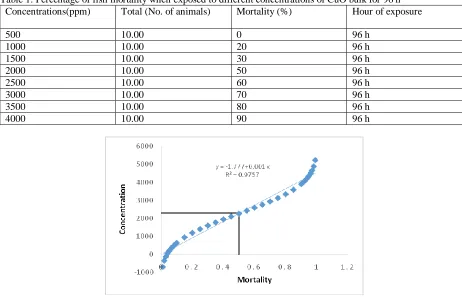
Fishes exposed to xenobiotics were divided into 4 groups and mortality of the fishes in each group was continuously monitored throughout the experiment. It was observed that in Group I of CuO bulk exposed fishes no mortality was observed at 500ppm for 96 h duration. At 1000, 1500 ppm, fishes showed 20 and 30 % mortality, respectively. However, at 4000 ppm total mortality of fishes was observed at 96 h (Table 1). In Group II of np treated fishes, no mortality was observed at 5, and 25 ppm concentrations up to 96 h. Cumulative mortality of 10 and 30% were observed at 50 and 75ppm concentrations, and 100% mortality was recorded at 175 ppm.(Table 3 ).
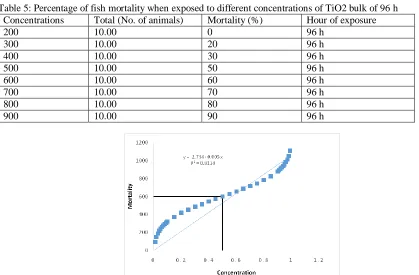
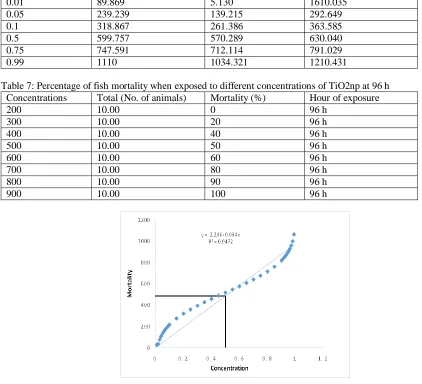
Acute LC50 values at 96 hrs were recorded as 2263 ppm for CuO bulk, 97.02 ppm for CuO np,599 ppm for TiO2 bulk and 518 ppm for TiO2 np (Tables 2,4 and 6; Figs. 3-5). The results of probit analysis indicated that the percentage of mortalities were positively correlated (r = 0.97, 0.78, 0.81 and 0.94) with the concentrations of CuO bulk, CuOnp, TiO2 bulk and TiO2-NPs, with r values 0.97, 0.78, 0.81 and 0.94 respectively.
Table 1: Percentage of fish mortality when exposed to different concentrations of CuO bulk for 96 h Concentrations(ppm) Total (No. of animals) Mortality (%) Hour of exposure
500 10.00 0 96 h
1000 10.00 20 96 h
1500 10.00 30 96 h
2000 10.00 50 96 h
2500 10.00 60 96 h
3000 10.00 70 96 h
3500 10.00 80 96 h
4000 10.00 90 96 h
Figure .2 Results of the probit analysis showing the relationship of concentrations of CuO bulk to mortality of Rasboradandia
Table 2: Probit analysis of 95% confidence limits for effective concentrations of CuO bulk in Rasboradandia 95% Confidence Limits
Prob Concentration (ppm) Lower Upper
0.01 33 4.009 38.270
0.05 168.5 12.282 35.097
0.1 631.160 265.273 407.573
0.5 2263 2097.062 2428.038
0.75 3122 2927.592 3361.822
0.99 5225 4786.337 5823.971
Table 3: Percentage of fish mortality when exposed to different concentrations of CuOnp at 96 h Concentrations Total (No. of animals) Mortality (%) Hour of mortality
5 10.00 0 96 h
25 10.00 0 96 h
50 10.00 10 96 h
75 10.00 30 96 h
100 10.00 50 96 h
125 10.00 80 96 h
150 10.00 90 96 h
Figure 3. Results of the probit analysis showing the relationship of concentrations of CuOnp to mortality of Rasboradandia
Table 4: Probit analysis of 95% confidence limits for effective concentrations of CuOnp in Rasboradandia 95% Confidence Limits
Prob Concentration (ppm) Lower Upper
0.01 17.043 1.751 28.655
0.05 40.473 28.892 49.456
0.1 52.963 43.222 60.683
0.5 97.021 91.452 102.609
0.75 120.210 114.101 127.410
0.99 176.999 165.294 192.422
Table 5: Percentage of fish mortality when exposed to different concentrations of TiO2 bulk of 96 h Concentrations Total (No. of animals) Mortality (%) Hour of exposure
200 10.00 0 96 h
300 10.00 20 96 h
400 10.00 30 96 h
500 10.00 50 96 h
600 10.00 60 96 h
700 10.00 70 96 h
800 10.00 80 96 h
900 10.00 90 96 h
Figure 4. Results of the probit analysis showing the relationship of concentrations of TiO2 bulk to mortality of Rasboradandia
Table 6: Probit analysis of 95% confidence limits for effective concentrations of TiO2 bulk in Rasboradandia 95% Confidence Limits
0.01 89.869 5.130 1610.035
0.05 239.239 139.215 292.649
0.1 318.867 261.386 363.585
0.5 599.757 570.289 630.040
0.75 747.591 712.114 791.029
0.99 1110 1034.321 1210.431
Table 7: Percentage of fish mortality when exposed to different concentrations of TiO2np at 96 h Concentrations Total (No. of animals) Mortality (%) Hour of exposure
200 10.00 0 96 h
300 10.00 20 96 h
400 10.00 40 96 h
500 10.00 50 96 h
600 10.00 60 96 h
700 10.00 80 96 h
800 10.00 90 96 h
900 10.00 100 96 h
Figure 5. Results of the probit analysis showing the relationship of concentrations of TiO2np to mortality of Rasboradandia
Table 8: Probit analysis of 95% confidence limits for effective concentrations of TiO2np in Rasboradandia 95% Confidence Limits
Prob Concentration (ppm) Lower Upper
0.01 28.349 13.633 53.502
0.05 131.817 49.366 193.877
0.1 217.201 148.952 269.345
0.5 518.395 486.513 549.292
0.75 676.915 642.037 718.766
0.99 1065 988.231 1168.510
IV. DISCUSSION
Engineered nanoparticles may present living systems with a uniquely novel challenge, since such materials were not generally encountered by living organisms during the course of biological evolution (Dowling, 2004; Colvin, 2003, 2004; Howard, 2004; Moore, 2002; Warheit,2004).Metal-based nanotechnologies are increasingly used for environmental remediation and several industrial processes; however, toxicological impacts of metal np on the aquatic ecosystem remain poorly understood (Chen et al., 2012).Determination of the LC50 values is highly useful in the evaluation of safe levels or tolerance levels of pollutants (Prenteraet al., 2004)
Rasboradandia. Results of 96-h bioassay showed that CuOnp had the lowest LC50 value and thus, it is the most toxic metal oxide form among the tested ones in this study. The median lethal concentrations of CuOnp, CuO bulk, TiO2-np and TiO2-bulk were 2263, 97.02, 599.7, 518.3 ppm, respectively. Besides, 100% mortality of fishes was observed at 120 ppm concentration of CuOnp whereas, in TiO2 np exposure, 100% mortality rate was observed only at 900 ppm concentration after 96hrs. Therefore, the nanoparticles CuO is comparatively more toxic to the fish than TiO2 np. TiO2np of less than 25 nm was reported to cause higher growth inhibition of algae (Desmodesmussubspicatus) and greater immobilization of Daphnia magna than those bigger than 100 nm (Hund-Rinke and Simon, 2006). In addition, exposure to 0.22 μm filtered TiO2np caused higher mortality among D.magna than un-filtered ones, indicating that toxicity might be directly related to the size of the dispersed np(Lovern and Klaper, 2006).The toxicities of oxide np have been reported for mammalian cell lines (Chang et al., 2007), bacteria (Huang et al., 2008), and crustaceans (Heinlaanet al., 2008). Heinlaanet al., (2008) reported that nanoCuO showed more toxicity than bulk CuO to Crustaceans. The difference in toxicity might be due to the difference in chemical composition and size of the nanoparticles as reported in these studies.
Hall et al.,2009 reported very high LC50 values of >500 mg/L were observed for fathead minnow( Pimephalespromelas ) after 48hourrsof exposure to TiO2np, whereas in Oreochromismykiss 96 hr LC50 of TiO2npwas>100 mg/l (Warheitet al., 2007) and no effects on Daniorerio were observed below 500 mg/L (Zhu et al., 2008).These observations agree with the results of the present study which recorded an LC 50 value of 518.3 ppm for TiO2np at 96 hours in Rasboradandia. Sub lethal effects of nanosized TiO2 have been reported on juvenile rainbow trout (Oncorhynchusmykiss) after 14 days waterborne exposure (Federiciet al., 2007) and 8 weeks exposure through fish food (Ramsdenet al., 2009). In the above mentioned studies, the authors assessed TiO2np of different sizes and with or without different stabilization agents, which seems to be the reason for the differing acute toxicity. Comparison of LC50 at 96 hrs indicates that the toxicity of nanoparticles and their bulk forms are in the order of CuOnp> TiO2np>TiO2 bulk >CuO bulk. When compared to their bulk counterparts, CuOnp were found to be more toxic at lower concentration whereas TiO2np and bulk form produced mortality at a similar concentration. Although the np of CuO and TiO2 used in the study were almost similar in size they differ very much in their toxicity. A key difference between bulk and nanoscale materials is the much higher surface area of a given mass or volume of nanoparticles (NPs), compared to an equivalent weight or volume of bulk material particles. This increased surface area enhances certain properties of the materials.(Clemente et al.,2013)
TiO2 nanoparticles were not more toxic compared to larger particles as observed by when rats were exposed to TiO2np and that the toxicity was not dependent on particle size/surface area, but rather the surface reactivity (Warheitet al.,2006, 2007). However, Adams et al., (2006) reported no difference between TiO2, SiO2, ZnOnp and bulk toxicity to bacteria because they formed similar size aggregates. Franklin et al,. (2007) also reported similar toxicity between ZnOnp and bulk forms to freshwater microalgae. Therefore np toxicity, caused by size or by composition, differ very much in their toxic effects.TiO2np seems to be less toxic than other metal oxide np, TiO2 exists in different structural forms with different properties and consequent environmental impacts. Among them, anatase and rutile are considered the most likely to be found in the environment (Ju-Nam and Lead,2008).In the present study np selected was anatase form considering its diverse array of industrial and medical applications.Toxicities of TiO2npanatase have been reported to be biologically more active in terms of cytotoxicity or DNA damage (Affuanet al., 2009). Their toxic effects were reported in zebra fish embryos after exposure to 500mg/l of anatase TiO2 (Zhu et al.,2008).
Hence nanoparticles remain unpredictable in their toxicities when exposed to the environment. NP are behaving very differently from their bulk particles of the same chemical composition (Wiggintonet al., 2007).This may be attributed to high reactivity, small size, and high surface area per unit volume of np. Direct np toxicity results from the chemical composition and surface reactivity (Navarro et al., 2008).
V.CONCLUSION
The widespread application of manufactured metal oxide NPs arises great concern about their safety for human and aquatic organisms. The high toxicity of nanoparticles shows that the nano level gives rise to specific concern. But today there is a lack of information regarding if nanoparticles of different composition are more toxic than larger particles when assessing differenttoxicological outcomes. Hence acute toxicity study of different nanoforms needs much attention
VI. REFERENCES
[1] Adams, L.K., Lyon, D.Y., Alvarez, P.J.J. 2006. Comparative eco-toxicity of nanoscale TiO2, SiO2, and ZnO water suspensions. Water Research, 40: 3527–3532.
[2] Auffan, M., Rose J., Wiesner, M R, Bottero, J. 2009.Chemical stability of metallic nanoparticles: a parameter controlling their potential cellular toxicity in vitro. Environ Pollut.157:1127-1133.
[4] Cha, K.E., Myung, H., 2007. Cytotoxic effects of nanoparticles assessed in vitro and in vivo. J. Microbiol. Biotechnol., 17: 1573 –1578. [5] Chang, J.S., Chang, K., Liang, B., Hwang, D.F., Kong, Z.L. 2007. In vitro cytotoxicity of silica nanoparticles at high concentrations
strongly depends on the metabolic activity type of the cell line. Environ. Sc. & Technol., 41 (6):2064–2068.
[6] Chen, P.J., Tan, S.W., Wu, W.L. 2012. Stabilization or oxidation of nano-scale zero valent iron at environmentally relevant exposure changes bioavailability and toxicity in medaka fish. Environ. Sci.Technol., 46:8431–8439.
[7] Clemente, Z., CastroV,L.,Feitosa ,L. O. ,Lima ,R., JonssonC.M., Maia ,A.H.N.,Fraceto ,L.F.2013. Fish exposure to nano -TiO2 under different experimental conditions:Methodological aspects for nanoecotoxicology investigations.Science of the Total Environment. 463–464, 647–656.
[8] Dowling, A.2004. Development of nanotechnologies. Mater Today,7(1):30–5
[9] Federici, G., Shaw, B.J., Handy, R.D., 2007. Toxicity of titanium dioxide nanoparticles to rainbow trout (Oncorhynchusmykiss): gill injury, oxidative stress, and other physiological effects. Aquatic Toxicol. 84: 415-430.
[10] Finney, D.J.1971. Probit analysis, 3rd ed. Cambridge University Press, London, 333pp.
[11] Franklin, N.M., Rogers, N.J., Apte, S.C., Batley, G.E., Gadd, G.E., Casey, P.S. 2007.Comparative toxicity of nanoparticulateZnO, bulk ZnO, and ZnCl2 to a freshwater microalga (Pseudokirchneriellasubcapitata): the importance of particle solubility. Environmental Science & Technology, 41: 8484–8490.
[12] Gatoo, M.A., Naseem, S., Arfat, M.Y., Dar, A.M., Qasim, K.,Zubair,S.2014. Physicochemical properties of nanomaterials: Implication in associated toxic manifestations. BioMed. Research International, 2014:1-8.
[13] Griffitt, R.J.,Weil, R., Hyndman, K.A., Denslow, N.D., Powers, K., Taylor, D., Barber, D.S.2007. Exposure to copper nanoparticles causes gill injury and acute lethality in Zebra fish (Daniorerio). Environ. Sc and Technol., 41: 8178–8186.
[14] Hall, S., Bradley, T., Moore, J.T., Kuykindall, T., Minella, L., 2009. Acute and chronic toxicity of nano-scale TiO2 particles to freshwater fish, cladocerans, and green algae, and effects of organic and inorganic substrate on TiO2 toxicity. Nano Toxicol.3:91-97.
[15] Heinlaan, M., Ivask, A., Blinova, I., Bubourguier, H., Kahru, A. 2008. Toxicity of nanosized and bulk ZnO, CuO and TiO2 to bacteria Vibrio fischeri and crustacean Daphnia magna and Thamnocephalusplatyurus. Chemosphere, 71: 1308–1316.
[16] Howard, C.V.2004. Small particles - big problems. Int. Lab News ,34(2):28–9.
[17] Huang, Z., Zheng, X., Yan, D., Yin, G., Liao, X., Kang, Y., Yao, Y., Huang, D., Hao, B.2008. Toxicological effect of ZnO na noparticles based on bacteria. Langmuir 24,4140–4144.
[18] Hund-Rinke .K., Simon, M.2006.Ecotoxic effect of photocatalytic active nanoparticles (TiO2) on algae and daphnids. Environ SciPollut Res.13:225–32.
[19] Jiang, Wei.,Mashayekhi, Hamid., Xing, Baoshan.2009. Bacterial toxicity comparison between nano- and micro-scaled oxide particles. Environ Poll. 157: 1619–1625.
[20] Ju-Nam,Y.,Lead, J.R.2008.Manufactured nanoparticles: an overview of their chemistry, interactions and potential environmental implications. Sci Total Environ.400:396-414.
[21] Keller, A.A., Wang, H., Zhou, D., Lenihan, H.S., Cherr, G., Cardinale, B.J., Miller, R., Ji, Z.2010. Stability and aggregation of metal oxide nanoparticles in natural aqueousmatrices. Environ. Sci. Technol., 44: 1962–1967.
[22] Klaine, S.J., Alvarez, P.J.J., Batley, G.E., Fernandes, T.F., Handy, R.D., Lyon, D.Y.,Mahendra, S., McLaughlin, M.J., Lead, J .R, 2008. Nanomaterials in the environment: behavior, fate, bioavailability, and effects. Environ. Toxicol. Chem.. 27: 1825–1851.
[23] Lin, D.H., Xing, B.S. 2007. Phytotoxicity of nanoparticles: inhibition of seed germination and root growth. Environ. Poll. 15 0:243–250. [24] Lin, D.H., Xing, B.S., 2008. Root uptake and phytotoxicity of ZnOnanoparticles.Environ. Sc& Technol., 42: 5580–5585.
[25] Lovern, S.B., Strickler, J.R., Klaper, R., 2007. Behavioral and physiological changes in Daphnia magna when exposed to nanopa rticle suspensions (titanium dioxide, nano-C60, and C60HxC70Hx). Environ.Sc. & Technol., 4 (12): 4465–4470.
[26] Lovern. S.B., Klaper R. 2006.Daphnia magna mortality when exposed to titanium dioxide and fullerene (C60) nanoparticles. Environ ToxicolChem .25:1132–7.
[27] Moore,M.N.2002. Biocomplexity :the post-genome challenge in ecotoxicology. AquatToxicol., 59:1–15.
[28] Navarro, E., Baun, A., Behra, R., Hartmann, N.B., Filser, J., Miao, A.J., Quigg, A., Santschi, P.H., Sigg, L. 2008. Environmental behavior and ecotoxicity of engineered nanoparticles to algae, plants, and fungi. Ecotoxicology ,17: 372–386.
[29] Prentera, J., MacNeila, C., Dicka, J.T.A., Riddella, G.E., Dunnb, A.M. 2004. Lethal and sublethal toxicity of ammonia to nati ve, invasive and parasitized freshwater amphipods. Water Res., 38:2847–2850.
[30] Ramsden, C.S., Smith, T.J., Shaw, B.J., Handy, R.D., 2009. Dietary exposure to titanium dioxide nanoparticles in rainbow trou t, (Oncorhynchusmykiss): no effect on growth, but subtle biochemical disturbances in the brain. Ecotoxicol. 18: 939-951.
[31] Rauscher,H., Roebben,G., Amenta, V., BoixSanfeliu, A., Calzolai, L., Emons, H. 2014.Towards a Review of the EC Recommendation for a Definition of the Term Nanomaterial Part 1: Compilation of Information Concerning the Experience with the Definition, In: Rauscher, H., Roebben, G.(eds.), JRC Scientific and Policy Report EUR 26567 EN.
[32] Reddy, K.M., Feris, K., Bell, J., Wingett, D.G., Hanley, C., Punnoose, A. 2007. Selective toxicity of zinc oxide nanoparticle s to prokaryotic and eukaryotic systems. Applied Physics Letters, 90:213902.
[33] Wang, Huanhua., Wick, Robert L.. Xing. Baoshan. 2009. Toxicity of nanoparticulate and bulk ZnO, Al2O3 and TiO2 to the nematod e Caenorhabditiselegans.Environ.Poll., 157 :1171–1177.
[34] Warheit, D.B., Hoke, R.A., Finlay, C., Donner, E.M., Reed, K.L., Sayes, C.M., 2007.Development of a base set of toxicity tests using ultrafine TiO2 particles as a component of nanoparticle risk management. Toxicol Letters. 171: 99-110.
[35] Warheit, D.B., Webb, T.R., Colvin, V.L., Reed, K.L., Sayes, C.M. 2007. Pulmonary bioassaystudies with nanoscale and fine-quartz particles in rats: toxicity is not dependent upon particle size but on surface characteristics. Toxicol. Sci., 95:270–280.
[36] Warheit, D.B.,Webb, T.R., Sayes, C.M., Colvin, V.L., Reed, K.L. 2006. Pulmonary instillation studies with nanoscale TiO2 rods and dots in rats: toxicity is not dependent upon particle size and surface area. Toxicol. Sci. 91:227–236.
[37] Warheit, D.B.2004 Nanoparticles: health impacts? Mater Today .,7:32–5
[38] Wigginton, N.S., Haus, K.L., Hochella Jr., M.F. 2007. Aquatic environmental nanoparticles. J. Environ. Monit., 9: 1306 –1316.
[39] Zhu, X., Chang, Y., Chen, Y.2010. Toxicity and bioaccumulation of TiO2 nanoparticle aggregates in Daphnia magna. Chemosphere,78: 209-215.