Page 196 www.ijiras.com | Email: [email protected]
Influence Of Project Implementation Practices On Project
Performance In Sonysugar Company, Kenya
Engineer Eric Ochieng Ngage
Student, Master of Science in Project Management, Jomo Kenyatta University of Agriculture and Technology, School for Human Resource Development, Nairobi, Kenya
Dr Willy Muturi
Lecturer,
Jomo Kenyatta University of Agriculture and Technology, College for Human Resource Development, Nairobi, Kenya
I. INTRODUCTION
Project performance is a concept used in an organizational context to measure the level of project impact, outcome and output delivery capability within an organization. (PMI, 2016). The finding of a research by Pulse indicates that fewer projects globally are being completed within budget or meeting original goals and business intent and there are essential needs to improving both project and business results. Results show current state of project outcomes as projects completed within original budge constitute 55%, projects completed on time 51%, failed project’s budget lost 32% (PMI, 2016). The study by Price Water House Coopers which covered all major sectors in the global economy sampled from
the organizations drawn from Africa, Asia, Australia, Europe, North America and South America, found that 50% of business projects failed, and only over 2% achieved 100% success (PWC, 2004). To enhance project performance, (Lin, Ho, and Huang (2007) recommended understanding of the processes of rework, effectiveness and efficiency in project delivery within time, cost and quality standard.
Project initiated, implemented and closed on time, within budget, at specified quality standards, and most importantly without unprecedented procurement delay is major criterion of measuring project performance. In order to improve the level of project performance in construction projects, the owners, consultants, and contractors, have to deal with the delay in procurement, causing materials shortage which was important Abstract: This study was motivated by poor project performance contributing to production losses, hence affecting the SonySugar generation. General objective of this study was to investigate influence of project implementation practices on project performance. Specifically this study sought to achieve the following four objectives: determine the influence of project cost management on project performance; examine the influence of projects time management on project performance; establish the effect of projects procurement management on project performance; assess the influence of project quality management on project performance. The methodology used was a descriptive survey applying stratified random sampling technique to select a sample size of 78 company employee’s management cadre who were involved in projects. Data was analyzed using descriptive and inferential statistics. The study revealed that there was a significant relationship between project implementation practices and project performance in SonySugar Company. The identified significant aspect were unsatisfactory project cost management, uncoordinated project time management, inadequate project procurement management and insufficient project quality management. The findings and recommendations of this study could benefit key project participants and researchers. Based on these findings the study recommends that: cost estimation should be clearly defined with appropriate precision, putting realistic timelines, giving autonomy to procuring entities by the government to procure their requirements establishing policies governing the process of project implementation in line set procedures.
Page 197 www.ijiras.com | Email: [email protected] performance factor (Enshassi, Mohamed & Abushaban, 2009.
Mbachu and Nkando (2007) established that quality and attitude to service is one of the key factors constraining successful project delivery in South Africa
Although the Kenya government sets aside enormous budget for developmental projects, Ministries, Departments and Agencies continue to register poor project performance due to sustained low absorption rates of capital expenditure. Therefore forcing the Government to scale down, postpone or abandon some of the projects contained in its manifesto. Some of the affected projects were the Standard Gauge Railway, delivery of 5,000 megawatts of power, putting 1 million acres under irrigation, reviving the tourism industry and reviewing mineral wealth are among the plans that faces a new reality. In Kenya like other sugar producing countries, sugar is one of major source of revenue contributing significantly to the socio-economic development growth.
A. PROJECT IMPLEMENTAION AT SONYSUGAR
SonySugar has been implementing projects since inception in 1979 and in the recent ten years, focused on capital project implementation through five year corporate strategic plans cycle. Replacement of the obsolete equipment present an opportunity for capital projects implementation at South Nyanza Sugar Company which could have evident effect of improving project performance, hence revenue and growth rates from planned projects (Adera, 2012). Projects that which were investigated encompass 250 m3 Vertical Crystallizer, Multi tray Clarifier and 80 ton Batch Pan Projects, Enterprise Resource Planning (ERP), Fire station building and Archive building. Work Breakdown Structure (WBS) and Gantt charts were the tools deployed in management and implementation of projects.
B. STATEMENT OF THE PROBLEM
Project implementation practices challenges in SonySugar have been cited by Internal Audit and also through other GoK agencies (MDG, 2010; KSB, 2014; Adera, 2012, Mbayi, 2012, Republic of Kenya, 2005). Internal Audit has repeatedly observed that projects performances are replete with abandonment of projects, cost and time overruns, financial difficulties. Subsequently leading to low productivity and high cost of sugar production as shown in SonySugar production data. Consequences of these underperformances of projects has contributed to the inability of SonySugar to meet production targets effectively and efficiently, hence unexpected costs and production losses which remained a serious concern to all stakeholders.
SonySugar has been planning a series of projects in the strategic plan under the capital expenditure framework to be undertaken over strategic plan period of five year cycle from 2004 to 2019. Report of an evaluation by Internal Auditors in 2015 on the progress of implementation of projects which had initiated, showed that projects cost more than similar ones in private sugar factories. This indicated there is a gap in project implementation practices as only a few number of project has been accomplished within the stipulated budget, time frame, quality. The study done by (Adera, 2012) on the influence of
organizational project maturity practices on performance of state corporations found that, projects implementation in the company was not well coordinated and lapses existed that needed restructuring to enhance project performance and factory operation output. Project performance in SonySugar had been affected by time overruns, slipped schedule, procurement delays and quality short fall therefore having a negative impact on company’s revenue and profitability.
A study by (Mbayi, 2012) on factors influencing implementation of projects in state owned sugar firms in Kenya concluded that SonySugar did not have structured framework for project implementation. Noted that, challenges associated with project performance included capital project cost management, schedule management, and procurement management. Project implementation practice factors are critical issue if not addressed, is likely to exacerbate underlying success factors of the project. With the challenges of project cost management, project time management, project procurement management and project quality management, SonySugar is likely to miss in project performance targets, required efficiency, production targets and cost reduction that would have made it competitive in the global market. Prevalence of poor project performance cannot be allowed to continue in SonySugar Company as it affects factory efficiency and sugar production therefore needs an urgent study for immediate exploitation of viable options that can fast track the revitalization. The study will try to address weak project implementation practices observed, provide a roadmap to accomplish planned projects within cost, time and quality hence improved project performance and profitability, stable, and robust organization.
C. RESEARCH OBJECTIVES
The general objective for this study was to investigate the influence of project implementation practices on project performance in South Nyanza Sugar Company; Specific objectives were; to determine the influence of project cost management on project performance, to examine the influence of project time management on project performance, to establish the effect of project procurement management on project performance and to assess the influence of project quality management on project performance in SonySugar Company.
II. LITERATURE REVIEW
A. THEORETICAL LITERATURE REVIEW
AGENCY THEORY
Page 198 www.ijiras.com | Email: [email protected] agent or managers. Agency theory is relevant to this study as
in project procurement management. the client or project owner becomes the principal and the vendor or consultant is referred to as an agent during project implementation .Agency theory attempts to describe the agency relationship, in which one party (the principal) delegates work to another party (the agent), who performs that work (Eisenhardt, 1989). In this relationship, the principal hires an agent to do the work, or to perform a task the principal is unable or unwilling to do.
For illustration, in an organization, the principals are the shareholders of a company, delegating to the agent, the management of the company, to perform tasks on their behalf. In project management, two important agency relationships are those between stakeholders and the project sponsor, and client and vendors. Agency theory is most relevant in situations in where contracting is difficult. The key point of agency theory is to test contracting problems in projects. The principal should know whether their agent’s actions serve in their best interest, if not then it follows that agency loss is likely to arise. One objection to agency theory is that it relies on an assumption of self-interested agents who seek to maximize personal economic wealth (Bruce, Bucks, & Main, 2005). Standards of agency duty and action is necessary to resolve the potential differences between the principal’s and the agent’s interests where they exists.
Technical consultant act as agents for their clients during project implementation. Agency theory can be applied to the agency relationship driven from the separation between ownership and control; organizations delegate control to professional project managers to run the implementation of Company projects on their behalf. Functional line manager normally play a passive role in the day-to-day management of the company projects. The separation of roles and control in project management help in avoiding a potential conflict of interests between contractors and clients. Sharma has extended the agency theory and focuses on the principal-professional relationship, where professionals can include consultants (Sharma, 1987). As a result of several high profile projects collapse, caused by over-dominant functional managers, there has been a very active debate about engaging consultants as professional to assist principals and how stakeholders can seek to ensure that consultants do not abuse their powers.
THEORY OF CONSTRAINTS
The theory of constraints is a method for optimizing project processes to boost overall project performance. The theory of constraints is looked at as it relates to successful project time management and project quality management. The theory of constraints is the conviction that every system has a constraint, or drawbacks that obstructs the system's performance. During project implementation, the constraint are normally cost, time, performance and quality. According to (Hales 2015), the idea behind the theory is to find and manage that constraint and evaluate performance with the view of improvements. Time is the major constraint and the most valuable resource in a project and it would be terrible if it is wasted. Every project delivery that is supposed to be made is time-bound. When it comes to project time management, it is not just the time of the project manager, but
the responsibility of the whole project implementation team to management as a constraint.
To minimise challenges related to project time, taking consideration of scheduling as one of the constraint in project time management is important. In this approach, utilization of resource allocation for each task is based on project activities estimation and duration determination. Utilization of resources can affected the quality of the output of the project. In addition to the estimate and resource allocation, cost element always plays a vital role in time management. This is due to the fact that schedule over-runs are quite expensive. During project implementation drawbacks may be experienced that are impacting negatively to the progress of the project. Normally there is need to resolve the situation quickly and put back the project on track, so utilization of the theory of constraints becomes a convenient. The basic premises of the theory of constraints assume that people can think, they are good and systems are simple (Goldratt, 2009). Using the theory of constraints is similar to reviewing the project as the biggest constraint or bottleneck, address the issue, and test the performance. This process is repeated until the project's performance is optimized and there are no constraints impeding the project. Identifying the constraint can be done using many methods, such as reviewing external processes, reviewing project assignments, looking into project management quality processes and timelines, and brainstorming with the project implementation team. Quantitative tools, which can give each constraint a numerical score, to determine the impact of each constraints a data driven decisions can be used. Once the constraint is identified, the next step is to manage the issue to optimize project performance to avoid impacting the project schedule or quality by brainstorming on how to manage the issue and improve project performance. Project time management and quality management are key responsibility of the project implementation team and therefore the whole team should be equipped with a strong skill and sense in time and quality management.
RESOURCE-BASED VIEW THEORY
Page 199 www.ijiras.com | Email: [email protected] equipment, manufacturing facilities, IT systems) have also
been found to positively affect innovation. Resource encompasses the ability to provide efficient and cost-effective project implementations on an ongoing basis
Resource comprises stakeholders, equipment, facilities, time, money required for the successful completion of the project (Turbit, 2005 ). Organizational and financial resources include a firm’s capital, formal reporting structure, planning, controlling, and coordinating systems as well as informal relations among groups within a firm and those in its environment. Foss and Knudsen (2003) assert that there is no doubt about how successful the resource-based view is to organizations. In the context of project management, the ability to avoid large, persistent cost overruns, unnecessary delay, and quality failure is likely to be an important precursor to superior. Peteraf and Barney (2003) assert that superior resources are more efficient in the sense that they enable a company to produce more economically and satisfy stakeholder needs. This is evident in the private sugar factories which has better project implementation practices that is not controlled by bureaucracy. In recent developments some organizations in the sugar sector have extended their product line and now producing fortified sugar through implementation of new project to stay competitive. This is as a result of changing consumer needs which is aimed at addressing, correcting, and preventing the known nutrient deficiencies amongst the Kenyan population.
III. RESEARCH METHODOLOGY
To take account of representation of all the cadre of respondents in the management from functional areas of the various departments, proportional calculation was considered to obtain sample size of 78 respondents from the population of 257 respondents who have had engagement with projects in the company and charged with the responsibility of project planning, implementation and evaluation. Four different strata or groups; 9 Executive Management, 26 Senior Management, 95 Middle Management and 127 Supervisors were identified. A stratified random sampling technique was used to select samples from the homogenous subgroup of job categories and grading. Mugenda and Mugenda (2003) asserts that stratified random sampling involves selecting subjects in such a way that the existing subgroups in the population are more or less reproduced in the sample.
Questionnaires encompassing a five point Likert scale containing both open and closed-ended questions was used as data collection instrument to aid gathering quantitative primary data. In social studies a questionnaire is used to measure opinions, attitudes, scores, intelligence (Welman & Kruger 2001). Seventy Eighty (78) questionnaires were given out to the respondents. The final data was then analyzed quantitatively using descriptive statistical measures as well as inferential statistics to give preview of the general trend. The analysis was carried out using the regression tool, SPSS to understand which among the independent variables are related to the dependent variable and to explore the forms of relationships. A regression equation was used to find out what relationship, if any, exists between sets of data.
IV. RESEARCH FINDINGS AND DISCUSSION
PROJECT PERFORMANCE
Table 1 summarizes the computed analysis and summary of the respondent’s attitude on the extent of projects performance’s acceptance in respective functional area. On the Likert scale of 1 - 2.5 Agree; (1≤ A < 2.5); 2.6 - 3.4 Uncertain (2.6 ≤ U < 3.4), and Disagree (3.5 ≤ D < 5.0). Assigning (1≤ A < 2.5) satisfactory, (2.6 ≤ U < 3.4) moderate, and (3.5 ≤ LE < 5.0) unsatisfactory.
Table 1: Project performance Indicators Results
Overall, the project performance in SonySugar is not satisfactory as indicated by a mean score of 2.52 out of a possible 5. It is worth noting that that the project performance is moderately satisfying with a mean score between satisfaction and dissatisfaction. The tendency toward dissatisfaction was due to failure of projects completion within specified quality with a mean score of 3.23 and projects required additional budget. This implied that project implementation in SonySugar lack coordination therefore gaps exist that are bound to cause poor performance. This supported the assertion by Adera (2012) that, cost overrun was caused by requested for supplementary budget approval on need basis to complete stalled projects.
PROJECT COST MANAGEMENT INFLUENCE ON PROJECT PERFORMANCE
V. great extent
Great extent Moderate
extent
Little extent V. little extent
Mea n
SD
f % f % f % f % f %
Budget pre determination & discussion prior to
initiation
25 35.7 33 47.1 3 4.30 5 7.10 4 5.70 2.00 1.10
Project cost preparation and
estimation
23 32.9 30 42.9 8 11.4 4 5.70 5 7.10 2.11 1.15
Adequate projects
budget allocation 19 27.1 21 30.0 19 27.1 8 11.4 3 4.3 2.36 1.1
3 Project cost reports
& update 7 10.0 35 50.0 16 22.9 10 14.3 2 2.9 2.50 0.9
6 Conducting
projects budget reviews meetings
16 22.9 22 31.4 16 22.9 10 14.3 6 8.6 2.54 1.2 4
Projects completed
within budget 15 21.4 23 32.9 19 18.6 11 15.7 2 2.9 2.46 1.0
9 Documenting
useful information on cost
19 27.1 28 40.0 13 18.6 8 11.4 2 2.9 2.33 1.07
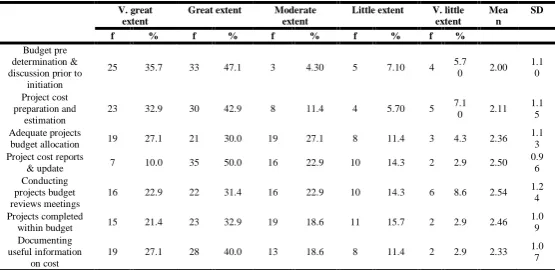
Table 2: Project Cost Management Indicators Response Descriptive
Page 200 www.ijiras.com | Email: [email protected] All project cost management factors considered except
only conducting project budget reviews meetings with a mean of 2.54 was outside the range of great extent (1≤ GE < 2.5), but still in the moderate extent bracket. The results indicated that, there were inadequate budget pre-determination and discussion prior to initiation and commencement, ineffective project cost preparation and estimation, inadequate projects budget allocation. The implication was inadequacy in budgeting process. The finding further indicated lack of adherence to budgeted project costs. Adherence to cost estimates is a phenomenon that if given attention can play a key role in reducing the occurrence of cost escalation, (Choge & Muturi, 2014). Documentation of useful information on cost monitoring and control during implementation as asserted by (Mbayi, 2012) in a research investigating factors influencing implementation of projects in state owned sugar firms in Kenya was deficient. Some of the projects were proposed without a clear plan on the sources of funding which led to delays and postponement or abandonment. This could be attributed to bureaucracy in getting budget approvals and laxity in conducting project budget review meetings. It could be argued that a more important reason was the thin spread of financial resources by the company over a large number of projects budgeted for implementation in a financial year. These were found to be impediments to projects performance for proposed projects.
PROJECT TIME MANAGEMENT INFLUENCE ON PROJECT PERFORMANCE
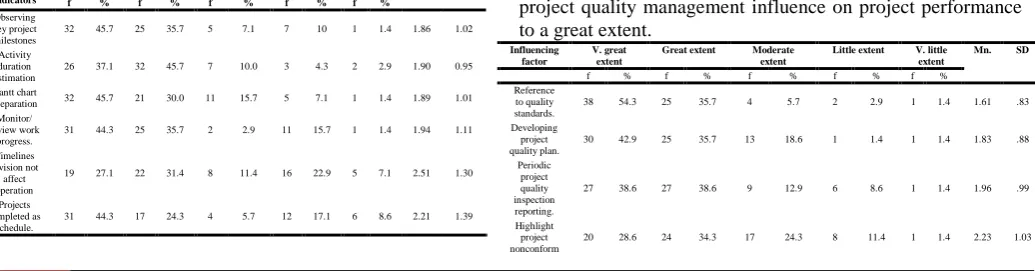
Table 3 shows the results the level of the agreement, if project time management was a factor that might assist the company improve on project performance. Scores of” strongly agree/agree” were taken to present a factor which had a mean score of 1 to 2.5 on the continuous Likert scale (1 ≤A < 2.5), Uncertain 2.6 ≤U < 3.4, disagree/strongly disagree 3.5≤ D < 5.0, where A is agree, U uncertain and D disagree. All the project time management indicators had the mean below 2.5 except revision and adjustment of timelines without affecting operation, implied that taking control of the indicators might assist in project time management and help the company improve on its project performance. In the study estimation of activity duration came out as a key indicator, pre-planning process is essential to package all estimates into complete project duration from start to finish. This depicts the same finding with (Owuor, 2011), that realistic project schedules should always be developed and adhered to in order to ensure timely completion of projects.
Project Time Management Indicators
Strongly Agree
Agree Uncertain Disagree Strongly
Disagree
Mn. Stdev
f % f % f % f % f %
Observing key project milestones
32 45.7 25 35.7 5 7.1 7 10 1 1.4 1.86 1.02
Activity duration estimation
26 37.1 32 45.7 7 10.0 3 4.3 2 2.9 1.90 0.95
Gantt chart
preparation 32 45.7 21 30.0 11 15.7 5 7.1 1 1.4 1.89 1.01 Monitor/
review work progress.
31 44.3 25 35.7 2 2.9 11 15.7 1 1.4 1.94 1.11
Timelines revision not
affect operation
19 27.1 22 31.4 8 11.4 16 22.9 5 7.1 2.51 1.30
Projects completed as
schedule.
31 44.3 17 24.3 4 5.7 12 17.1 6 8.6 2.21 1.39
Table 3: Project Time Management Indicators and Descriptive Statistics
PROJECT PROCUREMENT INFLUENCE ON
PROJECT PERFORMANCE
Table 4 contain respondents’ responses on project procurement management indicators. Mean score of 1-2.5 represent “Strongly agree and agree” on the continuous Likert scale, (1≤Agree<2.5), uncertain, (2.6≤Uncertain<3.5); disagree and (3.6≤disagree<5.0); strongly disagree. From the above findings, failure to implement procurement plan was prominent with a mean score of 1.53. Government delay in approving project budgets with high threshold, mean score of 1.71. This corroborate with (Sebastian M, 1990) assertion that, as projects get delayed during the implementation due to requirement for approval by the Government of the revised estimates. Requirement by the Government to follow Public Procurement & Disposal Act 2015, mean of 1.87 while inadequate contract administration with a mean of 1.96 and. Poor solicitation procedure with a mean of 2.10. Least important is lack of knowledge about the right source with mean score of 2.11 The results show all the identified project procurement management indicators were within the range of (1≤Agree<2.5) implying that project procurement management influence project performance.
Strongly Agree
Agree Uncertain Disagree Strongly
Disagree
f % f % f % f % f % Mean Std
Failure to implement procurement
plan.
45 64.3 18 25.7 3 4.3 3 4.3 1 1.4 1.53 .880
Government
regulations 32 45.7 26 37.1 5 7.1 3 4.3 4 5.7 1.87 1.10 Poor solicitation
procedure 23 32.9 27 38.6 13 18.6 4 5.7 3 4.3 2.10 1.07 Knowledge from
right source. 27 38.6 23 32.9 10 14.3 5 7.1 5 7.1 2.11 1.21 Delayed Govt.
approvals 38 54.3 19 27.1 9 12.9 3 4.3 1 1.4 1.71 .950 Inadequate
contract administration
20 28.6 37 52.9 10 14.3 2 2.9 1 1.4 1.96 .824
Table 4: Influence of Project Procurement Management on Project Performance
PROJECT QUALITY MANAGEMENT AND PROJECT PERFORMANCE
Table 5 shows respondents’ response on identified project quality management indicator; the attitude on factors contributing to project quality management. Based on the argument that 1.0 to 2.5 on the continuous Likert scale great extent; (1≤ GE <2.5), moderate extent 2.6 ≤ ME < 3.4, and little extent 3.5≤ LE <5.0. All the indicators mean fall in (1≤ GE <2.5) range implying that all of this factors contribute to project quality management influence on project performance to a great extent.
Influencing factor
V. great extent
Great extent Moderate
extent
Little extent V. little
extent
Mn. SD
f % f % f % f % f %
Reference to quality standards.
38 54.3 25 35.7 4 5.7 2 2.9 1 1.4 1.61 .83
Developing project quality plan.
30 42.9 25 35.7 13 18.6 1 1.4 1 1.4 1.83 .88
Periodic project quality inspection reporting.
27 38.6 27 38.6 9 12.9 6 8.6 1 1.4 1.96 .99
Highlight project nonconform
Page 201 www.ijiras.com | Email: [email protected]
ity. Project
scope change requests and
approvals
18 25.7 29 41.4 17 24.3 5 7.1 1 1.4 2.17 .94
Project acceptance
criteria documentati
on
33 47.1 21 30 5 7.1 10 14.3 1 1.4 1.93 1.12
Appointmen t quality assurance teams.
30 42.9 21 30.0 11 15.7 5 7.1 3 4.3 2.00 1.12
Ex-post project evaluation.
19 27.1 22 31.4 19 27.1 5 7.1 5 7.1 2.36 1.16
Project monitoring
and evaluation
31 44.3 24 34.3 12 17.1 2 2.9 1 1.4 1.83 .91
Table 5: Response on Project Quality Management Descriptive Data
Project progress monitoring and evaluation was considered necessary since it guided a project to successful completion through taking stock of positive progress and considering actions for mitigating deviations from plan. Developing project quality plan also served as forums to build consensus among team implementation teams and other project stakeholders for decision making especially on project scope change requests and approvals. The results of the research are consisted with findings of (Adera, 2012)that the company depicted a moderated level of adoption of quality management into the project management maturity practices.
REGRESSION ANALYSIS
A regression model was developed where all the key factors under each predictor’s variable were tested to determine specific effect they had on the dependent variable. The analysis utilized SPSS software to facilitate all computations and output for interpretation of the study.
Model R R Square Adjusted R
Square
Std. Error of the Estimate
1 0.497a 0.247 0.201 0.873
a. Predictors: (Constant), Project Procurement Management, Project Cost Management, Project Time Management, Project Quality Management
b. Dependent Variable: Projects Performance
Table 6: Model Summary of project implementation practices
SUMMARY OF MODEL
Result summary in Table 6 indicate, 49.7% correlation exists between project implementation practices and project performance as indicated by the R value of 0.497. This shows a medium relationship between project implementation practices and project performance. The result further indicates 24.7% of the variation of project implementation practices is due to variation in project performance. When the level of variance is adjusted for possible errors due to estimation, it is reduced marginally to 20.1%. This implies that the data fits the regression model.
ANALYSIS OF VARIANCE
Model Sum of
Squares
Df Mean
Square
F Sig.
1 Regression 16.270 4 4.068 5.341 0.001
b
Residual 49.501 65 0.762
Total 65.771 69
a. Dependent Variable: project performance.
b. Predictors: (Constant), Project Procurement Management, Project Cost Management, Project Time Management, Project Quality Management.
Table 7: ANOVA (Analysis of Variance)
The results of analysis of variance (ANOVA) for regression coefficients are shown in table 7. The sig column shows the goodness of fit of the model. The results indicate the significance of the F statistic is 5.341and the p value is 0. 0.001 at 95% level of significant. Typically, as “Sig” is less than 0.05, it is concluded that the model could fit the data. This implies that this model is statistical significant and a relationship between the variables could be found. Therefore it implies the model was accepted.
REGRESSION COEFFICIENTS RESULT
Model Unstandardized
Coefficients
t Sig.
B Std. Error
1
(Constant) 1.207 0.369 3.271 0.002
Project Cost Management -0.322 0.107 -3.017 0.004
Project Time Management. 0.314 0.107 2.942 0.005
Project Procurement Management
0.219 0.098 2.226 0.029
Project Quality Management 0.261 0.112 2.341 0.022
a. Dependent Variable: Project performance.
Table 8: Regression Individual Coefficients Results
The regression model was specified as Y= 1.207– 0.322X1 + 0.314X2+ 0.219X3 + 0.261X4
Table 8 provides information effect of individual variables (the "Estimated Coefficients" or “beta”) on the dependent variable. The coefficient of regression not being
zero implies that project implementation practice had influence on project performance.
V SUMMARY OF FINDINGS, CONCLUSIONS AND RECOMMENDATIONS
A. SUMMARY OF FINDINGS
Page 202 www.ijiras.com | Email: [email protected]
EFFECT OF PROJECT COST MANAGEMENT ON PROJECT PERFORMANCE
Results revealed that there was insufficiency in project cost management practice hence low project intake and poor performance. The evaluation generated a clear evidence that the management in SonySugar had challenges in execution of project cost management to guide the company to improve project performance. The key aspects in project cost management where the company had failed as demonstrated by most the agreement of respondent was inadequacy in predetermination and discussion of project budget before the initiation and commencement. There was lack of clear frame work on all the basic financial requisites for projects. This result corroborate with (Adera, 2012) finding that projects experienced cost overrun. The organization also failed in preparation of project cost estimates at the concept stage and refining throughout the project preparation process and during implementation to direct all the activities that are required to accomplish the projects. Difficulty in allocating projects adequate budget impeded the progress of most of the projects due to delay in approving revised budget. Despite the high prevalence of cost management practices, results indicated meagre project performance for the period of the study. Kagiri and Wainaina (2008) asserted that before the start of actual implementation of projects organizations to should undertake detailed implementation planning covering aspects such as physical work, time plan, input resources, inter-linkages, organization and management systems, output generation, and cost planning.
EFFECT OF PROJECTS TIME MANAGEMENT ON PROJECT PERFORMANCE
Data analysis, presentation and interpretation of findings revealed that the most challenging element experienced in terms of projects time management in SonySugar was poor project milestones scheduling. It is worth noting that all the identified challenges in relation to projects time management as described in the literature review were an impediment to project performance to a great extent. The projects recorded time overrun, implying that there was no better understanding of project time management which could build confidence for the implementation team and intended beneficiaries to deter project failure. This supports arguments that lack of project activities scheduling and planning causes a great deal of delays and missed time lines affecting the stakeholders.
EFFECT OF PROJECTS PROCUREMENT
MANAGEMENT ON PROJECT PERFORMANCE
Analysis of findings indicated that project procurement management practices were deficient. hence low project performance; failure to implement procurement plan; none compliance to required government regulation, poor methods of vendors or material solicitation, lack of knowledge for the right source of material, delayed government approvals and inadequate contract administration were impediment to successful project implementation. The research also revealed Government delay in approving project budgets with high
threshold was cumbersome and delayed delivery of the services consequently delay of project delivery. Of the respondents interviewed, requirement by the Government to follow Public Procurement & Disposal Act 2015 had 58 contrary to popular belief that procurement Acts aid in doing business in a transparent manner. This agrees with (Ibrahim, 2014) assertion that involvement in statutory procurement systems results into failure in implementation of procurement plan affecting project performance.
EFFECT OF PROJECT QUALITY MANAGEMENT ON PROJECT PERFORMANCE
Data analysis and questionnaire responses revealed that SonySugar inappropriately apply quality management. Reference to standards, specifications, designs, documentation, periodic inspection and reporting, inability to developing project quality plan document were found to be the most severe challenges faced by SonySugar in project quality management. Highlighting nonconformance, noting scope change requests and approvals, documentation of acceptance criteria and commissioning, monitoring and evaluation process, formation of quality assurance team are challenges emanating from management. But the implication of this result is that unless these challenges are taken seriously and addressed accordingly, the project performance of SonySugar will never improve. Leong T K (2014), asserted that QMS maintenance and practices are generally able to improve project performance and overall performance which have been evidenced by acceptance criteria, reference to project standards and quality documentation from this research and other aspects from previous studies.
B. CONCLUSIONS
Relationships between independent variables were tested and compared with dependent variable (project performance). To establish the existence of a relationship, regression analysis was used with a beta coefficient (β) value where -1< β<+1. The finding were: relationship between project cost management and project performance was statistically significant, (p=0.004) with 95% confident level of significant; project time management and project performance relationship was significant (p=0.005) with 95% confident level of significant; project procurement management and project performance relationship was significant (p=0.029) with 95% level of significance; Finally project quality management and project performance relationship was statistically significant at p=0.022 with 95% confidence level.
C. RECOMMENDATIONS
Page 203 www.ijiras.com | Email: [email protected] information dispensation delivering as some of the new
project management practices. Project implementation teams should adopt project costs management where defined spending are realistically planned, estimation done with appropriate precision to include contingencies. Costs must be controlled by always current bottom-up best-practice systems. End-users should incorporate project time management by developing realistic project schedules estimates taking into account all project phases. observe project procurement management, the government should give the autonomy during procuring requirements for the materials to the management under guidelines to reduce on the procurement process which seems to slow down the process of implementation; the management to ensure that there are proper standard, guidelines and policies governing the process of project implementation to mitigate project quality management inadequacy; develop procedure for measuring project performance outcomes to aid in showing the actual contribution that funded projects made to the overall company objectives and their impacts; controlling challenges emanating from the management through prompt action taken on issues raised by project implementation teams and offering incentives to curtail variations. This study was conducted only at SonySugar Company Limited, a similar study should be undertaken in other Sugar factories to find out whether same variables can attain same results.
REFERENCES
[1] Adera, O. B. (2012). Influence of organizational project maturity practices on performance of state corporations. a case of south nyanza sugar company limited.
[2] Almarri, K., & Gardiner, P. (2014). Application of Resource-based View to Project Management Research: Supporters and Opponents. Procedia -Social and Behavioral Sciences, 437 – 445.
[3] Bruce, A. T., Bucks, T., & Main, G. M. (2005). Top Executive Remunaration. A view from Europe Journal of Management Studies, 42(7), 1493-1506.
[4] Eisenhardt, K. M. (1989). Agency Theory: An Assessment and Review. Academy of Management Review, 14(1), 57-74.
[5] Enshassi, A., Mohamed, S., & Abushaban, S. (2009). Factors Affecting the Performance of Construction Projects in the Gaza strip Egypt. Journal of Civil Engineering and Management, 15 (3), 269–280.
[6] Foss, N., & Knudsen, T. (2003, June). The Resource-Based Tangle: Towards a Sustainable Explanation of Competitive Advantage. Managerial and Decision Economics, 24(4), 291-307.
[7] Goldratt, E. M. (2009). The Choice. North River Press.
[8] Hales, L. (2015). Theory of Constraints in Project Management. Retrieved from
http://study.com/academy/lesson.
[9] Kagiri, D., & Wainaina, G. (2008). Time and Cost Overruns in Power Projects in Kenya. A Case Study of Kenya Electricity Generating Company Limited; A case study of Kenya electricity generating company limited. Nairobi, Kenya.
[10]Kruger, S. J., & Welman, J. C. (2001). Research Methodology For the Business and Administrative Sciences. Cape Town: Oxford University Press South Africa.
[11]Leong, T. K. (2014). Using Project Performance to Measure Effectiveness of Quality Management System Maintenance and Practices in Construction Industry. The Scientific World Journal, Volume, 9.
[12]Lin, T., Ho, Y., & Huang, Y. (2007). Seasonal Effect of Pavement on Outdoor Thermal Environments in Sub-Tropical Taiwan. Building and Environment, 42(12), 4124-4131.
[13]Mbachu, J., & Nkando, R. (2007). Factors constraining successful building project implementation in South Africa,. Construction Management and Economics, 25(1), 39–54.
[14]Mbayi, S. (2012). Factors influencing implementation of projects in state owned sugar firms in Kenya: the case of south nyanza Sugar Company limited.
[15]Mohamed, Z. (1997). Business process management: a boundaryless approach to modern competitiveness, Emerald insight, 3(1), 64-80.
[16]Mugenda, O. M., & Mugenda, A. G. (2003). Research Methods, Quantitative and Qualitative Approaches. African centre for Technology Studies. Nairobi Kenya. [17]Peteraf, M. A., & Bergen, M. E. (2003). Scanning
dynamic competitive landscape: a market-based and resource-based framework. Strategic Management Journal, Vol, 24, 1027-1041.
[18]Peteraf, M., & Barney, J. (2003). Unraveling the Resource-Based Tangle. Managerial and Decision Economics, 24, 309-323.
[19]PMI. (2016). The High Cost of Low Performance. Pulse of the Profession® data; 8th Global Project Management Survey.
[20]PwC. (2004). Boosting Business Performance through Programme and Project Management:. Boosting Busines. [21]Sharma, A. (1987). Professional as Agent: Knowledge
Assymetry in Agency Exchange. Academy of Management Review, 22(3), 758-798.
[22]Song, X. M., & Parry, M. (1997). The determinants of Japanese new products success. Journal of Marketing Research, Vol. 34, pp. 64-76 No, 1.