Design and Analysis of Rectangular Microstrip
Patch Antenna using Metamaterial for Wimax
Application at 3.5GHz
Rekha Kumari Bagri
M.Tech scholar, Department of Electronics and Communication EngineeringGovt. Mahila Engineering College Ajmer(Raj.), India
Santosh Meena
Assistant Professor, Electronics and Communication Engineering
Govt. Mahila Engineering College Ajmer(Raj.), India
Abstract—This present paper show Design and analysis of patch antenna using metamaterial (MTM) structure is proposed for WIMAX application at 3.5 GHz. The proposed antenna is designed by SRR with thin wire loaded with Rectangular microstrip patch antenna on FR-4(lossy) substrate at 50 matching impedance and at 3.2 mm height from the ground plane by using CST MWS Software at operating frequency 3.5 GHz. This paper show comparison between Rectangular microstrip patch antenna alone and Rectangular microstrip patch loaded with meta-material with enhancement in bandwidth, Directivity and Return loss at same resonant frequency. The Bandwidth increase 393.1MHz as compare to 79.1MHz of Rectangular microstrip patch antenna and Return loss reduce to -33.943189 dB compare to RMPA alone.
Keywords— Rectangular Microstrip Patch Antenna (RMPA), Left Handed Metematerials, Return Loss, Directivity, Impedance Bandwidth.
I.INTRODUCTION
In modern wireless communication systems, the microstrip patch antennas are commonly used in the wireless devices. Therefore, the miniaturization of the patch antenna has become an important issue in reducing the volume of entire communication system. The common method for reducing the microstrip patch antenna size is to utilize a high permittivity dielectric substrate. But, the antennas are more expensive, less radiation efficiency, and have narrow bandwidth. To overcome the above drawbacks, many design techniques of the patch antenna have already been proposed. WIMAX has more efficient application at 3.5GHz. In this application it has low cost, wider bandwidth and lower size. Application of a conventional antenna always limited since they are governed by the ‘right hand rule’ which determine how electromagnetic wave should behave. However, a metamaterial substrate offers an alternative solution to wider antenna applications using the ‘left hand rule’ [3]. Metamaterials are composite materials with unique electromagnetic properties due to the interaction of electromagnetic waves with the finest scale periodicity of conventional materials [4]. The important parameters of any type antenna are impedance bandwidth and return loss. The impedance bandwidth depends on parameters related to the patch antenna element itself and feed used.
II.DESIGNSPECIFICATIONS
(W)-2.4 Calculation of length extension
(4)
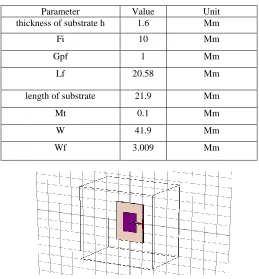
III. ANALYSIS OF PATCH ANTENNA AND METAMATERIAL STRUCTURE WITH SIMULATED RESULTS The Rectangular Microstrip Patch Antenna is designed on FR-4(lossy) substrate at 50 matching impedance, dielec-tric constant=4.3 and height from the ground plane d=1.6mm.The parameter of rectangular microstrip patch antenna are L= 21.9mm, W= 41.9mm, Cut Width= 5mm, Cut Depth= 10mm, length of transmission line feed= 26.3mm, with width of the feed= 3.009mm shown in figure1. The simple RMPA is inspired by metamaterial structure at 3.5GHz.
Table-1 Rectangular Microstrip Patch Antenna parameter
Parameter Value Unit
thickness of substrate h 1.6 Mm
Fi 10 Mm
Gpf 1 Mm
Lf 20.58 Mm
length of substrate 21.9 Mm
Mt 0.1 Mm
W 41.9 Mm
Wf 3.009 Mm
Figure 2. S-Parameter Magnitude of Rectangular microstrip patch antenna at 3.5GHz.
The bandwidth of simple RMPA is 79.1MHz and Returnloss is -14.422016dB. Table-2 Metamaterial specification
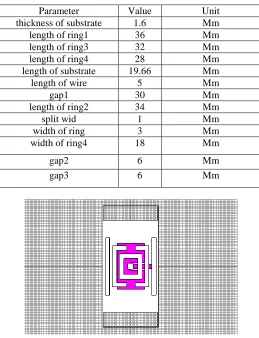
Parameter Value Unit
thickness of substrate 1.6 Mm
length of ring1 36 Mm
length of ring3 32 Mm
length of ring4 28 Mm
length of substrate 19.66 Mm
length of wire 5 Mm
gap1 30 Mm
length of ring2 34 Mm
split wid 1 Mm
width of ring 3 Mm
width of ring4 18 Mm
gap2 6 Mm
gap3 6 Mm
Figure 3. Design of proposed Metamaterial structure at the height of 1.6 mm from ground plane.
Figure 4. Rectangular microstrip patch antenna with proposed Metamaterial structure between two waveguide plane.
Simulation result of Return loss and bandwidth of Rectangular microstrip patch antenna loaded with metamaterial structure is shown in Fig 5. The proposed meta-material structure reduces the return loss by -33.943189dB and increases the bandwidth up to 393.1MHz.
Figure5. Simulation of Return loss and impedance band width of RMPA with proposed Metematerial structure at operating frequency .
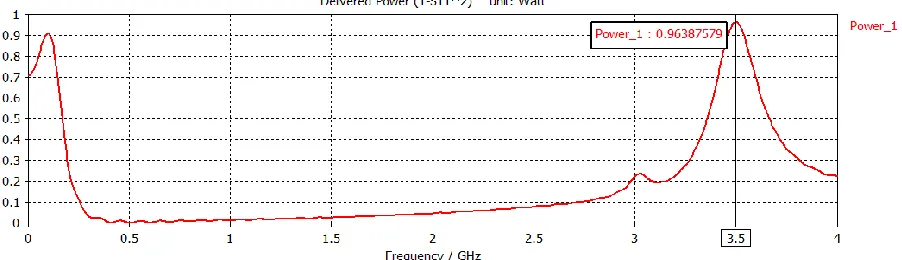
The maximum power deliver to rectangular microstrip patch antenna is 0 .96387579watt . As compared to RMPA alone, maximum power deliver to proposed antenna is increased up to 0.99959665watt.
Figure7. Delivered power to reduced size RMPA loaded with Metamaterial structure.
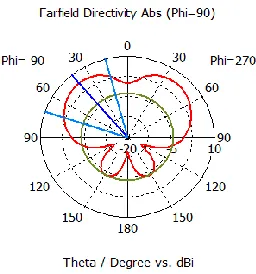
Figure 8. Radiation pattern of RMPA at 3.5 GHz showing directivity of 6.012dBi.
Figure 10. Directivity of RMPA alone (polar view).
Figure11. Directivity of RMPA loaded with Metamaterial (polar view).
w
Figure13. E-Field pattern of RMPA loaded with Metamaterial.
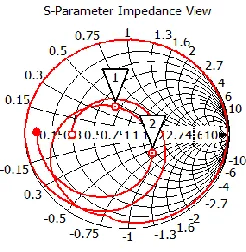
Figure 14. Smith chart of simple Rectangular microstrip patch Antenna.
Figure15. Smirth chart of RMPA loaded with Metamaterial.
The Smith chart plot represents that how the antenna impedance varies with frequency which is normalized at 50 ohm for perfect matching.
(NRW)-Where
V2 = S21 - S11
d = Thickness of the Substrate = Freaquency in radian i = imaginary coefficient c = Speed of Light V2 = Voltage Minima
IV.SIMULATIONRESULTS
In this paper, Rectangular microstrip patch antenna loaded metamaterial structure is found that the potential Parameter of the proposed antenna is increased. This design is operated at 3.5GHz. At 3.5GHz, the bandwidths are increased up to 393.1MHz in comparison to 79.1MHz of RMPA alone. The Return loss of proposed antenna are reduced by -33.943189dB at dual band frequency as comparison to -14.422016dB of RMPA alone. The directivity of proposed antenna is 11.18dBi as comparison to directivity of RMPA alone is 6.012dBi. The maximum power deliver to proposed rectangular microstrip patch antenna is 0.99959665watt.
V.CONCLUSION
I have shown that left handed Metamaterial improves the bandwidth as well as reduces return loss of this Patch Antenna. The proposed antenna provide the better improvement in the impedance bandwidth and reduction in the return loss at 3.5GHz. The drawback of Patch Antenna was impedance bandwidth. For this purpose, Rectangular microstrip patch antenna loaded with metamaterial structure has been proposed for improving the bandwidth by using CST MICROWAVE STUDIO. in this paper Rectangular microstrip patch antenna loaded metamaterial structure is suitable for wimax application at 3.5GHz in wireless communication.
ACKNOWLEDGEMENT
The auther wish to thank their parents for their constant motivation without which this work would have never been completed. I express my gratitude towards Dr. Santosh Meena Asst. Professor, Gweca, Ajmer.
REFERENCES
[1]. A. Khidre, Kai Fang Lee ; Fan Yang ; A.Eisherbeni, -“ wideband circularly polarized E-Shaped Patch Antenna for wireless application(wireless corner)” Antennas and Propagation Magazine, IEEE, Volume: 52 , pp.219-229, 2010.
[2] M.R.C. Mahdy, M.R.A. Zuboraj, A. Al Noman Ovi, M.A. Matin, “An Idea of Additional Modified Modes in Rectangular Patch Antennas Loaded With Metamaterial” Antennas and Wireless Propagation Letters, IEEE, Volume: 10 pp.869-872, 2011
[3] P. Mookiah, K.R. Dandekar, Metamaterial-Substrate “Antenna array for MIMO Communication system” Antennas and Propagation, IEEE Transaction, Volume: 57, pp 3283-3292, 2009
[4] H.A. Jang, D.O. Kim and C. Y. Kim “Size Reduction of Patch Antenna Array Using CSRRs Loaded Ground plane progress” In Electromagnetics Research Symposium Proceedings, KL MALAYSIA, March 27-30, 2012-1487.
[5] Douglas, H. W., R. L. Haupt, and P. L. Werner, Fractal antenna engineering: “The theory and design of fractal antenna arrays," IEEE Antennas and Propagation Magazine, Vol. 41no.7, pp.1516-1529, July 2005.