VOLUME 6 | ISSUE 2 | 2011 | 462
Effect of a combined program of physical activity
and intellectual activity in the cognitive
functioning of the elderly
AURORA MARTÍNEZ-VIDAL1 , AURORA PRADA MARTÍNEZ3, MARÍA DEL PINO DÍAZ PEREIRA1,
MARÍA JOSÉ MARTÍNEZ-PATIÑO2
1Faculty of Science Education, University of Vigo, Orense, Spain
2Faculty of Science Education and Sport, University of Vigo, Pontevedra, Spain 3Research Group HI6-University of Vigo, Spain
ABSTRACT
Martínez-Vidal A, Prada A, Díaz MP, Martínez-Patiño MJ. Effect of a combined program of physical activity and intellectual activity in the cognitive functioning of the elderly. J. Hum. Sport Exerc. Vol. 6, No. 2, pp. 462-473, 2011. Aerobic exercise done in an enriched environment with intellectual activity seems to improve cognitive performance associated with the aging process of humans, although the results can sometimes be contradictory. The objective of the present study was to ascertain to what degree the practice of combined aerobic exercise and memory strategies improve the cognitive functioning, in general, and to a more concrete measure in the cognitive memory domain of the elderly. Sixteen subjects, the majority of which were women with only two of which were men, participated in the investigation. The average age of all participants was 71. A prospective, longitudinal, and intra-subject design was to evaluate the cognitive abilities before and after the intervention, using a modified Mini Mental State Examination (MMSE) as the instrument of measure. The intervention lasted over a period of eight months and consisted in a physical activity program based upon various abilities of displacement as well as association, sequential, and imagination memory strategies. The recall differential variable presented statistical differences significant at the 95% confidence interval to the degree pre and post intervention (t= -4.842; sig = 0.000; with the limits at -1.71028 y -0.66472) while the other cognitive domains showed general improvement in the post-intervention measures although no reaching significant levels. On the other hand, it was demonstrated by Cochran´s Q test that after the intervention, an overall incremental improvement existed in the number of subjects that responded correctly to all items in each cognitive domain, being most prominent and the only significant percent of subjects that after the program responded correctly to all of the items in the recall (0.011). No significant improvements were shown in the terms of age group nor in terms of initial cognitive function (U of Mann Whitley), however, the subjects who initially had the lowest cognitive level are among those that benefited the most from the program. Key words: PHYSICAL ACTIVITY, INTELLECTUAL ACTIVITY, MEMORY, ELDERLY, COGNITIVE ABILITY.
1Corresponding author. Universidad de Vigo. Facultad de Ciencias de la Educación. Campus Universitario As Lagoas s/n.
32004. Orense. E-mail: [email protected] Submitted for publication February 2011. Accepted for publication June 2011.
JOURNAL OF HUMAN SPORT & EXERCISE ISSN 1988-5202
© Faculty of Education. University of Alicante
463 | 2011 | ISSUE 2 | VOLUME 6 © 2011 University of Alicante
INTRODUCTION
Aging is a natural process accompanied by structural and functional impairment of the brain with an apparent decrease in the different cognitive domains, particularly the memory, which impacts the personal autonomy and quality of life for the elderly. Abnormal cognitive functioning that does not, however, affect daily life has been termed “mild cognitive impairment (MCI) and in addition to the loss of memory can imply other cognitive functions(Montenegro & Montejo, 2007). Light deterioration of the memory, without actually being MCI, is present in about 40% of individuals 60 years of age and older (Feldman & Jacova, 2005). Aiming to evaluate environmental stimulation, different lines of research emerge that are based on the regenerative capacity of the brain of the elderly: whether or not physical exercise, cognitive stimulation or whether the both when integrated can reduce or delay the cognitive decline associated with age. Reviewed below are findings that suggest that some association does exist between physical activity and reduced risk of cognitive impairment.
Effects of physical exercise on the cognitive ability
An interest has grown over the last decade to evaluate the to what degree an active lifestyle, more precisely through aerobic exercise, can prevent or alleviate the decline of cognitive function in elderly adults. In eight of the eleven studies reviewed (Angevaren et al., 2008) it was found that aerobic exercise could markedly produce the consumption of O2 by about 15% and beneficial effects could be seen in
certain cognitive indicators such as the information processing speed, visual attention, and delayed memory. However, these improvements do not demonstrate results significant enough that they should be taken with caution. Similar results were found in different reviews (Ericsson & Kramer, 2009), in which some authors (Kramer et al., 1999) obtained better executive controls such as switching tasks and in the the selective attention. On the other hand (Colcombe et al., 2004, 2006) they do verify that greater neuronal activity to a task requiring attention but it was not found to make significant differences in cognitive ability (MMSE). Finally, (Dutsman et al., 1990; Hilman et al., 2003) an increased cerebral blood flow was observed in zones related directly to verbal learning and memory. These benefits extended to Alzheimer´s patients to a to a greater aerobic capacity in those that have less brain atrophy than subjects who are not in shape (Burns et al., 2008; Heyn et al., 2004). Additionally, postmenopausal women in good physical shape, independent from HRT (hormone replacement), show an increase in cognition and brain volume than women that are less physically fit (Ericson et al., 2007).
Studies published in 2010 confirm that some of these findings but also point to certain inconsistencies, on one hand, it appears that aerobic exercise produce improvements in executive control, especially in women (Baker et al., 2010), but on the other hand, in a prospective study (Thorleif et al., 2010) with elderly subjects aging over 55 years, concluded that participants in high or moderate physical activity are at lower risk for cognitive decline than people who do not perform physical activity. On the contrary, in a sample of 1324 subjects of elderly subjects without dementia, subjects who practiced moderately intense physical activity were associated with a lower risk of MCI, although this was not the case for those who practiced light or intense physical activity.
VOLUME 6 | ISSUE 2 | 2011 | 464
the intensity of the exercise in the interventions, variations in the use and nature of the control group as well as the type of perceptual and cognitive tasks that have been used to assess mental function.
Cognitive training programs to combat mental decline
Some epidemiological studies indicate that subjecting persons at certain periods of life to enriched or complex environments can produce beneficial effects in regards to cognition and the risk of dementia, although their effects are not fully demonstated (Studenski et al., 2006).Other than reading and crossword puzzles, activities traditionally considered to be moderate cognitive stimulation, numerous programs of cognitive training for those over 65 years of age exist for those with and without dementia. These are generally oriented toward cognitive stimulation and specifically at memory improvement (García-Sánchez et al., 2002). In said programs, techniques and appropriate strategies are applied to address memory failures and that independently claim to improve the quality of life, functional capacity, and personal autonomy. Some studies point to the fact that through cognitive one can improve his or her mental state as evaluated by the Mini Mental State Examination (MMSE) and memory and demonstrated through word lists and tests of memory association (Breuil et al., 1994).
However, one of the daunting questions is how far the improvements obtained through such programs can actually be transferred to the everyday problems of the elderly (Fernández et al., 1992). In an attempt to verify such a direct transfer to the cognitive domains of daily living, the ACTIVE plan (for Advanced Cognitive Training for the Independent and Vital Elderly) was designed (Ball et al., 2002) and its results indicate the improvement of reasoning and speed – and to a lesser extent – in memory, but they still do not make it possible to ascertain their transfer to everyday life. Some authors (Cicerone, 1997) argue that cognitive training in the elderly should begin by acknowledging the need for strategies that compensate for deficits in their abilities and involve both active and metacognitive participation. It has also been indicated (Peña-Casanova, 1999) that the cognitive training should be global in scope, holistically including attention, perception, and language.
Integrated research: physical activity with mental activity
A third line of research that which integrates the physical and cognitive activity in the same intervention. In support of this idea of summational effects, some authors (Colcombe & Kramer, 2003) maintain that when cognitive impairment exists during exercise, the resulting effect is greater. Drawing from this idea, different programs combing physical activity and cognitive activity, under the name of memory motor skills (Pont & Carrogio, 2007) or memory in movement (Rey et al., 2008), among others.
465 | 2011 | ISSUE 2 | VOLUME 6 © 2011 University of Alicante
activity, lower than that documented in other previous studies; furthermore, when simultaneous participation in cognitive stimulating activities is considered, confusion could be generated in the association between physical activity and the cognitive improvements.
The problem
Thus, the reviewed literature indicates some relationship between physical activity and cognitive performance for the elderly does exist, there is still no conclusive evidence that the benefits of exercise outright improve the cognitive function in daily life nor prevent nor delay dementia. The previously obtained results cannot be generalized, in some cases because they are contradictory and in others because of methodological shortcomings evident in the investigations. In the reviews conducted (Studenski et al., 2006), some of the most relevant reasons for inconclusive evidence were identified: lack of definition in the parameters of exercise, poor specification in the type of cognitive stimulation activities, the lack of specification of the cognitive abilities being evaluated, and the instruments used.
Purpose of study
In the context of the integrated investigation of physical activity and mental activities, the following objective was established: to assess, through the combined practice of aerobic exercise and cognitive stimulation activities, improved cognitive functionality, in general. It is also aimed to more specifically assess the following cognitive domains: spatial orientation, temporal orientation, understanding of basic tasks, comprehension of tasks involving lateralized body control, delay recall, visual motor memory and the reversed spelling of words. A secondary objective is to determine the extent to which improvements can be related to age or initial level of cognitive ability.
Hypothesis
The systematic combination of aerobic and intellectual activity will produce beneficial effects in regards to cognitive abilities in the elderly, whatever the age or the initial level of cognitive capacity.
MATERIAL AND METHODS
Design of the investigation
A prospective, longitudinal, and intra-subject design was used to evaluate the cognitive capacities before and after and eight month intervention in which physical and mental exercises were combined.
Sampling
The sample consisted in 16 subjects, of whom the majority were women (only two of whom were men) with a mean age of 71.37±6.15 years and a range from 61-85 years. It corresponded to a group of persons enrolled in a physical activity program for seniors of the Department of Social Welfare of the City of Ourense. The following criterium were used: over 60 years of age, having personal autonomy, regular attendance to the program and not displaying health problems that could impede the subject´s participation in the aerobic activity. The study initially included 22 subjects but six were dismissed for not demonstrating regular attendance to program sessions.
Instrument and variables
VOLUME 6 | ISSUE 2 | 2011 | 466
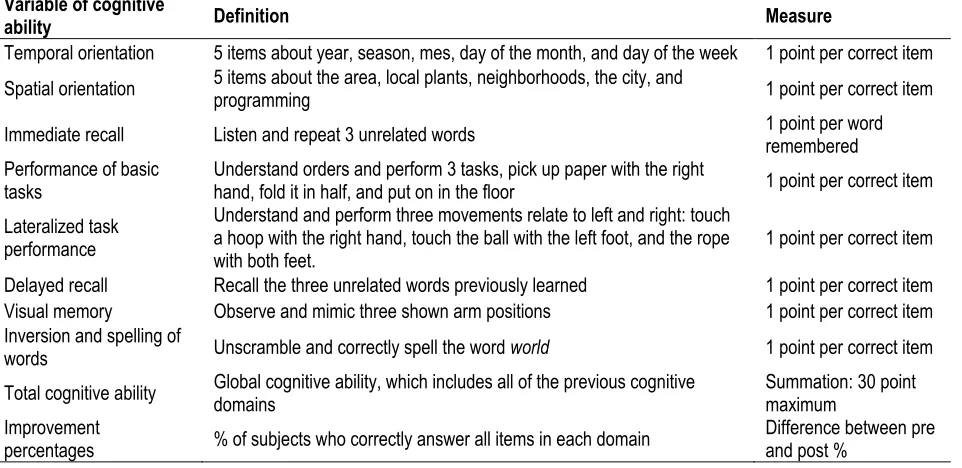
Table 2. Cognitive Ability variables included in the modified MMSE.
Variable of cognitive
ability Definition Measure
Temporal orientation 5 items about year, season, mes, day of the month, and day of the week 1 point per correct item Spatial orientation 5 items about the area, local plants, neighborhoods, the city, and programming 1 point per correct item Immediate recall Listen and repeat 3 unrelated words 1 point per word remembered Performance of basic
tasks Understand orders and perform 3 tasks, pick up paper with the right hand, fold it in half, and put on in the floor 1 point per correct item Lateralized task
performance
Understand and perform three movements relate to left and right: touch a hoop with the right hand, touch the ball with the left foot, and the rope
with both feet. 1 point per correct item Delayed recall Recall the three unrelated words previously learned 1 point per correct item Visual memory Observe and mimic three shown arm positions 1 point per correct item Inversion and spelling of
words Unscramble and correctly spell the word world 1 point per correct item Total cognitive ability Global cognitive ability, which includes all of the previous cognitive domains Summation: 30 point maximum Improvement
percentages % of subjects who correctly answer all items in each domain Difference between pre and post %
Given the interest of movement in this investigation, the items originally calculated and designed were substituted for other related body controls – namely – visual motor memory (to observe and reproduce three positions of the arm) which involved lateralized body control (understanding the order given and executing the three movements related to the right and left). The total number of correct items gives a maximum total of 30 points which indicates no deterioration of cognitive capacity. The internal cohesion of the items making up the implied instrument have been checked against the Crombach alpha index (0.727). Moreover, the correlation index of the introduced items with respect to the total cognitive ability, is highly significant in the case of lateralized body control (0.009) and insignificant in regards to visual memory.
Procedure
The intervention program integrated both physical and mental activity. Motor skills, based on various displacement abilities and cognition, are associated with proposing and resolving problems (sensory learning) involving, first of all, general cognitive abilities such as attention, perception, spatial orientation, temporal orientation, as well as other pneumonic strategies like association, sequencing, and visualization. Therefore, they can be associated with physical activity of moderate intensity in an environment cognitively and socially enriched as the proposed problems require social relationships and diverse arguments. The program consisted of two, 60 minute weekly sessions for a total of 64 sessions within 8 months. The structure of the sessions is detailed below.
− Introduction (10 minutes):
− Motor strategies: general joint mobilization and awareness of breathing − Cognitive strategies: attention, observation, and perception
467 | 2011 | ISSUE 2 | VOLUME 6 © 2011 University of Alicante
− Main Aerobic section (40 minutes): − Motor strategies: varied shifts − Pneumonic strategies
− Association of displacement of diverse elements, such as numbers, days of the week, colors, forms, rhythms, trajectories, guidelines, etc.
− Sequencing of aerobic steps, combinations of steps in choreographed routines, small circuits.
− Final Section (10 minutes):
− Relaxation and mental imagery of some of the actions carried out in the beginning sections (movements, rhythms, groupings, etc.)
Data analysis
The level of significance for all tests was established at the 95th percentile. Prior to the various analysis
carried out, such was agreed upon in order to check the assumptions of normality and homogeneity of the variances of the variables through testing Kolmororov-Smirnov.
In order to achieve the stated objectives, the following analysis was carried out:
1. Analysis of the differences between paris of variables (comparison of means for related samples, T of student), measured before and after the intervention program.
2. Analysis of the percentage of improvement of subjects who respond correctly to all items of each variable (cognitive domain). Cochran´s Q test statistic.
3. Analysis of the greatest improvements in each variable depending on the age group younger and older than 70 years) and analysis of gains to each variable in terms of cognitive level (less than 25 points and above on the MMSE). In both cases, a nonparametric test is implied. (U of Mann Whitney).
RESULTS
The results are presented in three blocks: (1) Difference between pre and post intervention of the cognitive domains of MMSE; (2) Improvement percentages in the number of subjects who responded positively to all of the items en each variable of the cognitive domain; (3) Analysis of the post-intervention improvements in terms of age group and level of cognitive ability groupings.
Differences between the pre and post intervention measures of different cognitive domains
VOLUME 6 | ISSUE 2 | 2011 | 468
Tabla 3. Descriptive results of the different cognitive domains before and after intervention (mean, standard deviation, standard error). Statistic of contrast (t test) and levels of significance and confidence interval.
Variables of the MMSE Mean SD SE Statistic Contr. t Signif. 95% of confidence Lower Upper
Temporal Orientation pre 4.3750 0.8062 0.2016 -0.696 0.497 -0.50802 0.25802 Temporal Orientation post 4.5000 0.8944 0.2236
Spatial Orientation pre 3.3750 1.2042 0.3014 -0.716 0.485 -0.74531 0.37031 Spatial Orientation post 3.5625 1.0935 0.2734
Immediate Recall pre 2.8750 0.5000 0.1250 -1.000 0.333 -0.39143 0.14143 Immediate Recall post 3.0000 0.0000 0.0000
Basic Skills pre 2.5625 0.7274 0.1819 0.000 1.000 -0.19457 0.19457 Basic Skills post 2.5625 0.6292 0.1573
Lateral Skills pre 2.1250 0.8062 0.2016 -0.899 0.383 -0.63200 0.25700 Lateral Skills post 2.3125 0.7042 0.1760
Delayed Memory pre 1.4375 0.8921 0.2230 -4.842 0.000 -1.71028 0.66472 Delayed Memory post 2.6250 0.5000 0.1250
Visual Memory pre 2.5625 0.5124 0.1281 -0.324 0.751 -0.47382 0.34882 Visual Memory post 2.6250 0.5000 0.1250
Inversion of Words pre 3.6250 1.7464 0.4366 -0.545 0.594 -0.92119 0.54619 Inversion of Words post 3.8125 1.5152 0.3788
Total Cognitive Ability pre 24.6875 4.5712 1.1428 -0.604 0.555 -1.98150 1.10650 Total Cognitive Ability post 25.1250 3.6492 0.9123
Percentage of improvement (pre and post intervention) in the number of subjects that successfully completed all of the items of each cognitive domain.
Another perspective of the program´s impact on the cognitive capacity of the sample subjects is the percentage of subjects that respond correctly to all of the items in each cognitive domain, before and after intervention. Table 4 shows general improvements in this percentage after post-intervention measures, stressing statistical significance in the the case of increasing the percentage of subjects that correctly respond to all items of the delayed memory recall variable (0.01 in Cochran´s Q test.)
Table 4. Percentage of subjects that correctly responded to all items in each cognitive domain, before and after the intervention. Statistical error (Cochran´s Q test).
Pre (%) Post (%) Cochran Q test Signif
Temporal Orientation 56.00 68.00 1.000 0.317
Spatial Orientation 18.80 12.50 0.200 0.655
Immediate Recall 93.00 100.00 1.000 0.317
Basic motor skills 60.00 62.00 1.000 0.317
Lateralized motor skills 37.50 43.00 0.200 0.655
Delayed Memory Recall 12.50 62.00 0.640 0.011
Visual Memory 56.30 62.00 0.111 0.739
469 | 2011 | ISSUE 2 | VOLUME 6 © 2011 University of Alicante
Differences in the cognitive domain improvements in regards to age groups and cognitive levels
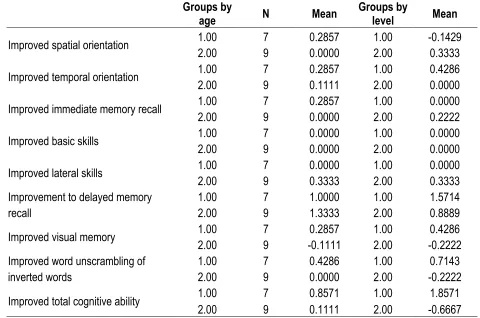
It is considered to be of interest to know to what degree the improvements in the different domains are related to age (younger and older than 70 years old) and/or cognitive level (below and over 25 points in the MMSE. Do all subjects improve to the same level or distinctly based upon group designation? Table 5 presents the results from this perspective.
Table 5. Mean post-intervention improvement values, as grouped by age and level of cognitive ability.
Groups by
age N Mean Groups by level Mean
Improved spatial orientation 1.00 2.00 7 9 0.2857 0.0000 1.00 2.00 -0.1429 0.3333
Improved temporal orientation 1.00 2.00 7 9 0.2857 0.1111 1.00 2.00 0.4286 0.0000
Improved immediate memory recall 1.00 2.00 7 9 0.2857 0.0000 1.00 2.00 0.0000 0.2222
Improved basic skills 1.00 2.00 7 9 0.0000 0.0000 1.00 2.00 0.0000 0.0000
Improved lateral skills 1.00 2.00 7 9 0.0000 0.3333 1.00 2.00 0.0000 0.3333 Improvement to delayed memory
recall 1.00 2.00 7 9 1.0000 1.3333 1.00 2.00 1.5714 0.8889 Improved visual memory 1.00 2.00 7 9 -0.1111 0.2857 1.00 2.00 -0.2222 0.4286 Improved word unscrambling of
inverted words 1.00 2.00 7 9 0.4286 0.0000 1.00 2.00 -0.2222 0.7143 Improved total cognitive ability 1.00 2.00 7 9 0.8571 0.1111 1.00 2.00 -0.6667 1.8571
In this sense, the most remarkable in the comparison of the degrees of improvements made is the absence of significant differences according to age group and cognitive level (U of Mann Whitney). When observing age groups, it can be ascertained that the variable of total cognitive ability presents improved results in those under the age of 70, which is still only 0.1111. When each of the cognitive domains was tested, improvements were found in those over the age of 70 in two cases, particularly in understanding lateral tasks (1.3333 against 1.0000). In neither case, though, are they statistically significant improvements.
VOLUME 6 | ISSUE 2 | 2011 | 470 DISCUSSION
How should the results be interpreted when they do not function as expected nor in accordance with previous literature?
The recently performed research, even with contradictory data, can provide some evidence that aerobic exercise can produce determined effects in the functionality of the brain which can improve different cognitive domains. In this study, in the global cognitive ability as much as each of the variables that comprise the MMSE test, slight improvements were shown but none of them reached to significant values (0.000). These results exceed those set by others authors (Angevren et al., 2008) in which the improvements of the delayed memory were were just developing and insignificant. In general, memory is one of the cognitive domains that seems to benefit from physical, aerobic exercise y from cognitive stimulation, especially when subjected to stimulation through pneumatic techniques during physical activity, as occurred in this study. In general, the results are on the same page as the most recent work of 2010 (Colcombe et al, 2004; Baker et al, 2010; Thorleif et al., 2010), in which evidence has associated an active lifestyle in the elderly to a lowered risk of mild cognitive impairment (MCI). Slight improvements also appear in various cognitive domains, especially in that of attention span, but no significant differences have yet to be obtained in differences in overall cognitive ability (MMSE).
Moreover, in this study, a clear relationship could not be found between the general cognitive functionality improvements and and age of the subjects (the old nor the much older) neither was there clear evidence that the initial cognitive capability dictated the level of improvement that a program of this nature could produce in an individual. However, although without significant differences, the younger subjects (60-70 years) obtained better results than the subjects older than 70 years of age. Meanwhile, the subjects pertaining to the group with the lowest level of initial cognitive capacity obtained better improvements than those having a higher initial cognitive capacity.
These results are consistent with some of the studies reviewed (Ericsson & Kramer, 2009; Baker et al., 2010) in which cognitive improvement could be seen, even in cases of pathological cognitive impairment such as in dementia, and are also coherent with other research (Geda et al., 2010) where adults between the ages of 50 and 65 years of age improved their cognitive capacities at a level of 0.61 while those older than 60 improved at a level of 0.68. Similarly, other authors have achieved greater results in their research (Angevaren et al., 2008; Sturman et al., 2005) noting the greatest effect in the older subjects but observing that the effects diminish over time. Despite the relevance of the results with predating literature, it is not thought to be necessary to regard them as monumental as no significant difference between groups were found, which may be due to the increased emphasis for improvements in the subjects that have the greatest cognitive decline and not necessarily on the program.
471 | 2011 | ISSUE 2 | VOLUME 6 © 2011 University of Alicante
CONCLUSIONS
1. After the physical activity program performed under cognitive stimulation, the average total cognitive ability of all of the sample subjects shows slight improvements in the post-intervention procedures of MMSE, although these differences do no have statistical significance.
2. The delayed memory recall is the cognitive domain that provides the most relevancies, as significant differences exist in the sample total (0.000 in the T test) between pre and post intervention at a 95% confidence level.
3. An important improvement percentage also was found in the number of subjects that correctly respond to all of the items in each cognitive domain, again being the percentage of subjects responding correctly to all items of the delayed memory recall, which shows a large increase, from 12.5% to 62% with a level of significance of 0.011 (Cochran´s Q test).
4. The difference according to age and cognitive ability levels (U of Mann Whitney) are not significant, although they do show certain trends that also suggest that those under 70 years of age benefit more than those who are older , except in the domains of delayed memory recall and basic tasks, in which the older age group received more benefits. Contrarily, in the groups of cognitive level it seems that the improvements were slightly higher in the subjects with lower initial cognitive capabilities (under 25 points in the MMSE).
5. While the interpretation of data should be done with caution and should be confirmed with programs lasting over a longer span of time, in both the sampling and the training period, the results were consistent with previous studies that show that the benefits of an active lifestyle – physically and intellectually – are associated with a lower risk of cognitive deterioration in the elderly.
REFERENCES
1. ANGEVAREN M, AUFDEMKAMPE G, VERHAAR HJ, ALEMAN A, VANHEES L. Physical activity and enhanced fitness to improve cognitive function in older people without known cognitive
impairment. Cochrane Database Syst Rev. 2008; 16:(2). doi
[Back to text]
2. BAKER LD, FRANK LL, FOSTER-SCHUBERT K, GREEN PS, WILKINSON CW, MCTIERNAN A, ET AL. Effects of aerobic exercise on mild cognitive impairment. A controlled trial. Arch Neurol. 2010; 67:71-79. Back to text]
3. BALL K, BERCH DB, HELMERS KF, JOBEL JB, LEVECK MD, MARSISKE M, ET AL. Effects of cognitive training interventions with older adults: A randomized controlled trial. JAMA. 2002; 288(18):2271-2281. Back to text]
4. BREUIL V, DE ROTROU J, FORETTE F, TORTRAT D, GANANSIA-GANEM A, FRAMBOURT A, ET AL. Cognitive stimulation of patients with dementia: preliminary results. J Geriatr Psychiat.
1994; 9:211-7. [Back to text]
5. BURNS JM, CRONK BB, ANDERSON HS, DONNELLY JE, THOMAS GP, HARSHA A, ET AL. Cardiorespiratory fitness and brain atrophy in early alzheimer´s disease. Neurology. 2008; 71(3):210-16. Back to text]
6. CICERONE KD. Cognitive rehabilitation: learning from experience and planning ahead.
VOLUME 6 | ISSUE 2 | 2011 | 472
7. COLCOMBE SJ, ERICKSON KL, SCALF P, KIM JS, PRAKASH R, MCAULEY E, ET AL. Aerobic exercise training increases brain volume in aging humans. J Gerontol A Biol Sci Med Sci. 2006; 61(11):1166-70. Back to text]
8. COLCOMBE SJ, KRAMER AF, ERICSON KL, SCALF P, MCAULEY E, COHEN NJ, ET AL. Cardiovascular fitness, cortical plasticity and aging. Proc Nati Acad Sci USA. 2004;
101(9):3316-21. doiBack to text]
9. COLCOMBE SJ, KRAMER AF. Fitness effects on the cognitive function of older adults: a meta-analytic study. Psycol Sci. 2003; 14:125-30. doiBack to text] 10. DUTSMAN RE, EMMERSON RY, RUHLING RO, SHEARER DE, STEINHAUS LA, JOHNSON SC,
ET AL. Age and fitness effects on EEG, ERPS visual sensitive and cognition. Neurobiol Aging.
1990; 11(3):193-200. do[Back to text]
11. ERICSON KL, COLCOMBE SJ, ELAVSKY, MCAULEY E, KOROI DL, SCALF PE, KRAMER AF. Interactive effects of fitness and hormone treatment on brain health in elderly women. Neurobiol
Aging. 2007; 28(2):179-85. doiBack to text]
12. ERICSSON KI, KRAMER AF. Aerobic exercise effects on cognitive and neural plasticity in older adults. Br J Sports Med. 2009; 43(1):22-24. Back to text]
13. ETGEN T, SANDER D, HUNTGEBURTH U, POPPERT H, FÖRSTL H, BICKEL H. Physical Activity and Incident Cognitive Impairment in Elderly Persons. Arch Internat Medic. 2010; 170(2):186-19.
Back to text]
14. FELDMAN H, JACOVA C. Mild cognitive impairment. Am J Geriatr Psychiatry. 2005; 13:645-655.
Back to text]
15. FERNÁNDEZ R, IZAL M, MONTORIO I, GONZALEZ JL, DIAZ P. Evaluación e intervención psicológica en la vejez. Barcelona: Ed. Roca; 1992. [Back to text]
16. FOLSTEIN MF, FOLSTEIN SE, MCHUGH PR. Mini Mental State: A practical method for grading the cognitive state of patients for the clinician. J Psychiat Res. 2005; 12:189-198.
doi[Back to text]
17. GARCÍA-SANCHEZ C, ESTEVEZ A, KULISEVSKY J. Estimulación cognitiva en el envejecimiento y la demencia. Rev Psiquiatría Fac Med Barna. 2002; 29(6):374-378. Back to text] 18. GEDA MSC, ROBERTS MS, KNOPMAN MD, CHRISTIANSON BSC, PANKRATZ PHD, IVNIK
PHD, BOEVE MD, TANGALOS MD, PETERSEN PHD, ROCCA MD. Physical Exercise, Aging, and Mild Cognitive Impairment A Population-Based Study. Arch Neurol. 2010; 67(1):80-86. [Back to text]
19. HEYN P, ABREU BC, OTTEMBACHER KJ. The effects of exercise training on elderly persons with cognitive impairment and dementia: a meta-analysis. Arch Phys Med Rehab. 2004;
85(10):1694-704. doiBack to text]
20. HILMAN CH, SNOOCK EM, JEROME GJ. Acute cardiovascular exercise and executive control function. Int J Psychophysio. 2003; 48(3):307-14. doiBack to text]
21. KRAMER AF, HAHN S, COHEN NJ, BANICH MT, MCAULEY E, HARRISON CR, ET AL. Ageing, fitness, and neurocognitive function. Nature 1999; 400:418-19. Back to text]
22. MONTENEGRO M, MONTEJO P. Diagnóstico y perfil diferencial de sujetos con deterioro cognitivo leve. Mafre Medicina. 2007; 18(1):17-24. Back to text]
23. PEÑA-CASANOVA J. Activemos la mente. Fundación La Caixa; 1999. Back to text] 24. PONT P, CARROGIO M. Ejercicios de motricidad y memoria para personas mayores: propuesta
473 | 2011 | ISSUE 2 | VOLUME 6 © 2011 University of Alicante
25. REY A, CANALES I, TÁBOAS I. Memoria en movimiento programa de estimulación cognitiva a través de la motricidad para personas mayores. Obra Social Caixa Galicia; 2008. Back to text]
26. STUDENSKI S, CARLSON C, GREENOUGH W, KRAMER A, REBOK W. From bedside to bench: Does mental and physical activity promote cognitive vitality in late life? Sci Aging Knowl Environ.
2006; 10:pe21. doiBack to text]