641 | International Journal of Computer Systems, ISSN-(2394-1065), Vol. 03, Issue 12, December, 2016 Available at http://www.ijcsonline.com/
Programming ‘Al-dani’ Quranic font using Visual Open type Layout Tool
(VOLT)
Mussa A. Abudena, Shihab A. Hameed, Aisha H. Hashim, Othman O. Khalifa
Electrical and Computer Engineering Department
Faculty of Engineering, International Islamic University Malaysia, IIUM
Abstract
There is a lot of Font maker soft wares. Accordingly, there are several fontsin different languages were produced including Arabic fonts. A few Quranic fonts which used to write holy Quran according to Uthmanic script – that is the standard script to writing Quran- were available. The special Quranic font called Al-dani we had been designed and implemented. For more accurate positioning of the diacriticals over the letters or below of them, and to achieve the optimum connectivity and kerning between the letters, Microsoft Visual Open type Layout Tool (VOLT) was used to program the Al-dani Quranic font. This paperbasically wrote to explain of the techniques to program Al-dani Quranic font. The results of programming this font is presented.
Keywords: Computer fonts, Arabic fonts, Quranic fonts, Microsoft VOLT.
I. INTRODUCTION
As known, there are three types of Arabic scripts: StandardProsody, and Quranic. In prosody script the words written as they spoken, that it used for balance the Arabic poetry. On the other hand the Quranic script has its marks and letters which help the reciter of Quran to recite it according to rules of intonation. Quran is the words of Allah, that was revealed to the Prophet Muhammad. [1][2] The collection of Quran happened at the time of Abu-Bakr: The Prophet Succession, and the second in the era of Othman bin Affan, after, Moslems were copying the Quran with their own hands. [3][4] After invention of the computer, there were a few attempts to produce computer fonts that able to write Quran according to Uthmanic scripts, where these scripts are the standard for writing Quran.Al-dani Quranic font is one of these fonts. [5] There are many ready package programs used in design, produce, and development of computer fonts by various languages including Arabic, they can be used by the designer to create a font capable of writing Quran according to Uthmanic script. The most popular of these programs include:
Illustrator, Metafont, FontLab, Fontstruct, Font Constructor, and
FontCreator. FontCreator is the software which used to produce Al-dani Quranic font, but this font still need enhancement to be ready for writing Quran by programming it.[6]Microsoft Visual OpenType Layout Tool used to add OpenType Layout Tables to TrueType and OpenType fonts that makes the fonts more accurate in connecting of letters together, and facilitate the positioning of diacriticals over or below them.[7]Al-dani Quranic font was programmed by VOLT and considerable results had achieved.
II. INVESTIGAION
Before we present of framework in detail, we briefly discuss a summary of some published work in producing and development of computer fonts. We identify the key functionalities provided through the investigation that serve as the preliminary functionality requirements for our framework.
A. Computer fonts
1) What is OpenType Layout?
One of the OpenType format's most important features is its ability to support increased typographic complexity within a single font. From multiple styles of figures to complex script-specific ligatures, OpenType allows for typographic richness that was previously quite difficult to achieve. OpenType fonts do this by storing extra data that can be exposed by OpenType-aware operating systems and applications. While OpenType fonts are backward-compatible with pre-OpenType programs (OpenType supersets both TrueType and Adobe Type 1 formats), the new layout features will not work with older programs. With the recent release of Adobe's new page-layout package InDesign (version 1.5 is the latest release), typographers and designers have access to a program that supports a selection of OpenType Layout (OTL) features.
2) Latin fonts
Latin font family is, obviously, the most numerous group of computer fonts, which are used everywhere and supported by all the major and minor operating systems, as well as multiple software applications. Fonts2u, a brand-new and highly progressive web site for free font downloading, offers over 25 thousands of Latin fonts.
Though a number of Latin typefaces are usually installed on any computer, people still demonstrate great interest towards new and fresh Latin font examples. While Arial and Times New Roman fonts seem pretty traditional and conventional, a great variety of fonts, supporting Latin character map, in multiple appearances and designs are available to fit any type of document or a designing project.[8]
3) Arabic fonts
Altogether, more than 250 workable fonts are listed. Most of these are headline or decorative fonts, although there are many general naskh, thuluth and even nastaliq (or "nastaliq-like") fonts here. Many of the fonts have similar names, and are clearly derived from standard font faces, so different fonts may often look fairly alike. But still, the net result is a very large variety in shapes and behaviour. [9]
4) Quranic fonts
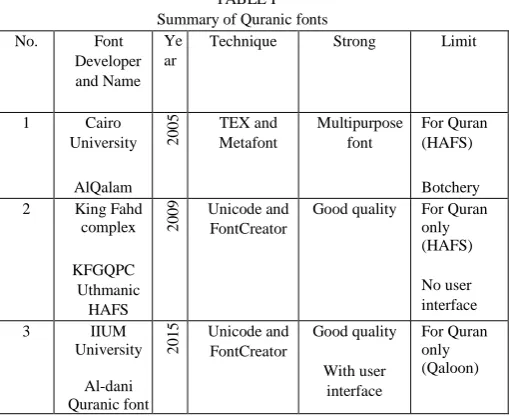
There is a few of computer Quranic fonts, here three of them.
i. AlQalam font:
It is a research project carried out at the Electronics and Electrical Communications Department, Faculty of Engineering, Cairo University. AlQalam is freely available system intended for typesetting Quran (using script Al-khrraz), other traditional texts, and any publications in the languages using the Arabic script. It aims to achieve an “Naskh’’ font with quality close to that of Arabic calligraphers, by modeling the pen nip and the way it is used to draw curves as closely as possible using a font description language -METAFONT. It is based on the TEX and Metafont open source typesetting and font design systems. [10]
ii. King Fahd glorious Quran printing complex font: One of the fonts of computer coding compatible with the international Unicode, assigned to write the text of the Holy Quran corresponding to the Uthmanic font of mushaf prophetic city for narration (riwayat) HAFS. [11] See figures 4c and 4d.
iii. Al-dani Quranic font:
It is a research project carried out at the Electrical and Computer Department, Faculty of Engineering, IIUM University. It had designed and implemented using FontCreator software. A special virtual keyboard had designed and implemented as well to use as a user interface which can type all Arabic letters and Al-dani Quranic letters, marks, and diacriticals. [5]
This font basically assigned to write the text of the Holy Quran corresponding to the Uthmanic font (Al-dani) of mushaf Aljmahieriah for narration (riwayat) Qaloon. [6] [12] See figure 4a.
TABLE I Summary of Quranic fonts No. Font
Developer and Name
Technique Strong Limit
1 Cairo University
AlQalam
2
0
0
5 TEX and Metafont Multipurpose font For Quran (HAFS) Botchery 2 King Fahd
complex KFGQPC Uthmanic HAFS 2 0 0
9 Unicode and FontCreator
Good quality For Quran only (HAFS)
No user interface
3 IIUM
University Al-dani Quranic font 2 0 1
5 Unicode and FontCreator Good quality With user interface For Quran only (Qaloon)
B. Font makers software
There are many programs used in design, produce, and development of computer fonts by different languages including Arabic, these programs can be used by the designer to innovate a font capable of writing holy Quran according to Uthmanic script. The most popular of these programs include:
• Illustrator • Metafont • FontLab • Fontstruct • Font Constructor • FontCreator
FontCreator is the most commonly used and widespread and preferable by many designers because of its characteristics and vantageswhich assist the design of fonts. Accordingly, it used to design and implement of Al-dani Quranic font. [13]
III. PROGRAMMING OF AL-DANIQURANICFONT
Figure 1 Block Diagram for programming Aldani Ye
i. What is VOLT?
The Microsoft Visual OpenType Layout Tool provides an easy-to-use graphical user interface to add OpenType layout tables to fonts with TrueType outlines. It is licensed free and can be downloaded from the online community set up for it. The community hosts an active discussion forum, version history information, a wish-list and related downloads. Links to VOLT's release notes, as well as tips and tutorials are also posted.
VOLT supports a wide range of substitution and positioning types. It also contains a proofing tool for reviewing the application of layout table lookups. It allows import and export of glyph names, lookups, glyph groups and a full project.
The tool has been used by community members to add OpenType layout tables to various fonts supporting scripts, including Arabic (Naskh and Nastaliq writing styles), Bengali, Cyrillic, Devanagari, Greek, Gujarati, Gurmukhi, Kannada, Latin, Sinhala, Syriac, Telugu, and Thaana. [14]
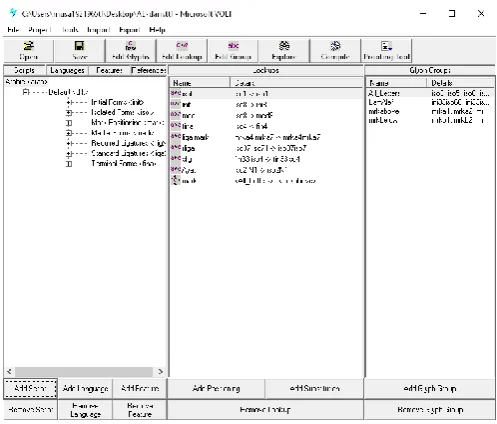
ii. The Screenshots of Microsoft VOLT appear in Figure 2.
Figure 2a- The Screenshot of VOLT Software.
Figure 2b- The Screenshot of Lam-Alef group.
Figure 2c- The Screenshot of opening Al-dani font inVOLT Software.
Figure 2d- The Screenshot of Mark positioning for letter Thal.
iii. Flowchart for Programming ‘Al-dani’ Quranic font using Visual Open type Layout Tool (VOLT)
Figure 3 illustrates this flowchart. Start
Open the font
Create lookup tables for:
All forms of Arabic and
Aldani Quranic letters.
Create lookup tables for:
All ligatures
position OK
Install the programmed Aldani Quranic font
write the whole Quran
End Is the output likes
Mushaf
No
Yes
Yes
Cerate group tables for: All letters, Lam-Alef, above diacriticals, and
below diacriticals
Program the accurate position for each
diacritical
Use the font to write
selected pages
No
Figure 3- The flowchart for Programming ‘Al-dani’ Quranic font using
Visual Open type Layout Tool (VOLT)
Figure 4 shows the comparison between the output of the programmed Al-dani Quranic font and the other computer Quranic fonts, and handwritten Quranic pages as well.
Figure 4a –The programmed Al-dani Quranic font
Figure 4b - Calligrapher handwritten [15]
Figure 4c- Alqalam Quranic computer font. [10]
Figure 4d - KFGQPC Uthmanic HAFS Quranic computer font. [11]
IV. RESULTS
Fi gure 5- Letters with diacriticals.
Now, see letters how consist words when connected together.
Figure 6- Words written by Al-dani Quranic font.
As a sample, these lines written by programmed Al-dani Quranic font.
Figure 7- Sample of Al-dani Quranic font.
V. CONCLUSIONS
In this paper, we explained the types of computer fonts including Quranic fonts. There are few attempts for writing the Quran using computer, among them: AlQalam font,King Fahd glorious Quran printing complex font, and Al-dani Quranic font.These approaches are explored. In addition, we mentioned many types of readypackage programs that used to produce computer fonts. Moreover, we gave a short explanation about Microsoft VOLT. This paper the emphasized the importance of VOLT to program of Al-dani Quranic font. As a future work, a complete font design technique to write the whole Quran with other narrations in less time will be finalized.
REFERENCES
[1] Leemhuis, F. (2006). From palm leaves to the Internet. The Cambridge Companion to the Quran, 145.
[2] Mohammad Shafi, (2013). The QUR`AN - How it was Revealed and Compiled.
[3] Burton, J. (1979). The Collection of the Qur'an. CUP Archive. [4] Motzki, H. (2001). The Collection of the Quran. A Reconsideration
of Western Views in Light of Recent Methodological Developments. Der Islam, 78(1), 1-34.
[5] Abudena, M. A., & Hameed, S. A. (2015). Toward a Novel Module for Computerizing Quran’s Full-Script Writing.
[6] Abudena, M. A., Hameed, S. A., Hashim, A. H., & Khalifa, O. O. (2016). Unicode Encryption and its Role in Facilitating Writing
Quran using the Computer.
[7] Crewdson A., (2000). Microsoft Typography. [8] Fonts2u web site www.fonts2u.com [9] The Arabic Macintosh web site.
[10] Ameer M. Sherif, Hossam A.H. Fahmy, (2008). Meta-designing parameterizedArabic fonts for AlQalam.
[11] King Fahd Complex for Printing the Holy Quran web site www.qurancomplex.org
[12] Abudena, M. A. (2015). Proposal to encode Quranic marks used in Quran published in Libya, L2/15-329, Complete UTC Document Register.
[13] High-Logic Software, (2007). Manual FontCreator 5.6 [14] Microsoft Typography web site