Performance Analysis of BER Using Efficient Coding
and Interleaving Techniques in MIMO-OFDM System
1
Sudhir Sawarkar, 2 Swati Dutta
1, 2
Department of Electronics and Telecommunication Datta Meghe College of Engineering
Sector 3, Airoli, Navi Mumbai
Abstract - Error free transmission is the main aim of wireless communication. However nowadays with the increase in multimedia services there is a demand for ever increasing data rates. To reduce the bit error rate forward error correction methods (FEC) methods are now employed. In this paper we compare the BER performance of 16-QAM and 64-QAM modulation techniques with and without interleaving process. Also further we analyze the performance of MIMO OFDM system using OSTBC coding technique and compare it with convolution coding.
Keywords -MIMO- OFDM, Forward Error Correction (FEC), OSTBC Coding, Convolution Coding.
1. Introduction
MULTIPLE-INPUT MULTIPLE-OUTPUT (MIMO) technology combined with orthogonal frequency-division multiplexing (OFDM) and channel coding, has recently attracted significant attention and is mainly used for high speed data communication[12]. MIMO offers high spectral efficiency through spatial multiplexing, OFDM is a multicarrier modulation technique which provides resilience against interference caused by multipath propagation, and coding combines the ability to exploit the diversity in a frequency-selective wideband MIMO channel with a straightforward approach to rate adaptation. Due to these significant advantages, the combination of these three technologies constitutes the basis for many next generation wireless communication systems.
Recently MIMO OFDM systems have been studied at various levels for consumer applications and other wireless systems. FEC is one of the important aspect of MIMO OFDM system. In this paper we analyze the performance using a combination of per antenna coding and cross antenna interleaving.
This paper evaluates the performance of 16- QAM and 64-QAM when interleaving process is performed. It is shown that Bit Error Rate (BER) is improved due to interleaving process. Also two encoders are used. The analysis has been performed using MATLAB for simulation and evaluation of BER for both modulation techniques and by using convolution encoder and OSTBC. The analysis shows that BER further reduces when OSTBC encoding is used for both modulation techniques.
We have divided this paper in different sections. Section II gives the system description with special emphasis on MIMO, OFDM and coding schemes. Section III shows the comparison of bit error rate (BER) with the help of various graphs. Section IV provides the future scope. Section V concludes this paper.
2. System Description
2.1 Multiple Input Multiple Output Systems
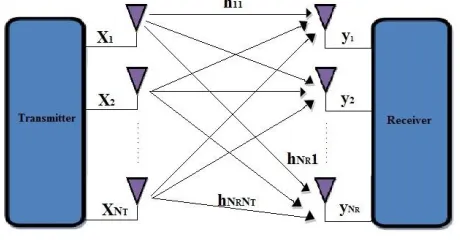
Fig. 1 MIMO- OFDM System.
MIMO system consists of three components, mainly transmitter, channel and receiver Transmitter sends a multiple data such as x1, x2, x3… xN say xi from different transmit antenna and signal is received by each receive antenna (r1, r2, r3….rN say rj) simultaneously. The relation between transmit data and receive data is given by [14]:
r1= h11 x1 + h12 x2+…+ h1N xN, (1)
r2= h21 x1 + h22 x2+…+ h2N xN, (2)
…
rN = hN1 x1 + hN2 x2+...+ hNN xN
(N)
The MIMO signal model is described as r= Hx+n where r is Nr*1 received signal vector, H is Nr*Nt the channel matrix, x is Nt*1 transmitted vector and n is Nr*1 Gaussian noise vector. With Nt inputs and Nr outputs the channel can be expressed as Nr*Nt channel matrix H. By showing the channel in a matrix form, we can fully recover the transmitted data. The channel matrix can be represented as:
where hij is the attenuation and phase shift between the jth transmitter and ith receiver. It is assumed the MIMO channel behaves in the quasi static manner [12].
2.2 Orthogonal Frequency Division Multiplexing
Orthogonal Frequency Division Multiplexing (OFDM) is a multicarrier transmission technique, which utilize the bandwidth available many carriers; each which is modulated by a low rate data stream. In term of multiple access technique, OFDM is similar to FDMA in that the multiple user access is achieved by subdividing the available bandwidth into multiple channels that are then allocated to users. However, OFDM uses the spectrum much more efficiently by spacing the channels much closer together [2]. This is achieved by making all the carriers orthogonal to one another, which prevent interference between the closely spaced carriers. This helps in reducing the spacing between carriers
Fig. 2 Concept of OFDM Signal: (a) conventional multicarrier technique (FDM), and (b) orthogonal frequency division multiplexing technique.
Fig. 3 Block Diagram OF OFDM [1].
3.2 Convolution Coding
Convolution coding technique implies various types of category. Orthogonal convolution coding, Super orthogonal convolution coding, Standard convolution coding, Punctured convolution coding are the basic categories of Convolution coding which generally applied on MIMO-OFDM. Encoder consist of two shift registers whose length is K in which parallel output of the first shift register are connected to second with a connecting block. Second shift register is heaving modulo 2 adder and the coder output formed by this shift register [15].
Fig. 4 Convolution Encoder
Where, k = number of bits shifted into the encoder at one time
n = number of encoder output bits corresponding to the k information bits
Code rate =k/n,” The quantity k/n called the code rate, is a measure of the efficiency of the code.
3.3 Puncturing
To ensure high reliability, however, convolution codes tend to occupy a large bandwidth. This is due to the fact that convolution codes add redundancy to each transmitted bit, producing a code rate of smaller than 1. The larger number of redundancy bits added to each transmitted bit, the stronger the protection given to the said bit against transmission errors [14]. One way to reduce the occupied bandwidth is by using punctured convolution codes [1]. Puncturing is the process of deleting some parity bits from the codeword according to a puncturing matrix. Puncturing is the trade-off between rate and performance. Puncturing increases code rate without increasing complexity for code rate from 1/3 to ½ or more and decreases free distance of code. The redundant bits in coding decrease the bandwidth efficiency. The bandwidth efficiency decreases with increase in redundant bits in coding. The puncturing pattern adjust code rate to achieve system requirement, the puncturing pattern adjust code rate.
3.4 Interleaving
communication system. The classical use for interleaving is to disperse sequences of bits in a bit stream so as to minimize the effect of burst errors introduced in transmission and the BER reduces at the output [11]. This has become an extremely useful technique for minimization of errors. The basic work done by an interleaver is that it rearranges the order of symbols to be transmitted following a particular rule and at the receiver the reverse rule can be used to restore the original sequence.
4. Simulation Results and Analysis
This paper analyses the bit error rate performance of Convolution and OSTBC code in AWGN channel using 16-QAM and 64-QAM as modulation schemes. Block interleaver and time interleaving process is used. There is a significant performance improvement of BER when inter leaving process is performed for both 16 QAM and 64 QAM modulation techniques.
4.1 BER Analysis of 16-QAM
In this section BER analysis of MIMO-OFDM system using Convolution code and OSTBC code structure is done for 16-QAM modulation over AWGN channel.
Fig. 5 BER Analysis of 16-QAM.
From above graph it was found that OSTBC coded system performs better as compared to convolutional coded system. BER for OSTBC 16-QAM is very less as compare to its neighbor techniques. Following table shows the comparative analysis of BER for both techniques at different SNR values.
Table 1: BER values for 16-QAM
SNR(dB) value
BER without
OSTBC BER with OSTBC
8 1 0.7
10 0.99 0.45
12 0.9 0.2
4.2 BER Analysis of 64-QAM
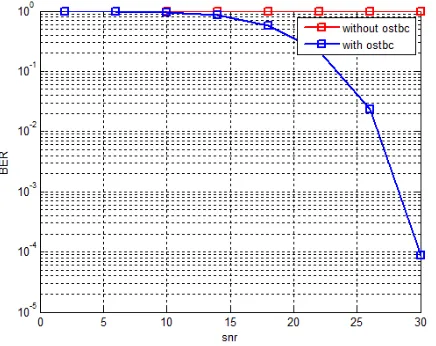
In this section BER analysis of MIMO-OFDM system using Convolutional code and OSTBC code structure is done for QPSK Modulations over AWGN channel.
Fig. 6 BER Analysis of 64-QAM
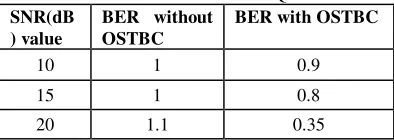
Following table shows the comparative analysis of BER for both techniques at different SNR values.
Table 2: BER values for 64-QAM
SNR(dB ) value
BER without OSTBC
BER with OSTBC
10 1 0.9
15 1 0.8
4.3 BER Analysis of 16- QAM with Interleaving
Fig. 7 BER Analysis of 16-QAM with interleaving.
From the above graph it is observed that the 16-QAM system performs better when interleaving is performed for both types of coders.
4.4
BER Analysis of 64-QAM with interleavingFrom the graph below it is observed that the 64-QAM system performs better when interleaving is performed for both types of coders.
Fig. 8 BER Analysis of 64-QAM with interleaving.
5. Conclusion
In this paper we compare the performance of MIMO-OFDM system in terms of BER using Forward Error Correction codes on AWGN channel. Here Convolutional
codes are used as FEC codes. We evaluate Bit Error Rate of convolutional codes for 16-QAM and 64-QAM modulation schemes and compare them with OSTBC code. Results show that BER performance is improved when OSTBC coder is used. Also BER performance is further enhanced when interleaving is performed for both the modulation techniques.
6. Future Scope
The work presented in this paper, i.e. the BER performance of 16-QAM and 64-QAM for MIMO-OFDM system can be extended to other modulation techniques like BPSK, QPSK, DPSK etc. The results drawn from this paper can also be extended to include other types of error correcting codes like Reed-Solomon codes, BCH codes.
References
[1] Zafar Iqbal, Saeid Nooshabadi, and Heung-No Lee, “Analysis and Design of Coding and Interleaving in a MIMO-OFDM Communication System,” IEEE Trans. Consumer Electronics Vol. 58, No. 3, August 2012. [2] Meenal .D.Tayade & Prof.P.D.Gawande “Design of
OFDM Transmitter Baseband using FPGA architecture,” International Journal of Engineering Research and Applications Vol. 2, Issue 1,Jan-Feb 2012.
[3] H.Yu, M.-S. Kim, E. young Choi, T. Jeon, and S. Kyu Lee, “Design and prototype development of MIMO-OFDM for next generation wireless LAN,” IEEE Trans. Consumer Electron., vol. 51, no. 4, pp. 1134– 1142, Nov. 2005.
[4] J. Soler-Garrido, D. Milford, M. Sandell, and H. Vetter, “Implementation and evaluation of a high-performance MIMO detector for wireless LAN systems,” IEEE Trans. Consumer Electron., vol. 57, no. 4, pp. 1519 –1527, Nov. 2011.
[5] C.-S. Choi, Y. Shoji, and H. Ogawa, “Implementation of an OFDM baseband with adaptive modulations to grouped subcarriers for millimeter-wave wireless indoor networks,” IEEE Trans. Consumer Electron., vol. 57, no. 4, pp. 1541–1549, Nov. 2011.
[6] S. H. Muller-Weinfutner, “Coding approaches for multiple antenna transmission in fast fading and OFDM,” IEEE Trans. Signal Process., vol. 50, no. 10, pp. 2442–2450, Oct. 2002.
[7] S. Haene, D. Perels, and A. Burg, “A real-time 4-stream MIMO-OFDM transceiver: System design, FPGA implementation, and characterization,” IEEE J. on Sel. Areas in Commun., vol. 26, no, Aug. 2008. [8] L. Boher, R.Rabineau, and M.Helard, “FPGA
[9] Z. Iqbal and S. Nooshabadi, “Effects of channel coding and interleaving in MIMO-OFDM systems,”
IEEE Int. Midwest Sym. on Cir. and Sys.(MWSCAS), Seoul, Korea, August 2011.
[10] J.-M. Lin, H.-Y. Yu, Y.-J. Wu, and H.-P. Ma, “A power efficient baseband engine for multiuser mobile MIMO-OFDMA communications,” IEEE Trans. Cir. and Sys. I: Regular Papers, vol. 57, July 2010. [11] Y.-N. Chang, “A low-cost dual-mode deinterleaver
design,” IEEE Trans. Consume Electron., vol. 54, no. 2, pp. 326–332, May 2008.
[12] Helmut Bolskei, ETH Zurich, “MIMO-OFDM Wireless Systems: Basics, Perspectives, and Challenges” IEEE Wireless Communications, August 2006.
[13] G.Gangaram, MR.N.Muthu sankar, “Design of novel MIMO OFDM using Random Interleaver for 4G wireless communication” International Journal of Recent Development in Engineering and Technology,
Vol 2, Special Issue 3, Feb 2014.
[14] Aditya Kumar, Pratibha Tripathi, Amrita, “Performance Evolution of MIMO-OFDM System with Efficient Coding”, International Journal Of Engineering Research & Management Technology
Volume-1, Issue-2 March- 2014.
[15] Prabhakar Telagarapu, G.B.S.R.Naidu,Chiranjeevi, “ Analysis of Coding Techniques in WiMAX”,
International Journal of Computer Applications
Volume 22– No.3, May 2011.
Sudhir Sawarkar receives Ph.D. in Computer Engineering from Amravati University. Currently he is the Principal of Datta Meghe College of Engineering. He has 27 years of teaching experience. He has published 37 and 47 papers in international conferences and journals. He has published 8 papers in national conferences. He is the member of Indian Society for technical Education, Institute of technical Engineering, Computer Society of India and Board of Studies of Computer Engineering.
![Fig. 3 Block Diagram OF OFDM [1].](https://thumb-us.123doks.com/thumbv2/123dok_us/1333761.1641797/3.612.64.260.496.629/fig-block-diagram-ofdm.webp)