Electrical Properties of Indonesian Hardwood
Irzaman
1, Sucahyo Sadiyo
2, Naresworo Nugroho
2, Reinardus L. Cabuy
3*, Amar afif
3,
Fakhruzy
3, Merry Zabed
3, Ningsih Indahsuary
3, Esi Fajriani
3Abigael Kabe
3 and Sucipto41
Department of Physics, Faculty of Mathematics and Natural Sciences, Bogor Agricultural University. Indonesia, Jl. Meranti Kampus IPB Dramaga Bogor, 16680; email: [email protected]
2
Forest Products Department, Faculty of Forestry, Bogor Agricultural University. 3
Post-Graduate students at the Forest Products Department, Faculty of Forestry, Bogor Agricultural University. 4
Department of Agro Industrial Technology, Faculty of Agriculture Technology, Brawijaya University, Indonesia, Jl. Veteran Malang, 65145; email: [email protected]
* Corresponding Author
Abstract - Electric properties in wood have played a crucial part and continue to be study for meet the useful in the future. Apart from those, wood has basic properties and significantly different even in the same tree. Therefore it would be affected the function in its use. The aim of this investigation was to reveal the ability both in its capacitance and conductance properties. Wood samples used consist of four (4) hardwood species in which subsequently be cut adjusted with the tool. The measurement process using 3532-50 LCR HiTESTER (Hioki) with
frequencies: 10, 100, 103, 104, 2.104, 4.104, 6.104, 8.104
and 105 Hz respectively.
Result found that there were various values from the investigation of capacitance and conductance toward the frequency which applied. Capacitance value decrease continuously towards the frequency at 10Hz
until 105Hz. While capacitance was increasing
continuously in conductance property towards frequency at four (4) wood samples. Generally, these variations has influenced by wood properties and its structure in the wood.
Index Terms - Electric property, capacitance, conductance, hardwood
I. INTRODUCTION
Wood is considered as a complexity matter that had provided multi-purpose functions. It can be seen clearly in its structure and composition. Those components, therefore gives great contribution to the particular functions and services [1]. Definitely each species of wood or even in the same species has conspicuously different of cells and its structures. Those cases, hereafter will be establish its function as well as appropriation in further used. Wood utilization closely intertwined by its properties as well as has to be cautiously considered due to its possess hygroscopic characteristic which of relate closely to the surrounding environmental [2]. For practical purposes, the influences
of the anisotropy of wood, the fiber orientation in respect to the electric field, must be considered also [3]. The optimum field orientation in an application may be deduced from the ε’’eff versus moisture content curves
as losses are higher for the field orientation parallel to the grain, which is characteristic of wood and paper products [4]. That is way, in using it required specific comprehension particularly as electrical material purposed.
One of the basic properties which have to be known were whole materials as dielectric, solid, liquid or even gases possess ability to storage electrical energy. Wood was considered as solid materials which have plenty of benefit to be an electrical material. The thermal properties of wood are closely related to the fire performance of thick timber [5]. Although wood is a combustible material, there are several ways in which it outperforms fireproof metal in fire [6]. When wood is placed in an electric field, the current-carrying properties of the wood are governed by certain properties, such as moisture content, density, grain direction, temperature; and by certain components such as cellulose, hemicelluloses, and the lignin of wood. They also vary in an extremely complicated [7]. This Investigation aimed to reveal the electrical properties of several Indonesian hardwoods and its potency to being a semiconductor matter which deals with based on three differently wood sections.
II. CONDUCTANCE MEASUREMENT
conductance together with advanced mathematical modeling, it is often a good approach in purity assessment of wood material. This measurement is in a rapid mode, non destructive, and in-situ. It is based on electromagnetic energy, ultrasonic technique, and resonance. Measurement is developed that conduct interaction wood with electromagnetic wave. The conductance of a material is measured between two spatially fixed inert electrodes of known surface area. These electrodes are positioned parallel to and facing
one another, separated by a gap of fixed dimensions. Conductance part of dielectric properties is an interaction electromagnetic field with a low conductor material. Dielectric properties of material are influence frequency, temperature, water content, density, composition and material structure. Wood has dielectric properties and non ideal polarization conduct dissipation phenomena, energy adsorption, and damages that influence dielectric constant.
III. EXPERIMENTAL DESIGN
A. Wood Preparation
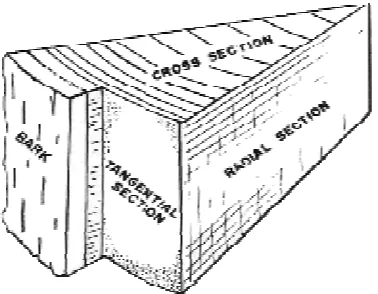
Samples of wood used in this experiment was consist of four hardwood species i.e. Sengon (Paraserienthes sp.), Mindi (Melia azadarach), Gemelina (Gmelina arborea), Jabon (Anthocephalus cadamba). Those hereinafter shaped according to electrodes tools namely 2cm x 1cm x 0.5cm for each species. In this phase also those samples established intentionally for three surface i.e. tangential, radial and cross-section. Thus, total samples used in this experiment for each species were 3(tangential, radial and cross-section) x 4(wood species). After that, those undergoes dried process used oven drying to reach appropriate wood moisture content (MC) that is around 10-15%. Figure 1 below shows three principal basic plane in wood.
Figure 1. Three basic plane in wood
B. Conductance Measurement
Conductance was measured using 3532-50 LCR HiTESTER (Hioki) that covers the range from 42Hz to 5MHz. Measurement get in room temperature (26-270C) and frequencies: 10, 100, 103, 104, 2.104, 4.104, 6.104, 8.104 and 105 Hz. Conductance was measured in nano Siemens (nS).
IV. RESULTS AND DISCUSSION
A. Dielectric Properties of Wood
Cross Section (X)
Capacitance of wood is one of
the woody materials ability to store electrical
current within a certain time. The result of wood capacitance measurement from several hardwood species as well as based on woody planes which at frequency ranging of 10 Hz to 105 Hz are subsequently shown in figures below.
Figure 2. The relationship between frequency and its capacitance in cross-section plane from four hardwood species.
Figure 2 showed that wood capacitance in the cross-section plane ranged 2176.36F to 10.05F which of these numbers obtained from four (4) wood samples. The highest capacitance value for four samples can be seen at the frequency of 10Hz than began to decrease at 100Hz in which on the scale the value ranged between 500–850F. While, The highest value reached by Paraseriethes sp. in the frequency of 10Hz and conversely the lowest was Melia azedarach.
When assessed based on the each wood properties, clearly can be seen that there were difference in specific
gravity and wood density which subsequently be
affected the capacitance value. Another factor likely affected also was moisture content for each wood samples.
The graph also broadly indicated that there is a downward trend of capacitance towards increase in the frequency. Decrease in capacitance with frequency seen prominently in the frequency of treatment 10, 102, 103Hz. from the figure 2 above was clear that the wood has the ability to store electrical charge limited
0 500 1000 1500 2000 2500
C
a
p
a
ci
ta
n
ce
(
F
)
In
C
ro
ss
-S
e
ct
io
n
Frequency (Hz)
to a particular frequency range. While from the fourth
wood samples used indicated that there were
no significant differences in terms of capacitance. However, it seems clear that the influence of the wood direction or plane (cross-section, radial and tangential) would be quite varied in capacitance value.
When the review on the its conductance
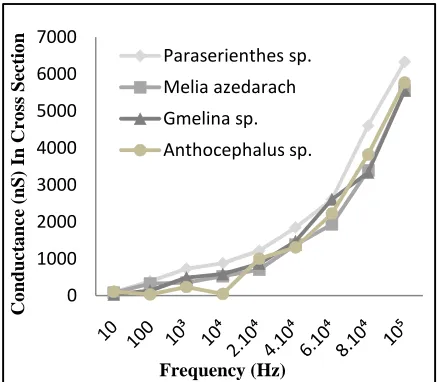
property on four samples have slight variation on the value. Property of conductivity is a measure of the ability of a material to be able to drain the electric charge. Figure 3 below exhibits the variation in conductance against frequency from four (4) wood samples in the cross-section plane.
Figure 3. The relationship between frequency and its conductance in cross-section plane from four hardwood species.
The figure 3 above shows the relationship between frequency and conductance in cross-section plane of wood. From this chart also can be seen that the large frequency given will followed by the great of conductance properties or in the other words it can be assumed that this effect is directly proportional. It is
means that the relationship between frequency
and conductance was proportional in the cross-section
plane. Can be seen also that
the Paraserianthes sp. have thehighest conductance valu e outperformed the others wood species with the number. Clearly seen also that conductance value at maximum frequency (105) ranged from 5500nS to 6500nS. While the three other types tend to have the
same conductance value. The results of these
measurements expressly summarized that if
the frequency increased continuously so it will be influentially capacitance value.
Radial section (R)
Radial section is one of the three sections of
wood that is very influential on the formation properties
of wood. Observations in this section are frequently act because in this field occurred a wide range of materials and fluid displacement. Figure 4 and 5 below will present the relationship between wood capacitance and conductance towards frequency in the radial section of wood.
Figure 4. The relationship between frequency and its capacitance in radial section from four hardwood species.
Figure 4 in general exhibited that wood capacitance in the radial plane ranged 1874.933F to 1.939F which of these numbers obtained from four (4) wood samples. It seen also that the highest value from four (4) wood sample was Paraseriethes sp. in the frequency of 10Hz while the lowest was Melia azedarach with the frequency of 105Hz. This value indicated that capacitance in the radial section also reduced when frequency increases. Reduction in capacitance with
frequency seen prominently in the frequency
of treatment 10, 102Hz, where at frequency of 10Hz, capacitance value ranged between 1500–2000F. Then in the frequency at 100Hz appears decreased with ranging of frequency between 10–300F. from the figure above was clear that the wood has the ability to store electrical charge limited to a particular frequency range. While from the fourth wood samples used indicated that there were no significant differences in terms of capacitance. this is likely influenced by uniformity of moisture content in which from whole sample used has been undergone pre-drying treatment prior to investigation process.
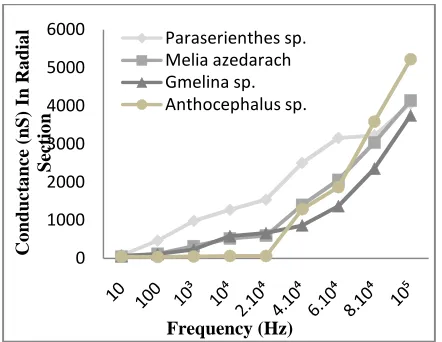
While the conductance properties in the radial section looks quite varied at four (4) wood species. Figure 4 below exhibits the variation in conductance against frequency from four (4) wood samples in the radial section.
0 1000 2000 3000 4000 5000 6000 7000
C
o
n
d
u
ct
a
n
ce
(
n
S
)
In
C
ro
ss
S
ec
ti
o
n
Frequency (Hz)
Paraserienthes sp.
Melia azedarach
Gmelina sp.
Anthocephalus sp. 0
500 1000 1500 2000 2500
C
a
p
a
ci
ta
n
ce
(
F
)
In
R
a
d
ia
l
S
ec
ti
o
n
Frequency (Hz)
Figure 5. The relationship between frequency and its conductance in cross-section plane from four hardwood species.
From figure 5 above exhibited there were variations among four wood species. Paraserienthes sp. points out increasing number of conductance starting from 10Hz to 105Hz. In contrast, for Anthocephalus sp. from the graph shows that it tend to start increases the value
of the conductance frequency at 104Hz.
This difference is likely due to by differentiation in the wood basic properties particularly in grain orientation as well as lumen size. It has played a crucial part also in electoral property of wood. In this case, there is possibility of differentiation in lumen size among these wood samples so that it will effect also on conductance value.
In general, wood basic properties which affected the ability of wood material as conductance such as density, moisture content (MC), extractive content grain direction as well as structural irregularities namely checks, and knots, fiber angle, temperature. Moisture content is
one important factor in supporting conductance. Moisture content will significantly affect on wood properties when its water level has been below the fiber saturation point (bellow 30% of MC). It subsequently will also affect the decrease in conductivity properties [9].
Tangential Section (T)
Tangential section is one of the crucial parts also in determining the quality of wood particularly in physical properties. The section play an important function in hygroscopic owing to it is the site of a significant shrinkage and swelling on wood. Figure 6 points out the relationship between the frequency and capacitance in the tangential section for four wood samples.
Figure 6. The relationship between frequency and its capacitance in tangential section from four hardwood species.
Figure 6 exhibited that wood capacitance in four (4) wood samples tend decreases along with increasing of frequency. The highest value of capacitance ranged 1000F–1400F in which the highest wood sample was Gmelina sp. then followed by Paraseriethes sp., Anthocephalus cadamba and Melia azedarach. This value indicated that capacitance in the tangential section also reduced when frequency increases. Reduction in capacitance with frequency seen prominently in the frequency of 10, 102Hz. It is clear that the wood inclines has the ability to store electrical charge limited to a particular frequency range.
The conductance properties in tangential section looks quite varied for four (4) wood species. Figure 7 below point out the variation in conductance against frequency from four (4) wood samples in the cross section.
From figure 7 looks that there were increasing in conductance property towards frequency at four (4) wood samples in which at the frequency of 104Hz seems look started to increase gradually. Definitely, it indicated that increasing of frequency will be followed by increasing also in conductance at the tangential section. It can be seen also that Anthocephalus sp. has the highest value of frequency from the others in 105 Hz. It was reached 7757.223Hz. Variations found here of course greatly influenced by wood properties. It can be significantly differ even if in the same wood. The basis factor supported that condition was wood structure associated with lumen size. Wood consists of thousand of cell which interrelated to support the main function for sustainability. Cell lumen has a great function in distributed nutrition in wood as well as storage. However, in this case of electrical link it will be resistor in effort to transport electrical component along cell wall.
Capacitance value obtained base on three dimensional section (cross section, radial and tangential) showed that there was significant influence on frequency. Can be seen also that capacitance value decrease sharply towards frequency at 10Hz and 100Hz and 103Hz. These values indicated that those wood species quite effective in response to conductance but only for low frequency treatment (< 103Hz). From these figures also expressed there are no significant influences among the direction of wood on capacitance value. However, there was different value in early from three direction of wood. Capacitance at the cross section has a highest ranges value 2700F–2300F while the second was at the radial between 1500F–1900F and the last was tangential with ranges 1000F–1400F.
In general, inability of wood as a good capacitance particularly in this experiment material was closely intertwined by its properties. Wood is a multi complex material owing to composed of wide range of cell types. Therefore these properties are further determined the quality and properties. Besides that, wood contained lots of material as composed which merges as one unity [10].
Conductance value look quite varied according to wood direction (cross section, radial and tangential). It can be seen in the figures of conductance graph where conductance value start varied when frequency above 103Hz to 105Hz. While, in each wood species see also different value at the last frequency treatment (105Hz). Generally, for wood direction has been showed that cross section has the highest average value ranged between 5300nS – 6300nS if compared with others. This is show that conductance through the cross section plane possess better carrying capacity so that it indicated that cross section plane in wood has a better function if used for conductance. Cross section plane structure in wood composed from cells which related one and others vertically and has a primary function for propping up standing tree [11]. In these structures, seen that wood cells component was closely indivisible from others so
that possess strongly relationship either as a transport function or mechanical.
V. CONCLUSION
Wood used for electrical materials currently has been developing for meet a demand requirement particularly in industry and housing. Considering that it has many
advantages compared with others. From this
investigation obtained that wood from Indonesian hardwood has a great potency to be developed as a conductance material. However, detail and complete investigation have to be done associated with wood properties and environmental influence as well as other factors.
ACKNOWLEDGMENT
This work was supported by Program Penelitian Antar Lembaga dan Perguruan Tinggi 2011. DIPA IPB, The Republic of Indonesia under contract no. 52/13.24.4/SPP/PL/2011.
REFERENCES
[1] Ze-Xin Fan, Kun-Fang Cao and Becker Peter 2009. Axial and radial variations in xylem anatomy of angiosperm and conifer trees in Yunnan, China. IAWA Journal, Vol. 30 (1) : 1-13. [2] Antony Finto, Jordan Lewis, Laurence R. Schimleck Richard F. Daniels and Alexander Clark 2009. The Effect of Mid-Rotation Fertilization On The Wood Properties Of Loblolly Pine (Pinus Taeda). IAWA Journal, Vol. 30 (1): 49–58.
[3] Resch Helmuth 2006. High-Frequency Electric Current for Drying of Wood–Historical Perspectives. Maderas. Ciencia y tecnología 8(2): 67-82.
[4] James, W.L.; Hamill, D.W. 1965. The Dielectric properties of Douglas fir measured at microwave frequencies. Forest Prod. J. 15(2): 51-56.
[5] Forest Product Laboratory 2009. Wood
Handbook-wood as an engineering material. General Technical Report FPL-GTR-190. Madison, WI: U.S.
[6] Siau J. F., 1995. Wood: Influence of Moisture on physical properties. Department of wood science and forest products Virginia polytechnic institute and state university. Keene-New York.
[7] Kabir F. Mohammed 2001. Temperature Dependence of the Dielectric Properties of Rubber Wood. Wood and Fiber Science 33(2), 2001, 233-238.
Journal of Basic & Applied Sciences IJBAS-IJENS Vol: 11 No: 05.
[9] James L. William 1988. Electric Moisture Meter for Wood. United States Department of Agriculture. Forest Product Laboratory. General Technical Report. FPL-GTR-6.
[10] Hidayat S and Simpson W. T., 1994. Use of green moisture content and basic specific gravity to group tropical wood for kiln drying. Forest products laboratory. Madison-United States. [11] Yuniarti A. D. and Pandit I. K., 2010. The shape
of ligulate extension from several woods. Journal of tropical wood science and technology. Vol 8. No.1. 83-87.