The Influence of CFRP Confinement on RC
Circular Column
Ayuddin
1, H. Parung
2, M.W.Tjaronge
3, R. Djamaluddin
41
Ph.D. Candidate, Departement of Civil Engineering Hasanuddin University, Indonesia (Gorontalo State University, Indonesia, Email : [email protected] 2,3,4
Departement of Civil Engineering, Hasanuddin University, Makassar, Indonesia Jl. Perintis Kemerdekaan Km 10 Makassar, South Sulawesi-90245, Indonesia
Abstract-- The Carbon Fibre Reinforced Polymer (CFRP) have been increasingly used in concrete construction as the confinement of RC columns.The purpose of this program is to investigate the effect of CFRP material as external reinforcement. Compressive strength analysis is done by creating several column interaction diagram in order to describe the column interaction diagram that does not have confinement, column confined with transverse reinforcement, column confined with transverse reinforcement and CFRP tensile, and interaction diagrams for columns confined with transverse reinforcement and the CFRP tensile -compressive. Analytical results obtained from the increase in maximum compressive axial force between the column that are not confined to the column confined with transverse reinforcement is 16.75 %, the column that are not confined to the column confined with transverse reinforcement and CFRP tensile is 64.61 %, and the column that are not confined to the column confined with transverse reinforcement and CFRP tensile -compressive is 92.74 %. This analysis indicate that the effect of CFRP confinement can increase the strength significantly.
Index Term-- Column, CFRP Confinement, column interaction diagram, maximum axial compression.
I. INT RODUCT ION
The world's progress fairly quickly followed by an increase in population resulted in a prominent increase in the use of concrete, as in the works of construction of buildings and transportation facilities such as bridges, highways and other work. The factors that make concrete are widely used as building materials such as: easy to set up, relatively high durability against fire and weather than steel, has a high compressive strength and most of the constituent materials are readily available at the location, and can be obtained cheaply . Nevertheless, the structural concrete also has the disadvantage that the low tensile strength and are brittle so it should be anticipated.
Along with the development of science and technology field of materials specifically for concrete structural components, it is also developing technologies such confinement reinforcement. One confinement reinforcement technology rapid development is the use of polymer fibres are known as term fibre reinforced polymer (FRP). The CFRP material has certain advantages, among others has a very high tensile strength and it’s very light weight so as to facilitate installation. The CFRP material is appropriately applied to a column structural elements known to be very sensitive when exposed to the load. Columns are a dominant element of construction that accept axial loads. In fact, in addition to axial load centric column also accept the load caused by the
bending moment. To maintain the stability of the structure of the column then an alternative solution is given externally confinement in order to achieve the maximum load the column without experiencing a sudden collapse du e to excessive load.
The model of external confinement is intended to increase the lateral stress that add strength and slow the process of the collapse of the column cross section, so that the collapse in the ductile range. The greater the quantity of lateral reinforcement is installed, then the increase in the strength and ductility of the column will be higher. in addition to the column should be guaranteed strength, the column must be able to dissipate earthquake energy well that his form is the ability of the ductility of the column should be higher so that the planning column design requires a more robust and has a higher ductility structures. One of the design structure in fields of rapid development today is the use of CFRP material as confinement externally applied to the column.
II. DEVELOPMENT OF CFRP CONFINEMENT
The development of materials for concrete confinement is growing very rapidly. One result of technological developments is the use of the material is composite fibres for external confinement and repair of concrete structures on components. The results showed that the use of these composite fibres enhance and improve the mechanical performance of concrete structures and components.
Studies Fam and Rizkalla (2001) showed that the use of FRP materials increased columns component stiffness, and more thick FRP materials are used, increasing the strength of the column components. Additionally Fam and Rizkalla (2001) recommends the need to further study conducted to assess the effect of bending moments and shear on the behaviour of columns confined with FRP. The results are quite important from the research Fam and Rizkalla (2001) is a proposed form of constitutive relations field components using the FRP material.
also concluded that the bonding adhesion between the concrete with FRP does not affect the axial capacity of the column.
Li et al. (2005) says that the use of FRP column covering concrete is an effective method to increase the strength and ductility of the column cross section. Other than that obtained also concluded that the thickening veil of FRP increases lateral confinement stress leading to increased confinement stress better. More information is also presented that the mechanism of concrete stress -strain relationship confined with FRP depends also on the strength of concrete is not unconfined, the normal quality concrete after post-peak stress seen strain hardening phenomenon, while the high quality concrete phenomena are weaker strain.
Moran and Pantelindes (2002) developed a model of the behaviour of the compressive component were given a FRP material confinement, the model proposes a parameter that can represent the behaviour of the plastic confinement known as strain ductility ratio.
Carey and Harries (2005) showed that the use of FRP confinement is more effective at normal quality concrete and less effective for high quality concrete due to brittle nature of concrete. However, that also described the properties of concrete are not significantly influence the stress -strain behaviour of FRP confined concrete but rather the properties of FRP sheet has a significant effect. In addition, the results of this research also recommends some important things that ), recommends using a formula Saafi et al (1999) to calculate the unconfined concrete peak stress and the peak strain using the equation proposed Delorenzis and Tepfers (2003). Finally, for practical needs recommended that limit stress of 0.3 f'c.
Braga et al. (2006) proposed a model of analytical columns confined by FRP based on the theory of field strain elastic. The model can be applied in addition to structural components confined with FRP, also can be used on type of different confinement such as the transverse reinforcement or carbon fibre. Matthys et al. (2005) also did extensive research on the behaviour of the structure of the repaired columns using CFRP. The conclusion of the research that by using CFRP materials in column structure significantly damaged can increase the capacity and strength of the column structure.
III. CONFINEMENTMECHANISM
Confinement provided by the FRP mechanism similar to that posed by the confinement of conventional reinforcement, it's just based on a number of studies it appears that the effectiveness of FRP produces a better confinement. When a cross-section of reinforced concrete will be approach to full strength before the steel melting, The cross section also increased axial deformation and lateral direction, the next section will be destroyed.
Furthermore, to delay the destruction of the cross section of concrete is commonly used restraint techniques at its core. One form of confinement is considered good by conventional reinforcement, FRP or CFRP because it provides the ability to absorb a considerable deformation before the collapse of the column cross s ection (Priestley, 1981), adequate ductility and increase the capacity of the core by an amount equal to the capacity of the cover, so that
will maintain the capacity of the melting column at chipped concrete covers. The mechanism of the process of confinement can be seen in Fig. 1, which is drawing free-body diagram mechanism of confinement forces on the cross bar, if the spiral cross bar put at a distance (pithch) s.
Ac
Ag
Inti beton sh
ell
(b). Pengekangan oleh spiral Ash
(c). Gaya-gaya yang bekerja pada sengkang setengah spiral (a). Penampang kolom
h
Ash. fyh
Ash. fyh
fl
d
Fig. 1. Confinement mechanism
Based on the studies (Richart et al., 1928; Martinez, 1984) with the confinement would be obtained on the compressive strength of concrete core of column.
' '
1
,
4
85
,
0
c lcc
f
f
f
(1)Confined stress (f'l) is calculated assuming that the reinforcement confinement has reached its melting stress (fyh) when the column failed. Based on Fig. 2, to obtain the amount of lateral confined stress on the core concrete produced by the confinement of reinforcement, then the algebraic sum of these forces,
'
2
A
shf
yh
d
s
f
l (2)s
d
f
A
f
l sh yh2
'
(3)
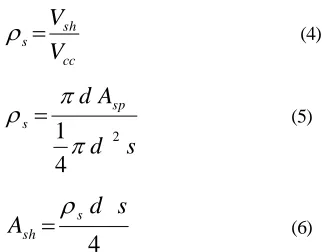
The volumetric ratio of reinforcement is defined as the ratio of the confined reinforcement volume of the concrete core volume, namely:
cc sh s
V
V
(4)s
d
A
d
sp s2
4
1
(5)4
s
d
A
sh
s (6)Substituting equation (6) into equation (5) is obtained
yh s
l
f
f
'
0
,
5
(7)or
yh c
l
f
f
'
(8)
' '
c g cc
c
f
A
f
A
(9)It's just that along with the development of research utilizing FRP confinement, then the parameter f’l (confined stress) for different FRP confinement cases using conventional reinforcement. Illustration of comparative use of the material is shown in Fig. 3.
Fig. 2. (a) and (b) Confinement with FRP jackets, (c) Convensional confinement
IV. FRP CONFINEMENT MODELS Model of Mander et al. (1988)
Mander et al. (1988) proposed a formula for round column to the effects of FRP confinement namely:
1.25
' 2 ' 9 . 7 1 25 . 2 ' ' cp f fcp c f fcp c f cc
f (10) (10)
Where confinement stress formula is:
R
t
n
E
fcp
.
f.
f.
f.
f (11) Model of Mirmiran et al. (1998)Mirmiran et al. (1998) proposed MCR parameters for circular confinement by using of FRP material are:
'
2
co rf
f
D
R
MCR
(12) WithD
t
f
f
r
2
j j (13)The increase in strength of ultimate column due to confinement of FRP are :
32
,
1
ln
169
,
0
' '
MCR
f
f
cc cuwhen MCR < 0,15 (14)
and ultimate strain is :
0,0529 0,5214 1,8506
2 1 : 2 D L D L cu cu (15)
further that the addition of strength due to FRP confinement is
c
c
f
E
f
0
2
(16)Model of Bisby et al. (2005)
Bisby et al. (2005) proposed a formulation increased strength due to FRP confinement is
' 1 ''
1
co l co ccf
f
k
f
f
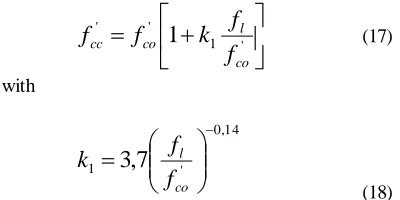
(17)with
14 , 0
' 1
3
,
7
co lf
f
k
(18)while the strain at peak stress of concrete section is
'001
.
0
co com co ccf
d
t
E
(19)Bisby et al. (2005) proposed to use the equation Karbhari and Gao (1997) or Spoelstra and Monti (1999) for FRP confinement, one of the equations Karbhari and Gao (1997) is
d t f E E d t f f f com c com c co co cc 2 2 1 , 3 ' '
' (20)
Model of Li et al. (2005)
Li et al. (2005) proposed the addition of strength due to FRP confinement is
a co
cl
f
f
f
1''
'
(21)
Subsequent constitutive equation for the area of ascending branch, region I) is
C
B
A
f
c
c2
c
(22) while in the area of descending branch, region II is
n cl cl c cl c
f
f
' ' '1
when εc > ε’cl
(23) with
0
,
1
0
,
075
' col
f
f
n
(24)or
135
,
0
16
,
0
'
co lf
f
n
(25)Model of Carey et al. (2006)
The increase in strength of concrete column due to confinement by using FRP is
84 , 0
'
'
1
2
,
2
whereas strain when at the time stress is
148 , 0 8 , 0
' '
1
26
,
2
jc con
c cc
E
f
f
(27)
Furthermore, the formulation of Shawn et al. (2006) consists of four quadrants, but is commonly used is the equation that represents the quadrant is
nkcc c cc
c
cc c
n
n
f
f
1
(28)
with
1
62
67
,
0
*
cc c cc
f
f
f
k
(29)cc cc c
c
f
E
E
n
(30)
300
9
,
0
004
,
0
s yhcu
f
(31)
V. MET HODOLOGY PROGRAM
In this paper we will analyze the circular concrete columns using transverse reinforcement and CFRP material as a confinement by connecting a experimental results formula which is done by researchers associated with confinement by using transverse reinforcement and CFRP material. According to the researchers that the confinement by using CFRP material as external confinement can have a significant effect in increasing the capacity of the column compared with no use of transverse reinforcement and the CFRP material. Research of confinement with transverse reinforcement have been carried out by researchers, but lately also growing use of composite materials is CFRP material. Mander et al. (1988) has conducted research of confinement by proposing the formulation of the circular column. Mirmiran et al (1998) conducted a study for circular confinement with proposed of MCR parameters (Modification Confinement Ratio), Bisby et al (2005), and Li et al (2005) also conducted a study on reinforced concrete columns that use CFRP material as confinement. According to the researchers said that the effect of transverse reinforcement and CFRP material as confinement will provide increased a column strength significantly. To determine the effect of CFRP confinement in the column, so in this paper will be analyzed a circular column to produce 4 analyzes the interaction diagram, including unconfined diagram of column interaction, diagram of column interaction confined by transverse reinforcement and CFRP which only takes into account strength of its tensile, and diagram of column interaction unconfined by transverse reinforcement and CFRP material, both of tensile strength and compressive also taken into account. The discussion is done by looking at the capacity of the column
that occurs in the maximum axial, balanced axial, balanced moment, moment of pure bending, and minimum axial.
In the program of this analysis are used a circular column to know the effect of confinement on CFRP material externally with the data used are the dimensions of the column with a diameter of 300 mm, compressive strength of concrete (f'c) was 23 MPa, the amount of longitudinal reinforcement were 6 pieces, diameter of longitudinal reinforcement was 16 mm, diameter of transverse reinforcement was 10 mm, fy longitudinal reinforcement was 400 MPa, fy transverse reinforcement was 240 MPa, Es 2 x 10⁵ MPa, the spacing of transverse reinforcement was 100 mm, thick of concrete cover was 40 mm, thick of CFRP layer was 0.5 mm with high modulus of CFRP was 5490 MPa, and elasticity modulus of CFRP was 3:29 x 105 MPa.
VI. ANALYSIS RESULT S
In analyzing this program, there are some things to consider such that the tensile strength is only borne by the steel and CFRP, while the tensile strength of concrete is ignored. Compressive strength contributed by steel and concrete to interaction diagram that only take into account of CFRP tensile strength. while for interaction diagram that takes into account the compressive strength of CFRP, so the compressive strength contributed by the reinforcement steel, concrete and CFRP in the compressive area. Stress concrete used is equivalent concrete stress by SK SNI T-15-1991-03 on section 3.3.2 item 7, which states that the stress of concrete f'c shall be assumed uniformly distributed in the region of equivalent compressive which is limited by the edge of the cross-section and a straight line parallel to the neutral axis distance of
of fibre with maximum compressive strain, where c is the height of neutral line, then the distance c of the fibre with the maximum strain to the neutral axis must be measured in the direction perpendicular to the axis, and the value = 0.85 for f'c ≤ 30 MPa and reduced by 0.008 for every increase of 1 MPa , but not be less than 0.65
The results of the column interaction diagram calculations shown in tables I. These results were obtained by performing the calculation of main points in the interaction diagram of the column. In this paper used an equivalent rectangular cross section of the column is obtained from the transformation of circular columns. In the drawing is done by giving 4 as a main point of reference, the maximum compressive axial point, the point of maximum tensile axial, balanced point and pure bending point. In the drawing of the interaction diagram of the column is required at least four in points of reference, namely :
- Determination of the point Po, with the maximum compressive axial.
At this point, concrete, steel reinforcement, and FRP contributed to the strength of concrete that has compressive overall.
( ) = 0.85 x 23 (70650 – 1206) + 400 x 1206 = 1840030.20 N
- Determination of the point Po, with a maximum tensile axial Mn = 0
= 400 x 1206 = 482400 N
- Determining the point of balanced
At this point, : and the maximum tensile of the outer fibre of concrete is not confined concrete ( ) is 0.003, The outer reinforcement of steel is considered to have experienced melting so that the strain ( ( ) is 0.002.
Furthermore, the calculation of the balanced neutral line calculated using the formula triangle thus obtained = 109.20 mm. Further calculation of strain and stress of steel, and the forces that occur in the column. The results a forces of column as follows:
= 0.85 f’c b c
= 0.85 x 23 x 294.375 x 0.85 x 109.20 = 534182 N
= ( ) = 603 (400 – 0.85 x 23) = 229411.35 N
= . = 603 x 400 = 241200 N So we get :
= = 522393.35 N
= ( ) ( ) ( )
= 80416430.65 Nmm e = 154.23 mm (balanced condition)
Interaction diagram for the calculation of the transverse confinement of the column that had done the same with the columns that are not confined but the concrete compressive strength and strain are used differently than before. The results of calculations for the transverse compressive strength of confinement reinforcement (f'cc) obtained at 28.37 MPa and the maximum concrete strain ( ) of 0.00426, while the calculation of the interaction diagrams of columns having transverse confinement and CFRP (tensile) do the same with the columns that are not confined but concrete compressive strength and strain are used differently than before.
The results of calculations for the transverse compressive strength of confinement reinforcement and CFRP-tensile (f'cc) of 43.260 MPa obtained by using the formula Mander et al (1988) and the maximum concrete strain ( ) of 0.00637 and for the calculation of concrete confined with transverse reinforcement and CFRP (tensile and compressive), the calculation is the same as the CFRP tensile strain in which the compressive strength of concrete used and each is f'cc = 43.260 MPa and
=0.00637.
For more details, the calculation of the interaction diagram for the column is not confined, confined columns with transverse reinforcement, confined column with transverse reinforcement and CFRP tensile, confined column with
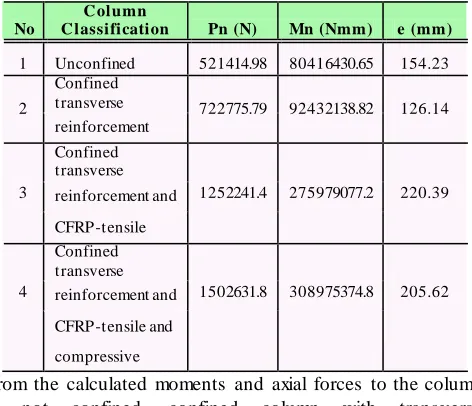
transverse reinforcement and the CFRP tensile and compressive are shown in table I.
TABEL I
COLUMN INTERACTION DIAGRAM CALCULATIONS WITH DIFFERENT CLASSIFICATIONS IN THE BALANCED CONDITION.
No
C olumn
C lassification Pn (N) Mn (Nmm) e (mm)
1 Unconfined 521414.98 80416430.65 154.23
2
Confined
transverse 722775.79 92432138.82 126.14 reinforcement
3
Confined transverse
1252241.4 275979077.2 220.39 reinforcement and
CFRP-tensile
4
Confined transverse
1502631.8 308975374.8 205.62 reinforcement and
CFRP-tensile and
compressive
From the calculated moments and axial forces to the column is not confined, confined column with transverse reinforcement, confined column with transverse reinforcement and CFRP tensile, confined column with transverse reinforcement and the CFRP tensile an d compressive, then it can be made with the column interaction diagram in Fig. 3, 4, and 5.
Fig. 3. Detailed F-M diagram for unconfined column and confined transversal reinforcement
Fig. 5. Detailed F-M diagram for unconfined column and confined tensile- compressive
From the above interaction diagram can be seen that the difference in the column without the confined with unconfined transverse reinforcement showed an increase in strength, it looks a capacity greater than without confined transverse reinforcement, this is due to an increase in confined concrete compressive strength (f'cc) of greater v alue and therefore contributes to the increase in bearing capacity of the column axial load and moment. From the interaction diagram, the values obtained for the maximum axial of column is not confined is 1564025.6 N, while the value of the maximum axial transverse reinforcement for columns confined is 1825930.24 N.
Thus, the transverse confinement reinforcement can increase the strength of 16.75 %. Furthermore, the maximum axial capacity of the confinement of CFRP tensile is 2574515.73 N. This value changes due to this condition not only steel reinforcement giving a contribution for tensile axial but there are a contribution for tensile axial from CFRP so it gives increase the strength of without confined on unconfined column transverse reinforcement and CFRP tensile is 64.61 %.
While, on the condition of confined column transverse reinforcement and CFRP tensile-compressive, the maximum axial capacity is 8323703.39 N, this indicates that an increase in the capacity of the column is quite large compared to the condition of the columns without confinement is 92.74 %.
For the combined column of interaction diagram with column is not confined, confined column with transverse reinforcement, confined column with transverse reinforcement and CFRP tensile, confined column with transverse reinforcement and the CFRP tensile and compressive, the results of the combined difference in the interaction diagram as shown in Fig. 06 below.
Fig. 6. Detailed F-M Interaction Diagram of Combination
From fig. 04 of the combined column interaction diagram shows that the differences in values , both axial and moment capacity. For concrete columns without the confined and confined column with transverse reinforcement, axial tensile maximum toward a point, this is because the column is not confined and unconfined column with transverse reinforcement, the tensile axial force from steel reinforcement the attached. While CFRP confined column which only take into account the tensile strength and The CFRP take into account of tensile strength and compressive, so the maximum tensile axial, maximum compressive and increased its moment, but there are differences in which CFRP tensile compressive, moments and compressive axial is much greater its enhancement than confined column of CFRP tensile.
This is due to the confinement of CFRP tensile-compressive into account the influence of the tensile-compressive strength of CFRP in the column so it can give an additional of compressive axial capacity and moment is greater in the column. While for the tensile axial in the column with tensile CFRP and the CFRP tensile-compressive in the same into a larger point from unconfined column and the column is confined by transverse reinforcement. This is due to the addition of tensile axial force from itself CFRP confinement with the steel reinforcement attached, so that the column capacity of this CFRP will be larger than the other two columns of interaction diagram is unconfined column and the column is confined by transverse reinforcement.
VII. CONCLUSIONS
This study purpose to give an idea of the strength of reinforcement concrete column when it's given an external reinforcement by using CFRP material and it’s also give an overview of the difference in the column analysis that unconfined column and The column is confined by transverse reinforcement and CFRP material as an external reinforcement. Conclusion the analysis conducted showed a significant increase in strength with increasing of column capacity by 64.61 % of CFRP tensile and 92.74 % of CFRP tensile-compressive when compared with confined the transverse reinforcement and without confinement. This means that the capacity of the column with CFRP confinement given able to hold given ultimate load. This research could be a specific recommendation in planning a design column.
For the development of further research is necessary to develop other column models as this study only analyzed for the case of circular columns. In addition, further research is needed for full-scale to verify that the columns confined with CFRP to size of the field can show the same behavior as in laboratory experiments..
ACKNOWLEDGEMENT S
REFERENCES
[1] Bisby, L.A., Dent, A.J.S., Green, M.F., 2005, Comparison of Confinement Models for FRP Wrapped Concrete, ACI Structural Journal, January-February, pp.62-72.
[2] Braga, F., Gigliotti, R., Laterza, M., 2006, Analytical Stress-Strain Relationship for Concrete Confined by Steel Stirrups and/or FRP Jackets, Journal of Structural Engineering, ASCE, September, pp. 1402-1416.
[3] Carey, S.A., Harries, K.A., 2005, Axial Behavior and Modelling of Confined Small-Medium-, and Large-Scale Circular Sections with Carbon FRP Jackets, ACI Structural Journal, July-August, pp.596-604.
[4] De Lorenzis L, Tepfers R., 2003, Comparative Study of Models on Confinement of Concrete Cylinders with Fiber-Reinforced Polymer Composites. ASCE Journal of Composites for Construction, pp. 219-234.
[5] Fam, A.Z. and Rizkalla, S.H., 2001, Confinement Model for Axially Loaded Concrete Confined by FRP T ubes", ACI Structural Journal, pp.251-461.
[6] Li, Y.F.; Chen, S.H.; Chang, K.C; Liu, K.Y., 2005, A Constitutive Model of Concrete Confined by Steel Reinforcements and Steel Jackets, Canadian Journal Civil Engineering, March, pp. 279-288. [7] Mander, J.B., Priestley, M.J.N., and Park, R., 1988., Observed Stress Strain Behavior of Confined Concrete, Journal of Structural Engineering, ASCE, August, pp.1804-1825.
[8] Matthys, S., T outanji, H., Audenaert, K., and T aerwe, L., 2005, Axial Load Behavior of Large-Scale Columns Confined with Fiber-Reinforced Polymer Composites, ACI Structural Journal, March, pp. 258-267
[9] Mirmiran, A., Shahawy, M., Samaan, M., El Echary, H., Mastrapa, J.C., Pico O., 1998, Effect of Column Parameters on FRP Confined Concrete, Journal of Com posite for Construction, November, pp.175-185.
[10] Moran, D.A. Pantelides, C.P., 2002, Variable Strain Ductility Ratio for FRP Confined Concrete, Journal of Composites for Construction, November, pp.224-232 .
[11] R. Park., T . Paulay., 1975., Reinforced Concrete Structures, Wiley, New York.
[12] Saafi, M., T outanji, H., and Li, Z, 1999., Behavior of Concrete Columns Confined with Fiber Reinforced Polymer T ubes, ACI Mat. Journal, pp. 500–509.
[13] Sheikh, S. A., and Yau, G., 2002. Seismic Behaviour of Concrete Columns Confined with Steel and Fiber-Reinforced Polymers, ACI Structural Journal, January, pp. 72-80.
[14] Standar SK SNI T -15-1991-03, 1991. Tata Cara Perhitungan Struktur Beton untuk Bangunan Gedung, Yayasan LPMB, Bandung, Indonesia.
Ayuddin, he is a lecturer in civil engineering Gorontalo State University, Gorontalo Province, Indonesia, Jl. Jenderal Sudirman No. 6 T elp/Fax : +62435 821-125-825754 Post Code: 21752 E-mail :
[email protected]. Now, he is
a doctoral candidate in civil engineering, School of Engineering, Hasanuddin University, Jalan Perintis Kemerdekaan Km. 10 Makassar 90245, South Sulawesi, Indonesia. Telp. +62411 584639, Fax: +62411 586015. He was born in Sengkang-Wajo, South Sulawesi, Indonesia on 30th May 1977. He graduated with a master degree in civil engineering from Hasanuddin University, Makassar-Indonesia in 2003. He previously worked as an Engineering Consultant in Indonesia. Later he taught in the department of civil engineering as a lecturer in Gorontalo State University. He has published more than 10 Articles related to concrete behavior under seismic stress or earthquake resistance of structures. He was also active in writing books that relate to the concept of earthquake resistant structures and the organization of engineering, he was a member of The Institution of Engineers Indonesia.
He rman Parung, Prof.,Dr.,Ing.,M.Eng; His current address is in Civil Engineering Departement, School of Engineering, Hasanuddin University, Jalan Perintis Kemerdekaan Km. 10 Makassar 90245, South Sulawesi, Indonesia. T elp. +62411 584639, Fax: +62411 586015.
Doctor of Civil Engineering, The Institutfuer Stahlbau und
Werkstoffmechanik, T echnische Universitaet, Darmstadt, Germany in 1998
Master of Civil Engineering, Auckland University, New Zealand in 1992
Bachelor of Science, Civil Engineering, Hasanuddin University, Makassar, Indonesia 1986
Muh. W ihardi Tjaronge, Prof, Dr, ST, M.Eng ; His current address is in Civil Engineering Departement, School of Engineering, Hasanuddin University, Jalan Perintis Kemerdekaan Km. 10 Makassar 90245, South Sulawesi, Indonesia. T elp. +62411 584639, Fax: +62411 586015.
Doctor of Civil Engineering, Nagoya Institute of Techonology, Japan, 2002
Master of Civil Engineering, Nagoya Institute of Techonology, Japan, 1999
Bachelor of Science, Civil Engineering, Hasanuddin University, Makassar, Indonesia 1993
Rudi Djamaluddin, Dr, ST, MT ; His current address is in Civil Engineering Departement, School of Engineering, Hasanuddin University, Jalan Perintis Kemerdekaan Km. 10 Makassar 90245, South Sulawesi, Indonesia. T elp. +62411 584639, Fax: +62411 586015.
Doctor of Civil Engineering, University of Kyushu, Japan, 2003
Master of Civil Engineering, University of Kyushu, Japan, 2000