Integration between HQs of GCC Islamic Banks and their Subsidiaries in Malaysia:
A Knowledge Transfer Perspective
Ali Abusalah Elmabrok
1, Ng Kim-Soon
2and Abd Rahman Ahmad
31Faculty of Technology Management and Business, Universiti Tun Hussein Onn Malaysia. Email: [email protected] 2
Faculty of Technology Management and Business, Universiti Tun Hussein Onn Malaysia. Email: [email protected]
3
Faculty of Technology Management and Business, Universiti Tun Hussein Onn Malaysia. Email: [email protected]
Article Received: 15 August 2017 Article Accepted: 30 September 2017 Article Published: 10 December 2017
1. INTRODUCTION
The significant global integration is under way in the banking industry and in the next years, individual banks will
expand their reach into many countries. Likewise, several observers expect that many national banking markets
will develop large foreign components; as that happens, the nationality of a bank in such a market will matter little
to prospective customers by Berger et al., (2003). Financial services integration in the Asia-Pacific region is at an
early stage. With recent liberalization and deregulation efforts, many spurred by the Asian economic crisis
(Skipper, 2000). Paradoxically despite this recognition subsidiary management research has not yet uncovered how
subsidiary managers should develop knowledge transfer process which reflects the integration with HQ and there is
an expectation on subsidiary management to create knowledge and innovation and develop their mandate (O'Brien,
2011). Whereas, Islamic banking and finance services between the GCC countries and Malaysia have entered into
an optimistic phase as mentioned by Ab Rahman et al. (2009); Abu-Hussin et al. (2011); Abu-Hussin (2010);
Haider (2007). With the growing demand for the Islamic financial services from investors, traders as well as
consumers. As stated by Kim-Soon et al. (2016) there are now 5 Islamic banks subsidiaries from the GCC countries
investment in Malaysia. This is due to its popularity of being the Islamic financial hub in the South East Asia. It is
the main target for GCC Islamic banks for providing Islamic finance services to the region. Knowledge transfer
practically recognized with inbound and outbound flows which indicates knowledge moves or being transferred
from headquarters to subsidiary or conversely, which is the knowledge going from subsidiary to headquarters to
achieve the integration (Abdullah et al., 2013). This research paper aims to investigate the role of knowledge
transfer in the integration between HQs of GCC Islamic banks and their subsidiaries in Malaysia.
A B S T R A C T
Islamic banking and finance have been watched vastly in both the GCC’s and Malaysia’s financial system.. However, these GCC Islamic banks subsidiaries have been the going through tough, strapped by paltry returns and stymied by fierce competition from the local banks. The future of these GCC subsidiaries in Malaysia is being scrutiny through by when their headquarters back home is reaping a much higher return on equity. Thus, this study is conducted to investigate the integration between headquarters of GCC Islamic banks and their subsidiaries in Malaysia. Five large GCC Islamic banks subsidiaries in Malaysia were identified to document the integration between headquarters of these banks and their subsidiaries. The data of this study were collected through sending out questionnaires to subsidiaries of GCC Islamic banks in Malaysia, as well as conducting semi-structured interviews with the top managements of these banks and through reviewing, tracking and comparing the information of their past and current from literature works to report the impact of integration on knowledge transfer. The results show that the GCC Islamic banks subsidiaries in Malaysia are at the moderate level of integration on knowledge transfer. The two factors which are the level of integration and friendliness role in knowledge transfer significantly influence the integration between subsidiaries and the headquarters. The findings result in developing a conceptual unifying model of knowledge transfer between Islamic banking and financial services within Islamic banks and provide impetus for future empirical testing.
2.LITERATURE REVIEW
Over the past four decades, states (countries) have become much more integrated financially, in many instances
through out-of-state (foreign bank) entry. For example, banking deregulations in the US have led to the emergence
of financial conglomerates that can now operate unhindered within the 50 states of the Union (Dincbas et al., 2015).
A similar trend is also observed for the recent development, apparently, Malaysia has been successful in attracting
GCC investors to put their money in its economic development. Indeed, Gulf’s investors, are a major contributor to the project’s development. Apart from a government incentive and the country’s attractiveness, this new
emergence of huge GCC investment in Malaysia has also been contributed to the financial facilities, especially the
Islamic Finance institutions which have been widely established in Malaysia either local Islamic Banks or foreign
Islamic Bank particularly from GCC (Mohammed and Kim-Soon, 2016).
Although many researchers have attempted to investigate the effect of HQ control on subsidiary performance, these
efforts have yielded conflicting empirical results. Interestingly, even studies of foreign subsidiaries located in the
same country have produced conflicting findings. However, however not reveal much about the effect of the
integration between the HQ and the subsidiary (O'Brien, 2011).
In comparison to earlier studies, the results of Harzing and Noorderhaven, (2006) show an increased differentiation
between subsidiaries, as well as an increase in the relative importance of both knowledge and product, flows
between subsidiaries suggesting that MNCs are getting closer to each other more than headquarters. Some
important effects of MNCs in a host country, beyond those on employment and value added creation, are those
linked to the possibilities of knowledge transfer to and from host economies, via the technological diffusion
generated through supply chain relationships and the embodiment of technology in goods and services (Cantwell
and Alvarez, 2011).
Nowadays, competitive advantage increasingly depends on the control over intangible resources rather than
tangible resources (Hall, 1992). One of the firm’s intangible resources is knowledge. The idea of knowledge
transfer, especially between the headquarters and subsidiaries of MNCs, has gained momentum in recent years due
to globalization of the economy and rapid growth in information technology (Jung-Chi, 2006) and (Huysman et al.,
2006), increase in knowledge based organisation supported by Aliei et al., (2011) and increase in competitive
pressure (Kazmi and Hasiri, 2002). Saturated domestic markets have led firms to seek growth opportunities in
foreign markets, particularly in emerging economies with significant economic growth and market potential.
With the advent of knowledge-based economy in the international literature, knowledge transfer is defined as the
process by which knowledge travels from a knowledge holder (a person, organization or country possessing the
knowledge) to a knowledge recipient through one or many transfer channels including human capital mobility,
absorption capacity, integration, FDI, patent, link with academy, producer-consumer two-way knowledge transfer,
channels and impact of international knowledge transfer, international technology transfer, technology transfer
through FDI.
Multinational corporations are enterprises which engage in foreign direct investment and own value-adding
activities in many countries 6. MNC has its management headquarters in a country which is known as the home
country and operates in other different countries, known as the host countries, by Porter, (1990). It involves many
approaches such as participation in management, joint-venture (JV), transfer of technology and, expertise in
delivering products and services globally (Moosa, 2002). To become a market leader in the global market,
headquarters have to develop greater understanding of global customers and competitors through its subsidiaries, in
order to be integrated. Furthermore, developed knowledge of customers in host countries enables the headquarters
to increase knowledge of competitors operating in global markets. In addition, it enables the headquarters to offer
products that are differentiated from those of its competitors. Moreover, increase in knowledge transfer is expected
to provide the headquarters with more exposure to diverse knowledge associated with different host markets which
leads to creative outcomes, cited by Abdullah et al. (2013).
The integration between headquarters and subsidiaries contribute towards relational knowledge which can create
the competitive advantage for the company. Subsequently, it is imperative for managers to understand the role of
knowledge transfer between the headquarters and their subsidiaries in achieving the competitive advantage (Lee et
al., 2008). On the other hand, the manager at the subsidiary is also considered to deliver messages between the
headquarters and the employees. The performance in the subsidiary also affect the performance in headquarter
directly as stated by Andersson et al., (2002). Simultaneously, subsidiaries also contribute many innovative and
creative ideas that are expected to encourage its performance enhancement. More communications and sharing of
knowledge between the headquarters and subsidiaries will minimize the gaps in order to achieve the optimal
performance.
Accounting for the lack of research done in the field of knowledge transfer in international banking, the conceptual
framework of Schlegelmilch and Chini, (2003) is modified in order to develop an explanatory model of knowledge
transfer within multinational financial institutions. The basic model intends to explain what influences the
effectiveness and benefit of knowledge transfer and how the actual process occurs. In order to allow for the
particular situation of knowledge transfer within the integration two variables, namely friendliness and level of
integration (Birkinshaw et al., 2000), are included in the model. Besides the organizational and cultural distance of
the respective subsidiary primarily the developed knowledge transfer capabilities influence the effectiveness of
knowledge transfer, cited by Haiss and Schellander (2010).
3. METHODOLOGY
In order to address the main research objective of this research paper and to understand the socioeconomic
Islamic banks subsidiaries in Malaysia have been conducted. Allowing for the complexity of the research issue,
exploring each case’s knowledge transfer experiences made the integration of the subsidiaries deepen the insight
into the field of knowledge transfer in banking. The headquarters of these banks are located in Gulf Cooperation
Council countries namely United Arab Emirates, State of Bahrain, Kingdom of Saudi Arabia, Sultanate of Oman,
State of Qatar and the State of Kuwait. The bank’s names are Al Rajhi bank, Kuwait Finance house, Asian Finance
bank, Alkhair International Islamic bank and RUSD Investment bank.
Firstly, the variables in this study were measured using survey questionnaire with 5 point Likert Scales of no or
little extent to very great extent. The questionnaire was developed based on the scale used in previous related
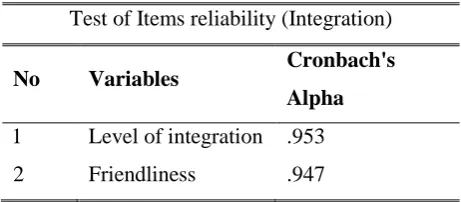
studies. To ensure the reliability of the questionnaire, the variables have a Cronbach Alpha value of more than 0.9
as shown in table 1, which is very strong, where the minimum value required confirming the reliability of the
survey questionnaire is above 0.7 stated by Cavana et al. (2001).
Table 1: Cronbach Alpha value for each used variable
Test of Items reliability (Integration)
No Variables Cronbach's Alpha
1 Level of integration .953
2 Friendliness .947
The population of this study consists of the executives and managers working at the banks. Only executives and
managers were chosen because they are the one who usually communicate with the headquarters and involve in
knowledge transfer activities. However, upon early screening, all 5 questionnaires are usable and therefore, the
questionnaire return rate is 100%. For data analysis, this study chooses the statistical package for social science
(SPSS). Thus, two variables are proposed: level of integration and friendliness. Secondly, an interview protocol
was prepared to investigate and verify the answers of the questionnaire. The interviews were conducted with the
respondents who are the main executives or a board member nominated by the main executive in the GCC Islamic
banks subsidiaries in Malaysia.
4.RESULTS
Structured questionnaire was important for the availability of data for making empirical analyses based on
statistics. Then, a crucial strength of ‘face-to-face survey’ was the possibility to provide better understanding on the questionnaire’s answers through clarifications, detailed information, and examples provided by the respondents. Therefore, after presenting the questionnaire’s results, it might be useful reviewing the most important findings
from the 5 interviews with the respondents.
number of branches operating in different states in Malaysia. The five questionnaires were sent to the main branch
located in Kuala Lumpur. Descriptive data (mean values, standard deviation, and the trends) on all variables are
provided in Tables 2 and 3.
According to Table 2, the questions or items have the mean range of between 2.80 and 3.40 which indicates a
medium of central tendency level. The average mean score for the level of integration is 3.12 which indicates a
medium level of central tendency towards integration between headquarters of GCC Islamic banks and their
subsidiaries in Malaysia. Hence, generally the results of the first test found that the integration between HQ and
subsidiary is at an average level.
Table 2: Levels of argument for the integration between HQ and subsidiary
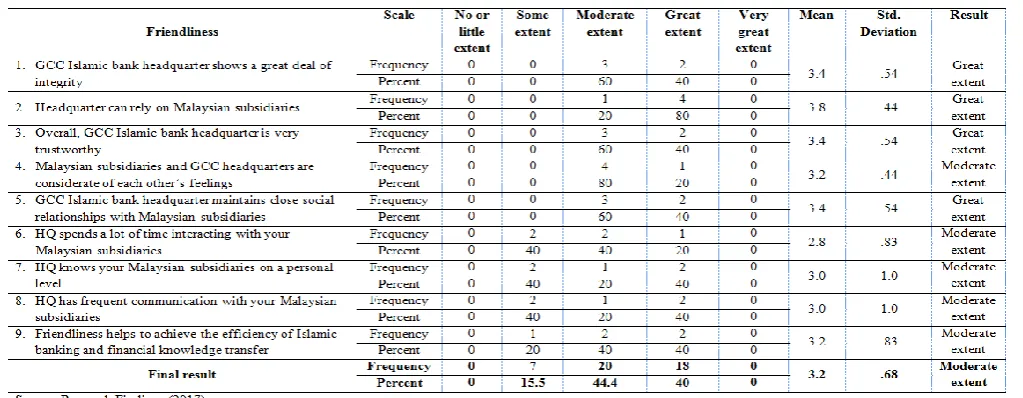
While, Table 3 shows that the high central tendency level with the mean score of 3.80 where the headquarters can
rely on the Malaysian subsidiaries. The average mean score for the friendliness is 3.24 which had a medium level of
central tendency towards integration between headquarters of GCC Islamic banks and their subsidiaries in
Malaysia. For this reason, the results of the second test found that the average scale is 3.2 as a moderate extent
based on Likert Scale of 1 to 5.
To the case studies of the integration between the banks, the questionnaire sent out to 5 GCC Islamic banking
groups’ subsidiaries in Malaysia helps answering the research questions and tests for the applied model of
knowledge transfer. The survey discovers factors influencing the integration of knowledge transfer in banking.
(Haiss and Schellander, 2010) emphasize the complex requirements of empirical banks research and the lack of
objective measures for studies of knowledge flows.
This paper places an emphasis on a perceptional approach, i.e. the proposed variables of the model are measured
via the indicated self-perception of subsidiary top managers and experts who participated in the research survey.
The target population for the questionnaire consists of bank top management in Islamic subsidiary banks in
Malaysia owned by GCC Islamic banks. Since the focus of the investigation lies on know-how transfer within the
integration, an important condition for the participation in the survey is that the subsidiaries have not been newly
established. In total 5 questionnaires were answered. The questionnaire answers as appeared in the tables above.
After highlighting the role of knowledge in international banking integration, the first theory proposition is
established refers to the competitive advantage in emerging market economies by foreign banks. Foreign banks are
supposed to have advantages compared to their host country competitors. Results of the questionnaire for the first
part of the survey questions ask about integration levels of Islamic banking and financial knowledge between HQs
of GCC Islamic banks and their subsidiaries in Malaysia.
Respondents consider that moderate level integration knowledge is operated in their subsidiaries. Respondents also
indicated that the level of knowledge complexity is difficult, as illustrated in table 2. Whereas, the second part of
the survey questions ask about to what extent is the level of friendliness acquisition of Islamic banking and
financial knowledge from HQs of GCC Islamic banks to their subsidiaries in Malaysia. The respondents rated that
moderate extent levels of friendliness were acquired. However, about almost half of the answers show that great
extent levels of friendliness were the GCC Islamic bank headquarters are offering, as illustrated in table 3.
In order to address the main research question of this paper and to understand the socioeconomic phenomena of
knowledge transfer in banking within its real life context, five in-depth case studies of prominent GCC Islamic
banks subsidiaries in Malaysia have been conducted. Allowing for the complexity of the research issue, exploring
each case’s knowledge transfer experiences made for the integration.
The described results from the interviews are present know-how transfer methods that have been developed over
the ongoing expansion of the banks. The investigation have led to a major understanding about the integration
process which was not pursued with the same vigour as in other cases, perhaps because the headquarter
managements were sensitive to the subsidiary employees, but the common systems and reporting standards were
existed and used.
At the time of the integration at the banking, markets showed relatively low levels of intermediation and both target
banks ranked among the biggest players in their countries’ financial sector. The names of the banks remain
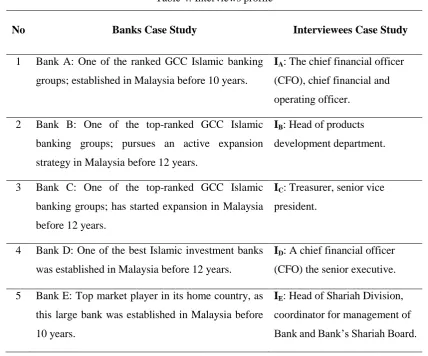
confidential due to data protection. Data for the case studies was collected via semi-structured interviews that were
conducted with representatives of executives or a board member nominated by the main executive.
Table 4: Interviews profile
No Banks Case Study Interviewees Case Study
1 Bank A: One of the ranked GCC Islamic banking
groups; established in Malaysia before 10 years.
IA: The chief financial officer
(CFO), chief financial and
operating officer.
2 Bank B: One of the top-ranked GCC Islamic
banking groups; pursues an active expansion
strategy in Malaysia before 12 years.
IB: Head of products
development department.
3 Bank C: One of the top-ranked GCC Islamic
banking groups; has started expansion in Malaysia
before 12 years.
IC: Treasurer, senior vice
president.
4 Bank D: One of the best Islamic investment banks
was established in Malaysia before 12 years.
ID: A chief financial officer
(CFO) the senior executive.
5 Bank E: Top market player in its home country, as
this large bank was established in Malaysia before
10 years.
IE: Head of Shariah Division,
coordinator for management of
Bank and Bank’s Shariah Board.
To start with, the perceptions of the integration between hqs and subsidiaries, the initial analysis showed that the
level of integration between headquarters of the GCC Islamic banks and their subsidiaries in Malaysia is scaled as
a moderate while the friendliness level of integration scaled is as a moderate extent based on the survey
questionnaire results.
At first, the focus interest is on the level of integration given by the HQ to the subsidiary. We basically want to
understand to what extent the GCC Islamic bank-based HQ provides any kind of knowledge resources to its
Malaysian subsidiary bank in order to promote the knowledge transfer process. We do not refer only to knowledge
First of all, all of the interviewees agreed on the trends of the questionnaire answers, and the interviewees assured
that the banks subsidiaries are standing at the moderate level of integration. Whereas IA explained, headquarter did
not use to provide efforts during the early establishment, information and reports were prepared and reviewed
during monthly program review meetings held with the management board but of little or no avail. Recently, the
situation has changed for the better where a common platform for communication and the storage of information is
set up in form of an e-room. IC expounded, the bank is not majority owned, and otherwise, the subsidiary
performance sure will be much better.
Also, commented that there was ‘an absence of clear leadership from headquarters during the last five years due to
changing the CEOs most of the time. In addition, the net result was a stalled integration process, but if there will be
a concentrate on knowledge transfer it will make an attempt between the headquarters and subsidiaries to work with
one another in synergistic ways.
When knowledge has transferred from headquarter to the subsidiary, it was needed to be successfully applied and
practiced in the local market. ID expressed that there will be huge advantages if models of knowledge to be
transferred are well running to be implemented by subsidiary banks. IE emphasized that there are achievements and
success for employees in the subsidiary that is developed best practices together with the group.
In addition, the process of integration is still a stalled, but if there will be a concentrate on knowledge transfer it will
make an attempt between the HQ of the GCC Islamic bank and the subsidiary in Malaysia to work with one another
in interactive ways.
Eventually, the combination of integration and knowledge transfer models is supported by autonomy and it will
provide the transfer of innovation from a subsidiary to the local market.
Major difficulties that were noted by the interviewees referred to the coordination of the various integrations,
different organizational cultures and the acceptance of change by the employees of the new subsidiary. Moreover,
the integration process was not pursued with the same vigour as in other foreign direct investments.
As with most open-ended questions, the analysis and evaluation of responses from the first set of interview
questions were challenging, after taking some liberties in interpreting and categorizing those responses.
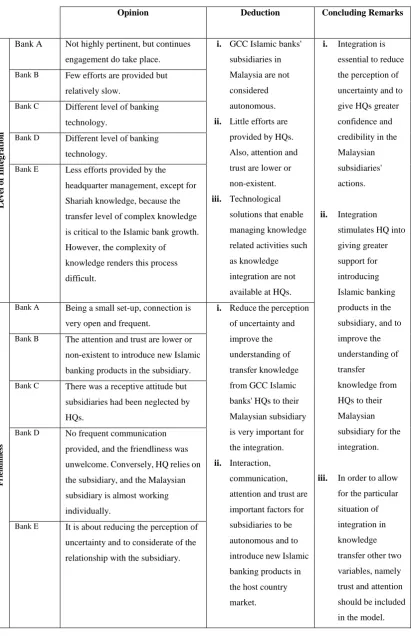
Nevertheless, Table 5 summarizes the opinion of respondents toward the integration between GCC Islamic banks’
Table 5: Opinions of respondent banks toward integration between HQ and subsidiary
Opinion Deduction Concluding Remarks
L ev el o f Integ ra tio n
Bank A Not highly pertinent, but continues
engagement do take place.
i. GCC Islamic banks'
subsidiaries in
Malaysia are not
considered
autonomous.
ii. Little efforts are
provided by HQs.
Also, attention and
trust are lower or
non-existent.
iii. Technological
solutions that enable
managing knowledge
related activities such
as knowledge
integration are not
available at HQs.
i. Integration is
essential to reduce
the perception of
uncertainty and to
give HQs greater
confidence and
credibility in the
Malaysian
subsidiaries'
actions.
ii. Integration
stimulates HQ into
giving greater
support for
introducing
Islamic banking
products in the
subsidiary, and to
improve the
understanding of
transfer
knowledge from
HQs to their
Malaysian
subsidiary for the
integration.
iii. In order to allow
for the particular
situation of
integration in
knowledge
transfer other two
variables, namely
trust and attention
should be included
in the model. Bank B Few efforts are provided but
relatively slow.
Bank C Different level of banking technology.
Bank D Different level of banking technology.
Bank E Less efforts provided by the headquarter management, except for
Shariah knowledge, because the
transfer level of complex knowledge
is critical to the Islamic bank growth.
However, the complexity of
knowledge renders this process
difficult. Fr ie n d li n ess
Bank A Being a small set-up, connection is very open and frequent.
i. Reduce the perception
of uncertainty and
improve the
understanding of
transfer knowledge
from GCC Islamic
banks' HQs to their
Malaysian subsidiary
is very important for
the integration.
ii. Interaction,
communication,
attention and trust are
important factors for
subsidiaries to be
autonomous and to
introduce new Islamic
banking products in
the host country
market. Bank B The attention and trust are lower or
non-existent to introduce new Islamic
banking products in the subsidiary.
Bank C There was a receptive attitude but subsidiaries had been neglected by
HQs.
Bank D No frequent communication provided, and the friendliness was
unwelcome. Conversely, HQ relies on
the subsidiary, and the Malaysian
subsidiary is almost working
individually.
Bank E It is about reducing the perception of uncertainty and to considerate of the
5. DISCUSSION
This research paper started with a review of the conceptual and the empirical studies that have contributed to the
understanding of the integration for knowledge transfer. Accordingly, the review of the relevant literature showed
that integration has been included as dependent variable in many empirical studies of knowledge transfer process,
in line with Minbaeva, (2007).
The above results supported previous literature including Birkinshaw et al., (2000) and followed by Haiss and
Schellander, (2010) that suggested in order allowing the particular situation of knowledge transfer within the
integration two variables, namely friendliness and integration level are included in the model. However, in order to
develop an explanatory model of knowledge transfer within multinational financial institutions, there must be other
variables such as the organizational and cultural distance. In some cases, other researchers suggest that the strategic
mandate of the subsidiary, as well as its ability to engage in knowledge transfer, have an effect on the development
of knowledge transfer capabilities in terms of transmission channels, infrastructure, and processes. By their nature,
the banks reach classifications are somewhat arbitrary. For instance, these banks have a strong Arab presence but
do not operate under the Malaysian financial system like the local competitors. Nevertheless, all five banks are
generally recognized as large, foreign banks. The findings are materially unchanged when the dividing lines
between foreign and regional banks and between regional and local banks are altered. Overall, it is confident to
state that the results are not an artifact of the definition of each bank reach yet. By applying the resource-based
model of knowledge transfer strategy making to the subsidiary manager there is the potential to make important
contributions to two streams of literature. From an international business perspective, considering the volume of
subsidiary management research, it is surprising that up until now the underlying contributors and processes which
drive subsidiary strategy have remained an unknown quantity. The knowledge transfer framework could unlock
valuable insights, which have so far eluded researchers. For the integration field, there is an opportunity to apply
knowledge transfer framework of strategy development to a specific and underexplored setting. These research
opportunities represent the motivation behind this review, to highlight the potential of applying an existing
framework to the emerging topic of subsidiary strategy. Ref to O'Brien, (2011)
Furthermore, this study report all sample statistics using only the subsidiary bank choice. ''To what extent will
knowledge be transferred from HQ to the subsidiary?'' find that the results reported here are not altered by use of an
alternative definition that includes the headquarter bank. This paper is related with different strands of the literature
on integration and financial knowledge transfer. First, this research work is linked with the research on the
knowledge transfer process given the financial development of countries. (Birkinshaw et al., 2000) shows that
integration is a part and parcel of the international knowledge transfer model in the banking sector agreed with
Haiss and Schellander, (2010). Others find that integration is a part of model that would be amended to transfer
knowledge in organisations. If this is the case, the transfer of knowledge embedded in the activities benefits from
Finally, the integration between headquarters and subsidiaries as proposed in this study is essential to reduce this
perception of uncertainty and to give headquarters greater confidence and credibility in subsidiaries’ actions.
Consequently, this integration stimulates headquarters into giving greater support for investment in a subsidiary.
There is a growing branch of the literature that pays special attention to the strategies of multinational companies
and, in particular, to the role of subsidiaries in integration on an international basis. In recent decades, research
results in the field have permitted researchers to improve the understanding of transfer of knowledge from HQs to
subsidiaries and their integrations. The findings are interesting given that many researchers have offered excessive
praise for the importance of integration and paid little attention to other determinants of the knowledge transfer
process. On the other hand, the absence of the results on integration is in line with recent suggestions that while
integration is an important determinant of knowledge transfer, it is not necessarily the only one.
6.CONCLUSION
Through the discussions on this research paper, it is easy to be observed the importance of knowledge transfer at
MNC’s. Since often is identified constraints mainly due the integration, competition for resources or ability to engage and cultural barriers etc, it’s important to point out strategies and mechanisms that can be used by MNC’s to
improve their knowledge transfer capabilities between headquarters and subsidiaries.
This paper contributes to the growing literature on the integration for knowledge transfer and management in GCC
Islamic banks subsidiaries in Malaysia. This current research work has attempted to further the debate on to what
extent that integration is influencing the knowledge transfer process or how knowledge transfer plays a key role to
achieve the integration between HQ and subsidiaries.
Concisely, this study has shown that two factors namely level of integration and friendliness role in knowledge
transfer do influence the integration between subsidiaries and the headquarters. Further, this study has limitations
that future study may address by other studies.
First, the questionnaires were distributed at five GCC Islamic banks subsidiaries in Malaysia and the respondent
consists of executives. Future study may consider involving more banks as it can further validate the findings if the
study involves firms from Islamic banking and finance industry. Furthermore, targeting top management of the
banks that have experience in knowledge transfer will consolidate the research findings. Second, this study was
conducted semi-structured interviews at the subsidiaries of GCC Islamic banks in Malaysia. The effect of
integration might be different if the study is conducted in another environment at other countries. Therefore, there
are many other factors that influence knowledge transfer that may either directly or indirectly influence the process
of knowledge transfer and they are not highlighted in this study.
It includes factors such as strategic role, ability to engage in knowledge transfer, labour relations, organisational
factors on knowledge transfer processes between the Islamic bank headquarters and subsidiaries.
ACKNOWLEDGMENT
This research project is supported by Universiti Tun Hussein Onn Malaysia. The authors wish to thank the
respondents who have spent their precious time and patience for participating in this project.
REFERENCES
[1] Ab Rahman, Asmak Binti, and Mohd Fauzi Bin Abu-Hussin. "GCC economic integration challenge and
opportunity for Malaysian economy." Journal of International Social Research 2.9 (2009) 44-54.
[2] Abdullah, N. A. H. N., & Liang, L. Y. (2013). Knowledge Sharing between Multinational Corporation's
Headquarters and Subsidiaries: the Impact of Manager's Role, Compensation System and Cultural Differences.
Journal of Economics and Behavioral Studies, 5(10), 660.
[3] Abu-Hussin, M. F., A. A. Sulaiman, and Mohd Yahya bin Mohd Hussin. "Capturing Arab gulf market: An
analysis of Malaysian exports competitiveness in the market." African Journal of Business Management 5.21
(2011): 8521-8535.
[4] Abu-Hussin, M. O. H. D. Exploring international trade between Malaysia and GCC countries: Empirical
analysis on trends, developments and challenges. Diss. Durham University, 2010.
[5] Aliei, M., Ashrafi, B. & Aghayan, S. (2011). Studying the Relationship between Organizational Citizenship
Behavior and Knowledge Sharing (Case study Knowledge-Based Organizations). Interdisciplinary Journal of
Contemporary Research in Business, 3(3), 341-348.
[6] Andersson, U., Forsgren, M., & Holm, U. (2002). The strategic impact of external networks: subsidiary
performance and competence development in the multinational corporation. Strategic management
journal, 23(11), 979-996.
[7] Berger, A. N., & Smith, D. C. (2003). Global integration in the banking industry. Fed. Res. Bull., 89, 451.
[8] Birkinshaw, J., Bresman, H., & Håkanson, L. (2000). Managing the post‐acquisition integration process: How
the human iintegration and task integration processes interact to foster value creation. Journal of management
studies, 37(3), 395-425.
[9] Cantwell, J., & Alvarez, I. (2011). International integration and mandates of innovative subsidiaries in Spain.
Institutions and Economies, 3(3), 415-444.
[10]Cavana, R. Y., Delahaye, B. L., & Sekaran, U. (2001). Applied business research: Qualitative and quantitative
methods. John Wiley & Sons Australia.
[11]Dincbas, N., Michalski, T. K., & Ors, E. (2015). Financial Integration and Growth: Banks' Previous Industry
Exposure Matters. Available at SSRN 2630969.
[12]Dunning, J. H. (1993). Multinational Enterprises and the Global Economy. Wokingham, Berkshire: Addison
Wesley.
[13]Haider, Haseeb. (2007) GCC investment in Asia to rise to $30b in 2007. United Arab Emirates.
[14]Haiss, P., & Schellander, E. (2010). Knowledge Transfer by Austrian Banks to the Transition Economies of
[15]Hall, R. (1992). The strategic analysis of intangible resources. Strategic management journal, 13(2), 135-144.
[16]Harzing, A. W., & Noorderhaven, N. (2006). Knowledge flows in MNCs: An empirical test and extension of
Gupta and Govindarajan's typology of subsidiary roles. International Business Review, 15(3), 195-214.
[17]Huysman, M. & Wulf, V. (2006). IT to support knowledge sharing in communities, towards a social capital
analysis. Journal of Information Technology (Palgrave Macmillan), 21(1), 40-51.
[18]Jung-Chi, P. (2006). An empirical study of the relationship between knowledge sharing and IS/IT strategic
planning (ISSP). Management Decision, 44(1), 105-122.
[19]Kazmi, A. & Hasiri, H. (2002). Knowledge Management (Vol. 2). New Delhi: Prentice Hall.
[20]Lee, R. P., Chen, Q., Kim, D., & Johnson, J. L. (2008). Knowledge transfer between multinational
corporations' headquarters and their subsidiaries: Influences on and implications for new product
outcomes. Journal of International Marketing, 16(2), 1-31.
[21]Minbaeva, D. B. (2007). Knowledge transfer in multinational corporations. Management international
review, 47(4), 567-593.
[22]Mohammed, A. A. E., & Kim-Soon, N. (2016). Characteristics of GCC Islamic Banks Investment in Malaysia.
European Journal of Scientific Research. 140(4)
[23]Moosa, I. A. (2002). Foreign Direct Investment: Theory, Evidence and Practice. Basingstoke. Hampshire,
Houndmills.
[24]Kim-Soon, N., Mohammed, A. A. E., & Ahmad, A. R. (2016). Features of Gulf Cooperation Council Banks
Investment in Malaysia. Advanced Science Letters, 22(12), 4452-4456.
[25]Nour, S. (2003, December). The Incidence and Transfer of Knowledge within the Arab Gulf Societies. In
Tenth Annual Conference of the Economic Research Forum for the Arab Countries, Iran and Turkey (ERF).
Morocco, Marrakesh.
[26]Nour, S. (2014). Overview of knowledge transfer in MENA countries-The case of Egypt (No. 017). United
Nations University-Maastricht Economic and Social Research Institute on Innovation and Technology
(MERIT).
[27]O'Brien, D. (2011). Subsidiary Strategy and the Role of the Subsidiary Manager: Integrating the Middle
Manager Perspective.
[28]Porter, M. E. (1990). The competitive advantage of nations. New York: The Free Press.
[29]Schlegelmilch, B. B., & Chini, T. C. (2003). Knowledge transfer between marketing functions in multinational
companies: a conceptual model. International Business Review, 12(2), 215-232.
[30]Skipper, H. D. (2000). Financial services integration worldwide: Promises and pitfalls. North American